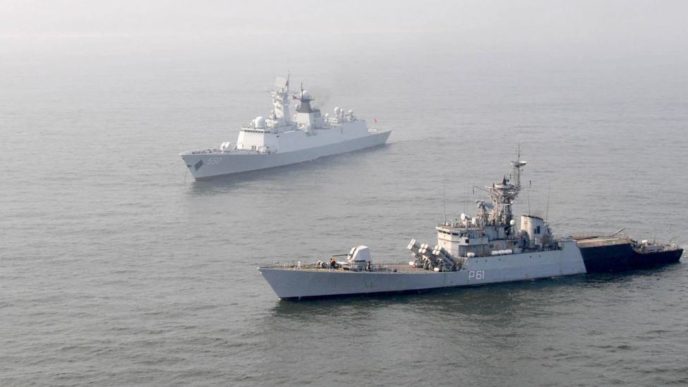
The Obama administration is moving toward what could be a dangerous showdown with China over the South China Sea.
The confrontation has been building for the past three years, as China has constructed artificial islands off its southern coast and installed missiles and radar in disputed waters, despite U.S. warnings. It could come to a head this spring, when an arbitration panel in The Hague is expected to rule that China is making “excessive” claims about its maritime sovereignty.
What makes this dispute so explosive is that it pits an American president who needs to affirm his credibility as a strong leader against a risk-taking Chinese president who has shown disregard for U.S. military power and who faces potent political enemies at home.
“This isn’t Pearl Harbor, but if people on all sides aren’t careful, it could be ‘The Guns of August,’” says Kurt Campbell, former assistant secretary of state for Asia, referring to the chain of miscalculations that led to World War I. The administration, he says, is facing “another red line moment where it has to figure out how to carry through on past warnings.” (Read more from “The U.S. Is Heading Toward a Dangerous Showdown With China” HERE)
00Joe Millerhttps://joemiller.us/wp-content/uploads/logotext.pngJoe Miller2016-03-16 01:30:582016-04-11 10:51:29The U.S. Is Heading Toward a Dangerous Showdown With China
With Chinese buyers eyeing farm land in Australia and New Zealand, authorities are coming under growing pressure to balance the need for foreign investment against accusations of “selling out.”
Currently up for sale is the S. Kidman and Co. Limited cattle empire — a vast Outback estate which covers 1.3 percent of Australia’s land mass and has an average herd of 185,000 cattle.
Treasurer Scott Morrison blocked its sale to all foreign investors in November, including from China, saying it was contrary to the national interest given part of the holding overlaps with a military testing range.
But Morrison recently approved the sale of Australia’s largest dairy farming business to a Chinese buyer, despite criticism that businessman Lu Xianfeng’s Aus$280 million (US$210 million) purchase of Tasmania’s Van Diemen’s Land Company could impact food security.
In a statement headed “Sell Out”, independent Senator Nick Xenophon labelled the decision “wrong, wrong, wrong” saying Morrison failed to give sufficient weight to an alternative Australian bid. (Read more from “Unease Over Chinese Investors Buying Farms Down Under” HERE)
00Joe Millerhttps://joemiller.us/wp-content/uploads/logotext.pngJoe Miller2016-03-14 00:34:232016-04-11 10:51:36Unease Over Chinese Investors Buying Farms Down Under
With a series of edicts, speeches and martial ceremonies, President Xi Jinping has over the past six months unveiled China’s biggest military overhaul since the aftermath of the Korean War.
The plan seeks to transform the 2.3-million-member People’s Liberation Army, which features 21st-century hardware but an outdated, Soviet-inspired command structure, into a fighting force capable of winning a modern war. China is shifting from a “large country to a large and powerful one,” Xi explained in November. The restructuring will be a major focus of the country’s new defense budget, which will be announced Saturday as the annual National People’s Congress gets under way in Beijing . . .
Here are the key elements of Xi’s plan:
The first piece of the overhaul — announced by Xi during a grand military parade through Tiananmen Square on Sept. 3 — calls for eliminating 300,000 PLA personnel by 2017. While Xi presented the cutbacks as proof of China’s commitment to peace, they’ll largely target non-combat personnel and should make the country’s forces more focused and efficient . . .
Advanced military actions such as intercepting rival aircraft, carrying out drone strikes and using special forces to extract hostages, demand the sort of close collaboration China’s army-centric military has lacked. Xi intends to fix that by reorganizing the armed forces into five branches under a joint-command structure modeled after that of the U.S. (Read more from “Inside China’s Plan for a Military That Can Counter U.S. Muscle” HERE)
00Joe Millerhttps://joemiller.us/wp-content/uploads/logotext.pngJoe Miller2016-03-04 00:14:202016-04-11 10:51:58Inside China’s Plan for a Military That Can Counter U.S. Muscle
China warned the United States on Wednesday not to adopt punitive currency policies that could disrupt U.S.-China relations after Donald Trump’s win in the Nevada caucus.
Foreign Ministry spokeswoman Hua Chunying told reporters in Beijing that “we are following with interest the U.S. presidential election.”
Hua was asked about China’s response to a possible Trump presidency and his announced plan to punish China for currency manipulation with a tax on Chinese goods.
“Since it belongs to the domestic affair of the U.S., I am not going to make comments on specific remarks by the relevant candidate,” she said.
“But I want to stress that China and the U.S., as world’s largest developing and developed countries, shoulder major responsibilities in safeguarding world peace, stability and security and driving world development,” the spokeswoman added. (Read more from “China Warns U.S. After Trump Wins Nevada Caucus” HERE)
By Lucas Tomlinson and Yonat Friling. The Chinese military has deployed an advanced surface-to-air missile system to one of its contested islands in the South China Sea according to civilian satellite imagery exclusively obtained by Fox News, more evidence that China is increasingly “militarizing” its islands in the South China Sea and ramping up tensions in the region.
The imagery from ImageSat International (ISI) shows two batteries of eight surface-to-air missile launchers as well as a radar system on Woody Island, part of the Paracel Island chain in the South China Sea.
It is the same island chain where a U.S. Navy destroyer sailed close to another contested island a few weeks ago. China at the time vowed “consequences” for the action . . .
The missiles arrived over the past week. According to the images, a beach on the island was empty on Feb. 3, but the missiles were visible by Feb. 14.
A U.S. official confirmed the accuracy of the photos. The official said the imagery viewed appears to show the HQ-9 air defense system, which closely resembles Russia’s S-300 missile system. The HQ-9 has a range of 125 miles, which would pose a threat to any airplanes, civilians or military, flying close by. (Read more from “In Provocative Move, China Places Advanced Surface to Air Missiles on Artificial Island During Middle of Obama’s Asian Conference” HERE)
_________________________________
China Has Raised the Stakes in South China Sea With Surface-To-Air Missile Batteries
By Dean Cheng. The U.S. government has reported that China has deployed several batteries of surface-to-air missiles (HQ-9) to Woody Island, Paracels, in the South China Sea. This is a significant military move, and it makes clear that China is prepared to employ military forces to support its expansive claims to the South China Sea.
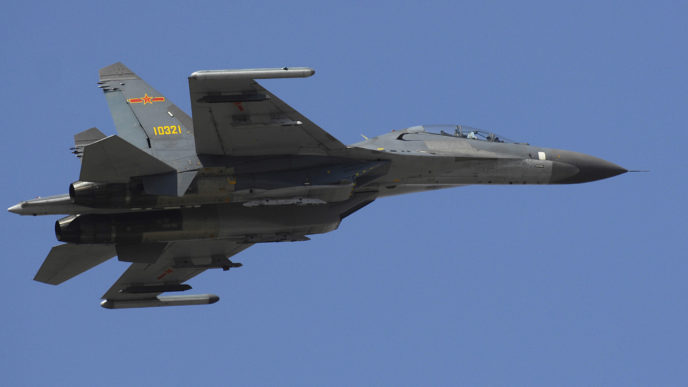
The People’s Liberation Army (PLA) has previously deployed some of its advanced fighters (J-11 fighters, the domestic version of the Su-27) to Woody island but did not apparently make this permanent. This surface-to-air missiles deployment appears to be for the longer term.
The HQ-9 is the Chinese equivalent of the Russian S-300/SA-10 SAM, a very advanced, very capable system comparable to the American Patriot SAM. Its deployment creates a 125-mile danger zone around the Paracels and marks a major increase in the scale and capabilities of forces deployed to the region.
While the Paracels are not the Spratlys (where China has built a number of artificial islands), they are part of the larger dispute underway about the future of the South China Sea.
Seized from South Vietnam in 1974, the Paracels remain a source of contention between China and Vietnam, which has not acceded to the Chinese seizure. In 1988, China sank three Vietnamese ships in nearby waters, to underscore its commitment to retaining those islands.
The Chinese have laid claim to a vast area of the South China Sea encompassed by what is known as the “Nine Dash Line” (recently revised to 10 dashes). The area includes not only the Paracels and Spratlys, but also Macclesfield Bank and Mischief Reef, as well as the Pratas island group (currently held by Taiwan). To administer these dispersed territories, the Chinese promoted the city of Sansha, on Woody Island, in 2012 to a prefecture level and vested it with authority over all of these islands. The Chinese have also sought to treat the region, which includes vital shipping lanes over which $5.3 trillion’s worth of trade transits, as virtually their territorial waters.
Chinese vessels have repeatedly sought to enforce these expansive claims. In 2009, for example, Chinese forces interfered with the operations of the USNS Impeccable and several other ships. Earlier this year, the USS Curtis Wilbur, in a recent freedom of navigation operation, sailed near Woody Island to underscore the American commitment to freedom of the seas. (For more from the author of “China Has Raised the Stakes in South China Sea With Surface-To-Air Missile Batteries” please click HERE)
https://joemiller.us/wp-content/uploads/Barack_Obama_at_Las_Vegas_Presidential_Forum.jpg20483072Joe Millerhttps://joemiller.us/wp-content/uploads/logotext.pngJoe Miller2016-02-18 23:01:462016-04-11 10:52:30In Provocative Move, China Places Advanced Surface to Air Missiles on Disputed Island During Middle of Obama’s Asian Conference
You’re about to hear first-hand testimony and see video of an unprecedented Christian revival happening in parts of China. What is unique about this story is how God is moving among communist-controlled government churches.
CBN News traveled to southern China and obtained exclusive, never-before-seen images, from inside these churches . . .
Pastor Duan says what is happening today in Beijing and in other parts of China as it relates to the powerful move of God amongst the Three-Self Churches is quite remarkable considering where the church has been in the last 30 years.
“Every sermon that the pastor preached back then had to be vetted by the government authorities. Young people were never allowed to attend these churches so you’d only see old people, mostly women,” Duan said. “Preaching about the power of the Holy Spirit was forbidden. You couldn’t talk about end times or preach repentance.” (Read more from “Radical Revival Falls on China’s State-Controlled Churches” HERE)
North Korea’s fourth nuclear test may be its most consequential, but the world is limited in how far it can escalate its response.
Though the Obama administration disputed North Korea’s assertion that it had tested a hydrogen bomb, which would be the most powerful nuclear weapon the country has ever tested, the act violated international treaties, showing that measures to rein in Pyongyang have failed.
Still, unless North Korea’s powerful backer, China, agrees to change course and strengthen sanctions in a way that hampers Pyongyang’s economy and brings the regime near collapse, nuclear experts say the the country’s young leader, Kim Jong-un, will remain undeterred.
“Basically North Korea is committed to developing a nuclear weapons program and we don’t have the policy tools to convince them or force them to give it up,” said Gary Samore, President Barack Obama’s former chief adviser on nuclear policy.
“If you look at the tools available and the magnitude of the problem, it can’t be resolved as long as the North Korean regime survives,” Samore continued in an interview with The Daily Signal.
“The best we can do is slow down and delay program, and I think we have done that.”
Bruce Klinger of the Heritage Foundation, who served as the CIA’s deputy division chief for Korea analysis, argues the Obama administration is not “fully implementing” U.S. laws against North Korea.
“Obama has said North Korea is the most heavily sanctioned country in the world, and there’s not much more we can do, but that’s not true,” Klinger told The Daily Signal. “We are not making the pain strong enough for North Korea to change policy. This administration has had a policy of timid incrementalism. But under existing U.S. law there are things we can do, because we have done them to other countries.”
Samore said Obama’s strategy to confront North Korea has been similar to past presidents, whose diplomatic overtures were frustrated by a regime that ignores international pressure, while the most powerful potential partner in that effort, China, has proved unwilling to take major action.
“What’s remarkable is how consistent U.S. policy has been over last three presidents, and how consistently it has failed,” said Samore, who also worked on nuclear issues in the Clinton and Reagan administrations. “We are really limited in what we can do as long as China has fundamentally different national interests.”
China, as a member of the United Nations Security Council, has veto power over any resolution put forth by that body, and is especially influential in the context of North Korea because it is Pyongyang’s largest trading partner and economic provider.
In the past, China and Russia have objected to potential United Nations measures that could threaten the North Korean regime’s survival, such as sanctions targeting financial transactions with the country, or sales of commodities like coal.
“For the Chinese, as much as they are uncomfortable with the North Korean nuclear program, their bigger fear is a collapse of the regime, and unification under a government friendly to the U.S,” Samore said. “That would weaken China’s geopolitical position. North Korea may not be much of an ally to China, but it’s better for them than the Korean peninsula being dominated by a government friendly to the U.S.”
After meeting Wednesday, the Security Council vowed to “begin to work immediately” on a resolution imposing additional measures against North Korea, and the American ambassador to the United Nations, Samantha Power, called for a “tough, comprehensive and credible package of new sanctions.”
The Security Council has adopted four major resolutions since 2006 sanctioning North Korea for continuing to develop its nuclear weapons program and calling on Pyongyang to dismantle it.
But Samore said existing measures specifically target North Korea’s nuclear and missile programs and don’t strongly impact the country’s basic economy.
“If you look at the last resolution [from March 2013], there are bans on the sale of certain commodities to North Korea because of their potential use for nuclear activity, and a ban on financial transfers that people believe could support the nuclear program,” Samore said. “But these are all targeted sanctions, so they are not important in influencing the overall economy. The big question is whether the Chinese would be willing to consider sanctions beyond targeted sanctions. I’d be delighted if this last test would be enough to persuade Beijing to go a bit further, but we haven’t seen much evidence of that.”
House Speaker Paul Ryan, R-Wis., on Thursday said Congress would not wait to take action of its own, with plans next week for a sanctions vote against North Korea that will likely receive bipartisan support.
Outside of actions related to sanctions, South Korea is talking with the U.S. about deploying American strategic weapons on the Korean peninsula, according to Reuters.
South Korea also said it will restart propaganda broadcasts into North Korea, Reuters reported.
Bruce W. Bennett, a defense analyst at the RAND Corporation focused on Northeast Asian military issues, said the U.S. is wise to consider nontraditional measures such as these.
“Part of the problem is we usually focus on economic responses with some form of sanctions,” Bennett said. “But North Korea is largely isolated from the international marketplace and has not been affected much by U.N. actions. I think we have to ask if economic sanctions are the right approach. If we could also put political pressure on North Korea, that might change their incentives.”
If North Korea doesn’t change, the stakes are significant.
North Korea is different than Iran, another nuclear threat, in that Pyongyang already has a small arsenal of nuclear weapons, while Tehran only has ambitions to do so.
Some nuclear experts say North Korea could have more than 20 weapons by the end of this year.
While Samore says North Korea is “years away” from being able to deliver its nuclear arsenal into a weapon that could hit the U.S., Pyongyang has medium-range missiles that threaten allies South Korea and Japan sooner.
“This particular test, this is the fourth one, so it’s hard to get too excited,” Samore said. “But the overall trend is North Korea is seeking to develop the nuclear weapons ability to attack us. There are no questions that is the objective.” (For more from the author of “Why China Is the Biggest Deterrent to Stopping North Korea’s Nuclear Program” please click HERE)
https://joemiller.us/wp-content/uploads/logotext.png00Joe Millerhttps://joemiller.us/wp-content/uploads/logotext.pngJoe Miller2016-01-08 00:18:392016-04-11 10:54:07Why China Is the Biggest Deterrent to Stopping North Korea’s Nuclear Program
Those fearing that China is the big risk in the year ahead for global markets hope that the first trading day of 2016 does not set the tone for the rest of the year.
Between a 7% fall in shares that triggered new circuit breakers on the Shanghai SHCOMP, -1.63% and Shenzhen stock exchanges 399100, -3.29% and accelerated weakness in the yuan, there is ample fodder for China bears.
The question being posed anew is whether 2016 will be the year Beijing finally throws in the towel on its attempts to coerce multiple asset markets upwards, while its economy continues to sink in a sea of debt.
While yet more weak industrial activity numbers from the Caixin China December PMI got the new year off to a flat start, the bigger concern is whether the leadership still has the will or the ability to continue holding up stock prices as its confronts ever more painful policy choices.
The black start to January trading had its roots in the controversial government intervention last summer to rescue stocks from a rout, which wiped over $4 trillion off share values and sent shock waves around global markets. (Read more from “China’s Rigged Markets Could Fall Much Further, Much Faster” HERE)
https://joemiller.us/wp-content/uploads/logotext.png00Joe Millerhttps://joemiller.us/wp-content/uploads/logotext.pngJoe Miller2016-01-04 22:43:562016-04-11 10:54:16China’s Rigged Markets Could Fall Much Further, Much Faster
China accused the U.S. and other Western critics of hypocrisy and “double-standards” Tuesday as it defended a new counter-terrorism law that gives authorities greater powers to monitor private communication.
The law, passed over the weekend, would also require telecom and Internet companies to provide encryption and other technical assistance to China’s anti-terror efforts.
Chinese authorities insist the new powers are necessary to combat growing terrorist threat at home and abroad.
However, State Department spokesman Mark Toner expressed concern over the law’s “overreach,” saying it “could lead to greater restrictions on the exercise of freedoms of expressions, association, and peaceful assembly.”
That criticism is “hypocritical,” state-run Xinhua News Agency said in a commentary published Tuesday, adding that the U.S. and other countries also have required technology firms to cooperate in terror-related surveillance. (Read more from “China Blasts the U.S. About Anti-Terror Surveillance Law – They’re Brutally Honest” HERE)
https://joemiller.us/wp-content/uploads/logotext.png00Joe Millerhttps://joemiller.us/wp-content/uploads/logotext.pngJoe Miller2015-12-30 00:14:492016-04-11 10:54:27China Blasts the U.S. About Anti-Terror Surveillance Law – They’re Brutally Honest
Pastor Su Tianfu slides into the back seat and tells the driver to hit it . . .
It is days before Christmas, but instead of working on his sermon, Su is giving his tail the slip.
The slight and soft-spoken Protestant preacher is no stranger to surveillance. Su has worked for years in China’s unregistered “house churches,” and he said he has been interrogated more times than he can count.
But even Su is surprised by what has happened in Guiyang this month: a crackdown that has led to the shuttering of the thriving Living Stone Church, the detention of a pastor on charges of “possessing state secrets” and the shadowing of dozens of churchgoers by police.
A local government directive leaked to China Aid, a Texas-based Christian group, and reviewed by The Washington Post advises local Communist Party cadres that shutting down the church is necessary to “maintain social stability”— a catchall phrase often used to justify sweeping clampdowns. (Read more from “Christians in China Feel Full Force of Authorities’ Repression” HERE)
https://joemiller.us/wp-content/uploads/logotext.png00Joe Millerhttps://joemiller.us/wp-content/uploads/logotext.pngJoe Miller2015-12-24 21:34:232016-04-11 10:54:40Christians in China Feel Full Force of Authorities’ Repression