Posts

Former Government Worker Charged With Giving Top-Secret Info to China

The Justice Department announced Thursday that it had arrested and charged a former US government employee for sharing top-secret information with a Chinese government agent.

The criminal complaint states that Kevin Mallory has been charged with delivering defense information to aid a foreign government and making false statements to investigators. The Justice Department said Mallory could face a life sentence if convicted . . .

The criminal complaint says Mallory met with a Chinese national in Shanghai during March and April 2017 who “represented himself” as working for a think tank the FBI has said is intertwined with Chinese intelligence. Mallory consented to an interview with FBI agents in late May, where he told them about a communication device the Chinese national had provided him with. He allowed the FBI to examine the device, and the Justice Department said the FBI found classified information on it, including a document marked top-secret. (Read more from “Former Government Worker Charged With Giving Top-Secret Info to China” HERE)

Follow Joe Miller on Twitter HERE and Facebook HERE.

China Is ‘Sticking’ to the Paris Agreement in Name Only, Its Plans Show a Much Different Intent

As President Donald Trump prepared to withdraw the U.S. from the Paris Agreement on climate change, the media is rife with stories about how China pledged to fully implement its global warming pledge.

China did vow to keep its Paris Agreement commitments, but that won’t really mean much given it pledged to increase greenhouse gas emissions for the foreseeable future.

The New York Times reported Chinese Premier Li Keqiang vowed Thursday that “his country remained committed to the fight against climate change and to participating in international efforts for a greener world.”

Two days earlier, the Times reported China was “poised to take the lead on climate,” and it’s more likely we’ll see “China pushing the United States to meet its commitments and try to live up to the letter and spirit of the 2015 Paris Agreement, even if Mr. Trump has signaled he has no intention of doing so.”

Environmentalists and Democratic politicians used the talking point as well. They argue the U.S. has ceded leadership on global warming to China. (Read more from “China Is ‘Sticking’ to the Paris Agreement in Name Only, Its Plans Show a Much Different Intent” HERE)

Follow Joe Miller on Twitter HERE and Facebook HERE.

Despite the Rhetoric, US Trade Deficit With China Is Not a Big Problem. Here’s Why.

When we discuss international trade and balance of payments, there are two types of accounts.

There is the current account, which includes goods and services imported and exported and receives the most political attention.

In 2016, the American people imported $479 billion worth of goods and services from Chinese producers, and we sold $170 billion worth of goods and services to Chinese customers.

That made for a $309 billion current account deficit. In other words, we purchase more goods and services from Chinese producers than Chinese consumers purchase from American producers.

How much of a problem is it when there is a deficit, or a negative imbalance, on current accounts? Let’s look at it.

I buy more from my grocer than he buys from me. Our Department of Defense buys more from General Dynamics than General Dynamics buys from our Department of Defense.

With just a bit of thought, one could come up with thousands of examples in which one party buys more from another than that party buys from it—creating deficits in current accounts.

But a current account deficit is always offset by a surplus somewhere else. That somewhere else is known as the capital, or financial, account.

This account consists of direct foreign investment, such as the purchase or construction of machinery, buildings, or whole manufacturing plants. The capital account also consists of portfolio investment, such as purchases of stocks and bonds.

In our capital account, the U.S. has a huge surplus with China. That means money is flowing into our country from China.

In other words, Chinese people are investing more money into the U.S.—in the forms of home and factory purchases, stocks, and bonds—than Americans are investing in China.

Of necessity, the deficit that we have with China on our current account, ignoring timing issues, must equal the surplus we have with China on our capital account.

It turns out that foreigners own $30 trillion worth of U.S. assets, such as stocks, Treasury bonds, manufacturing plants, and real estate.

One of the reasons that foreigners hold so much U.S. capital is that our country is one of the world’s most attractive places to invest.

Secondly, our capital markets, unlike our goods markets, are open to foreigners. Foreigners can buy and sell any U.S. asset in any quantity, except in cases in which national security is an issue.

One of the troubling aspects of foreign confidence in America is that foreigners invest so much in U.S. Treasury bonds. That in turn gives the U.S. Congress greater latitude to engage in profligate spending.

Japan owns $1.1 trillion worth of U.S. Treasury bonds, and China owns $1 trillion.

What about President Donald Trump’s call to reduce our current account trade deficit?

By the way, we know that we’re being deceived when a politician talks only about the current account deficit, without a word about the capital account surplus.

If foreigners sell us fewer goods, they will earn fewer dollars. With fewer dollars, they will be able to make fewer investments in America.

But that’s fine with politicians. The beneficiaries of trade restrictions are visible. Tariffs on tires, clothing, and electronics will mean more profits and jobs and more votes for politicians.

The victims of trade restrictions, such as people in the real estate market and other areas where foreigners are investing, are less visible.

Last year, Chinese citizens alone purchased record amounts of residential and commercial real estate, bringing their five-year real estate investment total to more than $110 billion.

Let’s put trade deficits into historical perspective.

If trade deficits were something for a president to fret about, every U.S. president from 1790 to today ought to have been fretting. For most of our history, we have had current account deficits.

I should say every president except Herbert Hoover and Franklin D. Roosevelt, whose administrations ushered in the Great Depression. Nine out of the 10 years of the economic downturn of the 1930s, our nation had a current account trade surplus.

Should we reproduce the economic policies of that era and recreate the “wonderful” trade surplus? (For more from the author of “Despite the Rhetoric, US Trade Deficit With China Is Not a Big Problem. Here’s Why.” please click HERE)

Follow Joe Miller on Twitter HERE and Facebook HERE.

Cause for Alarm? China Put in Charge of Iranian Nuclear Site

China and Iran have signed a deal to modify an integral part of the latter’s nuclear program at the Arak heavy water nuclear site. The news comes just one day after the Trump administration certified that Iran has committed to its responsibilities under the nuclear agreement signed by the former Obama administration and the Iranian regime in 2015. On the same day that President Trump verified Iran’s compliance in the agreement, the Iranian Supreme Leader declared the United States an “enemy” nation.

A heavy water plant is an essential element in producing the material needed to developing a nuclear weapons program. Iran insists that the Arak reactor is purposed with producing “isotopes for cancer and other medical treatments.” However, heavy water reactors are needed to cool down reactors that churn out plutonium, which can be used to create a nuclear bomb.

The Arak plant was uncovered thanks to 2002 satellite images from the Institute for Science and International Security.

As part of the Joint Comprehensive Plan of Action (JCPOA) agreed to by Iran and world powers, Iran is supposed to modify the heavy water reactor so it could not produce weapons-grade plutonium.

Whether the United States can trust China to lead the project is a matter of concern. Most geopolitical observer recognize that China views Iran as an ally and the United States as an adversary.

Moreover, China has previously helped supply the Iranian regime with nuclear material and advanced missile technology that would have been otherwise likely impossible to produce internally. Since the early 80s, the Chinese government has clandestinely and overtly helped the Mullahs develop their nuclear program.

International agencies such as the United Nations have been tasked with verifying compliance. No American inspectors are allowed on any of the Iranian nuclear sites, thanks to terms agreed to by the Obama administration. Therefore, whether or not Iran is cheating on the nuke deal is left completely to foreign bodies.

Iran has already breached the material limits used by the nuclear reactor that were imposed under the JCPOA. The IAEA, the U.N.’s nuclear watchdog, said Tehran exceeded the limit twice last year.

Beijing is looking forward to beginning the project. “The signing of this contract will create good conditions for substantively starting the redesign project,” said China Foreign Ministry spokesman Lu Kang. (For more from the author of “Cause for Alarm? China Put in Charge of Iranian Nuclear Site” please click HERE)

Follow Joe Miller on Twitter HERE and Facebook HERE.

4 Issues Trump Will Likely Confront Chinese Leader About

North Korea will be the top agenda item for President Donald Trump when he meets Friday with Chinese President Xi Jinping.

“As you know, I’ll be meeting with the president of China very soon in Florida, and that’s another responsibility we have, and that’s called the country of North Korea,” Trump said Wednesday during a Rose Garden press conference with King Abdullah II of Jordan.

Trump suggested his predecessor, President Barack Obama, allowed North Korea to grow stronger.

“We have a big problem. We have somebody that is not doing the right thing and that’s going to be my responsibility,” Trump said, referring to North Korean dictator Kim Jong Un. “But I’ll tell you, that responsibility could have been made a lot easier if it was handled years ago.”

White House officials said there were a number of other items the two leaders will discuss—one being trade and commerce—paramount during Trump’s campaign, where he frequently took shots at the Chinese.

The meeting Friday and Saturday at Trump’s Mar-a-Lago estate in Florida will be a significant chance for both leaders to learn about one another, said Fred Fleitz, a former State Department official in the George W. Bush administration.

“China is coming here to try to figure Trump out. He’s not like a president they’ve ever seen before. He’s not a president they can walk all over like Obama was,” said Fleitz, now a senior vice president for the Center for Security Policy, a national security think tank.

Here are the four key issues Trump and Xi will likely be discussing.

1.) North Korea

North Korea initiated a missile test this week aimed at Japanese waters, but the test reportedly failed. The country previously conducted a missile test in February, and several in 2016. North Korea leader Kim is reportedly seeking to produce a long-range nuclear weapon capable of hitting the continental United States in a few years.

“Trump is going to be forceful with China over North Korea. He is not going to ask for help anymore. We are going to demand help,” said Walter Lohman, director of the Asian Studies Center at The Heritage Foundation. “The time for talk is over. The U.S. can impose secondary sanctions on Chinese companies if China doesn’t cooperate.”

A senior White House official told reporters the matter is urgent and “the clock is now very, very quickly running out.”

“Because of the amount of leverage that China has economically, the best outcome would be one in which China very thoroughly implements the U.N. sanctions and resolutions,” the official said. “That is really what we’re working toward.”

China has blocked U.N. Security Council resolutions against North Korea. After South Korea deployed the Terminal High Altitude Area Defense, or THAAD, missile defense system, China threatened South Korea with economic, diplomatic, and military measures.

2.) Trade

The administration recognizes it is economically interdependent with China, but will insist that all bilateral trade be “mutually beneficial,” according to a White House official.

“President Trump is very concerned about how the imbalance in our economic relationship affects American workers, and wants to address these issues in a candid and productive manner,” a senior White House official said. “President Trump will convey to President Xi the importance of establishing an economic relationship that is fair … We want to work with the Chinese in a constructive manner to reduce the systemic trade and investment barriers that they’ve created that lead to an uneven playing field for U.S. companies.”

A report by the U.S. trade representative in March said the U.S. trade deficit more than doubled from 2000 to 2016, from $317 billion to $648 billion, and that “[o]ur trade deficit in goods and services with China soared from $81.9 billion in 2000 to almost $334 billion in 2015.”

China joined the World Trade Organization in 2001.

3.) South China Sea

Late last year, China expanded artificial islands and seized an unmanned underwater drone belonging to the U.S. Navy in the South China Sea.

“The United States will certainly continue to fly and sail where international law allows. I would not be surprised if that came up in conversation,” a senior White House official told reporters. “It’s no secret that the president was disturbed by activities that took place under the last administration. He and his Cabinet members have been on the record as saying that has got to stop.”

This is again a matter in which the Obama administration allowed China to show too much assertiveness, Fleitz noted.

“China will look at American leadership. The lack of leadership has been very destructive,” Fleitz said.

4.) Religious Freedom and Human Rights

Fleitz also said that Trump should make a strong statement about China’s mistreatment of the Uyghur community in Xinjiang, which human rights groups have criticized.

He said there are several issues to address specifically, but hopes Trump speaks broadly about China’s abysmal human rights record in the meeting.

A White House official said this will likely come up.

“I’m not going to pre-speak the president’s talking points, but human rights are integral to who we are as Americans,” the senior official said. “It is the reason we have alliances at the end of the day, one of the reasons, other than they serve our security and prosperity here at home. Human rights issues I would expect will continue to be brought up in the relationship.” (For more from the author of “4 Issues Trump Will Likely Confront Chinese Leader About” please click HERE)

Follow Joe Miller on Twitter HERE and Facebook HERE.

Women’s Rights Activist Slam UN Agency’s Support of China’s Forced Abortions

. . .One of [WRWF Founder and President, Reggie Littlejohn,] recommendations regarding how the UN can help the women and babies of China is by investigating UNFPA’s activities in China, demanding transparency, and in the case of a lack of cooperation, defunding UNFPA. Littlejohn states: “The United States Secretary of State should investigate and evaluate UNFPA’s activities in China, and the President should de-fund them under the Kemp-Kasten Amendment, which ‘prohibits funding for any organization or program that, as determined by the President, supports or participates in the management of a program of coercive abortion or involuntary sterilization.’”

“UNFPA has been found to be complicit with coercive population control in China in the past, and I have no doubt that any unbiased investigation would find them complicit again. I have long advocated for the defunding of UNFPA. The U.S. cut off funding to UNFPA in 2002 because an investigation, headed by then Secretary of State Colin Powell, found that UNFPA was complicit with the Chinese Family Planning officials in coercive implementation of China’s one-child policy. The Obama administration restored this funding. The UNCSW – as the advocate for women’s rights within the United Nations – should press relentlessly on the UNFPA to be fully transparent and accountable regarding its ‘family planning’ activities in China. I believe that any independent, unbiased investigation into UNFPA’s activities in China will lead to the inescapable conclusion that they are complicit with China’s population control practices, which include forced abortion and involuntary sterilization. To the extent that the global community is funding the UNFPA, the blood of Chinese women and babies is on our hands.” (Read more from “Women’s Rights Activist Slam UN Agency’s Support of China’s Forced Abortions” HERE)

Follow Joe Miller on Twitter HERE and Facebook HERE.
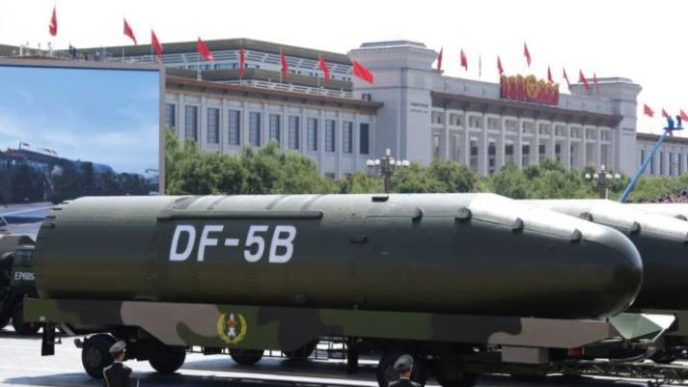
US Intel Caught Flat-Footed AGAIN as China Successfully Tests 10 Warhead Nuclear Missile

China flight tested a new variant of a long-range missile with 10 warheads in what defense officials say represents a dramatic shift in Beijing’s strategic nuclear posture.

The flight test of the DF-5C missile was carried out earlier this month using 10 multiple independently targetable reentry vehicles, or MIRVs. The test of the inert warheads was monitored closely by U.S. intelligence agencies, said two officials familiar with reports of the missile test. . .

Estimates of China’s nuclear arsenal for decades put the number of strategic warheads at the relatively low level of around 250 warheads. . .

Uploading Chinese missiles from single or triple warhead configurations to up to 10 warheads means the number of warheads stockpiled is orders of magnitude larger than the 250 estimate. . .

The Chinese state television channel CCTV-4 last week broadcast nuclear threats, including graphics showing new DF-41 missiles deployed in northern China and graphics showing the missiles’ strike path into the United States. The Jan. 25 broadcast included a graphic of a 10-warhead MIRV bus for the DF-41. (Read more from “US Intel Caught Flat-Footed AGAIN as China Successively Tests 10 Warhead Nuclear Missile” HERE)

Follow Joe Miller on Twitter HERE and Facebook HERE.

Is the Chinese Economy Hitting Stagnation?

For roughly three decades, the Chinese economy registered a staggering annual growth rate in the vicinity of 10 percent. Over the past four years, however, it has clearly slowed from that breakneck speed.

There has also been increased skepticism about the reliability of the old growth figures, and even whether today’s slower pace of expansion can be maintained. These signs and others suggest that China may be entering a period of stagnation.

Is this true?

While China’s economy recorded its slowest growth in 25 years in 2015, its official number was still a respectable 6.9 percent.

Many who follow China are increasingly relying on microeconomic data to assess the direction of China’s economy. This includes electricity consumption, passenger traffic, service sector spending, freight volume, and credit growth.

Here, the data is mixed. For example, in 2015, the number of international passengers traveling to and from China reached 42 million—a new record. The service economy has also been growing briskly, at an 8-9 percent pace in recent years.

On the other hand, the volume of rail freight traffic has declined for two consecutive years and electricity consumption has risen only 0.5 percent during the past year.

These microeconomic factors point to an economy growing in the 4-5 percent range.

Most importantly, much of the recent growth has been manufactured by enormous credit growth. Despite the authorities’ goal of wanting to trim total debt, total social credit growth is advancing close to the pace it was during the 2008-2009 global financial crisis.

Much of the rise in debt has been at the corporate level. According to the Bank for International Settlements, Chinese companies have accumulated $18 trillion in debt, equivalent to approximately 170 percent of gross domestic product.

The loans have come from the banking sector, which are now very vulnerable in the event of heavy defaults. State-owned companies account for over 55 percent of that debt.

Moreover, Chinese are issuing far more short-term debts. In the third quarter of 2016, 82 percent of Chinese corporate bonds had maturities of less than three years, compared with just 36 percent in the same quarter of 2010.

China’s two steadfast pillars of growth, exports and domestic investment, clearly show cracks in their veneers. China’s exports for October slumped 7.3 percent from the previous earlier, despite the yuan’s depreciation during the past year.

This is reflected in the stock of foreign exchange reserves, which peaked over a year ago at $4 trillion but have now fallen to $3.1 trillion.

Imports have also been falling—clear evidence that domestic demand has slowed more than the authorities or headline numbers acknowledge. Despite stringent capital controls, capital flight has clearly accelerated as affluent Chinese have lost confidence in the domestic economy.

Fixed asset investment is still running at 45 percent of GDP, leading to significant excess capacity in industries ranging from steel to solar panels.

Earlier objectives to lay off 6 million workers in state-owned enterprises early in President Xi Jinping’s term have not materialized, and state-owned banks continue directing credit to prop them up.

So, is the Chinese economy entering a period of stagnation?

Because the credit spigots cannot gush indefinitely and much of the mounting debt will likely go bad, it appears reasonably likely. And the window to solve these problems is quickly closing. (For more from the author of “Is the Chinese Economy Hitting Stagnation?” please click HERE)

Follow Joe Miller on Twitter HERE and Facebook HERE.

China State Media Warns Trump Against Isolationism, Calls for Status Quo

Chinese state media has warned the U.S. president-elect against isolationism and interventionism, calling instead for the United States to actively work with China to maintain the international status quo.

President-elect Donald Trump threatened to tear up trade deals and pursue a more unilateral foreign policy under his “America First” principle during a tempestuous election campaign.

But China and other foreign governments are uncertain how much of Trump’s rhetoric will be translated into policy because he has at times made contradictory statements and provided few details of how he would deal with the world.

Trump often targeted China in the campaign, blaming Beijing for U.S. job losses and vowing to impose 45 percent tariffs on Chinese imports. The Republican also promised to call China a currency manipulator on his first day in office.

U.S. isolationist policies had “accelerated the country’s economic crisis” during the Great Depression, warned a commentary by China’s official Xinhua News Agency, though it added that “election talk is just election talk”. (Read more from “China State Media Warns Trump Against Isolationism, Calls for Status Quo” HERE)

Follow Joe Miller on Twitter HERE and Facebook HERE.

Duterte Aligns Philippines With China, Says U.S. Has Lost

Philippine President Rodrigo Duterte announced his “separation” from the United States on Thursday, declaring he had realigned with China as the two agreed to resolve their South China Sea dispute through talks.

Duterte made his comments in Beijing, where he is visiting with at least 200 business people to pave the way for what he calls a new commercial alliance as relations with longtime ally Washington deteriorate.

“In this venue, your honors, in this venue, I announce my separation from the United States,” Duterte told Chinese and Philippine business people, to applause, at a forum in the Great Hall of the People attended by Chinese Vice Premier Zhang Gaoli.

“Both in military, not maybe social, but economics also. America has lost.”

Duterte’s efforts to engage China, months after a tribunal in the Hague ruled that Beijing did not have historic rights to the South China Sea in a case brought by the previous administration in Manila, marks a reversal in foreign policy since the 71-year-old former mayor took office on June 30. (Read more from “Duterte Aligns Philippines With China, Says U.S. Has Lost” HERE)

Follow Joe Miller on Twitter HERE and Facebook HERE.