Posts

Radical Dem Worked For Russian Lawyer Who Met With Trump, Jr.

Radical left-wing icon former California Democratic Rep. Ron Dellums was a hired lobbyist for Natalia Veselnitskaya, the Russian lawyer who met with Donald Trump Jr. June 9, 2016, the Daily Caller News Foundation Investigative Group has learned.

Dellums, who represented liberal San Francisco and Oakland, Calif., is a long-time darling of left-wing political activists. He served 13 terms in Congress as an African-American firebrand and proudly called himself a socialist. He retired in 1996.

The former congressman is one of several high-profile Democratic partisans who was on Veselnitskaya’s payroll, working to defeat a law that is the hated object of a personal vendetta waged by Russian President Vladimir Putin.

A national outcry has erupted in the establishment media about Trump Jr.’s meeting with Veselnitskaya. But there has been little focus on the Democrats who willingly served for years on her payroll helping to wage a Russian-led lobby campaign against the law. Congress passed the legislation, the Magnitsky Act, in response to the murder of Sergei Magnistky, a Russian lawyer who alleged corruption and human rights violations against numerous Russian officials.

According to a complaint filed to the Department of Justice Foreign Agents Registration Act division last July, Dellums failed to register as a foreign agent representing a Russian-driven effort led by Veselnitskaya to repeal the Magnitsky Act. (Read more from “Radical Dem Worked for Russian Lawyer Who Met With Trump, Jr.” HERE)

Follow Joe Miller on Twitter HERE and Facebook HERE.

Despicable Nebraska Democrat Says He’s ‘F**King Glad’ Scalise Got Shot

A Nebraska Democratic Party (NDP) operative has been fired from his position on the Technology Committee of the of the NDP after recorded audio appeared in which he says he was “f***ing glad” that Congressman Steve Scalise, R-La., was shot and that he wishes Scalise “was f***ing dead.”

Phil Montag, the state party’s technology committee co-chairman, was recorded saying “I’m glad he got shot” and “I wish he was f***ing dead” during a private meeting with NDP Black Caucus Chair Chelsey Gentry-Tipton that was recorded.

Rep. Scalise was shot during a targeted attack on GOP members of Congress in Alexandria, Va., in mid-June by radical leftist James T. Hodgkinson, who wanted to kill Republicans. Gentry-Tipton has come under fire herself after she made comments on Facebook that she thought it was “funny” that Republicans were “crying” after Scalise and four others were injured.

Listen:

Here is a transcript of the discussion, provided by Leavenworth St., a conservative blog in Nebraska:

Male: “Right now, so what is it that you want to do?”
Phil Montag: “Let me tell you, that motherf***er, the one that was shot, the scafie guy…I mean that guy, what’s was his name scafie?”
Female: “Scalise”
Male: “I really don’t want you to deflect right now.”
Montag: “No, this motherf***er, like his whole job is to like get people , convince Republicans to f***in’ kick people off f***in’ healthcare”
Female: “We know all of this.”
Montag: “I hate this motherf***er”
Female: “We know this”
Montage: “I’m f***in’ glad he got shot!”
Male: “Phil! Phil!”
Montag: “I’m glad he got shot!”
Male: “Dude!”
Montage: “I’m not going to f***in’ say that in public.”
Female: “You don’t have to say that in public.”
Male: “Then what are you saying it to us for?”
Female: “Say something, say something.”
Male: “What are you telling us for?”
Montag: “I wish he was ***in’ dead!”
Male: “Why are you telling us but not telling anyone else?”
Montag: “Cause I’m trying to f***in’ figure all this s*** out.”
Male: “It’s OK, because I’ve been recoding this conversation since you’ve come in, so I will publicly release it myself.”

In the wake of the released audio, NDP Chairwoman Jane Kleeb removed Montag from his position with the state party.

“I apologize to all the Democrats who now have to answer at the sale barn or hair salon what is wrong with the direction of politics,” Kleeb told the Lincoln Journal Star.

“The hateful rhetoric has no place in the Democratic Party and does not represent the values of Democrats across our state and country who lift up working-class families every day.”

Reached for comment by Conservative Review, Kleeb said “The amount of heated political rhetoric is dangerous and reckless.”

Montag denied wishing that Scalise was dead, arguing to the Omaha World-Herald Thursday that his words had been taken out of context.

“Like every decent American I am saddened and horrified by the shooting of Congressman Scalise,” Montag told the paper by email. “I do not and did not wish for his death. I am hopeful that the entirety of the original, unedited recording will emerge so we can get to the truth of the matter.”

Mr. Montag did not respond to a request for comment from Conservative Review. (For more from the author of “Despicable Nebraska Democrat Says He’s ‘F**King Glad’ Scalise Got Shot” please click HERE)

Follow Joe Miller on Twitter HERE and Facebook HERE.

A Liberal Democrat Student Explains Why He Advocates Free Speech at Colleges

Free speech on campuses—and the lack thereof—was the topic of a hearing on Tuesday of the Senate Judiciary Committee.

Among the panelists was Zachary Wood, a 21-year-old student at Williams College and president of a group called Uncomfortable Learning, which attempts to expose students to a diversity of opinion by hosting speakers on campus.

Opposition from administrators and students forced the cancelation of two speeches planned by the group this year. Wood, a self-described liberal Democrat, is a passionate advocate for free speech, and wise beyond his years.

Madison Laton, a member of The Heritage Foundation’s Young Leaders Program, interviewed Wood the day after the hearing about the search for civil discourse on campus.

Why did you get involved with Uncomfortable Learning?

I got a sense early on that there were certain subjects on campus that people were less inclined to want to discuss and debate simply because they were controversial. It wasn’t the case that people could debate things and disagree on things and work through their understandings of complicated issues without thinking, “This person is against me, or doesn’t like me.”

I thought that Uncomfortable Learning was important because it addressed the need to bring views to campus that people really weren’t engaging with, and those were largely conservative views.

While I identify as a liberal Democrat, and while I admire President [Barack] Obama and I agree with him on most things, there are times, there are circumstances in which I think what Republicans are saying not only needs to be heard, but has some insight and might even be right. Just because I’m a liberal Democrat, I don’t always agree with liberal Democrats.

How would you describe the political climate on your campus?

A lot of people are solidly to the left, but the most vocal factions on campus are not just left, they tend to be very radical. They don’t really believe in the political system. They don’t just think the right is wrong, they think that the left and right together are wholly inadequate and that what we need is a kind of socialist democracy. They’re Marxists, largely.

So the ones who constantly speak out on everything are far to the left, so it gives the impression that everyone is that far to the left.

Do those who oppose Uncomfortable Learning fairly represent the student body?

We have got a group of about 50 to 70 students who absolutely hate Uncomfortable Learning, and because they are so vocal, and because some are antagonistic—even using intimidation at times—it is difficult for people to come out and say, “I’m not that against this idea of Uncomfortable Learning, I’m at least willing to think about it more and try it out.”

And there is a number of people who are like, “I like UL but don’t tell anyone I said that.”

Why do you think so many of your generation are against free speech?

One thing at work is the echo chamber. You have a bunch of liberals in one place. The second part of it is that people have so much access to information, and so much of the news is opinionated and opinion-based.

Sites like Facebook that have algorithms make it easy for people to create a steady influx of things they want to hear. It makes it very easy for people to just say, “If there is a certain set of views that I don’t want to engage with, then I’m just not going to engage with them.” You can block anything or ignore anything.

I also think there is another element, and this is not discussed much: the trend on the left, in progressivism, to view inclusivity as a necessary component of moral progress. I have no problem with inclusivity, but in many respects this push for inclusivity often means restricting or constraining the rights of others, and that’s what I have a problem with.

College administrators and college educators are not encouraging students to see the world as a place with many layers of complexity, and a place in which you have to work through your differences and solve things and figure things out, not just push everything away and ignore it. So I think that my generation is less resilient than generations in the past.

Are students exposed to a variety of viewpoints in class?

No, with one caveat on that: I can name a few professors at Williams who do their very best to expose us to a variety of viewpoints. But outside of that, I do not think that people are exposed to a variety of viewpoints in class. It is often the case that professors have leftist views and they advance these views and they express these views as if that’s simply the way it is.

I try to give people the benefit of the doubt, not to assume that because of moral or political differences someone doesn’t have principles as well. Maybe they have insight into something that I could really benefit from.

What do you think are the consequences of barring speakers from campus?

Sen. Ted Cruz, R-Texas, touched on this [in the hearing], and I was glad he asked the question: “What happens when a heckler’s veto wins, when people can effectively shut down a speaker or prevent an event from happening?”

It allows them to see that as a victory when it should not be viewed as a victory. That is not what this country was founded on. That’s not what America’s about at our best. We are about empowering dissent. We are about saying, “Listen, you say what you think, you stand by your principles.”

When speakers are barred, what happens is that you have certain preconceptions, certain assumptions about how people see the world that do not get challenged in any way. You lose sight of individual differences. It subsumes individuality, and you don’t appreciate people for the uniqueness of their own perspectives. You lose sight of things like, Cruz and I disagree on a number of things, but when it comes to free speech, it sounds like we are pretty much in line with each other.

If colleges and universities are supposed to foster ideas, why do so many administrations cave to demands that undercut free speech?

It has to do with job security. It has to do with this idea of “no trouble on my watch.”

But my view is very different. I think that every issue that matters in this country is, in and of itself, controversial because people disagree. We shouldn’t be running from that on college campuses. We should be embracing that precisely because by embracing that we are deepening and advancing our own ability to construct stronger arguments.

That’s what college is really about. It’s about preparing us to be, whatever we’re going to be in the world, to make a positive difference in the world and to address any number of these issues that we really care about.

A lot of times, college administrators are trying to make students feel safe. But who is going to try to make you feel safe after you graduate? Is your employer going to say, “I want to make sure you feel safe today at work, so in this meeting, no one is to say anything”? That’s not how the world works.

At the hearing, Sen. Dianne Feinstein, D-Calif., said that the threat of violence should carry more weight than free speech in deciding whether to allow a speaker on campus. Do you think there is a point when security concerns should outweigh free speech?

I would agree with what Floyd Abrams and Frederick Lawrence said: We should always make the presumption in favor of free speech. That is to say, we should trust students, have faith in our students.

Let’s trust that if college administrators are doing our jobs correctly, students can handle this. If you really believe in the fact that your institution of higher education is a great institution, then you’ve got to have faith in your students.

Everyone needs to understand that part of liberty is the fact that I can’t force you to go to a talk you don’t want to go to. If it bothers you that much, don’t go. When I invite Suzanne Venker or John Derbyshire, you’re not mandated to attend. You’re not mandated to read their books. I think it would be great if you did, and I would encourage you to do so.

Administrators need to think about ways in which they can ensure that events are conducive environments for learning. If that requires more security, if that requires police, if that requires planning ahead, they need to take those steps. What they shouldn’t be doing is discouraging students from bringing controversial speakers.

You mentioned yesterday that you have tried to encourage your conservative classmates to speak up in class. What do you think it would take to convince them to do so?

The one thing that I’ve tried to do is when we’ve had panels, and everyone on the panel is liberal, if I have a friend who is a conservative, I’ll say: “This is an opportunity. They’re not grading you, they’re not someone from whom you may end up having to ask for a letter of recommendation. Try it here.”

The real fix would be for professors to encourage students to say what they think, to encourage them to speak up, to challenge them. I’d say that fewer than 20 percent of my professors, maybe 15 percent, say that.

How did you feel after the hearing? What do you think it accomplished, if anything?

I was encouraged by the fact that there was a general consensus that free speech is not just critical as this abstract value, but that people understand the concrete ways in which free speech is essential to our democracy, the concrete ways in which intellectual freedom on a college campus is indispensable to the kind of intellectual growth and development that is essential to becoming a more capable citizen in a very complex and competitive world.

I was emboldened by the fact that everyone on the panel, for the most part, seemed to agree that we’re oftentimes compromising speech and we need to push back against that.

Is there anything you would like to add?

I’ve received a lot of criticism and backlash, and I think it’s very easy sometimes for people to say that the problem is students—they are too sensitive or too intolerant.

I want to be clear about this: There is intolerance on college campuses, and the idea that you’re too weak or too frail or too sensitive is real. But it is on educators and administrators to think about the ways in which they can do more.

I think students mean well and administrators mean well, but I want to encourage people to not just blame student activists. Ultimately, we need to see this in terms of “What are the ways educators and administrators can do more to protect these values and promote political tolerance on campus?” (For more from the author of “A Liberal Democrat Student Explains Why He Advocates Free Speech at Colleges” please click HERE)

Follow Joe Miller on Twitter HERE and Facebook HERE.

Heavily Funded Democrat Falls Short as Georgia House Seat Stays Republican

Republican Karen Handel soundly defeated Democrat Jon Ossoff in Tuesday’s closely watched, historically expensive race for the congressional seat once held by GOP superstar Newt Gingrich.

Handel, 55, a businesswoman who was Georgia’s secretary of state, had 127,021 votes or 53 percent with 99 percent of precincts reporting.

Ossoff, 30, a documentary filmmaker and former congressional aide who does not live in the House district, had 114,390 votes or 47 percent.

Polls had the race going down to the wire.

“It was going to require all hands on deck, which is exactly what we had,” Handel told a jubilant victory party at 10:39 p.m., thanking President Donald Trump for his support.

Five months into Trump’s presidency, pundits cast the race in Georgia’s 6th Congressional District as a referendum on his administration and a bellwether for the balance of power in Congress nearly a year and a half before the midterm elections.

Trump defeated Democrat Hillary Clinton in the district by under 2 percentage points in November even though the previous incumbent, Republican Tom Price, won re-election to the seat with about 60 percent of the vote.

The race between Ossoff and Handel is the most expensive House race ever, CBS News reported, with fundraising exceeding $50 million.

By the end of May, Handel and Ossoff had spent $3.2 million and $22.5 million, respectively, according to campaign finance reports filed with the Federal Election Commission, ABC News reported.

“This is a huge win for conservatives,” Cole Muzio, president of the Family Policy Alliance of Georgia, told The Daily Signal in an email. “A record-setting fundraising haul, busloads of out-of-state volunteers, and national unity around Jon Ossoff could not convince Georgians to vote against their own interests.”

The seat opened in February when the Senate confirmed Price as Trump’s secretary of the Department of Health and Human Services.

Handel beat 10 other Republican candidates in the April 18 “jungle primary” with 20 percent of the vote, setting up the Tuesday runoff with top vote-getter Ossoff, who rolled up 48 percent as one of five Democrats in the race.

Trump, Vice President Mike Pence, and House Speaker Paul Ryan all backed Handel in the runoff.

She thanked all of them, as well as House Majority Whip Steve Scalise, R-La., hospitalized in serious condition six days after being shot by a man with a rifle and handgun who targeted Republican lawmakers at a baseball practice just outside Washington.

The president tweeted at 10:41 p.m.:

Republicans have held the seat for nearly 40 years, since Gingrich, later speaker of the House, first won it in 1978.

Ossoff’s platform included Democrat touchstones such as defending health care reform, civil rights, environmental protection, and Planned Parenthood.

Handel campaigned on repealing and replacing Obamacare, supporting the pro-life cause, and achieving “a simpler, fairer, tax code that promotes economic growth” as well as “securing our borders.”

Another special election Tuesday actually turned out to be closer as South Carolina voters filled the House seat previously held by Office of Management and Budget Director Mick Mulvaney, who Trump nominated to the post in December.

With 97 percent of precincts reporting, Republican Ralph Norman defeated Democrat Archie Parnell, 51 percent to 48 percent, in the 5th Congressional District. Norman’s margin was about 2,700 votes out of more than 83,000 ballots cast, Fox News reported.

Trump tweeted:

Norman, 64, previously was president of the York County Board of Realtors and served in South Carolina’s House of Representatives for 11 years. Parnell, 66, was a tax attorney for the U.S. Department of Justice and for the U.S. House Ways and Means Committee under Democrats’ leadership.

“It’s time to govern, it’s time to get things done, it’s time to go to work,” Norman said in his victory speech.

In Georgia, Handel was deputy chief of staff to Gov. Sonny Perdue and chairman of the Fulton County Board of Supervisors before running successfully for secretary of state and serving from 2007 to 2010.

She came to the attention of conservatives across the country in 2012, when she quit as senior vice president of public policy at Susan G. Komen for the Cure. She did so after the breast cancer charity reversed its decision to stop funding Planned Parenthood, a reversal she opposed.

“In a district that Donald Trump won by 1 [percentage] point, Karen Handel managed a strong victory and pushed back against the onslaught of Pelosi-Planned Parenthood money that poured into the district,” Muzio of the Family Police Alliance told The Daily Signal, adding:

After a disciplined campaign in the first round, Ossoff showed his true colors in the runoff when he attacked Karen Handel for opposing Planned Parenthood funding. There will be a number of narratives that come from this result, and the significance of this runoff will almost certainly be overstated. But, make no mistake about it, this was a win for conservatives.

Republicans previously won special congressional elections in Kansas and Montana.

Republicans previously won special congressional elections in Kansas and Montana.

“Democrats literally bet the House on a win here, and this defeat will certainly leave their base utterly demoralized ahead of 2018,” Muzio said.

Georgia’s 6th District includes northern suburbs of Atlanta and parts of Cobb, Fulton, and Dekalb counties.

Ossoff was a national security staffer and aide to Rep. Hank Johnson, D-Ga., for five years. He grew up in the area, but does not currently reside in the 6th District, as The Washington Post reported.

During an interview Tuesday on MSNBC, Ossoff told Stephanie Ruhle that his living outside the district did not matter to voters, and that he had not considered moving.

“Well, if voters were raising that as a serious concern, Steph, maybe I would,” Ossoff said, adding:

But voters care about how policy and how representation is going to impact their daily lives. They know I grew up in this community, they know I grew up in the 6th District, they know why I’m a couple of miles south of the line. It’s not a major issue in the race.

Handel was born in Washington, D.C., and grew up in the Maryland suburb of Upper Marlboro.

Trump raised some eyebrows with this effusive tweet this morning, which some pundits predicted could hurt Handel:

Four hours later, the hospitalized Scalise tweeted:

Dan Holler, spokesman for Heritage Action for America, the lobbying affiliate of The Heritage Foundation, told The Daily Signal in an email that Handel’s win is good news for the Republican Party.

“Despite tens of millions of dollars flowing into the race—a level of funding that cannot be replicated in every midterm race—Republicans managed to hold on,” Holler said, adding:

It would be a mistake to view this as a sign of confidence in the national party, though. The slow legislative pace and the absence of a bold governing agenda is dampening Republican enthusiasm, and absent conservative policy victories, that may continue heading into 2018.

Benita Dodd, vice president of the Georgia Public Policy Foundation, a nonpartisan research organization, told The Daily Signal in an email that the state’s 6th District race was largely civil despite what many partisans saw as high stakes.

“The most encouraging part of the 6th District runoff, the most expensive congressional election in U.S. history, is that it managed to stay mostly civil in an increasingly hostile political arena,” Dodd said, adding:

That said, Jon Ossoff’s campaign waged a sophisticated, successful ‘Wag the Dog’ operation: It began with a 30-year-old unknown, a Democrat who had never held office and doesn’t even live in the 6th District. With funding largely from campaign donations outside the state, he was portrayed as a palatable and viable challenger to Karen Handel, a well-known, respected, and successful GOP veteran and resident of the reliably Republican district.

The spending points to what’s to come in the midterms and beyond, she said:

This costly effort is portentous of the direction of future campaigns. It’s ominous, given the attention span of many voters in a 140-characters-or-less era, that campaign rhetoric can be so easily manipulated. As for the overwhelming cost, it’s an unpleasant downside that early voting ratchets up the cost of political campaigns.

(For more from the author of “Heavily Funded Democrat Falls Short as Georgia House Seat Stays Republican” please click HERE)

Follow Joe Miller on Twitter HERE and Facebook HERE.

Democrats Are Now Officially the Party of Death

There is no more room in the Democratic party for pro-life Americans. The chairman of the Democratic National Committee has made that clear. As clear as the water Pontius Pilate used to wash his hands. Townhall reports:

Top Democrats recently told their party to get in line with their radical abortion agenda or step aside. As a way to bury the controversy over the Democrat National Committee campaigning with a Democratic mayoral candidate, Heath Mello, who once voted for pro-life legislation, DNC Chair Tom Perez and Sen. Dick Durbin (D-IL) insisted that it was a mistake and that Roe v. Wade is non-negotiable.

The magazine America, whose liberal Jesuit editors are at least pro-life, pointed out what this really means:

Abortion is now the single issue defining the Democrats, and Ilyse Hogue, the president of NARAL Pro-Choice America, is the de facto head of the party. … NARAL is at least as powerful within the Democratic Party as the National Rifle Association is within the Republican Party.

Bad News? Or Just Reality Emerging?

It’s hard to know precisely how to feel about this development.

We are Christians, pro-lifers and conservatives — in that order. There’s no conflict among those things. In fact they go together. But each is a different angle from which to view political questions.

We live in a democracy. We bear a solemn responsibility under God: making just laws for ourselves. So abortion is a political question. It isn’t in China, Cuba or other totalitarian states. There the people’s masters simply impose the practice on them. (You know, the way liberals want the Supreme Court to keep on doing.)

It’s key to keep our priorities in order. So let’s scrutinize this news about the Democrats under each of those three categories.

As Christians, We’re Saddened

From a spiritual perspective, this is tragic. One of our nation’s two political parties is now completely dedicated to a fundamental evil. Abortion is even worse than segregation. (Democrats defended that for 100 years). It’s on the level of slavery. To be an active Democrat, going forward, is now to participate in evil. If you raise money for Democratic candidates, give to Democratic causes, or in any way participate in that party’s bid for power. … You are implicated.

Our hearts go out to lifelong Democrats who care about unborn life. And to candidates like Heath Mello who tried to save their party from plunging over the cliff. But it has taken the plunge.

And that is something to mourn. It should lead us to prayer. It should lead pro-lifers who’ve belonged to the Democratic party to take a good hard look at leaving. Maybe they should start a third party that’s clearly pro-life, which also represents their views on other issues, where morality is not so black and white: such as poverty programs, immigration policy and other liberal priorities.

But they can’t go on cooperating with the party of NARAL — any more than pro-life Republicans could stay in that party if it endorsed euthanasia to cut back on Medicare costs.

As Pro-Lifers, We’re Conflicted

As citizens committed to protecting the vulnerable from violence, we’re deeply saddened. We honor pro-life Democrats of the past, like the great Ellen McCormack and Robert Casey. They championed the human rights of unborn children in a party that was being hijacked by hedonism and feminism. They fought the good fight. And failed.

Strategically, it’s a bad thing for a cause to be trapped in just one party. Defenders of Israel are glad that pro-Israel candidates exist in both political parties. The National Rifle Association cultivates pro-Second Amendment Democrats. So have pro-lifers, as long as that party made room for differences of conviction. The danger is that Republicans will take our votes for granted, and continue to shove the life issue to the back burner.

But the two-party strategy might be falling apart for other causes too. The anger and intolerance of leftist activists is driving the Democratic party away from a true defense of Israel. Ever more liberal organizations are backing the bigoted “Boycott-Divestment-Sanctions” movement that targets Israel and even American Jews for open discrimination.

On the gun issue, Democratic leadership still prudently allows candidates in selected regions to dissent from the overwhelming party consensus against private handgun ownership. But how long that will last, in our current atmosphere of a rush to extremes? Of hooded leftist demonstrators silencing campus speakers with impunity? Ten years, max, we predict. Sooner rather than later, there will be no more room for Jim Webbs in the Democratic party.

Now the Stakes Are Obvious

On the positive side, the Democrats’ decision to side as a party with baby-parts merchants like Planned Parenthood does … clarify matters. It shreds for once and all the phony “Seamless Garment” that leftists within the churches have used to bury the unborn under a pile of other, more popular priorities.

As we wrote here last summer, members of Democrats for Life were essentially giving political cover to rabid pro-choicers like Hillary Clinton. How? By pretending that issues where people of good will can differ over the wisest policy for enhancing human life were somehow comparable to abortion. No, health insurance, welfare, wages or even gun violence cannot be classed with abortion. Like genocide or unjust wars of conquest, it’s a practice that’s purely evil which no just government should enable. Period.

As Conservatives, We’re Hopeful

Of course, as citizens with strong, clear convictions about the sanctity of human life, we don’t like to see the party that represents half the country oppose us. It pushes the common good a little further out of reach. We wish that Democrats would come around on a whole range of issues. In an ideal world, both parties would accept core conservative principles — as both parties did on many issues, back in 1960 or so. Then elections could be about competency, honesty and character.

Just as slavery and segregation denied the founding principles of our country, so does abortion. It is profoundly toxic to have one of our two major political parties aligned against the nation’s very founding. The Democratic party at first clung to slavery, then to segregation. Now it clings to abortion. How long will it take political reality to peel its white knuckles off its latest fetish of evil? Only time will tell.

That said, from the point of view of accomplishing things: The Democrats’ move is wicked, vicious and helpful. To us. It demonstrates in flesh and blood the left’s commitment to an ideology of suicide.

The left in America has increasingly embraced a whole set of convictions that fit together like a puzzle. What holds the pieces in place is a dark, insidious view of human beings.

We Represent Different Species

Conservatives (especially Christians) believe that human beings are free, responsible creatures — the image of God. We only enjoy our freedoms as part of a compact; each one comes paired with a solemn responsibility. We don’t expect to “get away” with enjoying our rights while abandoning our duties. We don’t want to be paid for work we didn’t do. Nor to fund other people’s willful idleness. We don’t expect to enjoy all the pleasures of life and evade the consequences.

What better example could we find of a reckless abuse of freedom and disregard of duty than the practice of legal abortion? Everyone knows that sex is connected to having children, as eating is to nutrition. But the Sexual Revolution came along and offered us all the “benefits” of bulimia. Contemporary hedonism wants to totally sever that connection — to change the very nature of sex itself. God made it to be the glue that holds two people together in love for life, and generates new lives. Modern man wants it to be a low-investment, low-commitment (but much more enjoyable) game of Twister.

No real conservative can support that. Few liberals today have the stomach to oppose it. So of course the Democratic party is monolithically pro-abortion. It’s the logical consequence of the secular leftist view of man: a lumpy featherless biped who seeks out pleasure. We can win his votes, the Democrats reckon, by offering him a bigger pile of bananas. (For more from the author of “Democrats Are Now Officially the Party of Death” please click HERE)

Follow Joe Miller on Twitter HERE and Facebook HERE.
How Democrats Stole the Judicial Confirmation Process

The “stolen seat”????

As in the Republican Senate “stole” a seat on the Supreme Court because it refused to confirm President Obama’s election year nomination of Merrick Garland? Something none other than then-Senator Joe Biden vowed when he thought then President George H.W. Bush might get a court nomination in the election year of 1992.

How about this? How about the Democrats stole — make that deliberately destroyed — the U.S. Senate’s judicial confirmation process — something they started years ago.

With the nomination and now ongoing Senate confirmation hearings of Trump Supreme Court nominee Neil Gorsuch, conservatives are well within their rights to roll their eyes at the disingenuous lies that are coming Judge Gorsuch’s way. Whether the topic is Obamacare, birth control, the role of federal agencies, or all manner of rights ranging alphabetically from abortion to workers, the liberal attack machine is at work. And alas, there is sadly not a thing new about this.

As it happens, I had the opportunity to work on the confirmations of five Reagan Supreme Court nominations as a member of the White House Office of Political Affairs. One of those nominees was Judge Robert Bork — the nomination where the verb “to bork” emerged. Later, in the Bush 43 era, as a private citizen, I was heavily involved in President Bush’s nomination of a best friend from college for a seat on the Third Circuit Court of Appeals. I went into this 2001-2002 episode with eyes open and taking notes, and the experience — which ended with the successful confirmation of Judge D.Brooks Smith — became a small book: “The Borking Rebellion: The Never-Before-Told Story of How a Group of Pennsylvania Women Attorneys took on the Entire U. S. Senate Judiciary Committee–And Won”

The bottom line? There is no limit — none — to what liberals will do to defeat a GOP president’s judicial nominations. And what once was limited to Supreme Court nominees has now long-since spread to confirmation fights for the lower courts. Note well that in his recent confirmation battle to become attorney general, former-Senator Jeff Session’s history as a defeated — make that borked — Reagan judicial nominee for a lower court was dredged up all over again.

The grim fact of what has become routine at these events is that they have become the very antithesis of what they were originally conceived to be: a serious forum to discuss the legal issues of the day.

Instead they have become political snake pits, with one far-left wing special interest after another lined up to assail any and everything about a GOP president’s nominee of the moment. How does this work? Let me provide but one example from the confirmation of Judge Smith.

I write to request your opinion concerning certain ethical questions that have arisen with the nomination of Judge D. Brooks Smith in the United States Court of Appeals for the Third Circuit.

So began a 2002 letter from then Wisconsin Senator and liberal Democrat Russell Feingold to NYU Law School Vice Dean Stephen Gillers. On the surface, the letter seems routine to the point of innocuous. A letter from a sitting U.S. senator on the Senate Judiciary Committee to a then-vice dean of a prominent American law school on the subject of judicial ethics. It sounds and appears as something totally normal, well within the bounds of senatorial inquiry when considering a judicial nomination.

Not so fast.

After working on those five Supreme Court nominations I mentioned above, I had learned something about how liberals played the game. The obvious question to me was: Who is Stephen Gillers — really? The answer did not require much digging, although characteristically it was the kind of digging the liberal media of the day never got around to doing when they would quote Gillers on the subject of judicial ethics. Not in the habit of quoting myself, let me break that rule here to quote from “The Borking Rebellion.” For the sake of reference, note that the group referred to here — the Community Rights Counsel — was a far-left, hyper-partisan special interest group whose mission had become, among other things, attacking GOP judicial nominees. Note as well that Professor Gillers was cited repeatedly in the liberal media as simply an ethics expert. I wrote this:

‘Nothing for Free’ was the title of a report issued by the Community Rights Counsel in July of 2000. A report attacking judicial seminars…I found this reference in its very first sentence:

“The authors are indebted to…Steven Gillers (sic)…(who) reviewed earlier drafts and provided unique and unfailingly helpful advice on improving the final product.”

Wow. The article in The Washington Post on Brooks Smith and John Gardner Black (a central figure in a fraud case heard by Smith) had been produced by research from Kendall. In writing the story that challenged Brooks’ ethics, Post reporter Ed Walsh then went to Stephen Gillers, presenting him in the story simply as a ‘professor of legal ethics at New York University Law School.’ Gillers was then quoted in the story casting doubt on Brooks (‘a serious argument for recusal is present…Judge Smith should have revealed the information’etc.)

In other words, the Post used Kendall’s CRC research to criticize Brooks, then used Kendall’s CRC consultant Gillers to verify that an ethics breach is potentially ‘present.’ Gillers was never identified as a CRC consultant, presented instead as a disinterested third party expert on legal ethics.

This was but one small piece of the Smith nomination, but standard procedure when it came to dealing with liberals on Supreme Court nominations. Not to wax Trumpian, but the confirmation system had been rigged. In that case, a sitting Democratic senator on the Judiciary Committee wrote a letter to a supposed legal ethicist whom he knew to be an ideological ally and on whom he could count for an opinion to the senator’s liking. Likewise the Post, either not bothering to check the “ethics expert” for any ties that would rule him out as an uninterested observer — or knowing full well and deliberately omitting the fact — blithely used him as a source to condemn the nominee. The paper, of course, never mentioned the “ethics expert” as someone who was in fact tied to the interest group that was attacking the nominee.

This is the game that the confirmation process has become. And that cited incident in the Smith case doesn’t even touch the surface of the well of deceit and dirty tricks used against one nominee for an appeals court opening.

Why does this mean anything now? Because as the Gorsuch nomination is played out it appears more than likely that at this exact moment in political time the nominee will be confirmed. A superb, well-thought of nominee has been nominated by a GOP president with a GOP Senate at hand to get him confirmed. But make no mistake. The Gorsuch nomination is merely a moment where the liberal interest groups who have so corrupted this process — stolen it — are shaking off the doldrums resulting in a breather from nomination fights. But the moment the news hits that the next justice has decided to hang up his or her judicial robe — or as lower court nominations proceed with a roster of conservatives — you can bet that the forces who have spent years — say again years — corrupting this process will be out in force.

The question then will be a simple one. Are conservatives ready? Are they, to use a baseball metaphor, finished with the spring training of the Gorsuch nomination and ready for World Series judicial confirmation hard ball?

Time will tell. But, to mix metaphors, forewarned is forearmed. (For more from the author of “How Democrats Stole the Judicial Confirmation Process” please click HERE)

Follow Joe Miller on Twitter HERE and Facebook HERE.
A Dishonest Rewriting of Democratic Racist History

The media is doing a terrible disservice to U.S. history, race relations, and the Democratic Party by dishonestly papering over the Democrats’ racist history. The Washington Post, in particular, engaged in this to make political hay and to criticize Sen. Ted Cruz.

The article began:

The day after Sen. Elizabeth Warren (D-Mass.) was rebuked while making a speech critical of Sen. Jeff Sessions (R-Ala.), Sen. Ted Cruz blasted Democrats, saying their party is the one rooted in racism.

“The Democrats are the party of the Ku Klux Klan,” Cruz (R-Tex.) said in an interview on Fox News on Wednesday. “You look at the most racist — you look at the Dixiecrats, they were Democrats who imposed segregation, imposed Jim Crow laws, who founded the Klan. The Klan was founded by a great many Democrats.”

Cruz isn’t the first Republican to associate Democrats with the Ku Klux Klan.
I’m going to stop there, and remind us all of some history.

A Dark Moment in Georgia

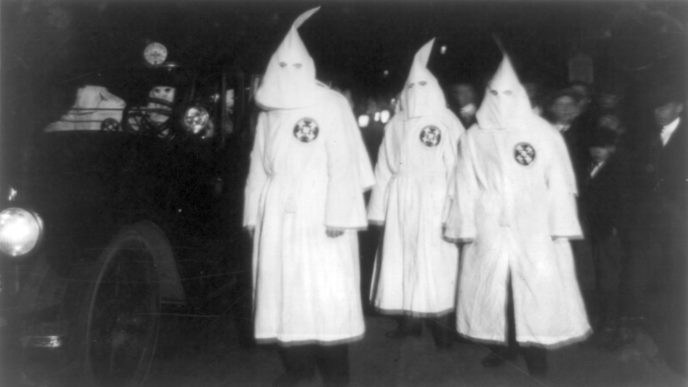
One of the darkest moments of Georgia history occurred on November 25, 1915. A local granite contractor, Sam Venable, was the owner of Stone Mountain, west of Atlanta. He joined a group of 40 men led by “Colonel” William J. Simmons, that included the speaker of the Georgia House, on a trek to the summit.

What happened there is a matter of historical record.

Under Simmons’ direction, the fifteen shivering men gathered stones to build a base for the cross of pine boards he had brought up earlier that day, and a crude altar upon which he laid an American flag, an open Bible, an unsheathed sword, and a canteen of water. They put on the bed-sheet robes and pointed mask caps and then gather around in a semi-circle as Simmons touched a match to the kerosene-soaked cross, the dancing light of the win-blown flames creating an eerie backdrop for the ceremony. With practiced oratory he then called forth the Invisible Empire from its slumber of nearly half a century.1

A week later, the silent film The Birth of a Nation opened in Atlanta. The film portrayed the Ku Klux Klan in a rather heroic light, and portrayed black men “as unintelligent and sexually aggressive towards white women.” Atlanta newspapers ran an announcement of “The World’s Greatest Secret, Social, Patriotic, Fraternal, Beneficiary Order” next to advertisements for the movie.

The Old South and the Democratic Party

In those days, the South was ruled by a single party: the Democratic Party. The first Republican governor of Georgia since 1872 was Sonny Perdue (now nominated as Secretary of Agriculture). The first GOP senator since 1873 was Mack Mattingly in 1981, and he served just one term.

There is no doubt that Democrats led the South during the height of the KKK’s popularity. Yet Kristine Guerra of The Washington Post treated it like a political football and punted. “Cruz isn’t the first Republican to associate Democrats with the Ku Klux Klan,” she wrote.

She then spent eight paragraphs responding to a 2013 remark by Virginia state Sen. Stephen Martin, who said the Democratic Party created the KKK, for which he later apologized and retracted. The entire piece was crafted to refute what Cruz said to Fox News, which is irrefutable. So Guerra dug to find something she could refute, and tied it to Cruz. If that’s not dishonest reporting, then dishonest reporting isn’t a “thing” anymore.

In her specious argument, she quoted Carole Emberton, “an associate professor of history at the University of Buffalo,” attributing the quote to PolitiFact. Possibly she was too lazy to get her own quote, so she just Googled it from another left-leaning media source. Guerra wrote that Emberton said party lines of the 1860s and 1870s “are not the party lines of today.”

Guerra added, “By the 1960s, the Democratic Party was becoming the party of the civil rights movement.” That line was not a quote from Emberton or anyone. It was the reporter misstating the facts, badly.

The Civil Rights Act of 1964, although supported by President Lyndon Johnson, was filibustered for 54 days, with South Carolina Democrat Strom Thurmond leading the opposition. That forced a bipartisan group of senators to introduce a substitute bill to gain enough votes for cloture. The filibuster continued, ultimately taking up 60 legislative days to overcome. Only eight southern Democrats voted for the bill in the House, and one in the Senate.

(To be fair, southern legislators of both parties voted against the legislation. But southern Democrats voted 107 against — in both houses — to Republicans’ 11.)

It is obvious that Democrats did not “become the party of the civil rights movement” by the 1960s.

The Press Must Acknowledge Democrats’ Ugly Racist History

After her major detour through rewritten history, Guerra finally returned to Cruz and the context of his remarks, which is Sen. Elizabeth Warren’s citing of 30-year-old accusations of racism against newly-confirmed Attorney General Jeff Sessions.

Guerra opposed the Senate’s decision to bar Warren from speaking after she violated Rule 19 by impugning another senator from the floor. Apparently, Democrats get a pass for 100 years of blatant and open racism, with some of those senators serving into the 2010s. But remarks made by the late Ted Kennedy and Coretta Scott King in the 1980s are to be held against Sessions.

How can our nation ever be expected to move past racial division when the press won’t acknowledge the Democrats’ ugly history, yet dishonestly smear Ted Cruz, and prop up Liz Warren? (For more from the author of “A Dishonest Rewriting of Democratic Racist History” please click HERE)

Follow Joe Miller on Twitter HERE and Facebook HERE.

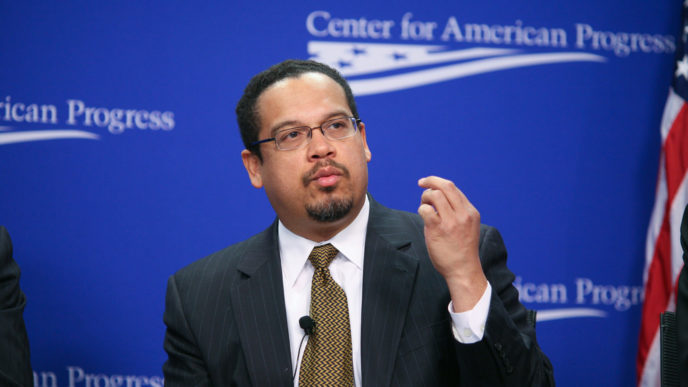
DNC Boots Candidate from Chairmanship Race for Criticizing Ellison’s Islamic Faith

The Democratic National Committee is kicking a candidate out of the chairmanship race after he told The Hill that Rep. Keith Ellison (D-Minn.) should not be the party’s next leader because he is a Muslim.

In a Jan. 5 email to The Hill, Vincent Tolliver, a former House candidate in Arkansas, said that Ellison, the first Muslim elected to Congress, should not be chairman because of Islamic positions on homosexuality.

“His being a Muslim is precisely why DNC voters should not vote for him,” Tolliver wrote. “Muslims discriminate against gays. Islamic law is clear on the subject, and being gay is a direct violation of it. In some Muslim countries, being gay is a crime punishable by death.”

“Clearly, Mr. Ellison is not the person to lead the DNC or any other organization committed to not discriminating based on gender identity or sexual orientation,” Tolliver continued. “I’m shocked [the Human Rights Campaign] has been silent on the issue. A vote for Representative Ellison by any member of the DNC would be divisive and unconscionable, not to mention counterproductive to the immediate and necessary steps of rebuilding the Democratic Party.”

A spokesperson for Tolliver said he stands by the statement. The Hill did not report on the remarks in early January because it was unclear whether Tolliver would be an active candidate for chair. (Read more from “DNC Boots Candidate from Chairmanship Race for Criticizing Ellison’s Islamic Faith” HERE)

Follow Joe Miller on Twitter HERE and Facebook HERE.

Former Democratic Congressman Gets 10 Years in Prison for ‘Widespread Criminal Activity’

The long-awaited sentencing of former Pennsylvania Congressman Chaka Fattah was handed down Monday in his federal corruption case.

U.S. District Judge Harvey Bartle III, who presided over the case, sentenced Fattah to serve a 10-year prison term.

Fattah was found guilty in June of numerous charges, including bribery, racketeering, money laundering and several types of fraud.

Following his conviction, he announced his resignation from Congress.

Upon announcing Fattah’s sentence, Bartle said, “Those in high places will certainly know what happens in this courtroom today.”

He went on to say, “While you have done much good, you also engaged in grave and widespread criminal activity. You abused your trust, time and time again.”

After hearing his sentence, Fattah stood and addressed the judge, saying, “The investigation and the trial has been the most disappointing event in my now 60-year life. I’ve helped tens of millions of people and that has nothing to do with the fact that I have been found on the wrong side of these questions by a jury.”

Defense attorney Albert Dandridge turned to Fattah’s family and supporters in the courtroom and said, “That’s about as good as we could have expected.”

Prosecutors were seeking a sentence between 17 and 22 years for Fattah.

Fattah was ordered to present himself to the prison by Jan. 25, 2017.

As Fattah exited the courthouse, he briefly spoke with reporters.

He did not comment on the sentence, except to say, “We respect the court’s decision.”

Fattah also thanked his family, friends and staff for their support “through this very tough time.”

In February, Bartle sentenced Fattah’s son, Chaka Fattah Jr., to five years in prison for fraud and ordered him to pay $1.1 million in restitution to those he defrauded, including banks, clients and the Philadelphia School District.

When the younger Fattah said he didn’t know that anything he did was against the law, the judge responded, “Mr. Fattah, you had many opportunities and advantages that most young people could only dream about. You made a plethora of bad choices of your own free will.” (For more from the author of “Former Democratic Congressman Gets 10 Years in Prison for ‘Widespread Criminal Activity'” please click HERE)

Follow Joe Miller on Twitter HERE and Facebook HERE.

Senate Democrats Retreat, Allowing Spending Bill to Avert Government Shutdown

Senate Democrats, digging in their heels Friday over health benefits for coal miners, threatened to shut down the government over the weekend for lack of a short-term spending agreement by a midnight deadline.

But Friday evening Democrats gave in, Politico reported, saying they would fight on in the New Year but not be held responsible for shutting down the government.

“We’re not going to shut down the government. We’re going to keep it open,” Sen. Chuck Schumer, D-N.Y., the incoming minority leader, said.

The House voted overwhelmingly Thursday, 326-96, to pass the stopgap spending bill to keep the government running through April 28, when Donald Trump will have been in the White House for more than three months.

In the Senate, however, Sen. Joe Manchin, D-W. Va., led a fight to secure a one-year extension of health benefits for miners, rather than the four months provided by the short-term measure lawmakers call a continuing resolution.

“We need to bring attention to the people who have done the work. They’re forgotten heroes,” Manchin said at one point.

Manchin and other Democrats said they would vote against the short-term spending bill, Politico reported, but it was expected to clear the Senate late Friday night.

Manchin, reportedly under consideration for secretary of energy or another post in the Trump administration, postponed a scheduled Friday meeting with the president-elect until Monday.

The new fiscal year began Oct. 1, but both chambers in late September approved a resolution funding the government through Dec. 9 at the current $1.07 trillion level. That deal was set to expire at midnight as Friday became Saturday.

Generally, the short-term spending measure continues current funding while providing additional money for specific defense, disaster relief, and health care initiatives.

President-elect Donald Trump’s transition team last month called for Congress to pass the stopgap spending measure until lawmakers could take up a longer-term bill in the weeks after Trump is sworn in as president Jan. 20.

Conservatives such as Rep. Mark Walker, R-N.C., argue that the continuing resolution practice should not be a standard mode of operation.

“Though this outcome was preferable to a larger, long-term spending bill, it is my sincere hope that our final vote of 2016 is not indicative of how we will operate in 2017,” Walker said in a prepared statement Thursday after the House vote.

Walker was one of 33 Republicans to vote no before the House adjourned and lawmakers went home for the Christmas holidays.

“This bill is a far cry from how our government should be funded and what priorities should be appropriated,” he said.

Conservatives especially focused on several key areas of policy, among them:

Anti-Terror Operations

The continuing resolution allocates $10.1 billion for what the Obama administration calls “overseas contingency operations,” a supplemental fund that provides money to the Pentagon and State Department related to fighting terrorism in the Middle East and elsewhere abroad.

Sen. John McCain, R-Ariz.,chairman of the Senate Armed Services Committee, said the continuing resolution does not adequately support the needs of the military.

Those who supported a short-term spending bill are “harming the military and will do great damage to the military and our ability to defend the nation,” McCain told reporters last month.

21st Century Cures Act

The continuing resolution includes $872 million for the 21st Century Cures Act, designed to expedite the drug-approval procedures of the Food and Drug Administration.

It eventually would earmark “billions to the National Institutes of Health, in part to combat cancer and invest in precision medicine,” Politico reported.

Disaster Relief

The spending bill provides $4.1 billion in relief for disaster areas, including funding for repairs to U.S. Highway 34 in Colorado after a flood in 2013. It includes $170 million for Flint, Michigan, where a public health crisis continues following lead contamination of the city’s drinking water.

Mattis Waiver

The bill includes a waiver of existing law requiring that any member of the military must be retired for seven years before becoming secretary of defense.

This waiver is designed to allow Trump’s pick for secretary of defense, retired Marine Gen. James Mattis, to be nominated and confirmed even though he has been retired for only three years.

Export-Import Bank

Notably, the continuing resolution did not contain a provision designed to prop up the Export-Import Bank, a significant victory for conservatives who want to pull the plug on the government bank that provides loans and loan guarantees for foreign buyers of U.S. goods.

Currently, only two of Ex-Im’s five board seats are filled and, because of the vacancies, the bank’s supporters wanted Congress to change the bank’s quorum rules. This would allow Ex-Im to again approve loans of more than $10 million.

Some lawmakers, including Rep. Bill Huizenga, R-Mich., a member of the House Financial Services Committee, said the move would be “completely inappropriate,” as one board member could be responsible for allocating millions of dollars in loans.

The use of a continuing resolution to keep the government running remains distasteful to many conservative lawmakers because they say it ignores problems that deserve immediate attention and action.

“A continuing resolution is nothing different than taking last year’s appropriations bills, just changing the date on it and moving it over to this year, so it doesn’t address the areas of overspending, it doesn’t surgically go in and be able to change things like an appropriations bill does,” Sen. James Lankford, R-Okla., said Thursday in an interview with C-SPAN.

Lankford said he believes the short-term spending bill is a vehicle for neglecting to solve inevitable problems.

“A continuing resolution, or a CR as it is often called here in D.C., just takes out [the spending level for] last year, [and] moves it over to this year, regardless of the things that have been discovered that were problems in the last year or regardless of new priorities that we may have for the coming year,” he said.

The office of Rep. Tom Price, R-Ga., chairman of the House Budget Committee and Trump’s choice to lead the Department of Health and Human Services, noted that Congress has failed to pass a budget in six of the past 10 years.

Aides to Price, who did not vote on the stopgap spending bill, tweeted out a chart reminding Americans that in 18 of the past 20 years, Congress relied on a yearlong continuing resolution or omnibus spending bill to fund the government rather than the regular appropriations process:

(For more from the author of “Senate Democrats Retreat, Allowing Spending Bill to Avert Government Shutdown” please click HERE)

Follow Joe Miller on Twitter HERE and Facebook HERE.