President Donald Trump is abruptly reversing himself on key issues. And for all his usual bluster, he’s startlingly candid about the reason: He’s just now really learning about some of them.
“After listening for 10 minutes, I realized it’s not so easy,” the president said after a discussion with Chinese President Xi Jinping that included his hopes that China’s pressure could steer North Korea away from its nuclear efforts.
“I felt pretty strongly that they had a tremendous power” over North Korea, he said in an interview with The Wall Street Journal. “But it’s not what you would think.” (Read more from “Is This a New Trump? Abrupt Reversals May Reflect Experience” HERE)
https://joemiller.us/wp-content/uploads/483208412-real-estate-tycoon-donald-trump-flashes-the-thumbs-up.jpg.CROP_.promo-xlarge2-2.jpg8421180Joe Millerhttps://joemiller.us/wp-content/uploads/logotext.pngJoe Miller2017-04-14 21:05:492017-04-14 21:05:49Is This a New Trump? Abrupt Reversals May Reflect Experience
In six months, the Trump administration plans to produce a plan to shrink the size of government, eliminate programs, and reduce the federal workforce—and is seeking public input on how to proceed.
The memo from Office of Management and Budget Director Mick Mulvaney directs federal agencies:
As part of their planning efforts, agencies should focus on fundamental scoping questions (i.e. analyzing whether activities should or should not be performed by the agency), and on improvements to existing business processes.
Requiring agencies to justify their functions is long overdue, said Chris Edwards, director of tax policy studies at the libertarian Cato Institute. He said the “scoping” should include determining if activities are “nonessential, whether they violate federalism, and whether they would flunk a cost-benefit test.”
Still, he said the success of the plan could depend on the will of both Congress and political appointees implementing the reforms.
“This could be the best shot we have of eliminating agencies,” Edwards told The Daily Signal. “A lot will depend on the quality of political appointees, and are they committed to smaller government. During the [George W.] Bush administration, a lot of the political appointees were just corporate climbers.”
“Also, will members of Congress be supportive? After [President Donald] Trump’s skinny budget, we saw a lot of Republicans in Congress, unfortunately, defend programs in their region,” Edwards added.
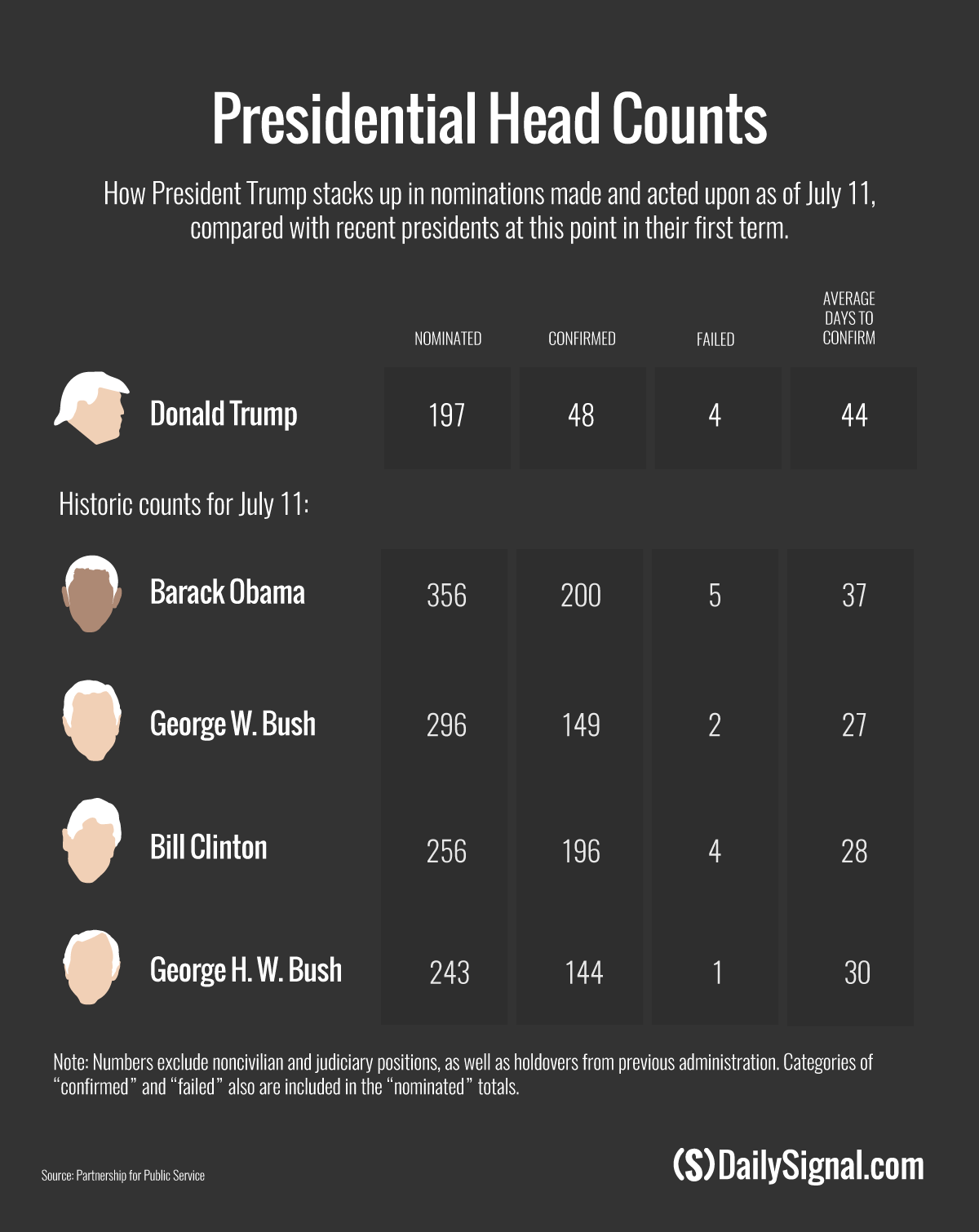
Trump has moved at a very deliberative pace in filling political positions thus far, noted Robert Rector, a senior research fellow with The Heritage Foundation, who is skeptical of the plan.
“Policy changes can’t come from the bureaucracies themselves,” Rector told The Daily Signal. “Policy change needs to come through Congress and comes when you bring outsiders in to impose reforms.”
Rector said neither the Department of Health and Human Services nor the Department of Housing and Urban Development were likely to come back with viable plans for change.
“If they did, it’s the exact opposite of what reform you would want,” he said.
In a White House video, Mulvaney said, “President Trump calls it draining the swamp. What it really means is making government more accountable to you, more effective and more efficient.”
The Mulvaney memo doesn’t outline cuts, but with the requirements, the video says, “Mulvaney is building a case to cut government a year from now.”
Mulvaney released the 14-page memo Wednesday, titled “Comprehensive Plan for Reforming the Federal Government and Reducing the Federal Civilian Workforce,” that aims to save tax dollars and require each government agency to submit a proposal to modernize and streamline operations in 180 days. The OMB is seeking input from the public, and will incorporate the final plans into the fiscal year 2019 budget proposal issues next March. President Donald Trump’s signed an executive order on March 13 directing the OMB to submit a comprehensive plan to reorganize the federal government.
The Mulvaney memo proposes “crosscutting reforms” to streamline all programs over the next four years, including reducing the number of federal employees.
But the plan will have opponents. The leader of the American Federation of Government Employees, the largest union representing federal workers, said, “There are some good ideas and some very dangerous ideas” in the memo.
One he didn’t like stresses more outsourcing, when the government already spends twice as much on contractors as employees, according to the union.
“Nobody knows precisely what these contractors do, how well they do it, who they’re hiring, or where they’re working,” American Federation of Government Employees President J. David Cox said in a statement. “In contrast, the data on federal employees’ jobs, pay, productivity, demographics, and location are completely transparent and widely scrutinized, as is appropriate.”
Cox also defended funding for the Environmental Protection Agency workforce. But the union president did find some common cause with the Trump administration’s report.
He said that it would be useful to evaluate layers of management—or the problem of having too many supervisors per worker.
“As representatives of front-line employees, AFGE members can tell you that excessive ratios of managers to workers on the front lines creates operational inefficiency and takes resources away from the direct provision of services to taxpayers,” Cox said in the statement. “The government does have too many managers and some of those positions should be converted to jobs that serve the American people.”
Reducing the workforce is important, but eliminating whole government programs is where the money is, Edwards said. The report requires agencies to justify why government should be involved in a specific function.
“There is no doubt the left has built a fortress to defend programs,” Edwards said. “Federal money goes to the states and then to city and local governments and every level will defend that money. So will government employees, contractors, and interest groups. It’s a fortress, but it’s not insurmountable. When Republicans are able to cut spending, it doesn’t hurt them politically. It usually helps them.” (For more from the author of “Trump White House Moves Forward with Plan Government Employee Union Dubs ‘Dangerous'” please click HERE)
https://joemiller.us/wp-content/uploads/donald-trump6-1024x682.jpg6821024Joe Millerhttps://joemiller.us/wp-content/uploads/logotext.pngJoe Miller2017-04-13 23:14:422017-04-13 23:14:42Trump White House Moves Forward with Plan Government Employee Union Dubs ‘Dangerous’
President Donald Trump is expected to sign legislation Thursday erasing an Obama-era rule that barred states from withholding federal family planning funds from Planned Parenthood and other abortion providers . . .
The legislation squeezed narrowly through the Senate last month after Vice President Mike Pence cast the tie-breaking vote.
It was passed using an obscure measure called the Congressional Review Act, which lets lawmakers undo regulations enacted in the last months of the Obama administration with just a majority vote. (Read more from “Trump Expected to Sign Legislation Erasing Obama-Era Rule on Family Planning Funds” HERE)
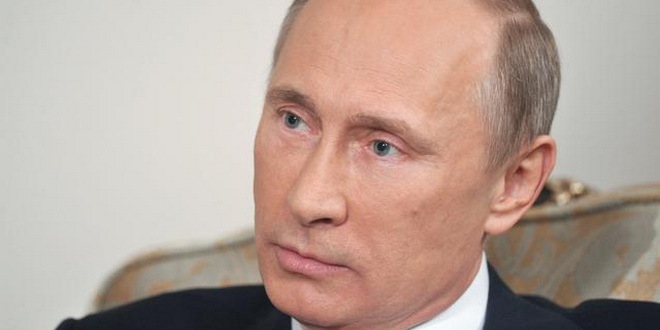
It has become quite clear that Russian autocrat Vladimir Putin has come to deeply regret throwing the weight of his security state behind now-President Donald Trump’s election campaign. Unlike the administration preceding him, Trump has acted decisively to combat Russia’s worldwide influence. From the American missile strikes against the Assad regime in Syria to the inclusion of Montenegro to NATO, Putin massively miscalculated in his strategy to use his state-media and other influence and intelligence operations to support President Trump’s bid for the presidency.
Moscow is infuriated that Trump officials have charged Russia with being intimately involved in Bashar al-Assad’s chemical weapons attack on innocents in Syria last week. According to top U.S. officials, a Russian-made fighter jet bombed a hospital to cover up for the Assad regime’s use of the Sarin nerve agent (which is classified as a weapon of mass destruction) against Syrian men, women, and children. A senior National Security Council official told reporters Tuesday that the U.S. was able to confirm the aforementioned events thanks to a combination of open source intelligence, signals intelligence, and evidence samples.
In another move that angered Moscow this week, Trump approved the addition of Montenegro to the North Atlantic Treaty Organization (NATO), which was originally conceived — and remains partially purposed — to stop Russian intrusion into northern and eastern Europe. Russia fiercely opposes the expansion of NATO, which the Kremlin sees as an adversarial military entity.
Russian strongman Putin has basically admitted the honeymoon period between he and Trump is over, telling state-media on Wednesday: “One could say that the level of trust on a working level [with the United States government], especially on the military level, has not improved but has rather deteriorated.”
His remarks come as Secretary of State Rex Tillerson traveled to Moscow to meet with Russian officials. Tillerson was initially set to converse with the Russian president, then Putin cancelled their meeting. Now it appears that they will indeed meet Wednesday.
Tillerson’s counterpart, Sergey Lavrov, has added himself to the long list of Moscow officials who have become upset with Trump’s policies.
“I won’t hide the fact that we have a lot of questions, taking into account the extremely ambiguous and sometimes contradictory ideas which have been expressed in Washington across the whole spectrum of bilateral and multilateral affairs,” Lavrov pouted during his meeting with Tillerson. “And of course, that’s not to mention that apart from the statements, we observed very recently the extremely worrying actions, when an illegal attack against Syria was undertaken.”
Doubling down on his anti-Putin stance, President Trump has personally added weight to critiques against the Russian leader. Discussing the Syrian strikes on Fox Business Wednesday, Trump said Putin “is backing a person that’s truly an evil person.”
Trump has also ramped up pressure on Russian allies in Iran and China. White House officials continue to refer to Moscow as being on a diplomatic “island,” utilizing the metaphor to showcase Putin’s waning influence over global affairs.
Additionally, both U.N. Ambassador Nikki Haley and Secretary Tillerson have called out Russia for its moral depravity in a way rarely seen in overt channels.
Last week, both Haley and Tillerson unleashed intense critiques against Russian involvement in Syria. Russia has “no interest in peace” in Syria, Ambassador Haley opined. Secretary Tillerson added that Russia and Iran “bear moral responsibility” for Assad’s slaughter.
During the American presidential campaign, Russia acted decisively in selling out in Trump’s favor. To be clear, no firm evidence has ever been presented to indicate that the Russians swung the election in Trump’s favor or even successfully influenced a single voter. Still, from the time in which he was the GOP frontrunner up to Election Day, Russian state television had nothing but good things to say about candidate Trump.
President Trump held his cards close, while his opponent, former Secretary of State Hillary Clinton, was much more up front in criticizing the Russian government.
All indications seemed to imply that Trump was the dream candidate for Moscow. He refused to criticize Putin for his country’s vast human rights abuses, seemed open to cooperating with Russia on a variety of issues, and was openly skeptical about NATO and the European Union.
In response, Moscow appeared to observe the rhetoric of Clinton and Trump as an indicator for future action. To the honest observer of Russian media, it became very clear who the Kremlin supported, given that the state controls the media agenda. The U.S. intelligence community concluded that Russia took their efforts a step further and attempted to influence the election in Trump’s favor by harming Secretary Clinton’s favorability. An intelligence community assessment stated that “Putin and the Russian government developed a clear preference” for Trump and attempted to “denigrate” and “harm” Clinton’s electability.
In their rage, leftist media outlets floated countless conspiracies involving Trump being allegedly controlled by Putin. In one such example, Clinton partisan and former CIA official Mike Morrell called Trump an “unwitting agent” of Russia. To this day, zero evidence has surfaced to confirm their wild allegations. The establishment media, like the Russians, appeared to misread Trump in a similar manner.
The Russians grossly miscalculated. It’s hard to imagine, just 82 days into a presidency, that Hillary Clinton would move so decisively against the Putin regime in the way that President Trump has. In less than ninety days, Trump has managed to infuriate Putin to the point where, in a sulking fit, he canceled a meeting with the U.S. secretary of state.
President Trump was never the “unwitting agent” of Russia the media made him out to be. In the end, Trump played the Russian government like a fiddle, leaving the Kremlin more vulnerable than ever. (For more from the author of “Putin and the MSM Just Learned a Painful Lesson … Trump Played Them Like a Fiddle” please click HERE)
https://joemiller.us/wp-content/uploads/32445930143_0e442d0896_b.jpg5951024Joe Millerhttps://joemiller.us/wp-content/uploads/logotext.pngJoe Miller2017-04-12 22:56:262017-04-12 22:56:26Putin and the MSM Just Learned a Painful Lesson … Trump Played Them Like a Fiddle
President Trump is taking steps to keep his campaign promise to create jobs and economic growth by reducing energy regulations, but his effort falls short of fully reversing former President Obama’s climate change agenda.
Trump recognizes that by removing the regulatory shackles on domestic energy development, processing and transport, the U.S. can unleash its vast natural energy resources and become an energy superpower yielding numerous economic benefits including job creation, boosted tax revenue, increased exports, and improved national security.
To reach that goal requires a stubborn determination to rip Obama’s climate change agenda out by its roots and build a pro-fossil fuel energy policy on a strong foundation.
Trimming the climate change edges will not give the business community the regulatory certainty it needs to bring about a U.S. energy renaissance.
Despite progress, lingering questions remain about Trump’s commitment to completely overturning Obama’s anti-fossil fuel policies.
For example, Trump has not canceled U.S. participation in the United Nations Paris Climate Change Agreement, a carbon tax trial balloon was floated at the White House, and the EPA is not reopening its 2009 greenhouse gas endangerment finding which drives climate change regulations.
Admittedly, unwinding former President Obama’s climate change regulatory agenda is no small task, and Trump has made meaningful strides through executive branch actions and the Congressional Review Act.
Giving the green light to the Dakota Access Pipeline and the Keystone XL Pipeline was important. The pipeline approvals allow a safer method of moving crude oil while providing construction and refinery jobs as well setting the stage for boosting energy exports.
Trump’s new Executive Order on Promoting Energy Independence and Economic Growth includes many beneficial policies that peel back key elements of the Obama climate change regime including changing EPA’s Clean Power Plan.
Despite these advances, Trump needs to take stronger steps for a pro-fossil economy including his promise to coal miners.
Trump’s recent executive order to rewrite the Clean Power Plan is not compelling enough for utilities — the companies that will determine the future of the coal industry.
As a Reuters story shows, the president’s Clean Power Plan effort does not give utilities the business certainty they need to invest in coal generated electricity.
According to its survey, Reuters found about sixty percent of utilities said coal power is not part of their long-term investment.
A spokesperson for North Dakota’s Basin Electric Power Cooperative said, “… the executive order takes a lot of pressure off the decisions we had to make in the near term, such as whether to retrofit and retire older coal plants.” He then added, “But Trump can be a one-termer, so the reprieve out there is short.”
Smart business leaders are not going to gamble on changing political winds or the legal outcome of expected lawsuits. With abundant natural gas supplies, utilities have the luxury of picking less politically risky power sources.
Adding to the business uncertainty is Trump’s hesitation to pull out of the Paris Climate Change Agreement. During the campaign, Trump promised he would “cancel” U.S. participation in the UN effort.
Trump’s indecision on the Paris Agreement is confusing and troubling. Without the Clean Power Plan, the U.S. can’t meet its emissions targets, making our continued participation deceiving and meaningless.
Taxing energy via a carbon tax sends the wrong signal to energy companies, and it preferentially harms coal since it emits twice the amount of carbon dioxide than natural gas.
Conservative critics are also questioning Trump’s commitment to reverse Obama’s climate change agenda because the EPA is not looking to change the agency’s 2009 endangerment finding.
The EPA’s endangerment finding is the rule that established greenhouse gasses including carbon dioxide pose a danger to human health and it serves as the foundation for climate change regulations.
Tackling the endangerment finding will unleash the climate change mob including companies that bet big bucks on energy regulations, but it would allow a full vetting of the new climate change science.
Reversing the EPA endangerment finding would provide the long-term certainty businesses need.
As a builder, Trump knows the importance of a solid foundation. In the political context, that means his energy policy must withstand the winds of progressive attacks now and in the future.
For Trump to achieve his energy vision for the U.S., he must show the business community and the world he is serious about reversing Obama’s entire climate change agenda. (For more from the author of “Trump Wants to Unleash America’s Energy Potential. So Why Is He Keeping Aspects of Obama’s Destructive Agenda?” please click HERE)
https://joemiller.us/wp-content/uploads/Barack_Obama_and_Donald_Trump.jpg24583463Joe Millerhttps://joemiller.us/wp-content/uploads/logotext.pngJoe Miller2017-04-10 21:25:302017-04-10 21:25:30Trump Wants to Unleash America’s Energy Potential. So Why Is He Keeping Aspects of Obama’s Destructive Agenda?
In a rare acknowledgement of conservative journalists by the most powerful arbiter of serious journalism, political commentator and columnist Peggy Noonan on Monday won a Pulitzer Prize for her columns for The Wall Street Journal on the 2016 presidential campaign.
Awarding her the 2017 Pulitzer Prize for distinguished commentary, judges said Noonan earned it for “rising to the moment with beautifully rendered columns that connected readers to the shared virtues of Americans during one of the nation’s most divisive political campaigns.”
The Pulitzer judges recognized Noonan’s graceful but grounded work—she tends to write as if passing along personal, first-person musings on what she has observed or friends have said—in 10 columns published between Feb. 27 and Dec. 31, 2016.
In the first entry, she writes of the divide between two classes—the “protected” and the “unprotected”—and the dissatisfaction among the latter, ordinary Americans, that powered Donald Trump’s campaign:
Many Americans suffered from illegal immigration—its impact on labor markets, financial costs, crime, the sense that the rule of law was collapsing. But the protected did fine—more workers at lower wages. No effect of illegal immigration was likely to hurt them personally.
It was good for the protected. But the unprotected watched and saw. They realized the protected were not looking out for them, and they inferred that they were not looking out for the country, either.
The unprotected came to think they owed the establishment—another word for the protected—nothing, no particular loyalty, no old allegiance.
Mr. Trump came from that.
Noonan would be sharply critical of Trump during the campaign, but saw early that he not only could win the nomination but also the general election against Hillary Clinton.
Although her columns and commentary sometimes have been kinder to more centrist or even liberal Republicans such as John McCain and George W. Bush than to conservatives such as Sarah Palin or Ted Cruz, many conservative Americans still claim Noonan, 66, as one of their own.
This is perhaps because she continued to hold up the example of one of her greatest political heroes, Ronald Reagan.
Noonan, who first drew national attention as a speechwriter and special assistant to President Reagan from 1984 to 1986, has written a weekly column for The Journal since 2000.
The Brooklyn native also is the author of nine books, five of them best-sellers, beginning with 1990’s “What I Saw at the Revolution: A Political Life in the Reagan Era,” through 2015’s “The Time of Our Lives: Collected Writings.”
As her Wikipedia entry notes, Noonan wrote Reagan’s acclaimed “Boys of Pointe du Hoc” speech in 1984 marking the 40th anniversary of D-Day. Millions of Americans also heard Reagan deliver a moving, Noonan-penned address to the nation following the explosion of the space shuttle Challenger in 1986.
While writing speeches for Vice President George H.W. Bush (she was chief speechwriter for his successful campaign to succeed Reagan as president), Noonan coined the phrases “a kinder, gentler nation” and “a thousand points of light.” She also came up with “Read my lips: No new taxes”—a memorable pledge (and play on Clint Eastwood) that came back to haunt Bush.
In a column published Nov. 26, less than three weeks after Trump defeated Clinton, Noonan warned that the incoming president’s reputation as a garrulous dealmaker needed to undergo a transformation so that he is seen as patriot above all.
She wrote:
The press does not believe, not for a second, and Democrats do not believe, not for a second, that Mr. Trump will be able to change the habits of a lifetime. They are relying on it.
Mr. Trump shocked them by winning. He should shock them now with rectitude.
(For more from the author of “Peggy Noonan, Who Explored Why Trump Appeals to Americans, Wins Pulitzer for Commentary” please click HERE)
On Thursday, President Donald Trump ordered the launch of 59 Tomahawk cruise missiles against an airfield in Syria.
The strike came in response to Tuesday’s chemical weapons attack ordered by Bashar Assad against the rebel-held town of Khan Sheikhoun in northwestern Syria.
Trump immediately condemned that attack, which reportedly killed 80 people, including men, woman, and infant children. The target he selected for last night’s strike was the airfield used to launch that very attack.
The strategic impact of this tactical move is hard to overstate.
The deterrent effect of this attack for Assad’s use of chemical weapons is clear, but the bigger message is global. This was Trump’s first big step in re-establishing the meaning of American presence, America’s word, and the general respect for American power in the eyes of nations, friend and foe.
Many here in the United States are worried about the escalation in tensions this attack might bring about in the world. But whether you are confronting a playground bully or a rogue nation, you have to be willing to accept risk to protect the things you hold dear.
Bullies may fight back when they are confronted because they won’t willingly give up their power. But refusing to stand up to them simply means you are choosing to live under their rules.
It doesn’t matter what your name is, or whether you have a powerfully protective family or network of friends that will shield you from such confrontations. You have to be willing to step into the breech and accept the associated risk if you want to chart your own destiny.
Elect to run, and you’ll be running for the rest of your life. Choose to hold your ground, and you’ll establish a level of confidence and strength that will make even the worst of actors think twice about challenging the lines you draw in the sand.
Trump’s decision last night drew a line in the sand. It changed the atmosphere across the entire globe and affected the conversations taking place right now in cities like Pyongyang, Moscow, and Beijing—and of course, at Mar-a-Lago.
It put the world on notice that the repercussions for challenging the word or the wherewithal of the United States is no longer limited to stern rhetoric, and that a debilitating, kinetic response can come swiftly and often without warning. (For more from the author of “Trump’s Response to Syria a Bold First Step in Rebuilding US Credibility” please click HERE)
https://joemiller.us/wp-content/uploads/29302157051_c3ff9ba563_b.jpg6831024Joe Millerhttps://joemiller.us/wp-content/uploads/logotext.pngJoe Miller2017-04-09 22:48:202017-04-09 22:48:20Trump’s Response to Syria a Bold First Step in Rebuilding US Credibility
In what will almost certainly be the defining foreign policy decision of President Donald Trump’s first 100 days seems to be a significant shift from his noninterventionist rhetoric on the campaign trail in facing down Syrian dictator Bashar Assad.
Republican Sens. John McCain of Arizona and Lindsey Graham of South Carolina, longtime critics of the president, praised Trump’s decision to launch 59 Tomahawk missiles at the Syrian government’s Shayrat airfield, where a chemical weapons attack was launched that killed more than 70 Syrian civilians, including children.
Conversely, Republican Sens. Rand Paul of Kentucky and Mike Lee of Utah stressed that Trump should have sought congressional approval before the strikes. Meanwhile, conservative talk radio host Laura Ingraham noted the major policy shift.
While some Trump supporters on the pundit side might have been surprised by the strikes, it’s not likely to hurt the president with his supporters throughout the country, said Richard Benedetto, an adjunct professor of government at American University.
“Some Trump folks will be disappointed,” Benedetto told The Daily Signal. “Many of the so-called blue-collar Trump supporters backed him because they did not like to see America get pushed around.”
As a candidate, Trump heavily criticized George W. Bush, a former president of his own party, for launching the Iraq War, while in 2013, he tweeted that President Barack Obama shouldn’t intervene in Syria.
This doesn’t necessarily mean Trump has shifted away from a cautious attitude toward foreign entanglements, said Benedetto, a former White House correspondent for USA Today.
“He could still be a noninterventionist compared to Bush, but at the same time, wants to make it clear he is not Obama,” Benedetto said. “It doesn’t mean he will be an interventionist in other things. But this means he takes chemical weapons seriously and he believes he had to do something.”
During a Rose Garden press conference Wednesday, the president telegraphed a shift before the strike, stating he is flexible.
I don’t have to have one specific way, and if the world changes, I go the same way … I do change and I am flexible and I’m proud of that flexibility, and I will tell you that attack on children yesterday had a big impact on me, big impact. That was a horrible, horrible thing and I’ve been watching it and seeing it, and it doesn’t get any worse than that. And I have that flexibility and it’s very, very possible, and I will tell you it’s already happened that my attitude toward Syria and Assad has changed very much.
The New York Times ran a story with the headline “Trump’s Far-Right Supporters Turn on Him Over Syria Strike.” However, the story focused mostly on more extreme elements rather than the general Trump supporter or conservatives.
The expectations of Trump as a “restrictionist, realist, or isolationist” during the presidential campaign were miscalculated from the beginning, said Emma Ashford, a research fellow for defense and foreign policy at the libertarian Cato Institute.
“He talked in the campaign about staying out of stupid Middle East wars, but he also talked about Iraq and how we should have taken their oil, and how he would bomb the hell out of ISIS,” Ashford told The Daily Signal. “People tend to focus on whether he is a neocon or like Ron or Rand Paul. They ignore the third way, which is being a restrictionist on humanitarian matters but interventionist in other areas.”
Ashford noted that military presence in the Middle East has increased since Trump became president.
Ashford said that Obama’s decision not to strike Syria in 2013 was sound.
“It worked in that Assad did not use chemical weapons again while Obama was president,” Ashford said.
The change between campaign rhetoric and international affairs isn’t unusual for presidents. Woodrow Wilson campaigned on staying out of World War I. Franklin Roosevelt campaigned on staying out of World War II. Richard Nixon campaigned on exiting the Vietnam War, and George W. Bush shunned nation building, experts said.
“Campaign rhetoric is just designed to get votes,” James Carafano, a national security expert at The Heritage Foundation, told The Daily Signal. “Look at John McCain and Barack Obama in 2008, and they sounded almost identical. There was no way anyone could have predicted Barack Obama’s foreign policy over the next eight years.”
He continued that this is what one should expect from Trump as a businessman.
“This is who Trump is. He deals with what he is dealt,” Carafano said. “If profits are down, he doesn’t hold a press conference to pretend they are not. He deals with it.” (For more from the author of “Trump’s First Big Foreign Policy Move a Departure From Stump Speeches” please click HERE)
https://joemiller.us/wp-content/uploads/32984056422_53157424dc_b.jpg6831024Joe Millerhttps://joemiller.us/wp-content/uploads/logotext.pngJoe Miller2017-04-09 22:45:072017-04-09 22:45:07Trump’s First Big Foreign Policy Move a Departure From Stump Speeches
. . .Despite President Trump’s request for more than $1 billion to fund the Mexican border wall this year, GOP leaders are expected to exclude the money in the spending bill being prepared to keep the government open beyond April 28.
Speaker Paul Ryan (R-Wis.) says the choice is pragmatic and the money will come later.
But the issue has become a political thorn in the side of GOP leaders who are facing pushback from Republicans voicing concerns over the diplomatic fallout, the disruption to local communities and the enormous cost of the project, estimated to be anywhere from $22 billion to $40 billion.
With Democrats united against new wall funding, it’s unlikely the Republicans have the votes to get it through and prevent a government shutdown.
Among the loudest GOP skeptics are those representing border districts. Reps. Will Hurd (R-Texas) and Martha McSally (R-Ariz.), for instance, hail from districts that span a combined 880 miles of the U.S.-Mexico border. They’re pressing the administration to justify the huge costs. (Read more from “Dems Will Win Fight on Border Wall Unless Trump Starts Hammering RINO Collaborators” HERE)
President Trump seems to be adopting the standard Republican response to criticism from the left-wing media, that is, to act more like a Democrat.
That both justifies and fulfills the media agenda at the expense of the Trump agenda, at least what we thought it was.
That also explains the rise in influence of Jared Kushner, a Democrat, and his Goldman-Sachs globalist team at the expense of Stephen Bannon, a nationalist, whose views reflect those of the people who actually elected Trump.
The President should heed the admonition of English poet John Dryden, “Beware the fury of a patient man.”
That “patient man” is Trump’s base of support, which is now growing impatient. And without that base, the President has no support. None.
The Trump Presidency is at risk because he seems to be operating under a false assumption.
Forgive me for being blunt, Mr. President, but you were elected because of what you promised to do, not for who you are, but largely for who you claimed not to be.
You said it best yourself, Mr. President, in “The Art of the Deal” (1987):
You can’t con people, at least not for long. You can create excitement, you can do wonderful promotion and get all kinds of press, and you can throw in a little hyperbole. But if you don’t deliver the goods, people will eventually catch on.
A recent New York Times opinion article frames the current dilemma:
Stephen K. Bannon, the architect of Donald Trump’s campaign and presidency, is a man with a lot of ideas. He believes that Western civilization is locked in an existential battle with the barbarians at the gates, that nationalists must wrest control from the aloof and corrupt globalist elite, and that America is a once great nation shackled by welfare for both the poor and the wealthy…The first few months of President Trump’s term have been an attempt to put all of that theory into practice, and by any reasonable standard, that attempt has failed.
The ideas that carried you to your Presidency, Sir, did not fail – they were sabotaged. And now the agenda upon which your election was based, Mr. President, is withering through intentional neglect in order to replace it with one maintaining the corrupt and dysfunctional political status quo.
It should tell you something, Mr. President, that the same people who denounced and ridiculed you from the day you announced your candidacy, and still do, are now saying “Jared Kushner might save us after all.”
In that case, the “us” to be saved are the Democrats, the left-wing media and the swamp.
Saving them won’t save your Presidency, Sir, but will doom it because the people making such arguments are not those who elected you.
The downsizing of Stephen Bannon and the attacks on other “nationalist” advocates in your administration, Mr. President, are just some of the thousand cuts your enemies hope to inflict to bleed your Presidency white.
It is not a choice between family or friends or a competition between “Nepotism and Nationalism” and certainly not a matter of buttressing the Trump brand.
It is about the President keeping the promises he made to the American people and not diluted versions of them in order to placate those who had always preferred a Trump loss.
In the end, it is really about the survival of representative government.
https://joemiller.us/wp-content/uploads/32984155372_356bc301de_b.jpg6831024Joe Millerhttps://joemiller.us/wp-content/uploads/logotext.pngJoe Miller2017-04-07 23:33:322017-04-09 22:17:46Trump’s Presidency Could Be the Shortest in U.S. History