Posts

How the Federal Reserve Is Setting up Trump for a Recession, a Housing Crisis and a Stock Market Crash

Most Americans do not understand this, but the truth is that the Federal Reserve has far more power over the U.S. economy than anyone else does, and that includes Donald Trump. Politicians tend to get the credit or the blame for how the economy is performing, but in reality it is an unelected, unaccountable panel of central bankers that is running the show, and until something is done about the Fed our long-term economic problems will never be fixed. For an extended analysis of this point, please see this article. In this piece, I am going to explain why the Federal Reserve is currently setting the stage for a recession, a new housing crisis and a stock market crash, and if those things happen unfortunately it will be Donald Trump that will primarily get the blame.

On Wednesday, the Federal Reserve is expected to hike interest rates, and there is even the possibility that they will call for an acceleration of future rate hikes…

Economists generally believe the central bank’s median estimate will continue to call for three quarter-point rate increases both this year and in 2018. But there’s some risk that gets pushed to four as inflation nears the Fed’s annual 2% target and business confidence keeps juicing markets in anticipation of President Trump’s plan to cut taxes and regulations.

During the Obama years, the Federal Reserve pushed interest rates all the way to the floor, and this artificially boosted the economy. In a recent article, Gail Tverberg explained how this works…

With falling interest rates, monthly payments can be lower, even if prices of homes and cars rise. Thus, more people can afford homes and cars, and factories are less expensive to build. The whole economy is boosted by increased “demand” (really increased affordability) for high-priced goods, thanks to the lower monthly payments.

Asset prices, such as home prices and farm prices, can rise because the reduced interest rate for debt makes them more affordable to more buyers. Assets that people already own tend to inflate, making them feel richer. In fact, owners of assets such as homes can borrow part of the increased equity, giving them more spendable income for other things. This is part of what happened leading up to the financial crash of 2008.

But the opposite is also true.

When interest rates rise, borrowing money becomes more expensive and economic activity slows down.

For the Federal Reserve to raise interest rates right now is absolutely insane. According to the Federal Reserve Bank of Atlanta’s most recent projection, GDP growth for the first quarter of 2017 is supposed to be an anemic 1.2 percent. Personally, it wouldn’t surprise me at all if we actually ended up with a negative number for the first quarter.

As Donald Trump has explained in detail, the U.S. economy is a complete mess right now, and we are teetering on the brink of a new recession.

So why in the world would the Fed raise rates unless they wanted to hurt Donald Trump?

Raising rates also threatens to bring on a new housing crisis. Interest rates were raised prior to the subprime mortgage meltdown in 2007 and 2008, and now we could see history repeat itself. When rates go higher, it becomes significantly more difficult for families to afford mortgage payments…

The rate on a 30-year fixed mortgage reached its all-time low in November 2012, at just 3.31%. As of this week, it was 4.21%, and by the end of 2018, it could go as high as 5.5%, forecasts Matthew Pointon, a property economist for Capital Economics.

He points out that for a homeowner with a $250,000 mortgage fixed at 3.8%, annual payments are $14,000. If that homeowner moved to a similarly-priced home but had a 5.5% rate, their annual payments would rise by $3,000 a year, to $17,000.

Of course stock investors do not like rising rates at all either. Stocks tend to rise in low rate environments such as we have had for the past several years, and they tend to fall in high rate environments.

And according to CNBC, a “coming stock market correction” could be just around the corner…

Investors are in for a rude awakening about a coming stock market correction — most just don’t know it yet. No one knows when the crash will come or what will cause it — and no one can. But what’s worse for most investors is they have no clue how much they stand to lose when it inevitably happens.

“If you look at the market historically, we have had, on average, a crash about every eight to 10 years, and essentially the average loss is about 42 percent,” said Kendrick Wakeman, CEO of financial technology and investment analytics firm FinMason.

If stocks start to fall, how low could they ultimately go?

One technical analyst that has a stunning record of predicting short-term stock market declines in recent years is saying that the Dow could potentially drop “by more than 6,000 points to 14,800″…

But if the technical stars collide, as one chartist predicts, the blue-chip gauge could soon plunge by more than 6,000 points to 14,800. That’s nearly 30% lower, based on Friday’s close.

Sandy Jadeja, chief market strategist at Master Trading Strategies, claims several predicted stock market crashes to his name — all of them called days, or even weeks, in advance. (He told CNBC viewers, for example, that the August 2015 “Flash Crash” was coming 18 days before it hit.) He’s also made prescient calls on gold and crude oil.

And he’s extremely concerned about what this year could bring for investors. “The timeline is rapidly approaching” for the next potential Dow meltdown, said Jadeja, who shares his techniques via workshops and seminars.

Most big stock market crashes tend to happen in the fall, and that is what I portray in my novel, but the truth is that they can literally happen at any time. If you have not seen my recent rant about how ridiculously overvalued stocks are at this moment in history, you can find it right here. Whether you want to call it a “crash”, a “correction”, or something else, the truth is that a major downturn is coming for stocks and the only question is when it will strike.

And when things start to get bad, most of the blame will be dumped on Trump, but it won’t primarily be his fault.

It was the Federal Reserve that created this massive financial bubble, and they will also be responsible for popping it. Hopefully we can get the American people to understand how these things really work so that accountability for what is coming can be placed where it belongs. (For more from the author of “How the Federal Reserve Is Setting up Trump for a Recession, a Housing Crisis and a Stock Market Crash” please click HERE)

Follow Joe Miller on Twitter HERE and Facebook HERE.

Senate Judiciary Demands All Records on FBI Plan to Pay British Ex-Spy Who Made ‘Russia Dossier’ on Trump

Senator Charles Grassley (R-Iowa), chairman of the Senate Judiciary Committee, sent a letter to FBI Director James Comey demanding that his agency turn over all records of its reported plan to pay the British ex-spy — who compiled a salacious and unsubstantiated dossier on Donald Trump just prior to the election – to continue investigating the president.

The “Russia Dossier,” which claimed that Trump engaged in perverted sex acts in a Moscow hotel and allegedly was in collusion with the Russians, was published by the online site Buzzfeed. The disturbing allegations in the document were not substantiated. Famed author and Washington Post reporter Bob Woodward called the dossier a “garbage document.”

In his letter to FBI Director Comey, Chairman Grassley notes that the Washington Post “reported that the FBI reached an agreement a few weeks before the Presidential election to pay the author of the unsubstantiated dossier alleging a conspiracy between President Trump and the Russians, Christopher Steele, to continue investigating Mr. Trump.”

“The article claimed that the FBI was aware Mr. Steele was creating these memos as part of the work for an opposition research firm connected to Hillary Clinton,” said Grassley.

“The idea that the FBI and associates of the Clinton campaign would pay Mr. Steele to investigate the Republican nominee for President in the run-up to the election raises further questions about the FBI’s independence from politics, as well as the Obama administration’s use of law enforcement and intelligence agencies for political ends,” said Grassley. (Read more from “Senate Judiciary Demands All Records on FBI Plan to Pay British Ex-Spy Who Made ‘Russia Dossier’ on Trump” HERE)

Follow Joe Miller on Twitter HERE and Facebook HERE.

Watch: Popular Rapper ‘Shoots’ Trump in Music Video

Snoop Dogg stars in a new politically-charged music video that sees the rapper pull a gun on and “shoot” a parody clown version of President Donald Trump.

Visuals for “Lavender,” a song that first appeared on BADBADNOTGOOD and Kaytranada’s IV, show a clown-faced President “Ronald Klump” holding a press conference where he announces a plan to “deport all dogs.”

“The ban that this motherf*cker tried to put up; him winning the presidency,” Snoop says is what inspired the concept of that part of the video, Billboard reports.

The dog deportation plan spurs Snoop Dogg and a gang of armed men to ambush the parody President Trump. Snoop points a gun at Trump’s head and pulls the trigger. A giant “BANG” flag pops out.

Snoop says he’s not worried about what his critics might say of the controversial scene. (Read more from “Watch: Popular Rapper ‘Shoots’ Trump in Music Video” HERE)

Follow Joe Miller on Twitter HERE and Facebook HERE.

Judge: Obama ‘Went Outside Chain of Command,’ Used British Spy Agency to Surveil Trump

The Justice Department on Monday asked lawmakers for more time to gather evidence related to President Trump’s claim that former President Obama ordered wiretaps on Trump Tower’s phones during last year’s presidential campaign . . .

On “Fox & Friends” this morning, Judge Andrew Napolitano said that even if the Obama administration did spy on Trump, there may never be a way to prove it . . .

“Three intelligence sources have informed Fox News that President Obama went outside the chain of command,” Napolitano said. “He didn’t use the NSA, he didn’t use the CIA, he didn’t use the FBI, and he didn’t use the Department of Justice.”

Instead, Napolitano said, Obama used GCHQ, a British intelligence and security organization that has 24-7 access to the NSA database.

“There’s no American fingerprints on this,” Napolitano said. “What happened to the guy who ordered this? Resigned three days after Donald Trump was inaugurated.” (Read more from “Judge: Obama ‘Went Outside Chain of Command,’ Used British Spy Agency to Surveil Trump” HERE)

Follow Joe Miller on Twitter HERE and Facebook HERE.
Listen: President Trump Is Not Safe in the White House

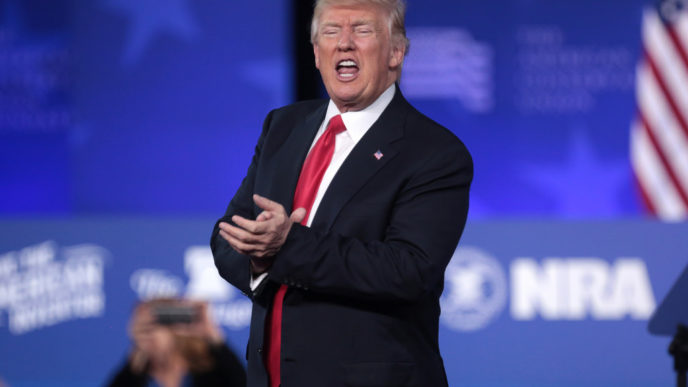
In this episode, I address the disastrous security failure at the White House this weekend and what can be done to ensure it doesn’t happen again.

I also discuss the Trump budget and the reasons liberals, and interest groups, are fighting it.

(For more from the author of “Listen: President Trump Is Not Safe in the White House” please click HERE)

Follow Joe Miller on Twitter HERE and Facebook HERE.

The Legal Questions Facing Trump’s New Travel Ban

With his revised temporary travel ban, President Donald Trump sought to resolve legal questions that caused a federal judge to halt the first version of the executive order.

Legal experts say the Trump administration succeeded in strengthening the legal case for the new order by applying travel restrictions to fewer people—exempting entire classes of individuals, including legal permanent residents—and providing a more detailed rationale for the policy.

However, Trump’s order, issued last Monday, remains vulnerable to challengers who argue the travel ban is an extension of a “Muslim ban” that the president promised during the campaign, and a violation of the First Amendment’s protection against religious discrimination.

“If this exact order had been issued by a different president without the context with which the order was issued, it’s a 100 percent certainty the order would be upheld in a court,” said Leon Fresco, the former head of the Department of Justice’s Office of Immigration Litigation, in an interview with The Daily Signal.

The new executive order bars entry to foreigners for 90 days from six terrorism-plagued, Muslim-majority countries who have never before entered America. It also suspends for 120 days resettlement to the U.S. of refugees from anywhere in the world. Syrian refugees are no longer subject to an indefinite ban, as they were in Trump’s first order.

The 90-day travel restriction applies to Iran, Syria, Somalia, Sudan, Yemen, and Libya, countries contained in Trump’s original order that the Obama administration and Congress had designated as posing risks of terrorism. Trump removed Iraq—a crucial counterterrorism partner—from that list in the new order.

Hawaii was the first state to sue over the new order, and a hearing in that case is scheduled for Wednesday. A federal judge in Maryland will also hear arguments on that day in a separate lawsuit over the ban.

Meanwhile, some of the states that helped block Trump’s original travel ban are already mounting challenges to the second one. Backed by several fellow Democratic attorneys general, Bob Ferguson of Washington asked the same federal district judge who issued a temporary restraining order on the original ban, James Robart, to extend that freeze and apply it to the updated restrictions.

With the new order set to take effect Thursday unless a court intervenes, The Daily Signal explores some of the legal questions surrounding the case.

Who Can Sue?

The new order sharply limits the types of people subject to the temporary travel ban.

Unlike the first order, the new one explicitly excludes lawful permanent residents of the U.S.

Others exempted from the travel restrictions include dual nationals of the six targeted countries who use a passport from another country not on the list, foreigners traveling for diplomatic purposes, and individuals who have already been granted asylum or refu­gee status.

In addition, the order contains a list of people who can be granted exemptions to the restrictions on a case-to-case basis, including when a “foreign national seeks to enter the United States to visit or reside with a close family member,” and instances where a foreigner previously admitted to the U.S.—such as college students or faculty—leaves the country and seeks to return.

“Who is left over?” writes Josh Blackman, a professor at the South Texas College of Law in Houston, in a recent blog post. “Aliens from these six nations who have never entered the United States, have no relatives in the United States, and have never received any travel document from the United States. The category of aliens who are actually excluded, and who would actually seek to visit the United States is likely small. No court has ever held that aliens that are seeking entry, who have zero connection to the United States, or its residents, have due process rights.”

Experts say because fewer people are affected by the new travel ban, it will be more difficult for challengers to the policy to find plaintiffs who have legal standing to sue.

“The best argument against the order is gone—that you are taking away people’s rights who had previously been admitted into the country without consideration of due process,” Fresco said. “That is gone now. Now you have the question of whether new people with no ties to the U.S. are permitted to enter here, and that has always been more tenuous legal ground to be on.”

Blackman speculates that those who assert a compelling interest to travel to the U.S. could try to sue. On his blog, he lists two such examples as a student in Syria who seeks to pursue a degree at the University of Washington, or an Iranian engineer who wants to work at Microsoft.

In a case out of Wisconsin, a man who fled Syria and was granted asylum in the U.S. sued so that the ban would not be applied to his wife and 3-year-old daughter, who are still in war-torn Aleppo and have asylum applications being processed. This past weekend, a federal judge in Wisconsin blocked enforcement of the policy against the Syrian man’s family.

“The court appreciates that there may be important differences between the original executive order, and the revised executive order—for example, the government points to a new waiver provision,” Judge William M. Conley wrote. “As the order applies to the plaintiff here, however, the court finds his claims have at least some chance of prevailing for the reasons articulated by other courts.”

Questions of Intent

Washington and Hawaii are claiming the new order, like the original version, is equivalent to a Muslim ban that Trump proposed in the campaign.

Opponents also point to statements by Trump’s advisers, including former New York Mayor Rudy Giuliani, who said Trump asked him how to implement a Muslim ban legally, and more recently, Stephen Miller, a senior White House adviser who said the revised order was meant to have “the same basic policy outcome” as the first.

The Trump administration rejects charges of religious intent, noting that most Muslim-majority countries were not included in the order. The new order contains no reference to religion, and removes a clause from the original version that would have granted preference to foreign travelers who belong to minority religious groups.

“Is it really possible that if the government says something once, it is prohibited in doing any policy moving forward on this subject?” Fresco said. “No one has won a case like that.”

However, Fresco and Blackman concede this argument is a powerful one, and they could envision at least one court that views Trump’s and his team’s previous comments as relevant to the new order, and tantamount to discriminating against Muslims.

“If a court believes this policy will forever be infected by the previous comments then there is absolutely nothing the government can do to ever eliminate that,” Blackman told The Daily Signal in an interview. “Then we are just wasting our time here and they will strike it down.”

Judging the Order’s Content

Legal experts say in the face of questions over religious intent, courts are more likely to view the order favorably if the government can prove why the policy is necessary.

The courts usually defer to the executive branch on issues of national security and immigration policy. Federal immigration law states that if the president finds “the entry of any aliens” would be “detrimental” to the country’s interests, he can impose restrictions.

But courts could impose stricter scrutiny over Trump’s order, considering the context under which he issued it.

“The question is, does the content of the order do enough to dispel a presumption that religious discrimination is the motive, or does it do things to confirm it?” said Richard Primus, a constitutional law professor at the University of Michigan, in an interview with The Daily Signal.

“The normal way a court answers that question is in part by asking is the content of the government action well tailored to the problem the government says it is trying to solve,” Primus added. “The less tailored it is, the more the decision-maker expects that the problem the defendant says they are trying to solve isn’t really what they are trying to solve.”

The Trump administration has argued the travel ban is necessary for national security reasons, and that the targeted countries are dangerous hotbeds of terrorism.

In making the case for the policy, the revised order contains a clause noting about 300 pending FBI counterterror investigations involve individuals who came to the U.S. as refugees, although it doesn’t specify how many came from the targeted countries.

Critics of Trump’s order counter that none of the recent terrorist attacks in the U.S.—from San Bernardino to Orlando—were perpetrated by anyone from the nations listed in the travel ban.

“The new executive order is certainly much more robust in explaining why the president thought he is justified in temporarily stopping immigration from those six countries,” said Stephen Yale-Loehr, an immigration law professor at Cornell Law School, in an interview with The Daily Signal.

“He can be criticized for why he picked those six countries, and not others, but the standard of review in most immigration cases is very low, sometimes even below a rational basis test,” Yale-Loehr added. “As long as the president has a bonafide, legitimate reason for whatever he does, the courts often say that’s good enough. In some cases, courts also have been deferential to presidents even when First Amendment issues have been raised.”

Blackman says the administration in its new order changes how it argues for the policy in a way that may make it tougher for courts to reject.

“The old order said we need a temporary pause because aliens from these countries will come to the U.S. and engage in acts of terror, when very few have actually done this,” Blackman said. “The new order makes a different point, which is we don’t have good diplomatic relations with these countries, and these countries are not providing accurate information of its citizens for the U.S. to bet on. That’s a very different point and a lot harder for the court to ignore.” (For more from the author of “The Legal Questions Facing Trump’s New Travel Ban” please click HERE)

Follow Joe Miller on Twitter HERE and Facebook HERE.
Palestinian Leader, President Trump to Hold First Phone Call

Palestinian President Mahmoud Abbas will speak Friday by telephone with U.S. President Donald Trump in the first contact between the two leaders since Trump took office in January.

Trump’s planned phone call to Abbas was revealed in a White House notice.

Abbas has spent many hours on the phone and in meetings with U.S. presidents and secretaries of state over the past decade but he has been unsuccessful when reaching out to Trump. His office did not comment ahead of the call. (Read more from “Palestinian Leader, President Trump to Hold First Phone Call” HERE)

Follow Joe Miller on Twitter HERE and Facebook HERE.
Trump Faces Challenge of Visa Overstays, the Largest Source of Illegal Immigration

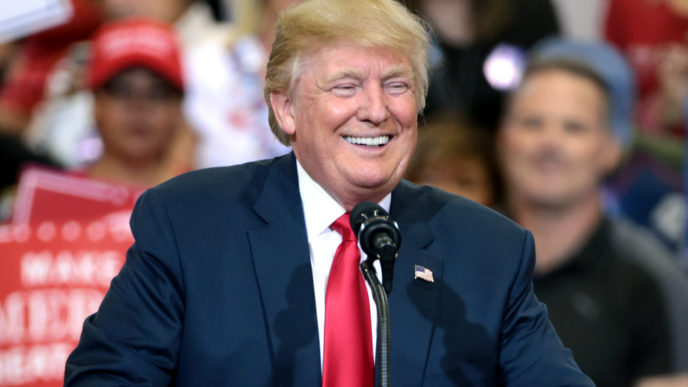
As President Donald Trump focuses on border security in his initial actions to counter illegal immigration, a new report shows the unauthorized population increasingly is made up of those who first entered the U.S. legally.

In each year from 2007 to 2014, the report from the Center for Migration Studies finds, more people joined the illegal immigrant population by remaining in the U.S. after their temporary visitor permits expired than by sneaking across the Mexican border.

In 2014, about 4.5 million U.S. residents, or 42 percent of the population of roughly 11 million illegal immigrants, had overstayed their visas, the report says.

Overstays accounted for about two-thirds—66 percent—of those who ended up joining the illegal immigrant population in 2014.

“What’s happened is that popular conception has made it seem that illegal immigration means people coming from the southern border,” Robert Warren, a co-author of the report, said in an interview with The Daily Signal. “One of the reasons we put the report out is that illegal immigration is much more varied and we need to look at different policy options.”

Visa overstays—legal entrants to the U.S. who stay past their allotted time here—long have been the underreported component of illegal immigration.

A report by the Department of Homeland Security found that as of Jan. 4, 2016, a total of 416,500 of the 527,127 overstays in 2015 remained in the U.S. More have left the country since then, the government said.

The Trump administration has referred to visa overstays, but so far has concentrated on fulfilling the president’s campaign promise to build a wall across the southern border.

“There’s this assumption in the Trump administration that the southern border is out of control and people are flooding across it, but we have much better control of the border now than we did in previous decades,” Edward Alden, an immigration and visa policy expert at the Council on Foreign Relations, said in an interview with The Daily Signal. “Whereas this other problem of visa overstays is increasingly becoming out of control.”

‘Shining a Light’

Trump’s revised executive order temporarily banning travel from six terrorism-prone, Muslim-majority countries contains some language related to combating visa overstays.

The president calls for Homeland Security Secretary John Kelly to pursue “expedited completion” of a long-promised and delayed system to obtain biometric data—such as fingerprints, facial recognition images, and eye scans—on those leaving the country. Such a system would tell the government who has left the country, and how many who should have departed are still here.

In 2004, the 9/11 Commission recommended the Department of Homeland Security complete an entry and exit system “as soon as possible,” viewing it as an important national security tool because two of the hijackers on Sept. 11, 2001, had overstayed their visas.

Foreigners who apply to enter the U.S. on a visa are interviewed and photographed and have their fingerprints taken at a consulate overseas before arriving here. But collecting biometric data on those exiting the country is not as easy.

Plagued by financial and logistical challenges, the government has introduced various pilot projects at some airports and land borders, but has struggled to implement a biometric exit system on a large scale.

Trump’s executive order asks Kelly to provide ongoing reports on the progress of an entry-exit system, but it does not impose a concrete timetable for completion.

“For a long time, administrations didn’t take the visa overstay issue seriously,” Mark Krikorian, director of the Center for Immigration Studies, said in an interview with The Daily Signal. “Hopefully with the White House’s light shining on the issue, we will see more progress on the entry-exit system, but it’s the kind of thing that will take a while. It’s a process, not an event like the border wall is.”

The Center for Immigration Studies, which calls for tougher enforcement of immigration laws, supports construction of the wall.

Shift in Behavior

The report from the Center for Migration Studies, which opposes the border wall, concludes that the biggest reason for the shift since 2007 toward more visa overstays, and fewer border-crossers, is the significant drop in illegal arrivals from Mexico in that time frame.

Mexico is the leading country for both overstays and arrivals across the border, representing about 55 percent of the illegal immigrant population, the study says.

But U.S. border apprehensions of Mexicans has fallen sharply, from 809,000 in 2007 to just 230,000 in fiscal year 2014—a level not seen since 1971, according to the Pew Research Center.

Alden, of the Council on Foreign Relations, argues that the trend toward an increasing percent of visa overstays and fewer border apprehensions of Mexicans shows that the Trump administration should not focus on building a wall — especially at a cost estimated to be as high as $25 billion.

“It doesn’t make a lot of sense to be spending most of our money fortifying the part of the border under the best control and ignoring visa overstays, which is getting worse,” Alden said.

But Krikorian counters that the Trump administration can have multiple focuses. He says the deterrent force of a wall is important.

“It’s one thing to say we need more of an emphasis on tracking and prosecuting overstays, and it’s a very different thing to say we shouldn’t bother with the border anymore,” Krikorian said, adding:

Yes, it does cost a great deal of money, and yes, for me, it’s not job No. 1 in a policy sense. But in a broader political sense it sends an important signal that the government is actually serious about illegal immigration control.

Trump’s early clampdown and rhetoric on illegal immigration may be having an impact. Roughly 840 people a day were caught illegally entering the U.S. from Mexico last month, according to Customs and Border Protection, a drop of about 39 percent from January.

“If the wall doesn’t go beyond being a symbol, and it just becomes an excuse to avoid doing those other things—like stopping overstays—than we have a problem,” Krikorian said. “I don’t get that sense from this administration.”

Policy Options

Beyond finishing the biometric entry-exit system, experts say there are quicker ways the Trump administration can tackle visa overstays.

In new memos detailing Trump’s interior enforcement policies on immigration, the Department of Homeland Security says it will broaden the scope of those targeted for deportation. Besides convicted criminals, they will include those charged with a crime or accused of a chargeable offense.

Immigration and Customs Enforcement (ICE), an agency of the Homeland Security Department, already has a team dedicated to pursuing illegal immigrants who overstayed their visas. The Trump administration could use its new deportation priorities to expand the pool of overstays whom immigration officers go after.

“The technology for entry-exit is getting better, so I can understand it’s getting less unrealistic,” said David Inserra, an expert on homeland security at The Heritage Foundation. “But rather than build an expensive list generator telling you who hasn’t left the country, I would rather have more counterterrorism analysts, ICE agents, or any number of things. If you allow ICE agents to do their jobs in a more complete and robust manner, you will inevitably catch more overstays and will encourage less overstays because they see and know they will be removed.”

The government also can take simpler steps to deter visa overstays by emailing reminders to foreigners of their expected departure date, specifying the consequences of not leaving on time.

Many who overstay their visas don’t intend to settle in America, Alden said, and simply don’t know when they have to leave.

“The biometric entry-exit system has been the unreachable holy grail,” Alden said. “But it doesn’t really get at the real problem. The problem is not an identification problem. The question is how do we discourage the act of overstaying a visa in the first place.” (For more from the author of “Trump Faces Challenge of Visa Overstays, the Largest Source of Illegal Immigration” please click HERE)

Follow Joe Miller on Twitter HERE and Facebook HERE.

The Radical Ties of the Imam Behind the Trump Immigration Lawsuit

The plaintiff listed in Hawaii’s lawsuit against President Trump’s executive order on immigration is a member of an organization that has several current and former leaders tied to terrorist activity.

Dr. Ismail Elshikh — the imam of the Muslim Association of Hawaii — is suing Trump in reaction to the second version of his immigration moratorium, which was signed on Monday. The order imposed a 90-day hold on foreign nationals from six terror-tied countries from entering the United States.

According to the Muslim Association of Hawaii website, Imam Elshikh is a member of the North American Imam Federation (NAIF), a fringe Islamic organization that has a board and current leadership stacked with radical Islamic connections.

Kyle Shideler, a terrorism expert and director of the Threat Information Office at the Center for Security Policy, tells CR that it’s concerning that Imam Elshikh is a part of NAIF.

“Given NAIF’s history it should come as no surprise that the end goal of this lawsuit is, ultimately, weakening American counter-terrorism or immigration security efforts,” Shideler said.

He added: “That a member of an organization whose leaders have included a convicted war criminal, an individual who defended donating money to a Hamas linked charity, and an unindicted co-conspirator in a terrorism bombing wants to tell the American people who they can admit for immigration should say a lot about why such an executive order is needed in the first place.”

Steven Emerson, the executive director of the Investigative Project on Terrorism, also voiced his concerns about Elshikh’s associations. He tells CR:

“NAIF is an extremely radical Islamist group whose leaders and members have defended some of the most violent terrorist groups in the world. Some members have been found to be actually linked to acts of Islamist terrorism. This is a group, some prosecutors have argued, whose incitement for violence could qualify their categorization as a providing material support for terrorism.”

Current NAIF board members include the former leader of an al-Qaeda-connected mosque and a radical preacher. Former leaders include a man convicted of leading an international death squad, and a prominent Islamist preacher who has praised Osama bin Laden.

Current NAIF leadership

Omar Shahin, a current board member of NAIF, is the former president of the Islamic Center of Tucson, a mosque that was once utilized as the “de-facto al-Qaeda headquarters in the United States,” according to the Investigative Project on Terrorism. As imam of the mosque, Shahin raised funds for the Holy Land Foundation, which was later shut down for funneling money to the terrorist group Hamas. He also held fundraisers for the Global Relief Foundation, which was later deemed by the U.S. Treasury Department to be connected to al-Qaeda and Osama bin Laden.

El Shikh received his PhD from the Graduate Theological Foundation Islamic Studies Department, which is headed by Shahin. The program was created in collaboration with the Islamic Society of North America (ISNA), an organization that was started as a Muslim Brotherhood front group.

Dr. Waleed Meneese, another NAIF board member, has explicitly called for fellow Muslims to kill Jews. “When the Children of Israel returned to cause corruption in the time of our Prophet Muhammad,” Meneese said in a recent sermon. “And they disbelieved him, God destroyed him at his hand. In any case, God Almighty has promised them destruction whenever they cause corruption,” he said of the Jewish people.

Meneese has also called for the killing of apostates from Islam, and for the treating of non-Muslims as second-class citizens.

Former NAIF leadership

Ashrafuzzaman Khan is the former president of NAIF and a current leader at the Muslim Brotherhood-connected Islamic Circle of North America (ICNA). In 2013, he was tried in a Bangladesh court as he was accused of drafting a kill list of intellectuals inside the country. He was charged with 11 counts of war crimes as the alleged leader of the Al-Badr death squad. In 2013, he and an accomplice were sentenced in absentia for the abduction and murder of 18 people, including nine university professors, six journalists, and three physicians.

Egyptian cleric Wagdi Ghoneim was the chairman of NAIF at the turn of the century. In 2005, he agreed to deportation to Qatar after U.S. authorities were concerned about his potential connections to terrorist organizations. Ghoneim has called Osama bin Laden a “martyred heroic mujahid” and is now closely tied to the Egyptian Muslim Brotherhood. He has been banned from entering several countries due to his radicalism.

Another former NAIF board member is Siraj Wahhaj, who was infamously listed as an unindicted co-conspirator in the 1993 World Trade Center bombings. Wahhaj testified in defense of the Blind Sheikh, Omar Abdel-Rahman, who served a life sentence for being the mastermind behind terrorist plots in the United States.

What else?

The North American Imam Federation is perhaps best known as the group that allegedly planned and staged the “flying imams” incident. After a 2006 NAIF conference, several imams connected to the group were booted from a domestic flight after exhibiting bizarre, threatening behavior, terrifying fellow passengers. NAIF and the Hamas-tied Council on American Islamic Relations (CAIR) showcased the incident as a prime example of America’s supposed problem with “Islamophobia.”

President Trump’s immigration moratorium, blocking non-citizens from coming into the U.S. from the six terror havens of Iran, Yemen, Somalia, Sudan, Syria, and Libya, will go into effect next week, barring a successful legal challenge by Elshikh and Hawaii or other actors.

(For more from the author of “The Radical Ties of the Imam Behind the Trump Immigration Lawsuit” please click HERE)

Follow Joe Miller on Twitter HERE and Facebook HERE.
Trump Halfway to First 100 Days

President Donald Trump this week threw his support behind a House Republican plan aimed at repealing and replacing Obamacare. While it’s not yet to the liking of everyone in his party, a health care proposal was a key pledge candidate Trump said would be part of his first 100 days in office.

Now, at the halfway mark of this critical period on Friday—the president has moved at a quick pace addressing the bulk of promised executive actions and proposals—such as taking early steps on border security and increased vetting of immigrants and refugees from Middle Eastern countries.

But there are still significant actions left to make and measures that haven’t been proposed in Congress in this crucial 100-day timeline.

The president has championed an “America First” agenda in the first 50 days, said Helen Aguirre Ferre, White House director of media affairs.

“He was very clear in his joint address to Congress, he’s not the president of the world, he’s the president of the United States of America, and he’s really shown it in the first 50 days as far as where his priorities are,” Ferre told The Daily Signal in a Facebook Live interview at the White House Friday.

Here’s a look at Trump’s promises at the halfway point.

Draining the Swamp

Trump promised six measures in the first 100 days to “clean up corruption and special interest collusion in Washington, D.C.”

The first measure on the list is unfulfilled, which is the one that requires the most effort.

Trump has not proposed—or at least hasn’t backed an existing proposal—for a constitutional amendment to impose term limits on members of Congress. Sens. Ted Cruz, R-Texas, and Mike Lee, R-Utah, have backed term limit proposals, but the White House hasn’t thrown its weight behind the proposition yet. A constitutional amendment requires the vote of two-thirds of Congress to pass then must be ratified by three-quarters of the states before becoming law.

Trump’s other measures to clean up Washington only required executive actions, which he moved on.

Trump almost immediately made good on a pledge to impose a hiring freeze on federal employees to reduce the federal workforce through attrition.

The president also signed an executive order requiring that for every new federal regulation, two existing regulations must be eliminated.

He placed a five-year ban on White House officials from becoming lobbyists after they left government service and a lifetime ban on White House officials from lobbying for a foreign government. However, it would take an act of Congress to prohibit congressional staffers from lobbying.

Protecting American Workers

Trump made seven promises about protecting the jobs of American workers—which was a central focus of his campaign.

He has withdrawn from the Trans-Pacific Partnership, a trade deal President Barack Obama entered with 11 countries, but one that was never approved by Congress.

Trump pledged to renegotiate the North American Free Trade Agreement. While there hasn’t been an executive order to that effect, Commerce Secretary Wilbur Ross said talks about NAFTA will launch later this year.

Ferre said she doesn’t have a timetable for every item that was part of the campaign’s 100-day plan. But, she said the president will address trade issues. Ferre added:

The president is bullish on trade, he wants to promote trade, but through bilateral trade agreements to make sure that we are getting a better bang for the buck. NAFTA for example, yes, let’s have good, robust trade with Mexico, but let’s make sure that this treaty that was negotiated over 20 years ago is still where it needs to be to address the needs of the American voters in 2017. I don’t know if it will necessarily be within the next 50 days, but the president has been very clear this is one of the trade issues that needs to be addressed. He took out the Pacific trade agreement because it was one that didn’t benefit American workers and really put some other countries at a greater advantage than American workers.

Trump has not yet directed Treasury Secretary Steven Mnuchin to label China a currency manipulator, and according to a news report, might be less likely to do so. Mnuchin said in late February that the U.S. will continue to use the existing criteria for judging whether China manipulates its currency.

Trump has also promised to lift restrictions on the production of American energy reserves. The White House has put this forward as part of its broader energy goals, but the White House hasn’t passed an executive order or formally backed legislation to this effect. Trump also has not moved to cancel payments to the United Nations climate change programs.

Trump signed an executive order to approve construction of the Keystone and Dakota Access pipelines. Authorizing Keystone construction was part of his 100-day plan.

On the same day as the two pipeline memorandums, Trump also issued an executive order “expediting environmental reviews and approvals for high priority infrastructure projects.”

In another presidential memorandum, Trump directed departments and agencies to support expanded manufacturing through streamlining permitting reviews and reducing regulations.

Restoring Security and Rule of Law

Trump vowed to “cancel every unconstitutional executive action” by Obama. He hasn’t moved back every Obama executive action yet, including Deferred Action for Childhood Arrivals, or DACA, a program that shields children of illegal immigrants from deportation.

Trump did nominate 10th U.S. Circuit Court of Appeals Judge Neil Gorsuch to fill the seat of the late Supreme Court Justice Antonin Scalia. During the campaign, Trump pledged to begin the process of replacing Scalia with a constitutionalist.

On Jan. 25, Trump signed a series of executive orders regarding immigration, his signature issue during the campaign. One order called for “immediate construction of a physical wall on the southern border, monitored and supported by adequate personnel so as to prevent illegal immigration, drug and human trafficking, and acts of terrorism.”

He also signed an order scaling back funding for “sanctuary cities,” the term for municipalities that refuse to cooperate with federal officials in enforcing immigration law.

The most controversial Trump initiative has been suspending immigration from seven Middle Eastern countries that have been designated hotbeds for terrorism. The first executive order, issued on Jan. 27, was struck down by a Washington state U.S. district judge, and the 9th U.S. Circuit Court of Appeals upheld the ruling.

Trump issued a second executive order that identifies only six countries and clarifies other aspects of the first order regarding visas and dual citizenship. On Thursday, Hawaii became the first state to sue over the revised executive order. The Trump administration said it will continue to defend the original executive order.

Legislative Agenda

Trump promised to promote an economic plan to grow the economy by 4 percent per year, adding 25 million new jobs, according to his 100-day plan. That would include an across-the-board tax cut. Under his plan, the middle-class earners would get a 35 percent tax cut, while the number of tax brackets would be reduced from seven to three. Trump proposed lowering the business tax rate from 35 percent to 15 percent.

Senate Majority Leader Mitch McConnell, R-Ky., said tax reform is unlikely before the August recess. However, White House press secretary Sean Spicer said Thursday he believed Congress could pass a package by the August deadline.

Trump hasn’t yet pushed a formal proposal to allow Americans to deduct child and elderly care from their taxes.

Meanwhile, Trump administration officials seem open to a border adjustment tax to prevent companies from laying off American workers for overseas tax breaks, then selling their products back into the United States. However, the “End Offshoring Act” named in his plan hasn’t been formally proposed.

Trump’s budget blueprint also addressed other legislative proposals included in the 100-day plan, such as rebuilding the military. The fiscal plan calls for a $54 billion hike in military spending, to be paid for by cuts to discretionary spending and foreign aid.

During his address to a joint session of Congress, Trump also talked about his proposal for a $1 trillion infrastructure program to be funded through federal and private sector money.

The Trump campaign also listed the “Restoring Community Safety Act,” as a legislative goal, to boost resources for federal law enforcement. While a bill hasn’t come forward, Trump took actions on two priorities of the proposal in executive actions.

He issued an executive order directing the attorney general to establish a task force on reducing crime and increasing public safety, and issued another executive order to “strengthen enforcement of federal law to thwart transnational criminal organizations” such as gangs, cartels, and racketeers. (For more from the author of “Trump Halfway to First 100 Days” please click HERE)

Follow Joe Miller on Twitter HERE and Facebook HERE.