Posts

Trump Restricts Immigration Program That Took This American’s Job

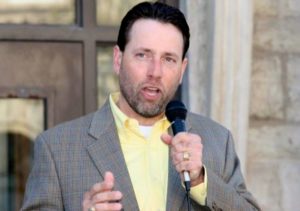
After years in private business, Kurt Ho had finally found a rewarding information technology job, working for a public hospital in Southern California, ensuring vital systems—such as fetal health monitors—were functioning properly.

In October, Ho learned his job at the University of California, San Francisco Medical Center was being outsourced to a company in India, called HCL Technologies.

Ho was told he could stay on the job, get paid for four more months, and earn a bonus if he trained his replacement. Ho’s dream job lasted less than three years.

“I was very surprised because this is a hospital—we are not talking about something you can easily outsource,” Ho, 58, told The Daily Signal in an interview, just a few weeks after his last day of work, Feb. 28. “This is very important work. You are talking about patients’ lives here. So I absolutely want my replacement to do well for the patients and their families, for the doctors—who depend on the service. That’s what we wish for.”

Ho, along with about 80 of his IT co-workers, lost his job as a result of loopholes in a high-skilled visa program—known as H-1B—that allows U.S. companies to fire Americans and replace them with cheaper, temporary workers.

For Ho, that unfortunate designation is not the worst part. Ho is in the prime of his career—competent and able, he says. Facing his 12-year-old daughter is another matter.

“I am trying to get her to go into the STEM program at school, to pursue science and technology like I did,” said Ho, a U.S. citizen who immigrated here from Malaysia in 1989. “But she looks at me and says, ‘They shipped your job to India.’ I am setting a bad example for her. She is discouraged. She says she is thinking about dancing now.”

According to CBS’ “60 Minutes,” which recently profiled another University of California, San Francisco Medical Center employee who lost his job, outsourcing the IT work could save $30 million for taxpayers over the next five years. The state-run university has a $5.9 billion annual budget.

Becoming a ‘Cheap Labor Program’

Experts say most companies use H-1B visas properly—to employ highly-skilled foreign guest workers in sectors Americans cannot fully serve. But stories of abuse, such as Ho’s, have inspired a bipartisan coalition in Congress, and the president, to push for reform.

On Tuesday, President Donald Trump signed an executive order that he said would make it harder for technology companies to replace American workers with cheap foreign labor.

“Right now, widespread abuse in our immigration system is allowing American workers of all backgrounds to be replaced by workers brought in from other countries to fill the same job for sometimes less pay,” Trump said during an appearance in Kenosha, Wisconsin, where he announced the new order. “This will stop.”

His executive order calls for an adjustment in how H-1B visas are distributed, but stops short of mandating specific policy changes. Trump directs government agencies to suggest changes “as soon as practicable” that would ensure the visas are awarded to “the most skilled and the highest-paid” applicants.

Currently, the H-1B program is capped at 85,000 visas distributed annually—with 65,000 general visas and 20,000 reserved for workers with a master’s degree or higher—but demand regularly exceeds supply. On Monday, U.S. Citizenship and Immigration Services announced it received 199,000 petitions this year for visas, which are distributed at random through a lottery. The visas last for three years, and can be renewed for three more years.

“The H-1B program is filling a need—there are critical skills we can get abroad that aren’t always available in the U.S.,” said David Kreutzer, a senior research fellow focused on labor and trade at The Heritage Foundation. “But we want the employers that have the greatest need for the rarest skill sets to be the ones to get these visas. The current lottery mechanism, where visas are allocated by random chance, does not do that.”

In another reform announced earlier this month, the Trump administration announced that U.S. Citizenship and Immigration Services will closely investigate employers with a high ratio of H-1B workers compared to American employees, and businesses that send visa holders to work off-site.

Experts interpret Trump’s measures against the H-1B program as explicitly targeting outsourcing companies that have come under the most scrutiny, and taken advantage of a loophole in the law that allows them to pay foreigners a minimum of $60,000.

Research compiled by Howard University associate professor Ron Hira shows that in 2014—the last year for which information is publicly available—all of the top 10 and 15 of the top 20 H-1B employers used the program principally to facilitate offshoring of jobs.

The top 13 outsourcing firms accounted for a third of all granted visas in 2014.

Indian outsourcing companies such as Infosys, Tata Consultancy Services, and Wipro receive most of the visas through the lottery system because they submit tens of thousands of applications to better their odds, Hira says.

“The intent of the program is a good one—to bring in the best and brightest to fill skills gaps, but the rules are so loosely written and loosely enforced that it’s basically gone off the rails, and it almost invites firms to come in and favor H-1B visa holders instead of the U.S. worker,” Hira, who studies the H-1B program, told The Daily Signal in an interview. “It’s highly profitable to replace a U.S. worker for a H-1B visa holder. It was never intended as a cheap labor program, but it’s become that.”

India’s leading technology trade group, the National Association of Software and Services Companies, says Indian companies are being unfairly targeted.

“We believe that the current campaign to discredit our sector is driven by persistent myths, such as the ideas that H-1B visa holders are ‘cheap labor’ and ‘train their replacements,’ neither of which is accurate,” the group said in a statement after Trump announced his executive order.

How H-1B Came to Be

The H-1B visa program came to life as part of an immigration reform package signed into law in 1990 by President George H.W. Bush. The law’s sponsors viewed it as a vehicle to attract top talent to America for “specialty occupations” such as science, technology, engineering, and math that face a shortage of capable U.S. workers.

Supporters of the program note that nearly every major high-tech company, including Apple, Google, and Facebook, rely on H-1B visas, and pay higher wages.

“Most companies use the H-1B very situationally,” said William Stock, president of the American Immigration Lawyers Association, in an interview with The Daily Signal. “They use it often because they don’t have another choice.”

The law, as it was originally written, was supposed to protect American workers.

It requires employers to pay foreign workers the area’s prevailing wage for the position, and to demonstrate that hiring foreigners would not “adversely affect” the working conditions of current employees in similar jobs.

An amended version of the law, enacted in 1998, included stronger protections, ordering companies that rely heavily on H-1B workers (more than 15 percent of their workforce) to promise not to replace American employees.

Yet, the amended law included a loophole. It allows H-1B reliant companies to be exempted from the requirements about protecting American jobs if they pay the foreign workers at least $60,000 a year, or hire a foreign worker with a master’s degree.

“The wage floor is way too low—the average IT worker in the U.S. makes way more than $60,000 per year,” said Hal Salzman, a labor force expert at Rutgers University, in an interview with The Daily Signal. “One simple reform to the program would be to take these tech companies at their word that there is a strong demand for high-skilled, world-class talent. Everyone would agree that the wage level for those jobs is at least $100,000, so you make that the salary floor, and for all practical purposes, the problem is solved.”

Stock contends that many companies who use the H-1B program are already paying above market wages, and requiring them to spend more could cause them to offshore more work permanently.

“Businesses want to make sure the wage test doesn’t become so onerous that it’s unrealistic,” Stock said. “Limitations on H-1Bs will drive more workers overseas. Sure, there is abuse within the program. That happens. We live in a fallen world. We have always said robust enforcement of labor standards that are already in place is the solution to those abuses.”

‘The Program at Its Best’

Bipartisan pressure to reform the H-1B visa program remains.

Experts say that Trump’s executive order will have limited practical impact, unless Congress steps in.

For example, changes in the number of visas awarded annually would need congressional approval.

Multiple bills have been introduced in Congress that would fundamentally change how visas are distributed, and who benefits from foreign work.

Rep. Ro Khanna, D-Calif., an Indian-American who represents Silicon Valley, has a personal stake in fixing the H-1B program.

Khanna, a freshman lawmaker, is one of the sponsors of a bill, called the H-1B and L-1 Visa Reform Act, that would eliminate the lottery system that rewards visas and replaces it with a “preference system.”

Under the legislation, which is also sponsored by Rep. Dave Brat, R-Va., of the conservative House Freedom Caucus, foreign students educated in the U.S. would get priority for visas. It would give special preference to those holding advanced degrees who would be paid a high wage and have valuable skills.

In addition, the proposal would not allow companies with more than 50 employees to hire more H-1B workers if 50 percent of their employees are already on H-1B and L-1s—another type of specialized work visa. Sens. Chuck Grassley, R-Iowa, and Dick Durbin, D-Ill., have introduced an identical bill.

“My sense is most Americans appreciate the contribution immigrants make to the workforce, they just don’t want the system gamed,” Khanna told The Daily Signal in an interview. “But under the H-1B program today, the beneficiaries are corporate interests. A lot of the H-1B workers are facing exploitation. The empathy is as much for them as the American workers who are getting the raw deal. The program at its best is for truly exceptional people to innovate and not as a way of underpaying foreign workers.”

Ho, the American who lost his job to a contracted Indian worker, said he too does not blame the H-1B visa holder.

“I am an immigrant myself; I would be the last person to bash immigrants,” Ho said. “The person who replaced me is taking advantage of an opportunity a broken system provides him.”

Last week, Ho landed another job, working for Robert Half International, a California-based information technology company.

“I have the skills, so getting work wasn’t an issue for me,” Ho said. “This is about taking a stand, not just for myself, but for my daughters, for my family, and for all Americans.” (For more from the author of “Trump Restricts Immigration Program That Took This American’s Job” please click HERE)

Follow Joe Miller on Twitter HERE and Facebook HERE.

11 Ways Trump Has Rolled Back Government Regulations in His First 100 Days

As President Donald Trump reaches his 100th day in the White House on April 29, he will have worked with Congress to rescind more regulations using the Congressional Review Act than any other president.

“We’re excited about what we’re doing so far. We’ve done more than that’s ever been done in the history of Congress with the CRA,” Rep. Doug Collins, R-Ga., told The Daily Signal in an interview, referring to the law called the Congressional Review Act.

The Congressional Review Act, the tool Trump and lawmakers are using, allows Congress to repeal executive branch regulations. Once the House and Senate pass a joint resolution disapproving of a particular regulation, the president signs the measure.

Passed in 1996 in concert with the Small Business Regulatory Enforcement Fairness Act and then-Speaker Newt Gingrich’s Contract with America reform agenda, the Congressional Review Act is what the Congressional Research Service calls “an oversight tool that Congress may use to overturn a rule issued by a federal agency.”

The law also prevents agencies from creating similar rules with similar language.

Until this year, the law had been used successfully only once—in 2001, when Congress and President George W. Bush rescinded a regulation regarding workplace injuries promulgated by the Occupational Safety and Health Administration during the Clinton administration.

Here’s a look at the 11 regulatory rollbacks Congress has passed and Trump has signed:

1. Regulations governing the coal mining industry (H.J. Res 41).

Mandated by President Barack Obama and finalized in 2016, these regulations “threatened to put domestic extraction companies and their employees at an unfair disadvantage,” White House press secretary Sean Spicer said.

The resolution, signed by Trump in February, repealed the rule and “could save American businesses as much as $600 million annually,” Spicer said.

2. Regulations defining streams in the coal industry (H.J. Res 38).

“Complying with the regulation would have put an unsustainable financial burden on small mines,” Spicer said.

The so-called Stream Protection Rule included “vague definitions of what classifies as a stream,” Nick Loris, a fellow in energy and environmental policy at The Heritage Foundation, told The Daily Signal in an email, and undoing it does away with ambiguities:

For many regulations promulgated by the Obama administration, they fundamentally disregarded the nature of the federal-state relationship when it comes to energy production and environmental protection.

The Stream Protection Rule … removed flexibility from mining steps and simply ignored that states have regulations in place to protect water quality. State and local environmental agencies’ specific knowledge of their region enables them to tailor regulations to promote economic activity while protecting the habitat and environment.

3. Regulations restricting firearms for disabled citizens (H.J. Res 40).

This rule, finalized during Obama’s last weeks in office, sought to “prevent some Americans with disabilities from purchasing or possessing firearms based on their decision to seek Social Security benefits,” Spicer said.

The repeal protects the Second Amendment rights of the disabled, Senate Judiciary Chairman Sen. Chuck Grassley, R-Iowa, said.

“Those rights will no longer be able to be revoked without a hearing and without due process. It will take more than the personal opinion of a bureaucrat,” Grassley said on the Senate floor.

But Rep. Mike Thompson, D-Calif., said the regulation didn’t cover “just people having a bad day,” adding:

These are not people simply suffering from depression or anxiety. These are people with a severe mental illness who can’t hold any kind of job or make any decisions about their affairs. So the law says very clearly they shouldn’t have a firearm.

4. A rule governing the government contracting process (H.J. Res. 37).

Undoing the regulation will cut costs to businesses and free federal contractors from “unnecessary and burdensome processes that would result in delays, and decreased competition for federal government contracts,” Spicer said.

5. A rule covering public lands (H.J. Res. 44).

The rule gave the federal government too much power “to administer public lands,” in the words of the official website of House Majority Leader Kevin McCarthy, R-Calif.

Sen. Mike Lee, R-Utah, told The Daily Signal in an interview that the Bureau of Land Management’s rule restricted the control that states and their citizens had, especially in the West.

“The Obama administration wanted to shift land policy from local governments with specific expertise to the federal government, basically shifting even more of the land management policy away from those affected by it,” Lee said.

“Repealing this harmful rule will go a long way toward empowering local stakeholders and ensuring that Arizona’s cattlemen, miners, and rural land users have a voice in the planning process,” Sen. Jeff Flake, R-Ariz., said in prepared remarks.

6. Reporting requirements regarding college teachers (H.J. Res. 58).

The rule mandated annual reporting by states “to measure the performance and quality of teacher preparation programs and tie them to program eligibility for participation in the Teacher Education Assistance for College and Higher Education grant program,” Spicer said.

Anne Ryland, a research assistant in education policy at The Heritage Foundation, told The Daily Signal in an email that the rule “gave the federal Department of Education power to evaluate teacher preparation programs at universities, and to link college students’ access to federal financial aid in the form of TEACH grants to the rating of the programs.”

“University programs,” Ryland added, “would be rated based on the effectiveness of their teaching graduates, with effectiveness determined by elementary and secondary students’ test scores and achievement gains.”

7. Regulations on state education programs (H.J. Res. 57).

Congress and Trump rescinded federal rules that “require states to have an accountability system based on multiple measures, including school quality or student success, to ensure that states and districts focus on improving outcomes and measuring student progress,” Spicer said.

The repeal is the first step in “a reconceptualization of Washington’s role in education,” Ryland said.

“These regulations were prime examples of federal micromanagement,” she said. “They were highly prescriptive and highly complex, serving only to put more power in the hands of bureaucrats and to distract schools and teachers from the work of educating students.”

8. Drug-testing requirements (H.J. Res 42).

Spicer said the regulation mandates an “arbitrarily narrow definition of occupations and constrains a state’s ability to conduct a drug-testing program in its unemployment insurance system.”

Four Republican governors—Scott Walker of Wisconsin, Greg Abbott of Texas, Gary Herbert of Utah, and Phil Bryant of Mississippi—wrote Rep. Kevin Brady, R-Texas, chairman of the House Ways and Means Committee, to ask that states be allowed to implement their own policies.

“We believe this rule should be replaced with a new rule that allows increased flexibility for states to implement … drug testing that best fits the needs of each state,” the governors said in the February letter.

9. Hunting regulations for wildlife preserves in Alaska (H.J. Res 69).

These regulations restricted Alaska’s ability “to manage hunting of predators on national wildlife refuges in Alaska,” Spicer said.

In a formal statement, Rep. Liz Cheney, R-Wyo., daughter of former Vice President Dick Cheney, called the rule “another example of the federal government’s determination these past eight years to destroy a state’s ability to manage their wildlife.”

10. Internet privacy rule (S.J.Res. 34).

Published during the final months of Obama’s presidency, the rule sought to force “new privacy standards on internet service providers, allowing bureaucrats in Washington to pick winners and losers in the industry,” Spicer said.

Flake, who sponsored the resolution of disapproval under the Congressional Review Act, said repeal helps keep consumers in charge of how they share their electronic information.

“My resolution is the first step toward restoring the [Federal Trade Commission’s] light-touch, consumer-friendly approach,” Flake said. “It will not change or lessen existing consumer privacy protections. It empowers consumers to make informed choices on if and how their data can be shared.”

11. Rule for logging workplace injuries (H.J. 83).

This rule from the Occupational Safety and Health Administration sought to squelch a more lenient one from the Labor Department. Spicer said the rule “disapproved” of a Labor regulation “extending the statute of limitation for claims against employers failing to maintain records of employee injuries.”

“This OSHA power grab was completely unlawful,” said Rep. Bradley Byrne, R-Ala., chairman of the House workforce protections subcommittee. “It would have done nothing to improve workplace safety while creating significant regulatory confusion for small businesses.”

Through extensive use of the Congressional Review Act, Collins said, Trump is establishing a “legacy” of deregulation.

“I think there’s really a legacy really to be had here,” the Republican congressman from Georgia said.

Congress, with backing from Trump, is making good on promises and saying, “We’re not going to allow our jurisdiction and our constitutional authority to be overrun by the executive branch,” Collins said.

Past administrations from both parties, he said, have not been so devoted to deregulation.

“There was a definite disconnect between the previous administration, and even previous Republican administrations, on doing things on their own and not going through the proper legislative process,” Collins said. (For more from the author of “11 Ways Trump Has Rolled Back Government Regulations in His First 100 Days” please click HERE)

Follow Joe Miller on Twitter HERE and Facebook HERE.

Trump, Sessions Target MS-13 Gang in Push Against Illegal Immigration

President Donald Trump’s administration has initiated an effort to target MS-13, an international criminal gang with El Salvador roots and a presence in many U.S. cities.

Trump, Attorney General Jeff Sessions, and Homeland Security Secretary John Kelly have all recently mentioned the gang by highlighting its dangers and explaining how they will combat the group.

In a Tuesday tweet, Trump blamed the Obama administration’s “weak illegal immigration policies” for MS-13’s increase in size and strength. He also noted that he plans to remove members of the gang “fast.”

In a Fox News interview with host Tucker Carlson this week, Sessions echoed Trump’s point by casting blame on MS-13’s growth on the previous administration, saying, “It’s no doubt that [the Obama administration] had an impact because so many of these [gang members] are illegally here without proper authority, and with a good, lawful border, they would not be here.”

He also said the gang has grown to 10,000 members in America.

Sessions said before a meeting with the Organized Crime Council—a coalition of 13 federal agencies:

Because of an open border and years of lax immigration enforcement, MS-13 has been sending both recruiters and members to regenerate gangs that previously had been decimated, and smuggling members across the border as unaccompanied minors … They are not content to simply ruin the lives of adults—MS-13 recruits in our high schools, our middle schools, and even our elementary schools.

To counter the illegal immigration problem, Sessions said the government will build a border wall and recruit more border agents.

“We can devastate this gang. We’re going after them. We are not going to allow them to take over a block, a corner of our communities and terrorize people with this violence,” Sessions said.

“[MS-13 gang members] are not geniuses … they are involved in the kind of activities that can be identified and they can be prosecuted,” he added.

Sessions also praised “Trump’s leadership,” to which he said contributed to this year’s 17-year low in illegal immigration, and claimed that the president is focused on putting a stop to “this lawlessness.”

Additionally, Sessions made a comment to those who wish to enter America legally: “What we want to say to the world is: Please come lawfully. Wait your turn, make your application, and it will be evaluated. And if you’re accepted, come. But don’t come illegally.”

“That’s what the American people have a right to expect their government to do. And in the process we can protect them from some of the violent criminals and terrorists that are coming in,” he said.

Kelly also came out to publicly condemn the gang, calling MS-13 a group “utterly without laws, conscience, or respect for human life.”

Hans von Spakovsky, a senior legal fellow for the Institute for Constitutional Government at The Heritage Foundation, said he views the Trump administration’s targeting of MS-13 as a focus on law and order that voters desire.

“This is the type of vigorous law enforcement the American people clearly voted for in November,” von Spakovsky said.

“Since most MS-13 gang members are illegal aliens, the administration’s reinvigoration of immigration enforcement will also help alleviate and destroy this problem that is endangering neighborhoods all over America,” he added. (For more from the author of “Trump, Sessions Target MS-13 Gang in Push Against Illegal Immigration” please click HERE)

Follow Joe Miller on Twitter HERE and Facebook HERE.

Trump Sees No Role for U.S. In Stabilizing Libya

President Donald Trump said Thursday that he does not see the U.S. playing a role in helping to stabilize Libya, because the U.S. has enough roles right now.

“I do not see a role in Libya. I think the United States has right now enough roles. We’re in a role everywhere, so I do not see that,” Trump said when asked if he sees a role for his administration in helping to stabilize Libya and if stabilizing Libya means combating terrorism and ISIS.

“I do see a role in getting rid of ISIS. We’re being very effective in that regard. We are doing a job, with respect to ISIS, that has not been done anywhere near the numbers that we’re producing right now. It’s a very effective force we have. We have no choice. It’s a horrible thing to say, but we have no choice,” the president said in a joint press conference with Italian Prime Minister Paolo Gentiloni at the White House.

Trump said he considers getting rid of ISIS the United States’ primary role.

“And we are effectively ridding the world of ISIS. I see that as a primary role, and that’s what we’re going to do, whether it’s in Iraq or in Libya or anywhere else, and that role will come to an end at a certain point, and we’ll be able to go back home and rebuild our country, which is what I want to do,” he said. (Read more from “Trump Sees No Role for U.S. In Stabilizing Libya” HERE)

Follow Joe Miller on Twitter HERE and Facebook HERE.
Professor Paints Picture of Trump’s Decapitated Head, Puts It on Display at Alaska College

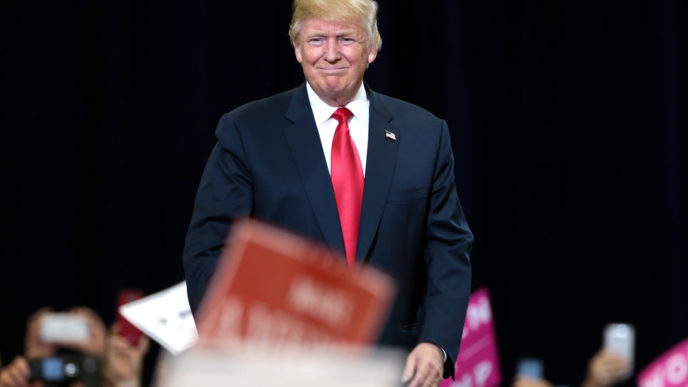
A professor at an Alaska university has put a painting of President Donald Trump’s decapitated head on display at the college art gallery.

Thomas Chung, assistant professor of painting at the University of Alaska Anchorage, painted a portrait of a “Captain America” actor holding Trump’s severed head with two eagles to his side and a young Hillary Clinton holding onto the actor’s leg, KTUU reported.

“I was reminded of those ’80s rock posters,” said Chung, “where there’s a woman in tattered clothes clinging to a strong male hero’s leg.”

The professor explained that the 2016 presidential election results influenced his painting.

“After Trump was elected, I spent days just weeping,” the professor said. “And it was really surprising, because I’m not a political person. I am a social artist. I deal mostly in ideals of culture and global culture, but this election bled into that.” (For more from the author of “Professor Paints Picture of Trump’s Decapitated Head, Puts It on Display at College” please click HERE)

Follow Joe Miller on Twitter HERE and Facebook HERE.
Trump to Announce ‘Tremendous Things’ for Veterans Health Care

Some veterans organizations don’t think a bill President Donald Trump signed Wednesday expanding private care options for veterans goes far enough.

Trump seemed to agree, which is why he said more announcements are coming next week regarding veteran care.

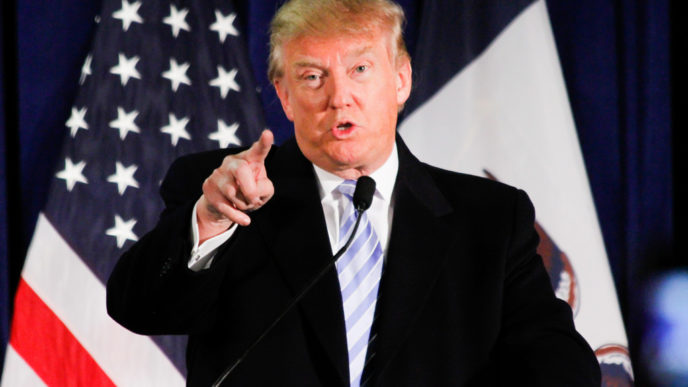
“There is still much work to do. We will fight each and every day to deliver the long-awaited reforms our veterans deserve and to protect those who have so courageously protected each and every one of us,” Trump said in the Roosevelt Room Wednesday after signing the Veterans Choice Program Extension Act.

The bill allows veterans to get private health care treatment outside the Department of Veterans Affairs system, but it will still be paid for by the VA.

Trump said he and Veterans Affairs Secretary David Shulkin will announce more steps to improve veterans’ health care at a press conference on April 27. The press conference, highlighting one of his key issues, comes near Trump’s 100-day mark since taking office.

“We’re going to have a news conference with David and some others to tell you about all of the tremendous things that are happening at the VA, what we’ve done in terms of progress and achievement,” Trump said.

Trump made improving health care for veterans a major theme during his 2016 presidential campaign.

Trump’s signing extends a law that was about to sunset, put in place as an emergency response to the VA waiting list scandal that first came to light in 2013, when veterans were often denied care, and in some cases even died.

“The veterans have poured out their sweat and blood and tears for this country for so long and it’s time that they are recognized and it’s time that we now take care of them and take care of them properly,” Trump said.

Trump noted the legislation allows veterans to see “the doctor of their choice” without being required to travel a long distanced to receive care.

“It’s not going to happen anymore,” Trump said.

This is only a good first step, said Mark Lucas, the executive director of Concerned Veterans for America, who attended the signing ceremony.

“The Choice Program was passed as a quick fix to the wait list manipulation scandal that broke three years ago, and while it’s helped, too many veterans still are forced to seek care at failing VA facilities,” Lucas said in a public statement. “Congress now has some time to work with Secretary Shulkin on broader, more permanent choice reforms that will truly put the veteran at the center of their health care and remove VA bureaucrats as the middlemen.”

The Choice Program was initially created by the Veterans Access, Choice, and Accountability Act of 2014. It provided the VA an additional $10 billion in emergency funding to expand veterans’ access to care, but came with a three-year sunset clause. That meant the VA had to either use or lose the $1 billion remaining.

The new bill that Trump signed into law on Wednesday addressed some issues that veteran groups such as Veterans of Foreign Wars had expressed concerns about. The new law eliminates the secondary payer requirement, clarifying that VA is the payer of care, not veterans. It also makes it easier to share medical documentation with Choice Program providers, so veterans don’t have to face unnecessary delays when scheduling appointments.

Though more announcements are coming at next week’s press conference, the VA secretary didn’t want to minimize the new law.

“This is a good day for veterans,” Shulkin said at the Roosevelt Room signing ceremony. “This is a great day to celebrate not only what veterans have contributed to this country but how we are making things better for them, and by working together, we’re going to continue this progress.”

Also, attending the event were Senate Armed Services Chairman John McCain, R-Ariz., and Senate Veterans Affairs Chairman Johnny Isakson, R-Ga., as well as Florida Gov. Rick Scott and House Veterans Affairs Chairman Phil Roe, R-Tenn. (For more from the author of “Trump to Announce ‘Tremendous Things’ for Veterans Health Care” please click HERE)

Follow Joe Miller on Twitter HERE and Facebook HERE.

‘America First’ Does Not Mean ‘America Only’

During the presidential campaign when Donald Trump spoke of putting “America first,” I never thought he meant “America only.” It appears that others understood him quite differently. They are not happy with his overseas actions. As summed up by Ann Coulter, “We want the ‘president of America’ back — not ‘the president of the world.’”

Of course, Coulter, along with other Trump loyalists like Paul Joseph Watson, Laura Ingraham, and Mike Cernovich, were not upset because the president bombed another country. They were upset because he bombed Syria after saying for years that we should stay out of there.

They felt betrayed and double-crossed.

They also felt that any American intervention in Syria was unwise, especially if it led to an attempt to remove Assad.

But we did not only bomb Syria. We sent warships to North Korea, warning the demented dictator of that country to behave, or else.

For Coulter, this means that Trump has already become a pawn of the Washington establishment. As she wrote:

Looking for some upside to this fiasco, desperate Trump supporters bleated that bombing Assad had sent a message to North Korea. Yes, the message is: The Washington establishment is determined to manipulate the president into launching counterproductive military strikes. Our enemies — both foreign and domestic — would be delighted to see our broken country further weaken itself with pointless wars.

What, then, are we to make of this? Has Trump caved in to the establishment already? Has he abandoned his pledge to put “America first”?

Nothing Unique About Trump’s ‘America First’ Promise

On the larger question of President Trump and the Washington establishment, time will tell. The same can be said about which direction the president will go. Will it be the way of Jared Kushner or will it be the way of Steve Bannon (a dramatic oversimplification)? Only time will tell.

But when it comes to Trump’s bombing of Syria and standing up to North Korea, I see no contradiction between these actions and “America first.” There is nothing exceptional with the elected leader of a country saying that they intend to put the interests of their country first. But of course! (For more from the author of “‘America First’ Does Not Mean ‘America Only'” please click HERE)

Follow Joe Miller on Twitter HERE and Facebook HERE.
Professor Who Tweeted ‘Trump Must Hang’ Takes Paid Leave of Absence

The professor who tweeted “Trump must hang” and that two Republicans should be executed for each immigrant deported is taking a paid leave of absence for the rest of the spring semester.

Professor Lars Maischak of California State University, Fresno agreed upon the leave of absence with the university, according to The Fresno Bee.

The professor’s paid leave of absence comes after The Daily Caller News Foundation reported on threatening tweets sent from his Twitter account (since deleted), including the following:

Daily-Caller-Lars-Maischak-5-620x474

Maischak’s five American history courses will be taught by a substitute teacher. Fresno State Provost Lynnette Zelezny told The Fresno Bee that 213 students will be affected.

“The agreement for the paid leave was reached in accordance with provisions in the collective bargaining agreement with the California Faculty Association, the union that represents all faculty,” said Joseph Castro, Fresno State’s president, in a statement obtained by The Fresno Bee. “During his leave of absence, Dr. Maischak will no longer have a teaching role, but will be conducting research off campus.” (Read more from “Professor Who Tweeted ‘Trump Must Hang’ Takes Paid Leave of Absence” HERE)

Follow Joe Miller on Twitter HERE and Facebook HERE.
Trump’s Disappointing Flip-Flop on the Export-Import Bank

President Donald Trump has apparently changed his mind about eliminating the crony Export-Import Bank, opting to “reform” the swamp rather than drain it.

As bad as this flip-flop is, his excuses for doing so are downright pitiful.

As a candidate in August 2015, Trump categorized the bank as “feather bedding,” adding, “I don’t like it. I think it’s a lot of excess baggage. I think it’s unnecessary. And when you think about free enterprise, it’s really not free enterprise.”

He was right, of course, but that was then.

On Friday, the president announced his intention to nominate former New Jersey Rep. Scott Garrett as bank president and former Rep. Spencer T. Bachus III to the Ex-Im board.

If the two are confirmed, the bank will return to full operation after 21 months without a board quorum—which prohibited deals exceeding $10 million.

And that means billions of taxpayer dollars to foreign firms and foreign governments with which to purchase exports from favored multinational companies such as Boeing, General Electric, and Caterpillar.

The best course of action would be to eliminate the bank altogether. There is no shortage of private export financing, and the subsidies distort credit and labor markets.

Perhaps worst of all, unsubsidized American companies are placed at a competitive disadvantage compared to the foreign firms collecting Ex-Im subsidies. (Delta, for example, loses out when Air India gets a sweetheart deal from Boeing by way of Ex-Im.)

A Meritless Flip-Flop

The White House is making much of the fact that Garrett has been a critic of Ex-Im, twice voting against renewal of the bank charter. That supposedly portends reform, although Congress has previously tried to do so without appreciable effect.

No amount of bureaucratic tinkering can shield taxpayers from bailouts in the event that bank reserves run dry—as occurred in the 1980s—nor protect American businesses from the disadvantages of the U.S. government subsidizing their foreign competitors.

In an April 12 interview with The Wall Street Journal, Trump acknowledged that he had been “very much opposed” to the bank but changed his mind because “lots of small companies will really be helped.

“But also maybe more importantly,” he said, “other countries give it, and … we lose a tremendous amount of business.” He also added, “So instinctively you would say it’s a ridiculous thing but actually it’s a very good thing and it actually makes money. You know, it actually could make a lot of money.”

All of which is nonsense.

Bank proponents focus on small firms to deflect attention from the fact that the vast majority of Ex-Im beneficiaries are titans of industry that are well-positioned to prosper without Ex-Im subsidies.

They do not lack access to private capital, and most have billions of dollars of backorders with which to keep production going.

In recent years, the bank supported less than half of 1 percent of small businesses—which in many cases aren’t so small.

(The bank’s definition of “small business” includes manufacturers with as many as 1,500 employees and service firms and retailers with as much as $20.5 million in annual revenues.)

On their own, businesses with fewer than 500 employees account for 98 percent of all firms exporting goods, and exports have reached high levels in recent years. In fiscal year 2016, for example, U.S. exports totaled $2.2 trillion, with Ex-Im supporting just 0.22 percent ($5 billion).

That makes one thing very clear: Export financing obviously is not a problem for small firms in the aggregate.

This is further validated by the fact that small businesses ranked “Exporting My Products/Services” as the least problematic of 75 business problems assessed in the 2016 annual survey by the National Federation of Independent Business Research Foundation.

(The cost of health care ranked as the most severe problem. The president would do well to focus on that rather than resuscitate Ex-Im.)

In the event that a small business cannot access private capital, it can seek to export through wholesalers or associate its business operations with larger firms or with global supply chains.

The real beneficiaries are the big boys like Boeing (market cap $110 billion), and the extent to which the bank caters to the company is staggering.

As of March 2014, at least 28 percent ($32 billion) of Ex-Im’s total portfolio was devoted to financing wide-body jets. In 2013, the bank authorized financing for the purchase of Boeing aircraft in 25 countries, including China, Russia, and the United Arab Emirates.

Subsidies for air transport, in general, comprised more than 45 percent of all export subsidies that year.

General Electric (market cap $256 billion) is another top Ex-Im beneficiary. The company began 2017 with a record backlog of $321 billion. Likewise, Caterpillar (market cap $54 billion) posted a backlog of $12 billion at the end of 2016.

Ex-Im Doesn’t ‘Level the Playing Field’

The claim that U.S. companies will lose sales to foreign competitors without Ex-Im financing is also drivel.

Economist Veronique de Rugy of the Mercatus Center has documented that only about a third of Ex-Im financing—which benefits just 2 percent of all U.S. exports—is designated in bank records as necessary to counter subsidized foreign competition.

A whopping 66 percent of the financing classified as necessary to counteract foreign competition went to Boeing.

In other words, Ex-Im Bank financing counteracts foreign subsidies for less than 1 percent of U.S. exports—with more than half the benefit accruing to Boeing.

Finance costs are only one among a variety of factors that affect a purchaser’s choice of supplier. Availability, reliability, and stability all play significant parts in purchase decisions. There should be no question that U.S. firms are capable of competing successfully without corporate welfare.

The claim of “competitive disadvantage” is further belied by the agreement among 31 member countries of the Organization for Economic Cooperation and Development to abide by a set of financing rules covering loan term limits, minimum fees, and other practices.

There is rarely such a thing as a “level playing field” in trade. Every country has advantages that others lack.

The ingenuity and drive of American companies can, in many instances, trump the export subsidies doled out by foreign governments—assuming, of course, that tax and regulatory barriers do not further restrict free enterprise.

It is silly for Ex-Im advocates to cite China’s massive subsidies as proof that Ex-Im is necessary. Do they really want America to emulate a country in which all the largest enterprises are owned by the state?

As reported in The Wall Street Journal, almost 14 percent of China’s listed, nonfinancial companies’ profits are attributable to government support, according to an analysis by Wind Info.

And let’s not forget that Trump campaigned on challenging China’s trade practices. He cannot now claim with any credibility that we must match its subsidies to stay competitive.

An Anti-Market Institution

Perhaps most disappointing, though, is the president’s defense of Ex-Im based on its potential to “make money.” That statement, out of all his others, insults the very concept of free enterprise and limited government.

By that rationale, Washington should assume control of all profitable companies to feed its insatiable appetite for spending.

In any event, the claim that Ex-Im is profitable is illusory: The bank uses “accrual” accounting, which does not factor in the risk of defaults related to bank financing.

For example, under current accounting methods, bank officials claim that Ex-Im will return a $14 billion surplus to taxpayers in the next decade.

But the Congressional Budget Office reported in 2014 that Ex–Im programs, if subjected to the fair value accounting methods required of private banks, actually operate at a deficit that will cost taxpayers some $2 billion over 10 years (in addition to the bank’s operating costs).

Ex-Im advocates offer myriad excuses for maintaining government interference in export financing, including job creation, gaps in private investment, and government subsidies lavished on foreign firms.

Such justifications do not stand up to the facts, and the purported benefits—if any—are not commensurate with the risk to taxpayers.

The president has made a huge mistake on Ex-Im, but it isn’t too late for him to change direction—back to where he was in the first place. (For more from the author of “Trump’s Disappointing Flip-Flop on the Export-Import Bank” please click HERE)

Follow Joe Miller on Twitter HERE and Facebook HERE.
Since When Did Trump Start Embracing Obamacare’s Illegal Subsidies?

The Republican Party has become one giant scam PAC. When they are out of power they boldly declare Democrat policies to be illegal and unconstitutional, yet when they get into power they continue the same policies. We’ve already seen this with the Iran treaty and Obama’s executive amnesty, which are still being recognized and enforced by this administration. Now we are facing the same dilemma with the illegal cost-sharing subsidies for Obamacare. It’s one thing to phase out harmful policies over time, but when it comes to illegal executive actions how can they continue administering them for even one day?

Obamacare’s regulations are so crippling and actuarily insolvent that the individual mandate and the open-needed subsidies given to consumers have done nothing to fix the health care problem. In fact, they have only further distorted the market and increased prices. To that end, the Obama administration, in one of the most lawless decisions of a lawless presidency, decided to create an additional layer of subsidies outside of statute to be given directly to insurers. One of those subsidies — referred to as cost-sharing reductions — reimbursed insurers for discounting co-payments and deductibles for low-income enrollees (the premiums were subsidized by the main Obamacare payouts).

The problem with this program, aside from further inflating the cost for those who aren’t subsidized, is that it’s completely unconstitutional. The Obama administration paid insurers billions of dollars outside of an appropriation from Congress. CBO projects that under current policy, this illegal program will cost $130 billion over 10 years.

Last year, in House v. Burwell, the GOP-led House sued Obama for creating his own slush fund without Congress. In a rare victory and through the prism of a legitimate exercise of judicial power — interpreting instead of nullifying a statute — Judge Rosemary Collyer sided with House Republicans in asserting that the cost-sharing subsidies were appropriated without consent of Congress.

One would expect that the minute Tom Price took over HHS, the unconstitutional subsidies would vanish. One would also expect Trump’s lawyers to immediately drop the previous administration’s appeal to the U.S. Court of Appeals for the District of Columbia Circuit regarding the constitutionality of those subsidies, right?

Not so fast.

The administration has declined to drop the appeal of the district court’s ruling, and is in fact continuing to offer the subsidies. Thus, what Republican universally regarded as unconstitutional when they were out of power, they are now administering — much like they are illegally handing out work permits to illegal aliens amnestied under Obama.

Some might suggest that Trump is in a lose-lose situation because now that Obamacare is the law of the land, even more states will be without any insurers if he shuts off the subsidies. Trump himself recognized this predicament in an interview with the Wall Street Journal. The president said that on the one hand he’d love to see the law collapse, but he fears he would be blamed for the collapse instead of the supporters of Obamacare. Even though he didn’t shut off the spigot immediately, he is entertaining the idea of threatening to suspend the cost-sharing as a means of getting the Democrats to the table.

This is a false dichotomy. The president needs to realize that there is a third option: actually repealing Obamacare and demanding that Republicans support him! As leader of the party, rather than bully conservatives into supporting Obamacare 2.0 he should demand that liberal Republicans get with the program and fully repeal the law and actually solve the health care problem. At that point, there won’t be a need for the illegal subsidies, and in fact, they would only further distort the market. Democrats will never have an incentive at this point to buy into any GOP bill. There is only one option.

Donald Trump must harness his populist appeal against big government and the health care industry by immediately suspending the kickbacks for insurers. It is hard to anticipate the actions of the private sector. But by repealing the coverage mandates of Obamacare with a reasonable transition period, and concurrently making it clear that all subsidies and kickbacks are permanently terminated, insurance companies will have no wiggle room other than to utilize the de-regulation to offer a multitude of market-based plans, including catastrophic and limited benefit plans. They would be forced to compete for consumer demand rather than have a monopoly over the small trough of regulated and subsidized plans.

His message should be unambiguous: “we will not regulate you and we will not subsidize you, go out and compete for consumer demand.” Then he should travel the country and rail against a crony socialist health care system that looks like a grocery shelf in Venezuela instead of one in America. He must demand that the liberal Republicans get onboard with full repeal of Obamacare or he risks violating one of his core campaign promises.

Unfortunately, as we are seeing with an array of domestic and foreign policy issues, New York Democrats are pushing the president in the other direction. Noted health care expert, Ivanka Trump, as well as President Kushner and Gary Cohen, are reportedly pushing to keep the subsidies, while Steve Bannon is arguing that we follow the Constitution. Liberal congressional Republicans, such as Rep. Tom Cole, R-Okla., and Sen. Lamar Alexander, R-Tenn., are also pushing for a continuation of the subsidies.

Sensing blood in the water, Democrats are now demanding that the subsidies be codified by Congress in the budget bill. Now that Democrats successfully jettisoned all conservative riders from the budget, why not go on offense and demand their priorities? After all, we can’t have a government shutdown. Now, instead of the battle lines over the budget being drawn over defunding refugee resettlement, Planned Parenthood, and the border wall, we must play defense on the cost-sharing subsidies.

Caving on principle begets more capitulation. There is no way to get around not repealing Obamacare but somehow pretending we are repealing it. The path forward is and always was very simple: full repeal of Obamacare with reasonable transition to what GOP has promised in terms of free market health care — or permanent irrelevance and humiliating electoral defeat. (For more from the author of “Since When Did Trump Start Embracing Obamacare’s Illegal Subsidies?” please click HERE)

Follow Joe Miller on Twitter HERE and Facebook HERE.