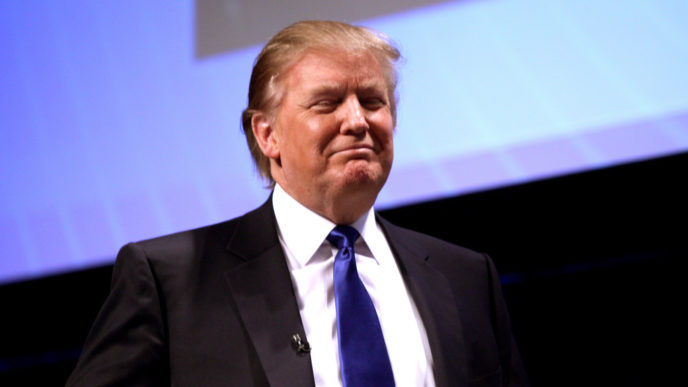
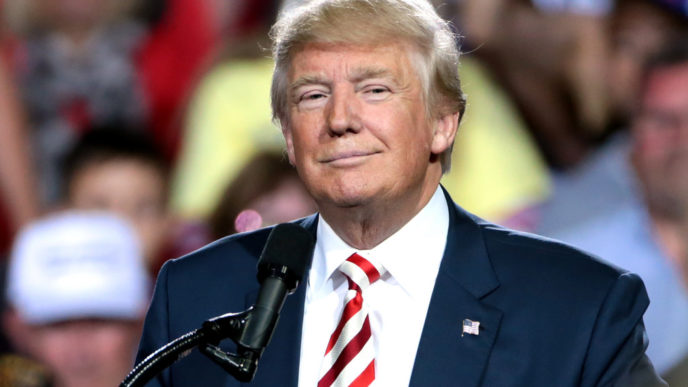
During the Republican primaries, when I was most critical of candidate Trump, I still didn’t believe he was a racist (in general) or an anti-Semite (in particular), yet charges of racism and even anti-Semitism persist against him to this day. After his speech last night, it seems to me that only his most cynical critics can lodge such charges against him. Will you really say that his address to Congress was racist?
Trump’s Praise of Black Leaders and Heroes
Let’s start with black Americans.
He began his speech by saying, “Tonight, as we mark the conclusion of our celebration of Black History Month, we are reminded of our Nation’s path toward civil rights and the work that still remains.”
Was he seeking to get a message across? Quite obviously, he was.
Several minutes later (but still early in his speech), he said, “We’ve financed and built one global project after another, but ignored the fates of our children in the inner cities of Chicago, Baltimore, Detroit — and so many other places throughout our land.”
It is no secret that a disproportionately high percentage of black Americans live in these inner cities, and so here too, he appeared to be sending a message, including this line, a few minutes later, as well: “And our neglected inner cities will see a rebirth of hope, safety, and opportunity.”
And since black Americans suffer disproportionately from poverty and joblessness, were these lines directed their way as well? “Ninety-four million Americans are out of the labor force.” And, “Over 43 million people are now living in poverty, and over 43 million Americans are on food stamps.”
More overtly, he singled out a black American woman, Denisha Merriweather, as an example of the merit of private schools, calling her a “remarkable woman,” noting that she was the first in her family to graduate from college (soon to get her Master’s degree), and stating, “We want all children to be able to break the cycle of poverty just like Denisha.”
His first example of an American killed by an illegal immigrant was a 17-year-old black man, Jamiel Shaw, Jr., “an incredible young man, with unlimited potential who was getting ready to go to college where he would have excelled as a great quarterback. But he never got the chance. His father, who is in the audience tonight, has become a good friend of mine.” (Note also that Trump honored Susan Oliver, a black woman, whose husband Danny, a white man, was a policeman killed by an illegal immigrant.)
Of course, the critics blast Trump as being a hypocritical opportunist, using these individuals to advance his own cause. But for anyone listening with an open heart and mind, the overall impression would be clear: President Trump is reaching out to the African American community and saying, “We are in this together, and I want to help.”
Trump’s Stand Against Anti-Semitism and Hate Crimes
As for the Jewish people, also in his very first lines, Trump referenced “recent threats targeting Jewish Community Centers and vandalism of Jewish cemeteries,” while later stating, “I have also imposed new sanctions on entities and individuals who support Iran’s ballistic missile program, and reaffirmed our unbreakable alliance with the State of Israel.”
Could you imagine an anti-Semite speaking in these ways, mentioning the vandalism of the Jewish cemeteries in his first paragraph, and in the context of civil rights at that?
He also referenced at the outset “last week’s shooting in Kansas City,” where a gunman allegedly yelled “get out my country” before killing one Indian man and wounding another, also wounding a white American who tried to stop him.
In other words, nationalism for Trump does not mean war on immigrants.
As for the immigrants whom he is deporting, Trump said, “we are removing gang members, drug dealers and criminals that threaten our communities and prey on our citizens. Bad ones are going out as I speak tonight and as I have promised.”
Do even the most “progressive” Democrats really want to keep such dangerous people in our country, especially when they are here illegally? And can the president really be accused of being anti-immigrant or, more broadly, anti-Hispanic for saying that such criminals should be deported? For that matter, was President Obama an anti-Hispanic, anti-immigrant racist when he deported 43,000 illegals in 2015?
Trump’s Pledge to Help Protect Peaceful Muslims, Christians from ISIS
As for Islam, Trump could not have been more specific, saying, “We are also taking strong measures to protect our Nation from radical Islamic terrorism,” then proclaiming, “As promised, I directed the Department of Defense to develop a plan to demolish and destroy ISIS — a network of lawless savages that have slaughtered Muslims and Christians, and men, women, and children of all faiths and beliefs. We will work with our allies, including our friends and allies in the Muslim world, to extinguish this vile enemy from our planet.”
Here he made clear that radical Muslim terrorists are “lawless savages” (rather than model Muslims) who “have slaughtered Muslims and Christians, and men, women, and children of all faiths and beliefs,” significantly putting Muslims at the top of this list.
In other words, even though Christians in Islamic lands suffer most acutely at the hands of radical Muslims, while Christians in other countries are often targeted by radical Muslims, the greatest number of casualties of radical Muslims are themselves Muslims. That’s why the president pledged to work with “our friends and allies in the Muslim world, to extinguish this vile enemy from our planet.”
Can you genuinely say that Trump is anti-Muslim (rather than anti-radical Muslim) based on these carefully delivered words?
Hope For a Presidential Future?
He even reached out to women, stating, “With the help of Prime Minister Justin Trudeau, we have formed a Council with our neighbors in Canada to help ensure that women entrepreneurs have access to the networks, markets and capital they need to start a business and live out their financial dreams.” (I’m not saying this removes charges of misogyny or undoes his past, inexcusable comments; I’m simply noting the statement and its purpose.)
Of course, critics like the extreme-left, Islamic congressman Keith Ellison will disparage Trump’s speech, claiming that Trump will say whatever he needs to say to sway public opinion but will not act accordingly. (Notably Ellison, along with DNC Chair Debbie Wasserman Schultz “reportedly remained ‘firmly seated’ while the widow of a slain Navy SEAL received a two-minute standing ovation, according to the Independent Journal Review’s Benny Johnson.”) And, obviously, this was just a speech.
But a speech is designed to accomplish certain goals and to send a certain message, and as far as a speech goes, the goals were clear and the message was clear.
Perhaps some of you who remain implacably opposed to the president will find room for at least a little hope? Perhaps some of you who have accused him of racism (and worse) might be willing to take a second look, give him some benefit of the doubt, and see if his actions match his words? Personally, I think it’s the least you can do.
For supporters of the president, his speech lived up to your expectations and proved that Donald Trump can truly act presidentially.
In the words of John Podhoretz, “In the first 38 days of his presidency, Donald Trump seemed to struggle to find his footing. On his 39th, he found it unexpectedly in a strong, direct and — surprise of surprises — beautifully modulated and spectacularly delivered address before Congress.” (For more from the author of “Please Don’t Tell Me Trump’s Speech to Congress Was Racist” please click HERE)
https://joemiller.us/wp-content/uploads/8567825104_3e647ea1f8_b-3-1.jpg6831024Joe Millerhttps://joemiller.us/wp-content/uploads/logotext.pngJoe Miller2017-03-01 17:59:542017-03-01 17:59:54Please Don’t Tell Me Trump’s Speech to Congress Was Racist
With family members of three Americans killed by illegal immigrants looking on, President Donald Trump on Tuesday night used his address to Congress to bring attention to his plan for an office to help victims of crimes committed by those not authorized to be in the country.
“I have ordered the Department of Homeland Security to create an office to serve American victims,” Trump said in his speech. “The office is called VOICE—Victims of Immigration Crime Engagement. We are providing a voice to those who have been ignored by our media, and silenced by special interests.”
The mention brought audible groans and murmurs from some, apparently Democrats, in the House chamber.
Trump mandated creation of the office as part of an executive order he signed Jan. 25.
But by using part of his prime-time address to highlight this little-known part of the executive order, Trump sent a message as his administration implements a series of tough immigration enforcement measures.
“The idea is to have an office that will assist and advocate for people who have been victims or family members victimized by criminal immigrants,” Jessica Vaughan, director of policy studies at the Center for Immigration Studies, said in an interview with The Daily Signal.
“There is a legitimate need for this kind of office, and they will be busy. I don’t see it as a symbolic or political move at all.”
The Trump administration has provided little information on what exactly the office will do, its budget, or staffing level. On Wednesday, Immigrations and Customs Enforcement (ICE), the agency in the Department of Homeland Security tasked with creating the office, gave few additional details.
“The men and women comprising the VOICE office will be guided by a singular, straightforward mission—to support victims of crime committed by immigration violators through access to information and other resources, as needed,” ICE spokeswoman Jennifer Elzea said in a statement to reporters.
Information, Answers
In memos last week detailing implementation of Trump’s immigration policies, John Kelly, secretary of the Department of Homeland Security, wrote that victims of crime committed by illegal immigrants “are often not provided adequate information about the offender, the offender’s immigration status, or any enforcement action taken by ICE against the offender.”
Kelly said ICE will appoint a liaison to “facilitate engagement with the victims and their families to ensure they are provided information about the offender and that their questions and concerns regarding immigration enforcement are addressed.”
Little published data exists on crime committed by illegal immigrants, and critics of the new office worry the president is exaggerating the risks to make his immigration enforcement initiatives more attractive.
A 2015 study by the nonpartisan Migration Policy Institute found that 820,000 illegal immigrants had criminal convictions, including about 300,000 with felony records.
“What they are trying to do is criminalize immigrants,” David Leopold, an Ohio-based immigration attorney, told The Daily Signal. “It seems this administration will stop at nothing to dehumanize and criminalize immigrants.”
Administration officials and their defenders point out that the program is aimed at illegal immigrants, not immigrants in general.
‘Providing Evidence’
In the memos, Kelly writes that the process to gather and publish information about crime committed by illegal immigrants is hampered by a previous DHS policy that protected all those on whom the agency has records through the Privacy Act of 1974, regardless of their immigration status.
The Privacy Act of 1974 governs the collection, use, and dissemination of personal information about individuals maintained in federal government records.
Kelly said DHS no longer will afford privacy rights to those who are not U.S. citizens or legal permanent residents. He also ordered ICE to provide monthly reports to the public detailing the arrest and release of illegal immigrants.
“The biggest thing this new office ought to be doing, and what it sounds like it is going to be doing, is gathering information on and regularly reporting the quality and quantity of crimes committed by illegal immigrants,” said Hans von Spakovsky, a senior legal fellow at The Heritage Foundation. He added:
I don’t know of any government agency that is on a regular and consistent basis collecting this information and reporting it to the public and Congress. That is a very important way of providing evidence of the effects of not enforcing our immigration laws.
Objections of Immigration Lawyers
Immigration lawyers have expressed concerns about language in Kelly’s memo on reallocating DHS resources currently used to “advocate on behalf of” illegal immigrants to the new VOICE office.
It’s not clear what funds Kelly means, and ICE did not answer questions from The Daily Signal on that subject.
Greg Chen, director of advocacy at the American Immigration Lawyers Association, told The Daily Signal that no government resources explicitly benefit immigrants who live in the country illegally.
Chen and his colleague, William Stock, president of the group, speculated that Kelly may be referencing funds ICE currently uses for “community engagement officers.”
According to ICE, community engagement officers strengthen “partnerships with state and local law enforcement agencies, community organizations, local governments, civic leaders, and the public” by fostering communication regarding the government’s immigration enforcement efforts.
These ICE officers sometimes sought community assistance to identify people they were looking to apprehend, Stock told The Daily Signal.
“Because the [officers] have also dealt with issues like communication problems family members have if a loved one is detained, there has been some press labeling them and the overall Community Relations Office at ICE [as] ‘advocates for illegal immigrants’ and calling for them to be defunded,” Stock said.
‘Shooting Himself in the Foot’
If the Trump administration were to deemphasize these efforts, and illegal immigrants lost privacy protections, Chen said, he worries this will harm law enforcement investigations that depend on tips from residents.
“If Trump’s real goal is to improve national security and public safety, he is shooting himself in the foot,” Chen said. “Immigrant communities will be less likely to use local law enforcement services to report crimes, and that is what law enforcement needs.”
Regardless of this program’s fate, Vaughan, of the Center for Immigration Studies, contends that victims of crimes committed by illegal immigrants deserve more support. She said:
Every law enforcement agency in the country at the state and local level has a victim advocacy office. It seems only fair you should have something dedicated to those harmed in a crime that is committed by someone here illegally that would not have occurred if that person wasn’t in the country to begin with.
(For more from the author of “How Trump Proposes to Help Victims of Crimes by Illegal Aliens” please click HERE)
https://joemiller.us/wp-content/uploads/illegal-immigration-1.jpg467700Joe Millerhttps://joemiller.us/wp-content/uploads/logotext.pngJoe Miller2017-03-01 16:50:112017-03-01 16:50:11How Trump Proposes to Help Victims of Crimes by Illegal Aliens
President Donald Trump’s gesture for bipartisan immigration reform seemed to call for replacing the current legal immigration system that prioritizes family reunification with an economic merit-based system.
If that’s the direction, then some pro-enforcement groups seem willing to listen.
“Right now, just 16 percent of illegal immigrants came because they were sponsored by an employer,” Jessica Vaughan, director of policy studies for the Center for Immigration Studies, told The Daily Signal. “Ample research shows that immigrants admitted for employment are more likely to be self-sufficient, an economic plus, and on balance less of a fiscal burden.”
Critics of the focus on family reunification say it has led to chain migration.
Sens. Tom Cotton, R-Ark., and David Perdue, R-Ga., last month introduced the Reforming American Immigration for Strong Employment (RAISE) Act, which would rebalance the legal immigration system toward employment-based visas and immediate family households, rather than extended family members.
The sponsors project that if enacted, the legislation would lower overall immigration to 637,960 people per year, and to 530,958 immigrants in the second year. That’s down from 1.05 million immigrants admitted in 2015.
During his address to a joint session of Congress, Trump noted that Canada and Australia are among countries with a merit-based immigration system.
“It is a basic principle that those seeking to enter a country ought to be able to support themselves financially,” Trump said. “I believe that real and positive immigration reform is possible, as long as we focus on the following goals: to improve jobs and wages for Americans, to strengthen our nation’s security, and to restore respect for our laws.”
Rep. Luis Gutiérrez, D-Ill., chairman of the Immigration Task Force of the Congressional Hispanic Caucus, who dismissed the view that the president was making a bipartisan appeal for reform, said what Trump spoke about would limit Hispanics coming to the United States.
“[Trump] envisions an immigration system where quotas for Ph.D.s are set in Washington and the multitude of immigrants who built this country and who keep it flourishing would not be welcome,” Gutiérrez said in a statement. “The Latino community won’t forget and won’t let that happen. And the millions of allies we have who support immigration as a fundamental and integral aspect of America’s greatness will not forget either.”
Vaughan said that numbers of immigrants admitted to the U.S. are an issue even in a merit-based system.
“We have to be careful with the numbers and we don’t want American workers to be displaced,” she said.
A merit-based green card system would differ from a guest worker program because it would be more stringent for both the employer and the immigrant in proving they have skills and can contribute to the economy, Vaughan said.
White House press secretary Sean Spicer said the president is not compromising his principles.
“One of the network anchors said, if anyone can get a deal, it would be [Trump]. Obviously, he was pleased with that, because it’s true,” Spicer said. “He recognizes that a comprehensive solution has alluded our nation for a long time and it’s a big problem. If he can get it consistent with his principles, he will.”
In response to a later question, Spicer said: “I think he was making it clear that the results of our immigration system don’t yield one that reflects a merit-based one.”
Congress broadened the merit-based system in 1990, but left the family reunification-based system in place. A merit-based system should replace the family-based system in order to be more effective, Vaughan said.
If illegal immigrants could prove they have a particular skill set, this might open the door for a limited, economic-based amnesty, or legalized status for illegal immigrants, Vaughan said. However, this would be an economic-based granting of legal status to those who can be self-sufficient.
“Democrats might be on board if they saw a chance to get something in return, like amnesty,” Vaughan said. “It may be reasonable to look at, but it would require legislation.”
The chief focus is on legal immigration, though, and tackling the problem of chain migration, said Ira Mehlman, spokesman for the Federation of Americans for Immigration Reform.
“It would be about families and children, instead of siblings, which brings the biggest pressure, because those siblings bring spouses, who bring in-laws,” Mehlman told The Daily Signal. “The point is to have an objective assessment for letting people enter the country, who will complement, not compete with, our workforce.”
Mehlman noted the U.S. Commission on Immigration Reform in the 1990s that called for limits on immediate nuclear family and employment-based immigration. The commission was chaired by former Rep. Barbara Jordan, D-Texas, and was endorsed by then-President Bill Clinton. (For more from the author of “Trump Reform Could Admit More Self-Sufficient Immigrants” please click HERE)
After President Donald Trump gave his first joint address to Congress Tuesday night, numerous lawmakers voiced support for Trump’s tone and agenda.
Sen. Tim Scott, R-S.C., said Trump’s message was “critical” to Americans and noted Trump’s “strong” message on Obamacare.
“I was pleased to hear President Trump address many issues critical to everyday Americans, such as job creation, tax reform, national security, supporting our military and veterans, and improving addiction treatment services,” Scott said in a statement, adding:
The president made a strong call for the principles that will guide the replacement of Obamacare. I look forward to passing legislation that repeals Obamacare and builds a sustainable system for all American families.
House Speaker Paul Ryan, R-Wis., called the address a “home run.”
“That was a home run,” Ryan said. “President Trump delivered a bold, optimistic message to the American people.”
Ryan also said that Congress and the White House are on the same page in their stance on Obamacare.
“Obamacare is one of the biggest challenges that the American people face,” Ryan said. “Congress and the White House are united in our promise to repeal Obamacare and replace it with a patient-centered system.”
Sen. Ted Cruz, R-Texas, also reaffirmed his support for the full repeal of Obamacare.
“The vast majority of people in the country have been hurt by Obamacare,” Cruz said Tuesday morning in an interview with MSNBC and tweeted his support for full repeal of Obamacare during the joint address.
We should honor the promise we made to the American People — #FullRepeal of Obamacare. #Jointsession
“We have undertaken a historic effort to massively reduce job-crushing regulations, creating a deregulation task force inside of every government agency; imposing a new rule which mandates that for every one new regulation, two old regulations must be eliminated; and stopping a regulation that threatens the future and livelihoods of our great coal miners,” Trump said in the address.
In February, Trump signed legislation that removed regulations on coal mining provisions.
Rep. Diane Black, R-Tenn., who also serves as chairman of the House Budget Committee, said she is excited to see Trump putting actions behind his words.
“I support the president’s efforts to rebuild our military and protect our communities,” Brat said. “As Congress considers spending levels, the firewall between defense and discretionary spending must be torn down. I believe our men and women in uniform must have the capabilities to defend our country against current and future threats.”
Trump told Congress Tuesday night that “ … to keep America safe we must provide the men and women of the United States military with the tools they need to prevent war and—if they must—to fight and to win.”
Freshman Rep. Don Bacon, R-Neb., said he appreciated Trump’s message of unity.
“I applaud the president for his bold vision and for his message of national unity,” Bacon said. “I also look forward to working with this administration, and with congressional colleagues on both side of the aisle to renew our belief in America’s spirit so that we can guarantee our future generations the same opportunities that have been the hallmark of American greatness for over two centuries.”
Rep. Jim Jordan, R-Ohio, said Trump’s address showcased his commitment to the American people.
“We have a fundamental task,” Jordan tweeted. “Do what the voters sent us here [to] do.”
We have a fundamental task: Do what the voters sent us here 2 do. President Trump understands that, and it’s time 4 all of us 2 get 2 work.
Mr. Speaker, Mr. Vice President, members of Congress, the first lady of the United States, and citizens of America.
Tonight, as we mark the conclusion of our celebration of Black History Month, we are reminded of our nation’s path toward civil rights and the work that still remains. Recent threats targeting Jewish community centers and vandalism of Jewish cemeteries, as well as last week’s shooting in Kansas City, remind us that while we may be a nation divided on policies, we are a country that stands united in condemning hate and evil in all its forms.
Each American generation passes the torch of truth, liberty, and justice—in an unbroken chain all the way down to the present.
That torch is now in our hands. And we will use it to light up the world. I am here tonight to deliver a message of unity and strength, and it is a message deeply delivered from my heart.
A new chapter of American greatness is now beginning.
A new national pride is sweeping across our nation.
And a new surge of optimism is placing impossible dreams firmly within our grasp.
What we are witnessing today is the renewal of the American spirit.
Our allies will find that America is once again ready to lead.
All the nations of the world—friend or foe—will find that America is strong, America is proud, and America is free.
In nine years, the United States will celebrate the 250th anniversary of our founding—250 years since the day we declared our independence.
It will be one of the great milestones in the history of the world.
But what will America look like as we reach our 250th year? What kind of country will we leave for our children?
I will not allow the mistakes of recent decades past to define the course of our future.
For too long, we’ve watched our middle class shrink as we’ve exported our jobs and wealth to foreign countries.
We’ve financed and built one global project after another, but ignored the fates of our children in the inner cities of Chicago, Baltimore, Detroit—and so many other places throughout our land.
We’ve defended the borders of other nations, while leaving our own borders wide open, for anyone to cross—and for drugs to pour in at a now unprecedented rate.
And we’ve spent trillions of dollars overseas, while our infrastructure at home has so badly crumbled.
Then, in 2016, the earth shifted beneath our feet. The rebellion started as a quiet protest, spoken by families of all colors and creeds—families who just wanted a fair shot for their children, and a fair hearing for their concerns.
But then the quiet voices became a loud chorus—as thousands of citizens now spoke out together, from cities small and large, all across our country.
Finally, the chorus became an earthquake—and the people turned out by the tens of millions, and they were all united by one very simple, but crucial demand, that America must put its own citizens first … because only then, can we truly Make America Great Again.
Dying industries will come roaring back to life. Heroic veterans will get the care they so desperately need.
Our military will be given the resources its brave warriors so richly deserve.
Crumbling infrastructure will be replaced with new roads, bridges, tunnels, airports and railways gleaming across our beautiful land.
Our terrible drug epidemic will slow down and ultimately, stop.
And our neglected inner cities will see a rebirth of hope, safety, and opportunity.
Above all else, we will keep our promises to the American people.
It’s been a little over a month since my inauguration, and I want to take this moment to update the Nation on the progress I’ve made in keeping those promises.
Since my election, Ford, Fiat-Chrysler, General Motors, Sprint, Softbank, Lockheed, Intel, Walmart, and many others, have announced that they will invest billions of dollars in the United States and will create tens of thousands of new American jobs.
The stock market has gained almost three trillion dollars in value since the election on November 8th, a record. We’ve saved taxpayers hundreds of millions of dollars by bringing down the price of the fantastic new F-35 jet fighter, and will be saving billions more dollars on contracts all across our Government. We have placed a hiring freeze on non-military and non-essential Federal workers.
We have begun to drain the swamp of government corruption by imposing a 5 year ban on lobbying by executive branch officials –- and a lifetime ban on becoming lobbyists for a foreign government.
We have undertaken a historic effort to massively reduce job?crushing regulations, creating a deregulation task force inside of every Government agency; imposing a new rule which mandates that for every 1 new regulation, 2 old regulations must be eliminated; and stopping a regulation that threatens the future and livelihoods of our great coal miners.
We have cleared the way for the construction of the Keystone and Dakota Access Pipelines — thereby creating tens of thousands of jobs — and I’ve issued a new directive that new American pipelines be made with American steel.
We have withdrawn the United States from the job-killing Trans-Pacific Partnership.
With the help of Prime Minister Justin Trudeau, we have formed a Council with our neighbors in Canada to help ensure that women entrepreneurs have access to the networks, markets and capital they need to start a business and live out their financial dreams.
To protect our citizens, I have directed the Department of Justice to form a Task Force on Reducing Violent Crime.
I have further ordered the Departments of Homeland Security and Justice, along with the Department of State and the Director of National Intelligence, to coordinate an aggressive strategy to dismantle the criminal cartels that have spread across our Nation.
We will stop the drugs from pouring into our country and poisoning our youth — and we will expand treatment for those who have become so badly addicted.
At the same time, my Administration has answered the pleas of the American people for immigration enforcement and border security. By finally enforcing our immigration laws, we will raise wages, help the unemployed, save billions of dollars, and make our communities safer for everyone. We want all Americans to succeed –- but that can’t happen in an environment of lawless chaos. We must restore integrity and the rule of law to our borders.
For that reason, we will soon begin the construction of a great wall along our southern border. It will be started ahead of schedule and, when finished, it will be a very effective weapon against drugs and crime.
As we speak, we are removing gang members, drug dealers and criminals that threaten our communities and prey on our citizens. Bad ones are going out as I speak tonight and as I have promised.
To any in Congress who do not believe we should enforce our laws, I would ask you this question: what would you say to the American family that loses their jobs, their income, or a loved one, because America refused to uphold its laws and defend its borders?
Our obligation is to serve, protect, and defend the citizens of the United States. We are also taking strong measures to protect our Nation from Radical Islamic Terrorism.
According to data provided by the Department of Justice, the vast majority of individuals convicted for terrorism-related offenses since 9/11 came here from outside of our country. We have seen the attacks at home -– from Boston to San Bernardino to the Pentagon and yes, even the World Trade Center.
We have seen the attacks in France, in Belgium, in Germany and all over the world.
It is not compassionate, but reckless, to allow uncontrolled entry from places where proper vetting cannot occur. Those given the high honor of admission to the United States should support this country and love its people and its values.
We cannot allow a beachhead of terrorism to form inside America — we cannot allow our Nation to become a sanctuary for extremists.
That is why my Administration has been working on improved vetting procedures, and we will shortly take new steps to keep our Nation safe — and to keep out those who would do us harm.
As promised, I directed the Department of Defense to develop a plan to demolish and destroy ISIS — a network of lawless savages that have slaughtered Muslims and Christians, and men, women, and children of all faiths and beliefs. We will work with our allies, including our friends and allies in the Muslim world, to extinguish this vile enemy from our planet.
I have also imposed new sanctions on entities and individuals who support Iran’s ballistic missile program, and reaffirmed our unbreakable alliance with the State of Israel.
Finally, I have kept my promise to appoint a Justice to the United States Supreme Court — from my list of 20 judges — who will defend our Constitution. I am honored to have Maureen Scalia with us in the gallery tonight. Her late, great husband, Antonin Scalia, will forever be a symbol of American justice. To fill his seat, we have chosen Judge Neil Gorsuch, a man of incredible skill, and deep devotion to the law. He was confirmed unanimously to the Court of Appeals, and I am asking the Senate to swiftly approve his nomination.
Tonight, as I outline the next steps we must take as a country, we must honestly acknowledge the circumstances we inherited.
Ninety-four million Americans are out of the labor force.
Over 43 million people are now living in poverty, and over 43 million Americans are on food stamps.
More than 1 in 5 people in their prime working years are not working.
We have the worst financial recovery in 65 years.
In the last 8 years, the past Administration has put on more new debt than nearly all other Presidents combined.
We’ve lost more than one-fourth of our manufacturing jobs since NAFTA was approved, and we’ve lost 60,000 factories since China joined the World Trade Organization in 2001.
Our trade deficit in goods with the world last year was nearly $800 billion dollars.
And overseas, we have inherited a series of tragic foreign policy disasters.
Solving these, and so many other pressing problems, will require us to work past the differences of party. It will require us to tap into the American spirit that has overcome every challenge throughout our long and storied history.
But to accomplish our goals at home and abroad, we must restart the engine of the American economy — making it easier for companies to do business in the United States, and much harder for companies to leave.
Right now, American companies are taxed at one of the highest rates anywhere in the world.
My economic team is developing historic tax reform that will reduce the tax rate on our companies so they can compete and thrive anywhere and with anyone. At the same time, we will provide massive tax relief for the middle class.
We must create a level playing field for American companies and workers.
Currently, when we ship products out of America, many other countries make us pay very high tariffs and taxes — but when foreign companies ship their products into America, we charge them almost nothing.
I just met with officials and workers from a great American company, Harley-Davidson. In fact, they proudly displayed five of their magnificent motorcycles, made in the USA, on the front lawn of the White House.
At our meeting, I asked them, how are you doing, how is business? They said that it’s good. I asked them further how they are doing with other countries, mainly international sales. They told me — without even complaining because they have been mistreated for so long that they have become used to it — that it is very hard to do business with other countries because they tax our goods at such a high rate. They said that in one case another country taxed their motorcycles at 100 percent.
They weren’t even asking for change. But I am.
I believe strongly in free trade but it also has to be FAIR TRADE.
The first Republican President, Abraham Lincoln, warned that the “abandonment of the protective policy by the American Government [will] produce want and ruin among our people.”
Lincoln was right — and it is time we heeded his words. I am not going to let America and its great companies and workers, be taken advantage of anymore.
I am going to bring back millions of jobs. Protecting our workers also means reforming our system of legal immigration. The current, outdated system depresses wages for our poorest workers, and puts great pressure on taxpayers.
Nations around the world, like Canada, Australia and many others –- have a merit-based immigration system. It is a basic principle that those seeking to enter a country ought to be able to support themselves financially. Yet, in America, we do not enforce this rule, straining the very public resources that our poorest citizens rely upon. According to the National Academy of Sciences, our current immigration system costs America’s taxpayers many billions of dollars a year.
Switching away from this current system of lower-skilled immigration, and instead adopting a merit-based system, will have many benefits: it will save countless dollars, raise workers’ wages, and help struggling families –- including immigrant families –- enter the middle class.
I believe that real and positive immigration reform is possible, as long as we focus on the following goals: to improve jobs and wages for Americans, to strengthen our nation’s security, and to restore respect for our laws.
If we are guided by the well-being of American citizens then I believe Republicans and Democrats can work together to achieve an outcome that has eluded our country for decades.
Another Republican President, Dwight D. Eisenhower, initiated the last truly great national infrastructure program –- the building of the interstate highway system. The time has come for a new program of national rebuilding.
America has spent approximately six trillion dollars in the Middle East, all this while our infrastructure at home is crumbling. With this six trillion dollars we could have rebuilt our country –- twice. And maybe even three times if we had people who had the ability to negotiate.
To launch our national rebuilding, I will be asking the Congress to approve legislation that produces a $1 trillion investment in the infrastructure of the United States — financed through both public and private capital –- creating millions of new jobs.
This effort will be guided by two core principles: Buy American, and Hire American.
Tonight, I am also calling on this Congress to repeal and replace Obamacare with reforms that expand choice, increase access, lower costs, and at the same time, provide better Healthcare.
Mandating every American to buy government-approved health insurance was never the right solution for America. The way to make health insurance available to everyone is to lower the cost of health insurance, and that is what we will do.
Obamacare premiums nationwide have increased by double and triple digits. As an example, Arizona went up 116 percent last year alone. Governor Matt Bevin of Kentucky just said Obamacare is failing in his State — it is unsustainable and collapsing.
One third of counties have only one insurer on the exchanges –- leaving many Americans with no choice at all.
Remember when you were told that you could keep your doctor, and keep your plan?
We now know that all of those promises have been broken.
Obamacare is collapsing –- and we must act decisively to protect all Americans. Action is not a choice –- it is a necessity.
So I am calling on all Democrats and Republicans in the Congress to work with us to save Americans from this imploding Obamacare disaster.
Here are the principles that should guide the Congress as we move to create a better healthcare system for all Americans:
First, we should ensure that Americans with pre-existing conditions have access to coverage, and that we have a stable transition for Americans currently enrolled in the healthcare exchanges.
Secondly, we should help Americans purchase their own coverage, through the use of tax credits and expanded Health Savings Accounts –- but it must be the plan they want, not the plan forced on them by the Government.
Thirdly, we should give our great State Governors the resources and flexibility they need with Medicaid to make sure no one is left out.
Fourthly, we should implement legal reforms that protect patients and doctors from unnecessary costs that drive up the price of insurance – and work to bring down the artificially high price of drugs and bring them down immediately.
Finally, the time has come to give Americans the freedom to purchase health insurance across State lines –- creating a truly competitive national marketplace that will bring cost way down and provide far better care.
Everything that is broken in our country can be fixed. Every problem can be solved. And every hurting family can find healing, and hope.
Our citizens deserve this, and so much more –- so why not join forces to finally get it done? On this and so many other things, Democrats and Republicans should get together and unite for the good of our country, and for the good of the American people.
My administration wants to work with members in both parties to make childcare accessible and affordable, to help ensure new parents have paid family leave, to invest in women’s health, and to promote clean air and clear water, and to rebuild our military and our infrastructure.
True love for our people requires us to find common ground, to advance the common good, and to cooperate on behalf of every American child who deserves a brighter future.
An incredible young woman is with us this evening who should serve as an inspiration to us all.
Today is Rare Disease day, and joining us in the gallery is a Rare Disease Survivor, Megan Crowley. Megan was diagnosed with Pompe Disease, a rare and serious illness, when she was 15 months old. She was not expected to live past 5.
On receiving this news, Megan’s dad, John, fought with everything he had to save the life of his precious child. He founded a company to look for a cure, and helped develop the drug that saved Megan’s life. Today she is 20 years old — and a sophomore at Notre Dame.
Megan’s story is about the unbounded power of a father’s love for a daughter.
But our slow and burdensome approval process at the Food and Drug Administration keeps too many advances, like the one that saved Megan’s life, from reaching those in need.
If we slash the restraints, not just at the FDA but across our Government, then we will be blessed with far more miracles like Megan.
In fact, our children will grow up in a Nation of miracles.
But to achieve this future, we must enrich the mind –- and the souls –- of every American child.
Education is the civil rights issue of our time.
I am calling upon Members of both parties to pass an education bill that funds school choice for disadvantaged youth, including millions of African-American and Latino children. These families should be free to choose the public, private, charter, magnet, religious or home school that is right for them.
Joining us tonight in the gallery is a remarkable woman, Denisha Merriweather. As a young girl, Denisha struggled in school and failed third grade twice. But then she was able to enroll in a private center for learning, with the help of a tax credit scholarship program. Today, she is the first in her family to graduate, not just from high school, but from college. Later this year she will get her masters degree in social work.
We want all children to be able to break the cycle of poverty just like Denisha.
But to break the cycle of poverty, we must also break the cycle of violence.
The murder rate in 2015 experienced its largest single-year increase in nearly half a century.
In Chicago, more than 4,000 people were shot last year alone –- and the murder rate so far this year has been even higher.
This is not acceptable in our society.
Every American child should be able to grow up in a safe community, to attend a great school, and to have access to a high-paying job.
But to create this future, we must work with –- not against -– the men and women of law enforcement.
We must build bridges of cooperation and trust –- not drive the wedge of disunity and division.
Police and sheriffs are members of our community. They are friends and neighbors, they are mothers and fathers, sons and daughters – and they leave behind loved ones every day who worry whether or not they’ll come home safe and sound.
We must support the incredible men and women of law enforcement.
And we must support the victims of crime.
I have ordered the Department of Homeland Security to create an office to serve American Victims. The office is called VOICE –- Victims Of Immigration Crime Engagement. We are providing a voice to those who have been ignored by our media, and silenced by special interests.
Joining us in the audience tonight are four very brave Americans whose government failed them.
Their names are Jamiel Shaw, Susan Oliver, Jenna Oliver, and Jessica Davis.
Jamiel’s 17-year-old son was viciously murdered by an illegal immigrant gang member, who had just been released from prison. Jamiel Shaw Jr. was an incredible young man, with unlimited potential who was getting ready to go to college where he would have excelled as a great quarterback. But he never got the chance. His father, who is in the audience tonight, has become a good friend of mine.
Also with us are Susan Oliver and Jessica Davis. Their husbands –- Deputy Sheriff Danny Oliver and Detective Michael Davis –- were slain in the line of duty in California. They were pillars of their community. These brave men were viciously gunned down by an illegal immigrant with a criminal record and two prior deportations.
Sitting with Susan is her daughter, Jenna. Jenna: I want you to know that your father was a hero, and that tonight you have the love of an entire country supporting you and praying for you.
To Jamiel, Jenna, Susan and Jessica: I want you to know –- we will never stop fighting for justice. Your loved ones will never be forgotten, we will always honor their memory.
Finally, to keep America Safe we must provide the men and women of the United States military with the tools they need to prevent war and –- if they must –- to fight and to win.
I am sending the Congress a budget that rebuilds the military, eliminates the Defense sequester, and calls for one of the largest increases in national defense spending in American history.
My budget will also increase funding for our veterans.
Our veterans have delivered for this Nation –- and now we must deliver for them.
The challenges we face as a Nation are great. But our people are even greater.
And none are greater or braver than those who fight for America in uniform.
We are blessed to be joined tonight by Carryn Owens, the widow of a U.S. Navy Special Operator, Senior Chief William “Ryan” Owens. Ryan died as he lived: a warrior, and a hero –- battling against terrorism and securing our Nation.
I just spoke to General Mattis, who reconfirmed that, and I quote, “Ryan was a part of a highly successful raid that generated large amounts of vital intelligence that will lead to many more victories in the future against our enemies.” Ryan’s legacy is etched into eternity. For as the Bible teaches us, there is no greater act of love than to lay down one’s life for one’s friends. Ryan laid down his life for his friends, for his country, and for our freedom –- we will never forget him.
To those allies who wonder what kind of friend America will be, look no further than the heroes who wear our uniform.
Our foreign policy calls for a direct, robust and meaningful engagement with the world. It is American leadership based on vital security interests that we share with our allies across the globe.
We strongly support NATO, an alliance forged through the bonds of two World Wars that dethroned fascism, and a Cold War that defeated communism.
But our partners must meet their financial obligations.
And now, based on our very strong and frank discussions, they are beginning to do just that.
We expect our partners, whether in NATO, in the Middle East, or the Pacific –- to take a direct and meaningful role in both strategic and military operations, and pay their fair share of the cost.
We will respect historic institutions, but we will also respect the sovereign rights of nations.
Free nations are the best vehicle for expressing the will of the people –- and America respects the right of all nations to chart their own path. My job is not to represent the world. My job is to represent the United States of America. But we know that America is better off, when there is less conflict — not more.
We must learn from the mistakes of the past –- we have seen the war and destruction that have raged across our world.
The only long-term solution for these humanitarian disasters is to create the conditions where displaced persons can safely return home and begin the long process of rebuilding.
America is willing to find new friends, and to forge new partnerships, where shared interests align. We want harmony and stability, not war and conflict.
We want peace, wherever peace can be found. America is friends today with former enemies. Some of our closest allies, decades ago, fought on the opposite side of these World Wars. This history should give us all faith in the possibilities for a better world.
Hopefully, the 250th year for America will see a world that is more peaceful, more just and more free.
On our 100th anniversary, in 1876, citizens from across our Nation came to Philadelphia to celebrate America’s centennial. At that celebration, the country’s builders and artists and inventors showed off their creations.
Alexander Graham Bell displayed his telephone for the first time.
Remington unveiled the first typewriter. An early attempt was made at electric light.
Thomas Edison showed an automatic telegraph and an electric pen.
Imagine the wonders our country could know in America’s 250th year.
Think of the marvels we can achieve if we simply set free the dreams of our people.
Cures to illnesses that have always plagued us are not too much to hope.
American footprints on distant worlds are not too big a dream.
Millions lifted from welfare to work is not too much to expect.
And streets where mothers are safe from fear — schools where children learn in peace — and jobs where Americans prosper and grow — are not too much to ask.
When we have all of this, we will have made America greater than ever before. For all Americans.
This is our vision. This is our mission.
But we can only get there together.
We are one people, with one destiny.
We all bleed the same blood.
We all salute the same flag.
And we are all made by the same God.
And when we fulfill this vision; when we celebrate our 250 years of glorious freedom, we will look back on tonight as when this new chapter of American Greatness began.
The time for small thinking is over. The time for trivial fights is behind us.
We just need the courage to share the dreams that fill our hearts.
The bravery to express the hopes that stir our souls.
And the confidence to turn those hopes and dreams to action.
From now on, America will be empowered by our aspirations, not burdened by our fears –-
inspired by the future, not bound by the failures of the past –-
and guided by our vision, not blinded by our doubts.
I am asking all citizens to embrace this Renewal of the American Spirit. I am asking all members of Congress to join me in dreaming big, and bold and daring things for our country. And I am asking everyone watching tonight to seize this moment and —
Believe in yourselves.
Believe in your future.
And believe, once more, in America.
Thank you, God bless you, and God Bless these United States.
https://joemiller.us/wp-content/uploads/5440603914_97c06d6eaa_b-2-1.jpg6831024Joe Millerhttps://joemiller.us/wp-content/uploads/logotext.pngJoe Miller2017-02-28 19:55:212017-02-28 19:55:30Watch Trump’s Address to a Joint Session of Congress
If you wanted to destroy Donald Trump’s presidency, what advice would you give him? Let’s see. He ran as the candidate of the people against self-perpetuating elites; as a pro-life constitutional conservative who would appoint justices like Scalia; and as a tough negotiator who knew how get the best deal for his voters.
So if your goal was to ruin and humiliate President Trump, to split him from his voters and make him a virtual lame duck in his first year in office, you’d want to set a trap that if he triggered it, would expose all three of those claims as empty campaign rhetoric. You’d want to prove that Trump actually fawns on elites and betrays the people; that he was lying about his views on the Constitution and abortion; and that he’s really a gullible sap, in way over his head, who will trade the people’s birthright for a moldy mess of pottage.
Senate Democrat Offers a Suicide Move for Trump
And now there’s a Democratic senator who has exactly the plan to accomplish all that. As CNN reports:
Sen. Tom Udall has an idea that could place both Judge Neil Gorsuch and Judge Merrick Garland on the Supreme Court at the same time.
The Democrat from New Mexico presented the plan Monday morning to Gorsuch, President Donald Trump’s nominee for the Supreme Court, as well as to Gorsuch’s team of White House aides and former Sen. Kelly Ayotte, who’s been attending Gorsuch’s meetings with senators.
His proposal is for Trump to meet privately with Supreme Court justices who are interested in retirement. If one of those justices decided they would be willing to retire, and if Trump promises to nominate Garland, President Barack Obama’s unconfirmed former SCOTUS pick, in their place, then the retiring justice would submit a letter of resignation contingent on that promise.
Then, both Garland and Gorsuch would be voted on simultaneously….
Republicans need eight Democrats to cross over and vote for Gorsuch in order to avoid a Democratic filibuster. Republicans can get around that rule by invoking the so-called “nuclear option,” requiring only a majority to move ahead with voting for the nominee. Udall said he doesn’t support changing any Senate rules.
I bet he doesn’t.
The sheer impudent gall of a Democratic senator proposing such a preemptive surrender for President Trump is almost astounding. After seven years of Barack Obama proposing far-left judicial activists to the Court, and the Republican Senate meekly confirming each of them, in his final months in office he responded to the death of Justice Antonin Scalia by picking Merrick Garland, a firm believer in the fetish of a “living Constitution.” What that phrase really means is that the Constitution’s words are dead as doornails, and may be safely ignored, in favor of what five Harvard or Stanford grads decide the Founders would have written if they were alive today — and went to the “right” schools and held all the “right” opinions.
Aren’t the American People Good Enough to Vote on Laws?
The “living Constitution” amounts, in fact, to a permanent sitting Constitutional convention controlled by the left, plucking one issue after another out of the grubby hands of “deplorable” voters, and enshrining their own policy preferences and moral views as virtual dogma — carved in stone, like Roe v. Wade or Obergefell v. Hodges. Then any federal, state or local law can be summarily invalidated, if it violates the maxim made up by those five justices, and scrawled between the lines of our founding document.
If Trump accepted Udall’s “deal,” he’d be throwing away a crucial vote, most likely the deciding vote, on the U.S. Supreme Court, essentially giving Barack Obama a do-over appointment to the Court. Why would Udall believe for a second that Trump would roll over like that? Perhaps it is the long years Udall spent in the U.S. Senate, where the GOP did indeed let Democrats walk all over them, playing the Court nominations game like the Washington Generals — you know, the hapless team that suits up and lets itself get creamed by the Harlem Globetrotters.
Does Udall think Trump went through all the abuse and media frenzy, that he’s enduring the worst vilification in the history of American politics, to let Chuck Schumer and company steamroller him on his legacy? Because a key part of what Trump leaves behind will consist in his appointments to these lifetime positions on SCOTUS. If Trump were to hand the Democrats a free seat on that Court, just to avoid having to trash the cheap procedural trick called the judicial filibuster, he might as well build his wall to Mexico with missing sections every five miles, or let the Chinese government write up all of our trade deals. Why not give the U.N. control over America’s handling of refugees, while we’re at it?
Trash the Fake Filibuster
In fact, what Trump really needs to do is to let the Democrats filibuster Gorsuch, and force the GOP to tear up the filibuster. That will give him total freedom of action on his next Court appointment. He can tell Chuck Schumer and company to go fly a kite, and appoint Steve Bannon if he wants to. (Not a bad idea, come to think of it.) Why would Trump throw away that kind of power? Why betray the pro-life voters who elected him?
Sen. Udall seems to have missed what happened in the 2016 election. He thinks that Jeb! or Kasich was elected, someone who will trade away crucial points of principle in order to be well-liked. (Notice how the left is now rehabilitating George W. Bush, once he’s harmless and powerless.) Trumps knows that the left hates him. He has learned to take their lemons and make them into Trump brand lemon vodka. If he were to cave on the Court as Udall is suggesting, Trump might as well go back to running casinos. At least there, the House always wins. (For more from the author of “How Trump Could Become a Lame Duck Right Now: Fall Into Udall’s SCOTUS Trap” please click HERE)
https://joemiller.us/wp-content/uploads/Donald_Trump_haircut_Laconia_by_Michael_Vadon_July_16_2015_cropped.jpg21112228Joe Millerhttps://joemiller.us/wp-content/uploads/logotext.pngJoe Miller2017-02-28 19:04:032017-02-28 19:04:03How Trump Could Become a Lame Duck Right Now: Fall Into Udall’s SCOTUS Trap
On Monday, President Donald Trump’s budget director, Mick Mulvaney, announced that the administration will seek a defense budget of $603 billion for 2018—“one of the largest increases in history.”
Trump said nondefense spending would be cut by an equal $54 billion, “the largest proposed reduction since the early years of the Reagan administration.”
The White House characterized the defense bump as a 10 percent increase. Both the percentage increase and the $54 billion figure refer back to the 2011 Budget Control Act caps for fiscal year 2018, which is $549 billion.
As is typical in Washington, nearly everyone can find something to be unhappy about in this proposal. As in most cases, the reality lies somewhere in the middle.
Reasons to View This Announcement Positively
As The Heritage Foundation reported in our 2017 Index of U.S. Military Strength, in the last five years, as a result of a diminishing budget and equipment overuse, the military has been sorely depleted. The Army is smaller than it has been since World War II, the Navy the smallest since World War I, and the Air Force the smallest since its existence.
And it’s not just smaller—it’s less ready. As the military service vice chiefs of staff testified in January, only three of the Army’s brigade combat teams are ready to fight today, one-quarter of Navy aircraft are flyable, and the Air Force is suffering from crippling pilot and maintenance personnel shortages.
Major weapon systems are also aging and not being replaced. The average age of Air Force aircraft is 27 years old, and the Army does not have the ability to replace its main battle tank, which is already 37 years old.
U.S. spending on national defense has declined to 16 percent of the federal budget from 32 percent in the early 1980s, constantly being squeezed lower by larger and larger entitlement spending. Similarly, the percentage of gross domestic product spent on national defense has declined to 3.2 percent from 6.8 percent in 1986.
In real constant dollars, the Department of Defense’s budget has declined by 24 percent since 2011. By any measure, America is not spending enough to sustain its military in these times of increasing global threats.
So any proposed increase in military spending is both welcome and sorely needed. Trump’s proposal to increase defense spending is helpful and represents a clear commitment. It is also encouraging that the president is willing to take on this fight to repeal the Budget Control Act caps and increase defense spending.
Just the Beginning
But this increase on its own is insufficient to begin the rebuilding. It simply represents an “on-ramp” to rebuilding.
The Obama administration had already planned to spend $584 billion in 2018 on defense, and the military services have already prepared detailed plans to spend that amount.
A 2018 budget of $603 billion represents an increase of 3 percent, not 10 percent, over the previous administration’s plans. An $18 billion increase will not be enough to regrow the military, rebuild near term readiness, and commence needed modernization programs.
And this recent announcement did not mention the 2018 “overseas contingency operations” account request, which must remain relatively the same as 2017’s in order to make real progress.
Heritage recommends a 2018 defense budget of $632 billion, with the additional implementation of $14 billion in savings we have proposed through various initiatives as well as a similar level of funding for overseas contingency operations.
Fully rebuilding the military will probably require more than can be reallocated from just discretionary spending, and in future years, more sources will be required.
Both Sen. John McCain, R-Ariz., and Rep. Mac Thornberry, R-Texas, have correctly pointed out that this 2018 budget will not be sufficient to rebuild the military. Hopefully, working together, Congress and the administration can provide the necessary funds in 2018 and beyond to begin rebuilding the military.
In sum, the announcement of an increased defense budget for 2018 is good news for our military and nation. The deterioration of our armed forces did not happen overnight—it occurred over years, and to now rebuild it will similarly take years.
The president’s proposal is a welcome and necessary first step in that process, but more will be needed. (For more from the author of “Trump’s Defense Proposal Would Boost a Languishing Military” please click HERE)
https://joemiller.us/wp-content/uploads/Flickr_-_The_U.S._Army_-_www.Army_.mil_262.jpg16322464Joe Millerhttps://joemiller.us/wp-content/uploads/logotext.pngJoe Miller2017-02-28 18:17:322017-02-28 18:17:32Trump’s Defense Proposal Would Boost a Languishing Military
President Donald Trump, who staked his campaign on a hard-line approach to illegal immigration, now says he is open to considering possible legal status for some undocumented immigrants as part of a compromise to overhaul the nation’s immigration system.
“The time is right for an immigration bill, as long as there is compromise on both sides,” Trump told news anchors and correspondents attending a White House luncheon today.
The president is floating the idea ahead of his first address to a joint session of Congress tonight, signaling a willingness to negotiate on an issue that has pitted Democrats against some Republicans for years. It was not immediately clear whether the president would raise the issue in his speech.
Trump indicated openness to moving beyond a strict focus on law enforcement to addressing the legal status of some of the estimated 11 million undocumented immigrants in the U.S. – including a possible path to citizenship for “DREAMers,” who were brought to the country illegally as children. (Read more from “Trump: ‘Time Is Right for Immigration Bill,’ Open to Giving Some Legal Status” please click HERE)
https://joemiller.us/wp-content/uploads/Donald_Trump_speaking_at_Iowa_State_University.jpg8511280Joe Millerhttps://joemiller.us/wp-content/uploads/logotext.pngJoe Miller2017-02-28 18:04:352017-02-28 18:04:35Trump: ‘Time Is Right for Immigration Bill,’ Open to Giving Some Legal Status
President Donald Trump’s first budget will boost military spending by $54 billion and pay for it by scaling back nondiscretionary spending—including cuts to foreign aid—the president and his budget director said.
“This defense spending increase will be offset and paid for by finding greater savings and efficiencies across the federal government,” Trump said Monday morning announcing his budget proposal.
“We’re going to do more with less and make the government lean and accountable to the American people,” Trump said. “We can do so much more with the money we spend.”
The budget blueprint lays out administration priorities for each agency to follow. The full budget proposal will be presented in May, according to Mick Mulvaney, the director of the Office of Management and Budget.
“It is an America first budget,” Mulvaney told reporters during the White House press briefing. “It will show the president is keeping his budget and doing exactly what he said he was going to do when he ran for office.”
Mulvaney said the budget will also secure the border, take care of veterans, and increase school choice.
“It does all of that without adding to the currently projected [fiscal year] 2018 deficit,” Mulvaney said.
Top-line defense discretionary spending will be $603 billion, a $54 billion increase for the military. Top-line nondefense discretionary spending will be $462 billion, which is a $54 billion savings, under the pending proposal. That’s the largest proposed budget reduction since the Ronald Reagan administration, Mulvaney said.
More details will come in Trump’s speech to a joint session of Congress Tuesday night. But, during his Monday morning remarks in a National Governors Association meeting, Trump pledged the budget would include infrastructure funding.
“We spend $6 trillion in the Middle East and we have potholes all over our roads,” Trump said. “So we are going to take care of that. We are going to start spending on infrastructure big.”
The Daily Signal asked how committed the administration is to a border adjustment tax for the budget.
“I’m not going to get into tax reform today. The president has said we will have an outline soon,” White House press secretary Sean Spicer responded during the White House press briefing.
Spicer continued:
What I will say is he has talked about the concerns he has with current regulatory and tax policy that benefit people for moving out of the country and shipping product back in while shedding American workers. He will continue to fight for policies that promote manufacturing and job creation in the United States and supports American workers. I don’t want to get ahead of policy. There has been a lot of input, as I mentioned.
The Trump budget seems to have broken the wall between defense discretionary and nondefense discretionary spending, said Romina Boccia, deputy director of the Thomas A. Roe Institute for Economic Policy Studies.
“Previously, defense increases were used as an excuse for domestic increases,” Boccia told The Daily Signal. “This is more responsible than what we’ve seen from the Obama administration.”
Boccia said Congress and the administration must demonstrate a willingness to cut programs in order to build credibility for entitlement reform. (For more from the author of “GOP Governors Say Real Threat Comes If Obamacare Not Repealed” please click HERE)
https://joemiller.us/wp-content/uploads/29829421110_c710ea2e3c_b.jpg6831024Joe Millerhttps://joemiller.us/wp-content/uploads/logotext.pngJoe Miller2017-02-27 22:31:032017-02-27 22:31:03Trump Pledges Boost in Military and Infrastructure Spending, Cut in Foreign Aid
Christians have traditionally followed the command that the Apostle Paul gave to Timothy:
I urge, then, first of all, that petitions, prayers, intercession and thanksgiving be made for all people — for kings and all those in authority, that we may live peaceful and quiet lives in all godliness and holiness. (1 Timothy 2:1-2)
If the early Christians could pray even for Roman rulers who persecuted them, how much more should we pray for political leaders whom we have a hand in choosing. But the call to prayer is even more urgent now, when some occultists who oppose President Trump have started to gather to do him harm — calling for people to perform a ritual to curse President Trump, “bind” him and eventually remove him from office.
By the light of the waning crescent moon last night, self-described witches united to cast a spell on President Trump and his supporters with a ritualistic ceremony. It’s a ritual they plan to repeat every month, and they’ve encouraged others to join them. A Facebook event page, posted by a group that prefers to “remain anonymous,” states, “A Spell to Bind Donald Trump and All Those Who Abet Him: Every Waning Crescent Moon at Midnight Beginning February 24, 2017, Ending when he is driven from office.”
Currently, nearly 9,000 people are following the page. And the #bindtrump effort has clearly reached into the entertainment industry. Pop singer Lana Del Rey will said she would join the event as well, posting dates and times of the rituals on Twitter. The liberal music magazine Rolling Stone, tongue only part-way in its cheek, was also on board, saying so far nothing else has worked to stop Trump, “so maybe a little witchcraft isn’t such a bad idea, after all?”
While some may claim that magic — or at least tonight’s effort — is nonsense and powerless, the Bible is full of scriptures condemning the practice nonetheless. Galatians 5:19-21 is one example:
The acts of the flesh are obvious: sexual immorality, impurity and debauchery; idolatry and witchcraft; hatred, discord, jealousy, fits of rage, selfish ambition, dissensions, factions and envy; drunkenness, orgies, and the like. I warn you, as I did before, that those who live like this will not inherit the kingdom of God (My emphasis).
Deutoronomy 18:10-12 puts it plainly:
And do not let your people practice fortune-telling, or use sorcery, or interpret omens, or engage in witchcraft, or cast spells, or function as mediums or psychics, or call forth the spirits of the dead. Anyone who does these things is detestable to the Lord.
For those who practice the occult, Revelation promises that “their place will be in the lake the burns with fire and sulfur.”
Christians Fighting Back in the Spirit
As Rolling Stone reports, one group of Christians is performing spiritual warfare of its own to combat the spells — and calling all Christians to do the same. The Christian Nationalist Alliance, on their website, has declared a Day of Prayer for each of the spell-casting days.
This is a declaration of spiritual war and it requires a response. … We beseech all Christian soldiers to answer this call to action by reading from Psalm 23. We ask you to join us in praying for the strength of our nation, our elected representatives and for the souls of the lost who would take up Satanic arms against us.
Psalm 23 (RSV) says:
The Lord is my shepherd, I shall not want;
he makes me lie down in green pastures.
He leads me beside still waters; he restores my soul.
He leads me in paths of righteousness
for his name’s sake.
Even though I walk through the valley of the shadow of death,
I fear no evil;
for thou art with me;
thy rod and thy staff,
they comfort me.
Thou preparest a table before me
in the presence of my enemies;
thou anointest my head with oil,
my cup overflows.
Surely goodness and mercy shall follow me
all the days of my life;
and I shall dwell in the house of the Lord
for ever.
Dave Kubal, President of Intercessors for America (IFA), told Charisma News, “Whether or not this call for spells pans out and people act on it, we feel compelled, as the Body of Christ and intercessors, to come against this evil with immediate and powerful prayer.” (For more from the author of “Witches Seek Curse on President Trump; Christians Respond With Spiritual Warfare Prayer” please click HERE)