Posts

Trump Has Jumped the Great White Race Shark, but What About Judge Curiel and La Raza?

Republicans are scrambling to deal with the statements which Donald Trump won’t stop making about Gonzalo Curiel, the judge picked to preside over an upcoming fraud trial, where plantiffs who claim they were ripped off by Trump University will air their grievances — even as Trump runs for president. In a self-serving move that seems much more aimed at avoiding civil liability for shady business dealings than at unifying Americans behind his candidacy, Trump claimed that Curiel cannot conduct a fair trial because he is biased. The “proof” Trump gave is unsettling: He said that Curiel could not try Trump impartially because he is of Mexican descent.

As the Wall Street Journal reported:

In an interview, Mr. Trump said U.S. District Judge Gonzalo Curiel had “an absolute conflict” in presiding over the litigation given that he was “of Mexican heritage” and a member of a Latino lawyers’ association. Mr. Trump said the background of the judge, who was born in Indiana to Mexican immigrants, was relevant because of his campaign stance against illegal immigration and his pledge to seal the southern U.S. border. “I’m building a wall. It’s an inherent conflict of interest,” Mr. Trump said.

As usual, Trump muddled a legitimate point in a haze of provocative rhetoric. Judge Curiel should be looked at skeptically because of what he has done, not who he is. It is documented that Curiel joined and still belongs to the San Diego La Raza Lawyers Association. That name is profoundly alarming: The National Council of La Raza is an extremist Latino pressure group that favors complete amnesty for illegal immigrants, expansive affirmative action for such newcomers, and a wide array of other policies based not on any moral or Constitutional principle — but instead on the tribal self-interest of Latinos, especially immigrants. (For a full, alarming account of La Raza’s radical agenda and links to Marxist organizer Saul Alinsky, see this article.)

Labor activist Cesar Chavez warned that the very term “La Raza” is “anti-Gringo” — in other words, racist. Trump critics have asserted that there is no direct organizational tie between the national tribalist group and Curiel’s organization. One wonders how media would have reacted if Trump belonged to a supposedly innocuous Anglos-only business group that called itself a “Klan.” Would reporters be satisfied if he answered, “Oh, we’re not that Klan. There’s no formal affiliation.” Indeed, Curiel’s group is affiliated with the National Hispanic Bar Association, which last year called for a boycott aimed at Trump’s business interests — interests akin to Trump University, which is the subject of the very case that Curiel is slated to impartially judge.

If only Donald Trump had said all this, and only this, instead of lazily citing Curiel’s ethnic heritage itself — which is no more inherently predictive of how he will judge a case than Clarence Thomas’s is.

What Trump actually said is profoundly unsettling. It suggests that American citizens in public life must be judged by their ethnic origin — in the same way that Japanese-Americans were during World War II, when Democrat president Franklin Delano Roosevelt forcibly interned more than 100,000 citizens and legal residents, regardless of whether or not they had shown any sympathies for the Japanese regime they had left behind.

In FDR’s defense, he was trying desperately to protect the country from sabotage in time of war, while all Trump aims to do is to win a fraud trial over a sleazy business that targeted gullible working class Americans — regardless of their race, creed or national origin. What Trump and Roosevelt’s stances do have in common is that they contravene American principles — which our Founders believed apply to every citizen equally, and our Constitution later extended to cover groups of people unjustly excluded, such as descendants of African slaves. At least FDR could honestly say he was busy protecting the nation.

Is Trump Just a Rough-Edged Burkean?

But of course that is what Trump claims, over and over again, on a wide array of issues from trade and foreign policy to immigration. Several sober conservative thinkers have pointed to Trump’s rise as proof that the “respectable” Right and the Republican party have abandoned the first task of conservatism in any country: prudently guarding the fragile fabric of society as it exists against radical changes (economic, social, and political) that might harm it in ways which intellectuals and policy wonks cannot predict.

That’s the conservatism of Edmund Burke and Russell Kirk, and it is every bit as race-neutral as neoconservative or Classical Liberal theories that elevate other priorities, such as “national greatness” or limited government. Irish, Jamaican, or Korean conservatives could sign on to such a creed — though the status quo each is guarding would be rather different.

What makes conservatism complex for Englishmen and Americans is that each of the societies we defend can be seen as a Goose that lays a Golden Egg — a shining set of principles including ordered liberty, political equality, race-neutral justice, and economic innovation. These principles sometimes demand that we make the Goose a little uncomfortable, in its own best long-term interests. Indeed, those principles are the very reason that the Anglosphere came to dominate the global economy and become the gold standard of good governance — instead of Holy Russia, the Japanese Empire or Greater Germany.

The Americanism First Committee

But what if we become so fixated on the sheen of the Golden Egg that we do real harm to the Goose? Too many “Golden Egg” conservatives see America as an ideology first, which just happens to have attached itself to a country, as Marxism did to Russia (though Americanism yielded better political and economic outcomes). If you see America this way, you are liable to view your opponents — who might be motivated by prudence and legitimate, Burkean caution — as “un-American” tribalists, Babbits, or bigots.

Mainstream conservatives have heaped far too much scorn on Trump’s supporters, and some of it even spilled over onto those of us who backed Senator Ted Cruz — a man of thorough Constitutional principle, who actually kept the vital tension between the sheen of the Egg and the health of the Goose.

Meanwhile, the Left in America from academia to many of our churches holds the Golden Egg in rank contempt, as useful only for cramming down the Goose’s throat to choke it to death. Progressives see no contradiction in calling others “racist” on the thinnest possible evidence, while at the same time demanding that books be purged from curricula simply because their authors (such as Chaucer) were white.

I once sat in room full of priests in Baton Rouge and fumed as the official speaker invited by our bishop explained that it is by definition impossible for non-whites to practice racism — because that term only applies to the activities of the nationally privileged “group.” None of the clergy seemed to realize that this definition is both Machiavellian and Marxist, completely at odds with Christian principles of human dignity. Nor do the Protestant ministers who approved this charming document (h/t Allen West). See especially point #10.

Privilege-575x1024

It is statements like this which give rise to movements like Trump’s. (For more from the author of “Trump Has Jumped the Great White Race Shark, but What About Judge Curiel and La Raza?” please click HERE)

Follow Joe Miller on Twitter HERE and Facebook HERE.

This Pro-Hillary Ad Brutalizes Trump, but There’s One Problem

It is an effective attack on Trump. It is the first of many from the group. The Super PAC said, in the YouTube video description, “between now and Election Day we will share stories of middle-class Americans across the country and educate voters about why Hillary Clinton is the clear choice for President. We can and must stop Donald Trump.”

When you watch the ad, you immediately get the feeling you could be watching a pro-life ad. With a little tweak the ad could be a negative ad against Hillary Clinton. Right at the 23-second point, the mother says, “when I saw Donald Trump mock a disabled person, I was just shocked.” She could have just as easily said, “when I saw Hillary Clinton stand up and support disability selective abortions, I was just shocked.”

Last month, Clinton vocally and unequivocally came out against an Indiana Law that would ban disability selective abortions. The Washington Post reported:

“I will defend a woman’s right to make her own health-care decisions,” Clinton said to a few hundred supporters packed into a sweltering recreation center. “I’ll tell ya, I’ll defend Planned Parenthood against these attacks. And I commend the women of this state, young and old, for standing up against this governor and this legislature.”

She did not mention the details of the legislation, House Bill 1337, which bans abortions for several factors not deemed life-threatening. As enacted, the bill prohibits termination of pregnancy if the woman asking for it is motivated by the “race, color, national origin, ancestry, or sex of the fetus” or “diagnosis or potential diagnosis of the fetus having Down syndrome or any other disability.” [emphasis added]

Doctors routinely suggest that disabled children be aborted. This is something that even ABC News took note of this week. A fact that Clinton certainly must know.

While Donald Trump’s mocking of a disabled reporter was crass and inexcusable, he does not support killing children for having disabilities. Hillary Clinton, just last month, did. (For more from the author of “This Pro-Hillary Ad Brutalizes Trump, but There’s One Problem” please click HERE)

Follow Joe Miller on Twitter HERE and Facebook HERE.
Trump vs. Reagan: What Is a Conservative?

Many of Donald Trump’s supporters have compared him to Ronald Reagan. It is quite instructive that Trump himself picked up the 1980 Reagan campaign slogan, “Let’s Make America Great Again.” Trump speaks positively of Ronald Reagan, and, like Reagan, claims to be a conservative.

“Of course Trump is a conservative,” writes a Trump enthusiast at Townhall. “Actually on the most important issues of the day, he’s the most conservative GOP Presidential candidate since Reagan.”

Many longtime Reagan conservatives beg to differ. The Trump comparisons make them bristle.

But if Trump insists he is a conservative, then it is incumbent upon him to do something that ought to be fairly simple: explain how and why he is a conservative. He should tell us—as Reagan often did—what conservatism means.

That was never a problem for Ronald Reagan. Reagan remains the prototype of modern conservatism. He is the ideology’s standard-bearer. In the dictionary next to the word “conservative” there should be a photo of Ronald Reagan.

So, let’s start with Reagan’s understanding of conservatism—a good yardstick with which to try to size up Trump. In fact, to narrow the comparison even tighter, I will go with a Reagan definition of conservatism that he provided prior to the presidency, without the aid of a White House speechwriter scripting him.

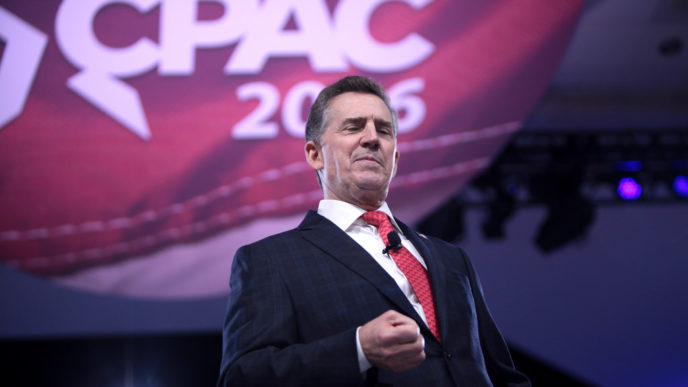
On February 6, 1977, Reagan spoke to CPAC, the Conservative Political Action Conference, a venue he would address no less than 13 times through his final year in the White House, not missing a single CPAC during any year of his presidency. (Donald Trump bailed out of CPAC this year.)

On this particular date, which happened to be Reagan’s 66th birthday, he acknowledged that conservatism is often described differently by “those who call themselves conservatives.” Nonetheless, differing claims by different people calling themselves “conservatives” does not mean that we cannot identify certain common conservative principles. To that end, Reagan stated:

The common sense and common decency of ordinary men and women, working out their own lives in their own way—this is the heart of American conservatism today. Conservative wisdom and principles are derived from willingness to learn, not just from what is going on now, but from what has happened before.

The principles of conservatism are sound because they are based on what men and women have discovered through experience in not just one generation or a dozen, but in all the combined experience of mankind. When we conservatives say that we know something about political affairs, and that we know can be stated as principles, we are saying that the principles we hold dear are those that have been found, through experience, to be ultimately beneficial for individuals, for families, for communities and for nations—found through the often bitter testing of pain or sacrifice and sorrow.

There’s a definition that every self-professing conservative needs to take to heart and mind. It is one you could find in conservative classics, such as Russell Kirk’s The Conservative Mind, or glean from decades of reading William F. Buckley’s flagship publication of the conservative movement, National Review, or from the older Human Events—all of which Ronald Reagan read assiduously. Reagan had an informed comprehension of conservatism because he devoured these writings. He did the intellectual heavy lifting that facilitated his full conversion from a 1940s New Deal FDR liberal to a conservative trying to save the Republican Party from the Rockefeller Republicans who were not conservatives.

What Reagan said here in February 1977 is worth underscoring: The essence of conservatism is to preserve and conserve time-tested values that have endured for good reason and for the best of society, for citizens, for country, and for order—internal and external order (see Kirk’s The Roots of American Order). Again, think about that definition. Do not fall for the Leftist canard that cruelly caricatures conservatism as merely wanting to preserve anything and everything from the past, from slavery to Jim Crow to women not voting. Quite the contrary, conservatives want to preserve the values and ideals that are timeless and time-tested for the benefit of humanity, not the detriment. We conservatives cling to and seek to conserve and preserve not just any ideas but worthy ideas. If we merely sought to keep any, say, 19th century idea, then why aren’t we fighting for Marxism or some variant of socialism, as many of our “progressive” friends still do? That isn’t conservatism, regardless of what you heard about it from some liberal professor or clicked in a Google search.

In that same speech to CPAC, Ronald Reagan enunciated a number of conservative principles and positions: freedom and liberty, free markets, religious freedom, constitutional rights and protections, anti-communism, smaller government, local government, individualism, voluntarism, communities, families, self-reliance, hard work, common sense, reason, faith in God. (In my book on Reagan conservatism, I distill 11 principles that I believe capture Reagan conservatism.) He called for a prudent and just government that spends money wisely and whose stewards act with integrity and honesty. Here, too: we need a nation comprised of outer order and inner order, a virtuous government that is the product of virtuous citizens.

And finally, Reagan told CPAC that the time had come “to present a program of action based on political principle that can attract those interested in the so-called ‘social’ issues and those interested in ‘economic’ issues.” He wanted a complete conservatism that combined the two core strands of contemporary American conservatism (the social and economic) into “one politically effective whole.”

There is much more I could say about this, but let’s pivot to Donald Trump’s explication of conservatism. I’ll consider the two recent occasions where Trump was asked to give a definition.

In New Hampshire during an ABC News debate in February, Trump was asked point blank, “What does it mean to be a conservative?” In response, Trump stated:

Well, I think I am, and to me, I view the word conservative as a derivative of the word “conserve.” We want to conserve our money. We want to conserve our wealth. We want to conserve. We want to be smart. We want to be smart where we go, where we spend, how we spend. We want to conserve our country. We want to save our country. And we have people that have no idea how to do that, and they are not doing it. And it’s a very important word and it’s something I believe in very, very strongly.

Ironically, this definition (I’ve provided the entirety of Trump’s statement) does not suggest that he believes in conservatism “very, very strongly.” He might believe in conserving money and wealth very, very strongly, which is fine, but that isn’t a definition of conservatism.

There is no sense in Trump’s statement of any grounding let alone a rich or nuanced cognizance of conservative philosophy.

What’s worse, Trump gave that definition with a look of surprise and unpreparedness—with a deer-in-the-headlights look. That is worse because only two weeks prior he was asked the same question in an interview on CBS’s “Face the Nation,” where his response was shockingly dismal. The candidate this time should have been equipped to give a better answer.

That other Trump definition, offered to CBS in January, was at best a stream of consciousness, with occasional disconnected outbursts of random policy observations. Here is (verbatim) what he told CBS when asked for his definition of a conservative:

Well, I think it’s a person that doesn’t want to take overly risk. But I think that’s a good thing. I think it’s a person that wants to—in terms of government, I’m talking about—a person that wants to conserve, a person that wants to, in a financial sense, balance budgets. A person that feels strongly about the military, and I feel very strongly about the military. And, you know, you have some of these people they don’t even want to focus on the military, our military is falling apart. I feel very, very, and I have always felt very, very strongly about the military. By the way, if you look at vision, when you look at the word “vision,” I was the one that said, “take the oil,” I’ve been saying that for years, and I said, “take the oil, let’s take the oil,” and nobody would listen, then all of a sudden after Paris they started saying “maybe that’s right, we’ll take the oil.” They still don’t do it the proper way. You know, I was—which is a little bit different than a normal conservative—but I was very much opposed to the war in Iraq. A lot of these guys were all for the war in Iraq, look what that’s got us: We spent $2 trillion, we lost thousands of lives, we have nothing, we’re now handing Iraq over, just handing over to Iran. Iran is going to take over Iraq, and I said that was going to happen. I said that years ago, in 2003-2004, that Iran will take over Iraq with the largest oil reserves in the world. And that’s not a conservative position. When I was, you know, saying, don’t go into Iraq—I’m a very militaristic person, I’m very much into the military, and we’ll build our military bigger, better, stronger than ever before, but—and that’s safe, that’s actually the cheapest thing to do, opposed to what we have right now, but I was opposed to the war in Iraq. Most conservatives were gung-ho. I mean, these guys, every one of them, wanted the war in Iraq. Look where it got us.

Here again, what I’ve quoted is the entirety of Trump’s response. My transcript leaves out nothing.

Trump’s “definition” is, in short, anything but a picture of conservatism. To the contrary, what you just read is a picture of a non-conservative exploiting a conservative movement in order to try his hand at getting elected president via the Republican Party—the party of Reagan conservatism.

This definition from Trump is confusing, incoherent, and incomprehensible, and it is a vindication of legitimate concerns by true conservatives that Donald Trump as the GOP’s new standard-bearer is poised to do enduring damage to the modern conservative movement that Ronald Reagan did so much to advance.

Is Donald Trump a Reagan conservative? Certainly not by any definition he has hazarded to try to give. (For more from the author of “Trump vs. Reagan: What Is a Conservative?” please click HERE)

Follow Joe Miller on Twitter HERE and Facebook HERE.

Trump Issues What He Says Will Be His Last Statement on Trump U Controversy

Responding to the controversy involving his remarks about the Hispanic judge presiding over the Trump University fraud case, Republican presidential candidate Donald Trump issued a lengthy statement Tuesday on Facebook.

Trump has said U.S. District Judge Gonzalo Curiel could not be impartial in the case because of his “Mexican heritage.” Curiel was born and raised in the United States.

In his Facebook statement, the billionaire businessman writes, “It is unfortunate that my comments have been misconstrued as a categorical attack against people of Mexican heritage. I am friends with and employ thousands of people of Mexican and Hispanic descent.”

“The American justice system relies on fair and impartial judges,” he continues. “All judges should be held to that standard. I do not feel that one’s heritage makes them incapable of being impartial, but, based on the rulings that I have received in the Trump University civil case, I feel justified in questioning whether I am receiving a fair trial.”

Defending the university, Trump writes, “Throughout the litigation my attorneys have continually demonstrated that students who participated in Trump University were provided a substantive, valuable education based upon a curriculum developed by professors from Northwestern University, Columbia Business School, Stanford University and other respected institutions.”

Trump points out that after completing the real estate course, Tarla Makaeff, the original plaintiff, completed several surveys in which Trump University was given an “excellent” rating. He goes on to imply that when the attorneys for the students realized Makaeff would not be a good witness for the plaintiffs, they decided to drop her from the case.

Referring to other students involved in the lawsuit, Trump says they also completed surveys, rating the university as “excellent.”

Trump writes that when asked what Trump University could do to improve programs, one student suggested that sandwiches be brought in and the lunch break be expanded to 45 minutes. Another student suggested “more comfortable chairs.”

Continuing, Trump draws attention to the program’s “generous” policy of giving a full refund to students when requested within three days of signing up for a program, or by the end of the first day of a multi-day program, whichever came later.

Citing his position as the presumptive Republican nominee as well as a campaign that has focused on illegal immigration, Trump questions whether a fair trial is possible.

Trump concludes his post by saying, “While this lawsuit should have been dismissed, it is now scheduled for trial in November. I do not intend to comment on this matter any further. With all of the thousands of people who have given the courses such high marks and accolades, we will win this case!” (For more from the author of “Trump Issues What He Says Will Be His Last Statement on Trump U Controversy” please click HERE)

Follow Joe Miller on Twitter HERE and Facebook HERE.

The False Comparison of Trump to Hillary

A lot of Republicans still upset over Donald Trump winning the nomination resort to a false equivalence between Trump and Clinton in order to justify sitting the election out or even voting for Hillary.

Take a recent example by the National Review’s Ramesh Ponnuru. First he lists Hillary’s manifold sins that Trump is innocent of: lying to the parents of the Benghazi victims, promising to nominate hard-left jurists to the Supreme Court, and supporting Obamas’ high-tax economics and unconstitutional amnesty of illegal aliens.

Then Ponnuru offers a catalogue of Trump’s sins Hillary hasn’t committed: mocking a reporter’s disability, indulging a preposterous conspiracy theory about Ted Cruz’s father and Lee Harvey Oswald, threatening a trade war with China, or threatening war crimes against the families of terrorists. Trump’s list presumably balances Hillary’s flaws, in order to make the point that both Trump and Hillary are equally distasteful, thus making the election a Hobson’s choice for principled conservatives.

But this comparison is false and misleading, for Trump and Clinton have had very different careers with different obligations and responsibilities.

Most obviously, Donald Trump is a private citizen who has never held public office. He is a businessman in a world where decorum and class often aren’t as important as sharp elbows and tough negotiating skills, where making a profit is more important than consistency or sparing people’s feelings. His goal is to make money, and his flamboyant life-style is our culture’s sign of his skills and success at doing so. Moreover, his flaws of personality and character, like his rude bluster and outrageous claims, are not, alas, that exceptional or different from those of millions of other private citizens, which may explain his populist appeal. And in his line of work, especially as a reality television star, such braggadocio and insensitivity may be assets. Intellectuals of more delicate sensibilities and refined manners may not like such déclassé qualities or grubby dealings, but most of them don’t live in a hard, risky world of tough negotiations and profit and loss.

Hillary Clinton is in a very different line of work from Trump’s. Her whole life has been spent as what we laughably call a public servant. In other words, she is supposed to be working not for profit or her own status and enrichment, but for the public weal. For progressives, that means striving for “social justice,” income equality, the abolition of prejudice and bigotry, the emancipation of women, the improvement of the middle class, and the salvation of the planet from the merchants of death by carbon. This is what she tells us over and over, and this is her case for why she should be president.

But while Trump’s character flaws have been assets in his profession, Hillary’s arrogant sense of entitlement, relentless money-grubbing, chronic mendacity, and obvious dislike of people other than her minions all undercut her claims to be a public servant, and help explain why she has serially failed at that role.

Of course, some presidents have shared the same flaws as Hillary, but they at least showed some restraint in exploiting their position for private gain, and at least could pretend to be a warm “people person,” as the ghastly phrase goes. Even Richard Nixon appeared on Laugh In. But Hillary has been inept at camouflaging her unseemly ambitions and even pretending to be a caring tribune of the people––in contrast, say, to Elizabeth Warren, who is just as much a hypocritical one-percenter as Hillary, but manages to come across as sincerely passionate. With Trump, however, you know exactly what you’re getting.

Finally, if a businessman like Trump fails, he reaps most of the damage. But if a “public servant” like Hillary fails, the security and interests of every single one of us are damaged, even as she advances her own political and fiscal interests as much as Trump does. Trump’s alleged shenanigans with Trump University are nothing compared to Hillary’s exploitation of her position as Secretary of State to steer money to her foundation, which is to say to herself, her husband, her daughter, her friends and political cronies, no matter the damage to America’s interests. Trump’s inconsistencies and alleged exaggerations about his net worth or charitable contributions are a dog-bites-man story compared to Hillary’s lies about Benghazi and her private email server. Nothing Trump has publicly said or done is as self-servingly despicable as Hillary’s implications that the grieving families of the four dead Americans in Benghazi are not telling the truth about her personal promise to them to “get” the obscure producer of the on-line video supposedly responsible for the attacks, when she knew that claim was untrue.

In short, Trump has been accountable to the bottom line. Hillary has been accountable to the people. Trump has succeeded in his job; Hillary has failed abysmally at hers. Making the two equally unpalatable to the principled voter is making a false equivalence between two different kinds of public life.

Perhaps Trump’s flaws would make him a bad president. But other presidents who had flaws equally distasteful––such as Lyndon Johnson, Richard Nixon, or Bill Clinton––managed to do some good things as president regardless. With Trump there’s at least a chance he could turn out to be a better president than his bluster and insults suggest. Hillary, on the other hand, has a long public record of using her position for personal gain, and putting her ambition ahead of her responsibilities to the country she supposedly serves. Her role as First Lady was marked by bungling health care reform, indulging silly fantasies of a “vast right-wing conspiracy,” and allowing herself––an “I am woman hear me roar” feminist––to be publicly humiliated by her satyr husband while attacking his victims. Her tenure in the Senate lacked any substantive legislative achievements, and her stint as Secretary of State furthered Obama’s destruction of America’s global influence, power, and security from Syria to the South China Sea. It may be possible that she could experience a road-to-the-White House conversion and become a good president, but given everything we know from her 25 years of public “service,” the probability is close to zero.

With Trump, in contrast, we know that at least he won’t be as destructive to our political order as Obama has been. With Hillary the odds are much higher that she will continue Obama’s “fundamental transformation” of our country into an E.U.-like technocratic regime of smug elites whose aim is to erode individual freedom and compromise our country’s sovereignty. Worse yet, if she becomes president, she will most likely nominate two or three Supreme Court justices, creating a court that will gut the and First and Second Amendments and legitimize further the dismantling of the Constitution’s divided powers and limited executive. And don’t put your faith in the Republican Senate that confirmed Loretta Lynch to shoot down every one of Hillary’s picks, even if that means eight years of an eight-member court.

The November election is not a choice between two equally bad candidates. It’s the moment when we reject the candidate who we know, based on her long public record of corruption, lying, and grasping for power and wealth, will take us further down the road to political perdition. (For more from the author of “The False Comparison of Trump to Hillary” please click HERE)

Follow Joe Miller on Twitter HERE and Facebook HERE.

Trump Bashes His Own Campaign Staff on Call With Surrogates: ‘You Guys Are Sometimes Getting Stupid Information’

Presumptive Republican presidential nominee Donald Trump bashed his own campaign staff during a call with supporters on Monday, telling his surrogates that his staff sometimes gives them “stupid information,” according to Bloomberg Politics.

During the call, Trump ordered his surrogates to defend his attacks regarding a federal judge’s Mexican heritage according to “two supporters who were on the call and requested anonymity to share their notes with Bloomberg Politics.”

Trump has directed a series of personal attacks towards the Hispanic judge hearing the Trump University lawsuit. Trump told The Wall Street Journal that U.S. District Judge Gonzalo Curiel has “an absolute conflict of interest” due to his heritage and Trump’s position that a wall should be built on the Mexican border.

According to Bloomberg Politics, during the call, former Arizona Gov. Jan Brewer interjected to tell Trump that she received a memo from his staff telling her not to discuss the lawsuit.

“Take that order and throw it the hell out,” Trump said before demanding to know who sent the memo. (Read more from “Trump Bashes His Own Campaign Staff on Call With Surrogates: ‘You Guys Are Sometimes Getting Stupid Information'” HERE)

Follow Joe Miller on Twitter HERE and Facebook HERE.

Reality: Trump on Islam

Former NSA head Michael Hayden recently joined a chorus of Trump’s critics blasting him for offending Muslims. “The jihadist narrative is that there is undying enmity between Islam and the modern world, so when Trump says they all hate us, he’s using their narrative,” he said.

That’s true. It’s also meaningless because in this case the narrative is reality.

Jihadists do hate us. Islam has viewed the rest of the world with undying enmity for over a thousand years. Some might quibble over whether a 7th century obsession really counts as “undying”, but it’s a whole lot older than Hayden, the United States of America, our entire language and much of our civilization.

Islam divides the world into the Dar Al-Islam and the Dar Al-Harb, the House of Islam and the House of War. This is not just the jihadist narrative, it is the Islamic narrative and we would be fools to ignore it.

The White House is extremely fond of narratives. The past month featured Ben Rhodes, Obama’s foreign policy guru, taking a victory lap for successfully pushing his “narrative” on the Iran deal. Rhodes takes pride in his narratives. His media allies love narratives. But none of the narratives change the fact that Iran is moving closer to getting a nuclear bomb. Narratives don’t change reality. They’re a delusion.

Narratives only work on the people you fool. They don’t remove the underlying danger. All they do is postpone the ultimate recognition of the problem with catastrophic results.

Islamic terrorism is a reality. Erase all the narratives and the fact of its existence remains.

Instead of fighting a war against the reality of Islamic terrorism, our leaders have chosen to fight a war against reality. They don’t have a plan for defeating Islamic terrorism, but for defeating reality.
So far they have fought reality to a draw. Ten thousand Americans are dead at the hands of Islamic terrorists and Muslim migration to America has doubled. Islamic terrorists are carving out their own countries and our leaders are focused on defeating their “narratives” on social media.

Hayden repeats the familiar nonsense that recognizing reality plays into the enemy narrative. And then the only way to defeat Islamic terrorism is by refusing to recognize its existence out of fear that we might play into its narrative. But Islamic terrorism doesn’t go away when you stop believing in it.

You don’t have to believe in a bomb or a bullet for it to kill you. A plane headed for your office building or a machete at your neck is not a narrative, it is reality. If we can’t tell the difference between reality and what we believe, then reality will kill us. And nothing we believe will change that.

We are not fighting a war of narratives with Islam. This is a war of bombs and bullets, planes crashing into buildings and blades digging into necks. And yet the men in charge of fighting this war remain obsessed with winning a battle of narratives inside the Muslim world. They have no plans for winning the war. Instead they are occupied with managing the intensity of the conflict, taking out the occasional terrorist leader, bombing only when a jihadist group like ISIS has become too powerful, while waiting for their moderate Muslim allies to win the war of narratives for them by discrediting the jihadists.

The narrative mistake is understandable. The left remains convinced that it can get its way through propaganda. Its record is certainly impressive. But it’s strictly a domestic record. Getting Americans to believe seven strictly irrational social justice things before breakfast is very different than convincing the members of a devout tribal society with a deep sense of history that they really don’t want to kill Americans. All that the narrative war accomplished was to show that the propagandists who convinced Americans to vote for their own exploitation have no idea how to even begin convincing Muslims to do anything. Think Again Turn Away was an embarrassment. Various outreach efforts failed miserably. American politicians devoutly apologize for any disrespect to Islam, but Muslims don’t care.

Hayden isn’t wrong that there is a narrative. But Nazism also had a narrative. Once the Nazis had power, they began acting on it and their narrative became a reality that had to be stopped by armed force. But at a deeper level he is wrong because he isn’t reciting the Islamic or even the jihadist narrative, but a deceptive narrative aimed at us in order to block recognition of the problem of Islamic terrorism.

The Islamic narrative isn’t just that we hate them. More importantly, it’s that they hate us. Muslim terrorists are not passively reacting to us. They carry a hatred that is far older than our country. That hatred is encoded in the holy books of Islam. But that hatred is only a means to an end.

Hatred is the means. Conquest is the end.

Assuming that Muslims are oppressed minorities is a profound intellectual error crippling our ability to defend ourselves. Islamic terrorism is not an anti-colonial movement, but a colonial one. ISIS and its Islamic ilk are not oppressed minorities, but oppressive majorities. Islamic terror does not react to us, as men like Hayden insist. Instead we react to Islam. And our obsession with playing into enemy narratives is a typically reactive response. Rising forces generate their own narratives. Politically defeated movements typically obsess about not making things worse by playing into the narratives that their enemies have spread about them. That is why Republicans panic over any accusation of racism. Or why the vanilla center of the pro-Israel movement winces every time Israel shoots a terrorist.

Western leaders claim to be fighting narratives, but they have no interest in actually challenging the Islamic narrative of superiority that is the root cause of this conflict. Instead they take great pains not to offend Muslims. This does not challenge the Islamic supremacist narrative, instead it affirms it.

Rather than challenging Islamic narratives, they are stuck in an Islamic narrative. They are trapped by the Muslim Brotherhood’s narrative of “Good Islamist” and “Bad Islamist” convinced that the only way to win is to appeal to the “Good Islamist” and team up with him to fight the “Bad Islamist”.

The “moderate” Muslim majority who are our only hope for stopping Islamic terrorism is an enemy narrative manufactured and distributed by an Islamic supremacist organization. When we repeat it, we distort our strategy and our thinking in ways that allow us to be manipulated and controlled.

It isn’t Trump who is playing into jihadist narratives, but Hayden and everyone who claims that recognizing Islamic terrorism plays into enemy narratives while failing to recognize that what they are saying is an enemy narrative.

The very notion that the good opinion of the enemy should constrain our military operations, our thinking and even our ability to recognize reality is an enemy narrative of unprecedented effect.

And this is the narrative that our leaders and the leaders of the world have knelt in submission to.

Narratives only have the power that we assign to them. No narrative is stronger than reality unless we believe in it. Not only have our leaders chosen to play into the enemy narrative, but they have accepted its premise as the only way to win. And so they are bound to lose until they break out of the narrative. (For more from the author of “Reality: Trump on Islam” please click HERE)

Follow Joe Miller on Twitter HERE and Facebook HERE.

Trump Reveals Who He Thinks Will Be the First Female President

Republican presidential candidate Donald Trump revealed in a tweet Friday who he thinks will be the first female president: his daughter.

In response to another Twitter user, Trump tweeted out: “I think the first female president of the USA will be Ivanka Trump a beautiful intelligent young genuine successful lady!”

Clinton has relied heavily on the “woman card” during the Democratic primaries, often touting her campaign as historic and noting she would be America’s first female president.

Trump called her out for it in April, saying, “I think the only card she has is the women’s card. She has nothing else going. And, frankly, if Hillary Clinton were a man, I don’t think she’d get 5 percent of the vote. The only thing she has going is the woman’s card. And the beautiful thing is women don’t like her, OK?”

On the other hand, Trump has described daughter Ivanka as his most trusted adviser, and she was placed in the key role of executive vice president of development and acquisitions for the Trump Organization. Ivanka, who gave birth to her third child in March, has been quick to defend her dad whenever accusations have been thrown his way.

Even though her father’s tweet might have just been a sweet compliment, it’s possible that Ivanka could make a run for president in the future — especially if her dad becomes the next president of the United States. (For more from the author of “Trump Reveals Who He Thinks Will Be the First Female President” please click HERE)

Follow Joe Miller on Twitter HERE and Facebook HERE.
Watch: Obama ‘Trips Over His Tongue’ When He Goes off Teleprompter to Bash Trump

President Obama, lauded as one of America’s premier orators when he was elevated to the White House back in 2008, had a stuttering moment Wednesday as he was trying to trash Republican presidential candidate Donald Trump.

“If we turn against each other based on divisions of race or religion. If-if-if-if-if-if-if-if-if-if-if we, if we fall for, you know, a bunch of okie-doke, just because, you know it-it-uh. You know, it-it-it-it-it-it sounds funny or the tweets are provocative,” Obama said during an appearance in Elkhart, Indiana.

John S. Roberts, writing on Young Conservatives, noted that he was never impressed with Obama the orator in the first place.

“Barack Obama is usually known for being an eloquent speaker. I guess, right? That’s what people say,” Roberts wrote. “I mean, the man has used the word ‘uh’ more than anyone in recent memory.”

Roberts then called Obama’s inability to get through one sentence attacking Trump “tripping over his tongue.”

Jim Hoft wrote on Gateway Pundit, “Poor Barack. He wanted to sound more powerful. He really did! Unfortunately, it didn’t go as planned. He turned into a stuttering mess.”

Others noticed the rhetorical pothole as well.

“In the past I’ve pointed out when this guy stutters he is lying. Towards the end of his economic speech he was hinting to Trump and trying to slide in a cheap shot or two but that truthful Achilles heel kicked in!” wrote BMartin1776 on Saving the Republic. (For more from the author of “Watch: Obama ‘Trips Over His Tongue’ When He Goes off Teleprompter to Bash Trump” please click HERE)

Follow Joe Miller on Twitter HERE and Facebook HERE.
9-Year-Old Banned From ‘Making America Great Again’

One local Trump supporter is being banned from wearing a signature Donald Trump hat to school after it began to draw tense conversations.

Logan Autry left Powers-Ginsburg Elementary School early on Thursday because school leaders said something he was wearing is causing a safety concern on campus– his red hat.

“The vice principal came up to me and told me to take my hat off because it brings negative attention from other students. And I said no a few times and then the principal told me again and I still said no and refused,” said Logan Autry.

For three days straight the third grader wore the hat to class. But each day, more and more classmates began confronting him at recess.

“I still want to keep my hat. It’s not the hat that draws attention, it’s just my personality that the other children do not like,” said Autry. (Read more from “9-Year-Old Banned From ‘Making America Great Again'” HERE)

Follow Joe Miller on Twitter HERE and Facebook HERE.