Posts

TRUMP ON TRADE: More Sanders Than Reagan

The Trump media surrogates have a quandary. They’re not sure whether to compare their man Donald Trump to Ronald Reagan, distinguish him from Reagan, or dismiss Reagan. It depends on the day and the subject. So they spin, and spin, and spin.

One area in which Trump can be nailed down is his overall view of trade. As I explained at Conservative Review, when it comes to Trump’s own financial dealings, he is an unrepentant globalist, from which he has made a fortune. But these days, as he runs for president, the billionaire is a radical protectionist who has repeatedly declared his intention to impose massive tariffs aimed at the economies of other countries, such as Japan and Mexico, and a forty-five percent tariff on products from China. Such broad tariffs would most certainly result in retaliation by the targeted countries. This is a sure job-killer that would also drive up costs of everyday products to low- and middle-class Americans. The net result: economic misery, not just for those hard-working, tax-paying Americans who work in industries that rely on international commerce and trade, but mostly everyone.

This is not Reaganism but Herbert Hooverism. And besides the economic impact, this would lead to empowering further centralized government — politicians, courts, and bureaucrats — and weakening further the private sector and individual liberty. This is precisely what occurred during the Great Depression. The federal government always gets more powerful under these conditions, which is among the reasons constitutional conservatives resist it.

Trump has also threatened Ford Motor Company, should it move forward with building a plant in Mexico. He has warned Apple Inc. against continuing to manufacture iPhones in China. Should he become president, Trump does not have the constitutional authority to manage and control private companies as if they are his own. But the Hugo Chavez-like rhetoric alone should concern freedom-loving Americans.

None of this seems to matter to professional Trump media surrogates, including Julia Hahn at Breitbart. Not only does she ignore these stunning Trump proclamations, she insists, for now anyway, that there really is no light between what Trump is saying and proposing and what Reagan said and did. Her premise is so thoroughly preposterous and her “arguments” so thin, I thought it worth a brief examination. Indeed, the opposite is true. Trump’s position on trade is more akin to socialist Bernie Sanders. As Trump explained to ABC’s George Stephanopoulos on Sunday, “I’m going to get Bernie [Sanders] people to vote, because they like me on trade.”

First, let’s look at the bogeyman, the trilateral agreement with the United States, Canada, and Mexico known as the North American Free Trade Agreement (NAFTA). Trump has said, “We will either renegotiate it or we will break it.” He has called it “a disaster.” Not only was Reagan a powerful advocate for such a trade arrangement, he is credited with giving it birth when he announced his candidacy for president in 1979. Reagan called for a “North American accord.” Indeed, in 1984, as a result of Reagan’s efforts, Congress passed the Trade and Tariff Act, giving the president “fast-track” authority to negotiate free trade agreements. And in 1988, the Canada-U.S. Free Trade Agreement, the predecessor to NAFTA, was signed. (It has since been overtaken by NAFTA, which includes Mexico.)

Reagan was so passionate about free trade generally, and NAFTA in particular, on September 13, 1993, he penned an op-ed for The Wall Street Journal, titled “Tear Down The Trade Wall,” urging the passage of NAFTA. Below is an excerpt, but I would encourage you to read it in full here. I raise this op-ed because of the extensive propaganda campaign underway to justify Trump’s protectionism by comparing him to Reagan:

For decades America has led freedom-seeking people around the world in their struggles to destroy and dismantle the oppressive barriers that divide countries and restrict liberty. Today, many of those battles have been fought and won — the barricades that once stood between countries no longer exist and their citizens are able to live together in freedom and prosperity. With this in mind, we, as Americans — as North Americans — are faced with a new challenge. The Cold War is over, and now we must break down the tariff walls that restrict the free flow of trade on our continent. The North American Free Trade Agreement can bring us that victory.

The reason for a free trade agreement is simple: Throughout history, whenever and wherever trade barriers have been lowered, the participating economies have flourished. Through Nafta, we will most certainly see a boost to the economic vitality of the U.S., Canada and Mexico. It will help mature and expand the North American economy, keeping us globally competitive.

Presidents of both political parties have embraced the North American Free Trade Agreement in order to forge a powerful bloc to compete in today’s global economy. Its history goes back even further. When I announced my candidacy for president in 1979, I believed in the potential for the world’s largest free trade zone and called for the creation of such a North American Accord.

We took a major step forward in 1988, when we were able to forge a historic trade agreement between the U.S. and Canada. This agreement cut tariffs and eliminated other trade barriers and, as a result, the world’s longest undefended border got a lot busier. Back then objections were raised, but the critics were proven wrong and our trade grew to a world record $175 billion — and our two-way investment also reached record levels.

Read in full here at WSJ.

Moreover, on August 6, 1983, in a radio address to the nation, Reagan spoke about the benefits of trade and the dangers of protectionism. He said, in part:

I’d like to talk to you today about trade — a powerful force for progress and peace, as you well know. The winds and waters of commerce carry opportunities that help nations grow and bring citizens of the world closer together. Put simply, increased trade spells more jobs, higher earnings, better products, less inflation, and cooperation over confrontation. The freer the flow of world trade, the stronger the tides for economic progress and peace among nations.

I’ve seen in my lifetime what happens when leaders forget these timeless principles. They seek to protect industries and jobs, but they end up doing the opposite. One economic lesson of the 1930’s is protectionism increases international tensions. We bought less from our trading partners, but then they bought less from us. Economic growth dried up. World trade contracted by over 60 percent, and we had the Great Depression. Young Americans soon followed the American flag into World War II.

No one wants to relive that nightmare, and we don’t have to. The 1980’s can be a time when our economies grow together, and more jobs will be created for all. This was the spirit of the Williamsburg summit in May. The leaders of the industrialized countries pledged to continue working for a more open trading system. But sometimes that’s easier said than done.

In 1986, under the General Agreements on Tariffs and Trade (GATT), Reagan started the Uruguay Round of multilateral trade negotiations. It culminated in lowering tariffs throughout the world and eventually the World Trade Organization. Over one hundred countries were signatories.

The Reagan record of promoting trade, through words and actions, abounds. Yet, not a single word of any of this was relayed to Hahn’s readers in her Breitbart piece comparing Trump to Reagan. In fact, she doesn’t quote Trump’s famous words either, when he told The New York Times, in part, “I would tax China on products coming in. I would do a tariff, yes — and they do it to us.” He said he’s “a free trader,” but that “it’s got to be reasonably fair.” “I would do a tax. And the tax, let me tell you what the tax should be … the tax should be 45 percent.” Forty-five percent on what? Not a single product or some products. But on all products coming from China and other unspecified tariffs aimed at Japan and Mexico.

Instead, Hahn cherry picks the occasions when Reagan did impose tariffs, which were rare and specific. For example, Hahn writes:

Reagan did not hesitate to impose duties, tariffs, and other trade fairness measures to enforce trade rules — the same measures which they now criticize Trump for supporting. Indeed, Reagan was harshly rebuked by so-called ‘free traders’ for taking ‘protectionist’ actions such as a 45% tariff on Japanese motorcycles to save the Harley-Davidson Motor Company of Milwaukee, Wisconsin. Reagan’s action seems similar to Trump’s call for a 45% tariff on Chinese imports.

Obviously, I’m familiar with these actions. I’ve even mentioned on my radio program that Reagan imposed certain tariffs. In fact, I’ve gone further. I have pointed out several times that the federal government imposes over 12,000 tariffs on products and the Federal Reserve manipulates our currency as well through a variety of techniques, most especially quantitative easing. I don’t believe much of this has been beneficial to our nation’s economy or hard-working low- and middle-income Americans. For all the attacks on free trade by the protectionists and Big Labor, the problem is the lack of it. More trade and commerce, along with cuts in regulations and individual and corporate income taxes, would contribute mightily to the nation’s economic expansion and job creation.

But a trade war is triggered when one country directs broad-based tariffs at another country, resulting in retaliation. And that’s what Trump is promoting. Again, as Reagan put it, referring to the 1930s,”No one wants to relive that nightmare, and we don’t have to.” Even when Reagan lifted the special tariff imposed on Japanese motorcycles, on May 16, 1987 he addressed the nation and emphasized the importance of trade and commerce, condemning protectionist legislation and warning of its consequences.

In 1985, and at other times, Reagan warned that he would veto protectionist legislation bouncing around Congress. He stated, “[S]o-called protectionism is almost always self-destructive, doing more harm than good even to those it’s supposed to be helping. … Protectionism almost always ends up making the protected industry weaker and less able to compete against foreign imports. … From now on, if the ghost of Smoot-Hawley rears its ugly head in Congress, if Congress creates a depression-making bill, I’ll fight it.” Indeed, Reagan was true to his word. In 1985, he vetoed legislation imposing tariffs on textiles, shoes, and copper.

In 1986, when the Democrat House passed another protectionist bill, the New York Daily News reported:

Employing some of his strongest language to date against the House-passed trade bill, President Reagan Thursday called the measure ‘kamikaze legislation’ and warned that it could send the economy ‘into the steepest nosedive since the Great Depression.’ Speaking to the National Association of Manufacturers, Reagan renewed his threat to veto the bill if it emerges from Congress in the same form that passed the House last week on a vote of 295-115. The measure would impose import restraints on countries such as Japan that maintain large trade surpluses with the United States.

It was killed in the Senate.

In 1987, as Congress was readying more protectionist legislation, Reagan warned against it. In 1988, as promised, Reagan vetoed another textile protectionist bill over Democrat Party objections.

Reagan said, in part, “It would impose needless costs on American consumers, threaten jobs in our export industries, jeopardize our overseas farm sales and undermine our efforts to obtain a more open trading system for U.S. exports. This bill represents protectionism at its worst.”

Now, let’s return to the premise of Hahn’s Breitbart piece. She launched her essay with this:

The members of the #NeverTrump movement cite, in part, Donald Trump’s position on trade as a reason why they cannot support their party’s presumptive nominee, chosen by Republican voters. They argue that Trump’s position on trade represents a betrayal of the Ronald Reagan legacy that defines virtually all thinking and rhetoric among the professional conservative class in Washington, D.C. However, there is one significant problem with this line of attack: namely, Reagan’s record on trade far more closely resembles Trump’s position than it resembles the view of those in the #NeverTrump movement. In fact, by their own definition, Reagan would have been a radical “protectionist”—meaning professional conservatives who are #NeverTrump would also have been for #NeverReagan.

The absurdity of Hahn’s piece is now clear, as is her rhetoric. Reagan’s approach to trade and commerce has very little in common with Trump’s positions. It is another weak effort to tie Trump to Reagan, the latter being an enormously popular and successful president. Her leader is no Reagan. He’s actually more Sanders, as he reaches out to the latter’s supporters. Perhaps Hahn will turn her attention to that? Don’t count on it.

Finally, some clean up. Hahn cites a CATO Institute piece condemning the Reagan trade record. Well, here’s a link to a CATO Institute piece praising it. So what? Then Hahn takes offense at my interview of Marco Rubio, throwing some red-meat out there for obfuscation purposes. What does that have to do with anything? Nothing. Chalk that up to immaturity. And among all the real experts and scholars she can cite for authority about the Great Depression, who’ve written at great length about the subject, she chooses Pat Buchanan as her source. At least she didn’t use Pat to defend Trump’s position on Israel, whatever it is.

As Trump apparently feels the Bern, moving left on the minimum wage, taxes, and trade, I would encourage liberty-loving Americans to insist that he demonstrate to us his worthiness to be president. He can count on his media surrogates no matter what, that’s quite obvious. But he has to persuade millions of others. Meanwhile, we will keep the pressure on him to support more freedom and less government. (For more from the author of “TRUMP ON TRADE: More Sanders Than Reagan” please click HERE)

Follow Joe Miller on Twitter HERE and Facebook HERE.

Obama Itches for Trump Fight

President Obama can’t wait to take on Donald Trump.

Obama has been largely sidelined in the presidential contest, a last-year officeholder with high approval ratings who has repeatedly shown he likes to spar with political foes.

With Bernie Sanders continuing to slug it out with likely Democratic nominee Hillary Clinton, Obama largely has to choose his openings to talk 2016.

So on Friday, when the White House announced Obama would make a statement about the economy, the president knew he’d get asked about Trump, the presumptive GOP presidential nominee . . .

“We are in serious times, and this is a really serious job,” Obama said. “This is not entertainment; this is not a reality show. This is a contest for the presidency of the United States.” (Read more from “Obama Itches for Trump Fight” HERE)

Follow Joe Miller on Twitter HERE and Facebook HERE.
Dr. Ben Carson’s Shocking Announcement on Trump’s Vice Presidential Pick

(Editor’s note: links to the other top stories are below) Ben Carson added more fuel to the fire of suspicion about Donald Trump’s conservative bona fides, when he suggested the presumptive GOP nominee’s running mate could be a Democrat.

Trump tapped Carson to head up a committee, which will make recommendations to the candidate who would best to fill the vice president slot.

Carson told the Wall Street Journal, in an interview published Thursday night, among those choices could be a Democrat.

Trump’s former GOP rival also took himself out of the running for the No. 2 spot saying, “I’m not interested in doing that for a number of reasons,” he said. “I don’t want to be a distraction. I’m sure you remember how crazy the media was about me, I don’t want to be a distraction, it’s too important a time in our life” . . . .

In an interview with Fox News host Bret Baier Thursday night, [Trump] added that he would prefer that person to have experience moving legislation through Congress, which would seem to eliminate most of the potential gubernatorial possibilities. He specifically stated South Carolina Gov. Nikki Haley is not under consideration and strongly suggested Florida Sen. Marco Rubio is not either.

Fox News digital politics editor Chris Stirewalt named someone who would check both the Democrat and congressional experience boxes: former Virginia Senator and presidential candidate Jim Webb. “I would say that the correct running mate for Donald Trump, and I’ve said it before, and I’ll say it again, is Jim Webb. Military experience. Democrat. Bi-partisan,” Stirewalt said on Fox Radio Wednesday. (Read more from “Ben Carson Just Made This Major Announcement About Trump’s Vice Presidential Pick” HERE)

Additional Top Stories:

Target Getting Slammed For Tranny Insanity

Judge Puts Hillary on Hot Seat

Follow Joe Miller on Twitter HERE and Facebook HERE.
Trump Makes Announcement About Ben Carson

Ben Carson, whose outsider candidacy for the Republican presidential nomination flared briefly in 2015 before limping to a conclusion this spring, will play a role in selecting presumptive GOP-nominee Donald Trump’s vice president.

Trump told the New York Times on Wednesday that he does not plan to pick a running mate until July and will have in place a collaborative process to select the right person. Trump also noted he would be looking for a vice president with a political background to “get things done” in Washington.

“I’ll set up a committee, and that I will do soon,” Trump said. “I think on the committee I’ll have Dr. Ben Carson and some other folks” . . .

Carson said the Trump campaign can win over African-American voters . . .

He also said the challenge of defeating likely Democratic nominee Hillary Clinton will unite Republicans.

“You would have thought that after 2012 we would have learned the lesson, but we didn’t,” Carson said. “But now we just have some bigger wounds that have to be healed, but I think that the healing balm — the sap, the ointment — will be Hillary Clinton. When people begin to think about her and what she represents and the progressive ideology and how it’s going to destroy our financial underpinnings and our position in the world and empower our enemies.” (Read more from “Trump Makes Announcement About Ben Carson” HERE)

Follow Joe Miller on Twitter HERE and Facebook HERE.

This Is How Democrats Will Absolutely Destroy Donald Trump If He’s the Nominee

If you want to know how Democrats will go about trying to destroy Donald Trump if he is the Republican presidential nominee, look no further than a campaign ad recently released by Conor Eldridge, a former U.S. Attorney for the Western District of Arkansas running as a Democrat against Republican Senator John Boozman.

One suspects that we will see a flurry of such campaign commercials in districts across the country in races up and down ballots during the 2016 general election if Trump is to triumph in the GOP primary.

As President Barack Obama did with Mitt Romney, Hillary Clinton and a media that has to this point enabled Donald Trump’s rise with $2 billion in free messaging will seek to define Trump so damningly that Clinton will look comparatively angelic — which is saying something — ensuring his fall.

The Donald will be cast as a bigoted, misogynistic, unscrupulous oligarch with no principles except a lust for power. When Trump comes out swinging directly at Hillary, she will become just another one of Trump’s victims.

To his discredit, the New York businessman has provided the Democrats and the media (but I repeat myself) with a target-rich environment for making this case over his decades in the public eye. And best of all for Democrats, their attacks will not only be powerful, but have the benefit in some instances of being true.

One suspects that the opposition research file will be rich with examples of, among other things:

Individuals burned by Trump’s business dealings

Duped Trump University students

Disgruntled ex-Trump employees

Homeowners squelched by Trump’s use of eminent domain for personal gain

Trump supporters who have partaken in acts of violence, threatened journalists and others and/or exhibited an animating ideology of neo-Nazism and white supremacism

The worst or most ill-conceived of Trump’s words, a la the Eldridge ad, but also with respect to Hispanics and others, which can be easily juxtaposed with the words of sympathetic women, Hispanics and others

The ads write themselves.

And as with Sen. John McCain in 2008, a media that to this point has served effectively as a friend, thanks to its hours of free airtime, will instantly become a foe. Recall that Sen. McCain was labeled a “maverick” by mainstream media outlets, and embraced by Democrats for his willingness to take Leftist positions against his party. The day he won the Republican presidential nomination, the formerly fawning press turned their guns on him unmercifully.

While the media has certainly proven more hostile to Trump than McCain during this election cycle, mainly in response to his rhetoric and lack of decorum (note: less so his “heterodox” ideology), its efforts to date have had the effect of providing Trump with a reliable enemy to rail against which resonates with his supporters, all while constantly keeping him in the news cycle.

The media in fact has had good reason not to seek to destroy Trump outright to date. First, Trump is good for ratings, which means he is good for business. Second, by enabling Trump’s rise, the media has created a candidate that they believe is incredibly weak given his unfavorable ratings and the aforementioned devastating charges that can be leveled against him. While the media may have underestimated Trump’s political acumen, and the mood of the American electorate to date, nevertheless they know that a concerted effort can be used to break him down just as they built him up. If Mitt Romney, a decent man and moderate Republican with a stellar business record, could have his image utterly sullied, imagine what the media can do with The Donald. Third, especially as more Establishment Republicans signal their approval, even if tacit, of Trump, he will be used as the representative of the party generally and conservatism in particular. The goal? To toxify those with an “R” next to their name in a bid to take back Congress. Trump may very well have the blood on his hands of real conservatives, few though they may be in Washington.

“Electability” is hard to evaluate, especially given Trump’s unpredictability and the Teflon nature of his candidacy to date. But what is undeniable is that negative and devastating Trump ads will be ubiquitous and likely highly effective come the general election season if Trump is the nominee, as reflected in the aforementioned ad already being run in Arkansas. (For more from the author of “This Is How Democrats Will Absolutely Destroy Donald Trump If He’s the Nominee” please click HERE)

Follow Joe Miller on Twitter HERE and Facebook HERE.
Ryan Shows Trump There’s a Cost to How Trump Does Business

Donald Trump once warned Speaker of the House Paul Ryan he would pay a “big price” if Ryan didn’t get along with him. Look who is paying now.

Yesterday Ryan, in publicly saying he will not at this point endorse the presumptive nominee called Trump’s bluff. When asked by CNN’s Jake Tapper if he would support Trump, Ryan said “Well, to be perfectly candid with you, Jake, I’m just not ready to do that at this point. I’m not there right now.”

And, with that, maybe Trump is forced to finally start realizing the consequences of how he conducted his campaign, rotten in both personality and policy. There’s a steep cost to the way Trump’s campaign has done its business and he, not Ryan, is going to pay.

Others in GOP leadership should follow Ryan’s lead. They have “leverage “as Trump would say. Get on record now, stating your opposition to Trump and make a demand for him to change. If he doesn’t improve, which he won’t, you are free to run as far away from the Trump train wreck as your legs can carry you.

People’s reactions to the prospect of a President Trump separates the wheat from the chaff.

And, the chaff is easy to see. Senate Majority Leader Mitch McConnell endorsed Trump, robotically murmuring that Republicans must support Republicans to win and stop Democrats from winning the White House.

This time, however, Trump is scarier than Hillary Clinton to many. This is a man who gets his news from the National Enquirer for goodness sakes, who came on to the political scene during the Obama Administration by peddling birtherism on MSNBC’s Morning Joe.

Had any other candidate, any one of them, won the nomination, this would be the best news cycle of their campaign. People would probably disagree on various policies but Republicans could come together and agree the candidate was a man of integrity and character.

But not Trump.

This should be Trump’s honeymoon period, but good men and women should prepare for divorce. (For more from the author of “Ryan Shows Trump There’s a Cost to How Trump Does Business” please click HERE)

Follow Joe Miller on Twitter HERE and Facebook HERE.
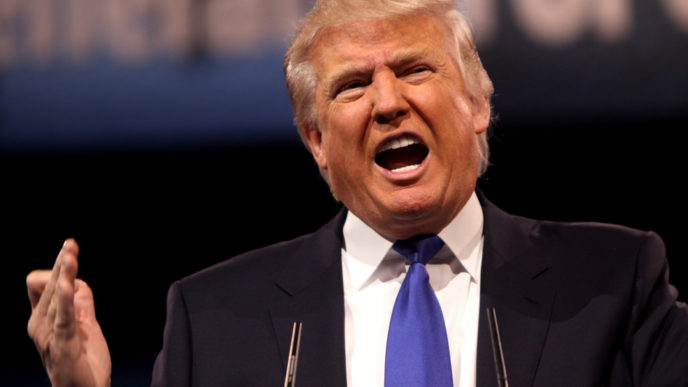
Lobbyists Struggle With Trump Reality

Republican lobbyists in Washington are struggling to come to grips with the possibility of a Donald Trump presidency.

“A lot of people woke up [on Wednesday] and went, ‘Oh, gosh, this is not a dream,’ ” said Jeff MacKinnon, a principal at Farragut Partners. “I don’t think downtown was really prepared for it happening so quickly. It did catch people off guard” . . .

Much of the downtown Republican crowd — lobbyists, consultants and PR operatives — built their careers working for establishment politicians like former Speaker John Boehner (R-Ohio), Sen. Roy Blunt (R-Mo.), and President George W. Bush . . .

Once Trump all but clinched the nomination this week, the topic of conversation among lobbyists quickly turned to the question of how Trump is going to finance a billion-dollar campaign.

Washington’s lobbying industry traditionally serves as an important resource for presidential candidates’ cash supply; supportive lobbyists often stay in close contact with campaign committees, participate in conference calls and recruit supporters. (Read more from “Lobbyists Struggle With Trump Reality” HERE)

Follow Joe Miller on Twitter HERE and Facebook HERE.
Many Americans Renounce Citizenship, Even Before President Trump

It seems crazy to call it the ‘New Normal’, but once again, record numbers of Americans are renouncing citizenship. Every three months, the Treasury Department publicly names individuals who renounced. It is surely more about FATCA, the Foreign Account Tax Compliance Act enacted in 2010, than it is about politics. Still, numbers are flying, with one poll saying that 1 in 4 Americans would consider leaving if Trump is elected. Others claim they will leave if Hillary is elected.

In reality, of course, most who bristle about politics are not serious. And for those who are, they surely mean a temporary move, not a final exit. In contrast, giving up citizenship is a big deal. Yet the number of published expatriates for the first three months of 2016 was a record 1,158. In 2015, there were approximately 4,300 expatriations. Comparing present to past suggests that Americans renouncing citizenship have risen 560% from their Bush administration high. There are now 18 times as many renouncers as in 2008.

Of course, these numbers seem tiny compared to the influx of immigrants. Yet expatriations have historically been much lower, making the uptick worrisome. Moreover, the published list is incomplete, with many not counted. Surprisingly, no one seems to know exactly how big the real number is, even though the IRS and FBI both track Americans who renounce. There is no single explanation, though some renounce because of global tax reporting and FATCA. One law adding to the mix is the IRS power to revoke passports.

The reasons for renouncing can be family, tax and legal complications. Dual citizenship isn’t always possible, as this infographic from MoveHub shows. And leaving can be expensive. Some countries have no fee, but America charges $2,350 to hand in your passport. That is more than twenty times the average of other high-income countries. The U.S. government has collected about $12.6 million in fees since the fall of 2014, after hiking its fee to renounce citizenship by 422%. Some renouncers write why they gave up their U.S. citizenship. (Read more from “Many Americans Renounce Citizenship, Even Before President Trump” HERE)

Follow Joe Miller on Twitter HERE and Facebook HERE.

Internationalist Koch Bros., Bush’s Apparently Think Hillary Is Better Than Trump

By Newsmax. In a political jaw-dropper that would have been inconceivable just six months ago, billionaire industrialists and conservative GOP donors Charles and David Koch are weighing supporting Hillary Clinton in her battle with Donald Trump for the White House.

Politico reports that representatives of Koch brothers warn that they “could sit out the presidential campaign entirely — or even back Hillary Clinton.”

The Koch brothers’ discontent with Trump’s aggressive campaign style first emerged last month when Charles Koch told ABC News it was “possible” Clinton, the Democratic presidential front-runner, would make a better president than Trump.

On Wednesday, Politico says, the Kochs would not rule out supporting the former secretary of state. (Read more from “Internationalist Koch Bros., Bush’s Apparently Think Hillary Is Better Than Trump” HERE)

_________________________________

George W. Bush Sitting out Election With H.W., No Plans to Endorse Trump

By Clyde Hughes. George W. Bush and his father, George H. W. Bush, will be sitting out the presidential election and have no plans to endorse Donald Trump, a spokesman said on Wednesday.

The Washington Post reported that it is the first time in five presidential election cycles that Bush 41 is not endorsing the Republican nominee.

A spokesman for his son, Bush 43, made a statement Wednesday evening after Ohio Gov. John Kasich followed U.S. Sen. Ted Cruz to the exit, noted The Guardian.

“President George W. Bush does not plan to participate in or comment on the presidential campaign,” said the spokesman for the two-term president before President Barack Obama. (Read more from “George W. Bush Sitting out Election With H.W., No Plans to Endorse Trump” HERE)

Follow Joe Miller on Twitter HERE and Facebook HERE.

Clinton, Trump Both Have Goldman Sachs Alums in Key Jobs

Hillary Clinton and Donald Trump have at least one thing in common: they’re both turning to former Goldman Sachs executives to help lead their campaigns.

Trump announced Thursday that he has hired Steve Mnuchin as his national finance chairman, citing in part his “extensive and very successful financial background.”

Mnuchin currently heads his own private investment firm, Dune Capital Management, but spent 17 years at Goldman Sachs. His father, Robert, was also a longtime fixture at the Wall Street giant.

One year ago, Clinton announced that her campaign’s chief financial officer would be Gary Gensler, who rose to Goldman’s co-head of finance after 18 years with the firm.

Before joining the campaign, Gensler was actually a Wall Street watchdog, serving as the head of President Obama’s Commodity Futures Trading Commission. There, he gained a reputation as one of the administration’s toughest regulators, making his selection primarily seen as an effort to calm Wall Street skeptics to Clinton’s left. (Read more from “Clinton, Trump Both Have Goldman Sachs Alums in Key Jobs” HERE)

Follow Joe Miller on Twitter HERE and Facebook HERE.