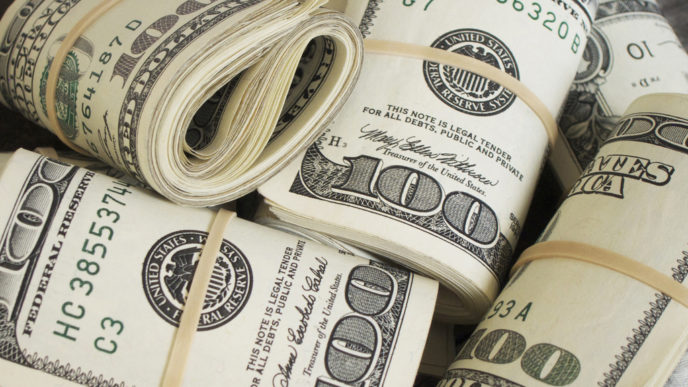
Federal Reserve officials expressed largely optimistic views of economic growth at their most recent meeting but also started to worry that financial market prices are getting out of hand and posing a danger to the economy.
Minutes from the Oct. 31-Nov. 1 Federal Open Market Committee meeting indicate members with almost universally positive views on growth — the labor market, consumer spending and manufacturing all were showing solid gains. While there were disagreements on the pace of inflation, and even a discussion about changing the Fed’s approach to price stability, the sentiment otherwise was largely positive.
Moreover, they said the picture could get even better if Congress lowers corporate taxes as part of the reform plan making its way through the Senate . . .
Stocks have been on a tear throughout 2017, setting a series of record highs and adding trillions in value. That’s come both on the heels of stronger corporate earnings and hopes that the tax reform plan, which would take the corporate rate from 35 percent to 20 percent, becomes a reality . . .
Some members feared what would happen if the market suddenly took a hit . . .
Concerns about the surge in stocks are not new at the Fed, but most officials have downplayed the idea that the market is in a bubble. Wall Street also has been at odds about the market, with Bank of America Merrill Lynch warning of a market top coming in 2018 though Goldman Sachs has predicted another big year.
(Read more from “Fed Officials Fear Financial Market ‘Imbalances’ and Possibility of ‘Sharp Reversal’ in Prices” HERE)
https://joemiller.us/wp-content/uploads/17123251389_bed3c3a1ba_b-12.jpg6581024Joe Millerhttps://joemiller.us/wp-content/uploads/logotext.pngJoe Miller2017-11-22 19:36:092017-11-22 19:36:09Fed Officials Fear Financial Market ‘Imbalances’ and Possibility of ‘Sharp Reversal’ in Prices
By Amanda Diaz. David Stockman has long warned that the stock market is on the verge of a massive collapse, and the recent price action has him even more convinced than ever that the bottom is about to fall out.
“I think it’s pretty obvious that the top is in,” the Reagan administration’s OMB director said Thursday on CNBC’s “Futures Now.” The S&P 500 has traded in a historically narrow range for the better part of 2015, having moved just 1 percent higher year to date. “It’s just waiting for the knee-jerk bulls, robo traders and dip buyers to finally capitulate.”
Stockman, whose past claims have yet to come to fruition, still believes that the excessive monetary policy from central banks around the world has created a “debt supernova,” and all the signs point to “the end of the central bank enabled bubble,” which could cause a worldwide recession. (Read more from “Stocks Are a Disaster Waiting to Happen” HERE)
Everybody Preparing for a ‘September Event’ That Coincides With Shemitah
By J. D. Heyes. [A]s September approaches, some are warning of a … provable threat – one rooted in the Jewish religion and in history – called the Shemitah Year, a 3,000-year-old mystery that is remains part of the Jewish faith.
What is the Shemitah? It is the “Sabbath year,” which is also known as the sabbatical or sheviit; the seventh year of a seven-year agricultural cycle mandated by the Torah, Judaism’s religious guidance, for the Land of Israel. . .
While that may not seem important to most Americans, InvestmentWatchBlog provided further evidence that the “seventh year” is again upon us:
Rabbi Johnathan Cahn noted that the Shmitah in 2001 caused the stock market collapse at the end of September, and then in 2008 the Shmitah also caused the economy trouble. The next Shmitah happens to be at the end of the 29th day of Elul this September. . .
Carl Gallups, pastor of Florida-based Hickory Hammock Baptist Church, host of a Christian radio show and author of “Final Warning: Understanding the Trumpet Days of Revelation,” agrees that time is growing short. . .
There can be no doubt that there is an amazing convergence of end-time prophecies occurring right before our eyes,” he told the news site. “Think of where we are in history – Israel is back in its land – a 2,500-year-old prophecy fulfillment – Jerusalem is in the hands of Israel, the nations of the world are rallying against Israel, including the U.S., and Israel is now literally surrounded by Islamic enemies who are publicly calling for the complete destruction of the Jewish state.
(Read more from “Everybody Preparing for a ‘September Event’ That Coincides With Shemitah” HERE)
https://joemiller.us/wp-content/uploads/logotext.png00Joe Millerhttps://joemiller.us/wp-content/uploads/logotext.pngJoe Miller2015-08-08 02:15:052015-08-08 02:15:05Stocks Are a Disaster Waiting to Happen
If we were going to see a stock market crash in the United States in the fall of 2015 (to use a hypothetical example), we would expect to see commodity prices begin to crash a few months ahead of time. This is precisely what happened just before the great financial crisis of 2008, and we are watching the exact same thing happen again right now. On Wednesday, commodities got absolutely pummeled, and at this point the Bloomberg Commodity Index is down a whopping 26 percent over the past twelve months. When global economic activity slows down, demand for raw materials sinks and prices drop. So important global commodities such as copper, iron ore, aluminum, zinc, nickel, lead, tin and lumber are all considered to be key “leading indicators” that can tell us a lot about where things are heading next. And what they are telling us right now is that we are rapidly approaching a global economic meltdown.
If the global economy was actually healthy and expanding, the demand for commodities would be increasing and that would tend to drive prices up. But instead, prices continue to go down.
The Bloomberg Commodity Index just hit a brand new 13-year low. That means that global commodity prices are already lower than they were during the worst moments of the last financial crisis . . .
The commodities rout that’s pushed prices to a 13-year low pulled some of the biggest mining and energy companies below levels seen during the financial crisis.
The FTSE 350 Mining Index plunged as much as 4.9 percent to the lowest since 2009 on Wednesday, with BHP Billiton Ltd. and Anglo American Plc leading declines. Gold and copper are near the lowest in at least five years, while crude oil retreated to $50 a barrel.
(Read more from “Commodities Collapsed Just Before the Last Stock Market Crash – so Guess What Is Happening Right Now?” HERE)
https://joemiller.us/wp-content/uploads/logotext.png00Joe Millerhttps://joemiller.us/wp-content/uploads/logotext.pngJoe Miller2015-07-25 03:52:432016-04-11 10:58:30Commodities Collapsed Just Before the Last Stock Market Crash – so Guess What Is Happening Right Now?
If a man swipes your wallet, he’s a thief. We don’t ask whether the pickpocket ultimately spent the cash on a worthy cause. Yet, supporters of corporate welfare would have you believe that as long as the companies receiving welfare prosper, you shouldn’t care that the government snatched your money to make it happen.
In fact, some people pushing corporate welfare are so dedicated to the ideology of political cronyism that they’ll euphemistically describe wealth redistribution from regular Americans to politically connected businesses as “economic development.”
On June 30, regular Americans won a big victory with the expiration of a particularly egregious example of cronyism, the Export-Import Bank, also known as Ex-Im. Recently, President Barack Obama and congressional Democrats have been cheerleading for Ex-Im. But in 2008, then-Senator Obama called Ex-Im “little more than a fund for corporate welfare.” He was right.
Ex-Im subsidizes the exports of mostly large, well-connected corporations. The top beneficiaries of Ex-Im’s support in 2014 included Boeing, General Electric, and Caterpillar — hardly companies in need of taxpayer assistance. Boeing alone received more than 68 percent of the benefits from Ex-Im’s long-term guarantees in 2014, which is why people derisively refer to Ex-Im as “Boeing’s Bank.”
Ex-Im uses your money to fund loans and guarantees to foreign companies that buy products from particular U.S. exporters. This transfer of money from you to them doesn’t create jobs; it destroys jobs. (Read more from “Keep Export-Import Bank in Its Corporate-Welfare Grave” HERE)
____________________________________________
TED CRUZ HAMMERS EVERYONE IN WASHINGTON FOR EX-IM BANK PLOY: ‘WASHINGTON CARTEL AT ITS WORST’
By Matthew Boyle. In an exclusive interview with Breitbart News, Sen. Ted Cruz is firing away at President Barack Obama, Senate Majority Leader Sen. Mitch McConnell, House Speaker Rep. John Boehner and pretty much everyone else in Washington for hatching a ploy to try to reauthorize the Export-Import Bank, which expired about a month ago.
“The Ex-Im Bank is the Washington Cartel at its worst,” Cruz said when asked about the emerging ploy by career politicians in D.C. to reauthorize the bank.
The Washington Cartel consists of career politicians in both parties who get in bed with Washington lobbyists, with special interests, and enrich those interests at the expense of the American taxpayers. The Ex-Im Bank consists of taxpayers providing hundreds of millions of dollars of loan guarantees to a handful of giant corporations, each of whom has armies of lobbyists that write campaign contributions to Democrats and Republicans who campaign in support of free markets, who campaign in support of turning around our deficit and debt, who campaign in support of principles like welfare reform. Now is the time to decide whether your principles matter more than campaign dollars.
Cruz had specific messages to every rank-and-file Republican, every rank-and-file Democrat and the two top GOP leaders on Capitol Hill, McConnell and Boehner, that he wants to make clear ahead of any Ex-Im effort.
“To every Republican: Are you going to join with Barack Obama in perpetuating the cronyism and corporate welfare of the Export-Import Bank, or are you going to stand up and honor the promises you made to the men and women who elected you?” Cruz said. (Read more about the reauthorization attempt of the Export-Import Bank HERE)
https://joemiller.us/wp-content/uploads/logotext.png00Joe Millerhttps://joemiller.us/wp-content/uploads/logotext.pngJoe Miller2015-07-24 03:08:062016-04-11 10:58:33Keep Export-Import Bank in Its Corporate-Welfare Grave
As the push continues in various locations around the country to raise the minimum wage to $15 per hour, the real world consequences of such a move have begun to surface.
Seattle became the first city in the nation to implement the $15 per hour minimum wage this past spring. Fox News reports that one unintended effect is that workers who are earning the higher wage are asking for fewer hours, so they can remain eligible for low income government benefits like childcare and tax credits.
Full Life Care, a home nursing nonprofit, told KIRO-TV in Seattle that several workers want to work less.
Local radio talk show host Jason Rantz on KIRO-FM noted the irony: “If [employees] cut down their hours to stay on those subsidies because the $15 per hour minimum wage didn’t actually help get them out of poverty, all you’ve done is put a burden on the business and given false hope to a lot of people.”
“Despite a booming economy throughout western Washington, the state’s welfare caseload has dropped very little since the higher wage phase began in Seattle in April. In March 130,851 people were enrolled in the Basic Food program. In April, the caseload dropped to 130,376,” according to Fox News. (Read more from “Seattle’s $15 Minimum Wage Law Just Came Back to Bite Them in a Totally Unexpected Way” HERE)
https://joemiller.us/wp-content/uploads/logotext.png00Joe Millerhttps://joemiller.us/wp-content/uploads/logotext.pngJoe Miller2015-07-24 03:07:342016-04-11 10:58:34Seattle’s $15 Minimum Wage Law Just Came Back to Bite Them in a Totally Unexpected Way
Greece’s parliament has voted to accept substantial economic reforms needed before the country can receive a fresh bailout worth as much as $96 billion.
The heavily indebted country needs the bailout money to avoid bankruptcy and a ‘Grexit’ from the euro, but the reforms are extremely unpopular.
Many Greeks resent that European lenders are imposing such harsh, strict reforms on their pension and tax systems.
Protests in front of the Greek parliament building in Athens turned violent on Wednesday ahead of the vote. Protesters threw Molotov cocktails and police responded with tear gas.
For months, Prime Minister Alexis Tsipras and his Syriza party rallied against the reforms. But Tsipras was forced to accept them as the country tottered on the brink of bankruptcy. (Read more from “Greece Votes ‘Yes’ on Bailout Bill” HERE)
https://joemiller.us/wp-content/uploads/logotext.png00Joe Millerhttps://joemiller.us/wp-content/uploads/logotext.pngJoe Miller2015-07-16 03:54:302016-04-11 10:58:51Greece Votes ‘Yes’ on Bailout Bill
Greeks were bracing Monday for the effects of the tough terms of an agreement that secured the country’s third bailout in five years, with many rejecting them while others said they were necessary to stay in the euro.
Haralambos Rouliskos, a 60-year-old economist who was out walking in Athens, described the deal as “misery, humiliation and slavery”.
Katerina Katsaba, a 52-year-old working for a pharmaceutical company, said: “I am not in favour of this deal. I know they (the eurozone creditors) are trying to blackmail us.”
But, Katsaba added: “I trust our prime minister — the decisions he will take will be for the best interests of all of us.”
The outline deal thrashed out between the 19 eurozone nations in strained overnight talks calls for Greece to push through a range of reforms to secure a bailout worth up to 86 billion euros ($96 billion). Without it, the country’s economy will collapse. (Read more from “Greeks See ‘Humiliation’ in Harsh Terms of Eurozone Bailout” HERE)
https://joemiller.us/wp-content/uploads/logotext.png00Joe Millerhttps://joemiller.us/wp-content/uploads/logotext.pngJoe Miller2015-07-14 02:27:112016-04-11 10:58:56Greeks See ‘Humiliation’ in Harsh Terms of Eurozone Bailout
By Lisa Abramowicz. Investors tend to respond to impending doom by selling risky stuff and hiding out in safer assets — namely, bonds in places such as Germany and the U.S.
There’s a problem with that formula this time around: Traders aren’t so sure they can find anything that’s truly safe right now. So, instead of piling into sovereign debt of developed nations, traders are pulling their money out of those places as the Greek economy teeters on the brink of collapse, Puerto Rico talks about delaying some debt payments and China’s stock market suffers its biggest selloff since 1992.
Investors yanked $2.9 billion from European government bond funds last week, more than ever before, and pulled $699 million from short-term investment-grade U.S. bond funds, Bank of America Corp. and Wells Fargo & Co. data show. While these assets have traditionally been havens during rocky periods, they look less appealing now after more than six years of unprecedented monetary stimulus that pushed yields to record lows.
Why is that a problem? Well, the European Central Bank’s bond-purchasing program this year sent yields so low (negative, in fact) that investors revolted, selling German debt in the face of some signs of economic growth and causing unprecedented volatility. In the U.S., the economy has improved enough that the Federal Reserve is planning to raise interest rates this year from virtually zero, where they’ve been since 2008 . . .
And nations and companies around the world have taken on unprecedented amounts of debt, all with the hope of igniting some growth, with the results being rather tepid. (Read more from “Good Luck Finding a Place to Hide as Global Markets Crumble” HERE)
By Bob Adelmann. In its just-released report “The 2015 Long-Term Budget Outlook,” the Congressional Budget Office stated bluntly:
The long-term outlook for the federal budget has worsened dramatically over the past several years, in the wake of the 2007-2009 recession and slow recovery…. If current law remained generally unchanged in the future … growing budget deficits … would push [the national] debt above its current high level.
It’s all about government spending that’s baked into the cake: the Baby Boomers retiring and asking the government to make good on its Social Security and Medicare promises and the rising costs of healthcare along with “an increasing number of recipients of exchange subsidies and Medicaid benefits attributable to the Affordable Care Act [which will] push up spending … if current laws … remain unchanged,” said the report.
The CBO created two avenues for politicians concerned about the matter to pursue: one, to keep the deficits from going any higher, and the other to bring them back down to historic levels. For the first, taxes would have to increase by $1,450 per person per year, starting immediately, or Social Security benefits would have to be cut by $2,400 per person per year, starting immediately . . .
The report considers the consequences of doing nothing: At some point investors in government bonds would become concerned about getting their money back and would demand higher interest rates to compensate for that risk. This would accelerate the deficits to new levels. As the report noted, “The larger the government’s debt, the greater the risk of a fiscal crisis.” (Read more from “US Financial Outlook Has “Worsened Dramatically”” HERE)
https://joemiller.us/wp-content/uploads/logotext.png00Joe Millerhttps://joemiller.us/wp-content/uploads/logotext.pngJoe Miller2015-07-07 03:32:122016-04-11 10:59:14Good Luck Finding a Place to Hide as Global Markets Crumble
By David Chance. The International Monetary Fund delivered a stark warning on Thursday of the huge financial hole facing Greece as angry and uncertain voters prepare for a referendum that could decide their country’s future in Europe.
Days after Greece defaulted on part of its IMF debt, the Fund, part of the lenders’ “troika” behind successive international bailouts, said Greece needed an extra 50 billion euros over the next three years, including 36 billion from its European partners, to stay afloat. It also needed significant debt relief.
The assessment, in a preliminary draft of the Fund’s latest debt sustainability report, underlines the scale of the problems facing Athens, whatever the result of Sunday’s referendum on the bailout offered by creditors last month.
Prime Minister Alexis Tsipras’ rejection of what he terms the “blackmail” of EU and IMF creditors demanding spending cuts and tax hikes has so angered Greece’s partners that there is no hope of reconciliation before Sunday.
With banks closed for a fourth day and capital controls in place, the future of the left-wing government hangs on the result, given the angry mood of voters in Greece, torn between resentment of the lenders and scorn for their own politicians. (Read more from “IMF Warns of Huge Financial Hole as Greek Vote Looms” HERE)
‘Yes’ Camp Takes Slim Lead in Greek Bailout Referendum Poll
By Lefteris Karagiannopoulos and George Georgiopoulos. Supporters of Greece’s bailout terms have taken a wafer-thin lead over the “No” vote backed by the leftist government, 48 hours before a referendum that may determine the country’s future in the euro zone, a poll showed.
The opinion poll by the respected ALCO institute, published in the Ethnos newspaper on Friday, put the “Yes” camp on 44.8 percent against 43.4 percent for the No” vote. But the lead was within the pollster’s 3.1 percentage point margin of error, with 11.8 percent saying they are still undecided.
With banks shuttered all week, cash withdrawals rationed and commerce seizing up, the vote could decide whether Greece gets another last-ditch financial rescue in exchange for more harsh austerity measures or plunges deeper into economic crisis.
It could also determine whether Greece becomes the first country to crash out of the 19-nation European single currency area, membership of which is meant to be irrevocable.
The survey found that 74 percent of Greeks want to stay in the euro, while just 15 percent want to return to a national currency, with 11 percent undecided. (Read more from this story HERE)
Economic Exodus Means Two-Thirds of Puerto Ricans May Soon Live in US
By Alan Yuhas. Facing a crisis of monumental proportions at home, tens of thousands of people are fleeing a Caribbean island in search of a better life in the United States only to find hardship and struggle on American shores. Their stories sound like those of millions of migrants – poverty at home, where the economy lies in tatters – but they differ from millions of others: they’re already American.
Unable to pay its $73bn debt, Puerto Rico has begun rationing water, closing schools and watching its healthcare system collapse and 45% of its people living in poverty. Emigration to the mainland has accelerated in recent years, activists say, and data shows that from 2003 to 2013 there was a population swing of more than 1.5 million people.
“This new wave of immigration can be compared with the immigration in the 1930s and 40s,” said Edgardo González, coordinator of the Defenders of Puerto Rico, an activist group. The Great Depression and second world war spurred the so-called “Great Migration”, when tens of thousands of Puerto Ricans moved to New York every year for nearly two decades.
Now most Puerto Ricans are arriving in central Florida, González said, but many cannot find jobs or even housing. “Some might stay with family for a few weeks, but for those who don’t have family, people end up homeless because of the lack of services,” he said.
“People end up living in hotels, living in cars or on the street. Then you have people who are homeless with kids, who get in trouble with the law, and you have to get into it with childcare and welfare services.” (Read more from this story HERE)
Keep an eye on the shadow banking system – it is about to be shaken to the core. According to the Financial Stability Board, the size of the global shadow banking system has reached an astounding 75 trillion dollars. It has approximately tripled in size since 2002. In the U.S. alone, the size of the shadow banking system is approximately 24 trillion dollars. At this point, shadow banking assets in the United States are even greater than those of conventional banks. These shadow banks are largely unregulated, but governments around the world have been extremely hesitant to crack down on them because these nonbank lenders have helped fuel economic growth. But in the end, we will all likely pay a very great price for allowing these exceedingly reckless financial institutions to run wild.
If you are not familiar with the “shadow banking system”, the following is a pretty good definition from investing answers.com . . .
The shadow banking system (or shadow financial system) is a network of financial institutions comprised of non-depository banks — e.g., investment banks, structured investment vehicles (SIVs), conduits, hedge funds, non-bank financial institutions and money market funds . . .
Shadow banking institutions generally serve as intermediaries between investors and borrowers, providing credit and capital for investors, institutional investors, and corporations, and profiting from fees and/or from the arbitrage in interest rates.
Because shadow banking institutions don’t receive traditional deposits like a depository bank, they have escaped most regulatory limits and laws imposed on the traditional banking system. Members are able to operate without being subject to regulatory oversight for unregulated activities. An example of an unregulated activity is a credit default swap (CDS).
These institutions are extremely dangerous because they are highly leveraged and they are behaving very recklessly. They played a major role during the financial crisis of 2008, and even the New York Fed admits that shadow banking has “increased the fragility of the entire financial system” . . .
So let’s hope that the financial devastation that we have seen so far this week is not a preview of things to come. The global financial system has been transformed into a delicately balanced pyramid of glass that is not designed to handle turbulent times. We should have never allowed the shadow banks to run wild like this, but we did, and now in just a short while we are going to get to witness a financial implosion unlike anything the world has ever seen before.
(Read more from “The 75 Trillion Dollar Shadow Banking System Is in Danger of Collapsing” HERE)
https://joemiller.us/wp-content/uploads/logotext.png00Joe Millerhttps://joemiller.us/wp-content/uploads/logotext.pngJoe Miller2015-07-02 03:43:582016-04-11 10:59:24The 75 Trillion Dollar Shadow Banking System Is in Danger of Collapsing