Posts

Poll Reveals Financial Strain: 4 in 10 Americans Report Deteriorating Finances

A recent survey conducted by Rasmussen Reports unveils the economic concerns of Americans, with more than four in ten (41 percent) stating that their personal finances have worsened in the past six months. The findings shed light on the financial challenges faced by a significant portion of the population in Biden’s America.

According to the survey, 32 percent of respondents anticipate a further decline in their personal finances, while 25 percent expect improvement. Meanwhile, 36 percent foresee their financial conditions remaining the same. The report indicates that only 17 percent of respondents reported an improvement in their finances over the past six months, with 38 percent stating that their situations have remained relatively stable.

In terms of bill payments, the survey reveals that 28 percent of American adults have been late at least once in the past six months when making major monthly payments such as rent, mortgage, car payments, or utility bills. In contrast, 65 percent report not missing any payments during this period.

The survey highlights demographic variations in financial experiences. For instance, 25 percent of whites, 40 percent of blacks, and 28 percent of other minorities have experienced late payments on major bills in the past six months. Additionally, the report notes that adults under 40, particularly men in this age group, are more likely than their elders to have made late payments, although older Americans are more likely to report a worsening personal financial situation.

Political affiliation also plays a role in respondents’ perceptions. Democrats (26 percent) are more likely than Republicans (16 percent) and unaffiliated voters (nine percent) to state that their financial situation has improved in the past six months. However, Democrats (36 percent) are also more likely to report being late on a major payment compared to Republicans (28 percent) and unaffiliated voters (20 percent).

Married adults and those with children at home express greater concern about the future, expecting their finances to worsen in the next six months. Predictably, respondents with annual incomes above $100,000 are more likely to report improved finances, while those earning under $50,000 indicate a decline.

Photo credit: Flickr

Delete Facebook, Delete Twitter, Follow Restoring Liberty and Joe Miller at gab HERE.

The Government’s Finances Are Much Worse Than Expected…

Last week, the Congressional Budget Office (CBO) revised their 2016 budget deficit figures and concluded that, in fact, this year’s deficit will be far worse than expected.

By a lot.

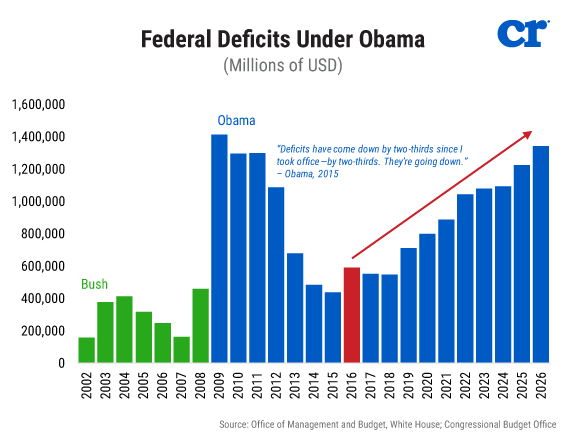
A $590 billion lot — $55 billion more than originally assumed.

This revised total comes after Obama perpetually attempts to sell the nation a narrative that he’s a fiscal champion and that his policies have reduced the deficit.

During a 2015 speech at a Michigan assembly plant, Obama bellows,

[ask] ordinary folks on the street, are the deficits going up or are they coming down, everybody automatically assumes, well, government spending and deficits must be going up. Deficits have come down by two-thirds since I took office – by two-thirds. They’re going down. [applause]

(Yes, the “applause” notation was included in the White House transcript of the speech.)

Obama’s firsts four years in office included deficits that were more than $1 trillion. Adjusted for inflation, those deficits are the largest in history — even compared to the deficits we ran during World War II. So, naturally, those deficits came down after the economy rebounded from the financial crisis. But as the chart below demonstrates, the decline in deficits is merely a hiccup — they are simply temporary. The deficit did drop (although, not even low enough to get to Bush era deficits) but will soon skyrocket.

Things are not looking much better for Obama’s fiscal record this year, either, where CBO has already had to revise this year’s budget deficit by $55 billion, for a total of $590 billion.

Sure, you might, say, what’s a $55 billion larger deficit for a government that is projected to spend nearly $4 trillion? Well, quite a bit actually. A $55 billion tab, levied on the American taxpayer, is equivalent to $450 more that you now owe, per household.

Do you have an extra $450 you’d like to send the government? Me neither.

For the most part, the increasing deficit is the result of spending. Yes, revenues are lower than CBO expected. In particular, corporate income taxes failed to meet their expected levels by $36 billion – and lagging corporate income taxes can be a sign of slowing profits and a slowing economy (more on that another time).

Meanwhile, programs like Social Security and Medicare, continue to grow faster than expected. The two combined added $35 billion more in spending that predicted. Of course, the U.S. debt isn’t helping much, either. CBO now predicts that net interest spending will be $23 billion larger than expected.

Well, you tell me: Do you think Obama’s deficits are going down? Who is applauding now?

Federal Deficits under Obama cleaned up

(For more from the author of “The Government’s Finances Are Much Worse Than Expected…” please click HERE)

Follow Joe Miller on Twitter HERE and Facebook HERE.

FEC Chair: Feds Must Help Americans Make ‘Thoughtful’ Contributions

03FECsub-master675The chairwoman of the federal agency responsible for overseeing the nation’s campaign finance laws has suggested that federal authorities should help Americans to make “thoughtful” political contributions.

The comment came during a Thursday meeting of the Federal Election Commission. The agency was considering whether to issue an advisory decision for an organization called “Democracy Rules” that created a game-like platform for making political contributions.

According to the rules of the platform, participants vote for one of a few issues in a given category, like immigration, that matter the most to them. Democracy Rules then identifies non-profit organizations or candidates likely to support the objectives of the winning side, and individuals pledge cash — as little as a dollar — in order to receive a vote on who should receive the money. In the last round, participants vote on whether to send the pooled funds to the winning organization or candidate.

The FEC’s three Republicans voted to issue an advisory opinion of approval, while the three Democrats voted against granting permission.

“Yes, I believe the American people are intelligent enough to make decisions,” said Democratic FEC chairwoman Ann Ravel. “But many of them also contribute to … sham PACs, over which we have no control. So in some cases, there’s a necessity for protection for some people to ensure that they’re not, that they’re able to make thoughtful, fair decisions.” (Read more from “FEC Chair: Feds Must Help Americans Make ‘Thoughtful’ Contributions” HERE)

Follow Joe Miller on Twitter HERE and Facebook HERE.

‘It’s Time to Hold Physical Cash,’ Says Senior Fund Manager

The manager of one of Britain’s biggest bond funds has urged investors to keep cash under the mattress.

Ian Spreadbury, who invests more than £4bn of investors’ money across a handful of bond funds for Fidelity, including the flagship Moneybuilder Income fund, is concerned that a “systemic event” could rock markets, possibly similar in magnitude to the financial crisis of 2008, which began in Britain with a run on Northern Rock . . .

The best strategy to deal with this, he said, was for investors to spread their money widely into different assets, including gold and silver, as well as cash in savings accounts. But he went further, suggesting it was wise to hold some “physical cash”, an unusual suggestion from a mainstream fund manager.

His concern is that global debt – particularly mortgage debt – has been pumped up to record levels, made possible by exceptionally low interest rates that could soon end, and he is unsure how well banks could cope with the shocks that may await.

He pointed out that a saver was covered only up to £85,000 per bank under the Financial Services Compensation Scheme – which is effectively unfunded – and that the Government has said it will not rescue banks in future, hence his suggestion that some money should be held in physical cash. (Read more from “‘It’s Time to Hold Physical Cash,’ Says Senior Fund Manager” HERE)

Follow Joe Miller on Twitter HERE and Facebook HERE.