Posts

A Biden Spokesperson Did Not Just Say *That* to Explain Joe’s Wandering Off at G7 Summit

Katie wrote about it yesterday. President Joe Biden was mentally lost during the G7 Summit in Italy. The man looked lost, and Italian Prime Minister Giorgia Meloni had to prevent the Delaware liberal from wandering off. It’s a video that speaks to a major concern of voters this year, which the Biden campaign has opted to spin by declaring the video misinformation. Oh, and that it should essentially be censored on social media. The Biden campaign and their liberal media allies have found their go-to talking point for any video showing Joe’s diminished mental state: it’s misinformation or a deep fake:

It’s not going to work. If the only thing you can think of to spin the bad press on Joe is that it’s misinformation, you’re losing. Eighty-six percent think Joe is too old to run again—that’s not some outlier. It’s a consensus brought on by these very moments. That’s also not dirty politics, folks. People are worried about Joe’s mental health, and rightfully so. And voters have seen the Biden record—they don’t like it.

(Read more from “A Biden Spokesperson Did Not Just Say *That* to Explain Joe’s Wandering Off at G7 Summit” HERE)

Photo credit: Flickr

Is the White House Embracing Human Rights in US Foreign Policy?

With the myriad U.S. interests at stake in foreign policy, where exactly do human rights fit in?

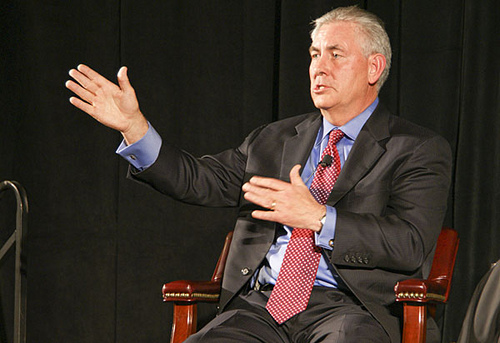
Secretary of State Rex Tillerson spoke to this question on Wednesday while discussing the role of values in U.S. foreign policy decision making.

Now I think it’s important to also remember that guiding all of our foreign policy actions are our fundamental values: our values around freedom, human dignity, the way people are treated. Those are our values. Those are not our policies; they’re values. And the reason it’s important, I think, to keep that well understood is policies can change. They do change. They can change … Our values never change.

Tillerson’s remarks suggest that human rights will be a component of the Trump administration’s foreign policy paradigm.

As in past administrations, U.S. engagement with foreign nations takes into consideration U.S. national interests, national security priorities, opportunities for economic advancement, and of course, human rights.

Tillerson reiterated that U.S. engagement with foreign countries, especially on human rights, may look different based on the various interests at stake.

Although frank, this admission reflects a realistic understanding of the complex nature of U.S. relations with other countries. It says that the U.S. should make clear its values and voice them, but also recognize that a foreign policy solely focused on human rights would be restrictive.

Unfortunately, the U.S. must deal with governments that are less than perfect in their respect for human rights—sometimes considerably so. But perspective and consideration are necessary.

Consider the cases of China and Cuba.

Addressing major threats to the U.S. and its allies should include working with China on issues like maritime security and the proliferation of weapons of mass destruction is necessary, even if we regard China’s domestic policies as abhorrent.

By contrast, restoring diplomatic relations with Cuba without requiring changes to its own repressive policies sends the signal that human rights are not a priority for the U.S.

Either way, Tillerson acknowledged that “…in some circumstances, [the U.S.] should and [does] condition our policy engagements on people adopting certain actions as to how they treat people.”

Balancing these priorities requires sound advice and judgement. To ensure that human rights are a priority, the administration should move quickly to fill crucial positions in the State Department.

Early on in the administration, President Donald Trump held a meeting with key stakeholders in the human trafficking community, signaling that U.S. leadership on trafficking in persons is critical to ending this global scourge.

Human trafficking may prove to be a gateway issue for other human rights concerns internationally and at home.

With the U.S. Department of State’s annual Trafficking in Persons report slated to come out mid-summer, and key legislation—the Trafficking Victims Protection Act—up for reauthorization, the conversation on trafficking will continue to be of importance through the rest of 2017.

The administration should take advantage of the ongoing conversation on human trafficking to reassert U.S. leadership, not just on trafficking, but also on other pressing human rights challenges. These include major threats to democracy and good governance across the globe, as well as the continued rise of religious persecution.

Advancing first principles and core American values overseas has been a critical component of past administrations, and should remain a critical part of the Trump administration’s foreign policy priorities. For that, more critical roles need to be filled.

Tillerson’s remarks offer promise that this will continue to be the case, but he cannot do it alone. (For more from the author of “Is the White House Embracing Human Rights in US Foreign Policy?” please click HERE)

Follow Joe Miller on Twitter HERE and Facebook HERE.

Cruz on Obama's Foreign Policy: 'Weakness is Provocative'

Photo Credit: Gage Skidmore

Photo Credit: Gage Skidmore

Sen. Ted Cruz, R-Texas, has surveyed what he calls “the Obama-Clinton foreign policy,” and he does not like what he sees.

Speaking Wednesday at The Heritage Foundation, Cruz condemned current policy as “appeasement and moral equivalency.”

Said Cruz: “One of the sad legacies of the last six years” is that “our friends no longer trust us and our enemies no longer fear us,” and that the United States risks going from “the leader of the free world to a dutiful and obedient member of the international community.”

Cruz criticized former Secretary of State Hillary Clinton’s remarks that we should “respect” and “empathize” with our enemies.

“What our foreign policy needs isn’t empathy,” said Cruz. “We need clarity, force and resolve. When America recedes from the world, the world is more dangerous.”

Read more from this story HERE.

Radio Host: Obama Has An ‘Anti-American Foreign Policy’

Photo Credit: Jacquelyn Martin / AP

Photo Credit: Jacquelyn Martin / AP

Coming to talk radio entirely by accident after a long career in mainstream journalism, Chris Plante, 54, is a rising national star who excels at entertaining and informing his growing audience. With a unique, authentic voice, this quick-witted host often engages with callers who disagree with him by listening and then asking them tough questions.

If the caller won’t engage, he’ll dismiss them as just another “squirrel in the backyard,” while giving sustenance to listeners who frequently report altered thinking from listening to Plante, much to the chagrin of what he describes as “the loony left.”

We interviewed Plante after one of his successful 3 hour morning shows atWMAL in Washington, D.C. He can be found at iHeartRadio and is also a Cumulus host, a network which is, theoretically, in 110 cities and which could put him on air in other cities.

With 17 years spent at CNN, Plante is a frequent thorn-in-the-side of the mainstream media. In this exclusive 22 minute video interview, Plante says, “I think the Iranian regime wishes that they had a media as compliant as the American media is to the Obama administration. It is just a referee bought and paid for by one team, by the Democrats.”

Referring to the drone attacks that killed four American citizens on orders by our President, Plante says “he [Obama] literally, gets away with murder.” When you consider it, the precedent “is very, very bad.”

Read more from this story HERE.

Prolific Historian: The Irony of Obama Feigning Peace Could Cause War (+audio)

Photo Credit: APTo one prominent historian and world observer, President Obama’s policies are raising the stakes for war, as well as extinguishing opportunities for our youth as the country gets more Europeanized.

When President Obama abdicates American world leadership, knowingly or not, he raises the likelihood that in the next two years, belligerents around the globe may take more risks because America is no longer likely to respond. What kind of risks are there for the country?

Victor Davis Hanson of the Hoover Institution says these risks could include, “I will cross the 38th parallel. I’m going to readjust this settlement in Cypress. I’m going to bully Japan, or Taiwan is ripe for invasion, or maybe we can take another Soviet republic back into Russia, or South America, there’s areas for aggrandizement.”

Confusing America’s former allies and adversaries, President Obama’s rejection of American exceptionalism has consequences not readily realized. Hanson says in this new 26 minute video interview with The Daily Caller filmed on June 10, “The irony is that Obama wants to be the global peacemaker, but by projecting this image of ambivalence, he’s going to be the global war-maker, if he’s not careful.”

Read more from this story HERE.

Blame Obama First: The President’s National Security Team Isn’t the Problem. Obama Is.

Photo Credit: APBy Matthew Continetti.

On June 12, as al Qaeda forces marched toward Baghdad, John McCain spoke on the Senate floor. Noting that the al Qaeda affiliate ISIS has conquered a third of Iraqi territory, has overrun the city of Mosul, has captured abandoned American equipment, and has stolen more than $400 million in cash reserves, McCain said that the enemies of the United States are on the verge of a strategic victory. Only a major course correction, McCain went on, might prevent the emergence of an al Qaeda state that stretches from eastern Syria to the outskirts of Baghdad. “It’s time that the president got a new national security team,” he said.

Criticism of that team—of Obama’s National Security Adviser, his Secretaries of Defense and State, and his top foreign policy speechwriter—has been mounting. “This is what happens when hacks take over foreign policy,” Kim Strassel wrote last week in a devastating Wall Street Journal column. The criticism is bipartisan. Col. Jack Jacobs, a NBC military analyst, said the other day that the Obama team “most decidedly” is weak, “and isolated, and a lot of decisions it makes are either ill considered or do not consider everything that needs to be considered.” David Ignatius is blunt: “The administration,” he said on Morning Joe, “is going to have to step up.”

The cliché “personnel is policy” strikes me as true. But its truth is a function of whether the personnel we are talking about actually have the capacity to make decisions. “The first thing I think we need to do,” McCain said on the Senate floor, “is call together the people that succeeded in Iraq, those that have been retired, and get together that group and place them in positions of responsibility so that they can develop a policy to reverse this tide of radical Islamic extremism, which directly threatens the security of the United States of America.”

McCain is dreaming. Does anyone think President Obama is about to replace Susan Rice with Fred Kagan, and switch out General Austin for General Petraeus? To assign responsibility for American incompetence to President Obama’s National Security Council is to miss the target. The NSC is a symptom of the dysfunction, not its cause. Behind our endless series of foreign-policy screw-ups—Benghazi, Snowden, Syria, Crimea, Bergdahl, Iraq—is not Obama’s team. It’s Obama.

Read more from this story HERE.

________________________________________________________________________

Photo Credit: APObama rules out sending troops back into combat in Iraq but promises to review military options – including air strikes

By David Martosko.

Barack Obama said Friday that his national security team will soon provide him with a list of ‘selective actions by our military’ to help push back a terrorist horde marching through Iraq, but insisted that ‘we will not be sending U.S. troops back into combat’ there.

He will be ‘reviewing options in the days ahead,’ the U.S. president said in a hastily scheduled statement on the South Lawn of the White House, before boarding Marine One en route to Bismarck, North Dakota.

The murderous Islamic State in Iraq and the Levant (ISIS), formerly known as Al-Qaeda in Iraq, ‘poses a danger to Iraq and its people,’ Obama said, ‘and given the nature of these terrorists, it could pose a threat to America and its interests as well.’

But he emphasized that Iraq’s government should ‘solve their own problems.’

The United States, Obama insisted, will not get involved in a protracted military campaign in the absence of work toward a political solution in the nation that Saddam Hussein once ruled with an iron fist.

Read more from this story HERE.

John Bolton: Children Are In Charge Of Obama’s Foreign Policy (+video)

When asked about the Administration’s response to the kidnapping of over 200 Christian girls by a radical Islamist group in Nigeria, Bolton told WMAL radio in Washington, DC, that the President’s “hashtag diplomacy” is “embarrassing” and merely a “way of emoting. I bet it makes the people who do it feel good, but it has no impact on what’s actually going on in Nigeria.”

Read more from this story HERE.

Obama’s Foreign Policy of Denial

Photo Credit: Charles Dharapak

Photo Credit: Charles Dharapak

Barack Obama’s 949-word response Monday to a question about foreign policy weakness showed the president at his worst: defensive, irritable, contradictory and at times detached from reality. It began with a complaint about negative coverage on Fox News, when, in fact, it was the New York Times’ front page that featured Obama’s foreign policy failures, most recently the inability to conclude a trade agreement with Japan and the collapse of Secretary of State John Kerry’s Middle East negotiations.

Add to this the collapse of not one but two Geneva conferences on Syria, American helplessness in the face of Russian aggression against Ukraine and the Saudi king’s humiliating dismissal of Obama within two hours of talks — no dinner — after Obama made a special 2,300-mile diversion from Europe to see him, and you have an impressive litany of serial embarrassments.

Obama’s first rhetorical defense, as usual, was to attack a straw man: “Why is it that everybody is so eager to use military force?”

Everybody? Wasn’t it you, Mr. President, who decided to attack Libya under the grand Obama doctrine of “responsibility to protect” helpless civilians — every syllable of which you totally contradicted as 150,000 were being slaughtered in Syria?

And wasn’t attacking Syria for having crossed your own chemical-weapons “red line” also your idea? Before, of course, you retreated abjectly, thereby marginalizing yourself and exposing the United States to general ridicule.

Read more from this story HERE.

Obama’s Foreign-Policy ‘Flexibility’ Seen as Weakness

By Joseph R. John.

The below listed Op-Ed was written by Admiral James A. Lyons, USN (Ret), the former Commander-In-Chief of the Pacific Fleet; he discussed the unilateral disarmament of the US Armed Forces by the occupant of the Oval Office, while Russia, China, Iran, and Al Q’ieda are building up their military strength.

Admiral Lyons discusses how the Obama administration’s 5 year foreign policy retreat resulted in Russia’s aggression in Crimea and Ukraine, China’s aggression opposing Japan ownership of the Senkaku Islands, Iran’s aggression against Israel & its development of nuclear weapons because Obama unilaterally lifted sanctions, Assad’s aggression against Syrian freedom fighters & his use of chemical agents again this past week against Syrian freedom fighters, and Egypt’s shift from its close relationship with the US to the establishment of a new military alliance with Russia.

Obama halted 30 years of longstanding military aid to Egypt, when the pro US Military Junta ousted Moslem Brotherhood President Mohammed Morsi. Morsi was deposed because his supporters were rioting & killing Christians throughout Egypt, and because Egyptian State Security documented for US Intelligence Agency in 2012 that Mohamed Morsi was a co-conspirator in the attack on the US Mission in Benghazi, that resulted in the death of 4 Americans (the Obama administration has withheld the fact that Morsi was a co-conspirator in the attack on the US Mission from the American people for 20 months).

As soon as Obama halted longstanding military aid to the new pro-US military Junta, Putin executed a long term military alliance with Egypt. Russia is now providing Egypt with $2 billion in military aide consisting of MIG 29M/M2 Fulcrum jet fighters, MI-35 helicopters, air defense missiles, coastal anti-ship defensive complexes, light weapons, and supporting ammunition. Saudi Arabia and the United Arab Emirates are paying Russia for that on-going military aid to Egypt, displacing America’s strongest Arab military ally in the Middle East.

The Black Flag of Al Q’ieda is now flying over territories it has been acquiring in its massive expansion over the last 5 years in Eastern Libya, in Fallujah in Iraq, in large areas of Yemen, in southern Somalia, in areas of Afghanistan, in the tribal region of Pakistan, and Al Q’ieda has been involved in the cocaine trade with FARC terrorists from Columbia, working in the Tri Border area of Argentine/Brazil/Paraguay based in the city of Ciudad del Este. Obama replaced Spec Ops boots on the ground that used to attack and capture Al Q’ieda terrorists for interrogation, with drone strikes from afar that has done nothing to stem the out of control worldwide expansion of Al Q’ieda over the last 5 years. Whenever an Al Q’ieda leader that is taken out by a drone strike, he is simply replaced by another Al Q’ieda leader.

History has taught mankind over the last 2000 years that, “Weakness Encourages Aggression”; President Ronald Reagan understood that well known fact and followed a different course, “Peace Through Strength.” The current occupant of the Oval Office still doesn’t understand the “Weakness Encourages Aggression” and for the past 5 years he has been intentionally disarming the US Armed Forces and systematically dismantling many of America’s military alliances.

Captain Joseph R. John, a combat veteran, is a 1962 graduate of the United States Naval Academy who retired from the US Navy after a long and distinguished career. He currently is the President of the Combat Veterans Training Group and is the founder of the Combat Veterans for Congress PAC.
_______

Photo Credit: Greg Groesch / The Washington Times

Photo Credit: Greg Groesch / The Washington Times

Obama’s foreign-policy ‘flexibility’ seen as weakness

By James A. Lyons.

The administration Kabuki dance we’re witnessing featuring U.S. refusal to provide nonlethal support equipment for Ukraine is President Obama displaying the new “flexibility” he promised Vladimir Putin he would have after his re-election. In short, it is capitulation.

The administration is trying to make the case that by showing restraint, Mr. Obama will encourage Mr. Putin, the Russian president, to be more willing to negotiate. The mind boggles. What’s taking place in Ukraine has far-reaching implications for the United States and our allies in both Europe and the Far East.

The apparent lack of support from NATO’s political leadership to help Ukraine maintain its sovereignty is clearly tied to its dependence on Russia for more than 30 percent of their energy requirements. This compromised position was accepted based on the assumption that European security after the Cold War could be guaranteed (with reduced defense budgets) by engaging Russia, not confronting it.

This now appears to be a costly error, since it has been known for some time that NATO’s engagement policies have not required Russia’s reciprocity. However, one positive outcome of the current crisis should be an unmistakable wake-up call for NATO, as its credibility is clearly being challenged.

The administration’s rationale for not providing nonlethal equipment, such as night-vision devices, body armor, medical kits, uniforms, boots and military socks to the “victim” is that it could be perceived by Russia as “destabilizing” and as a “force-multiplier,” and, therefore, too provocative. This is nonsense. Russia has deployed 40,000 fully equipped, modernized troops backed up by tanks, aircraft and helicopters, plus paid KGB goon squads that are creating havoc in Eastern Ukraine.

Read more from this story HERE.

Obama’s Fading Dream of a Foreign Policy Legacy

Photo Credit: Getty Images

Photo Credit: Getty Images

President Barack Obama envisioned building a foreign-policy legacy in his second term: a nuclear deal with sanction-strapped Iran, an end to U.S. involvement in conflicts overseas, and a successful pivot to Asia, including a trans-Pacific trade pact.

Fifteen months after his second inaugural, those goals look more problematic, and Syria’s Bashar Assad and Russia’s Vladimir Putin have created new crises. Dashed foreign-policy dreams aren’t unique to this second-term president: Dwight D. Eisenhower had to contend with the downing of a spy plane by the Soviet Union, the Iran-contra scandal bedeviled Ronald Reagan, and the Iraq War turned into a nightmare in George W. Bush’s second term.

Obama’s woes are complicated by a sense — denied by the White House — of American disengagement. “The perception of American withdrawal is palpable,” says Stephen Hadley, the national security adviser to George W. Bush.

“The Europeans and the Gulf states think that we’re leaving,” says Bill Cohen, who served as defense secretary under President Bill Clinton. “The Asian countries think we’re not coming.”

Moreover, the president is caught in a contradictory, and unfair, squeeze. On issues such as Syria and Russia, he’s depicted as insufficiently aggressive or tough. At the same time, the American public, turned off by the Iraq and Afghanistan wars, wants no part of more aggressive foreign entanglements. Even some Republicans are taking cues from Senator Rand Paul’s quasi-isolationists stance.

Read more from this story HERE.