Posts

Democrats Are About to Get Their 2020 Gun Control Candidate

The 2020 Democratic presidential field is about to get even more packed, and one prospective candidate wants to make his run all about gun control.

According to a report published by The Atlantic on Thursday, staunch gun control proponent Rep. Eric Swalwell (D-Calif.) has made plans to announce his presidential bid on late night television next week and will “center his campaign on gun control.”

Swalwell was a vocal supporter of a major House gun control bill that passed a few weeks ago, but his track record on anti-gun legislation goes back further.

In May 2018, he penned an op-ed in favor of banning and confiscating “military-style semiautomatic assault weapons” and wrote that “we should buy back such weapons from all who choose to abide by the law, and we should criminally prosecute any who choose to defy it by keeping their weapons.” . . .

Currently, Swalwell is an original co-sponsor of House Democrats’ “Assault Weapons Ban of 2019,” which would ban 205 firearms by name and cast a wide net against other semi-automatic guns as well as guns with “military-style” cosmetic features. (Read more from “Democrats Are About to Get Their 2020 Gun Control Candidate” HERE)

Follow Joe Miller on Twitter HERE and Facebook HERE

Meet the Sheriff Willing to Go to Jail to Protect His Residents’ Second Amendment Rights

By The Blaze. Colorado lawmakers are on the brink of passing a so-called “red flag” law, which would allow courts to revoke the Second Amendment rights of citizens who are declared threats to themselves or others.

Some Colorado sheriffs have vowed to not enforce the law if approved. And then there is Weld County Sheriff Steve Reams who has declared he is willing to go to jail in order to protect his constituents’ Second Amendment rights. . .

The law, which gun right advocates overwhelmingly oppose, has earned opposition from more than half of Colorado’s 64 counties, some of which have passed resolutions declaring their municipalities Second Amendment “sanctuaries.”

However, as CNN noted, failure to comply with a court order “to seize a person’s guns could mean sheriffs being found in contempt. A judge could fine them indefinitely, or even send them to jail to force them to comply.” For Reams, jail is a sacrifice he is willing to make.

“[The law] has so many constitutional questions,” Reams told KDVR-TV. “I can’t in good faith go forward and carry out a law that I believe puts constituents’ constitutional rights at risk.” (Read more from “Meet the Sheriff Willing to Go to Jail to Protect His Residents’ Second Amendment Rights” HERE)

____________________________________________________

Resolution Declares Weld County to Be a ‘Second Amendment Sanctuary’

By Fox News 31. Sheriff Steve Reams said the bill crosses too many constitutional lines and says the issue is mental health, not firearms.

“I have a duty for public safety but also have a duty to protect the Constitution,” Reams said.

The commissioners affirmed their “support for the Weld County Sheriff in the exercise of his sound discretion to not enforce against any citizen an unconstitutional firearms law,” according to the resolution. . .

Reams said the “red flag” bill would put deputies in greater danger.

“The way the bill is written is asking me or my agency to go out and affect one of these gun grabs, if you will, without any notification to person that we’re coming,” he said. “I think that puts my agency at undo risk.” (Read more from “Resolution Declares Weld County to Be a ‘Second Amendment Sanctuary'” HERE)

Follow Joe Miller on Twitter HERE and Facebook HERE

Dick’s Sporting Goods Lost Millions Over Anti-Gun Policies – Here’s How Much the Backlash Cost

Dick’s Sporting Goods took a loss of an estimated $150 million in sales last year after the company heavily restricted firearm purchases and began advocating for gun control.

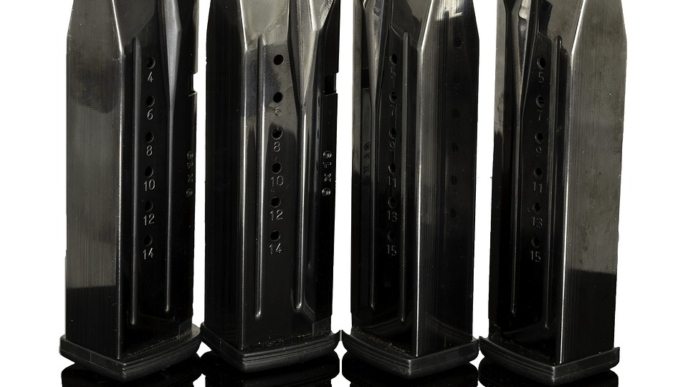
The company made various policy changes after a school shooting in Parkland, Florida, left 17 dead. It announced it would no longer sell modern sporting rifles or high-capacity magazines and increased the purchase age for all firearms to 21. . .

The anti-gun shift made massive waves when it was first announced in February 2018 and Stack was accused of violating fiduciary duties by knowingly and purposely giving up money. Some gun manufacturers cut ties with Dick’s and the National Shooting Sports Foundation (NSSF) expelled the company from its membership. The loss of customers was also almost immediately felt.

“Sales are so anemic and relations with gun manufacturers such as Mossberg so poor right now that you’ve even indicated Dick’s might get out the gun business entirely,” David Almasi, a vice president at the National Center for Public Policy Research, said in June on a shareholder’s call. “Meanwhile, Sportsman’s Warehouse reports that their gun sales and net sales were up 15 percent during the first quarter. That company credits consumer backlash against companies such as Dick’s as partially responsible for its success.” (Read more from “Dick’s Sporting Goods Lost Millions Over Anti-Gun Policies – Here’s How Much the Backlash Cost” HERE)

Follow Joe Miller on Twitter HERE and Facebook HERE

Federal Judge Strikes Down Ban on Firearm Magazines

By The Blaze. A federal judge struck down a California ban on magazines that are capable of housing more than 10 rounds because he said the law violated the Second Amendment.

Judge Roger T. Benitez of the U.S. District Court for the Southern District of California issued the judgement on Friday afternoon and totally invalidated the ban. . .

“Plaintiffs contend that the state’s magazine ban thus cannot survive constitutionally-required heightened scrutiny and they are entitled to declaratory and injunctive relief as a matter of law,” he explained. “Plaintiffs are correct.” . . .

“Judge Benitez took the Second Amendment seriously and came to the conclusion required by the Constitution,” said NRA-ILA Executive Director Chris Cox.

“The same should be true of any court analyzing a ban on a class of arms law-abiding Americans commonly possess for self-defense or other lawful purposes,” he concluded.

(Read more from “Federal Judge Strikes Down Ban on Firearm Magazines” HERE)

__________________________________________________

Federal Court Strikes Down Magazine Ban

By The Daily Caller. Judge Benitez continues, “The statute hits at the center of the Second Amendment and its burden is severe. When the simple test of Heller is applied, a test that persons of common intelligence can understand, the statute fails and is an unconstitutional abridgment. It criminalizes the otherwise lawful acquisition and possession of common magazines holding more than 10 rounds – magazines that law-abiding responsible citizens would choose for self-defense at home. It also fails the strict scrutiny test because the statute is not narrowly tailored – it is not tailored at all.”

The ruling is another legal blow to gun control efforts in the state. Back in July, a three-judge panel of the Ninth Circuit ruled in the case to uphold a lower court’s ruling to block the enforcement of California’s restriction on the possession of firearm magazines that hold 10 rounds or more. . .

California has banned selling or purchasing magazines with more than a 10-round capacity since 2000; however, anyone who possessed these magazines prior to the law was grandfathered in and were allowed to keep the magazines. Three years ago, voters approved a measure to do away with the provision and the NRA filed a lawsuit. (Read more from “Federal Court Strikes Down Magazine Ban” HERE)

Follow Joe Miller on Twitter HERE and Facebook HERE

How Anti-Gun States Can Already Confiscate Guns Without Trial

Nobody wants clearly dangerous people to have guns, but new confiscation laws in anti-gun states are dangerous for gun owners, law enforcement, and the Bill of Rights.

On Tuesday, the Senate Judiciary Committee held a hearing titled “Red Flag Laws: Examining Guidelines for State Action.” Red flag laws, also called Extreme Risk Protection Orders or ERPOs, seek to identify dangerous people before they commit violent crimes and remove their access to firearms. Reports can be filed about a potentially dangerous person, whose Second Amendment right to own a gun can then be removed with very little process.

As of last month, 14 states have laws on the books empowering judges to issue red flag orders. While some have existed for a while, these laws became more popular at the state level following the 2018 Parkland shooting in Broward County, Florida, partly because of the clear warning signs that the murderer gave leading up to the attack and the tips that were fumbled by federal law enforcement.

Nobody wants people who are clearly dangerous to themselves and the public to have firearms. That’s why a lot of people own firearms themselves. So the impetus to take guns away from would-be mass shooters is at least an understandable one.

Additionally, such laws have been intended to cut firearm suicide rates in some states. However, taking away a gun merely removes a means of committing suicide. If a person is intent on killing himself and doesn’t get the help he needs, there are other ways it can be done.

But where’s the line clearly showing it’s OK to take away a person’s constitutional right?

“While the idea for these laws is reasonable, some statutes are not,” Independent Institute Research Director Dave Kopel pointed out in his testimony to the committee. “They destroy due process of law, endanger law enforcement and the public, and can be handy tools for stalkers and abusers to disarm the innocent victims.”

Kopel explained that while some state laws stipulate that only law enforcement can bring a red flag petition to a judge, newer versions allow petitions to be brought by “spurned dating partners or relationships from long ago.”

Another big due process problem with some of these statutes is that confiscation orders can be issued ex parte under some state laws, which means that they can be issued when a judge only hears one side of the story and the target of the petition is not permitted to defend himself.

Michael Hammond, legislative counsel for Gun Owners of America, describes these laws as allowing “police to convene a Kafkaesque secret proceeding, in which an American can be stripped of his or her gun rights and Fourth Amendment rights, even though gun owners are barred from participating in the hearings or arguing their side of the dispute.”

People affected by confiscation orders can typically petition to get their guns back after the fact, but even if they’re successful in doing so, they were still deprived of a constitutional right without even being able to confront their accusers. And when some states allow ex-dating partners to bring petitions without any sort of investigation and without giving people a chance to defend themselves, that’s just an outright mockery of the Fifth Amendment.

“If the Constitution can be suspended in a secret hearing, where does this lead?” Hammond writes. “What if this newspaper could be shut down for 21 days without due process — based on a secret complaint?”

Then there’s a practical public safety concern that stems from laws like this. It’s just one reason that sheriffs in several states don’t want to enforce these orders: When you take people’s rights away without giving them a chance to even show up in court and defend themselves, they might react adversely, endangering both law enforcement and the gun owners. Several law enforcement officials in Colorado have recently said that they will not enforce the state’s proposed red flag legislation if it becomes law.

Under the newer model for these laws being pushed by gun control organizations, Kopel explains, confiscation orders trigger “automatic, no-notice, surprise confiscation.” This system already claimed the life of a 61-year-old Maryland man last year after the cops showed up for a surprise confiscation just after five in the morning.

The impulse to take guns away from people who pose a clear threat to public safety is understandable. And taking Second Amendment rights away from people for non-criminal reasons is already on the books. Someone who has been adjudicated “as a mental defective” or involuntarily committed to a mental institution can’t buy a gun. But those situations, too, require due process of law.

And understandable impulses can easily be twisted for tyrannical ends, especially when one side of the debate has an overriding, unsatisfied desire for draconian gun control.

This is why we have the Bill of Rights: It not only protects our right to keep and bear arms, but also our right to due process of law so that our life, liberty, and property can’t be taken from anyone by mere government whim or fiat … or by the lone testimony of anybody with a grudge. (For more from the author of “How Anti-Gun States Can Already Confiscate Guns Without Trial” please click HERE)

Follow Joe Miller on Twitter HERE and Facebook HERE

Bernie Sanders Calls for Stripping of Second Amendment Rights Overnight

Late last night New Zealand Prime Minister Jacinda Ardern announced a ban on “military-style” semi-automatic rifles in the country.

“Today I am announcing that New Zealand will ban all military-style semi-automatic weapons. We will also ban all assault rifles. We will also ban all high capacity magazines,” she said. “We will ban all parts with the ability to convert semi-automatic or any other type of firearm into a military-style semi-automatic weapon.”

. . .

Democrat presidential candidate and socialist Bernie Sanders endorsed the move right away and said it needs to happen in the United States. He wants to strip Americans of their Second Amendment rights overnight.

Based on the specific criteria outlined in the New Zealand ban, Sanders is calling for a ban on essentially every firearm in the United States. The functional definition of “assault rifle” in this case includes nearly all firearms in regular, legal and proper use by millions of Americans. New Zealand doesn’t have a Second Amendment. The United States of America does.

As a reminder, the man who helped stop the horrific mosque shooting — which has prompted these extreme measures — chased the shooter away with a semi-automatic handgun.

(Read more from “Bernie Sanders Calls for Stripping of Second Amendment Rights Overnight” HERE)

Follow Joe Miller on Twitter HERE and Facebook HERE

Guns, Ammo, and Tactical Gear: Oh My! Here’s How Much Firepower Swamp Agencies Have Stockpiled

As you get ready to file those tax forms before the annual April deadline, it might interest you to know that the Internal Revenue Service (IRS) currently has 15 submachine guns and around five million rounds of ammunition at its disposal.

And while those numbers might seem shocking to many, the IRS isn’t the only federal agency with a stockpile. According to a GAO report from December, a lot of federal agencies have a lot of firepower.

A recent article by Adam Andrzejewski, founder and CEO of Open the Books, a transparency nonprofit, points out some rather eye-popping procurements by federal agencies over the past decade.

The IRS currently has 4,461 guns, including 621 shotguns, 539 rifles, and those 15 submachine guns. The Department of Health and Human Services has over one million rounds of ammunition stockpiled for use.

The VA doesn’t just have red tape and long waiting times, it turns out. The agency also purchased almost 3,000 rounds for each of its almost 4,000 police officers between 2010 and 2017. The agency also has camouflage uniforms, riot gear, and “tactical lighting.”

In total, the GAO report lists “at least $1.5 billion in total” spending on ammunition, firearms, and tactical equipment between the 20 agencies it surveyed from fiscal years 2010 through 2017.

But while the title of Andrzejewski’s post asks why President Trump’s federal agencies have been stockpiling these weapons and ammunition, a great many of the purchases were made during the Obama administration.

Here’s a quick breakdown of the numbers by year, according to Appendix II of the GAO report:

While the IRS hasn’t spent any funds on new hardware since 2014, the agency’s ammunition purchases held somewhat steady into 2017.

The Environmental Protection Agency’s hardware purchases spiked in 2013, 2014, and 2016, but show very little for 2017.

VA law enforcement purchases showed a 2017 spike, though there were steady purchases and a 2011 spike during the Obama years.

HHS has two departments that have purchased munitions: The National Institutes of Health, which saw a spike in firearms buying in 2017, and and the Office of Inspector General, which did almost all of its recent gun shopping between 2010 and 2012.

Furthermore, the same section also outlines why each department and agency listed claims to need the firepower, though some information was deemed “sensitive” by HHS, the IRS, and the Transportation Security Administration and was redacted from the report’s original version.

Why do agencies have all this firepower? According to the report, each of these different agencies has its own federal law enforcement officers (FLEOs). For instance, the EPA’s police program “enforces the nations’ laws by investigating cases, collecting evidence, conducting forensic analyses; and provides legal guidance to assist with prosecutions.” The VA’s police force “Protects veterans by enforcing federal law at VA medical facilities (and some National Cemetery and Benefits locations) and by serving as initial response forces to active threat incidents.” And the NIH has guns to protect “our country’s scientific research and the NIH research community.”

Those explanations may or may not be reassuring to the small-government-minded, who might be coming down with an understandable case of the heebie-jeebies at this point.

Questions such as whether regulatory agencies require their own specific law enforcement capabilities, how much oversight Congress takes over these weapons purchases, and whether or not agencies should be limited in the amount of ammunition they can stockpile at a given time are all fair game. And they should be asked. Do you have to be concerned about a martial law crackdown to wonder if federal agencies stocked on firepower are a good thing? (For more from the author of “Guns, Ammo, and Tactical Gear: Oh My! Here’s How Much Firepower Swamp Agencies Have Stockpiled” please click HERE)

Follow Joe Miller on Twitter HERE and Facebook HERE

County Declares Itself ‘Second Amendment Sanctuary County’ to Protest Gun Law

In protest of a pending law that expands background check requirements for gun purchases, a New Mexico County has deemed itself a “Second Amendment Sanctuary County,” according to Fox News.

One of the laws in question, HB 8 would require background checks for gun purchases even between private citizens, which the New Mexico Sheriff’s Association called an unenforceable law.

The other law, HB 83, would create an “Extreme Risk Protection Order” that would authorize the seizure of guns and ammo from people who are deemed to be a danger to themselves or others. . .

New Mexico House Republicans expressed support for Quay County’s decision to pass a resolution in protest of the laws.

“We see counties starting to fight back against the over-reach of House Democrats,” state Rep. Rod Montoya (R-Farmington) said. “New Mexicans who are not even accused of a crime can lose their 2nd Amendment rights under this bill and that’s beyond wrong.”Under HB 8 it would be a misdemeanor to buy or sell a gun privately without a federal background check. (Read more from “County Declares Itself ‘Second Amendment Sanctuary County’ to Protest Gun Law” HERE)

Follow Joe Miller on Twitter HERE and Facebook HERE

Here’s Why Sheriffs in Washington State Are Now Receiving Death Threats

Spokane County Sheriff Ozzie Knezovich said he refused to enforce Washington State’s latest gun control law, I-1639. According to the Sheriff’s office, a person called into Crime Stoppers to report a threat made on Facebook.

“Sheriff Knezovich is going to get a bullet in his skull,” the post allegedly read. The caller also said he’d shoot anyone who disagrees with I-1639.

When investigators looked into the person’s Facebook account, the user also commented on a news story about Grant County Sheriff Tom Jones refusing to enforce the new law. The person commented on the news story saying, “I am going to kill every single one of them,” referring to Republicans. . .

Spokane County detectives are currently investigating the threats. Any information that is found will be forwarded to the Joint Terrorism Task Force and various law enforcement agencies throughout the state.

The ballot initiative has been controversial since it began collecting signatures. The Second Amendment Foundation challenged various aspects of the ballot measure, including its signature gathering process and the whether or not it violated the Second Amendment. (Read more from “Here’s Why Sheriffs in Washington State Are Now Receiving Death Threats” HERE)

Follow Joe Miller on Twitter HERE and Facebook HERE

GOP Senators Introduce Bill to Relax Regulations on Firearms Suppressors

A handful of Republican senators are trying to make it easier for hunters and recreational shooters to get equipment to better protect their hearing, but don’t expect the anti-gun crowd to go along with it.

On Thursday, GOP Sens. Mike Lee, Utah, John Cornyn, Texas, Rand Paul, Ky., James Risch, Id., and Mike Crapo, Id., introduced the “Silencers Helping Us Save Hearing Act of 2019,” which would “ensure the elimination of all federal regulations of suppressors.”

“Suppressors can make shooting safer for the millions of hunters and sportsmen that exercise their constitutional right to use firearms every year,” reads a statement from Lee’s office. “The current process for obtaining a suppressor is far too expensive and burdensome. Our bill would remove these unnecessary federal regulations and make it easier for firearms users to protect themselves.”

Given that there aren’t 60 Republicans to prevent a filibuster on this and the House speaker’s gavel is currently held by the vehemently anti-gun Nancy Pelosi, this legislation realistically has less than a snowball’s chance of making it to the president’s desk during this session of Congress.

But bills like this also spark conversations and debates to move cultural needle on an issue. And there’s a lot of complete misinformation out there about suppressors.

Suppressors, colloquially referred to as “silencers,” are non-lethal gun accessories that lower the volume of a gunshot, which, the press release notes, goes from around the level of an airplane takeoff to that of a running chainsaw.

If it’s been said once, it’s been said a thousand times, the term “silencer” is a gross and widespread misnomer. Suppressors don’t silence guns at all. They simply suppress the sound; hence the term. Don’t believe everything you see in movies. These devices aren’t as good at creating the kind of muffled “pew pew” sound that an international spy would need to discreetly assassinate someone outside a European cafe in broad daylight as Hollywood and the anti-gun lobby might lead you to believe. But they’re great at mitigating hearing damage for hunters and sportsmen who shoot on a regular basis.

If you don’t believe that, here’s some video of suppressors at work.

Despite this reality, suppressors are regulated much in the same way that fully automatic machine guns and short-barreled shotguns are. This means that there’s an extensive, expensive, and bureaucratic process to get hold of one legally. That process is what this bill is trying to end. (For more from the author of “GOP Senators Introduce Bill to Relax Regulations on Firearms Suppressors” please click HERE)

Follow Joe Miller on Twitter HERE and Facebook HERE