Posts

Is the Wall Possible? What Trump Can Do on Immigration

When Donald Trump is inaugurated as president in January, he has the authority to dramatically reshape immigration policy by himself.

While Trump would need Congress to appropriate money to fund his biggest campaign promise — building a wall across the southern border — he can act alone in other areas, just like President Barack Obama has, in deciding how to enforce immigration law.

“The president does have a lot of executive authority and discretion to enforce the law as he wishes,” said David Leopold, an immigration attorney and former president of the American Immigration Lawyers Association. “There is a lot of immigration enforcement discretion.”

How Trump Can Act Alone

In interviews with The Daily Signal, Leopold and other experts described how Trump could act on the many promises he made to overhaul U.S. immigration policy.

Trump can take immediate actions by himself, starting with canceling Obama’s 2012 Deferred Action for Childhood Arrivals program, or DACA, which has provided deportation protection and work permits to about 800,000 immigrants who were brought to the U.S. illegally as children.

The program grants protection for two years, after which beneficiaries can apply again. New applicants can still request DACA protection through the Department of Homeland Security’s U.S. Citizenship and Immigration Services (USCIS).

“One of questions is whether he would cut [DACA] off immediately or let the program sunset so that when people’s protection expires, he does not allow for renewals,” said Faye Hipsman, a policy analyst at the Migration Policy Institute. “USCIS is still receiving first-time DACA applications, so that would occur in a pretty staged and staggered manner.”

Trump could also permanently cancel a broader Obama program that made more people eligible for DACA protection and extended legal status to include the parents of U.S. citizens or legal residents. The Supreme Court has blocked that program.

In addition, Trump, if he wishes, can change the priorities of the Department of Homeland Security on who it seeks to deport.

The Obama administration asked Immigration and Customs Enforcement (ICE), the agency that handles most deportations, to focus its resources on those who are considered threats to public safety, or are have been convicted of crimes, usually a felony.

Other priorities for deportation include individuals who have been convicted of multiple misdemeanors, and recent arrivals who came here illegally after Jan. 1, 2014.

“Right now, the way the Obama administration is treating it, is unless you are a priority, we won’t actively go after you. Trump can flip that,” said Theresa Cardinal Brown, the director of immigration policy at the Bipartisan Policy Center, and a former policy advisor at the Department of Homeland Security.

After calling for mass deportations early on in his campaign, Trump has walked that back to say he would focus enforcement on illegal immigrants with criminal records.

“Right away, border security is one of the top five things he will try to address right out of the starting gate,” said Jessica Vaughan of the Center for Immigration Studies. “That includes taking the handcuffs off the immigration agencies and letting them get back to doing their job according to the law. I don’t want to say there will be immediate drastic change. But there are many things the Trump administration can do on their own right away to restore control to immigration policy.”

Seeking Help From Congress

Trump would need Congress’ cooperation on his signature proposal — finishing the construction of a wall across the southern border.

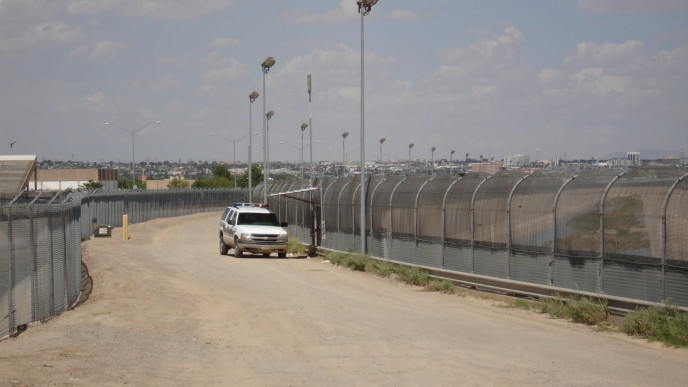
The border security mechanism that Congress would support would likely not come in the form of a brick-and-mortar wall described by Trump, but as extended fencing.

Immigration experts say the U.S. has spent billions in recent years fencing about one-third of the border.

The next president has the template to finish the job.

In 2006, the Republican-controlled Congress passed the Secure Fence Act, which authorized 700 miles of additional fencing along the border with Mexico. President George W. Bush signed the law. However, his administration later pushed for an amendment to the bill to give the government the discretion to determine what type of fencing was appropriate in the various areas of the border, depending on environmental and land-use restrictions.

As a result of that amendment, the majority of the fencing erected as a result of the law has been vehicle barriers — designed to stop vehicles rather than people, and single-layer pedestrian fencing. The original law called for double-layered fencing. Subsequent Republican attempts to require double fencing have failed.

“Depending on what type of infrastructure he wants, [Trump] probably already has the authorization to do it,” Brown said. “He just needs Congress to appropriate money.”

Similarly, Congress would have to approve the funding for another major Trump proposal: tripling the number of ICE agents who focus on deporting immigrants living in the country illegally.

Brown says personnel costs already make up about 80 to 90 percent of the budgets of ICE and Customs and Border Protection (CBP), the agency that protects the border.

The border patrol, meanwhile, has faced challenges fulfilling hiring goals mandated by Congress.

Republicans in Congress who share Trump’s hardline positions on immigration say they welcome his plans, even though they will certainly cost a lot of money.

“It seems to me the Republican conference sees we just had a seismic, historic election so there is a new mandate to get things right with immigration,” said Rep. Dave Brat, R-Va., in an interview with The Daily Signal. “It was one of [Trump’s] big issues, and one of my big issues that I ran on. So yes, it is worth the money. Look at France and Germany. If you don’t secure borders, you lose the entire country.”

House Speaker Paul Ryan, R-Wis., who met with Trump on Thursday, was asked by Fox News’ Bret Baier if he supports building a wall but committed only to “physical barriers.”

“I’m in favor of securing the border,” Ryan said. “And I do believe you need to have physical barriers on the border. I will defer to the experts on the border as to what is the right way to actually secure the border.”

Senate Majority Leader Mitch McConnell, R-Ky., is less committal on whether he’d support paying for a border wall.

Speaking to reporters Wednesday, McConnell did not directly answer questions about if he supports Trump’s wall proposal.

“I’m not going to go back and relitigate events of the past,” he said. “We have a new president. I would like to see him get off on a positive start. I think we should look forward and not backward and kind of rehash and relitigate the various debates we had internally and with the Democrats over the past year.”

Pressed again, McConnell added: “Border security is important. I think even our Democratic friends realize we haven’t done a very good job of that. Achieving border security is something that I think ought to be high on the list.”

But despite Republican control of the House and Senate, Trump’s border security plans needing congressional approval will likely be opposed by Democrats. In the Senate, Democrats still have the power of the filibuster to block legislation.

“If enforcement is his primary push, Democrats will be opposed to that unless legalization is part of the conversation,” Brown said. “That has been the quid pro quo on immigration for years.”

More Trump Proposals

Along with his more prominent proposals, Trump has also called for punishing so-called sanctuary cities that limit their cooperation with federal immigration authorities.

Trump could withhold federal funding from those cities, but would need support from Congress to do so.

The president-elect has not limited his plans to illegal immigration.

He said he would reduce legal immigration levels, a step requiring the approval of Congress.

And Trump said he would suspend immigration from countries that are “compromised by terrorism,” although he has not clarified what countries he’d consider. (For more from the author of “Is the Wall Possible? What Trump Can Do on Immigration” please click HERE)

Follow Joe Miller on Twitter HERE and Facebook HERE.

Immigration Lunacy: DOJ Seeks to Prosecute Sheriff Arpaio for Enforcing Federal Immigration Law

The inmates are running the asylum. Literally.

In Stolen Sovereignty, I warned about judges granting citizen rights to those who are in the country without the consent of the people and providing them standing to sue for affirmative benefits. Now, in the latest legal assault on Arizona, law enforcement, and sovereignty, illegal aliens have succeeded in getting a radical judge and the Obama Administration to collude against Maricopa County Sheriff Joe Arpaio and charge him with criminal contempt for enforcing federal immigration and national sovereignty in his jurisdiction, which has been devastated by the effects of illegal immigration. He faces up to six months in jail if convicted of contempt. Meanwhile, the most violent criminal aliens remain at large in the state. This is Orwellian beyond imagination.

In August, Judge G. Murray Snow of the U.S. District Court of Arizona took the unprecedented step of referring Arpaio for misdemeanor criminal contempt charges for allegedly not following a prior court injunction against his police tactics of apprehending those reasonably suspected of being in his jurisdiction illegally. The injunction stems from a 2007 class-action lawsuit brought by the ACLU and the Mexican American Legal Defense and Educational Fund (MALDEF) accusing the Maricopa County Sherriff of racial profiling — the golden goose of liberal litigation against law enforcement. After soliciting federal officials to take action against a sitting sheriff protecting one of the most dangerous jurisdictions, the Obama DOJ took up the mantle and brought charges against Arpaio the day before early voting began in his race for reelection. The charges were brought up at a hearing last Tuesday, called for by Judge Susan Bolton who herself is a notorious liberal activist who has sided with illegal aliens over Arizona sovereignty for years.

When the charges were announced, the Arizona Republic observed the unprecedented nature of this case:

Announcement of the charge, which came minutes into the start of the criminal-contempt proceedings, surprised even those closest to the lawsuit.

“Usually a set status conference is a meeting between the court and council to discuss legal issues,” said Mel McDonald, Arpaio’s defense attorney. “We had no clue that they were going to come here today and make the announcements that they made.”

McDonald said Arpaio will plead not guilty.

Legal experts say the judge and attorneys have little historical guidance moving forward with the case.

“As rare as it is to have a federal judge refer the head of a law-enforcement agency for prosecution, it is even rarer that the Department of Justice would pick up that gauntlet and move forward with the charge,” said Paul Charlton, a former U.S. attorney for the District of Arizona. “It’s unheard of.”

As I note in my book, our Founders are rolling over in their graves at the sight of a sheriff being placed on trial for taking common sense steps to protect his state’s sovereignty and applying federal law in cases of reasonable suspicion laws over which Congress, not the judiciary, has plenary authority. While Arpaio admits to mistakenly violating the injunction, the broader question is how a federal court can issue an injunction against sovereignty laws of a nation using … you guessed it … the Fourteenth Amendment. Arpaio was acting according to federal law, which requires the federal government to respond to state inquiries on an individual’s immigration status [8 U. S. C. §1373c]. Yet, he is potentially facing jail time while illegal aliens chanted “Si se puede! Si se puede!” outside the court house. This is an image and a perverse juxtaposition even Orwell could never have imagined.

A number of important observations are in order:

1. While thousands of criminal aliens are being released onto the streets of Arizona, Sheriff Arpaio is the one who is facing the prospect of jail time. There is something fundamentally wrong when a state like Arizona is being destroyed by a foreign invasion and local elected officials are hamstrung from defending the state, even though they are following federal law. At the same time, sanctuary cities that thwart federal immigration law, are being rewarded by the federal judiciary.

2. While illegal aliens get standing in court to sue over the enforcement of federal immigration laws — as we covered last week — Arpaio and other law enforcement officers were never able to get standing to sue Obama for violating federal immigration law when he implemented the DACA amnesty. As Janice Rogers Brown wrote in her concurring opinion in the Arpaio case where she reluctantly accepted the precedent on standing issues, “if an elected Sheriff responsible for the security of a county with a population larger than twenty-one states cannot bring suit, individual litigants will find it even more difficult to bring similar challenges.” By individual litigants, she meant taxpayers suing on behalf of American sovereignty, not illegal aliens suing to remain in this country against the national will.

3. The legacy of the Supreme Court’s decision in Arizona v. United States — in which the court gutted the state’s ability to protect itself — will make life harder for Arpaio’s defense and any law enforcement agency that wants to protect sovereignty. That decision, which was authored by Justice Anthony Kennedy and joined by Chief Justice John Roberts, was shredded by Justice Antonin Scalia who was so irate he read his dissent from the bench. He warned that the court’s injunction against SB 1070 “deprives States of what most would consider the defining characteristic of sovereignty: the power to exclude from the sovereign’s territory people who have no right to be there.” “Neither the Constitution itself nor even any law passed by Congress supports this result,” wrote an indignant Justice Scalia.

4. How ironic that the courts are now using the Fourteenth Amendment to steal the sovereignty of the nation and the states. House Judiciary Committee Chairman James F. Wilson said during the debate over the 14th Amendment in 1866 that the addition to the Constitution established “no new right” and declared no new principle: “[I]t is not the object of this bill to establish new rights, but to protect and enforce those which belong to every citizen.” Tragically, that amendment — which was designed to protect existing rights of American citizens — is being used to disenfranchise the citizenry at the hands of illegal aliens!

5. Consider the damage wrought upon Arizona by illegal immigration as the sheriff who is protecting his people faces jail time. Here are some key facts from chapter five of my book:

As of 2013, it was estimated that there were 630,700 illegal aliens residing in Arizona (including American-born anchor babies). That is a population of foreign invaders larger than the total population of any single colony at the time of our Founding.

Over 10% of the state’s public school population is comprised of illegal alien children. When coupled with the fiscal strain of health care and incarceration, the total cost of illegal immigration is $2.4 billion a year.

The Arizona Department of Corrections estimates that illegal aliens comprise 17% of its prison population and 22% of all felony defendants in Maricopa County.

Arizona has become the drug smuggling capital of the country. From 2010-2015, heroin seizures in Arizona have increased by 207%, while Methamphetamine seizures grew by 310%. In FY 2014, there were more pounds of Marijuana seized in the Tucson corridor than every other border sector combined.

Arpaio has a grim road ahead of him — as does the entire state of Arizona — if Congress doesn’t strip the courts of their foray into immigration law. Judge Bolton was the original district judge who placed the injunction on SB 1070, Arizona’s enforcement law. The Ninth Circuit is … well … the Ninth Circuit. And Roberts has already agreed with the five leftists on the court that states must follow the whims of international law and the Obama administration instead of congressional statutes.

Scalia used to lament that states would never have joined the union had they been told they would be crushed by the federal courts. As Scalia concluded in his dissent in Arizona, “if securing its territory in this fashion is not within the power of Arizona, we should cease referring to it as a sovereign State.”

Who ever said crime doesn’t pay and cheaters never prosper? (For more from the author of “Immigration Lunacy: DOJ Seeks to Prosecute Sheriff Arpaio for Enforcing Federal Immigration Law” please click HERE)

Follow Joe Miller on Twitter HERE and Facebook HERE.

Find out What Immigration Growth Looks Like in Your State

There are more immigrants living in the United States than ever before. The foreign-born are more likely to come from China and India—often equipped with skills and a higher education—than Mexico.

Many of the immigrants who live here have called the U.S. home for a while—an average of nearly 21 years—and their economic and social progress improves over time.

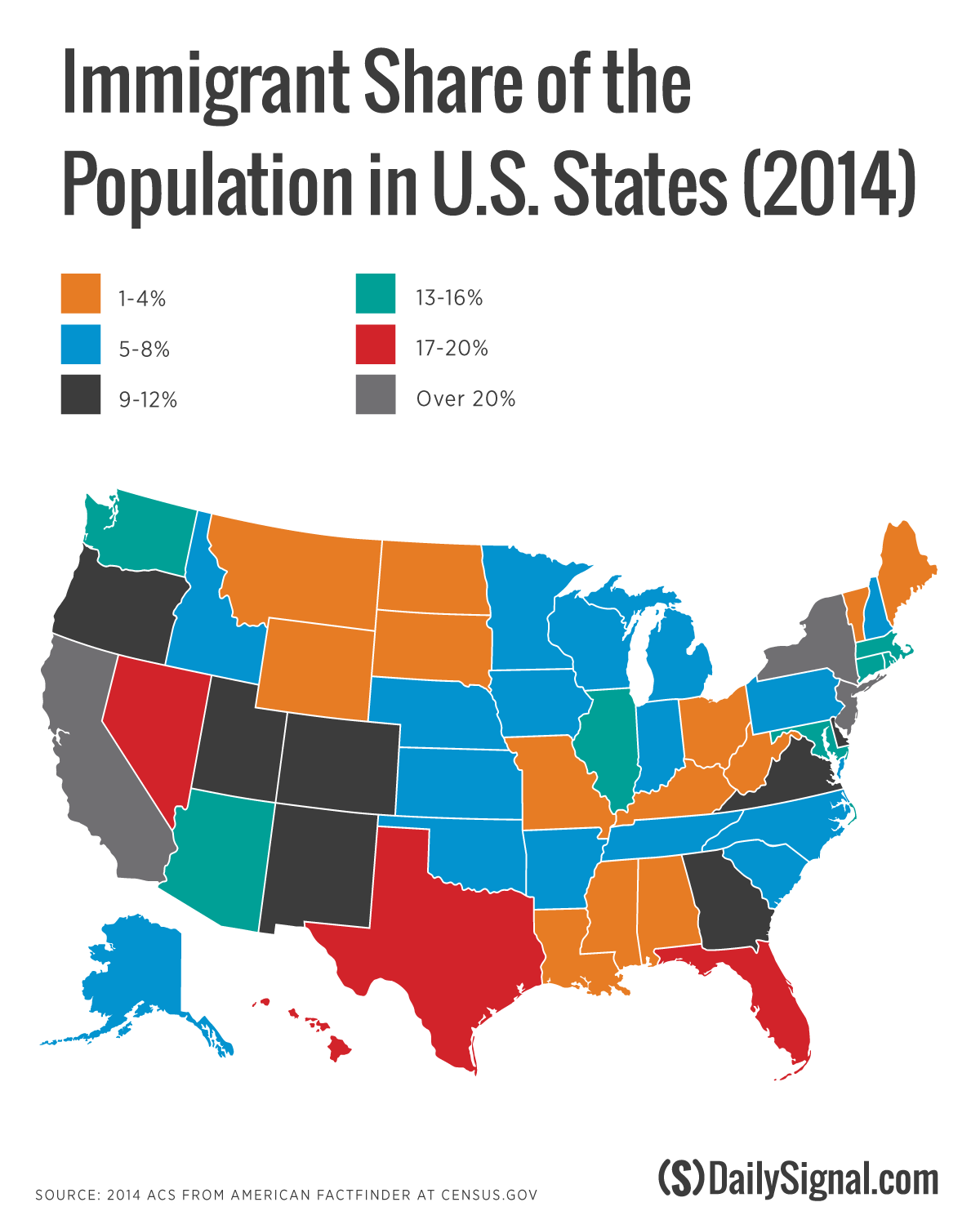
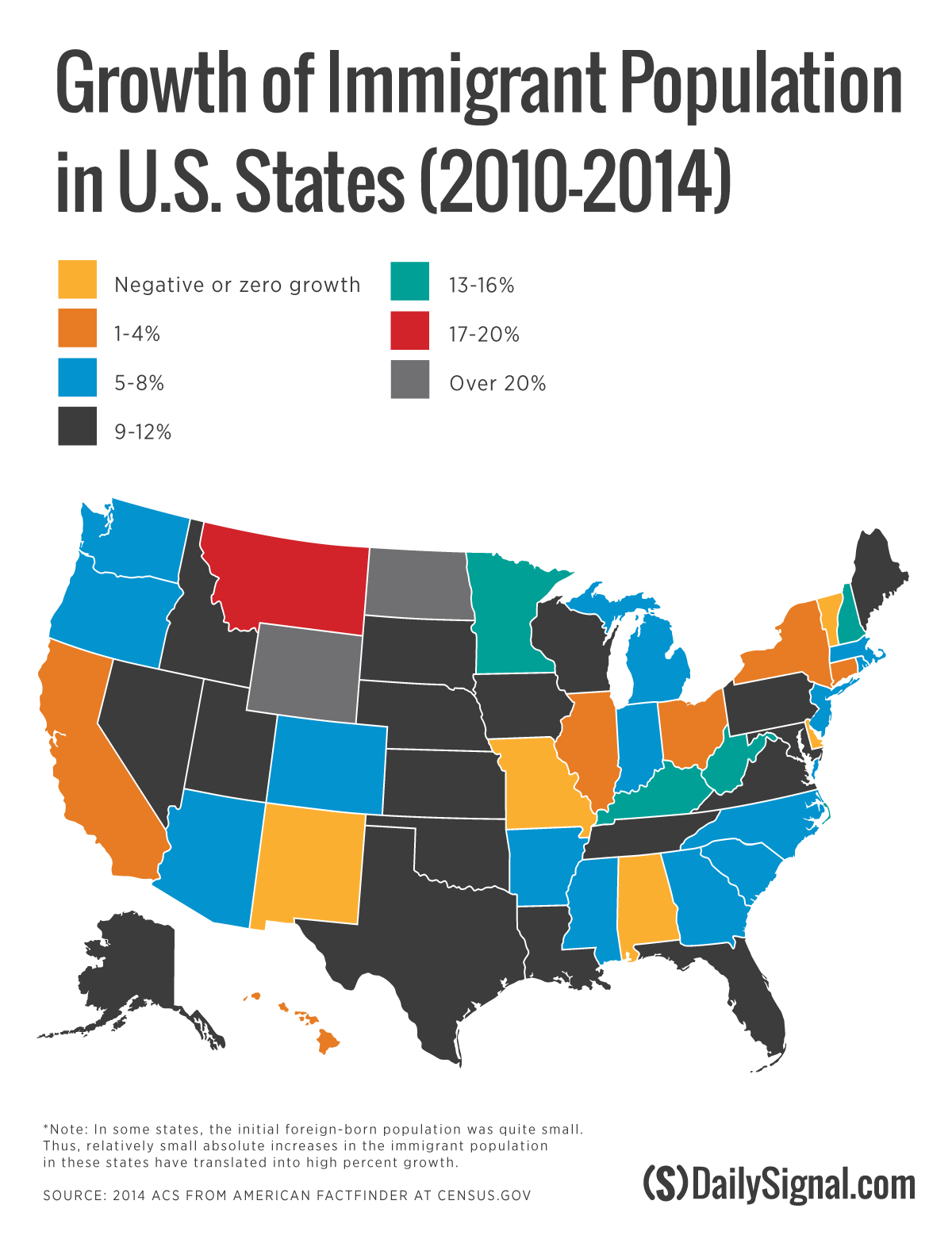
Immigrants continue to flock to places where there are others like them. California has nearly one-fourth of the nation’s immigrants living there, while New York and Texas remain popular places for non-natives to call home.

But states outside of traditional immigrant settlements—like Georgia, North Carolina, Minnesota, Colorado, Washington, and Nevada—have also seen significant increases in their foreign-born populations.

161014_immigration_table-1_v2

This is the profile of the nearly 43 million immigrants residing in the U.S. today, as told from 2014 and 2015 Census Bureau data presented by the Center for Immigration Studies in a recent report.

The study, which includes figures for both legal and illegal immigrants, comes at a time when the question of what to do about immigration is a defining political issue. It’s a debate that promises to continue into a future where the foreign-born occupy a larger and larger percentage of many states’ populations, and the makeup of the nation’s immigrants is proving to reflect the rich-poor divide in America, from wealthy technology innovators, to poor agricultural workers.

“We are kind of heading into uncharted territory when it comes to immigration,” said Steven A. Camarota, the author of the report who is the director of research for the Center for Immigration Studies, which advocates for less immigration.

“From a policy perspective, I would expect efforts to further increase the level of immigrants to the U.S. of all kinds, including family-based and skill-based. I think you will see constituencies trying to satisfy sectors as varied as the hotel and restaurant industries, Silicon Valley, and ethnic advocacy groups that are more about family immigration,” Camarota told The Daily Signal in an interview.

161014_immigration_table-2_v2

The portrait of U.S. immigrants presented in the study will likely be interpreted depending on how an individual values immigration.

Just take education, a measurable where the picture of immigrants is nuanced.

In 2014, 30 percent of immigrants lacked a high school diploma or General Educational Development (GED) certificate, compared to 10 percent of their native-born counterparts.

Yet, that same year, 29 percent of the 36.7 million immigrants ages 25 and older had a bachelor’s degree or higher, compared to 30 percent of native-born adults.

Interestingly, the share of college-educated immigrants is higher—44 percent—among those who entered the country since 2010. That trend is not an accident, experts say.

India was the leading country of origin for new immigrants in 2014, with 147,500 arriving to the U.S. out of 1.3 million total foreign-born individuals who moved to America that year.

About 40 percent of Indian immigrants hold a graduate degree. Fewer than 12 percent of native-born Americans do.

China had the second-largest amount of new entrants to the U.S., with 131,800. And though Mexico ranked third on this list in 2014—130,000 came from there that year—the net number of Mexican immigrants living in the U.S. has not increased since 2010, and even illegal immigration by Mexicans has decreased drastically since the recession.

Illegal immigration is increasingly coming from Central America, where women and children fleeing violence and poverty in El Salvador, Guatemala, and Honduras seek asylum in the U.S.

“Since the recession, the number of Mexican immigrants coming to the U.S. has not grown—that’s an under-told story in the data here,” said Randy Capps, the director of research for U.S. programs at the Migration Policy Institute, which is nonpartisan.

“Contrast that with the rapid growth in the number of Chinese and Indian immigrants—which in total is still a quarter of the number of U.S. residents from Mexico. The numbers of Chinese and Indians are the biggest source of growth now and going forward. People who come from those two countries have increasingly strong economic ties to the U.S., have strong middle-class backgrounds with the ability to get more education as needed, and have more resources and relatives already in the U.S. That’s the future of immigration in America.”

Despite these positive trends, Camarota is quick to point to other indicators that he argues show costs to immigration.

Once they come here, immigrants are more likely to not have health insurance coverage than the native-born. In 2014, 27 percent of the foreign-born were uninsured, compared to 9 percent of natives.

Also that year, 27.1 percent of immigrants and their U.S.-born children under 18 were on Medicaid, compared to 17.9 percent of natives and their children.

More immigrants were in poverty in 2014 (18.5 percent of them), in contrast to 13.5 percent of natives.

While the foreign-born and natives make equal use of cash assistance programs, more immigrant households use food assistance programs.

Most concerning to Camarota, he says, is a downward trend in the number of native-born young adults without a college degree who are not working, a marker that he considers related to competition with immigrants for low-wage jobs.

In 2000, 66 percent of natives 18 to 29 years old with only a high school education were employed. That compares to 53 percent of such U.S.-born young people who were working in 2015.

“This is a point that we should be giving a lot of thought: the drastic deterioration in work among native-born young people,” Camarota said. “And if you don’t work when you are 18, the chance you will work at 27 is a whole lot less. This shows the argument that we have a shortage of workers and need to bring people to the U.S. to be nannies, maids, and busboys is absurd.”

Capps acknowledges Camarota’s concerns over less educated young people not working, but he argues there are many factors that contribute to that. He points to the data showing that gaps are closing between immigrants and natives in skills, education, and wages, and that the foreign-born improve on those indicators the longer they reside in the U.S.

All together, immigrants and natives have virtually identical rates of employment and labor force participation, according to the Center for Immigration Studies report.

“On the legal immigration side, it’s just the reality that we still have a very generous system, with 1 million coming to the U.S. every year,” Capps said. “It’s correct to note there are some costs to that. There are always costs associated to a group as big as 1 million people coming here, with job competition and public benefit use being some of them. But these are relatively small costs compared to the broader economic benefits of so many people immigrating here, many of them now coming with high skills.” (For more from the author of “Find out What Immigration Growth Looks Like in Your State” please click HERE)

Follow Joe Miller on Twitter HERE and Facebook HERE.

The Senate’s Final Act Before Recess? More Immigration From the Middle East!

While everyone is fixated on the drama in Cleveland and Trump’s choice of a running mate, our political class is still violating our sovereignty and security with endless migrants from the Middle East. We have so many emergencies within our national security apparatus and military that can and should be addressed within the National Defense Authorization Act (NDAA), yet the GOP-Senate chose to focus on more immigration as their final act before recess.

The Senate passed the Shaheen, D-N.H. (F, 2%) motion to instruct the conference committee negotiating the House-Senate differences in the NDAA to authorize a potentially unlimited amount Special Immigrant Visas (SIV) for Afghanis. Only 12 Republicans opposed the motion, which is non-binding, but makes it likely that an increase in SIVs will be in the final conference report:

Cruz, R-Texas (A, 97)
Grassley, R-Iowa (D, 68%)
Heller, R-Nev. (F, 57%)
Inhofe, R-Okla. (C, 74%)
Lankford, R-Okla. (C, 73%)
Paul, R-Ky. (A, 94%)
Risch, R-Idaho (C, 78%)
Rubio, R-Fla. (C, 79%)
Scott, R-S.C. (B, 89%)
Sessions, R-Ala. (B, 80%)
Shelby, R-Ala. (C, 70%)
Vitter, R-La. (C, 71%)

SIVs are afforded to those foreign nationals who serve as interpreters or contractors for the U.S. military abroad. On the surface, this seems like a prudent and compassionate move, and proponents of this are certainly playing the emotional card. However, this specific plan and the broader goal of getting involved in Islamic civil wars and then bringing in individuals from those wars is completely backwards.

First, as it relates to the Afghan SIVs specifically, Congress already added an additional 3,000 visas for these individuals plus an unlimited number for family members in last year’s NDAA. Most of those visas have not even been issued yet. So why would members of the Senate open the floodgates for even more visas at a cost of $446 million (the cost of just 4,000 additional visas, which was the original objective of the Shaheen amendment)? Remember, SIV recipients are treated like refugees and are immediately eligible for all social entitlement and resettlement programs. They are also permitted to bring in an unlimited number of spouses and children. In recent years, the program has been expanded for other support members beyond interpreters or those helping our soldiers on the front lines – and this program is in addition to a separate visa program specifically for interpreters.

Moreover, with the endless flow of immigration from the Middle East, why wouldn’t they at least cut other areas of immigration, such as the Syrian refugees who are arriving in the hundreds every week? Senators Sessions, R-Ala. (B, 80%) and Grassley, R-Iowa (D, 68%) attempted to negotiate a deal to offset the visa increase by reducing the number of visas issued from the diversity lottery. Yet, McCain, R-Ariz. (F, 35%) and the Democrats balked at the plan because their solution to everything is more immigration across the board.

Which brings us to the broader point: why is immigration the solution to everything? Why should our national security be dependent on letting in more people from the volatile countries we fight in? This cuts to the core of our failure to identify the enemy. The enemy is not just Al Qaeda or ISIS. The enemy is Sharia-based Islam. Even if we could possibly vet these people for not being double agents for the Taliban, a dubious task given the endless “green on blue” attacks in Afghanistan, most of these people believe in Sharia. Heck, the Afghani Constitution and government, for which our special operators are dying, is a sharia-based system. While some of those who come here will be as loyal to us as they were when serving our military, there is no way to ensure that either some of them or certainly their children, who are reared in a house sheltered by Sharia adherence, will not become problematic over time. Just last year, Bilal Abood, an Iraqi SIV recipient, who has since become a naturalized citizen, was arrested in Texas for suspected ties to ISIS. On top of that, thanks to the refusal of Congress to bring up Senator Ted Cruz’sR, Texas (A, 97%) Expatriate Terror Act, Abood will keep his citizenship.

As I’ve noted before, our post-9/11 response has been intellectually dyslexic because we fail to understand what we are fighting. In response to the horrible terror attack that was rooted in imprudent immigration policies, our military was dispatched to engage in endless operations in Afghanistan and Iraq … only to bring in more security risks through immigration from some of the most dangerous parts of the world.

What is so sad is that Republicans could have used this must-pass bill to address a number of emergencies in our military. Obama is remaking our military with transgender mandates, anti-religious bigotry, women in infantry at all costs, and terribly myopic missions in Syria and elsewhere. In addition, as administration officials testified at the House Oversight and Government Reform Committee today, roughly 20,000 illegal aliens convicted of rape, robbery and murder (not including the tens of thousands charged with other crimes) were released by U.S. Immigration and Customs Enforcement (ICE) just last year. Why was there no sense of urgency to address any of these issues before breaking for summer recess? When will members of Congress put our sovereignty, security and society before other political interests?

Alas, Republicans can always be counted upon to act with alacrity to promote some of the most harmful policies of the Left. (For more from the author of “The Senate’s Final Act Before Recess? More Immigration From the Middle East!” please click HERE)

Follow Joe Miller on Twitter HERE and Facebook HERE.
Senate Dems Block Votes on Immigration Issues, Including Sanctuary Cities

The Republican-controlled Senate failed Wednesday to advance efforts to change federal immigration law — including one to cut funding to so-called sanctuary cities.

The vote was 53-44, failing to get the minimum 60 votes to begin debate on the issue.

The measure attempted to block congressional funding for sanctuary cities — municipalities that ban police from cooperating with immigration officials to potentially deport illegal immigrants.

Senate Republicans also failed to get enough votes to advance their proposed Kate’s Law – named after Kate Steinle, who was fatally shot in July 2015, allegedly by an illegal immigrant who had multiple felony convictions and was deported several times prior to the incident.

“How many times does this have to happen?” Pennsylvania GOP Sen. Pat Toomey asked just before the 55-42 vote that failed along party lines. “At some point, a person needs to go to jail. That’s what Kate’s Law does.” (Read more from “Senate Dems Block Votes on Immigration Issues, Including Sanctuary Cities” HERE)

Follow Joe Miller on Twitter HERE and Facebook HERE.

How Immigration Fueled the Brexit Result

The vote by Britons on Thursday to leave the European Union doubled as a referendum on how the country views the issue of immigration.

With immigration at an all-time high in Britain, voters concerned about related issues such as economic uncertainty and sovereignty decided to shed their national identity by voting to upend 43 years of life inside the European Union.

The tension over immigration is similar to what’s playing out in the United States, but different in an important way, in that Britain, as a European Union member, has no control of its borders.

That’s because as long as Britain is in the European Union, it has to allow anyone from the 28-member bloc to live and work there.

According to experts, Britain has experienced the changing face of immigration over the years.

Stephen Booth, the co-director of Open Europe, a nonpartisan think tank based in London and Brussels, said that of the roughly 5 million net immigrants to the United Kingdom between 1990 and 2014, over three-quarters came from outside Europe.

But immigration from the European Union now makes up nearly half of the United Kingdom’s net inflow, Booth said. The combination of European Union expansion in 2004 and 2007—which brought in poorer countries like Bulgaria, Romania, and Poland—and the Eurozone economic crisis has influenced substantial internal immigration to Britain and its relatively strong economy.

Proponents of immigration say it has grown the British economy, increased tax revenue, and attracted skilled workers. But critics say immigration has overwhelmed Britain’s public resources, and changed Britain’s culture and values.

“The evidence is that immigration does not have huge economic effects either way,” Booth said in a response to emailed questions from The Daily Signal. “There has been major changes to some areas of the country which are not used to immigration—new shops, languages, etc. Some people view this positively, others feel threatened by the change.”

“EU migrants make a fiscal contribution to the U.K., but the public is concerned that investment in public services, housing, and infrastructure has not kept pace and in some local areas integration is a challenge,” Booth added. “There is a particular concern about low-skilled migration, which can hold down wages for the lowest paid and increase competition for low-paid jobs.”

Yet Booth said policy changes such as the relaxation of restrictions on non-European migration in the late 1990s, and European Union expansion, were not preceded by appropriate public debate and that it is “not unreasonable” for Britons to clamor for greater control over who enters the country.

“[This is] particularly true when the government has promised to reduce numbers,” Booth said. “There is a feeling that politicians have promised something but are not delivering.”

Booth and other experts predict that Britain, split from the European Union and its ethos of free movement, will pursue a more selective immigration policy geared toward attracting skilled migration, based on the needs of the country.

“A ‘Brexit’ will result in a more global-based immigration policy attracting the best talent from around the world,” said Nile Gardiner, the director of The Heritage Foundation’s Margaret Thatcher Center for Freedom.

“This is not about isolation,” Gardiner told The Daily Signal. “It’s about creating a better system for the British economy.”

Booth and Gardiner recommend Britain adopt a policy emulating the point-based systems used in Canada and Australia.

Under this model, an immigrant is “scored” or valued based on skills and qualifications to contribute to the economy. Those who reach a certain threshold would be eligible for a visa.

The government would prioritize industries and employers with skills shortages.

Booth argues this method is more nuanced than it seems, though.

“There is likely to be a continued need for migrant labour to fill low-skilled jobs,” Booth said. “Therefore, the U.K. would also need a mechanism to fill low-skilled jobs or meet labour shortages where employers have recently relied on EU migrants.”

In addition, the result of Thursday’s referendum won’t bring instant change—on immigration or anything else.

The process of breaking apart begins when the government acts on a provision known as Article 50, which sets a two-year deadline for negotiating the departure.

Gardiner contends that Britain will struggle even more to contain immigration during the two-year negotiating period, since people will seek to cross its borders while they still can. Britain cannot legally deny migrants entry before the withdrawal formally takes place.

“There is a big fear factor here,” Gardiner said. “You will see a lot of Europeans moving to Britain in that period. I’m not sure there’s anything you can do to stop that.”

Both experts note that whether Britain is separate from the European Union or a part of it, the country will continue to feel the impact of immigration.

“Despite public pressure to reduce migration, there are several reasons why net immigration is unlikely to reduce much,” Booth said.

“[That’s because] of the effects of globalization on migration flows, which the U.K. is not alone in experiencing, and the likelihood of some constraints on U.K. immigration policy under a new arrangement with the EU.” (For more from the author of “How Immigration Fueled the Brexit Result” please click HERE)

Follow Joe Miller on Twitter HERE and Facebook HERE.
Islamic Immigration Skyrocketing in Last Years of Treasonous Obama Administration, Arabic Now Fastest Growing Language in US

Imagine if a bill had come before Congress after the 9/11 attacks debating the future of immigration from the Middle East. How many members of Congress would have voted to double migration from that volatile region and make it the fastest growing subset of our immigrants? 15 years after that tragic day, that is exactly what has happened, and with no input from the American people.

Last year, I counted the number of immigrants from predominantly Muslim countries and found that since 2001, the average annual intake has been roughly 100,000 per year, twice the rate in the ‘90s. But that trajectory has been increasing in recent years. During the five years from FY 2009 through FY 2013 alone, we’ve brought in 680,000 from those same countries. Now, there is evidence that this trajectory is growing sharper.

A few days ago, I posted a new immigration analysis from the Center for Immigration Studies detailing the sharp increase in overall immigration during the most recent two-year period: 2014-2015. Using the same Census data, a glance at the predominantly Muslim countries indicates that 308,000 new individuals emigrated here during those two years. The data is based on the Current Population Survey, which asks immigrants when they came to America. This is the first two-year period where the total number from Middle Eastern and predominantly Muslim countries has exceeded 300k. Which means that the annual rate of Muslim immigration has likely exceeded 150,000. Remember, these are individuals coming straight from the Middle East during the most volatile period of Islamic upheaval fomented by ISIS and other strains strictly adherent to Sharia Law.

According to Pew Research, Arabic is now the fastest growing language in the U.S. and the Census Department will offer Arabic translations of the decennial questionnaire for the first time in 2020. The number of people speaking Arabic has grown by 29 percent from 2010-2014, whereas the number of Spanish speakers has only grown by six percent over the same period. The most up-to-date monthly data from the Current Population Survey clearly indicates that this trend has grown in 2015 and for the first quarter of 2016.

As I lamented last Friday, we have sent our soldiers, particularly the special operators, to all sorts of hell holes over the past 15 years, often helping one side of the Islamic civil war over the other. We’ve dispatched them to endless wars with no good outcome. Yet, at the same time we are expending hundreds of billions of dollars and thousands of lives refereeing civil wars and playing interference for Iran and a corrupt Afghani government, we’ve imported the problem to our very shores free of charge.

According to Rep. Michael McCaul (R-TX), Chairman of the House Committee on Homeland, there are over 1,000 active homegrown terror cases being investigated by the FBI in all 50 states. This is not the result of ISIS or the Taliban coming here with an Air Force or Navy and invading America; this is the result of suicidal immigration policies.

There has been much discussion over a blanket ban on Muslim immigration, which was extremely popular in the GOP primaries, according to exit polls from every state. But why can’t we start with a more relevant policy of not making immigration from the Middle East the fastest growing category? Unfortunately, instead of using the annual defense bill to right the ship on our backwards immigration and defense policies, Sens. Jeanne Shaheen (D-NH), Thom Tillis (R-NC), and John McCain (R-AZ) are looking to add 4,000 more visas to the Afghan Special Immigrant Visa (SIV) program, granting green cards to those who work for the U.S. military as translators in Afghanistan. This is on top of the 3,000-visa expansions slipped into last year’s bill. As I noted last year, generally speaking, it is a good idea to provide this status to those natives who help the U.S. in foreign wars because they often need protection as a result of their work with the U.S. military. But as American citizens have witnessed over the past decade, the rampant spread of radical jihad throughout the Middle East has made it arduous to distinguish friend from foe.

While a number of Afghani translators have served faithfully, there have been numerous tragedies of our brave soldiers killed in Afghanistan at the prime of their lives because they were double crossed by an Afghani contractor or interpreter. One such “green-on-blue” attack killed U.S. Major General Harold Green in 2014, the highest-ranking casualty in a theater of war since Vietnam. Attacks from supposedly friendly Afghanis accounted for 15 percent of coalition soldier deaths in 2012.

Moreover, this is not a one-time deal; it has become our modus operandi to get involved in Islamic civil wars and then bring entire families in the tens of thousands from both sides to our shores. This is on top of the record high immigration from Pakistan and other Islamic countries and the almost 150,000 refugees we have taken from Iraq since 2007. If we are going to bring in more Afghanis under the guise of rewarding those who serve the U.S. military, can we at least reduce other categories of immigration from the Middle East? And if the only thing we can show for 15 years of involvement in Afghanistan and Iraq is hundreds of thousands of new Sharia-adherent immigrants, there is something wrong with our entire approach to war-fighting and homeland security.

Today, we mark the 72nd anniversary of the D-Day invasion. In 1944, we were a nation united under a morally and intellectually clear mission. We uncompromisingly defended our homeland and sent our soldiers across the world to fight with a defined mission, definitive outcome and no restrictive rules of engagement. Now, we send our troops into Islamic meat-grinders with appalling rules of engagement — often helping our enemies — and then we bring the problems straight to our shores. The best way to honor the sacrifice of the Greatest Generation at Omaha Beach is to follow in their example of how to fight a war: by putting the security of Americans first. (For more from the author of “Islamic Immigration Skyrocketing in Last Years of Treasonous Obama Administration, Arabic Now Fastest Growing Language in US” please click HERE)

Watch a recent interview with the author below:

Follow Joe Miller on Twitter HERE and Facebook HERE.
Another One Million Immigrants Admitted in 2014

US-Mexico_border_fenceIt’s better late than never. The Department of Homeland Security finally released the immigration numbers for 2014. They still have not released the entire Yearbook of Immigration Statistics that includes naturalization numbers, but they posted the annual topline numbers on green cards admitted. Here are the highlights:

A total of 1,016,518 immigrants were granted green cards in 2014, continuing the pattern of one million new legal permanent residents (LPRs) every year.

Once again, Mexico was the top sending country, topping out at 134,000, far ahead of any other country. Remember, these are legal immigrants, so when the open borders lobby excuses illegal immigration from Mexico on account of not having enough legal immigration, this report demonstrates it’s a complete fiction.

Far from having a diverse pool of immigrants, 42.3% of all immigrants come from just six countries: Mexico, India, China, Philippines, Cuba, and Dominican Republic (in order of rank).

Among the top 20 countries, only the United Kingdom, which ranks 19 among countries sending immigrants to the United States, is a European nation.

Iran, Pakistan, Bangladesh and Nigeria are all nations with predominantly Muslim populations that rank among the top 20 sending countries.

Just 15% of the entire pool of immigration is comprised of employment-based visas. Not that everything is working well on the employment side, but at least it is advertised as somewhat skills based. The other 85% is either family-based, chain migration, or refugee and similar categories.

Almost 20% of those receiving green cards in 2014 reside in California. Roughly 60% reside in one of the following five states: California, New York, Florida, Texas, and New Jersey. At this pace, it will be hard for Republicans to remain competitive in Florida. And Texas will continue its slow march to becoming a purple state.

When my book, “Stolen Sovereignty,” is released I plan to delve into these numbers in greater detail. Taken as a whole, we have never brought in this many immigrants for such a sustained period of time nor have we ever tilted our immigration system to the third world for so many decades during any other time of our history. Numbers matter, and there are long term consequences to these policies. Republicans will learn that the hard way. (For more from the author of “Another One Million Immigrants Admitted in 2014” please click HERE)

Watch a recent interview with the author below:

Follow Joe Miller on Twitter HERE and Facebook HERE.
The Courts Are Even Worse Than Obama Administration on Immigration, Sovereignty

Once again, the unelected federal courts are violating Congressional authority over the most important societal question: who is allowed to become a member of our society?

As we’ve explored in detail in recent months, throughout our history the courts have always stayed away from questions of immigration and citizenship, with the understanding that a sovereign nation has the right to determine who enters its society and on what conditions a person is admitted to that society. In a representative democracy, those decisions are made by the elected branch of government. Unfortunately, the modern judiciary thinks otherwise, and as I warn in Stolen Sovereignty, the courts will completely take over immigration if they are not stripped of their ill-gotten powers.

Last July, the 2nd Circuit engaged in the ultimate usurpation of power and “struck down” (as if they have the power to do so) a longstanding statute governing citizenship of children born outside the country to an American father out of wedlock. Under existing law in place since 1952, it is easier for an unwed citizen mother to transfer citizenship to her child born abroad than an unwed citizen father. The mother must have been residing in the U.S. for only one year at any time prior to birthing the child abroad. On the other hand, the unwed father (if the mother is a non-citizen) must have resided in the U.S. for 10 years, with at least five of those years occurring after the age of fourteen (for those children born between 1952 and 1986).

In this case, Luis Ramon Morales-Santana was born in the Dominican Republic to a Dominican mother and an unwed father (at the time of birth) who was a U.S. citizen. However, his U.S. citizen father only satisfied the lenient residency requirements of a would-be unwed mother, not the stringent requirement for an unwed father. Now, Morales-Santana probably could have gotten away with claiming his father was transgender thereby being treated like a U.S. citizen mother, but I digress.

Morales-Santana sued for citizenship asserting that the statute violates… you guessed it… the Equal Protection Clause because it treats unwed fathers differently than unwed mothers. He was going to be deported in 2000 after he was convicted of various felonies, but were he entitled to citizenship he would obviously be spared from deportation.

Last year, the 2nd Circuit actually sided with Santana and struck down the statute. Why do I bring this up now? This was such an egregious power grab that, ironically, even the Obama administration just filed a petition for writ of certiorari with the Supreme Court, noting that this is an area of law solely reserved for Congress. Now, it would be nice for the administration to recognize this power when it comes to DACA and DAPA but it tells you something that the courts are to the left of the Obama administration as it relates to citizenship and immigration.

The reality is that the people’s representatives have the right to set any residency criteria for parents of children born abroad. Indeed, it wasn’t until 1934 that Congress made citizenship of children born abroad transferable through the mother altogether. It is through this statute that people like Sen. Ted Cruz (R-TX) are deemed automatic citizens at birth.

The fact that the courts would extend equal protection to foreign nationals and the conditions for citizenship thereof should leave no question as to how the courts would rule on birthright citizenship for illegal immigrants born in America. It also shows how this idea of amnesty without citizenship, peddled by some Republicans as a compromise amnesty arrangement, is a farce. Undoubtedly, the courts will grant them “equal protection” in no time and mandate judicial amnesty.

Judicial amnesty is a growing problem. If the Supreme Court refuses to hear the case or upholds the decision from the 2nd Circuit, another criminal alien will be allowed to remain in this country against our national will.

This is just another example of why Congress must act now to strip the courts of their illegitimate power over immigration. If America is going to become a nation without borders and a magnet for criminals from around the world, shouldn’t that decision at least be decided by the elected branch of government? (For more from the author of “The Courts Are Even Worse Than Obama Administration on Immigration, Sovereignty” please click HERE)

Watch a recent interview with the author below:

Follow Joe Miller on Twitter HERE and Facebook HERE.

How Liberal ‘Christian’ Immigration Policies Dehumanize EVERYONE

People have long made fun of me for treating my beagles like humans — feeding them wild salmon, taking them to top-line doctors, getting them ultrasounds and liver meds, buffalo treats and gator meat and letting them sleep in bed. To which I’ve always answered, “It’s my money. Go get a job and earn your own.”

But of course I don’t treat my dogs exactly as if they were human. When Franz Josef got sick with bladder cancer, and the medicine stopped working, I agonized for days, said my goodbyes, then slowly fed him a whole rack of barbecued ribs. I took him to the vet, where I stroked his velvet head as the medicine smoothed his path to dreamless sleep.

That is not how I treated my parents when each of them died of cancer. Instead, I sat with them as they agonized, prayed with them, and brought the priest to help them repent for all their sins. Some would say that Franzi got off easy, that people should be treated as “mercifully” as animals, and “granted” quick, painless deaths. Since cancer strikes everyone in my family, it will surely claim me some day, so I am tempted to agree.

But I can’t, as a Christian, admit that human beings should be treated the same as pets, intentionally killed to spare them needless, useless suffering. Because we know that human suffering isn’t necessarily useless. Jesus’ pains on the cross were not a meaningless tragedy, and if we unite ours with his, they aren’t either. We should diminish them all we can, and accept what is left as the price of human dignity, the tax we pay for sin — our own, or other people’s. It’s a mind-tangling mystery, but it’s better than the alternative.

Here’s the alternative, as described by author Richard Weikart in his powerful new book The Death of Humanity:

The University of Chicago evolutionary biologist Jerry Coyne has stated, “Although it’s seen by nearly everyone as humane — and even moral — to end the life of our terminally ill pets, it’s regarded as murder to make the same decision for ourselves.”

He scoffs at the idea that humans are qualitatively different from, or have greater value than, animals. However, if you read more of Coyne, you find that he embraces many moral stances typical of many American progressives. He would be horrified if I suggested that we round up all the homeless people in a city, sterilize them, imprison them until someone comes to take them home with them, and if no one comes for them, euthanize them. Yet this is how we treat stray dogs.

And it’s how too many Christians, including some of our leaders, are treating Muslim immigrants. We linger over pictures of cute little Arab kids, or carefully posed shots of exotic women in beautiful headscarves — and avert our eyes from angry, self-righteous mobs of military-age men thronging radical mosques in London, Brussels, Paris, Frankfurt. We suppress the obvious questions: “What on earth are those people doing there?” “What reckless fools let them in?” And (most important): “How can we make them go back where they belong?”

Instead, we focus on the brown, puppy eyes of the children, the sad faces of the women, the anecdotes of good, decent Muslims — like the store owner in Glasgow, who said “Happy Easter” to his Christian customers on Facebook. We don’t read the sequel, which reports that this gesture got him stabbed to death by a man from the local mosque.

We want to feel good about ourselves. We want to be congratulated as “tolerant,” “open” and “cosmopolitan.” We don’t want to be labeled, judged, maybe even harassed by our “tolerant” governments. We want to bask in the fuzzy, cozy, pseudo-Christian sentiment that all religions are at root the same, once you bat down the “extremists.”

Now, all dogs are at root basically the same. The behavioral differences between a Basset Hound and a German Short-Haired Pointer are finally superficial. Virtually all dogs, if they’re raised well, if they’re not abused, will respond with warmth and gratitude. It’s the humanitarian heresy that pretends that humans are just like dogs.

Regardless of what they say they believe, of the habits their cultures encourage, of the actual, literal words of the sacred texts of their religion…. We Westerners know better. A radicalized Muslim — that is, one who reads the Koran and takes it at face value — may say that he thinks that Jews are descended from monkeys and pigs. He may even believe that he believes it’s right to stone homosexuals to death, or marry girls at the age of nine, or “kill the unbeliever wherever you find him.”

But surely he doesn’t really think that, the progressive thinking goes. Not really. A few years of Western welfare checks, some shiny community centers paid for by local taxpayers, and a police force that firmly punishes native citizens if they complain about immigration, and just you wait and see! Those “angry” Muslims will be smiling, wagging their little tails and eating right out of your hand.

How fitting that elites in Belgium treat religious people this way, since their country is one of the euthanasia capitals of the world. They see every person as a pet.

I have distilled here the whole theory, in all its sophistication, that underlies Western multiculturalism and “Christian” support for mass immigration into a welfare state. That’s it, folks.

Are there useful things Christians and the West can do for Muslims back in their own troubled countries? Yes indeed. But only if we take them seriously as fellow human beings — which means that when they threaten or denounce us, we stand up and guard against them. (For more from the author of “How Liberal ‘Christian’ Immigration Policies Dehumanize EVERYONE” please click HERE)

Follow Joe Miller on Twitter HERE and Facebook HERE.