Posts

No Longer a Nation of Laws, Ninth Circuit Usurps Presidential Powers on Immigration Ban

San Francisco’s federal appeals court asserted a novel theory on Thursday to claim jurisdiction over the legal challenge to Executive Order 13769, affirming the lower court’s order halting President Trump’s temporary travel-restriction policy. . .

The Ninth Circuit went on to reject several of the tenuous theories the states of Washington and Minnesota asserted to claim standing to bring this lawsuit. Nonetheless, a three-judge panel of the court adopted one of the novel theories asserted by the state, holding that, “as the operators of state universities, the States may assert not only their own rights to the extent affected by the Executive Order but may also assert the rights of their students and faculty members.” Some of those students are effected by the immigration order.

President Trump’s Department of Justice (DOJ) argued that Congress has plenary authority over all immigration decisions, and that Congress had delegated complete discretion to the president in 8 U.S.C. § 1182(f) to make such decisions, especially when national security was at stake. . .

[Listen to Joe Miller Hammer the Ninth Circuit:]

The court held that the executive order likely violated the Due Process Clause of the Fifth Amendment, holding that the “Government has not shown that the Executive Order provides what due process requires, such as notice and a hearing prior to restricting an individual’s ability to travel”. . .

The court also gave at least some credence to what many considered one of the most tenuous claims in the lawsuit, the one asserting that appearing to prefer Christianity over Islam for immigrants violates the Constitution’s Establishment Clause. (Read more from “No Longer a Nation of Laws, Ninth Circuit Usurps Presidential Powers on Immigration Ban” HERE)

Follow Joe Miller on Twitter HERE and Facebook HERE.

Last-Minute Lawyer Faulted for ‘Poor Job’ Defending Trump’s Immigration Order

The lawyer who argued the case for President Donald Trump’s executive order designed to bar terrorists from entering the country is the target of sharp criticism for his performance Tuesday night before a federal appeals court.

“I’m not sure I’m convincing the court,’’ August E. Flentje says.

Flentje, a career Justice Department lawyer, took the case after two top lawyers in the Trump administration recused themselves.

“I’m not sure I’m convincing the court,’’ Flentje said out loud at one point in arguing for the executive order temporarily restricting travel to the U.S. from seven terrorism-prone nations.

During the Obama administration, then-Attorney General Eric Holder honored Flentje for helping to draft the legal case for same-sex marriage and for terrorism suspects being held in the Guantanamo Bay detention center, which the administration sought to close.

When the three-judge panel from the 9th Circuit Court of Appeals pressed Flentje for evidence connecting the seven countries to terrorism, he said, “These proceedings have been moving quite fast, and we’re doing the best we can.”

He said the government hadn’t included all the evidence yet. He cited some Somalis in the United States who he said were connected to the al-Shabab terrorist group.

Judge Michelle Friedland asked, “Can you point us to where in the record you are referring?”

Flentje responded: “It is not in the record.”

Flentje delivered a weak argument that likely could affect the outcome of the case, said Hans von Spakovsky, senior legal fellow at The Heritage Foundation.

“It was a very poor job. It’s the worst presentation I can recall seeing by a Justice Department attorney,” von Spakovsky, a former Justice Department lawyer, told The Daily Signal.

Justice Department spokeswoman Nicole A. Navas said the department wanted to avoid any conflicts of interest after the former employer of two top Trump administration lawyers filed a brief on behalf of opponents in the suit against the president’s executive order.

The acting solicitor general and acting assistant attorney general “have refrained from signing this brief, out of an abundance of caution, in light of a last-minute filing of an amicus brief by their former law firm,” Navas told The Daily Signal in an emailed statement.

“The department has no additional comment than what was stated in the government’s brief,” she added on the question of why Flentje argued the case in one of the nation’s most liberal circuits.

A federal judge in Seattle on Friday placed a temporary restraining order, or TRO, on enforcement of the week-old executive order. It put a nationwide pause on carrying out the order.

Flentje’s job Tuesday night was to make the legal case for Trump’s order on vetting immigrants from seven Middle Eastern countries that have been terrorism hot spots.

“There was a lot of back and forth in that entire argument,” White House press secretary Sean Spicer said Wednesday in response to a question on Flentje’s presentation and whether Trump was concerned about it.

“I think he did what he had to do to, represent the president’s case and represent the administration’s case on the TRO,” Spicer said of Flentje before adding of Trump:

He feels very confident on the merits. That’s where his focus has been. So I’m not concerned.

I think the president’s main concern has been … making sure that an executive order that was lawfully executed and [went] through the entire process—remember, the DOJ’s Office of Legal Compliance vetted this order and deemed it was legal. So we can follow this entire process to be sure it was done correctly, constitutionally, legally.

Washington state, later joined by Minnesota, challenged Trump’s executive order, arguing it would harm their states’ tax bases and businesses.

A U.S. district judge in Seattle did not rule on the merits of the case, but determined Washington state had standing and issued the temporary restraining order on the executive order. Now, the appeals court is deciding only on the restraining order and not, for now, the actual executive order.

Flentje started work at the Justice Department about 19 years ago, under President Bill Clinton. He continued under Presidents George W. Bush and Barack Obama.

Noel Francisco, the acting solicitor general, and Chad Readler, acting assistant attorney general, initially were going to represent the Trump administration.

Their decisions to remove their names from the most recent brief and from the case itself came after their former employer, the Jones Day law firm, filed an amicus brief against Trump’s executive order. Jones Day also filed a brief seeking to remove the two lawyers from the case, contending their involvement represented a conflict.

Flentje, the special counsel to the assistant attorney general, then became the highest-ranking Justice Department attorney to handle the case.

Interestingly, Jones Day was associated with both the Trump presidential campaign and the Trump transition team. The new president named a former Jones Day lawyer, Don McGahn, as White House counsel, the legal news site Above the Law noted.

The person filing the brief against Trump’s executive order now could pose ethical questions since the Jones Day firm has had such close ties to Trump in the past, von Spakovsky said.

“The opposing brief of the executive order is a very serious conflict,” von Spakovsky said.

In 2013, Holder issued the Attorney General’s Award for Distinguished Service to a team, including Flentje, that made the legal case that the Defense of Marriage Act, a Clinton-era law recognizing marriage as the union of a man and woman, was not constitutional.

In 2010, Holder’s Justice Department honored Flentje and other lawyers with the Attorney General’s Award for Excellence in Furthering the Interests of U.S. National Security. The award was for their work on 240 appeals involving detainees at the Guantanamo Bay prison for terror suspects.

(For more from the author of “Last-Minute Lawyer Faulted for ‘Poor Job’ Defending Trump’s Immigration Order” please click HERE)

Follow Joe Miller on Twitter HERE and Facebook HERE.

On Immigration, Winning Cheap Grace

The great theologian Dietrich Bonhoeffer wrote scathingly of “cheap grace,” which is the warm fuzzy feeling we give ourselves, and the praise we win from others, by making little virtue-signals that cost us almost nothing — and might well impose suffering on innocent third parties. Jesus Himself denounced it when He saw it among the Pharisees, but Christians are not immune.

In Bonhoeffer’s time, German pastors won cheap grace by safely denouncing Communist atrocities, while pretending that the same crimes weren’t happening just down the train tracks from their churches, at the hands of their own Nazi government. Catholic philosopher Rene Girard spoke of a similar psychological trick, which he called “victimism,” or the cynical use of weaker people’s suffering to aggrandize yourself and win power.

Speak Soothingly to Power

Cheap grace can always be gained by signing on with the sins that are popular with the powerful, and denouncing some evil that is distant or widely despised. Hence pastors in the segregated South could safely denounce the crimes of Josef Stalin, while ignoring the “strange fruit” that hung in their own towns’ trees after brutal lynchings of black men. How many pastors piled up cheap grace aplenty in the 1980s by fighting apartheid in faraway South Africa, and ignoring the abortion clinics that killed black babies by the thousands right down the street?

Now open borders Christians, such as the media-savvy Fr. James Martin, SJ, are gathering cheap grace in bushel baskets on the subject of immigration. In a shrill, moralistic screed that The Stream already analyzed as contrary to Catholic doctrine, Fr. Martin told Americans that it is simply and blankly un-Christian to secure our country’s borders, enforce its labor laws, or carefully vet refugees to keep out those committed to terrorism or sharia.

That is meant to end the argument, to threaten us with eternal damnation if we don’t accept Fr. Martin’s political program — one which no Christian government has enacted anywhere for almost 2,000 years. As a leader in the movement to really implement Christianity for the first time, ever, on immigration issues, Fr. Martin claims his place as one of the best Christians in history. Or so he would like us to see him.

We Learn, 2,000 Years Late, that Borders are Un-Christian

Does Fr. Martin, or any of the bishops who echo him, really believe that no Christian may vote to secure his country’s borders? Is it sinful for Mexico to police its border with Central America? For Latvia to guard its frontier with Putin’s Russia? For Israel to police the crossing into Jordan? I’ve never read any such statements, and I think I know the reason: It’s perfectly obvious that international borders require the rule of law, that sovereign countries deciding who comes and goes is part of what we must “render unto Caesar.”

It doesn’t harm Fr. Martin, in his cozy Manhattan office, that drug cartels and people smugglers control the U.S.-Mexico border, honeycombing it with tunnels and planting it with “rape trees,” with the clothes ripped off young women. Nor does he find himself exploited in an underground economy, where greedy employers turn away poor American workers with enforceable legal rights, then fill their factories or fields with docile, frightened foreign people whom they can threaten with deportation.

Fr. Martin doesn’t have children whose public school is in chaos, overburdened with the hopeless task of trying to assimilate and educate kids in a dozen different languages. Fr. Martin’s health insurance is covered by the wealthy Jesuit order, so he never needs to worry about what it will cost him to use an emergency ward — at a hospital which treats long lines of undocumented and uninsured workers, and so has to soak its few paying customers to avoid going bankrupt. Fr. Martin will never lose his job at America magazine to a lower-paid foreign priest who came in on an H1-B visa, whom he is forced to train.

The Cheapest Grace in the History of the Church
There is a long list of people, both foreign and American, who pay a heavy price for our blithe acceptance of immigration chaos. Few such people have columns in prestigious magazines, or get hired as faith consultants by Martin Scorcese — which Fr. Martin was, for the movie Silence. (As you’ll read here at The Stream, that movie’s ending was an icy apologia for priests who renounce Jesus, betray the Faith, and make a comfortable living helping pagans to persecute the church.)

Those people exist, from the villages emptied of men in rural Mexico, to the ghettos of America where black and Latino teens cannot find entry-level jobs. But it’s easy to ignore them.

Likewise it’s easy for Fr. Martin and others like him to call for utopian policies, wave Jesus around to silence our reality-based objections, and refuse to examine their real-world impact on the poor and the vulnerable. Better still, they can wield their “high-minded” demands to blunt the force of the growing pro-life movement, by insisting that all of us swallow their Seamless Garment poison pill, before we’re allowed to stop killing a million children each year. That wins them points with their powerful friends like Joseph Biden and Tim Kaine, both Jesuit allies and pro-choice Democrats. So men like Fr. Martin coast through life on a cushion of unearned praise and cultural privilege, while sneering at their weaker fellow citizens as “un-Christian,” cruel, and selfish.

I’ll give this to open borders Christians: They have found the source of the cheapest grace in the history of the church. Simon Magus would be proud. (For more from the author of “On Immigration, Winning Cheap Grace” please click HERE)

Follow Joe Miller on Twitter HERE and Facebook HERE.

Judge Robart’s Ruling Against Trump’s Immigration Order Is Baseless

If the law means anything, the Trump administration will succeed in overturning the so-called court ruling against its travel ban.

The nationwide stay of the ban issued by Judge James Robart, a Washington state-based federal district judge, is tissue-thin. It doesn’t bother to engage on the substance, presumably because facts, logic and the law don’t support Robart’s sweeping assertion of judicial authority in an area where judicial power is inherently quite limited.

This doesn’t justify President Donald Trump tweeting that Robart is a “so-called judge.” That slam earned Trump bipartisan blowback and may encourage other judges to tilt against Trump’s ban in response to a perceived threat to the independence of the judiciary. But Robart’s handiwork is shoddy and usurpatory, despite the fact that he is indeed a literal judge.

Even if you assume that the states of Washington and Minnesota have standing to pursue the litigation (Robart asserts implausibly that they “face immediate and irreparable injury” from the executive order, the heart of which is a three-month pause on most travel from seven countries), the stay falls down. It ignores our constitutional scheme and Supreme Court precedent, as the Justice Department brief seeking to reverse it persuasively argues.

First, Judge Robart is trespassing on a core executive responsibility. “The exclusion of aliens is a fundamental act of sovereignty,” the Supreme Court held in the 1950 Knauff case, “inherent in the executive power to control the foreign affairs of the nation.” The courts are not meant to second-guess the executive’s conduct of foreign affairs, or intrude on its plenary power in this area. “It is not within the province of any court,” the court noted in that decision, “unless expressly authorized by law, to review the determination of the political branch of the Government to exclude a given alien.”

Second, it’s hard to get around the relevant federal immigration law, which says, “Whenever the President finds that the entry of any aliens or of any class of aliens into the United States would be detrimental to the interests of the United States, he may by proclamation, and for such period as he shall deem necessary, suspend the entry of all aliens or any class of aliens as immigrants or nonimmigrants, or impose on the entry of aliens any restrictions he may deem to be appropriate.”

This is as explicit and wide-ranging as it gets. When the president has such authorization from Congress, the Supreme Court held in the Youngstown Steel case in 1952, his “authority is at its maximum, for it includes all that he possesses in his own right plus all that Congress can delegate.”

Finally, aliens residing outside the United States have no right to come here. The Supreme Court held in the 1982 Landon case, “an alien seeking initial admission to the United States requests a privilege and has no constitutional rights regarding his application, for the power to admit or exclude aliens is a sovereign prerogative.”

It’s not clear how Judge Robart expects opponents of the Trump ban to overcome these substantial and well-established obstacles. A more extensive and carefully reasoned decision by a Massachusetts-based district judge reached the opposite conclusion of his.

It is true that the ultimate source of the Trump executive order is his ill-advised call for a Muslim ban during the campaign. But the executive order, focusing on seven war-torn or hostile countries that had already been singled out for special scrutiny during the Obama administration, is manifestly not a Muslim ban.

Judge Robart may not like the Trump policy, but that doesn’t mean that it is illegal or unconstitutional. His ruling is worthy of the generally unhinged opposition to President Trump. If the judge doesn’t deserve the abuse that Trump heaped on him on Twitter, he produced what should rightly be considered so-called jurisprudence. (For more from the author of “Judge Robart’s Ruling Against Trump’s Immigration Order Is Baseless” please click HERE)

Follow Joe Miller on Twitter HERE and Facebook HERE.

Oops! Nancy Pelosi Accidentally Makes the Case for Trump’s Immigration Executive Order

On Tuesday night, House Minority Leader Nancy Pelosi, D-Calif. (F-10%) accidentally made a strong case for President Donald Trump’s executive order instructing the Department of Homeland Security to keep tabs on crime committed by illegal immigrants.

Laura Wilkerson, a Texas mothe whose son was “tortured,” “tied up like and animal,” and killed by an illegal alien, grilled Pelosi on her unabashed support of sanctuary cities:

“I am not a one-story mother. This happens every day because there are no laws enforcing the border,” Wilkerson said, as reported by the Washington Examiner. “How do you reconcile in your head about allowing people to disavow the law?”

Wilkerson continued:

“The second part of my question is this: if you need to go home tonight and line up your babies as you say, and your grandbabies, which one of them could you look in their eyes today, and tell them that they’re expendable for another foreign person to have a nicer life? Which one would you look to say, you, my child, are expendable for someone else to come over here and not follow the law.”

Pelosi, clearly bewildered by the mother’s impassioned testimony, offered a weak response, thanking Wilkerson for “channeling [her] energy to help prevent something like that from happening.” She then claimed that “our people [i.e. illegals] are not disobeying the law” in sanctuary cities.

“These are, law-abiding citizens, it enables them to, to be there without being reported to ICE [U.S. Immigration and Customs Enforcement] in case of another crime that they might bear witness to,” Pelosi said.

Pelosi then went on to explain why Trump’s executive order makes so much sense:

“The point is – is that you do not turn law enforcement officers into immigration officers. That is really what the point is in the sanctuary city. So, it is not a question of getting sanctuary. Someone who … is guilty of a crime. They should be deported. Or sent to jail for what they do if you can catch them in time.”

Here’s the irony: Trump’s executive order doesn’t turn local law enforcement into immigration agents. It merely seeks to call attention to illegals who commit crimes that harm U.S. citizens. Like Pelosi claimed during the town hall, Trump believes that these individuals shouldn’t be allowed to remain in the country. And it’s safe to conclude that Wilkerson also agrees with this.

Thanks, Nancy Pelosi, for being one of the only Democrats in Congress to (albeit unknowingly) come out strongly against senseless sanctuary city provisions that harm citizens and protect criminals. (For more from the author of “Oops! Nancy Pelosi Accidentally Makes the Case for Trump’s Immigration Executive Order” please click HERE)

Follow Joe Miller on Twitter HERE and Facebook HERE.
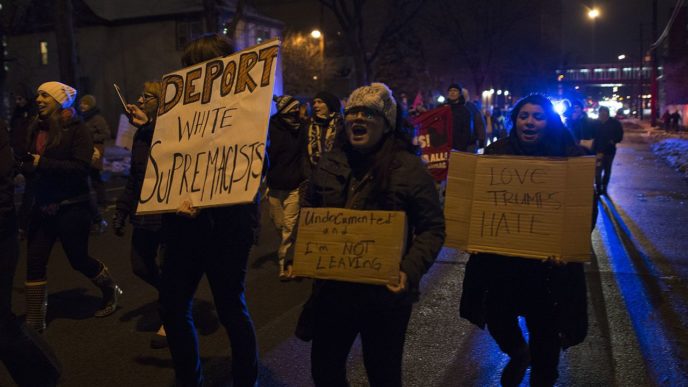
VIDEO: Just 14 Years Ago, Democrats Supported Cutting off Visas from Dangerous Countries

When it comes to immigration and national security (and every other policy, for that matter), even many conservative Republicans can’t hold the ground plowed by liberal Democrats just 14 years ago.

Only a handful of Republicans are calling for a shutoff or cooldown of immigration and visas from the Middle East. Trump has made it a staple of his campaign and Sen. Cruz, R-Texas (A, 97%) has for a halt to the refugee program. Sen. Rand Paul, R-Ky. (A, 92%) introduced a bill cutting off visas from countries overrun by terrorists. Yet, outside of a few House members, nobody else wants to pass even a standalone bill enacting this common sense imperative, let alone use the current budget bill to force the issue. All Republican leaders want to discuss is throwing more money at a problem rooted in willful blindness. Those bills will likely strengthen Muslim Brotherhood front groups responsible for training local law enforcement through block grant programs.

And what about Democrats? They don’t even want to discuss the issues of terrorism and insecure borders altogether.

However, it wasn’t always that way. In 2002, Congress passed the Enhanced Border Security and Visa Entry Reform Act, which addressed many of the insecurities in our visa tracking system. The bill passed the House and Senate unanimously. The bill was originally sponsored by a group of bipartisan senators, including Ted Kennedy and Sen. Dianne Feinstein, D-Calif. (F, 0%):

SEC. 306. RESTRICTION ON ISSUANCE OF VISAS TO NONIMMIGRANTS FROM COUNTRIES THAT ARE STATE SPONSORS OF INTERNATIONAL TERRORISM.

(a) IN GENERAL- No nonimmigrant visa under section 101(a)(15) of the Immigration and Nationality Act (8 U.S.C.1101(a)(15)) shall be issued to any alien from a country that is a state sponsor of international terrorism unless the Secretary of State determines, in consultation with the Attorney General and the heads of other appropriate United States agencies, that such alien does not pose a threat to the safety or national security of the United States. In making a determination under this subsection, the Secretary of State shall apply standards developed by the Secretary of State, in consultation with the Attorney General and the heads of other appropriate United States agencies, that are applicable to the nationals of such states.

The bill also established a program to monitor foreign students in the U.S. As part of that program, the Bush administration created the National Security Entry-Exit Registration System (NSEERS), which required visa recipients from countries that represent a security risk to register with an ICE office and report regularly about their plans. Unfortunately, Obama’s DHS abolished the program in May 2011. Now, there are twice as many foreign students in the United States, including well over 150,000 from the very countries originally monitored by the Bush administration program.

(Talk about hypocrisy! Donald Trump should just televise this Bill Clinton speech from 1995 and then simply state, “I’m Donald Trump and I approve this message!”):

Ultimately, the 2002 bill had a lot of loopholes, which voided out its benefits in the long run and allowed Obama to erase what was left of the bill. But the fact that Democrats were even willing to sign onto a piece of legislation advertised as cutting off visas from some Middle Eastern countries demonstrates just how far their party has moved in almost 15 years. Sadly, Republicans have moved on with them.

Less than a generation later, after admitting nearly two million immigrants from the Middle East and hundreds of thousands more on non-immigrant visas, wouldn’t you expect an even greater sense of urgency from our political class? Wouldn’t our leaders be especially concerned about this influx of immigrants given how the jihadist threat has evolved from organized command-and-control attacks to individual jihadists carrying out their own attacks?

The fact that Congress passed that type of legislation in 2002 is just one more indication of how far our political class has regressed in their commitment to America’s security over the past 15 years. The pagan ideal of multiculturalism has crushed any modicum of common sense that remained among our leaders in the immediate aftermath of 9/11. (For more from the author of “Just 14 Years Ago, Democrats Supported Cutting off Visas from Dangerous Countries” please click HERE)

Follow Joe Miller on Twitter HERE and Facebook HERE.

Separating Fact from Sickening Media Fiction on Trump’s Immigration Executive Order

There is a lot of confusion swirling around the events that transpired this weekend as a result of Trump’s executive order on immigration. Make no mistake: every word of Trump’s executive order is in accordance with statute.

It’s important not to conflate political arguments with legal arguments, as many liberals and far too many “conservatives” on social media are doing. While the timing and coordination of implementing this order might have been poorly planned, we shouldn’t allow that to undermine the broader need to defend our sovereignty. For courts to violate years’ worth of precedent and steal our sovereignty should concern everyone.

What the order actually does

Among other things, the key provisions at the center of the existing controversy are as follows:

It shuts off the issuance of all new immigrant and non-immigrant visas for 90 days from the following seven volatile countries: Syria, Iraq, Iran, Libya, Somalia, Sudan, and Yemen. Any non-citizen from those seven countries (not “all” Muslim countries) is excluded from entering the country during this time-period (which usually means they won’t be able to board a direct flight to America). After 30 days, the secretary of state and secretary of homeland security must submit a report to completely revamp the vetting process going forward.

Within 60 days, countries will have to submit any information that the administration determines necessary, pursuant to the findings of this report, in order to adjudicate a visa application and ensure they are properly vetted. Any country that fails to submit this information will not be able to send foreign nationals to our country. All the while, the ban can be extended and expanded at any time.

In addition, the entire refugee resettlement program is suspended for four months pending a complete investigation of the program and a plan to restructure it and prioritize those who are truly in danger of religious persecution. After 120 days, the program may resume, but only for those countries Secretaries Kelly and Tillerson determine do not pose a threat. The program from Syria is completely suspended until the president personally gives the green light.

With regards to refugees and those who seek to enter from the seven countries temporarily excluded, the order gave discretion to the State Department and DHS to admit individuals on a case-by-case basis for important reasons, even during the temporary moratorium.

Statement of principles on the right of a country to exclude non-citizens

Those who want to immigrate: There is no affirmative right, constitutional or otherwise, to visit or settle in the United States. Period.

Based on the social contract, social compact, sovereignty, long-standing law of nation-states, governance by the consent of the governed, the plenary power of Congress over immigration, and 200 years of case law, our political branches of government have the power to exclude or invite any individual or classes people for any reason on a temporary or even permanent basis – without any involvement from the courts. Congress has already delegated its authority to the president to shut off any form of immigration at will at any time.

Immigrants already here: Those already admitted to this country with the consent of the citizenry have unalienable rights. They cannot be indefinitely detained. However, they can be deported for any reason if they are not citizens. In Fong Yue Ting v. United States (1893), which is still settled law, the court ruled that Congress has the same plenary power to deport aliens for any reason as it does to exclude them and that the statutory procedures and conditions for doing so are due process. Congress has established the process for deportation of those already here. However, as long as a legal permanent resident leaves the country he has no affirmative right to re-enter. Either way, they have absolutely no right to judicial review other than to ensure that statutes are properly followed.

But can Trump prevent those with green cards from re-entering the country?

The statute is clear as day. The Immigration and Nationality Act (§ 212(f)) gives the president plenary power to “by proclamation, and for such period as he shall deem necessary, suspend the entry of all aliens or any class of aliens as immigrants or nonimmigrants.” Clearly, the president has the authority to block any non-citizen – including refugees, green card holders, and foreign students – from entering the country. Also, for purposes of deportation, there is no difference between a green card holder or a holder of a non-immigrant visa. No foreign national who has not yet obtained citizenship has an affirmative right to re-enter the country.

Is this a ban on Muslim immigration?

No, it’s a moratorium on immigration or re-entries from seven individual countries and a temporary moratorium on refugees from all countries, subject to case-by-case exceptions.

Why didn’t Trump place restrictions on immigration/visas from Saudi Arabia and other Muslim countries?

That’s probably a good idea. But this was actually a judicious and cautious approach from Trump to start with low-hanging fruit. These seven countries are failed states or enemies of the U.S. (in the case of Iran). As such, there is absolutely no way to share data with the host countries and properly vet them. Somalia has been one of the biggest trouble spots. The other countries are marred in Islamic civil wars. Moreover, these are the countries that existing law targets for travel restrictions, and that Obama’s own DHS listed last year.

Why would Trump include green card holders in the ban on re-entry?

Both liberals and conservatives expressed concern over hundreds of individuals going over to fight for ISIS. We are already limited in how we can combat this growing threat among U.S. citizens. Given that it is completely legal to exclude non-citizens upon re-entry, Trump extended the ban to legal permanent residents as well.

If a Somali refugee is travelling back to Somalia (so much for credible fear of persecution!), government officials should have the ability to prevent that person from coming back when necessary. Obviously, there are some individuals from these seven countries who already have green cards and we might not want to exclude. That is why the order grants discretion to the State Department to issue case-by-case exemptions for “religious persecution, “or when the person is already in transit and denying admission would cause undue hardship.” A CBP agent is always stationed at any international airport from which these individuals would board a direct flight to the United States (Paris and Dubai, for example). That individual would not allow anyone covered by this ban onto a U.S.-bound flight unless he grants them a hardship exemption.

Indeed, it appears that green card holders returning yesterday from those seven countries were all granted entry.

What’s with the chaos at the airports and the courts?

Henceforth, CBP agents will not allow individual aliens from those seven countries to board a flight to the U.S. So the chaos will end.

The problem arose from the 100 or so individuals that were already in transit when the order took effect. When they arrived at American airports, they were detained at customs. Standing at this point is not tantamount to being on American soil.[4] However, a federal judge in New York issued a stay and prevented the feds from sending two individuals back on a flight. Other judges have prevented officials from even detaining such persons. It’s unclear if federal agents might have made a mistake and released some of these individuals before ordering them to leave the country. Once they are released onto American soil, any effort to remove them is treated as a deportation, not an exclusion, and is subject to the due process afforded them by congressional statutes (not the Constitution).

Thus, it’s unclear if the stay even applied to any element of the order or whether it applied to anomalous circumstances or particular actions taken by federal officials that overstepped the order.

It’s also confusing because many contemporary judges have no respect for our sovereignty and have been gradually chipping away at the plenary power of Congress (or the president, pursuant to statute) to exclude aliens re-entering the country, despite years of settled law. If courts are indeed violating our sovereignty, this is the very grave danger I warned about in Stolen Sovereignty. Either way, it should not affect the ability of the administration to enforce the order against those who want to prospectively board flights to return. (For more from the author of “Separating Fact from Sickening Media Fiction on Trump’s Immigration Executive Order” please click HERE)

Follow Joe Miller on Twitter HERE and Facebook HERE.

Why the Electronic Immigration System Is Broken

On Monday, the Department of Homeland Security inspector general took the extraordinary step of speaking out against the reinstatement of the Electronic Immigration System to process naturalization benefits for immigrants.

Though the system should theoretically streamline immigration and naturalization processes by automating immigration applications and adjudication, it has become a sinkhole of government funds in recent years, costing $1.2 billion so far, despite the original estimated cost being $536 million.

For all the extra funds that have been extended to support the system, problems continue to abound, leading to the suspension of the program for naturalization benefits in 2016.

The problems that led to suspension of the program included nearly 20,000 missing or duplicate green cards that could be abused by criminals or even terrorists. The inspector general also identified numerous other deficiencies within the system, including problems with interfaces, which harmed the department’s productivity.

Additionally, though over $1 billion has been spent on the Electronic Immigration System, only two types of immigration benefits out of a total of about 90 can be applied for online.

The Department of Homeland Security has also struggled with the related problem of failing to digitize old immigration records, which has allowed illegal immigrants with outstanding deportation orders to become citizens.

Homeland Security employees are now being forced to focus their time and energy toward fixing the problems that have been created by this failed system.

Since the system has not met minimal technical and functional requirements, nor has a risk-based analysis been conducted, the inspector general is urgently recommending the system not be reinstated for naturalization applications.

With the swearing in of Gen. John Kelly as secretary of homeland security, there are certain things that must be focused on over the next four years.

Immigration has been a hot topic in the U.S. for the past several years, and restoring integrity to the immigration system should be high on the new administration’s to-do list.

To that end, automating immigration benefits and adjudication is a great idea to reduce paperwork and simplify the legal immigration and naturalization process. But it must be done correctly in order to keep the American people safe.

So far, the Electronic Immigration System has failed to do so on nearly all counts.

There is a lot of work yet to be done before U.S. Customs and Immigration Services should consider reinstating the Electronic Immigration System for naturalization applications.

The fact that the inspector general has urgently commented on the issue should be a red flag to all that this failed system needs serious attention. (For more from the author of “Why the Electronic Immigration System Is Broken” please click HERE)

Follow Joe Miller on Twitter HERE and Facebook HERE.
Deported Immigrants Get Taxpayer-Funded Grants From Obama Administration

The Obama administration is using a taxpayer-funded program to award business grants to Salvadoran migrants deported from the United States.

Run by the nonprofit Instituto Salvadorno Del Migrante and funded through a $50,000 grant from the taxpayer-backed Inter-American Foundation, the program “facilitates [deportees’] reintegration into their communities and supports their enterprises by offering financial education, technical advice, and assistance with business plans.”

“So, if you break the rules and get deported, we’ll help you start a business back in your home country. How absurd,” said Sen. Rand Paul, R-Ky.

The program was included in a report on government waste by the Senate Homeland Security and Governmental Affairs Subcommittee on Federal Spending Oversight and Emergency Management, chaired by Paul.

The Inter-American Foundation sought to clarify that the Salvadoran grants are not “intended” for criminal deportees, but the subcommittee had no confirmation that criminal deportees are prohibited from receiving funds. No specific award criteria were provided.

“What we do know is that about 30 percent of the returning deportees were deported due to violent or other crimes beyond undocumented presence,” Paul stated.

Program supporters argue that negative impressions about deportees hamper their chances to get loans in El Salvador. That’s unfair, they said, given that most criminal deportees’ crimes involve “assault, drunk driving, and drug possession.”

To which Paul responded: “So while banks justifiably hesitate to take on such a risk, it is apparently perfectly reasonable to pass that risk on to the American taxpayer.”

Jessica Vaughn, policy analyst at the nonpartisan Center for Immigration Studies, said that while many things could go wrong, “It’s in our interest to ensure that people who are deported don’t turn around and come back again.”

“In concept, it may not be that bad of an idea,” she told Watchdog in an interview.

While asserting that border deterrence is “the only thing that will work in the long run,” Vaughn added, “People have to have a reason to stay in their country.”

But she shared Paul’s concerns about rewarding criminal immigrants, noting that the bulk of deportees in the Obama era were convicted of crimes in the U.S.

If and when border security is tightened, Vaughn said, “I can see a program like this when we get back to deporting people who are caught working and not necessarily criminals.” (For more from the author of “Deported Immigrants Get Taxpayer-Funded Grants From Obama Administration” please click HERE)

Follow Joe Miller on Twitter HERE and Facebook HERE.

Republican-Led Congress Oversees Large-Scale Importation of Somali Migrants

The Somali refugee responsible for attacking young Americans at Ohio State University was deliberately imported into the country by the nation’s federal immigration policy–yet the scale and impact of immigration from undeveloped, foreign cultures is still a surprise to some politicians.

Since 2001, the United States has permanently resettled nearly 100,000 migrants from Somalia–a nation where the prevalence rate of Female Genital Mutilation for women and girls ages 15 to 49 is 98 percent, and where homosexuality can be punishable by death. In a single year, a Republican-led Congress funded visas for nearly 300,000 (temporary and permanent) Muslim migrants, which is a population that is nearly twice the size of the entire population of Dayton, Ohio.

The federal government invited Abdul Razak Ali Artan, 18, into the United States as a refugee, according to reports. Artan reportedly came to the U.S. in 2014, and his refugee status allowed him to fill a coveted slot at Ohio State University. It also allowed him to obtain federal benefits, and eventually would have given him quick access to citizenship, the voting booth, and the ability to bring over foreign relatives through chain migration.

Yet some Republican lawmakers seem unaware of the social and cultural impact that large-scale Muslim migration has had in their own backyards. (Read more from “Republican-Led Congress Oversees Large-Scale Importation of Somali Migrants” HERE)

Follow Joe Miller on Twitter HERE and Facebook HERE.