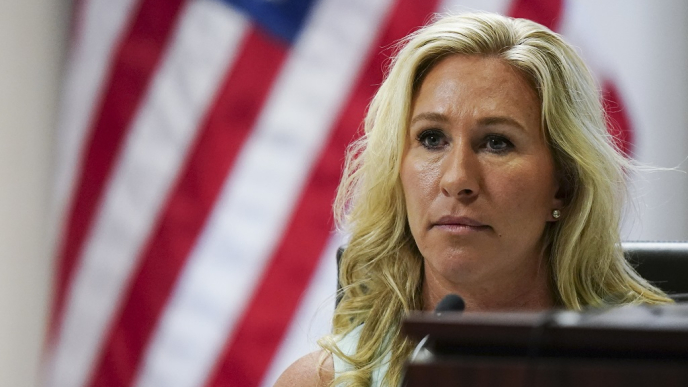
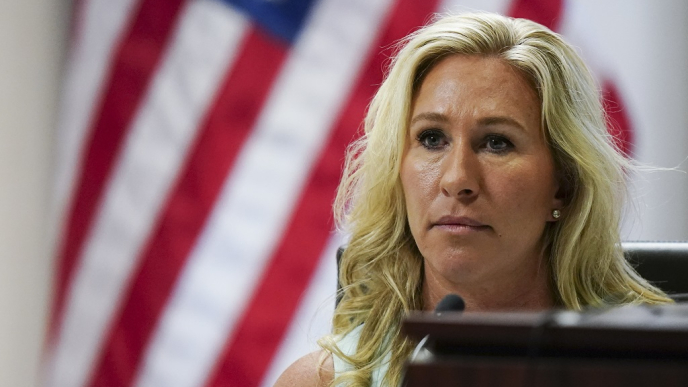
Sunday on CNN’s “State of the Union,” Rep. Marjorie Taylor Greene (R-GA) said President Donald Trump calling her a traitor put her life in danger.
Host Dana Bash, “As you just heard, and I know you saw, the president says he’s withdrawing support for you, encouraging primary challengers. You were one of his biggest supporters. What do you think happened here?”
Taylor Greene said, “I stood with President Trump when virtually no one else did, campaigned all over the country, spent millions of my own dollars helping him get elected. And I think that’s incredibly important. And I do support him and his administration. I support them in delivering the campaign promises we made to the American people. His remarks, of course, have been hurtful. However, I have something in my heart that I think is incredibly important for our country, and that is to end the toxic fighting in politics. This has been going on for years, and it has divided our country, split up friends and families, neighbors and it’s not solving our problems.” (Read more from “MTG: Trump Calling Me a Traitor Puts ‘My Life in Danger’” HERE)
https://joemiller.us/wp-content/uploads/Marjorie_Greene-3255199024.jpeg402523Joe Millerhttps://joemiller.us/wp-content/uploads/logotext.pngJoe Miller2025-11-16 20:12:432025-11-16 20:08:43MTG: Trump Calling Me a Traitor Puts ‘My Life in Danger’
In a stunning rupture between two of the most outspoken figures in the Republican Party, President Donald Trump on Friday publicly withdrew his endorsement of Rep. Marjorie Taylor Greene, accusing the Georgia firebrand of drifting “Far Left” and obsessing over the release of Jeffrey Epstein–related documents.
“I am withdrawing my support and Endorsement of ‘Congresswoman’ Marjorie Taylor Greene, of the Great State of Georgia,” Trump declared on Truth Social in an early-morning broadside that stunned GOP insiders.
He called Greene “wacky,” a “lunatic,” and said she has become consumed with “COMPLAIN, COMPLAIN, COMPLAIN!”
Greene, once one of Trump’s most loyal allies on Capitol Hill, has deviated from the president on several issues in recent weeks — including supporting an extension of Affordable Care Act subsidies and joining a bipartisan push to force public release of Epstein files.
The tension, Trump said, began when he advised Greene not to seek higher office.
“It seemed to all begin when I sent her a Poll stating that she should not run for Senator, or Governor — she was at 12%, and didn’t have a chance (unless, of course, she had my Endorsement — which she wasn’t about to get!),” Trump wrote.
He also mocked Greene for allegedly complaining that he no longer took her calls:
“With 219 Congressmen/women, 53 U.S. Senators, 24 Cabinet Members, almost 200 Countries… I can’t take a ranting Lunatic’s call every day.”
Trump hinted strongly that he is prepared to back a primary challenger in Georgia’s 14th District.
“I understand that wonderful, Conservative people are thinking about primarying Marjorie… if the right person runs, they will have my Complete and Unyielding Support,” he said.
He blasted Greene for making an appearance on The View, calling the hosts “Low IQ Republican hating Anchors.”
Greene is one of only four House Republicans who signed a discharge petition led by Reps. Thomas Massie and Ro Khanna to force a vote compelling the Department of Justice to release unclassified Epstein documents.
Trump has repeatedly dismissed Democratic efforts around the Epstein investigation as a “hoax,” but on Friday signaled he would direct DOJ and the FBI to probe Epstein’s ties to “Bill Clinton, Larry Summers, Reid Hoffman, J.P. Morgan, Chase, and many others.”
The president did not mention any investigation into Republicans or Trump associates who appear in flight logs or other records.
Within hours, Greene responded like a jilted ex — by posting her private text messages with Trump.
“President Trump just attacked me and lied about me,” she wrote on X.
“I haven’t called him at all, but I did send these text messages today.”
President Trump just attacked me and lied about me. I haven’t called him at all, but I did send these text messages today. Apparently this is what sent him over the edge.
The Epstein files.
And of course he’s coming after me hard to make an example to scare all the other… pic.twitter.com/EcUzaohZZs
The texts, addressed to “DJT,” show Greene urging Trump to “check the flight logs of Epstein’s plane,” alleging Bill Clinton flew with Epstein “26 times! Hillary too!!”
She argued that releasing the full Epstein files is necessary “for the women who were victims” and to expose “Democrat bad guys.”
Another text to a Trump aide, Natalie, shows Greene insisting she has defended Trump tirelessly for years and that the Epstein case is “not a hoax.”
“Apparently this is what sent him over the edge,” Greene concluded. “The Epstein files.”
Facebook is no longer censoring us! Please “like” us at Facebook [here]
YouTube is still censoring, but you can help us defeat that by subscribing [here]
https://joemiller.us/wp-content/uploads/ap22112558456391_custom-d28cdb7e698cc85d0655b4f51caf4af1f4bab8fa-2468564611-2.jpeg6261024Joe Millerhttps://joemiller.us/wp-content/uploads/logotext.pngJoe Miller2025-11-14 20:11:052025-11-15 21:52:36WATCH: Epstein Files Fallout: Trump Turns on Greene, Labels Her ‘Wacky Lunatic’
President Donald Trump issued a harsh rebuke of Republican Georgia Rep. Marjorie Taylor Greene following her recent remarks criticizing the White House.
CNN White House correspondent Kaitlan Collins asked Trump about Greene’s social media post expressing frustration over his White House meeting with Syrian President Ahmed al-Sharaa, a former al-Qaeda leader, Monday. The reporter also pressed the president over her comments criticizing the administration on cost of living and other domestic policy issues.
“I don’t know what happened to Marjorie,” Trump responded. “She’s a nice woman, but I don’t know what happened. She’s lost her way, I think, but I have to view the presidency as a worldwide situation, not locally. We could have a world that’s on fire where wars come to our shores very easily if you had a bad president.”
The new leader of Syria is a former Al Qaeda terrorist wanted by our government who is meeting with President Trump today at the White House on the U.S. Marine’s 250th anniversary.
He rose to power in Dec 2024, sanctions were lifted off Syria in June, and many Christians and… pic.twitter.com/El20YKN9VZ
He called former President Joe Biden a “horrible president,” pointing to the conflicts that began during his administration. “I put out 8 wars, 9 to come. I think I’ll get the other one taken care of,” Trump said before highlighting the economic toll of the Russia-Ukraine war on the U.S.
“When you’re president, you really have to sort of watch over the world because you are going to be dragged into it otherwise,” he added.
Trump then referenced his support for the “One, Big Beautiful Bill,” calling it “the biggest tax cuts in the history of the country” before taking another swipe at Greene.
Facebook is no longer censoring us! Please “like” us at Facebook [here]
YouTube is still censoring, but you can help us defeat that by subscribing [here]
(Read more from “Trump Issues Harshest Rebuke Yet Of MTG” HERE)
Rep. Marjorie Taylor Greene (R-GA) joined CNN’s Wolf Blitzer and Pamela Brown for a lengthy interview on Thursday that covered everything from the government shutdown, to some of Greene’s more controversial statements of late, to the House vote on releasing the Jeffrey Epstein files.
As the conversation wound down, Brown asked Greene about Sen. Ted Cruz (R-TX) recently slamming her for dabbling in what many viewed as anti-Semitism.
“So you recently suggested on X that a quote, ‘foreign government or powerful people may try to kill you.’ Republican Senator Ted Cruz of Texas shared that post of yours on X, writing, quote, ‘Why do crazy people keep thinking the Jews are trying to kill them?’ What do you say to Cruz, and what did you mean by that?” Brown asked.
“Well, first, that was an extremely ridiculous thing for Ted Cruz to say. I never said Jewish people. I’m not anti-Semitic. I don’t hate any people group for their identity or who they are. So that was unbelievably low for a sitting U.S. senator to say that. But what I’m talking about is very real. I have a tremendous amount of death threats,” Greene replied, adding:
It’s documented. I have some of the highest amount of death threats as a sitting member in the House of Representatives. And when you speak about certain issues, we can watch the calls and the emails and the messages—they increase, and the threats increase.
And so when I say I am seriously concerned for my life, and I say, “If something ever happens to me,” I really mean it. It’s okay for me to say that. This is the time that we’re living in, where we’re seeing political violence, and I’m totally against it completely in every which way. But when I say something like that and to have another Republican of my own party insult me and insinuate I’m saying something I never said is absolutely unacceptable.
(Read more from “Marjorie Taylor Greene Takes a Swing at GOP Leadership, Blasts Anyone Trying to ‘Prevent’ Epstein List ‘From Coming Out’” HERE)
https://joemiller.us/wp-content/uploads/ap22112558456391_custom-d28cdb7e698cc85d0655b4f51caf4af1f4bab8fa-2468564611.jpeg6261024Joe Millerhttps://joemiller.us/wp-content/uploads/logotext.pngJoe Miller2025-10-14 11:52:592025-10-14 11:13:16Marjorie Taylor Greene Takes a Swing at GOP Leadership, Blasts Anyone Trying to ‘Prevent’ Epstein List ‘From Coming Out’
U.S. Rep. Marjorie Taylor Greene blamed Republican congressional leadership for the ongoing government shutdown during an interview Thursday on CNN, calling on her party to fully fund the government. . .
“It shouldn’t be something we dangle — the American people or military pay — we shouldn’t be dangling it in front of them,” Greene said.
The Georgia congresswoman said she opposes a short-term funding bill and instead wants Congress to pass a full appropriations package, which she called its constitutional duty.
“I am a Republican and I support the President, so I voted for the continuing resolution,” Greene said. “I want to pass our appropriates. That’s our constitutional duty.” . . .
“We control the House. We control the Senate. We control the White House. I’ve been vocal saying you can use the ‘nuclear option’ in the Senate,” Greene said. “This doesn’t have to be a shutdown.” (Read more from “MTG Blames GOP Leadership for Shutdown” HERE)
Democrats have gained an unlikely ally in their fight to extend expiring Affordable Care Act funding: MAGA Republican Marjorie Taylor Greene.
“I was not in Congress when all this Obamacare ‘Affordable Care Act’ bullshit started. I got here in 2021. As a matter of fact, the ACA made health insurance UNAFFORDABLE for my family after it was passed, with skyrocketing premiums higher than our house payment. Let’s just say as nicely as possible, I’m not a fan,” Greene wrote on Monday night. “But I’m going to go against everyone on this issue because when the tax credits expire this year my own adult children’s insurance premiums for 2026 are going to DOUBLE, along with all the wonderful families and hard-working people in my district.
“And I’m absolutely disgusted that health insurance premiums will DOUBLE if the tax credits expire this year. Also, I think health insurance and all insurance is a scam, just be clear!” Greene continued. “Not a single Republican in leadership talked to us about this or has given us a plan to help Americans deal with their health insurance premiums DOUBLING!!!”
It isn’t just Greene’s adult children who will be slammed by raising premium costs if tax credits aren’t extended. Millions of Americans will have to fork over thousands of additional dollars to make sure they can get basic, often lifesaving care in this country if the Obamacare subsidies expire. Greene joins Representative Thomas Massie as the highest-profile GOPers to criticize the shutdown, as Massie called the shutdown a distraction to avoid voting on the Jeffrey Epstein files.
“Our country sent $30 billion to Israel in 2024 alone killing countless innocent children and sent HUNDREDS OF BILLIONS to Ukraine in the past few years,” Greene added in her statement Monday. “By the way, I voted NO to all of that murder! America has funded the Ukrainian government, Ukrainian pensions, and Ukrainian businesses during this entire stupid war that America should have nothing to do with. (Read more from “MTG Turns Against Republicans in Shocking Flip on Government Shutdown” HERE)
https://joemiller.us/wp-content/uploads/53423347434_221f713848_b-1842770069-1.jpeg6831024Joe Millerhttps://joemiller.us/wp-content/uploads/logotext.pngJoe Miller2025-10-07 16:41:462025-10-11 20:39:06MTG Turns Against Republicans in Shocking Flip on Government Shutdown
Georgia Congresswoman Marjorie Taylor Greene expressed deep concern this week over what she described as a “startling” collapse of traditional milestones for young Americans — namely marriage and homeownership — warning that an entire generation may be missing out on the foundation of the American Dream.
The Republican lawmaker, who is also a mother of three adult sons aged 22, 25, and 27, took to social media to voice her frustration following the early adjournment of House business by Speaker Mike Johnson. The session was reportedly cut short in part to avoid a floor vote on a bipartisan resolution to unseal documents related to the late financier and sex offender Jeffrey Epstein.
Greene, a co-sponsor of the measure seeking the release of the so-called “Epstein Files,” criticized the decision to leave Capitol Hill early, calling it another example of “political gamesmanship” taking precedence over issues that impact American families.
“I’m fighting for my kids and their entire generation. Their future is all that matters to me,” Greene posted on X (formerly Twitter).
I think this is one of the most startling and tragic statistics I have seen.
Only 12% of 30 year olds are married and own a home.
Marriage, family, and home ownership are the ultimate trifecta of security and happiness.
— Rep. Marjorie Taylor Greene🇺🇸 (@RepMTG) August 3, 2025
As part of her ongoing advocacy for what she calls “real American priorities,” Greene posted a dramatic chart showing a steep drop in the number of 30-year-olds who are both married and own a home — from more than 50% in the 1950s and 60s to just 12% projected for 2025.
“This is one of the most tragic and eye-opening statistics I’ve seen,” she wrote. “Marriage, family, and homeownership are the ultimate trifecta of stability and happiness. I hope we can reverse this downward trend.”
The graph underscores a growing concern among conservatives and some economists who point to rising housing costs, inflation, student debt, and cultural shifts as contributing factors to young adults delaying — or entirely forgoing — marriage and buying property.
Greene’s remarks reflect broader frustrations among many Americans who feel the promise of upward mobility has dimmed for their children, despite technological advances and a booming financial sector. Critics argue that the current economic framework has increasingly locked out younger generations from attaining the same quality of life their parents and grandparents enjoyed.
https://joemiller.us/wp-content/uploads/52984753036_34734ef096_b.jpg6831024Joe Millerhttps://joemiller.us/wp-content/uploads/logotext.pngJoe Miller2025-08-03 21:49:272025-08-03 19:04:11MTG Warns of Generational Collapse: “One of the Most Startling and Tragic Statistics I’ve Seen”
Rep. Marjorie Taylor Greene (R-GA) suggested President Donald Trump was “destroying states’ rights” with his “One Big Beautiful Bill” to fund government spending.
On Sunday, Fox News host Maria Bartiromo asked Greene about a “provision within the One Big, Beautiful Bill that prevents states from regulating artificial intelligence for 10 years.”
“You don’t want 50 states regulating their own AI that opens the can of worms up to Democrats who will over-regulate,” the Fox News host told Greene. “You see it differently.”
“The One Big Beautiful Bill delivers President Trump’s campaign promises on taxes, energy, and border,” Greene said. “And with what’s happening in LA, Antifa and the uprising with the cartels defending illegal aliens, and this is the Democrats’ agenda, we cannot have a poison pill that literally destroys federalism for 10 years.”
“Otherwise, we are no different than China, Maria,” the lawmaker continued. “Here’s the issue. If we tie our state’s hands for 10 years, we have no idea what AI will do. And the biggest fear is, is you look at the economy. AI is going to replace jobs from all kinds of sectors.”
(Read more from “MTG Slams Trump for ‘Destroying States’ Rights’ With His Big Beautiful Bill” HERE)
https://joemiller.us/wp-content/uploads/MAGA20GOP20Marjorie20Taylor20Greene-660x330-4224355750.webp330660Joe Millerhttps://joemiller.us/wp-content/uploads/logotext.pngJoe Miller2025-06-08 18:55:392025-06-08 18:48:55MTG Slams Trump for ‘Destroying States’ Rights’ With His Big Beautiful Bill
Rep. Marjorie Taylor Greene (R-GA) introduced an amendment to a supplemental funding bill for Ukraine that would require members of Congress who vote “in favor” to enlist in the Ukrainian military.
Greene’s amendment comes as House Republicans released the legislative text regarding four bills wrapped into one, according to CBS News.
Under the three bills, $26.4 billion would be sent to Israel, $60.8 billion would go to Ukraine, and $8.1 billion would go to countering the threat of China in the Indo-Pacific and providing foreign aid to Taiwan.
A fourth bill focuses on providing other defense measures to “strengthen” the “national security” of the United States.
“Any Member of Congress who votes in favor of this Act shall be required to conscript in the Ukrainian military,” the amendment to the Ukraine Security Supplemental Appropriations Act 2024 reads.
Rep. Marjorie Taylor Greene introduced an amendment requiring members to “conscript in the Ukrainian military” if they vote for the Ukraine supplemental bill. pic.twitter.com/n0SykKpA3I
https://joemiller.us/wp-content/uploads/OIP-2024-04-17T223014.741.jpeg316474Joe Millerhttps://joemiller.us/wp-content/uploads/logotext.pngJoe Miller2024-04-17 22:35:522024-04-17 22:31:23Marjorie Taylor Greene Introduces Amendment to Ukraine Bill: Members Who Vote ‘In Favor’ Required to Join Ukrainian Military
Georgia Republican Rep. Marjorie Taylor Greene filed a motion to oust Speaker Mike Johnson on Friday after the House passed a $1.2 trillion spending bill that includes dozens of left-wing earmarks but no Republican voters’ priorities. Greene urged Johnson not to allow the bill a floor vote, calling it a “complete departure” from the party’s core values.
“No Republican in the House of Representatives in good conscience can vote for this bill. It is a complete departure from all of our principles, especially if you call yourself ‘pro-life’,” Green said on the House floor.
No Republican in good conscience can vote for the uniparty minibus.
This is not a Republican bill. It is a Chuck Schumer, Democrat-controlled bill coming from the “Republican-controlled” House.
— Rep. Marjorie Taylor Greene🇺🇸 (@RepMTG) March 22, 2024
“This is not a Republican bill. This is a Chuck Schumer Democrat-controlled bill coming from the House majority that is supposed to be controlled by Republicans, but yet our majority has been completely handed over to Democrats,” Greene continued.
The 1,012-page bill passed the House 286-134, with 101 Republicans voting yes.
— Rep. Marjorie Taylor Greene🇺🇸 (@RepMTG) March 22, 2024
(Read more from “Motion Filed by Greene to Remove Speaker Johnson Following Approval of Mega Spending Legislation in House” HERE)
https://joemiller.us/wp-content/uploads/Mike-Johnson-II.jpeg252378Joe Millerhttps://joemiller.us/wp-content/uploads/logotext.pngJoe Miller2024-03-22 21:40:312024-03-22 14:44:06Motion Filed by Greene to Remove Speaker Johnson Following Approval of Mega Spending Legislation in House