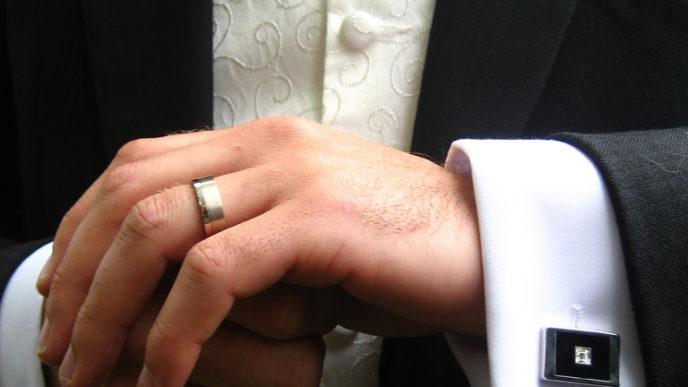
The ups and downs of married life take their toll on dads’ hearts, a new study found.
The roller-coaster relationship between spouses causes blood pressure, bad cholesterol and weight to rise and fall in men compared to those in stable relationships.
When things are bad and the relationship is deteriorating, men’s blood pressure soars.
But when they got along better with their wives, men saw their bad cholesterol and weight drop and generally saw cholesterol and blood pressure improve. (Read more from “Bad Marriage Tied to Bad Health in Men” HERE)
https://joemiller.us/wp-content/uploads/3734522499_edef3e9190_b.jpg1024768Joe Millerhttps://joemiller.us/wp-content/uploads/logotext.pngJoe Miller2017-10-10 20:14:192017-10-10 20:14:19Bad Marriage Tied to Bad Health in Men
But are these kinds of relationships really as healthy as recent reports suggest?
Just as Happy?
Studies traditionally report that people in open marriages and other forms of polyamory are less happy than monogamous couples. A March study suggests that’s because society is biased against them. Researchers at SAGE Journals found that “CNM [consensual non-monogamous] relationships generally have equally positive relational outcomes as monogamous relationships.”
But Dr. Brad Wilcox said there is a lack of good evidence on the actual appeal of open marriages. For instance, the Times piece on open marriages was “data free.” That was “striking,” he told The Stream. Wilcox is the director of the National Marriage Project at the University of Virginia.
Studies favoring polyamory “are based on non-representative samples,” he said. “It’s not really good science.” Even the SAGE study’s authors admit their survey respondents were not chosen randomly. They may have been biased toward positive reporting.
“My guess is that these marriages are really unstable,” Wilcox said. The complexity that comes along with an open marriage might be harder in practice than in theory, he added.
Wilcox noted that most Americans still favor the idea of fidelity. And people who have had just one partner in the last year and not several tend to be happier, he said. He called those pushing for polyamory and open marriages “a small minority.”
Redefining Morality
Why is that minority so vocal? Perhaps it has to do with Americans’ shifting view of morality.
LifeWay Research released a telling study last month. It revealed that 81 percent of Americans worry about “declining moral behavior.” But people disagree about the meaning of “moral.” Nearly 50 percent said that right and wrong are absolutes. But 20 percent said something is “wrong” only if it hurts someone.
According to the study, “More than 6 in 10 of those older than 45 say right and wrong do not change. For those 35 and younger, fewer than 4 in 10 make that claim.” The age gap between the two is not surprising. Another recent study revealed that only 4 percent of millennials hold a “biblical worldview.”
Since many people don’t view moral truths as absolute, the growing acceptance of polyamory makes sense. If it doesn’t hurt anybody, why not? “How is love bad?” asks one husband who lives with his wife, daughter, and his wife’s boyfriend.
True Happiness Requires Holiness
The Times portrays its “Open Marriage” interview subjects with sophistication. The author is impressed by the “boldness” of their unconventional ways. But really, there’s nothing new or bold about seeking sensual pleasure.
In Galatians, Paul refers to sinful desires as “the flesh.” He warns Christians to “not use your freedom as an opportunity for the flesh.” (Galatians 5:13) A few verses later, he writes:
But I say, walk by the Spirit, and you will not gratify the desires of the flesh. For the desires of the flesh are against the Spirit, and the desires of the Spirit are against the flesh, for these are opposed to each other, to keep you from doing the things you want to do. (Galatians 5:16-17)
Christians are taught to reject fleshly desires in favor of something greater. We believe true joy is found in holiness. And we become holy by accepting God’s salvation through Jesus Chirst. In that salvation, there is freedom from the sin that enslaves all of us.
Anything in marriage beyond fidelity between one man and one woman is sin. And so participating in anything else is to resubmit to sin’s bondage. As D.C. McAllister wrote for The Federalist in 2015, critiquing a polyamorist columnist:
Burrows was so quick to throw off the chains of religion and social norms that she fails to see that she has entered a new kind of bondage: she is bound by the chains of her sexual desires. Little does she know that those butterflies that make her feel so alive will soon become dragons that burn off her soul and reduce her to an empty shell of animalistic appetites. Burrows fails to see that liberty — real liberty — is found in self-government and self-control.
The idea of open marriage and poly-romance isn’t new. Neither is defining happiness and freedom by the unbridled pursuit of sensual pleasure. But there is a recent wave of exploration when it comes to the idea of polyamory as a legitimate, ethical relationship (and parenting) style — even if led by a “small minority.” Founded on empty desires, false morality and little research, it’s a wave that deserves push-back. (For more from the author of “Open Marriages Happier? Not So Fast, Family Research Expert Says” please click HERE)
https://joemiller.us/wp-content/uploads/marriage-451596_960_720.jpg640960Joe Millerhttps://joemiller.us/wp-content/uploads/logotext.pngJoe Miller2017-06-22 02:04:222017-06-22 03:56:20Open Marriages Happier? Not So Fast, Family Research Expert Says
In 2016, same-sex “marriage” was legalized in Colombia. One year later, the courts have now recognized a polyamorous “family” of three men. And there is no slippery slope.
Actor Victor Hugo Prada and his two partners, sports instructor John Alejandro Rodriguez and journalist Manuel Jose Bermudez, have signed legal papers with a solicitor in the city of Medellin, establishing them as a family unit with inheritance rights.
“We wanted to validate our household … and our rights, because we had no solid legal basis establishing us as a family,” said one of the men, Prada, in a video published by Colombian media on Monday.
Here in the States, the Associated Press notes that “More courts [are] allowing 3 parents of 1 child.” An example would be when a lesbian couple has a child with the help of another man, all three of whom become parents.
And there is no slippery slope.
From Biblical Marriage to ‘Ze’ and ‘Zir’ in 9 Years
When candidate Barack Obama ran for president in 2008, he knew that he could not reveal his true sentiments about gay “marriage.” According to David Axelrod, he knew it would hurt his election chances. So he clearly and decisively declared that marriage was the union of a man and a woman. He said this was his Christian conviction.
Today, a Republican congressman is shot in cold blood and liberal news commentators suggest that we can’t forget his record at a time like this. After all, he wanted to pass a Constitutional amendment defining marriage as the union of a man and a woman.
And there is no slippery slope.
It wasn’t that long ago that the Human Rights Campaign felt the need to remove “transgender” from its campaign to pass ENDA, the Employment Non-Discrimination Act. Today, in New York City, you can be fined up to $250,000 for failing to accept the stated identity of a trans employee. And Canada has just passed Bill C-16, which requires it citizens to use whatever gender pronouns a person chooses. For instance, “Refer to me as ze and zir rather than he or her.”
Failure to use a person’s pronoun of choice — “ze,” “zir,” “they” or any one of a multitude of other potential non-words — will land you in hot water with the commission. That, in turn, can lead to orders for correction, apology, Soviet-like “re-education,” fines and, in cases of continued non-compliance, incarceration for contempt of court.
And there is no slippery slope.
When Society Affirms the Slope
In recent years, the media has pushed polygamy, polyamory, and even consensual adult incest, with public opinion gradually shifting towards more acceptance of these lifestyles and acts. (For documentation, see here.)
And there is no slippery slope. Or perhaps the slippery slope isn’t so bad after all?
That was actually the conclusion of a number of liberal students who challenged a talk I gave at a local, secular university.
I was asked to speak on the subject of God and Sex. I addressed the question, “Are biblical standards of sexual purity destructive or constructive, helpful or harmful, binding or liberating?” In the lecture, I explained how everything reproduces after its kind. I also explained that we have to look at the trajectory of an idea or action or behavior. Where will it ultimately lead?
When it was time for Q & A, several students began to challenge my talk, claiming that there was no such thing as a slippery slope.
I asked them if they believed in the concepts of “love is love” and “I have the right to marry the one I love.” They all said yes, no matter how far it went. Three people? Four? Two adult brothers? And should the government be obligated to recognize all these relationships?
They answered in the affirmative to all my questions, concluding, “Well, I guess there is a slippery slope, but it’s not wrong.”
And that is where our society is heading. It’s becoming increasingly difficult to deny the reality of the slippery slope. The logical next step is to affirm it. (For more from the author of “Three Men Get ‘Married’ in Colombia and There Is No Slippery Slope” please click HERE)
https://joemiller.us/wp-content/uploads/gay-pride-flag-847064_960_720-2.jpg720855Joe Millerhttps://joemiller.us/wp-content/uploads/logotext.pngJoe Miller2017-06-21 20:48:012017-06-21 20:48:01Three Men Get ‘Married’ in Colombia and There Is No Slippery Slope
June 12 was the 50th anniversary of Loving v. Virginia, the Supreme Court case that made interracial marriage legal across the United States. So someone was bound to publish an article, claiming that arguments made against same-sex marriage today are just like arguments made against interracial marriage fifty years ago. Therefore (so it goes) people who oppose same-sex marriage are on the wrong side of history, just like those who once opposed marriage between races.
I’ll be glad to agree with them. Sure, the arguments are the same. There’s no difference at all! Just like there’s no difference between a man and a mouse.
Take Dave Singleton’s article at Salon.com. For the most part it’s a story — a moving and very personal one, at that. He tells what it was like when he found out it was his godfather and uncle, Robert McIlwaine, who had argued the state’s position against interracial marriage before the Supreme Court in the Loving case.
It’s a great read, except for the errors he makes here:
The similarity in language used by lawyers arguing on both sides of interracial and gay marriage is undeniable. I’ve heard the same faulty logic used in Loving v. Virginia applied to gays and lesbians: Gay marriage is a sacrilege that will topple society, and heterosexual marriages will suffer. One state shouldn’t have to accept what another state legitimizes. And what about the kids Adam and Steve aren’t fit to raise? Unless reared by Adam and Eve, they will be messed up, scorned by society and miserable.
Yes, there’s “similarity” there. Humans and mice have a lot in common, too. Mice and men both have four limbs, two eyes, two ears, a nose, a mouth and hair. Therefore what’s true for men is true for mice, right? Sure — if you ignore all the differences. That’s what Singleton did here.
Those differences are plenty. I’ll focus on just four of them.
1. Common Beliefs Across All of Humanity
Unlike the situation with same-sex marriage, people in general have never taken it as given that there’s something wrong with marriage between races. As Francis Beckwith wrote in a very helpful 2010 Public Discourse article, common law never put forth any ban on marriage between races. That means that “interracial marriage was a common-law liberty,” of a sort that could only be turned back by laws specially written to have that effect. Some states wrote those laws to that end, but they were the exception, not the rule.
Same-sex marriage, in contrast, could never have been anything but an exception — if anyone even thought about it, that is, which never happened until just a few years ago.
2. Interracial Marriage was “Wrong,” Same-Sex Marriage Didn’t Exist
Some states made interracial marriages illegal — but just as an illegal left turn is still a left turn, those illegal marriages were still marriages. Those states might have considered them harmful marriages, the wrong sort of marriages, and ultimately illegal marriages, but they still considered them marriages. Beckwith reminds us (quite sensibly) that it would have made no sense to write laws against people of different races getting married, unless it was in some real sense possible for them to marry.
All this is completely different when it comes to same-sex marriage. It wasn’t the case (as it had been with interracial marriage) that same-sex couples were getting married, and lawmakers decided to call it off because they thought it was wrong or harmful. There was nothing there to call off. Same-sex marriage didn’t even exist. The Supreme Court in 2015 didn’t just declare it legal, as they had in the Loving case; the Court actually created a new thing that had never existed before, except in those few states that had already done the same thing before then.
In fact, as Beckwith points out, same-sex marriage has a lot in common with these former laws against marriage between races. Both of them rely on state coercion to define marriage in terms of something other than the natural, historic understanding of male and female uniting as a couple and to build a family.
3. Interracial Marriage was Banned, Same-Sex Marriage Wasn’t
Look at it this way: Same-sex marriage was never banned. It was never even “against the law.” While some states banned marriage between races, no state ever did that with same-sex marriage. Instead states took it to be non-existent simply by the way marriage was defined.
The Supreme Court’s same-sex marriage decision two years ago was very different from Loving, for it reversed no ban. Instead it created a new definition for marriage. Rather than letting marriage be defined as it always has been: the lifelong committed union between a man and a woman, whose natural expectation is (for the great majority) the building of a family, the court made it something else entirely, the law. It became, for the first time, the committed union of any two adults who get along together, and probably have a romantic attraction to each other.
4. How Marriage is Defined
And that matter of how marriage is defined has always been at the heart of the case against same-sex marriage. The single most influential work against same-sex marriage was a paper by three scholars for the Harvard Journal of Law and Policy, followed by a book on the same topic by the same authors, both of them centered on the definition of marriage. There is something that marriage is, they say; there is something that makes marriage marriage, and that something necessarily includes the male-female aspect. Their reasons for that go far beyond the social effects Singleton lists in his article (and beyond what I have room to discuss here).
That’s not to say no one has ever put forth other arguments besides these. Singleton names a few of them (with a dismissive sneer). But those arguments are like ears, nose and hair: they tell part of the story, but they don’t omit some of the knowledge that counts the most.
Summary: A Man or a Mouse?
Let me summarize before I close.
Some states made decisions contrary to the rest of the country and against most of history. They decided marriage between races was a bad idea, so it should be banned.
In contrast to that, no state has ever banned same-sex marriage. Until an eye blink of history ago, no state ever took action against it because it was a bad idea. Instead, marriage was always, by definition a relationship for opposite-sex couples. There are good reasons it was defined that way. That definition and its reasons have always been at the heart of the case against same-sex marriage.
I’m sure Dave Singleton can tell a man from a mouse. I’m sure he knows differences matter, even where similarities may also exist. In the matter of marriage, though, he ignores real differences that really exist. Either that, or else he hides them.
Interracial marriage and same-sex marriage are just too different to be called the same sort of thing. (For more from the author of “Same-Sex Marriage Is Not Today’s Replay of Interracial Marriage” please click HERE)
https://joemiller.us/wp-content/uploads/wedding-rings-949106_960_720.jpg720960Joe Millerhttps://joemiller.us/wp-content/uploads/logotext.pngJoe Miller2017-06-19 18:48:282017-06-19 18:48:28Same-Sex Marriage Is Not Today’s Replay of Interracial Marriage
Arguably the most consequential cultural shift of the past 50 years that too many people are unaware of is the rise of what demographers call “median age at first marriage.”
Two simple numbers, one for men and the other for women, tell a great deal about where marriage and family rank among our culture’s priorities.
Growing Up, Then and Now
In 1950, the median ages for first marriages were 22.8 years old for men and 20.3 years old for women. As late as 1970, the median ages were 23.2 for men and 20.8 for women. And then those ages started rising, and they’re still going up. The figures as of 2013: 29 and 27, respectively.
What’s going on here? What does it mean? Those questions are raised in an important new study by the Census Bureau.
The study, entitled “The Changing Economics and Demographics of Young Adulthood: 1975-2016,” opens with a sobering conclusion: “What was once ubiquitous [for younger Americans’] during their 20s is now not commonplace until their 30s. Some demographers believe the delays represent a new period of the life course between childhood and adulthood, a period of ‘emerging adulthood.’” (For more from the author of “Delaying Marriage and Parenthood: The Consequences of ‘Emerging Adulthood'” please click HERE)
https://joemiller.us/wp-content/uploads/Wedding_rings.jpg9001200Joe Millerhttps://joemiller.us/wp-content/uploads/logotext.pngJoe Miller2017-05-15 02:48:162017-05-15 02:48:16Delaying Marriage and Parenthood: The Consequences of ‘Emerging Adulthood’
It is only irrational animus, bigotry, and hatred that causes some to deny that human beings and fairground rides cannot marry. Love is love, and sometimes love extends to the soaring tracks, twisting hairpin curves, and thrilling loop-de-loops of roller coasters.
Yes. Two women have married, not each other, which would not be unusual these days, but each has married a roller coaster. Not the same roller coaster, of course; that would be absurd; different roller coasters.
One lady, a Miss Wolfe, 33, church organist, fell in love with the roller coaster in Knoebels Amusement Park, Pennsylvania. According to one report, “Although she faces discrimination from employers, most of her family and friends have been supportive. ‘I’m not hurting anyone and I can’t help it,’ she said. ‘It’s a part of who I am.’”
Don’t scoff. No one chooses to be an objectum-sexual; it is something which is forced upon one. What’s that? What’s an objectum-sexual? As defined by the second wedded lady, Linda, 56, who tied her knot to the backside of a roller coaster, an objectum-sexual is a person who “has romantic feelings for inanimate objects.”
Psychology Today reports many are objectum-sexuals, folks who view their objects of love as “equal” partners. Who isn’t for Equality? Reports are coming in from the across the globe of objectum-sexuals marrying smart phones, steam engines, video game characters, rocks, trees, dolls, electronic devices, radios, pillows, cars, and, yes, the Eiffel Tower.
The Self-Sexuals
Animus, bigotry, and hatred not only motivates people to deny the rights of objectum-sexuals, but also to disparage the needs and desires of self-sexuals. Self-sexuals are people who love best themselves, making it natural that the objects of their matrimonial instincts are, well, themselves.
No less conservative an organ than Good Housekeeping reports that “self-marriage is a small but growing movement, with consultants and self-wedding planners popping up across the world.”
One such person is Brooklynite Erika Anderson who recently married herself. “It wasn’t an easy decision,” she said. “I had cold feet for 35 years. But then I decided it was time to settle down. To get myself a whole damn apartment. To celebrate birthday #36 by wearing an engagement ring and saying: YES TO ME. I even made a registry, because this is America.”
There is even, because this is America, a website, I Married Me, which advises readers to “Choose love.” Love is, after all, love. The site provides the unofficial motto for the self-marriage movement, “To honor myself is to understand and acknowledge that I am worthy”. Anybody can marry themselves, even folks who are already married to others, or to objects.
“It’s not a legal process — you won’t get any tax breaks for marrying yourself. It’s more a ‘rebuke’ of tradition, says Rebecca Traister, author of All the Single Ladies: Unmarried Women and the Rise of an Independent Nation.
Rebuke?
The Rebuke of History and Tradition and Nature
Tradition insists that marriage is between one man, one woman; the two become “one flesh.” The pairs came together to procreate and care for not just each other, but for their created families. Marriages were the result of the natural state of mankind, driven by necessities of biology, the environment, and even religion. No government dared risk interfering with this fundamental and organic process. To have meddled would have invited charges of monumental hubris.
But things change. Governments recognized Equality trumped Nature, and so mandated that history and tradition be overthrown. But first they were borrowed from. History and tradition insisted that marriage was the state between two people, so government meddling dictated any two people could marry.
But it will quickly be realized (and is being realized) that history and tradition can be no guide whatsoever, because history and tradition, while they do say marriage was for pairs, also insist, in the strongest possible terms, that marriage is only for man-woman pairs.
So history and tradition must be rebuked.
Those who want to keep with capital-Tradition are no longer allowed to do so. Traditionalists are still allowed to marry one another in the traditional way, but they are now forced to agree that government-defined “marriages” are equivalent to actual marriages. Governments have not, as yet, moved to “bless” object- and self-marriages, but there is no good reason for them not to.
And if people can marry roller coasters and themselves, why cannot sons marry their mothers? Cosmopolitan reports, “A Mom Fell in Love With Her Son and Plans to Have Children With Him,” which they call “genetic sexual attraction”. There is already a forum for interested people. Why not marriage?
After all, when marriage can be anything, marriage can be anything. (For more from the author of “When Marriage Can Be Anything, Marriage Can Be Anything” please click HERE)
https://joemiller.us/wp-content/uploads/Leaving_Seattle_City_Hall_on_first_day_of_gay_marriage_in_Washington_2-3.jpg19362936Joe Millerhttps://joemiller.us/wp-content/uploads/logotext.pngJoe Miller2017-01-08 21:01:172017-01-08 21:04:21When Marriage Can Be Anything, Marriage Can Be Anything
It sounds like a joke, but it is not entirely. Still recoiling from the insanity of marriage between two people of the same sex, we are told that people — women largely — are now marrying themselves. That’s right: having the dress, the ring, umpteen guests and saying “I do” to your very own ego. The UK’s Spectator magazine is the latest to survey this weird trend, the origins of which some writers trace back to 1993.
Admittedly, there are still only a handful of women in this lunatic fringe, but it includes writers, artists and life coaches who attract media attention. There’s an earnest TED talk about it by Tracy McMillan, an American television writer with a trail of broken marriages behind her; an online business peddling the I Married Me Self-Wedding In-A-Box, complete with ring, “ceremony instructions, vows, and 24 affirmation cards (so you can continue the practice)”; and lawyers to tell you, quite unnecessarily, whether it’s legal or not.
There is even a new word for these narcissistic nuptials: sologamy, which takes its place alongside monogamy, polygamy and polyamory as an apparently intelligible concept.
Yes, it’s ridiculous, but it is also sad to think of the dashed hopes, confusion and loneliness that would make ritual self-affirmation seem like a replacement for marital love.
That is why, although it would be easy to dismiss same-self marriage as a passing minority fad — already parodied by women marrying themselves to objects (a rock, a sandwich, a rollercoaster) and animals (a snake, a dolphin) — that will soon exhaust itself, we must take it seriously. It it is symptomatic of a serious dilemma facing women, and men, today: the difficulty of finding someone to marry. The difficulty of even understanding what marriage is.
Marriage rates in Western countries have fallen dramatically over the past 40 years, and especially since the 1980s. Economic changes affecting men’s employment, the rise of women’s employment, delayed marriage, the decline of religion, the social acceptability of pre-marital sex and cohabitation, ideas about the meaning of “equality” in marriage – these are just some of the factors in the decline of marriage.
According to a Pew Research Center analysis of Census data, in 2012 one-in-five adults ages 25 and older (about 42 million people) in the US had never been married, compared with only one in ten (9 percent) in 1960. Though they were not “out there” marrying themselves, men were more likely than women to have never been married (23 percent vs 17 percent).
But do these singles even want to be married? In a survey accompanying the Pew analysis, most young adults (67 percent) said society was just as well off if people had priorities other than marriage and children, while among never married adults, one third said they were not sure they would like to get married and another 13 percent said they did not want to marry.
This is the really awful story behind the ladies pledging to love, honor and obey themselves till death — the fact that so many young adults are not even sure that they want a spouse and children; the fact that they cannot see marriage as the institution that builds society and brings men and women, on the whole, health, wealth and happiness.
This is the sad bequest of the older generations to their children and grandchildren.
It’s true that marriage is not the only way to serve society and fulfill yourself. There have always been people who remained single because of some other compelling vocation (the Florence Nightingales, the missionaries, monks and nuns, the daughters and sons who supported their siblings and aged parents…) or simply lack of opportunity, but if marriage were not the natural vocation of most people the human race would wither and die. Women do not, on the whole, bear children without a commitment from their mate. And children do not generally thrive as they should outside of a married-parent home.
What the West has done in recent times is behave as though neither commitment nor children were essential to anyone’s fulfilment or to society. Look what you can have without marriage, we tell women: sex, a better job than most of the men available have; the support of the state if anything goes wrong; and if you really do want a child, there’s adoption or a sperm donor. Oh, and now the wedding! The ring! The anniversaries of your vows to yourself! Who needs a husband?
In truth, it is difficult to see what a husband adds — unless it is a good wage and another pair of hands — under the prevailing egalitarian model of marriage that seems to be so successful among the highly educated. You know: “gender equality”; fifty percent each of paid work and household chores.
Many scholars have observed that this idea of marriage does not appeal to working class men — and perhaps much of the middle class as well. A more equal sharing of roles, yes, but not with the precision of a business partnership, which is how marriage often is represented today.
What is lost in this model is something so fundamental that it could explain much of the current disenchantment with the institution: complementarity, the idea that man and woman are two halves of humanity, signifying our essentially relational nature.
One doesn’t have to be married to participate in the giving and receiving of human relationships, but marriage, with its typical fruitfulness in the form of children, reminds us all of an existential need and call. Given that it is also the way civilizations — especially the Christian civilization of the West — have grown and flourished, the idea that marriage can be replaced by self-love is both absurd and cruel.
Of course not everyone needs to be married. Of course we must love ourselves, in the sense of accepting ourselves and wanting what is truly best for us. Of course we must have a certain “wholeness” in order to give ourselves to others and receive what they have to give us.
But wholeness is a lifetime project that can only be achieved in relationship with others. Marriage is the great exemplar of that human project and the way that most people would pursue it in a sane society. We should be doing all we can to encourage young people to aim for it, to show them what it really is and to foster their hope for a good marriage, not manufacturing myths to protect failed sexual and gender revolutions. (For more from the author of “Alas, Marrying Oneself Is Now a Thing … Really” please click HERE)
https://joemiller.us/wp-content/uploads/bride-997604_960_720.jpg640960Joe Millerhttps://joemiller.us/wp-content/uploads/logotext.pngJoe Miller2016-09-04 22:04:152016-09-04 22:04:15Alas, Marrying Oneself Is Now a Thing … Really
When we interviewed Carly, 31, in the summer of 2010, she had been in an on-again, off-again cohabiting relationship with the father of her child for about 12 years. Never married, she called marriage a “piece of paper.”
One year later, however, she had broken up with her longtime boyfriend and was engaged to a different man.
Why did she accept his marriage proposal?
Contradicting what she said a year before, Carly (not her real name) told us: “Everybody says, ‘Oh, it’s just a piece of paper.’ But that piece of paper is … more binding than just really being together.”
She explained that her experience in a long-term cohabiting relationship had taught her that marriage was indeed different.
As we learned in our interviews with over 100 young adults in a mostly white working-class town in Ohio, most young people are neither adamantly opposed to marriage nor completely supportive: They are conflicted about marriage. They hope to get and stay married, providing for their own children the family stability that many of them did not have growing up.
One national study found that in 2001-2002, more than 80 percent of young adults said that marriage was important in their life plan. But many are also uncertain about how to achieve that aspiration and unsure about whether marriage retains the meaning they believe it should have.
Many of them witnessed the separation or divorce of their parents as children, or barely knew their dad or mom. Others saw their parents stay in marriages marked by abuse, drinking, drugs, or misery. Others admired their parents’ marriage but were shaken by the divorces of relatives or friends, or by hearsay about high divorce rates.
The legacy of the divorce culture is trauma and a crisis of trust. A study conducted in the mid-2000s found that of 122 working–and middle-class young people in cohabiting relationships, more than two-thirds expressed concerns about divorce that were related to their views about marriage. Many respondents said that they were reluctant to marry because they wanted to “do it right,” by which they meant marrying only once.
That legacy of divorce is reinforced by the cultural deregulation of sex and dating. As divorce-weary young people form their own romantic relationships, they hear from the culture that “sex is sex, regardless of who it’s with,” love should be “effortless,” and “you got one life to live, and you got to live it the way you want to live it.”
Those messages undermine their pursuit of a trusting and resilient lifelong relationship.
As a result, many young Americans are left on the outside looking in, admiring marriage but paralyzed with anxiety about becoming another divorce statistic or worried that their boyfriend or girlfriend is not trustworthy. Thus, more Americans are delaying marriage longer, and more (though still the minority) are forgoing marriage altogether.
In other words, the declining marriage rate is not so much a reflection that marriage is no longer desired, but that, in a culture of distrust and divorce, it is fragile.
The bad news is that young Americans have less confidence in marriage than their grandparents did and are carrying profound wounds. The good news is that, as one adult child of divorce said of his peers from fragmented families, “They lived it and they want a change.”
As another adult child of divorce told us, “I think my home life as a kid made me more driven to be like, ‘I’m not gonna have a broken home.’”
Many young people are afraid of marriage, but that does not mean they are giving up on it. If anything, they possess a hard-earned understanding about the suffering wrought by family fragmentation. They want a better life for their own children, and they deserve the support of everyone from cultural leaders to policymakers to business leaders as they seek that better way. (For more from the author of “Why Young Adults Both Want and Fear Marriage” please click HERE)
https://joemiller.us/wp-content/uploads/holding-hands-1149411_960_720.jpg640960Joe Millerhttps://joemiller.us/wp-content/uploads/logotext.pngJoe Miller2016-07-12 00:04:352016-07-12 00:04:35Why Young Adults Both Want and Fear Marriage
A state agency wants to remove a small-town judge in Wyoming from two posts because she told a reporter that her religious beliefs would prevent her from solemnizing same-sex marriages.
In her full-time responsibilities, Municipal Judge Ruth Neely isn’t authorized to preside over marriages. In part-time duties on the local Circuit Court, though, she could be asked to do so.
Now supporters across Wyoming and the nation are siding with Neely as she asks the Wyoming Supreme Court to prevent the state Commission on Judicial Conduct and Ethics from ending her 21-year career as a municipal judge in Pinedale, a town with a population of 2,030 just south of Yellowstone National Park.
The commission also seeks to impose a fine of up to $40,000 on Neely for saying her religious beliefs preclude her from doing gay marriages—nearly twice the $22,914 annual salary she made three years ago as a municipal judge with an office in Pinedale Town Hall.
“The fundamental principle that no judge should be expelled from office because of her core convictions unites a diverse group of Wyoming’s citizens, including members of the LGBT community who have expressed dismay at the commission’s actions here,” Neely’s lawyers argue in a brief filed at the state’s highest court.
Pinedale resident Kathryn Anderson—whom they identified as part of that lesbian, gay, bisexual, and transgender community—said in an affidavit that “it would be obscene and offensive to discipline Judge Neely for her statement … about her religious beliefs regarding marriage.”
Anderson, a lesbian, was married to another woman in 2014 by one of at least nine other public officials in Pinedale, besides clergy, empowered to officiate at weddings, Neely’s lawyers said in court papers. She said she didn’t ask Neely because she knew of the judge’s religious views.
In a formal statement on the case, Daniel Blomberg, legal counsel for the Becket Fund for Religious Liberty, said:
In America, the government doesn’t get to punish people for their religious beliefs—especially not for beliefs that the U.S. Supreme Court itself, in the very opinion that recognized same-sex marriage, said were ‘decent and honorable’ and held ‘in good faith by reasonable and sincere people.’
The Becket Fund, which this week filed a friend-of-the-court brief in support of Neely, is one of the most well-known organizations to rush to her defense.
‘Serve the Community’
Other groups and individuals filing briefs on her behalf include the Hispanic Leadership Conference; National Black Church Initiative; Coalition of African American Pastors USA; National Black Religious Broadcasters; Alveda King Ministries, led by a niece of Martin Luther King Jr.; and Heritage Foundation scholar Ryan T. Anderson.
Neely is one of a growing number of judges and other officers of the court targeted by self-identified progressives who argue that religious convictions about marriage are trumped by the political goals of those who successfully sought to redefine marriage in a landmark U.S. Supreme Court decision last year.
Even when an arrangements can be made for someone else to officiate at a same-sex wedding, the Becket Fund and other organizations argue, judges who decline to do so on First Amendment grounds face campaigns to remove them.
Neely, in her early 60s, has been an active member of Our Savior’s Lutheran Church in Pinedale for 38 years, during most of which she taught Sunday school. For the past 24 years, she has directed the church’s tone chime choir.
“I believe it to be part of my duty as a follower of Jesus Christ to use my talents to serve the community,” Neely said in an affidavit, adding:
I truly care about all the people whose cases I preside over, and in deciding their cases, I seek not only to ensure that justice is achieved, but also to help those individuals better themselves in the local community.
‘Choices Have to Be Made’
The Neely case began in December 2014, shortly after a federal judge in Casper, Wyo., struck down a state law defining marriage as the union of one man and one woman. A reporter from a local newspaper asked Neely whether she would be “excited” to officiate at same-sex marriage ceremonies, her lawyers said.
Neely, who used to work at the same newspaper, told the reporter that because of her religious beliefs, she would “not be able to do” same-sex marriages. She had not yet been asked to perform one, and other magistrates were available, she told the reporter, who quoted her in a story published Dec. 11, 2014.
“When law and religion conflict, choices have to be made,” she was quoted as saying.
The chairwoman of the Wyoming Democratic Party forwarded the article to the Commission on Judicial Conduct and Ethics, according to a sequence of events published in the Casper Star Tribune.
The Democratic official, Ana Cuprill, told the Star Tribune:
My concern in passing on that information was that I felt that any judgment that Judge Neely would have in the future might be challenged if there was some sort of an issue with someone who is LGBT and felt prejudiced, and that would be a liability in our town. … I was concerned when she said she was not going to follow the law.
In March 2015, the commission notified Neely that it was beginning formal disciplinary proceedings, alleging she had broken rules of judicial conduct, her lawyers said.
The agency alleged that by communicating her religious beliefs about marriage and her inability to solemnize same-sex marriages, Neely failed to follow the law and showed bias or prejudice based on sexual orientation.
‘Tremendous Asset’
Judge Curt Haws, the only full-time magistrate of the Circuit Court for the 9th Judicial District, suspended Neely from her part-time duties there in January 2015, telling her in a face-to-face meeting that it would be best, her lawyers say.
Neely volunteers on the steering committee of the local drug treatment court and was part of the committee that reviewed the same procedural rules now being used against her, according to court papers.
The judge and her husband, Gary, co-owned Bucky’s Outdoors, a popular “big boy toy store” offering snowmobiles and other gear, for many years before selling it. He continues to work there.
Pinedale Mayor Bob Jones called Neely a “tremendous asset to the community” in an affidavit, adding:
I know Ruth and Gary to be solid, unselfish, and caring people who are always willing to help those in need, especially the down-and-out in the community.
Neely worked as a schoolteacher in Fulda, Minn., after graduating from Gustavus Adolphus College, a 134-year-old liberal arts school in St. Peter, Minn., founded by Swedish Lutheran immigrants.
The couple married in St. Peter in 1977, just before moving to Pinedale. They have one grown daughter and two grandchildren.
‘Extreme Position’
According to the brief Neely’s lawyers filed April 29 with the state Supreme Court, the judicial ethics commission told the judge it would drop the proceedings if she agreed to resign as both a full-time municipal judge, where her duties don’t include marriages, and as a Circuit Court magistrate, where she “may” perform marriages.
In addition, the commission wanted Neely to admit wrongdoing and agree not to seek judicial office again in the state. The judge turned down the deal, her lawyers said.
This past February, the judicial ethics commission asked Neely to make a public apology and agree to officiate at same-sex weddings. She replied that to do so would violate her religious beliefs, the judge’s lawyers said.
The commission then recommended to the Wyoming Supreme Court that Neely be removed from both judgeships.
Neely is represented by Wyoming lawyer Herbert K. Doby and by three lawyers from the Arizona-based Christian legal organization Alliance Defending Freedom—James A. Campbell, Kenneth J. Connelly, and Douglas G. Wardlow.
In court papers, they skewer the commission for insisting that Neely cannot remain a judge, even though her main job as a municipal judge gives her no authority to perform weddings:
By adopting this extreme position, the commission has effectively said that no one who holds Judge Neely’s widely shared beliefs about marriage can remain a judge in Wyoming.
‘Find Another Line of Work’
Jason Marsden, a former Wyoming resident who is executive director of the Denver-based Matthew Shepard Foundation, told the Associated Press that Neely can’t do her job:
You can’t have a piecemeal government, or government by checkbox for the personal beliefs and bias of people who for a time hold a public office. If you want to hold a public office, you have to serve the public under the law, and if you can’t do that, you need to find another line of work.
The foundation is named after Matthew Shepard, a gay student at the University of Wyoming whom attackers beat, tied to a fence, and left to die in 1998. A federal hate crimes law now bears his name.
In her full-time duties of nearly 21 years, Neely hears cases arising under the ordinances of the town of Pinedale, which generally involve traffic and parking violations, animal control issues, and minor misdemeanors such as public intoxication and underage drinking.
For about 14 years, Neely also has served part time as a Circuit Court magistrate. Her lawyers say her authority extends to administering oaths, issuing subpoenas and search and arrest warrants, conducting bond hearings, and solemnizing marriages.
The law, however, appears to give a magistrate discretion in exercising that authority, saying he or she “may” officiate at wedding ceremonies.
Wendy Soto, executive director of the Commission on Judicial Conduct and Ethics, said in an email Wednesday that the agency “will not respond” to The Daily Signal’s questions about why it pursued the case after the Democratic official brought it to the agency’s attention.
Soto referred The Daily Signal to procedural rules on the commission’s website and said the agency will not provide the names of individuals and organizations that support its actions against Neely.
Doby, the judge’s local attorney, did not respond to The Daily Signal’s request for comment. A spokesman for Alliance Defending Freedom told The Daily Signal on Thursday that its lawyers will not comment on the case.
‘Readily Accommodate’
In court papers, her lawyers specify two alternatives that would allow Neely to remain a magistrate without compromising her religious beliefs.
In one, the state could allow her to refer same-sex marriage requests to other magistrates. Or, magistrates could route all wedding-related requests to a clerk, who would get details from the couple and then connect them with a “willing and available” magistrate.
Neely’s lawyers remind the Supreme Court that magistrates may decline to officiate at weddings for secular reasons, and other judges may disqualify themselves from other proceedings because of strongly held views or beliefs:
Indeed, just as the state could easily accommodate a judge who, for conscience reasons, needs to recuse [himself] from death-penalty cases or a judge who, after experiencing sexual assault, cannot preside over rape cases, the state could readily accommodate Judge Neely here.
The judge’s lawyers ask the Supreme Court to reject the commission’s recommendation to expel her, and to “allow her to continue serving her community with excellence as she has done for more than two decades.”
The conclusion of the brief reads:
Our society asks a lot of judges, but we do not ask them to abandon their convictions, whether religious or secular. Removing Judge Neely from the bench would send a clear message that anyone who shares her honorable and widely held religious beliefs about marriage is not fit for the judiciary (even for a position without authority to solemnize marriages).
Worse yet, it would jeopardize the career of any judge who holds a belief about any potentially divisive issue, because once the [judicial ethics] commission learns that a judge holds a view it does not like, it can invoke the machinery of the state to pursue that judge’s demise. Thus, a ruling for Judge Neely would protect not just her conscience rights, but those of every judge in Wyoming.
(For more from the author of “Judge Faces Removal, $40K Fine Because of Her Beliefs About Marriage” please click HERE)
https://joemiller.us/wp-content/uploads/Leaving_Seattle_City_Hall_on_first_day_of_gay_marriage_in_Washington_2.jpg19362936Joe Millerhttps://joemiller.us/wp-content/uploads/logotext.pngJoe Miller2016-05-14 23:15:222016-05-14 23:45:26Judge Faces Removal, $40K Fine Because of Her Beliefs About Marriage
The greater the height difference between a married couple, the happier the wife will be – according to a new study by researchers at Konkuk University in Seoul, South Korea.
Analysing data from 7,850 women from a long-term population survey, researchers found a greater height difference in a couple was positively related to the wife’s happiness – although that relationship weakened gradually over time, and tended to dissipate entirely after 18 years of marriage.
“The long period of the dissipation indicates a powerful impact of male height on women’s psychology, probably prepared by evolution,” said lead researcher Kitae Sohn.
“Although it has been known that women prefer tall men in mating for evolutionary reasons, no study has investigated whether a taller husband makes his wife happier.”
According to a 2014 study by Rice University and the University of North Texas titled “Does Height Matter? An Examination of Height Preferences in Romantic Coupling,” 48.9 per cent of women insisted on dating men who were taller than they were. (Read more from “The Secret to a Happy Marriage: It’s All in Your Height Difference” HERE)
https://joemiller.us/wp-content/uploads/logotext.png00kathleenhttps://joemiller.us/wp-content/uploads/logotext.pngkathleen2015-12-03 03:38:572016-04-11 10:55:33The Secret to a Happy Marriage: It’s All in Your Height Difference