Posts

‘Transparently Crooked’: Biden-Harris Admin Might Just Be Buying Votes With New Medicare Changes, Experts Say

The Centers for Medicare and Medicaid Services (CMS) announced in September that it would be reducing certain Medicare prescription drug premiums in what experts who spoke to the Daily Caller News Foundation called a ploy to buy votes before the November election.

Enrollees in the Medicare Part D prescription drug benefit are slated to have lower average monthly premiums for their pharmaceutical drugs next year due to the Biden-Harris administration pouring billions into subsidies for insurers, with premiums set to fall $7.45 from $53.95 in 2024 to $46.50 in 2025, according to a CMS press release. The move by the Biden-Harris administration is a political bribe aimed at securing the votes of Americans aged 65 and over who have the highest voter turnout historically, experts told the DCNF.

“The $2,000 dollar cap [on Medicare out-of-pocket prescription drug costs] as well as other Inflation Reduction Act (IRA) provisions were slated to triple the cost of Part D,” Michael Cannon, director of health policy studies at the Cato Institute, told the DCNF. “If millions of senior citizens see their premiums triple, they’d go to the polls and vote out those responsible. The Biden administration wanted to avert that.”

Premiums were slated to rise in 2025, largely due to a $2,000 cap on Medicare out-of-pocket prescription drug costs enacted as part of provisions in President Joe Biden’s IRA that go into effect next year. To stave off the increase, the White House set up a “stabilization” demonstration program for 2025 that will offer Medicare Part D insurers $15 dollars a month per enrollee in exchange for keeping premiums roughly stable, an initiative that is estimated to cost taxpayers $5 billion in 2025. (Read more from “‘Transparently Crooked’: Biden-Harris Admin Might Just Be Buying Votes With New Medicare Changes, Experts Say” HERE)

Fraud, Fake Treatments & Fatalities: The Dark Side of Chiropractic Care

The U.S. House of Representatives and the U.S. Senate recently reintroduced legislation to increase access to Medicare-covered services provided by chiropractors. Last year, the US chiropractic market size was worth $13.13 Billion. By the end of the decade, it will be worth over $18 billion. Each year, a whopping 35 million Americans seek chiropractic care. But why? It’s a questionable science full of questionable characters. . .

Chiropractic care was the original holistic medicine. As Dr. Steven Novella has noted, what used to be fraud is now known as holistic medicine (more on fraud in a minute). Dr. Edzard Ernst, a retired British-German physician and researcher, has expertly demonstrated the many ways in which chiropractic treatments are rooted not in science, but in mystical concepts.

Chiropractic medicine was founded by Daniel David Palmer, a known fraudster who performed the first chiropractic adjustment in 1895. Born in Ontario, Canada, Palmer moved to Iowa at the age of 20. Upon arrival, he started practicing magnetic healing, a pseudoscientific practice that involves placing magnets on various body parts for the purpose of pain relief. A devoted spiritualist, Palmer insisted that the core tenets of chiropractic treatment were “passed along” to him by the spirit of Jim Atkinson, a doctor who died 50 years earlier. In other words, Palmer “learned” about spinal adjustments from a paranormal entity. . .

Dr. Ernst told me we should be skeptical of what chiropractors are offering, largely because the whole practice was founded “by a deluded charlatan, who insisted that all human diseases are due to subluxations of the spine” . . .

Dr. William T. Jarvis famously referred to chiropractic as “the most significant nonscientific health-care delivery system in the United States.” Comparing the chiropractic community to a cult, Dr. Jarvis wondered, somewhat incredulously, why chiropractors are licensed to practice in all 50 US states. The entire profession, he warned, “should be viewed as a societal problem, not simply as a competitor of regular health-care.” (Read more from “Fraud, Fake Treatments & Fatalities: The Dark Side of Chiropractic Care” HERE)

Delete Facebook, Delete Twitter, Follow Restoring Liberty and Joe Miller at gab HERE.

WATCH: This Is Who Bernie Sander’s Tax Plan Hurts the Worst; Elizabeth Warren’s Tax Plan Is Horrible

By Townhall. Sen. Bernie Sanders (I-VT) has been one of the strongest supporters and advocates of Medicare for All. After all, he wrote the original bill for the system. While some of the other 2020 Democrats have said they wouldn’t raise taxes on average families, Sanders has been upfront and honest that taxes would need to be raised in order to pay for this new system. But he has argued those tax increases would actually cost Americans less in the long run. . .

“What we will do — what we will do is have a four percent tax on income exempting the first $29,000,” he told a cheering crowd. “All right, good. You — you’re better at arithmetic than I am. Because what that means is if you are that average family in the middle who makes $60,000 a year, that means we’re going to tax you on $31,000 at four percent.” . . .

Is the $29,000 exemption for couples then? What is the exemption, if any, for singles? Is it safe to assume that exemption would be $14,500 (half of what he proposed for families)?

Bernie has said this would be a tax increase, so everyone would pay four percent on everything they make over the threshold he established, although that isn’t even very clear. Even with that exemption, that raises taxes on the poor and middle class, the very people Sanders has said he aims to protect.

Not only that but this proposal runs counter intuitive to his $15/hour minimum wage proposal. If he wanted everyone to make, at a minimum, $15/hour or $31,200 a year, even the so-called “working poor” would have their taxes increased.

(Read more from “WATCH: This Is Who Bernie Sander’s Tax Plan Hurts the Worst” HERE)

________________________________________________

Why Elizabeth Warren’s wealth tax is a lousy idea

By Market Watch. . .Democrats want to raise income taxes on the affluent and corporations, and Sens. Bernie Sanders and Elizabeth Warren are pushing wealth taxes to pay for student-debt relief, free college tuition, infrastructure projects, and similar initiatives to lessen inequality.

Warren’s ultra-millionaires tax would impose a 2% levy on individual fortunes over $50 million and 3% on those over $1 billion to raise, she says, about $2.75 trillion over 10 years. In her Medicare for All plan, she even floated a 6% levy for billionaires. . .

Working-class men sidelined by the Great Recession, now attracted by higher wages, are re-entering the labor force. The real inequality problem appears concentrated in the middle class — too many college degrees have not added value as specialized professionals and technicians are more in demand than generalists.

About three-quarters of household wealth may be in liquid assets like stocks and bonds but their value fluctuates. If equities were up 20% in 2021, and the IRS took $1 million from a taxpayer owning $50 billion, would it give back the money if the market fell 20% the next year? Likely not.

Larry Summers — hardly an advocate for conservative causes — notes history indicates every 1 percentage point increase in income-tax rates produces a 0.6 percentage point decrease in taxable income. That implies Warren’s ultra millionaires tax would harvest only $1 trillion—broadly in line with the analyses of other liberal and conservative economists. (Read more from “Why Elizabeth Warren’s wealth tax is a lousy idea” HERE)

Follow Joe Miller on Twitter HERE and Facebook HERE

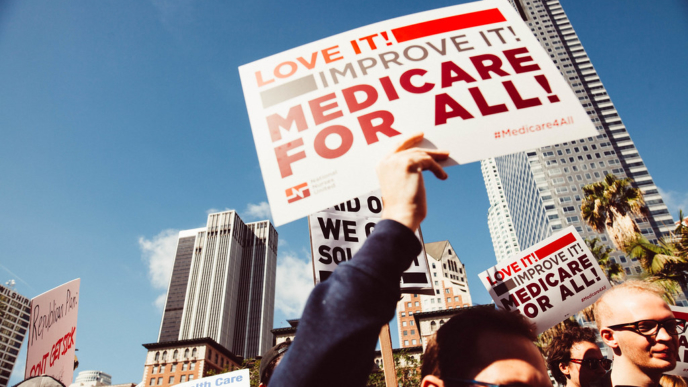
New Poll Reveals How Americans Feel About Medicare for All

Nearly half of likely U.S. voters oppose Medicare for All, according to a Rasmussen national poll published Thursday.

The poll found 46% of likely U.S. voters oppose the universal health care plan similar to those proposed by 2020 Democratic candidates like Sens. Bernie Sanders and Elizabeth Warren, while 39% are in favor of such a program, the poll shows.

Additionally, the survey also found that 56% of people making under $30,000 a year wouldn’t want to pay any more in taxes in exchange for a program like Medicare for All; 40% of 18- to 39-year-olds would not be willing to pay more taxes; and 45% of black individuals would not be willing to pay more taxes.

Among Democratic voters specifically, 32% are willing to pay any cost in higher taxes in exchange for Medicare for All.

The poll, which asked 1,000 likely voters if they support Medicare for All and had a margin of sampling error of +/- 3 percentage points, shows a decrease in support compared to a similar Rasmussen poll published Sept. 18. That poll found that 41% of likely voters opposed the universal health care program while 44% were in favor. (Read more from “New Poll Reveals How Americans Feel About Medicare for All” HERE)

Follow Joe Miller on Twitter HERE and Facebook HERE

New Report Shows How Much Americans’ Taxes Would Have to Go up to Pay for Medicare for All

The following is an excerpt from Blaze Media’s Capitol Hill Brief email newsletter:

Unless you’re completely detached from reality, you know that the Medicare for All proposals being tossed around among 2020 Democratic presidential candidates would have a heavy impact on the American taxpayer and economy. A new report from the Committee for a Responsible Federal Budget offers an idea of how heavy that impact would be.

“There is not enough annual income available among higher earners to finance the full cost of Medicare for All,” the report says, noting that lawmakers will have to find other ways to pay for it, which will likely mean raising taxes on the middle class. The report says there are a few different ways to foot the bill, such as doubling all individual income tax rates, imposing a new 32 percent payroll tax, or increasing the cost of goods and services by 42 percent through a value-added tax, just to name a few.

So, for those pushing the proposal out on the campaign trail, the question is (or at least ought to be) which kind of massive tax hike they think will be the most palatable to voters who don’t live in safe Democratic territory. No wonder some vulnerable House Democrats are nervous about how a fight over Medicare for All might affect their re-election prospects.

(For more from the author of “New Report Shows How Much Americans’ Taxes Would Have to Go up to Pay for Medicare for All” please click HERE)

Follow Joe Miller on Twitter HERE and Facebook HERE

How to Fully Realize the Potential of Medicare Advantage

The House Ways and Means subcommittee on health will host a hearing this week on promoting integrated and coordinated care for Medicare beneficiaries. The committee will review how Medicare Advantage, the program of competing private health plans, is providing services for senior and disabled citizens.

This wide-ranging program includes, among other things, Special Needs Plans (SNPs) and other models for improving care delivery for our most vulnerable seniors and people living with disabilities.

The Congress is right to focus on seniors with special needs. In Medicare Advantage, this population is helped by three different types of SNPs: dual-eligible, or D-SNPs (qualify for both Medicare and Medicaid), chronic condition, and institutional.

Access to these plans remains high. Enrollment in these plans grew by 7 percent in 2016 alone and has grown from 0.9 million in May 2007 to 2.2 million in April 2016. The current SNP authority is set to expire at the end of 2018.

A key benefit of many Medicare Advantage plans is the provision of care coordination.

The care coordination helps patients access what they need and, for those senior and disabled citizens who are financed by both Medicare and Medicaid (dual-eligibles), the coordination between Medicare and Medicaid can provide more efficient care delivery at lower costs.

One care model out of Arizona concluded that it kept enrollees out of the hospital and produced fewer readmissions than traditional Medicare coverage.

If more widely adopted, this sort of care coordination could be especially helpful for patients facing multiple chronic conditions. This is significant because chronic illness is the biggest single driver of medical costs.

The Centers for Disease Control and Prevention reported that about half of people in the United States had one or more chronic health conditions as of 2012, and that if these conditions were properly managed, the superior care delivery could reduce health care costs for Medicare and Medicaid by up to $125.5 billion.

Not surprisingly, the Senate Finance Committee recently reported out the CHRONIC Care Act, a bipartisan bill that will help Medicare beneficiaries facing chronic illness.

The intensifying congressional scrutiny on the potential of Medicare Advantage is especially well-timed. Medicare Advantage is the senior’s alternative to traditional Medicare, and it has been rapidly growing.

Today, Medicare Advantage accounts for almost one-third of the entire Medicare population. The reason: Medicare Advantage gives seniors better options than traditional Medicare.

Consider the most important. Unlike traditional Medicare, which is a defined-benefit program, Medicare Advantage is a far more flexible defined-contribution program, meaning that the government makes a per capita contribution to the plans that seniors choose.

These competing health plans offer a broader and richer range of medical services than traditional Medicare, including various preventive services, as well as care coordination and case management for persons with chronic illness.

Medicare Advantage, as documented by The Heritage Foundation, has other attractive features as well. It provides a broad range of personal choice. In 2015, for example, 99 percent of all Medicare beneficiaries had access to Medicare Advantage plans, and could typically choose from among 18 health plans.

Unlike traditional Medicare, all Medicare Advantage plans provide protection from the financial devastation of catastrophic illness. Not surprisingly, beneficiary satisfaction is higher than that of enrollees in traditional Medicare.

For beneficiaries and taxpayers alike, Medicare Advantage is economically efficient. According to Heritage analysis reports, Medicare Advantage plans deliver care at costs routinely lower than traditional Medicare costs.

In this context, it is also worth noting that Medicare beneficiaries often pay no more than the regular monthly Medicare Part B premium. In 2017, this will range from $109 to $134.

In fact, according to the Medicare Payment Advisory Commission, the panel that advises Congress on Medicare reimbursement, a stunning 81 percent of Medicare beneficiaries had access in 2016 to at least one Medicare Advantage plan that included catastrophic coverage, as well as prescription drug coverage, with no additional premium over and above the standard monthly Medicare Part B premium.

By contrast, enrollees in traditional Medicare may have to pay an additional monthly premium for a Medicare prescription drug plan. Nationwide in 2017, the average prescription drug plan monthly premium is $42.17.

Because traditional Medicare has no catastrophic protection, and other gaps in coverage, beneficiaries must buy supplemental private coverage, such as Medigap coverage, and pay another additional premium.

Nationwide in 2017, the average Medigap monthly premium is $183.

Medicare Advantage has demonstrated the capacity of private plans to create innovative products for senior and disabled citizens, including those with chronic and complex medical conditions.

Congress should build upon this progress, expand Medicare Advantage’s platform for new payment and delivery models, and encourage the participation of health plans that hold promise of improving medical outcomes while reducing costs.

The program’s success can be a strong foundation for further reform of the giant Medicare program, especially through the adoption of a premium support model—a model based on Medicare Advantage’s system of defined-contribution financing and market-based competition. (For more from the author of “How to Fully Realize the Potential of Medicare Advantage” please click HERE)

Follow Joe Miller on Twitter HERE and Facebook HERE.

Medicare Premiums to Increase for 15 Million

An old federal policy could cause more than 10 million Americans to get a higher Medicare bill next year.

A small provision in Medicare’s policy will lead to 15 million Americans facing more than 50 percent increases in their monthly premiums next year. A new bipartisan bill in the Senate would fix the problem, but its passage and how it would be funded is in the dark.

The federal government will release 2016 premiums for Medicare Part B in the next few weeks, but an increase appears to be imminent.

That’s because another entitlement program, Social Security, won’t dole out a cost-of-living-adjustment for recipients next year. It is the third time in the past 40 years that seniors won’t get an adjustment, according to an August report from the Center for Retirement Research at Boston University . . .

The decision has a huge impact on Medicare. Federal law includes a “hold-harmless” provision that limits a Medicare premium increase to the increase in an individual’s Social Security benefit, the report said. That means that if Social Security benefits are not raised, neither are Medicare premiums. (Read more from “Medicare Premiums to Increase for 15 Million” HERE)

Follow Joe Miller on Twitter HERE and Facebook HERE.

Important Medicare Changes for 2015: What You Need to Know

medicare_crisisMillions of seniors are going to have to dig deeper to pay for their Medicare benefits next year, thanks to rising costs for healthcare and medication.

AARP is warning members that nearly 10 million seniors with Medicare Part D drug policies could face rising prescription premium costs in 2015. Those enrolled in six of the 10 largest drug plans could face hikes ranging from 11 percent to 52 percent, if they don’t switch to different, less costly alternatives.

Another 3.5 million members enrolled in three other large plans will see premiums drop by 13 percent to 31 percent when the new policies kick in, Jan. 1.

The projections — from Avalere Health, which tracks healthcare trends — are a critical reminder that Medicare’s private plans can change their costs and benefits every year to reflect rising costs of medical care, driven in part by healthcare reform changes under Obamacare.

Open enrollment for Medicare continues through Dec. 7, giving Medicare beneficiaries the chance to compare and contrast dozens of private drug plans offered through Part D for next year.

Read more from this story HERE.

Medicare Paid for Meds after Patients Were Dead

Photo Credit: AP / Manuel Balce CenetaCall it drugs for the departed: A quirky bureaucratic rule led Medicare’s prescription drug program to pay for costly medications even after the patients were dead.

That head-scratching policy is now getting a second look.

A report released Friday by the Health and Human Services Department’s inspector general said the Medicare rule allows payment for prescriptions filled up to 32 days after a patient’s death — at odds with the program’s basic principles, not to mention common sense.

“Drugs for deceased beneficiaries are clearly not medically indicated, which is a requirement for (Medicare) coverage,” the IG report said. It urged immediate changes to eliminate or restrict the payment policy.

Medicare said it’s working on a fix.

Read more from this story HERE.

Democrats Joining Republicans in Protest Over Medicare Advantage Cuts

medicare1485Several Democrats — including some lawmakers whose re-election bids are seen as vulnerable in this year’s midterm races — are joining Republicans in calling for the Obama administration to stop proposed cuts to the Medicare Advantage program.

Administration officials plan to announce the 2015 rates for the program on Monday, reports The Hill, and could prove a sensitive issue as both parties are courting the senior citizens who tend to turn out in high numbers to vote in midterms.

Republicans say the program is a valid private alternative to Medicare, as it allows seniors to enroll in plans offered by private insurers, who are then directly paid by the federal government.

Until now, Democrats have complained that the plan receives a disportionate amount of money compared to the Medicare program, and Obamacare was partially funded through $200 billion in cuts over 10 years.

Opponents include Sens. Mark Pryor of Arkansas and Mary Landrieu of Louisiana, considered two of the Democratic Party’s most vulnerable senators seeking re-election. But some powerful Democrats are also speaking out, including Sens. Charles Schumer and Michael Bennett.

Read more from this story HERE.