Posts

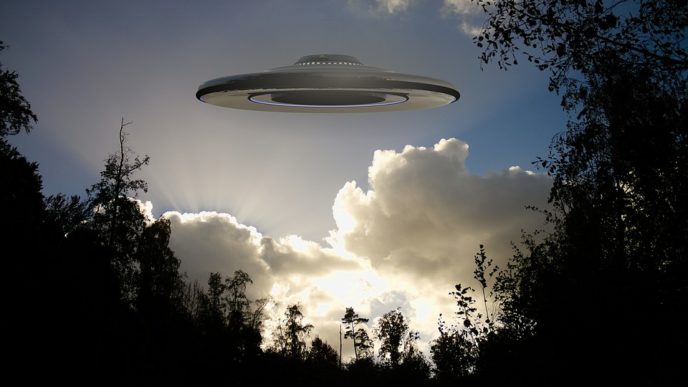
Navy Pilots Weirded out by ‘UFO’ Sighting

Cmdr. David Fravor and Lt. Cmdr. Jim Slaight were on a routine training mission 100 miles out into the Pacific when the radio in each of their F/A-18F Super Hornets crackled: An operations officer aboard the U.S.S. Princeton, a Navy cruiser, wanted to know if they were carrying weapons . . .

Commander Fravor, in a recent interview with The New York Times, recalled what happened next. Some of it is captured in a video made public by officials with a Pentagon program that investigated U.F.O.s.

“Well, we’ve got a real-world vector for you,” the radio operator said, according to Commander Fravor. For two weeks, the operator said, the Princeton had been tracking mysterious aircraft. The objects appeared suddenly at 80,000 feet, and then hurtled toward the sea, eventually stopping at 20,000 feet and hovering. Then they either dropped out of radar range or shot straight back up . . .

Hovering 50 feet above the churn was an aircraft of some kind — whitish — that was around 40 feet long and oval in shape. The craft was jumping around erratically, staying over the wave disturbance but not moving in any specific direction, Commander Fravor said. The disturbance looked like frothy waves and foam, as if the water were boiling . . .

But then the object peeled away. “It accelerated like nothing I’ve ever seen,” he said in the interview. He was, he said, “pretty weirded out.” (Read more from “Navy Pilots Weirded out by ‘UFO’ Sighting” HERE)

Follow Joe Miller on Twitter HERE and Facebook HERE.

Divers Recover the Remains of All Ten Sailors Who Died Aboard the USS McCain

Divers have recovered the remains of all ten U.S. sailors who lost their lives when an oil tanker slammed into the side of a U.S. destroyer.

The sailors were lost in an accident involving the Arleigh Burke-class guided-missile destroyer USS John McCain and the tanker Alnic MC, the 7th Fleet Public Affairs Office revealed Sunday.

The sailors who perished in this incident are:

Electronics Technician 1st Class Charles Nathan Findley, 31, from Amazonia, Missouri

Interior Communications Electrician 1st Class Abraham Lopez, 39, from El Paso, Texas

Electronics Technician 2nd Class Kevin Sayer Bushell, 26, from Gaithersburg, Maryland

[And more.]

(Read more from “Divers Recover the Remains of All Ten Sailors Who Died Aboard the USS McCain” HERE)

Follow Joe Miller on Twitter HERE and Facebook HERE.

Navy Revoked Security Clearance From Officer Retweeted by Trump in Wake of Charlottesville

A Navy reservist who known to push debunked conspiracy theories on social media was stripped of his security clearance, according to reports by NBC News.

Lt. j.g. Jack Posobiec, a Navy Reserve intelligence officer, was thrust into the public spotlight this week after President Trump retweeted his take on the white supremacist rally in Charlottesville, in which the officer implied the public outrage was fueled by media bias rather than concern of violence, according to NBC News . . .

Posobiec told Military Times Thursday that his security clearance was “reviewed” earlier this year and he resigned from the Office of Naval Intelligence in March and filed a complaint with the Inspector General claiming a “toxic work climate” and saying his chain of command treated him poorly due to his personal political beliefs. He said he never advocated for Trump in the office or on duty. (Read more from “Navy Revoked Security Clearance From Officer Retweeted by Trump in Wake of Charlottesville” HERE)

Follow Joe Miller on Twitter HERE and Facebook HERE.

McClatchy: Cyber Hack Feared in USS John S. McCain Crash

Red flags are being raised over fears that the latest at-sea collision involving the USS John S. McCain could have been caused by a cyberattack on the Navy’s electronic guidance systems, McClatchy reported.

The Pacific collision – the fourth involving a Seventh Fleet warship this year – occurred near the Strait of Malacca, a busy 1.7-mile-wide waterway connecting the Indian Ocean and South China Sea that accounts for roughly 25 percent of global shipping.

“When you are going through the Strait of Malacca, you can’t tell me that a Navy destroyer doesn’t have a full navigation team going with full lookouts on every wing and extra people on radar,” Jeff Stutzman, an ex-information warfare specialist in the Navy who works at Wapack Labs, told McClatchy.

“There’s something more than just human error going on because there would have been a lot of humans to be checks and balances.”

Chief of Naval Operations, Adm. John Richardson, did not rule out a cyberattack in the collision, from which 10 American sailors remain missing. (Read more from “McClatchy: Cyber Hack Feared in USS John S. McCain Crash” HERE)

Follow Joe Miller on Twitter HERE and Facebook HERE.

Time to Relieve Pacific Command? Another US Destroyer in Collision, This One Much Further South Than Reported, Near Disputed Chinese Base

By Bernard Betancourt. On Sunday August 20th at approximately 6:24 A.M. Japan time, the Liberian Flagged MV Alnic MC (Alnic) collided with the USS John McCain. Initial assessments from the Pacific Command are that the Alnic’s bow, its forward-most section, hit the USS McCain’s aft port side (left side near the back end of the ship) approximately 150 miles east from the Straights of Malacca, and about 100 miles from shore (based on data from marinetraffic.com). The collision occurred in the morning, at or near sunrise under partly cloudy skies and minimal sea conditions.

There are numerous issues that will require thorough investigation, but what’s obvious now is that accident occurred in open waters. And importantly, the USS McCain was much further south than the initial headline-grabbing naval operations originally stated. In fact, the collision occurred near the disputed South China Sea Islands where China has already built one base. Also nearby is Mischief Reef, about 100 miles from the coast of the Philippines. This location is where a new base is currently under consideration for construction by the Chinese.

The Good, The Bad, and The Ugly

In this situation let’s begin with the ugly. Ten US sailors are missing, and five are injured. That alone should be cause for pause. If the issue of strict maritime law plays out, right-of-way is going to be a major factor in determining fault and for the most part all parties will be held responsible in one way or another. Plus, one could ask why the USS McCain was that far south to begin with when their supposed operations were well to the northeast of the collision.

There really is no good news, but at least it appears at first blush that the USS McCain was likely not at fault. Based upon the Collision Regulations and the subsection on “Rules of the Road,” it appears the Liberian-flagged ship is likely to blame. But again, nothing can spin a real positive in the face of multiple US casualties.

Here’s the really bad news: US warships are designed to emit a minimal radar signature in order to evade radar detection. Additionally, a grey colored ship can be difficult to spot under certain weather conditions. They also typically operate with minimal running lights, which can be an issue when close encounters happen. The USS McCain just like the USS Fitzgerald collision two months ago was the far more maneuverable vessel. When the investigation occurs, this will likely be taken into account. An oil tanker is in a difficult situation, especially in a crossing situation. This scenario can get the USS McCain crew into hot water.

With the McCain collision unfolding just two months after the USS Fitzgerald Collision with the MV ACX Crystal, scrutiny needs to be applied to the upper echelons of US Pacific Command. Substandard training may be part of the problem, as one active-duty Navy officer expressed concern to Fox News over the training of young Navy officers aboard ships: “It’s not the same level of training you used to get.”

Incredibly, the McCain collision marks the fourth mishap for U.S. Navy ships in the Pacific since February. Aside from the USS McCain and USS Fitzgerald incidents, the Navy cruiser USS Antietam ran aground dumping over 1,000 gallons of oil in Tokyo Bay in February. In May, another cruiser, USS Lake Champlain, hit a South Korean fishing vessel. At minimum, Trump should seriously consider a change of command for the Pacific Fleet.

____________________________________________

Pacific Command: Destroyer Sailing Under its Own Power

By Ryan Pickrell. The USS John McCain sustained damage after colliding with a merchant vessel Monday, according to the U.S. 7th Fleet public affairs office.

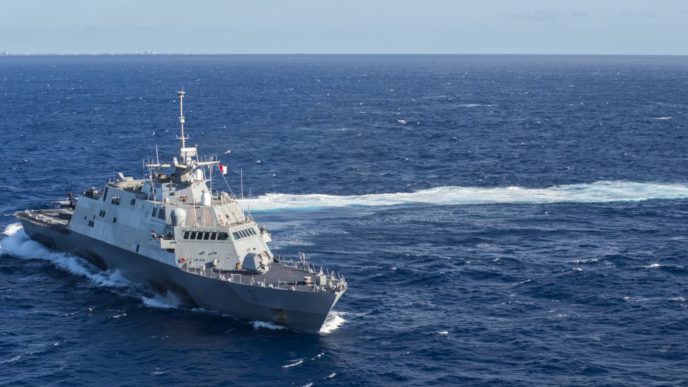
The American Arleigh Burke-class guided-missile destroyer was involved in a collision with the Alnic MC, an oil tanker several times larger than the U.S. naval vessel, while operating east of Singapore, near the Strait of Malacca. Initial reports indicate that the ship suffered damage to its port side. Search and rescue operations are underway. “Our first priority is determining the safety of the ship and crew. As more information is learned, we will share it,” Admiral John Richardson, chief of naval operations, said on Twitter.

The ship is sailing under its own power back to port while crew members fight flooding in multiple compartments, a possible sign that a decent-sized hole may have been punched in the ship’s hull. The Singaporean navy and coast guard are assisting U.S. naval vessels and aircraft with search and rescue. The extent of the damage is unclear at this time, but the Navy assesses that 10 sailors are missing and five are injured. (Read more from “US Destroyer Sustains Damage in Collision With Massive Oil Tanker” HERE)

Follow Joe Miller on Twitter HERE and Facebook HERE.

Japan Investigates Delay in Reporting US Navy Ship Collision; Other Mysterious Circumstances Abound

By Mari Yamaguchi. Japan’s coast guard is investigating why it took nearly an hour for a deadly collision between a U.S. Navy destroyer and a container ship to be reported.

A coast guard official said Monday they are trying to find out what the crew of the Philippine-flagged ACX Crystal was doing before reporting the collision off Japan’s coast to authorities 50 minutes later.

The ACX Crystal collided with the USS Fitzgerald off Japan’s coast, killing seven of the destroyer’s crew of nearly 300. The ships collided early Saturday morning, when the Navy said most of the 300 sailors on board would have been sleeping. Authorities have declined to speculate on a cause while the crash remains under investigation. (Read more from “Japan Investigates Delay in Reporting US Navy Ship Collision” HERE)
_______________________

As Japan Investigates, Other Contradictions Emerge

By Zachary Cohen.

[A]fter interviewing the ACX Crystal’s crew, the Japanese coast guard revised its crash time estimate to 1:30 a.m. [But t]he US 7th Fleet is maintaining that the collision occurred at 2:20 a.m. — and both US and Japanese officials have declined to explain why there is a discrepancy regarding timing.

Timing will play a critical role in determining exactly how the collision happened, particularly as the shipping data from Marinetraffic.com appears to indicate that the ACX Crystal made a sharp right turn at close to 1:30 am — the time that the Japanese coast guard said the crash occurred.

On Sunday, Vice Adm. Joseph Aucoin, commander of the US 7th Fleet, would not speculate on how the accident occurred, but said there would be multiple investigations into the collision, including one by the Navy’s Judge Advocate General and one by the US Coast Guard.

Other investigations could come from the Japanese and Philippine authorities, because of where the accident took place and the Philippine registration of the container ship. (Read more from Japan Investigates Delay, Other Contradictions Abound, HERE)

Follow Joe Miller on Twitter HERE and Facebook HERE.

Admiral, Seven Others Charged With Corruption in New ‘Fat Leonard’ Indictment

The Justice Department unsealed a fresh indictment Tuesday charging eight Navy officials — including an admiral — with corruption and other crimes in the “Fat Leonard” bribery case, escalating an epic scandal that has dogged the Navy for four years.

Among those charged were Rear Adm. Bruce Loveless, a senior Navy intelligence officer who recently retired from a key job at the Pentagon, as well as four retired Navy captains and a retired Marine colonel. The charges cover a period of eight years, from 2006 through 2014.

The Navy personnel are accused of taking bribes in the form of lavish gifts, prostitutes and luxury hotel stays courtesy of Leonard Glenn “Fat Leonard” Francis, a Singapore-based defense contractor who has pleaded guilty to defrauding the Navy of tens of millions of dollars.

The indictment lists page after page of bribes allegedly provided to the defendants including $25,000 watches, $2,000 boxes of Cohiba cigars, $2,000 bottles of cognac and $600-per-night hotel rooms. (Read more from “Admiral, Seven Others Charged With Corruption in New ‘Fat Leonard’ Indictment” HERE)

Follow Joe Miller on Twitter HERE and Facebook HERE.

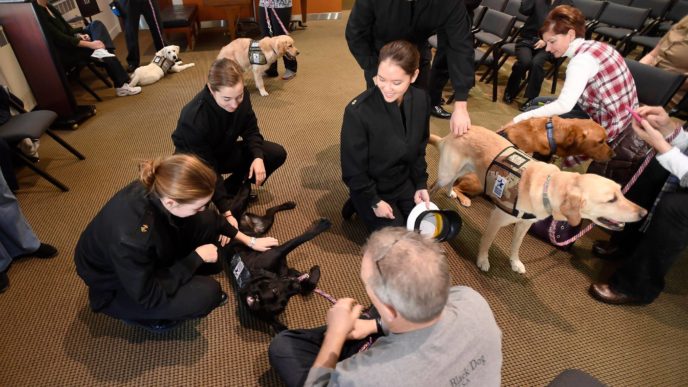
From Transgender 101 Class to Puppies for Stress Release, Is the Naval Academy Going off the Deep End?

Last November, the Naval Academy offered “Transgender 101” classes to staff and Midshipmen. A few weeks later, after having lost to Army 17-14 (their first loss in 15 years), the Midshipman are provided puppies for stress relief during finals. While no one thinks ill of a Midshipman in uniform petting a puppy in downtown Annapolis, the image of needing man’s best friend for stress relief during finals at the Naval Academy isn’t sitting too well with many of their Facebook followers, most of whom are associated with the Navy – fans, old salts, and many USNA grads.

Puppies and other furry friends are of course a great salve for many things – hospital patients, lonely elders, the blind, and more recently, those who suffer from PTSD. So the specter of requiring a salve for something that Midshipman have been doing since 1845 doesn’t quite compute when compared to those who have really suffered in the face of a relentless enemy.

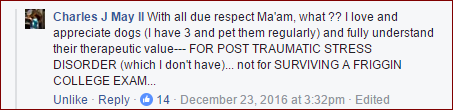
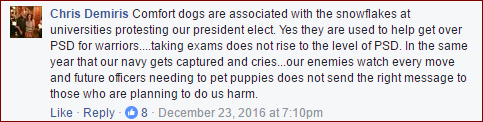
Negative comments ranged the gamut –

comment1

comment2

comment3

comment5

comment6

There were also plenty of light-hearted comments busting on the hard-liners, and who doesn’t love a puppy? But what is the mission of the Academy ? It’s to produce warriors who are not afraid of the enemy and are willing to lay their life on the line.

newsflash%2c-impose-stress

Is softness accepted at the Academy? Last September, LT David Nartker (USNA 2011) was issued a punitive letter of reprimand for his role in the capture of two USN boats by Iran in January 2016, for violating Article 92, “failing to obey an order or regulation”.

The entire event was attributed to “failure at every level”, to include the critical junior leadership level and to a “lax culture for US Navy sailors,” in a devastating report from military investigators”.

comment4

And while the Navy often gets chided in good fun for safe surroundings, the SEALS and sailors face grave danger daily all across the globe. Anyone stationed in or close to the Middle East is in harm’s way just for being an American, let alone one in uniform. The USS Cole was bombed in a terrorist attack in Oct 2000, with the loss of 17 sailors and 39 injured. And last January’s embarrassing capture of two Navy boats is testament that a Naval Academy graduate’s “moment of truth” is going to come without notice, and his or her training – in toughness – will make or break the engagement.

Don’t forget that Naval Academy graduates also serve in the Marines, the same Marines which have produced General James “Mad Dog” Mattis (Central Washington U, 1971), recently nominated by President Elect Trump for Secretary of Defense and General John Kelly, commissioned as a second lieutenant via Officer Candidate’s School in 1975, and recently nominated for Secretary of Homeland Security. ’62 USNA graduate John Ripley, Colonel USMC, is memorialized at the Academy for heroism in stopping he North Vietnamese Army’s advance into South Vietnam.

While all of these men embody toughness, no doubt they have compassion for their countrymen and especially their troops. But would they encourage furry friends as a means for building toughness to lead a strong military?

Compassion and diplomacy are critical characteristics for officers at all levels. So is toughness. The ability to handle stressful combat situations is based on training in handling stress, not on looking for the nearest puppy or kitten as soon as the stress level goes up. Let’s hope the Naval Academy doesn’t forget this.

Finally, one thing you should never do is give your enemy “talking points” about your weakness. One can only imagine the West Point cadets salivating at this gift of ridicule and humor, to be on national display in Philadelphia on December 9 this year.

west-point-field-day

Follow Joe Miller on Twitter HERE and Facebook HERE.

Thanksgiving 1943: American Sailors Pull off a Miraculous Naval Victory

As we celebrate Thanksgiving with our families and loved ones, let us remember the American sailors who 73 years ago spent their Thanksgiving fighting a Japanese task force off Cape St. George in the Solomon Islands.

In what could be considered a Thanksgiving miracle, not a single American life was lost — something worth giving thanks for even today.

The Solomon Islands lie to the east of Papua New Guinea and were the site of numerous decisive battles during World War II, including Guadalcanal. On Nov. 1, 1943, the American 3rd Marine Division launched an invasion of Bougainville, some 250 miles southeast of a major Japanese military base at Rabaul, New Britain. The Japanese commanders at Rabaul dispatched a five-ship convoy — part of what was known as the Tokyo Express — with additional army troops to reinforce their air base on Buka Island, just north of Bougainville and evacuate their naval personnel. The convoy consisted of two destroyers and three destroyer-transports.

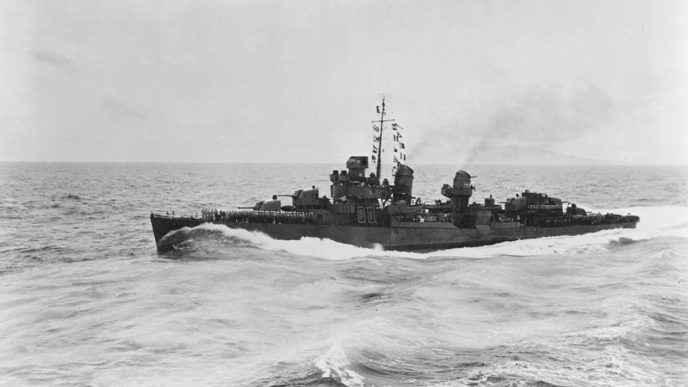
On the day before Thanksgiving, American Admiral William “Bull” Halsey ordered Captain Arleigh “31-Knot” Burke — who eventually became Admiral Burke, the Chief of Naval Operations — to stop the Japanese reinforcements, using Burke’s five-ship destroyer squadron to intercept the Japanese convoy. Burke had assumed command of 7th Fleet Destroyer Squadron 23 (nicknamed the “Little Beavers”) only a month before. Little Beaver was a reference to the sidekick of Red Ryder, a tough cowboy who was the hero of a very popular Western comic strip that had started in 1938.

When he received Halsey’s order, Burke was hundreds of miles away, taking on fuel at New Georgia Island. The destroyers that made up his small fleet — the Charles Ausburne (Burke’s ship), Claxton, Dyson, Converse, and Spence — had been in almost continuous battles for several months and were badly in need of maintenance.

Because of that, Burke’s ship was capable of only 31 knots, not its maximum speed of 38 knots. That resulted in a message from Admiral Halsey that gave Burke his nickname: “THIRTY-ONE KNOT BURKE GET ATHWART THE BUKA-RABUAL EVACUATION LINE … IF ENEMY CONTACTED YOU KNOW WHAT TO DO.”

Burke and his task force sped north to try to find and destroy the Japanese task force. They found what they were looking for not long after midnight on Thanksgiving Day, Nov. 25, 1943, when they encountered two of the Japanese destroyers, the Makinami and the Onami.

Long after the naval battle, Admiral Burke said that “there may have been blacker nights than Thanksgiving Eve, 1943, in the South Pacific, but none could have been more completely blacked out with regard to information of the enemy.” But Burke also said that it was “an ideal night for a nice, quiet torpedo attack.” Using their relatively new radar technology on the moonless, dark, overcast night, Burke’s squadron fired more than a dozen torpedoes and sank both ships, finishing off one of the Japanese destroyers with surface guns.

The chase was then on to catch the fleeing destroyer-transports. Burke’s task force caught up with the Yuguri, sinking it and damaging the Uzuki, although the Uzuki managed to escape with the last Japanese ship, the Amagiri. It was the Amagiri that had collided with PT-109, the boat skippered by Lt. John F. Kennedy, on August 1, 1943.

Trying to catch the fleeing Uzuki and the Amagiri, Burke went deep into Japanese-held territory — far beyond the reach of American air cover. With the onset of dawn and the possibility of massed attacks by Japanese aircraft, Burke wisely ended the chase and withdrew.

As they headed back to an American navy base in Purvis Bay, another 350 miles southeast of Bougainville, Thanksgiving was on everyone’s mind. Burke sent a message asking that Thanksgiving services be arranged for “all hands on arrival.”

Not a single American sailor was killed. Gunfire from the Japanese destroyers had all missed. A Japanese torpedo that hit one of the American destroyers didn’t explode. A group of torpedoes fired by the Japanese exploded in the wakes of Burke’s destroyers after he had a gut feeling that he should change position. And when Destroyer Squadron 23 withdrew, not a single plane from the four Japanese airbases in the vicinity of Rabaul (58 bombers and 145 fighters) attacked the task force. It was either luck or a series of miracles or a combination of both.

Burke’s strategy and tactics, and the performance of his sailors, led to the Naval War College calling the Battle of Cape St. George “an almost perfect surface action.” Bull Halsey called it the “Trafalgar of the Pacific.” It ended the Tokyo Express, the Japanese naval convoys that were used to supply Japanese land forces and attack Allied military efforts in the Solomon Islands.

Bull Halsey once famously said that “there are no great men; just great challenges that ordinary men, out of necessity, are forced by circumstances to meet.” The Battle of Cape St. George was one of those great challenges that, out of necessity, Captain Arleigh Burke and the hundreds of American sailors who served under him were forced to meet. They did so with the gallantry and can-do attitude that has long been a hallmark of the U.S. Navy. Burke himself told his sailors that they had been successful because of their “courage and valiant determination” and when they got safely to port, his “battle-weary crews [gave] thanks to God for their victory – and for their deliverance.”

So as you sit down to eat that great American bird (which Benjamin Franklin thought should be our national symbol instead of the eagle), with stuffing, mashed potatoes, cranberry relish, and whatever other goodies your family includes, give thanks for those American sailors who nearly eight decades ago spent Thanksgiving risking their lives to protect our nation in a fight with a merciless enemy. We owe them more than we can ever say. (For more from the author of “Thanksgiving 1943: American Sailors Pull off a Miraculous Naval Victory” please click HERE)

Follow Joe Miller on Twitter HERE and Facebook HERE.

Right on Time: U.S. Navy Seizes HUGE Shipment of Iranian Weapons En Route to Terrorists

As one might expect, the fanatical Islamic regime of Iran is dedicated to advancing Shariah doctrine through violence. The Iranian government has been instrumental in providing material support for terrorist operations around the globe and as President Obama crusaded tirelessly to offer them economic relief to bolster their economy, the zealots in Tehran simultaneously pledged to continue to mount militant efforts against the West and Israel.

The Iranians might be fanatics but it seems that they are not liars. The U.S. Navy, in late March, seized a shipment of Iranian weapons that were en route to Yemen to likely aid in terrorist efforts.

On March 28th, the Navy encountered an Iranian ship carrying a massive shipment of weapons including AK-47s and rocket-propelled grenades. The Pentagon revealed the discovery on Monday.

The shipment was the third such shipment discovered in recent weeks and the Pentagon believes the weapons were heading to Yemen to aid Houthi rebels in a war against a Saudi-led coalition that is backed by the United States. Then Houthi rebels, like Iran, are Shia.

For years, Obama worked behind the scenes to try and secure a deal with Iran that gave the despotic state sponsor of terrorism a hefty payday in exchange for meaningless promises. The U.S. was instrumental in lifting economic sanctions that had long hindered the regime, a move that infused Iran with roughly $150 billion. The U.S. also sweetened the pot with an additional $1.7 billion in taxpayer dollars for reparations when the U.S. did not follow-through on an agreement after Islamic revolutionaries took-over the government in the 1970s. State officials have claimed that they intend to pay more to Iran over the coming years. (Read more from “Right on Time: U.S. Navy Seizes HUGE Shipment of Iranian Weapons En Route to Terrorists” HERE)

Follow Joe Miller on Twitter HERE and Facebook HERE.