Posts

Trump Nominated for Nobel Peace Prize for Preventing India-Pakistan War

Pakistan nominated President Donald Trump for the 2026 Nobel Peace Prize for his “decisive diplomatic intervention and pivotal leadership” in brokering a ceasefire between India and Pakistan.

In a post on X, the Government of Pakistan praised Trump for having “demonstrated great strategic foresight and stellar statesmanship through a robust diplomatic engagement with both Islamabad and New Delhi which de-escalated a rapidly deteriorating situation.”

“The Government of Pakistan has decided to formally recommend President Donald J. Trump for the 2026 Nobel Peace Prize, in recognition of his decisive diplomatic intervention and pivotal leadership during the recent India-Pakistan crisis,” the government of Pakistan wrote. “The international community bore witness to unprovoked and unlawful Indian aggression, which constituted a grave violation of Pakistan’s sovereignty and territorial integrity, resulting in the tragic loss of innocent lives, including women, children, and the elderly.”

In response, Pakistan launched an operation called Bunyanum Marsoos, which the government of Pakistan described as “a measured, resolute, and precise military response, carefully executed to re-establish deterrence and defend its territorial integrity while consciously avoiding civilian harm.”

“At a moment of heightened regional turbulence, President Trump demonstrated great strategic foresight and stellar statesmanship through robust diplomatic engagement with both Islamabad and New Delhi which de-escalated a rapidly deteriorating situation, ultimately securing a ceasefire and averting a broader conflict between the two nuclear states that would have had catastrophic consequences for millions of people in the region and beyond,” the government of Pakistan continued. “This intervention stands as a testament to his role as a genuine peacemaker and his commitment to conflict resolution through dialogue.”

(Read more from “Trump Nominated for Nobel Peace Prize for Preventing India-Pakistan War” HERE)

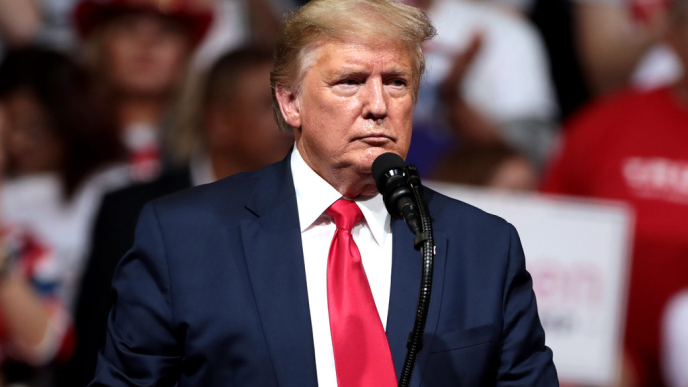
Photo credit: Gage Skidmore via Flickr

India Strikes Pakistan as Tension Between Nuclear-Armed Neighbors Following Terror Attack Reaches Fever Pitch

India launched airstrikes against Pakistan and Pakistani-controlled Kashmir on Wednesday, leaving at least eight dead and dozens more injured in an attack its fellow nuclear-armed South Asian neighbor has called an “act of war.”

India’s “Operation Sindoor” struck a total of nine Pakistani sites utilizing precision weapons, including drones, on Wednesday, targeting locations “where terrorist attacks against India have been planned,” the Indian military said.

Pakistani officials claimed the bombings killed eight people and injured 38 more, including five civilians who were killed in Ahmedpur East in the province of Punjab.

“Pakistan has every right to give a robust response to this act of war imposed by India, and a strong response is indeed being given,” Pakistan’s Prime Minister Shehbaz Sharif said in a statement.

After the strikes, Pakistani troops indiscriminately fired across the border into Indian-controlled Kashmir — killing three civilians, the Indian army said.

Pakistan also claimed to have shot down as many as five Indian aircraft, including fighter jets. Those claims were not confirmed by the Indian military as of Tuesday night. (Read more from “India Strikes Pakistan as Tension Between Nuclear-Armed Neighbors Following Terror Attack Reaches Fever Pitch” HERE)

Pakistan Fears ‘Imminent’ Indian Attack, Warns of Nuclear Response

Pakistan’s defense minister warned Monday that a military attack by neighboring India could be imminent following last week’s deadly militant attack on tourists in Kashmir, escalating tensions between the two nuclear-armed rivals. . .

Last week’s attack in Kashmir, which left 26 people dead, sparked outrage in Hindu-majority India and fueled calls for action against Muslim-majority Pakistan. India has long accused Pakistan of supporting militancy in Kashmir, a disputed region the two countries have fought two wars over.

Vice President J.D. Vance was in India during the attack in Kashmir, but his trip was part of a previously planned diplomatic mission aimed at strengthening U.S.-India relations. In the aftermath, Vance also reaffirmed U.S. support for India, condemning the attack and emphasizing the importance of the U.S.-India partnership. His visit underscored the strategic significance of bilateral ties, particularly as tensions with Pakistan escalated. Vance’s presence at such a critical moment allowed for immediate engagement with Indian leadership.

Asif added that Pakistan was on high alert and emphasized that the country would only consider using its nuclear arsenal in response to “a direct threat to our existence.” (Read more from “Pakistan Fears ‘Imminent’ Indian Attack, Warns of Nuclear Response” HERE)

Report: Pakistani Charged With Murder Plot Against Trump Was Allowed Into U.S. on ‘Public Benefit Parole’

A Pakistani national, now charged with a murder-for-hire plot against former President Donald Trump, was allowed into the United States on “significant public benefit parole” despite reportedly being on the government’s “watch list.”

On Tuesday, the Department of Justice (DOJ) announced charges against 46-year-old Asif Raza Merchant of Pakistan for allegedly attempting to carry out a murder-of-hire plot against Trump and other politicians.

In an unsealed complaint against Merchant, federal prosecutors allege that he first flew into George Bush Intercontinental Airport in Houston, Texas, on April 13 in the hopes of recruiting U.S.-based assassins to carry out the assassination plot.

According to documents that Just the News obtained, Merchant was interviewed, fingerprinted, and inspected following his arrival at the Houston airport. At the time of his inspection, federal agents noticed that Merchant had taken recent trips to Iran, a hotbed for Islamic terrorism.

Just the News reports that Merchant’s immigration records, available to federal agents at the time he arrived in Houston, “clearly stated in bright red that he was flagged by the Department of Homeland Security database with the identifier ‘WATCH LIST’ and denoted as a ‘Lookout Qualified Person of Interest.’” (Read more from “Report: Pakistani Charged With Murder Plot Against Trump Was Allowed Into U.S. on ‘Public Benefit Parole’” HERE)

Pakistan Has The Perfect Solution To Pride Month

It’s not often we turn to Pakistan for how to have a functioning society. But in this rare instance, they might be onto something.

A Pakistani man tried to open a gay club for Pride Month. He was promptly admitted to a mental hospital. Simple as.

First off, I don’t believe anyone is gay in Pakistan. Do you see how horny they are on Facebook? No American man has ever received a “Dear Sir, send balls now” message from a Pakistani incel.

But there’s a reason the woke hypocrites in our State Department only fly pride flags in Western countries. The rainbow burqa wasn’t going to fly… Obviously. . .

Public service announcement to all public school teachers: talk to a child about his or her gender identity, and you’ll earn a one-way ticket to the asylum. There’s something clearly wrong with anyone who would convince a young, healthy child to mutilate their body — let alone as part of a sick, sexual fetish. (Read more from “Pakistan Has The Perfect Solution To Pride Month” HERE)

Fighting Words: Biden Rebuked for Calling Nuclear-Armed Country ‘One of the Most Dangerous Nations’

Pakistan’s Ministry of Foreign Affairs summoned the U.S. ambassador on Saturday to express their “disappointment and concern” after President Joe Biden called Pakistan “one of the most dangerous nations in the world.”

The president made the remark at a fundraiser for the Democratic Congressional Campaign Committee in Los Angeles while discussing Chinese President Xi Jinping.

“This is a guy who understands what he wants but has an enormous, enormous array of problems. How do we handle that? How do we handle that relative to what’s going on in Russia? And what I think is maybe one of the most dangerous nations in the world: Pakistan. Nuclear weapons without any cohesion,” Biden said at the event, according to a transcript posted by the White House.

Pakistani Prime Minister Shehbaz Sharif said that his country takes nuclear safety measures “with the utmost seriousness.”

“Pakistan is a responsible nuclear state and we are proud that our nuclear assets have the best safeguards as per IAEA requirements,” Sharif tweeted on Saturday.

(Read more from “Fighting Words: Biden Rebuked for Calling Nuclear-Armed Country ‘One of the Most Dangerous Nations’” HERE)

Delete Facebook, Delete Twitter, Follow Restoring Liberty and Joe Miller at gab HERE.

Report: Epidemic of Muslims Kidnapping, Raping Christian Girls

The Christian parents of a 6-year-old girl in Pakistan who was beaten and raped by a Muslim have been threatened by local imams with the rape of their other daughters and with financial ruin if they proceed with a legal case, according to the advocacy group British Pakistani Christians,

It’s one of many such cases cited in a report highlighted by Raymond Ibrahim, a senior fellow at the Gatestone Institute, the David Horowitz Freedom Center and the Middle East Forum.

He points out that studies from as recently as 2019 show “around 1,000 girls from (Christian and other) religious minorities are forcibly converted to Islam every year. The numbers might [even] be higher as many cases are not even reported.”

The typical pattern is a Muslim kidnaps a young Christian girl, assaults and rape her. Then when confronted, the perpetrator produces a coerced or forged statement from the girl declaring she “converted” to Islam and “married” her attacker. Sometimes the girls are killed.

One human rights activist cited in the British Pakistani Christians report said that in “any other nation the perpetrators would be arrested, convicted for murder and sentenced for a long term.” (Read more from “Report: Epidemic of Muslims Kidnapping, Raping Christian Girls” HERE)

Follow Joe Miller on Twitter HERE and Facebook HERE

Pakistani Christian Sentenced to Death for Refusing to Convert to Islam

In the depths of a squalid Pakistani jail cell – kept far from the rest of the inmate population at Lahore’s District Prison – a poor Christian factory worker is awaiting execution.

A judge convicted Asif Pervaiz, 37, of blasphemy and he was sentenced to death earlier this month. Those advocating for Pervaiz’s innocence claim it was not blasphemy and that he merely refused to buckle to pressure and convert to Islam.

“This is a tragic situation; the first case in Pakistan’s recent history where a Christian has been accused of blasphemy for refusing to embrace Islam,” Pervaiz’s attorney, Saif Malook, told Fox News. “This man, Asif’s boss, wanted him to leave Christianity, and Asif knew he would suffer a lot by saying no. But he kept his faith.”

Pervaiz’s nightmare began in 2013 after his supervisor, Muhammad Saeed Khokher, at the garment factory where he worked allegedly pressured him to become a Muslim on multiple occasions, according to Malook. When he refused, Khoker went to police with allegations that the devoted Christian had sent him “blasphemous” text messages defaming the Muslim Prophet Muhammed.

Khokher has since denied that he had attempted to compel his work subordinate to convert. In Pakistan, insulting the Prophet carries a mandatory sentence of capital punishment, and the court has vowed that Pervaiz will be “hanged by his neck until death.” (Read more from “Pakistani Christian Sentenced to Death for Refusing to Convert to Islam” HERE)

Follow Joe Miller on Twitter HERE and Facebook HERE

Both Republicans and Democrats Are Clueless About Afghanistan

For eighteen years, we have wrongly applied counterinsurgency doctrine to a proxy war waged by Pakistan against the U.S. and Afghanistan. Bilateral negotiations with the Taliban will not bring peace to Afghanistan nor will it provide an adequate strategy to underpin U.S. national interests in South Asia, the future threat being China in the form of the China-Pakistan alliance.

Both Republicans and Democrats are Clueless about Afghanistan

Up until now, the ill-fated U.S.-Taliban negotiations were comprised of a collection of exit criteria based on relatively narrow War on Terror yardsticks, our presence being our sole bargaining chip in exchange for Taliban assurances, largely unenforceable without that presence.

Whatever strategy we think we’ve had has been constructed of false notions and an unwillingness to accept and act upon the regional nation-state dynamics of which the Afghan conflict is fundamentally a biproduct.

The War in Afghanistan has its origins in the decades-old antagonism between Pakistan and India, spawned by the violence-punctuated partition of the British Indian Empire in August 1947.

Pakistan has always viewed Afghanistan as a necessary client-state, a security buffer against what they consider potential Indian encirclement.

Not surprisingly, Pakistani interference in Afghanistan long pre-dated Soviet and American involvement during the 1980s, but it clearly accelerated Islamabad’s use of 4th generation warfare as an instrument of its foreign policy. That is, Islamist militants were found to be useful proxies for the Pakistani military and its Inter-Service Intelligence agency, the ISI, particularly against India and in Afghanistan, and that retaliation for their use could be largely “immunized” by Pakistan’s newly-acquired nuclear umbrella and its expanding alliance with China.

One source of America’s current dilemma in Afghanistan was the failure by the Reagan Administration, allowing the Central Intelligence Agency to blindly outsource Mujahideen funding to Pakistan’s ISI, which funneled American money and arms not to Afghan nationalists like Ahmad Shah Massoud, but to pro-Pakistani Islamists such as Gulbuddin Hekmatyar and Jalaluddin Haqqani.

It is now an undisputed fact that the Taliban were created by the ISI beginning in 1994 as a means to intervene in the Afghan civil war and influence the outcome in favor of Pakistani national interests when its previous favored Islamist, Gulbuddin Hekmatyar, failed in that effort.

While the U.S. has been fighting the War on Terror in Afghanistan since 2001, Pakistan has been using the Taliban as a proxy to control Afghanistan as part of its struggle with India and to promote the foreign policy ambitions of its “all weather” ally, China.

For eighteen years we have wrongly applied counterinsurgency doctrine to a proxy war waged by Pakistan against the U.S. and Afghanistan. That approach was never a winning strategy as long as Pakistan controlled the supply of our troops in landlocked Afghanistan and regulated the operational tempo through its proxy army, the Taliban, who has maintained an extensive recruiting, training and financial support infrastructure inside Pakistan, immune to attack.

Bilateral negotiations with the Taliban will not bring peace to Afghanistan nor will it provide an adequate strategy to underpin U.S. national interests in South Asia, the premise of which should be that U.S. adversaries do not unduly benefit from our withdrawal. U.S. leaders on both sides of the aisle need to acknowledge some on-the-ground realities.

First, Pakistan, not Afghanistan, is the epicenter of regional Islamic militancy and an exporter of jihad. Actions being taken by Pakistan in Kashmir against India are strikingly similar to those of its Taliban proxy in Afghanistan.

Second, China’s growing geopolitical strength and its increased presence in Pakistan have changed the strategic dynamics of the region, largely rendering whatever remains of U.S. South Asian policy obsolete. The future threat is from China in the form of the Chinese-Pakistani alliance. China’s aim is to dominate South Asia, first economically based on the China-Pakistan Economic Corridor and Afghanistan’s incorporation into it as a part of Beijing’s Belt and Road Initiative.

China then plans to expand militarily using its alliance with Pakistan to establish military bases, particularly on Pakistan’s Arabian Sea coast, thus controlling vital maritime lanes and the mouth of the Persian Gulf. Those bases would provide a critical link between China’s military facilities in the South China Sea and its naval base in Djibouti at the entrance of the Red Sea and the Suez Canal.

An Afghanistan solution should be framed within the context of a new South Asian strategy focusing on preventing Chinese-Pakistani domination. From a politico-military standpoint, two approaches, operating in parallel, are required.

We should adopt a traditional containment policy, including greater cooperation with India. U.S. naval and air power projection should be augmented to counter Chinese attempts to box-in U.S. forces in the Persian Gulf area and outflank the U.S. naval base at Diego Garcia. Additionally, increased financial and economic pressure needs to be applied to Pakistan to restrain its use of terrorist proxies as an element of its foreign policy.

In order to maintain a balance of power, the U.S. should use strategic disruption to thwart Chinese plans to dominate the region by targeting Pakistani vulnerabilities. Tactically, that would involve managing and, when necessary, exploiting the inherent conflicts in South Asia including state-to-state disputes, such as the Kashmir issue, the Sunni-Shia divide and ethnic separatism within Pakistan.

It is such a strategy Democrats and Republicans should be debating, not merely arguing over now meaningless War on Terror platitudes about Afghanistan. (For more from the author of “Both Republicans and Democrats Are Clueless About Afghanistan” please click HERE)

___________________________________________________

Lawrence Sellin, Ph.D. is a retired US Army Reserve colonel, an IT command and control and cyber security subject matter expert and a veteran of Afghanistan, Iraq and a humanitarian mission to West Africa. He receives email at [email protected]

Follow Joe Miller on Twitter HERE and Facebook HERE

Pakistani Duplicity Caused the United States to Lose in Afghanistan

“The war in Vietnam was not lost in the field, nor was it lost on the front pages of the New York Times or the college campuses. It was lost in Washington, D.C.”

H. R. McMaster wrote that statement in his 1997 scathing critique of the Vietnam War, Dereliction of Duty: Lyndon Johnson, Robert McNamara, the Joint Chiefs of Staff, and the Lies That Led to Vietnam. He was a major in the Army at that time. Now, he is a retired lieutenant general and former national security advisor to President Donald Trump.

It is indeed ironic that McMaster eventually contributed to what many people thought to be impossible by repeating the mistakes of Vietnam and losing the Afghanistan war—both in the field and in Washington, DC.

The real tragedy is that America’s leaders, in particular its military leaders, long knew that the war in Afghanistan could not be won having chosen to fight it in a manner that was alien to its nature, thus wasting both treasure and precious lives.

For over seventeen years we have wrongly applied counterinsurgency doctrine to a proxy war waged by Pakistan against the United States and Afghanistan. At the same time, we supplied Pakistan with generous aid packages to bribe them from pursuing a course of action opposed to our own, which they considered in their national interest.

Counterinsurgency was never a winning strategy as long as Pakistan controlled the supply of our troops in landlocked Afghanistan and regulated the operational tempo through its proxy army, the Taliban, which has maintained an extensive recruiting, training and financial support infrastructure inside Pakistan, where it has been immune to attack.

In essence, our leaders, through a combination of incompetence and indifference, allowed the United States to be defeated by Pakistan and paid them to do it.

Pakistan’s objectives for Afghanistan have always been different than those of the United States. Not only has Pakistan not helped the United States in Afghanistan, but from the very beginning through its support of the Taliban, Pakistan has actively worked against our interests and is responsible for prolongation of the war and the deaths and maiming of thousands of Americans and Afghans.

For example, Jalaluddin Haqqani, then the leader of the Haqqani Network, controlled the Khost region of eastern Afghanistan, which is where most of Osama bin Laden’s training camps and supporters were, was a CIA asset in the 1980s and met with U.S. officials soon after 9/11.

Journalist Steve Coll wrote:

“There was always a question about whether Haqqani was really Taliban, because he hadn’t come out of Kandahar; he wasn’t part of the core group. And it was quite reasonable to believe after 9/11 that maybe he could be flipped.”

In early October 2001, Haqqani made a secret trip to Pakistan, where Lt. Gen. Mahmood Ahmed, a religious hardliner and then director of Pakistan’s notorious intelligence agency, the ISI, advised him to hold out and not defect, promising that he would receive help.

Subsequently, Haqqani decided to stay with the Taliban and the Haqqani Network continues to be a threat and a source of instability in Afghanistan.

The United States was aware of Pakistan’s duplicity early on. Gary Berntsen, one of the first CIA operatives to arrive in Afghanistan, said:

“I assumed from the beginning of the conflict that ISI advisers were supporting the Taliban with expertise and materiel and, no doubt, sending a steady stream of intelligence back to [Pakistan].”

The same pattern of duplicitous behavior by Pakistan has continued over the last seventeen years.

Late last year, during a Taliban attack on the Afghan provincial capital of Ghazni, large numbers of Pakistani nationals were found among the dead, presumably fighting with the Taliban. The bodies were subsequently returned to Pakistan.

In a recently released video, Al Qaeda emphasizes its unity with Taliban and its role within the Taliban insurgency, as the jihadists, including Pakistanis, fight together to resurrect the Taliban’s Islamic Emirate of Afghanistan.

And yet American political leaders and senior military officers have done nothing, preferring to remain puzzled or indifferent as to why we have not won in Afghanistan.

Pakistanis openly brag that they have defeated the United States.

Shortly before his death in 2015, Lt. Gen. Hamid Gul, the former head of Pakistan’s ISI, a committed Islamist and known as the “godfather of the Taliban,” said in an Urdu language television interview:

“One day, history will say that the ISI drove the Soviet Union out of Afghanistan with the help of USA and another sentence will be recorded that says the ISI drove the USA out of Afghanistan with the help of the USA.”

The Pakistani audience roared with laughter and applauded in approval.

The problem of Pakistan as the actual instigator of the Afghan conflict was never adequately addressed and Taliban safe havens in Pakistan remained largely untouched.

Pressure was never applied to Pakistan’s pain points, its moribund economy and financial insolvency and the existential threat of ethnic separatism, in particular among Pakistan’s Baloch and Pashtun populations.

On the ground in Afghanistan, the war effort has been a program on automatic pilot, where everyone has been constantly reassured that everything was going according to plan and “progress was being made,” a phrase I heard endlessly during my own 2010 tenure at International Security Assistance Force (ISAF) Headquarters in Kabul. If the effectiveness of the strategy was ever questioned within the military chain of command, then it had no obvious effect.

Lacking any new ideas or even a recognition of reality, we chose to continue pursuing a proven inappropriate counterinsurgency approach in Afghanistan, which has now forced the United States into direct negotiations with the Taliban, a concession we had previously refused to consider.

Yet, an American withdrawal will only become a humiliating defeat, if the United States is forced into strategic retreat from South Asia because we do not have a plan in place to address the changing regional conditions in a post–U.S. Afghanistan.

The only bargaining chip the United States has in peace negotiations is our presence in Afghanistan, which has been the primary target of the Taliban negotiators, insisting that the United States announce a six-month withdrawal plan.

The American “presence” argument is tenuous at best. The United States should be identifying new forms of leverage to bolster our negotiating position in the short term and, longer term, provide a basis for a new South Asian strategy.

The recently-announced effort to strengthen military ties with India is a step in the right direction.

The United States should also include measures to thwart plans by the China-Pakistan Axis for regional hegemony. Beijing intends to extend its Belt and Road Initiative (BRI) throughout South Asia, including Afghanistan, and follow it with the establishment of military facilities, such as Chinese naval bases on the Arabian Sea.

The China-Pakistan Economic Corridor (CPEC) is the flagship of BRI. Pakistan’s southwestern province of Balochistan is CPEC’s center of gravity and the location of a festering independence insurgency. Just recently, the Balochistan Liberation Army made a daring and high-profile attack on the Pearl Continental Hotel in the heart of the Chinese-run port of Gwadar, CPEC’s centerpiece project.

An independent Balochistan could fulfill a number of U.S. strategic interests in the region, for example: providing Afghanistan a friendly neighbor and access to the sea; eliminating a major area of Pakistan’s terrorist infrastructure; placing additional pressure on Iran, which has its own restive Baloch population; and blocking Chinese ambitions for economic and military dominance of South Asia.

The foundations of a new U.S. strategy in South Asia should include burden shifting and, when necessary, strategic disruption of our adversaries.

______________________________________________________

Lawrence Sellin, Ph.D. is a retired U.S. Army Reserve colonel, an international IT businessman and a veteran of Afghanistan, Iraq and a humanitarian mission to West Africa. He receives email at [email protected].

Follow Joe Miller on Twitter HERE and Facebook HERE