Posts

3 Questions Ryan Needs to Answer Before Running to the LEFT on RINOcare

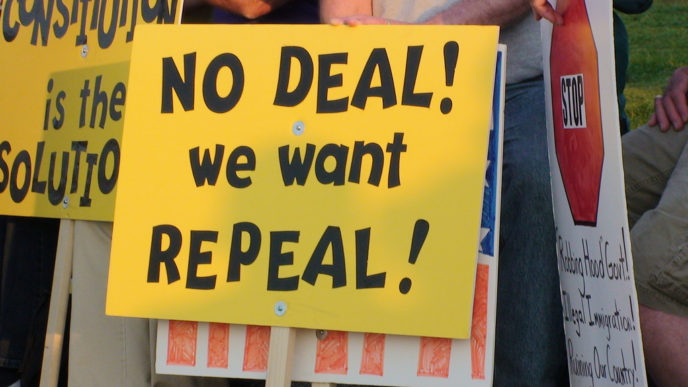
A new refrain echoing through the Washington, D.C., swamp, is the need to find Democrats to play along with GOP leadership, simply because the House Freedom Caucus didn’t jump at its beckoning during last week’s RINOcare debacle.

To paraphrase Sterling Archer, do you want single-payer healthcare? Because this is how you get single-payer healthcare – in the long run, at least.

(In case anyone needs a recap of the last few weeks, here’s a succinct one.)

Now failed GOP presidential candidate John Kasich, Rep. Adam Kinzinger, R-Ill., Fox News’ Judge Jeanine Pirro have all joined the call to disregard conservatives and run to the left to score support from the other side of the aisle.

This new impulse raises three questions that will have to be answered first:

1. Which Democrats do they plan on working with?

Yes, there are some Democrat members in states where the president won whose positions are precarious, but the Blue Dog Coalition is now a storied legend of a bygone era at this point. And Jim Webb’s 2016 campaign (and statements following) have provided more than enough insight as to what happens to those on the Left who don’t keep to the party’s line in the sand.

2. What will Trump trade to get “bipartisan consensus”?

Even if Paul Ryan can find some folks to break away, a bill that would gain Ryan enough consensus on the Left would almost certainly lose him critical support on the Right, all the while dragging the Republican Party even further from its repeal promises. Any sort of reform would have to be a real sweetheart of a deal for enough votes to break away from Minority Leaders Nancy Pelosi and Chuck Schumer, especially since Dems have every political incentive to allow the system to collapse under Republican governance.

3. Is it worth it?

Even in a best-case scenario, such an effort would only wreck the market slightly less than the current scenario, which is an easy way to slap the old “bipartisan” sticker on a bill while putting the country closer to an elephant-brand collapse (for which the inevitable answer will be a single-payer system). How IS Venezuela doing, by the way? I haven’t checked in a while.

Such a proposal would obviously run outside of the pale for the House Freedom Caucus, but what about those in the Republican Study Committee who weren’t sold on the RINOcare beta version to begin with?

And we mustn’t forget that the president himself cannot introduce legislation, nor can he bring it to the floor. For all the flaws in the original health care design, one would only hope that the speaker’s conservative leanings would lead him to put his foot down at some point … lest he put his name on anything that would taint the GOP’s “Better Way” agenda with a health care law that would be, at best, a slight reform of Obama’s signature boondoggle.

Meanwhile, Freedom Caucus leadership has made it clear that obstruction is not its goal — a real repeal of the law is. HFC Chair Mark Meadows, R-N.C., and Vice Chair Jim Jordan, R-Ohio, have iterated and reiterated their willingness to work with House Leadership and the Oval Office to draft a bill that better repeals more of Obamacare.

Rather than perform an act of ideological and political contortion to create an even more lukewarm bill with Democrat consensus, it would appear that Republican leadership would simply have to try something it failed to do on the first attempt: adequately include free-market reformers in the process, rather than handing them a do-or-die ultimatum.

This is not a situation where the conservative approach has been tried and found wanting, but one where the Republican approach has been found difficult and left untried.

Indeed, the temptation to take one’s ball and go home can be quite tempting, especially when you’re down a few runs in the second inning. But, in this case, it makes far less sense than going back to the dugout, tweaking your game plan, and finding a winning strategy that plays to your whole bench. There’s still time to win this one. (For more from the author of “3 Questions Ryan Needs to Answer Before Running to the LEFT on RINOcare” please click HERE)

Follow Joe Miller on Twitter HERE and Facebook HERE.

Ryan and Bannon Forge Unexpected Alliance on Border Tax

House Speaker Paul Ryan has won over an unlikely ally to salvage his controversial tax plan: Steve Bannon.

Trump’s top strategist once described Ryan as “the enemy,” but now the former Breitbart News chief is the speaker’s best chance to win approval for his border-adjusted tax, which Republicans currently say has almost no hope of clearing the Senate.

In a handful of White House meetings, Ryan found that Bannon was perhaps the most enthusiastic backer of the border-adjustment plan, according to a senior administration official and a person familiar with the sessions.

A vigorous endorsement from Donald Trump could help save the border-adjustment plan, which is running into strong opposition from the energy industry and retailers. The retailers took the unusual step of launching an advertising campaign on the tax issue aimed at viewers of Fox News’ Fox and Friends and Saturday Night Live, TV programs Trump is known to watch. (Read more from “Ryan and Bannon Forge Unexpected Alliance on Border Tax” please click HERE)

Follow Joe Miller on Twitter HERE and Facebook HERE.

Ryan: Presidents Often Prioritize Refugee Claims–Obama ‘Put a Preference in for Sexual Orientation’

House Speaker Paul Ryan (R-Wis.) said Thursday that there’s nothing wrong with President Donald Trump’s executive order on immigration including a preference for religious minorities facing persecution, because it’s a common practice for presidents to include preferences in refugee populations and that former President Barack Obama did the same thing for sexual orientation.

“Presidents always and often put preferences in refugee populations,” Ryan said. “I think President Obama had one for sexual orientation. They didn’t call that a sexual orientation test. He put a preference in for sexual orientation.

“Religious minorities who are being persecuted, there’s nothing wrong with preferring religious minorities from persecution. Yazidis are being persecuted. Sunnis in Shia countries are being persecuted. Christians are being persecuted, so there’s nothing wrong with saying we’re going to take into account minority religious persecution with our refugee situation,” he said.

Trump’s executive orders states: “The Secretary of State shall submit to the President an initial report on the progress of the directive in subsection (b) of this section regarding prioritization of claims made by individuals on the basis of religious-based persecution within 100 days of the date of this order and shall submit a second report within 200 days of the date of this order.”

In 2015, then President Obama issued a presidential memorandum titled Presidential Memorandum — International Initiatives to Advance the Human Rights of Lesbian, Gay, Bisexual, and Transgender Persons. (Read more from “Ryan: Presidents Often Prioritize Refugee Claims–Obama ‘Put a Preference in for Sexual Orientation'” HERE)

Follow Joe Miller on Twitter HERE and Facebook HERE.

House Speaker Paul Ryan Slates Obamacare Repeal for Spring

House Speaker Paul Ryan told House and Senate Republicans that lawmakers likely won’t repeal and replace Obamacare until March or April.

Speaking in the first major session of GOP lawmakers’ joint retreat in the City of Brotherly Love, Ryan said Wednesday that the health care law wouldn’t be repealed and subsequently replaced until spring.

“What we heard today was Obamacare is front and center,” Rep. Chris Collins, R-N.Y., told reporters, referring to the first session of the retreat, which outlined President Donald Trump’s first 200 days in office, or the “200 Day Plan.”

“Repeal and replace,” Collins added. “The word was by the springtime.”

Trump apparently has come around to this timeframe, after suggesting he wanted to see Obamacare repealed and replaced much sooner. Trump is scheduled to address the group of about 290 lawmakers Thursday.

Republicans are using a budget tool called reconciliation to repeal Obamacare, and lawmakers took the first step toward getting rid of the law using the fast-track procedure earlier this month.

GOP lawmakers originally had set a Jan. 27 deadline to craft the repeal bill, but Republicans admitted they would miss that deadline.

Since at least 2010, Republicans have campaigned on getting rid of the Affordable Care Act, popularly known as Obamacare. Now that they have the chance—with control of the White House as well as both chambers of Congress—some Republicans consistently have called for its swift repeal.

One senior Republican aide told The Daily Signal that the health care law should be rolled back “as soon as possible” to “fulfill our promise to voters that enabled unified government.”

Republicans first plan to use budget reconciliation to repeal the health care law and implement parts of a replacement, Collins said.

The next step is to use administrative actions, spearheaded by Tom Price, Trump’s nominee as secretary of the Department of Health and Human Services, to continue to dismantle Obamacare.

Last, they’ll implement additional parts of a replacement through the House and Senate’s normal procedures, called regular order.

That third and final step in Republicans’ repeal-and-replace process would require Democrats’ support, however, since 60 votes are needed to override a filibuster to block action in the Senate. Republicans hold 52 seats in the 100-seat upper chamber.

Heading into the closed-doors joint retreat at Loews Philadelphia Hotel, House and Senate Republicans were expected to hash out the final details of their plan for repealing and replacing Obamacare.

Though lawmakers in both chambers agree on how they’ll repeal Obamacare, through the budget reconciliation process, they haven’t come to a consensus on which parts of the law they’ll dismantle.

Conservatives want to repeal as much of Obamacare as possible using the budget reconciliation tool, which requires only a simple majority of 51 votes to advance in the Senate.

But centrist and liberal Republicans such as Sens. Bill Cassidy of Louisiana and Susan Collins of Maine want to keep Obamacare’s taxes in places.

Although the GOP lawmakers haven’t coalesced around a replacement for the law, they were scheduled to discuss proposals to do so at a session Thursday morning. (For more from the author of “House Speaker Paul Ryan Slates Obamacare Repeal for Spring” please click HERE)

Follow Joe Miller on Twitter HERE and Facebook HERE.

Ryan: Reconciliation Bill Will Block Planned Parenthood Funding

Stopping the stream of federal funding to Planned Parenthood, the nation’s largest abortion provider, will be part of the upcoming budget reconciliation package, House Speaker Paul Ryan said during a press briefing Friday.

This important announcement maintains the strong policy stance Congress took in the 2015 reconciliation bill that would have repealed Obamacare and stopped federal Medicaid funding to Planned Parenthood.

While that bill was vetoed by President Barack Obama, the outlook is much different now with the inauguration of a new president and the start of a new Congress committed to repealing Obamacare and defunding Planned Parenthood.

If the reconciliation bill is crafted as it was in 2015, it would make Planned Parenthood affiliates ineligible from receiving Medicaid reimbursements for one year after the enactment of the bill. Such federal reimbursements constitute a significant portion of the roughly $500 million in government funds sent to the nation’s largest abortion provider each year.

Federal funding could still flow to the many other qualified health care providers that offer the same services as Planned Parenthood affiliates, plus additional services, without entanglement in abortion. In fact, the last reconciliation bill increased funding for these community health centers.

Taxpayer money should not be used to fund elective abortion providers such as the Planned Parenthood Federation of America affiliates. Ending such tax funding has become even more urgent in light of serious and disturbing press coverage of Planned Parenthood representatives discussing the sale of body parts of aborted babies.

Of course, a reconciliation bill isn’t the only tool at Congress’s disposal with regard to defunding Planned Parenthood. To cut off all federal funding streams to Planned Parenthood, Congress should use the appropriations process to disqualify Planned Parenthood affiliates not only from receiving any federal Medicaid reimbursements, but also from receiving grants under specific discretionary programs, like Title X family planning.

Just this week, the Select Investigative Panel on Infant Lives issued its final report, which recommended that Congress defund Planned Parenthood. The Daily Signal’s Kelsey Harkness has highlighted six other disturbing findings in the panel’s report, which further underscores why Planned Parenthood should not receive taxpayer funding.

A reconciliation bill that makes Planned Parenthood affiliates ineligible to receive Medicaid reimbursements is an encouraging step toward ending federal funding for the nation’s largest abortion provider. (For more from the author of “Ryan: Reconciliation Bill Will Block Planned Parenthood Funding” please click HERE)

Follow Joe Miller on Twitter HERE and Facebook HERE.

Meet the Only Republican to Vote Against Re-Electing Paul Ryan as Speaker of the House

On the first day of the 115th Congress, Paul Ryan was re-elected as speaker of the House. The vote would have been unanimous, except for the vote of one conservative dissenter.

In an effort to “drain the swamp,” Rep. Thomas Massie of Kentucky cast the lone Republican vote against Speaker Ryan, and voted for Florida Rep. Daniel Webster.

Massie had better company two years ago. In January 2015, 25 conservatives dissented from the Republican caucus and voted against re-electing John Boehner as speaker. Twelve of those dissenters voted for Rep. Webster. Webster’s previous experience as speaker of the House in Florida — where he was known for restoring regular order and honest practices — was a big selling point to the defecting conservatives.

But with a new Republican administration coming in and with conservatives in Congress still hoping to work with Speaker Ryan, there was much less dissent leading up to Tuesday’s vote, versus two years ago.

While Massie wasn’t joined by his fellow conservatives, he was suspected as a possible dissenter:

No one can say Rep. Thomas Massie isn’t afraid to go against the grain (For more from the author of “Meet the Only Republican to Vote Against Re-Electing Paul Ryan as Speaker of the House” please click HERE)

Follow Joe Miller on Twitter HERE and Facebook HERE.

Paul Ryan in Precarious Position Ahead of Election Day

Paul Ryan says he’s running for House speaker again, but the Wisconsin Republican’s air of confidence belies divisions within the GOP and a deep-seated disdain for the party establishment from conservatives.

“I am going to seek staying on as speaker,” Ryan told Wisconsin talk-radio host Jerry Bader in an effort to quell speculation Friday. “There’s a lot of unfinished work to do, and I think I can do a lot to help our cause and our country.”

Returning to the job he’s held since October 2015 won’t be easy. The results of Tuesday’s election—regardless of who wins the presidency—are likely to bring calls for new leadership on Capitol Hill. Plus, with several House Republicans in danger of losing their seats, Ryan will face a more conservative caucus, potentially with fewer allies in his own party.

Conservatives, however, aren’t the only lawmakers creating headaches for the 46-year-old speaker from Janesville, Wisconsin.

This weekend, the latest challenge came not from the conservative House Freedom Caucus but instead a centrist Republican from Ohio. Politico reported Saturday that Rep. Jim Renacci, R-Ohio, is circulating a letter seeking to delay GOP leadership elections. The vote is set to take place Nov. 15, just one week after Election Day. It is a precursor to the official vote for House speaker in January.

“There are fractures in the conference which truly need to be discussed, vetted, and healed,” states the Renacci letter, which was obtained by Politico. “Asking members to vote for a leadership team within 24 hours of their return to Washington without time to reflect on ways of coming together as a conference is truly ill advised. That in itself ignores the reality that the conference is divided. … There is no reason to hastily hold elections.”

In a subsequent interview with Politico, Renacci also declined to endorse Ryan for speaker.

“At this stage of the game, I don’t know who all is running,” Renacci told Politico. “I’m very supportive of Paul, but when it comes to elections I want to see who’s in before committing [to] who I’m supporting.”

Renacci isn’t the first lawmaker to complain about the hurried nature of the leadership vote. In September, the Freedom Caucus mulled pushing for a delay as well. Conservatives wanted to evaluate Ryan’s handling of the lame-duck session of Congress before committing to support him.

There’s also another factor at play: Republican supporters of Donald Trump are unhappy with Ryan’s treatment of the GOP presidential candidate and, according to Politico, “they’ll lay the blame at Ryan’s feet if the GOP nominee loses narrowly.”

One such lawmaker, conservative Rep. Jim Bridenstine of Oklahoma, announced last month he wouldn’t support Ryan as speaker.

Another conservative, Rep. Thomas Massie, R-Ky., cited a different reason for his opposition to Ryan.

“It would be very difficult for him to get my vote based on what I assume his motives are, which are to run for president in 2020,” Massie told The Huffington Post last week.

Massie, who voted against Ryan for speaker in 2015, also outlined a series of conditions he would use to judge the next speaker. In a statement to The Huffington Post, he wrote:

The next speaker shouldn’t send the House on vacation for five weeks in August unless the appropriations bills are done. The next speaker needs to make good on the broken promise to give members and the American public time to read the bills. The next speaker should immediately put a stop to the institutionalized extortion that requires members to pay for their committee assignments with lobbyists’ money. Finally, the next speaker needs to allow a debate on whether or not to authorize the military conflicts the president has unilaterally engaged us in around the globe.

Under his leadership, Ryan failed to complete the annual appropriations process, prompting the need for a lame-duck session of Congress next month to fund the government. Conservatives opposed the post-election session because some members who are retiring or lost their elections will no longer be accountable to constituents, yet voting to spend billions in taxpayer money.

While Ryan put significant effort into the “A Better Way” agenda, there were few legislative accomplishments for conservatives to cheer about this year. One of the few cited by Ryan’s office—the fiscal relief package for Puerto Rico—was unpopular among conservatives.

“The American people are calling for action, not just ideas,” Rep. Jim Jordan, chairman of the Freedom Caucus, told The Daily Signal last month.

“The American people already understand the difference between what the parties stand for,” Jordan added. “What they want to see from Republicans is a willingness to stand firm and get something done.”

Ryan has pointed to 2017 as an opportunity to enact his agenda. In the radio interview with Bader, he said, “I’ve led us to offer a very comprehensive agenda to take to the country and I want to execute and implement that agenda.”

Executing and implementing that agenda could help win over some of Ryan’s critics. But for conservatives like Rep. Dave Brat, R-Va., Ryan needs to do more. That includes opposition to a trade deal negotiated by the Obama administration and a firm stance against amnesty for illegal immigrants.

“If he commits to regular order—in writing—and no Trans-Pacific Partnership until we reduce regulations and no amnesty bills and a commitment to reduce federal spending, then I will vote for any candidate who backs these conservative positions that 80 percent of Republicans share,” Brat told CNN.

“Each of these issues should just be reflexive for any Republican,” Brat added. “They should not take more than 5 seconds to say ‘yes.’”

Like Massie, Brat voted against Ryan for speaker in 2015. They were two of the nine Republicans who cast a ballot for Rep. Daniel Webster, R-Fla. The others were Reps. Curt Clawson, R-Fla.; Louie Gohmert, R-Texas; Paul Gosar, R-Ariz.; Walter Jones, R-N.C.; Bill Posey, R-Fla.; Randy Weber, R-Texas; and Ted Yoho, R-Fla.

Many members aren’t saying publicly if they’ll support Ryan until after Election Day.

“I’m not commenting on leadership elections until after Nov. 8,” Rep. Mark Meadows, R-N.C., told CNN. Meadows is a candidate to succeed Jordan as chairman of the Freedom Caucus if he decides to step down.

Jordan, meanwhile, was pressed by CNBC’s John Harwood last week on Ryan’s future, but he wouldn’t commit either way.

“There’s time to deal with who’s in leadership, who may not be in leadership, how leadership is done, what the rules are, what we’re going to focus on in the lame duck,” Jordan said on CNBC.

Jordan’s group of 40 Freedom Caucus members hold the most sway over the speaker election in January. Members of the conservative caucus huddled at Meadows’ Washington, D.C., apartment last week to plot their strategy.

Following the meeting, Politico reported that Freedom Caucus members might support Ryan if one of their own secured a seat at the leadership table. At least a couple lower-tier leadership roles could be available—vice chairman of the conference and secretary of the conference—if incumbents decided not to seek re-election to those roles.

But one Freedom Caucus member, Rep. Justin Amash of Michigan, suggested such a deal with GOP leadership wasn’t in the cards.

The uncertainty, at least for now, puts Ryan in a precarious position. Last year, he initially rebuffed the speakership before eventually emerging as John Boehner’s replacement. Since getting the job, he’s made defending the Republican majority a top priority. The GOP’s 2012 vice presidential nominee is using his national profile to raise money and campaign for incumbents. That includes members of the Freedom Caucus.

Ryan recently visited the districts of two vulnerable Freedom Caucus members: Reps. Rod Blum, R-Iowa, and Scott Garrett, R-N.J. They’ve returned the favor by supporting Ryan.

He’s also donated to the campaigns of more than a quarter of Freedom Caucus members, according to The Daily Caller News Foundation. They include Reps. Mick Mulvaney, R-S.C.; Alex Mooney, R-W.Va.; Mark Sanford, R-S.C.; Barry Loudermilk, R-Ga.; and Warren Davidson, R-Ohio.

Ryan will need as many of those conservative members in his corner given the probability that some of the 246 House Republicans won’t be back in January.

Even if he wins the initial backing of his GOP colleagues on Nov. 15, there’s still the possibility that Ryan won’t have the votes in January when the full House votes for speaker. To be elected speaker, Ryan needs 218 votes. Because no Democrats will support a Republican speaker, Ryan must limit the number of defections within the GOP to remain in the job.

“The final exam for Paul Ryan will be in January 2017, when there is a speaker election,” Rep. Raul Labrador, R-Idaho, told The New Yorker last year, “and we will look at his body of work and determine whether he gets a passing grade or not.”

Ryan won 236 votes last year. With a smaller GOP majority likely in January, it will be in the hands of House conservatives to ultimately decide if Ryan deserves to remain in the job. (For more from the author of “Paul Ryan in Precarious Position Ahead of Election Day” please click HERE)

Follow Joe Miller on Twitter HERE and Facebook HERE.

Conservatives Not Impressed by What Paul Ryan Achieved in First Year as Speaker

“For insisting the GOP is still a party of ideas,” Paul Ryan made Politico magazine’s annual list of the 50 most influential lawmakers, intellectuals, and leaders in politics.

A year into his job as House speaker, though, the self-described policy wonk has helped generate lots of white papers but few legislative wins.

And while some fellow House conservatives applaud Ryan’s policy agenda, which stakes out Republican positions on everything from poverty to national security, they insist there’s a better way to get conservative reforms into law.

Shortly after picking up the speaker’s gavel, Ryan announced his top priority would be increasing the contrast between Republicans and Democrats.

“The No. 1 goal for the next year,” Ryan said during a Dec. 3 speech in the ornate Great Hall of the Library of Congress, “is for conservatives to put together a complete alternative to the left’s agenda.”

That effort generated six comprehensive policy proposals on poverty, national security, the economy, separation of constitutional powers, health care, and tax reform. Collectively dubbed “A Better Way,” the agenda provides a Republican policy blueprint but no actual bills.

And when asked by The Daily Signal to detail the speaker’s top conservative achievements, Ryan spokeswoman AshLee Strong listed three other House bills that remain mired in the Senate, a controversial fiscal relief package for Puerto Rico, and a vetoed Obamacare repeal bill.

With just 16 legislative days left in 2016, it’s not clear the three House-passed bills will get a vote in the Republican-controlled Senate. Strong would say only that the speaker would “continue to look for ways to move these.”

Back in February, a more verbose Ryan told Fox News Channel’s Megyn Kelly that conservative reforms can happen only with a Republican in the White House, noting that “the problem with divided government is you can’t always get everything you want.”

If Republicans would try sometime, House conservatives respond, they might get what they need, namely legislative wins.

Rep. Jim Jordan, chairman of the influential 40-member Freedom Caucus, acknowledged the challenges presented by an entrenched Democrat minority in the Senate and President Barack Obama in the White House.

But, Jordan told The Daily Signal, a list of policy proposals isn’t enough.

“The American people are calling for action, not just ideas,” he said.

“The American people already understand the difference between what the parties stand for,” Jordan said. “What they want to see from Republicans is a willingness to stand firm and get something done.”

Ryan, 46, promises that change is coming and that his “A Better Way” agenda could become law—just not this year.

“Much of this you can do through budget reconciliation,” Ryan said Sept. 30 while clutching a pamphlet for that agenda during his weekly press conference, “and I think the rest of it is something that the vast majority of the American people want to see get done.”

A parliamentary power play, budget reconciliation allows the Senate to pass legislation with a simple majority, rather than the standard 60 votes to avoid a filibuster, if the bill in question is budgetary in nature.

Ryan employed the measure in December while quarterbacking an effort to send a bill repealing Obamacare to the president’s desk for the first time. Obama vetoed the legislation shortly after.

To use budget reconciliation, though, Congress first needs a budget to fund the government, something Republicans failed to deliver this year.

“Ryan’s big thing was returning to regular order on the budget. He couldn’t even do that,” said David Bozell, president of ForAmerica, a conservative group that claims more than 7 million members online.

“Think on that,” Bozell told The Daily Signal. “[Ryan is] a former Budget Committee chairman who couldn’t even pass a budget despite enjoying the biggest majority Republicans have ever had.”

But the lack of a budget isn’t for a lack of trying. For months, Ryan tried to reach consensus on a budget inside the GOP conference.

Negotiations broke down over spending levels negotiated by Ryan’s predecessor, then-Speaker John Boehner, and Obama in October. GOP leadership made it clear that if conservatives wanted policy wins during the funding process they first had to accept higher spending.

Bickering over those spending levels finally derailed a potential budget and set the stage for a series of last-minute votes on government funding.

To the chagrin of conservatives, Ryan’s first year as speaker likely will come to a close when lawmakers pass a spending measure during the lame-duck session, that period after the November election but before the next Congress convenes.

A lack of accomplishments on conservative policy, plus increased spending, has earned Ryan criticism from outside conservative groups. But some conservatives still hold out hope for victories in the next Congress.

“Speaker Ryan has shown himself to be very skilled at cleaning out the barn,” Jason Pye, communications director for the conservative advocacy group FreedomWorks, told The Daily Signal. “But he has to start sowing the seeds of real conservative reform.” (For more from the author of “Conservatives Not Impressed by What Paul Ryan Achieved in First Year as Speaker” please click HERE)

Follow Joe Miller on Twitter HERE and Facebook HERE.
Ryan Tells Republicans He Will Focus on House Races, Won’t Help Trump

House Speaker Paul Ryan, R-Wisc., told fellow Republicans on Monday that he has washed his hands of GOP presidential candidate Donald Trump and will focus on maintaining the Republican majority in the House.

“The speaker is going to spend the next month focused entirely on protecting our congressional majorities,” said AshLee Strong, Ryan’s spokeswoman.

According to those involved with the call, Ryan said he will not defend Trump or in any way support the billionaire’s campaign. He also said that he will not publicly withdraw his endorsement of Trump.

Ryan said he will devote “his entire energy making sure that Hillary Clinton does not get a blank check with a Democrat-controlled Congress,” the Associated Press reported, taking Ryan’s means to words he does not believe Trump can defeat Clinton in November.

As for other members of the House, Ryan told them “to do what’s best for you in your district,” the Associated Press reported.

Republicans currently hold the majority in both houses of Congress. Throughout the campaign, Republican leaders have worried whether a lackluster showing on Election Day for Trump could put those majorities at risk.

The Republican National Committee is also having a conference call with its members on Monday.

Ryan issued a statement Friday condemning Trump’s conduct in a leaked 2005 video in which Trump spoke graphically about his pursuits of women.

“Women are to be championed and revered, not objectified,” Ryan said Friday. “I hope Mr. Trump treats this situation with the seriousness it deserves and works to demonstrate to the country that he has greater respect for women than this clip suggests.”

Since that video was leaked, many Republicans have withdrawn their support for Trump.

CNN reported that during the call, Ryan’s decision to back away from Trump was met with disapproval by some congressmen. Ryan then made it clear that although he would keep his distance from the presidential campaign, he would not publicly break with his party’s nominee.

Earlier Monday, Kellyanne Conway, Trump’s campaign manager, told CBS This Morning that she hoped Ryan would stand by Trump. She also said that Republicans abandoning Trump may have a political price to pay, noting that Ryan was booed by Trump supporters over the weekend after disinviting Trump from an event in the wake of the controversial video’s release. (For more from the author of “Ryan Tells Republicans He Will Focus on House Races, Won’t Help Trump” please click HERE)

Follow Joe Miller on Twitter HERE and Facebook HERE.
Trump Endorses Ryan After Week of Tension

Donald Trump endorsed Paul Ryan on Friday night, after refusing to back the speaker’s reelection bid earlier this week.

“This campaign is not about me or any one candidate, it’s about America,” Trump said, although he did not immediately launch into his message of support.

“I understand and embrace the wisdom of Ronald Reagan’s big tent within the party,” he continued, acknowledging that he’ll need support in the House and Senate to get his agenda accomplished if elected. “So I embrace the wisdom that my 80 percent friend is not my 20 percent enemy.”

After a few minutes, Trump then uttered the magic words: “In our shared mission to make America great again, I support and endorse our Speaker of the House, Paul Ryan.”

The mogul’s backing came at a rally in Green Bay, Wis., less than a week before Ryan faces a primary challenger whom has Trump praised, though Ryan appears to have little to worry about in the Tuesday race with businessman Paul Nehlen. (Read more from “Trump Endorses Ryan After Week of Tension” HERE)

Follow Joe Miller on Twitter HERE and Facebook HERE.