A lockdown has been lifted at the Pearl Harbor Naval Shipyard in Hawaii after an active shooting situation with multiple victims was contained.
Joint Base Pearl Harbor-Hickam tweeted out that the base had access again, and officials at the base have reported that one person is dead. Officials also said that the shooter is currently being identified as a U.S. sailor who shot and injured three civilians with the Department of Defense before killing himself.
The names of the victims are not being released until their relatives are notified. Base security personnel and the Navy are investigating the incident. . .
Gates and base access are now open. Standby for further information regarding the active shooter incident. #JBPHH
— Joint Base Pearl Harbor-Hickam (@JointBasePHH) December 5, 2019
Councilmember Kymberly Pine released the following statement about the developing situation: “I am shocked and saddened at the news that multiple people have been hurt in an active shooter situation at Pearl Harbor. This is rattling for our community and my heart goes out to the families of the victims and emergency responders who are on the scene now.”
JBPHH security forces have responded to a reported shooting at the Pearl Harbor Naval Shipyard. The incident occurred at approximately 2:30 p.m. Due to the ongoing security incident, access/gates to #JBPHH are closed. We will update when we have further information. pic.twitter.com/6uZulGOUTx
— Joint Base Pearl Harbor-Hickam (@JointBasePHH) December 5, 2019
Scene right now outside of Pearl Harbor, which has been locked down due to reports of an active shooter. Heavy police presence in the area. We will update you with the latest details on @KHONnewspic.twitter.com/mHbHmmasm8
“Living on base always seemed so safe up until now. Things like this don’t happen in Hawaii. I never thought I’d have to worry about anything like this.”
Seventy-five years ago at about this very hour — 7:55 a.m. Hawaii time — airplanes bearing Japanese insignia began dropping bombs on ships docked at Pearl Harbor. The surprise attack took place on December 7, 1941 — a day which will forever “live in infamy,” as President Franklin Roosevelt declared shortly after the attack. The strike claimed the lives of 2,403 Americans, mostly seamen at the Pearl Harbor naval base. Most were teenagers. A strong sense of patriotism washed over America following the events of December 7, 1941, an emotion not lost on America’s youth. Pearl Harbor has taught Americans a lot about patriotism — then and now.
A Date Which Will Live in Infamy
It was early in the morning, just before 8 a.m. when squadron personnel working inside Hangar 54 heard the sound of Japanese Zeros (A6M2) and Kates (B5N2) dive-bombing the base. At first they thought it was a prank. But when they stepped outside, they realized the gravity of their situation. “Then it became survival,” recalled then-Navy flight engineer Dick Girocco in an interview with the Wall Street Journal. “As luck would have it, they were putting a pipeline of some sort out there by our hangar … we took cover in that.” He and the others ran away from the hangar and into the ditch for cover. “What I remember most was the noise and concussion,” said Girocco. “When the Arizona exploded, it actually shook the ground like an explosion.” Girocco was 20 years old at the time.
Jon “Chief Johnny” Gordon, now 94, said he was a 19-year-old kid getting ready to go to the beach when an airplane flew by. Most of the men at Pearl Harbor were just teenagers, like Gordon. “All kids and a few officers,” he said. “That was when we were called to save the world,” Gordon recalled.
Lester Lindow was aboard the USS Maryland when the attack began, he told FOX News in an interview. He, like Gordon, was planning to go surfing but as he and his buddies stepped out on the quarterdeck, he saw a Japanese plane fly overhead. About that time, said Lindow, “The bugler sounded general quarters and he said ‘This is no bull-you-know-what.’” Lindow remembered getting below in his battle station “pit” — at 19 years old he was a trainer on a 60-inch battery — and didn’t see much, but did feel and hear the enormous explosion that devastated the USS Arizona.
Stuart Hedley, 95, stationed on the battleship West Virginia, told The San Diego Union-Tribune most people today “don’t have the slightest idea what happened there.” When the bombers hit Battleship Row, the West Virginia was docked close to the Arizona. When the bomb hit the Arizona and detonated in a powder magazine, the 20-year-old saw “dozens of bodies” flying through the air. Hedley had to swim through oil-covered water with flames as high as buildings just to get to shore. “I knew how to swim, but not underwater,” he remembered. “I swam underwater that day.”
The average age of the men at Pearl Harbor was 19 years old.
The Rush to Enlist
The next day, December 8, President Roosevelt declared war on Japan.
The surprise attack had taken so much from so many. It took lives, of course, thousands of them. It took the innocence of a nation that believed it could remain out of the war just a bit longer. From a different perspective, though, it also took courage, bravery and heroism for the men to get in their planes and fight back during the second strike on Pearl, just an hour after the first. And it took strength and pride in their beloved America to make thousands upon thousands of men and women rush to enlist in the military. They believed in the USA and the good she stood for and could accomplish. They held a strong standard of right and wrong — and the unprovoked attack on Pearl Harbor would not go unpunished. In those days this young generation showed why it would become known as the Greatest Generation.
Gerry Davison was a college student sitting in class when he and his fellow students heard the news about Pearl Harbor. His professor got a call in the classroom and told them what had happened. “I didn’t even know where Japan was really on the map — or Pearl Harbor … but I knew immediately I was going to go,” he recalled, speaking to News8. Davison, along with nearly all of his classmates, quickly made plans to enlist. “It was such a devastating attack. It absolutely meant that we were totally going to go to war. And having heard from my dad about World War I all my life, I thought that’s what you’re supposed to do.” Asked if there was anything he
wished he could have done differently, Davison replied, “Only that I could have been there sooner.”
Patriotism in Decline
The sense of patriotism and love of country in America isn’t what it used to be. In the past, the identity of an American, the love of country, and the passion and uniqueness of America drove soldiers to enlist and fight for her. The idea of patriotism in America’s youth has changed.
In the aftermath of 9/11, even following Time magazine’s evocation of Roosevelt’s “day of infamy,” enlistment in the military was marginal at best. The New York Times reported that “Americans did not flock to military recruiting stations after 9/11 the way they did in 1941.” Perhaps it’s a waning patriotism that could not be revived even in the aftermath of 9/11.
In a 2014 Pew study, 75 percent of Baby Boomers felt they were patriotic, 64 percent of Generation Xers felt they were patriotic, but only 49 percent of Millennials felt the same. Perhaps the reason is that younger generations were raised with a sense of entitlement, receiving trophies for participation and scoring higher on a narcissism scale than previous generations, according to Time. Social media has flattened the world. Globalization has made the world a much smaller place; the younger generation identifies with faraway cultures and nations much more than in years past.
The one percent who were deployed to the Middle East following 9/11 wonder if the average American thinks about them and their service or the battles they have endured. One injured soldier said he wishes people would worry less about “Escalades and big-screen TVs,” and appreciate what they already have, to think about the world now and then, and to be more informed.
Today, on the 75th anniversary of Pearl Harbor only about 70 survivors of the attack still remain, a fast dwindling number of patriotic heroes. Those still living and able have been flown in to participate in the 75th commemoration ceremonies, perhaps their last trip to the site where so many of their friends and colleagues lost their lives. For some, thinking about Pearl Harbor and the events of that day is an opportunity to reflect on what “we as Americans value.” The takeaway for younger generations reflecting on Pearl Harbor is simple for Lester Lindlow: “Be American.”
Here is President Franklin D. Roosevelt’s “Day of Infamy” speech:
(For more from the author of “75 Years Later: What Pearl Harbor Taught Us About Patriotism” please click HERE)
https://joemiller.us/wp-content/uploads/pearl02.jpg529725Joe Millerhttps://joemiller.us/wp-content/uploads/logotext.pngJoe Miller2016-12-08 00:11:562016-12-08 00:11:5675 Years Later: What Pearl Harbor Taught Us About Patriotism
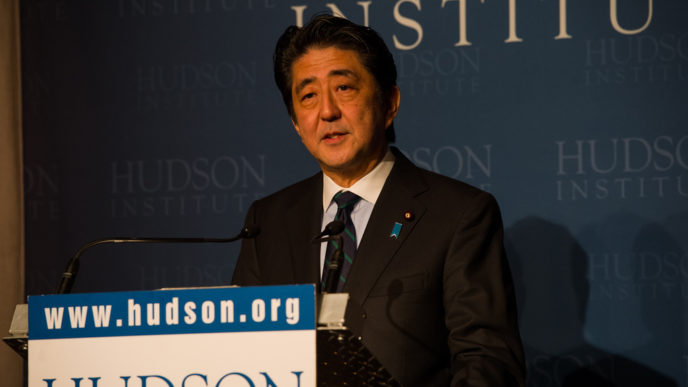
Japanese Prime Minister Shinzo Abe announced he would travel to Pearl Harbor later this month, the first Japanese leader to do so.
Abe commented he would accompany President Barack Obama to “pay tribute [and] comfort the souls” of those who died from both countries during World War II.
He emphasized his intent to “send messages about the importance of reconciliation” between the U.S. and Japan, former wartime enemies who became strong allies.
Abe’s visit, if not a quid pro quo for Obama’s visit to Hiroshima in May, makes a fitting counterpart to that trip, marking the alpha and omega of World War II in the Pacific.
In that sense, the two trips serve the same purpose as the USS Missouri, the location of the August 1945 signing of the treaty ending World War II, which is now moored next to the wreck of the USS Arizona, which was sunk during the December 1941 attack on Pearl Harbor.
Abe’s remarks at Pearl Harbor will be scrutinized for indications of Japanese remorse for its wartime hostilities. But Abe has already made several speeches striking a contrite tone.
During an April 2015 visit to Washington, he commented on his visit to the World War II Memorial, highlighting the battles of Pearl Harbor, Bataan, Corregidor, and the Coral Sea.
The prime minister expressed “eternal condolences” and “deep repentance” for the “lost dreams and lost futures of those young Americans.” Abe acknowledged “our actions brought suffering to the peoples of Asia, and vowed again to “uphold the views expressed by the previous prime ministers.”
In August 2015, Abe commemorated the 70th anniversary of the end of World War II by releasing a statement to make amends to Japan’s neighbors. Abe went further in acknowledging Japan’s wartime actions.
In December 2015, Abe and South Korean President Park Geun-hye were able to forge an agreement that provided a foundation for reconciliation of difficult historic issues arising from Japan’s 1910-1945 occupation of the Korean Peninsula.
America is often accused of having a short memory. But World War II remains a bedrock historic era and a lodestar for America’s sense of who we are as a country.
Pearl Harbor made clear that isolationism was not a viable way to avoid the dangers of the world. Withdrawing from the world and raising the drawbridge did not deter America’s enemies. The same is true today.
The United States arose phoenix-like from the devastation of Pearl Harbor and America’s “Greatest Generation” endured the crucible of war to bring peace and stability to the Pacific.
The U.S. and Japan overcame the animosity of conflict to become enduring partners and allies. That dichotomy is both a realization of Thomas Jefferson’s warning that “the price of freedom is eternal vigilance” and a symbol of what democracies can achieve together. (For more from the author of “Japanese Prime Minister’s Pearl Harbor Visit Will Further Reconciliation” please click HERE)
https://joemiller.us/wp-content/uploads/16655656911_7d0217dcde_b.jpg6821024Joe Millerhttps://joemiller.us/wp-content/uploads/logotext.pngJoe Miller2016-12-05 20:57:012016-12-05 20:57:01Japanese Prime Minister’s Pearl Harbor Visit Will Further Reconciliation