Posts

Pro-Life Advocates Optimistic as One of Their Own Gets Key HHS Job

President Donald Trump’s appointment of a national pro-life leader to serve as the top communicator at the Department of Health and Human Services is great news for the pro-life cause, leaders at associated organizations say.

Charmaine Yoest, longtime head of the group Americans United for Life, will assume the responsibilities of assistant secretary for public affairs at the sprawling federal agency.

Yoest, 52, will be the principal public affairs adviser to HHS Secretary Tom Price, which puts her in charge of speechwriting, strategic planning, and broadcast and digital communications.

“We are going to see a radical transformation occur within HHS,” Kristan Hawkins, president of Students for Life of America, told The Daily Signal in an interview.

“I fully expect us [as a society] to talk about … the consequences of abortion on women,” Hawkins said.

Tony Perkins, president of the Family Research Council, where Yoest worked for seven years, told The Daily Signal in an interview that she will have an important platform in the Trump administration working for Price:

In her capacity in public relations I am not sure exactly how deep she will get in policy directly, but I think indirectly she will have a huge impact making sure policies are consistent with the secretary’s vision, the president’s vision. And her knowing this [pro-life] issue inside and out, again, I think it’s going to have a significant impact.

Price, a former Republican congressman from Georgia, is himself pro-life.

From August 2008 to February 2016, Yoest was CEO of Americans United for Life, a group that seeks to advance the legal and policy issues of the pro-life movement. She has extensive experience in working for conservative, pro-life officials and organizations on the national level.

Her start date at HHS is pending.

Yoest’s political experience began when, as a young woman, she was on the staff of the White House personnel office during President Ronald Reagan’s second term. She went on to work as a policy analyst and vice president of communications at the Washington-based Family Research Council. She briefly advised the 2008 presidential campaign of former Arkansas Gov. Mike Huckabee.

Her new role as assistant secretary of public affairs at HHS, which does not require Senate confirmation, includes tasks such as overseeing the agency’s public affairs programming, leading its other public affairs activities, and managing digital communications.

Yoest, who will report directly to Price, also will oversee agency responses under the Freedom of Information Act and the Privacy Act, which allow individuals to access federal records. And she will direct a division that “leads the planning, development, and implementation of emergency incident communications strategies and activities.”

Yoest joins the new administration at an important time, Melanie Israel, a research associate at The Heritage Foundation, told The Daily Signal in an email.

“From respecting rights of conscience for health care entities to administering programs and grants, to establishing important agency regulations, there are many areas in which the Department of Health and Human Services can affirm the inherent dignity and worth of every person, from conception to natural death,” Israel said.

Jeanne Mancini, president of the March for Life Education and Defense Fund, previously worked in the Office of the Secretary at HHS. In an interview, Mancini told The Daily Signal that Yoest will have a significant role to play in the agency’s policy messaging.

“All of the different things that are happening at HHS, whether it’s through the Centers for Disease Control or National Institutes of Health or the Food and Drug Administration or the many other programs that are happening through there, Charmaine will help them with their messaging and she is very gifted at communication both digitally and in person,” Mancini said.

Planned Parenthood Federation of America, the nation’s largest abortion provider, is not supportive of Yoest’s appointment.

“It is unacceptable that someone with a history of promoting myths and false information about women’s health is appointed to a government position whose main responsibility is to provide the public with accurate and factual information,” Dawn Laguens, executive vice president of Planned Parenthood, said in a statement provided to The Daily Signal.

Yoest, Laguens said, “has spent her whole professional life opposing access to birth control and a woman’s right to a safe, legal abortion.”

Kevin Griffis, Yoest’s predecessor at HHS during the Obama administration, recently joined Planned Parenthood as vice president of communications.

Under Yoest’s leadership, Americans United for Life developed a legislative package called the Women’s Protection Project, designed to provide lawmakers with “specific legislative solutions to the growing concerns regarding the health risks to women from abortion.”

Chuck Donovan, president of the Charlotte Lozier Institute, an organization that seeks to educate society on the importance of protecting life, told The Daily Signal that such attacks on Yoest are unfounded.

“I think she is terrific,” Donovan said in an interview. “She’ll be the most knowledgeable policy person, my guess would be, to ever hold a position like that,” adding:

She’s not only a great communicator with experience [in] the media, print and broadcast, but she has written extensive policy documents. She knows the issues inside and out.

(For more from the author of “Pro-Life Advocates Optimistic as One of Their Own Gets Key HHS Job” please click HERE)

Follow Joe Miller on Twitter HERE and Facebook HERE.

Activists Discuss What Can Be Done to Advance Pro-Life Cause

Panelists told attendees of the Conservative Political Action Conference, or CPAC, that President Donald Trump has reset the tone of the pro-life movement for the better.

“President Trump … has put an end to the failed Republican strategy of … personally professing our adherence to the pro-life cause and then equivocating when it came time to vote,” Sean Fieler of American Principles Project said.

Fieler said Trump’s fearlessness of the media coupled with his life experience has made him an unlikely yet ideal spokesman for the pro-life cause:

We were afraid of the media’s narrative on abortion. President Trump is not afraid of the media’s narrative on abortion and he understood that he could communicate directly to the American people. He also understood that his personal life … he’s no Boy Scout, gave him the freedom to explain to the American people that abortion is the taking of a human life without a demoralizing tone and without suggesting even judgment.

The panel, titled “How the Election Has Changed and Expanded the Pro-Life Movement,” also included filmmakers Phelim McAleer and Ann McElhinney, and Marcie Little, creative director of pro-life organization Save the Storks.

The media, Fieler said, is one way the pro-life movement can act to bring change.

‘Engage the Media’

“We have to change political reality into cultural reality into action,” Fieler said.

Documentary filmmakers McAleer and McElhinney have made strides in using media to advance the pro-life message.

Their new documentary film, “Gosnell,” was made to help educate the public on the horrors of abortion.

“I was in Pennsylvania promoting a documentary … I saw this [court case of] this guy called Gosnell,” McAleer said.

McAleer said that he was intrigued and followed the case, which eventually led him to convince his colleague and spouse, McElhinney, to create a documentary film on convicted abortionist Kermit Gosnell.

Gosnell was sentenced to three life terms in prison for murdering three babies that were born alive at his abortion clinic.

Gosnell’s abortion clinic, Women’s Medical Society clinic in Philadelphia, was called a “house of horrors” by some due to Gosnell’s illegal practices.

McAleer and McElhinney are screening their new film at CPAC.

‘Challenge the Assumptions’

“I think for too long we have not challenged the assumption that abortion is good for women,” Little said.

Little of Save the Storks, a pro-life organization that offers alternatives to abortion, said she has seen firsthand the struggles post-abortive women face.

“I help run social media for Save the Storks … and I sit on the receiving end of the stories we get on a weekly and sometimes daily basis of women who have had abortions and walked through that struggle … and they are full of regret,” Little said.

Be Where the Need Is

Little said she believes that one of the best things activists can do for the pro-life movement is to be where women are who find themselves in crisis pregnancies.

“We tell their stories and we go right where they are,” Little said.

Little said that one way Save the Storks goes where the women are is through its medical mobile unit outreach.

“We offer them free resources right outside the door of the abortion clinic. Our messaging is women-centric—it is women first, we focus on how empowering it is to give women real information so they see … their child perfectly formed, to hear their heartbeat, and are motivated to choose life,” Little said.

CPAC, the largest annual national gathering of conservative activists, runs from Wednesday to Saturday at the Gaylord National Resort and Convention Center in National Harbor, Maryland, just outside Washington. (For more from the author of “Activists Discuss What Can Be Done to Advance Pro-Life Cause” please click HERE)

Follow Joe Miller on Twitter HERE and Facebook HERE.
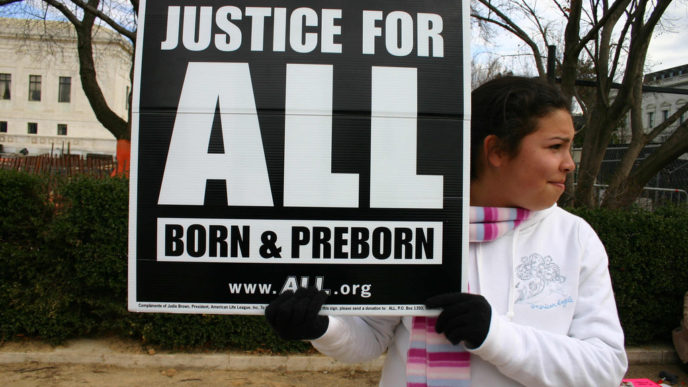
She’s Taking What She Learned on Capitol Hill to a National Pro-Life Group

Autumn Christensen has spent over a decade on Capitol Hill working to advance the pro-life cause, something that has been important to her since she was a girl.

“I grew up in a pro-life family,” Christensen says in an interview with The Daily Signal. “My grandfather prayed outside of abortion clinics in the ’70s.”

“I remember going with my parents and my younger brother to maternity centers at the holidays, volunteering and spending time with women who were experiencing an unplanned pregnancy. So [it’s] sort of in my nature that it’s one of the most important issues.”

Now Christensen’s work in the movement has brought her to a new position as director of policy at the Susan B. Anthony List, or SBA List, a conservative, pro-life policy organization based in Washington. The job means advancing pro-life policies in cooperation with the White House as well as Congress.

Tommy Binion, director of policy outreach for The Heritage Foundation, says Christensen’s new role is a great gain for the pro-life movement.

“Autumn is the definition of a servant leader both on Capitol Hill and within the pro-life movement,” Binion says, adding:

She combines an unmistakable passion for the lives of unborn children with a shrewd understanding of the law and the legislative process … Her years of service will pay dividends as pro-life majorities in the House and Senate work together with a pro-life president for the first time in a long time.

Christensen, 38, was born Autumn Fredericks in Minnetonka, Minnesota, and grew up in Jackson, Mississippi. She graduated in 2001 from Covenant College in Lookout Mountain, Georgia, where she majored in business and history.

She moved to the Hill in 2002 as a staff assistant for Rep. Dave Weldon, R-Fla. She worked on pro-life issues for Weldon, who left office in 2009, and attended weekly staff meetings for the Values Action Team, an organization of pro-family lawmakers founded in the ’90s by Rep. Joe Pitts, R-Pa.

That involvement introduced her to the organization she would work for next—the Congressional Pro-Life Caucus, a coalition of pro-life lawmakers. The caucus is bipartisan but keeps its membership confidential.

She started work as caucus director in October 2005. Her predecessor, John Cusey, had urged her to apply as he prepared to leave for a job in the executive branch. It was “an easy yes,” she says, because she respected the work of the caucus and its chairman, Rep. Chris Smith, R-N.J.

‘An Opportunity to Educate’

“When I first started with the caucus, we had Republican control across the board,” Christensen says. “President [George W.] Bush was in office. Then the Congress changed dramatically to Democratic control, and then President [Barack] Obama’s election and … during the Obama years we were certainly at the height of trying to prevent funding for abortion; we were concerned about the Hyde Amendment being eliminated.”

The Hyde Amendment is a provision, established in 1976 by the late Rep. Henry Hyde, R-Ill., that prohibits use of federal funds for most elective abortions or related health coverage.

Patience is one of the most important virtues for pro-life work, Christensen says.

“We were really in a very on-defense role,” she says. “And then we had the Republican Congress come in [in 2011] and we had opportunities to start moving pro-life legislation. … It always takes time to enact incremental progress toward reversing the effects of Roe v. Wade.”

Roe v. Wade is the 1973 Supreme Court ruling that legalized abortion across the nation.

As director of the Congressional Pro-Life Caucus, Christensen helped craft bills that would prohibit the use of federal funds for abortion and prohibit abortion of babies who are capable of feeling pain.

“They’re not law yet, but the first step is to get them moving through the Congress and have [lawmakers] first take votes on them,” she says. “They’re an opportunity to educate the public about the dangers of abortion [and] what abortion really is.”

Pushing Forward

Her faith informs her perspective, she says, but science influenced her pro-life beliefs.

“I’m an evangelical Christian and that has a big impact on my life and worldview,” Christensen says. “However, my conviction that the unborn are deserving of the same human rights afforded to the rest of us is rooted in biology. ”

Christensen’s husband, David, is vice president of government affairs at the Family Research Council, a conservative public policy organization in Washington, D.C. The couple, who met while working for Weldon, now have a 2-year-old son.

Christensen, who joined SBA List on Jan. 3, is familiar with the struggles that come with advancing the pro-life cause.

She recalls the challenges leading to the 2003 passage and enactment of the Partial-Birth Abortion Ban Act, which prohibits the aborting of a baby after it is partially delivered.

“I was in high school and college [in the mid-1990s] when the Partial-Birth Abortion Ban Act was moving through the House and the Senate, and it was veto after veto from President [Bill] Clinton,” she says. “But even as an average American out there, I knew about partial-birth [abortion] and it was a topic of conversation with friends who had pro-choice views.”

Bills she worked on for the caucus face a similar path, Christensen says.

“You know, we have to continue to push forward and we have to get across that 60-vote hurdle, and we have to get them to a pro-life president’s desk,” she says, adding: “It takes a lot of patience, but each step along the way is both an opportunity to move things forward legislatively and also to educate the public about abortion.”

The Senate requires 60 votes to end debate and bring legislation to the floor for a final vote.

‘Made Such a Difference’

Marilyn Musgrave, a former member of Congress who represented Colorado’s 4th District and now is vice president of government affairs for the Susan B. Anthony List, said the organization is excited that Christensen is part of the team.

“Autumn has been one of the most knowledgeable people on the Hill in regards to … issues we care about,” Musgrave tells The Daily Signal in a phone interview. “She made such a difference on the Hill. We are fortunate to have her on board.”

Christensen says she is optimistic about the future of the pro-life movement, especially due to the large involvement of young people in events such as the March for Life, a yearly rally held in Washington to protest the legalization of abortion.

“We know that Americans are becoming more [pro-life],” Christensen says, pointing in particular to younger Americans “looking at those ultrasound images of their brothers and sisters and their cousins and children and family members.”

“I think that the more we see, the more we know, and the more likely we are to grow into a country that cherishes life and wants to protect all unborn lives,” she says. (For more from the author of “She’s Taking What She Learned on Capitol Hill to a National Pro-Life Group” please click HERE)

Follow Joe Miller on Twitter HERE and Facebook HERE.

A Powerful Week Under a Pro-Life President

During my bus ride to the March for Life this morning, I found myself gratefully reflecting on the good work the pro-life movement has been doing over the past week.

Only days after the conclusion of Barack’s Obama’s presidency, we are witnessing an unprecedented barrage of pro-life activity in Washington D.C. Despite being a very recent convert on the pro-life issue, Trump may be presiding over the most energetically pro-life White House since Roe v Wade.

Let’s look at the week leading up to the March for Life, one day at a time.

This Week of Life and Hope

On Sunday, the 44th anniversary of Roe v Wade, NBC News reported that “a Trump administration official” told the network it was “a shame that the March for Life, which estimates the same number of marchers” as the pro-abortion Women’s March, “will not get anywhere near the same amount of coverage that this march got – and those pro-life members were NOT welcome at the Women’s March.”

On Monday, President Trump reinstated the Mexico City Policy, cutting off American taxpayer funding for abortions abroad. In a fuming press release, leading abortion provider Marie Stopes International reacted to Trump’s decision by providing some stats that are music to pro-life ears: “In 2017, USAID funding would have helped us reach 1.5 million women in some of the poorest, most underserved countries in the world.” (Read between the lines: That’s 1.5 million poor women whose children MSI won’t be able to abort.)

On Tuesday, the House voted 238-183 for H.R. 7, the No Taxpayer Funding for Abortion and Abortion Insurance Full Disclosure Act of 2017, which would make the Hyde Amendment permanent law, ending all federal funding of abortion and banning the use of Obamacare subsidies to obtain insurance coverage for abortions. The new legislation has yet to pass through the Senate, but the White House made a point of boosting its chances with a public promise: “The Administration strongly supports H.R. 7. … If the President were presented with H.R. 7 in its present form, he will sign the bill.”

Also on Tuesday, White House Press Secretary Sean Spicer mentioned the March for Life to the White House press pool on national television, promising that the pro-life cause was “very important” to the president, and that there would be a “heavy administration presence” at the March.

On Wednesday, President Trump shamed the press to its face for the deliberate, yearly media blackout of the March for life. In a conversation with the President, ABC News interviewer David Muir seemed to be aiming for a “gotcha” moment when he confronted Trump for supposedly not paying enough attention to the pro-abortion Women’s March that occurred in Washington D.C. the previous week.

“Could you hear them from the White House?” asked Muir.

“No, I couldn’t hear them but, the crowds were large,” the president replied, “but you’re gonna have a large crowd on Friday too, which is mostly pro-life people.”

Muir visibly tensed up.

“You’re gonna have a lot of people coming Friday,” Trump continued breezily, “and I will say this, and I didn’t realize this, but I was told, you will have a very large crowd of people, I don’t know as large or larger, some people said it’s going to be larger, pro-life people. And, they say the press doesn’t cover them.”

“I don’t want to compare crowd sizes,” Muir said, before trying to change the topic. “No, you shouldn’t,” Trump interjected, and repeated the complaint: “but let me just tell you, what they do say is that the press doesn’t cover them.”

On Thursday, President Trump again drew attention to the March for Life, and again embarrassed the press by calling out the obvious bias of refusing to cover it. This time, his comments had the advantage of coming during the nationally televised GOP Retreat in Philadelphia.

“By the way on Friday, a lot of people are going to be showing up to Washington,” the president said in what seemed to be an extemporaneous aside in the middle of his address.

Lot of people. You know the press never gives them the credit that they deserve. They’ll have three hundred-, four hundred-, five hundred-, six hundred-thousand people—you won’t even read about it. When other people show up, you read bigtime about it. Right? So it’s not fair, but … nothing fair about the media.

On Friday, of course all of this culminated in the national March for Life in Washington D.C., the largest annual human rights march in the world, with tens of thousands attending every year, often despite harsh winter weather conditions. The Washington Post — but not its headline writers — described this year’s assembly as “massive.”

“This is a new day, a new dawn for life,” said White House counselor Kellyanne Conway.

Not only was Conway a featured speaker, but for the first time a sitting vice president addressed the March for Life. In his beautiful, gentle speech Mike Pence declared, “Life is winning again in America.”

Later, as I marched, I was disappointed (if not surprised) at how few network news organizations were present. But unlike in past years, the White House not only took notice of the March, but publicly took note of its plight as a worthy human rights event purposely stifled by the powerful and the press.

“1000s gathered in DC to stand up for life & adoption and @CNN refers to them as ‘demonstrators’ #MarchForLife,” tweeted White House spokesmn Sean Spicer.

President Trump himself weighed in, tweeting, “The #MarchForLife is so important. To all of you marching — you have my full support!”

Later, in an interview with CBN News, the President spoke of his imminent Supreme Court nomination. “Evangelicals, Christians will love my pick and we’ll be represented very, very fairly.”

Beyond the March for Life

There is still much to be done for the pro-life cause in 2017, but it can’t be denied we are off to a hopeful start. Pro-life Americans should all look to President Trump and the Republican majorities in the halls of power, reminding them continually of the commitments we fully expect them to deliver on, including the defunding of Planned Parenthood, and the nomination of a pro-life Supreme Court Justice, which Trump promises to announce next Thursday.

Again, this amount of pro-life advocacy from the White House is unprecedented, and inspires a lot of hope for the pro-life cause. In fact, if we keep up our efforts and President Donald Trump continues to keep his promises, 2017 will be the pro-life movement’s most successful year to date. (For more from the author of “A Powerful Week Under a Pro-Life President” please click HERE)

Follow Joe Miller on Twitter HERE and Facebook HERE.
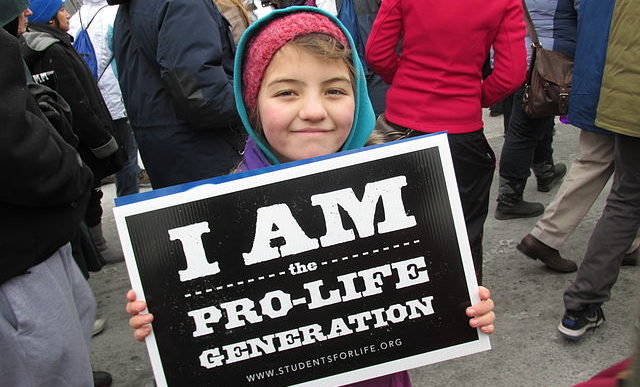
Why the March for Life Can Be a Remedy for ‘Fake News’

Washington, D.C., has had a few days to recover from the inauguration and the vile leftist Women’s March on Washington. But the nation’s capital is already gearing up for its next large, national demonstration with oceans of protestors taking peacefully to the streets … and you probably won’t hear a thing about it on the evening news.

This Friday, mainstream media outlets will have an opportunity to cover a potentially larger event of even greater significance: The March for Life. The event, held every year on or around the Jan. 22 anniversary of Roe v. Wade, features hundreds of thousands of people from across the country marching against abortion. It also enjoys notoriously low media coverage outside of conservative circles and outlets.

This is of course in stark contrast to media coverage of Richard Spencer’s fringe neo-Nazi, alt-“Right” gathering a few months ago, where networks, online outlets, and newspapers went absolutely gaga covering a handful of racists sitting in a multi-purpose room as if they heralded the dawn of a new era. Same with the Women’s March on Washington, which, from a firsthand perspective, appeared to be little more than a chance to wear a pink hat and show off the set of genitals you drew on some poster board. But I digress …

Of course, America’s distrust of the mainstream media is at an all-time high, the reputations built in decades past by figures like Ed Murrow and Walter Cronkite have been largely undone by years of grossly lopsided coverage — election cycles rife with blatant bias and salacious, unverifiable stories about Russian prostitutes doing unspeakable acts with the now-president.

The Federalist’s Sean Davis diagnoses the press’ problem as such:

This country desperately needs a source of information that is deemed credible by people across the political spectrum. It needs a free press that is capable of and willing to hold everyone in power accountable, regardless of their party or their ideology and regardless of their personal feelings toward whomever happens to be in charge. We need a press that believes in the rule of law rather than rule by men. And we need a media establishment that cares more about getting facts right than about anything else.

“Judging by the type of coverage we’ve seen since the election, that institution does not currently exist in this country,” he concludes.

And while the obscene, the salacious, and the unverified get wall-to-wall coverage and lionizing headlines, don’t expect anywhere near the same this Friday. Very few groups in America are as familiar with the consequences of the “fake news” phenomenon as the pro-life movement.

When news related to the unborn isn’t being covered up by mainstream outlets it’s being grossly misrepresented. Take for example The New York Times’ recent coverage of the March for Life, which excluded nearly every reference to the march’s actual name, referring to it only as an “anti-abortion” event (save for the March for Life president’s title).

And even then, the NYT story’s hook wasn’t about the consistently record-breaking crowds, or the actual message, but that Trump advisor Kellyanne Conway would be speaking at an “anti-abortion” event. No, really.

This sort of thing is common practice. On Monday, an annual Marist poll, sponsored by the Knights of Columbus and released in anticipation of March for Life, found that a whopping 74 percent of Americans favor significant restrictions on abortions, with a mere 16 percent believing that it should be allowed without any restriction. While this leaves Hillary Clinton and her extremist abortion lobby cronies in some rather thin company, don’t expect to see this covered outside the usual sources of pro-life news and information.

More than likely, if there’s any coverage of the march by the mainstream media, expect little more than a 30-second clip about some sort of abortion protest on the National Mall that’s heavy on footage of the pro-abortion counter-protestors who, after all, are just out there fighting a bunch of fundamentalists in the name of “women’s rights.”

Perhaps this year ought to be the one to change that — to attend the march and speak to attendees in earnest. To try to truly understand where they’re coming from. To give them as much air time and ink as will be given the pro-abortion protesters annually found at the end of the parade route.

“If the media wants to continue to be seen as a propaganda arm of the Democratic Party, ignore the march as usual. But if journalists are serious about improving their perceived objectivity and serving the American people at large, they should show up this Friday and give the tremendous pro-life crowds the news cycle they warrant,” reads a Monday morning statement from Terry Schilling, executive director of American Principles Project.

“This is a defining year for the pro-life movement. With a Republican House, Senate, and President, pro-life legislative goals are about to become pro-life legislative realities. The story is significant.”

To their credit, a few outlets in the wake of the presidential election have made concerted efforts to expand their horizons to include more voices, either by hiring new talent or realigning internally. While it may be comforting to see some outlets confront their extreme leftist imbalance in their newsrooms – which sometimes look more like North Korean election results – they should know they’re more than welcome on the Mall this Friday. (For more from the author of “Why the March for Life Can Be a Remedy for ‘Fake News'” please click HERE)

Follow Joe Miller on Twitter HERE and Facebook HERE.
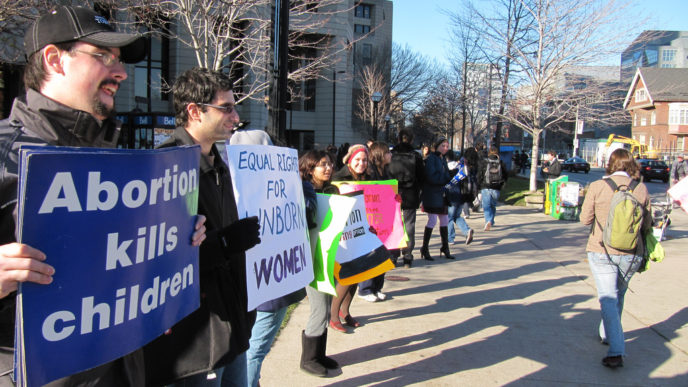
Pro-Life Student Group at Colorado State University Denied Grant for Event, Sues

A pro-life student group at Colorado State University is suing the school after it allegedly denied funds for an event simply because of the slated speaker’s pro-life views.

Students for Life at CSU is being represented by Alliance Defending Freedom (ADF), a non-profit law firm based in Arizona. The lawsuit was filed with a U.S. District Court Tuesday.

“A university is supposed to promote free speech,” Emily Faulkner, president of Students for Life at CSU, told CBS Denver Wednesday. She said she was “shocked” and “angered” upon receiving an email from the administration denying the Diversity Grant she requested.

According to CSU’s website, the Diversity Grant provides funding to official student organizations to help “establish a multicultural environment,” “celebrate diversity” and “raise awareness of differing perspectives.”

But when Faulkner requested a $600 grant last September to host pro-life speaker Josh Brahm of the Equal Rights Institute, she was denied.

The university explained in an email to Faulkner that Brahm did not “appear entirely unbiased” and that “folks from varying sides of the issue won’t necessarily feel affirmed in attending the event,” according to CBS Denver’s report and an ADF news release.

Students for Life at CSU raised the money on their own and held the event anyway, but Faulkner enlisted the help of ADF to sue the university.

In the lawsuit, Students for Life at CSU are asking the court to declare that CSU violated their constitutional rights, and that CSU pay the full $600 they were denied, as well as reimburse the mandatory fees they paid to join the organization. Those fees, paid by every official student organization, go toward funding the Diversity Grant program.

The lawsuit claims it is wrong for pro-life students in the group to be forced to help fund events they may disagree with, while being denied funding for events that express their own views.

“Universities should encourage all students to participate in the free exchange of ideas, not play favorites with some while shutting out others,” ADF Senior Counsel Tyson Langhofer said in a news release.

Other events listed on CSU’s calendar would seem to indicate some diversity, with a lecture on the intersection of Christian faith and science scheduled for January, and community drag show scheduled for April. According to the calendar, both events will be held in the Lory Center, the campus building where most Diversity Grant events take place.

Kristan Hawkins, president of Students for Life of America, believes that “CSU played favorites while stifling free speech, a typical response of abortion advocates who prefer to silence opposition rather than have a free exchange of ideas.”

CSU’s grant denial is the latest among recent examples from around the world of pro-life censorship. In December, The Stream reported that a university in Scotland banned pro-life groups like from becoming official clubs.

Additionally in December, The Stream reported that the lower house of the French parliament passed a bill criminalizing French websites that “deliberately mislead, intimidate and/or exert psychological or moral pressure to discourage recourse to abortion.”

Most recently, the Women’s March on Washington, scheduled to take place this weekend, removed a pro-life feminist organization from its official list of partners, despite the march’s espoused celebration of “intersecting identities.” The Women’s March revoked the pro-life group’s partnership status just two days after granting it, responding to women who tweeted outrage at the idea of pro-life feminism. (For more from the author of “Pro-Life Student Group at Colorado State University Denied Grant for Event, Sues” please click HERE)

Follow Joe Miller on Twitter HERE and Facebook HERE.
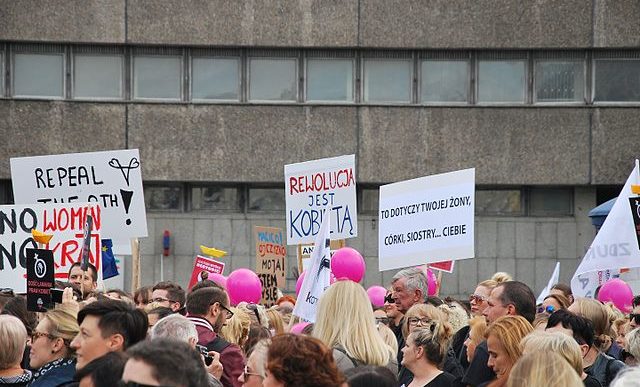
Pro-Life Women Explain Why They’re Still Going to the Women’s March

On Saturday, the day after the inauguration of President-elect Donald Trump, thousands of women are expected to gather in the nation’s capital for the Women’s March on Washington. The march was founded on principles of diversity, dignity, and inclusion.

But over the course of the past few days, several pro-life groups have been ousted as partners due to their position on abortion. Despite this, pro-life women tell The Daily Signal they’ll still attend the historic march. Watch the video to hear why. (For more from the author of “Pro-Life Women Explain Why They’re Still Going to the Women’s March” please click HERE)

Follow Joe Miller on Twitter HERE and Facebook HERE.
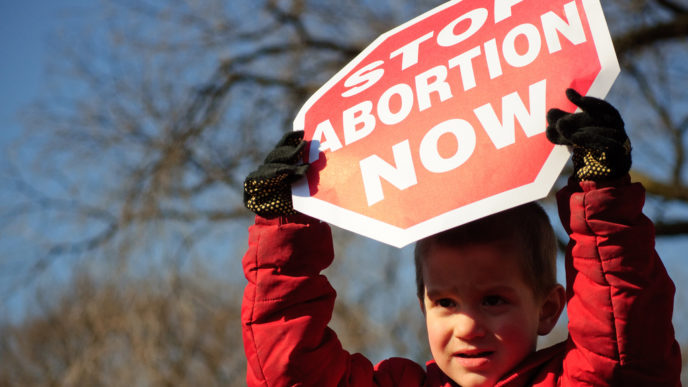
Let’s Be Pro-Life Champions, Not Just Vote Casters

“Radical hospitality and generosity.” That’s a phrase I heard Carter Snead, a law professor at Notre Dame, use this fall and I can’t get it out of my head. It’s an attractive phrase. It draws you in. It seems to call out to us that we are not alone, suggesting home and welcome. It’s a phrase that radiates hope and promise. It’s also a call to action.

It’s a notion similar to the one expressed by the words of Emma Lazarus inscribed at the base of the Statue of Liberty:

Give me your tired, your poor, your huddled masses yearning to breathe free, the wretched refuse of your teeming shore. Send these, the homeless, tempest-tost to me. I lift my lamp beside the golden door!

Are we going to live up to these words in the foreseeable future?

That’s a real question people have on their hearts and minds. There’s an uncertainty in the air, which centers on a Washington in transition. And with the Republican party in the majority in Congress, one of the first issues that has come up is defunding Planned Parenthood. There are many columns about the merits of this; this is not one of them. I’m grateful for Speaker of the House Paul Ryan’s commitment here. But winning this issue should be beyond Republican vs. Democrat dynamics. It should be about “radical hospitality and generosity.” (Read more from “Let’s Be Pro-Life Champions, Not Just Vote Casters” HERE)

Follow Joe Miller on Twitter HERE and Facebook HERE.

5 Things Pro-Lifers Have to Celebrate as 2016 Comes to a Close

2016 has been rough on everyone, and the pro-life movement is no exception. With the loss of Supreme Court Justice Antonin Scalia in February, followed by a major pro-abortion victory in Whole Woman’s Health v. Hellerstedt, the calendar year has been capped off by President Obama’s feeble, 11th-hour attempt to force states to fund Planned Parenthood.

However, as the numbers and some key developments illustrate, advocates for the unborn actually have great cause to celebrate at year’s end. Here are five signs of hope and encouragement.

1. Polling shows that a majority of Americans are pro-life

Almost 44 years after the Roe v. Wade decision was handed down in January of 1973, a majority of Americans identify as “pro-life” and support substantial restrictions on abortion:

A July survey conducted by the Marist Institute for Public Policy found:

[A]bout 8 in 10 Americans support substantial restrictions on abortion (78 percent), and would limit it to, at most, the first three months of pregnancy. This number includes 62 percent of those who identify as pro-choice, 85 percent of African-Americans and 84 percent of Latinos …

Furthermore, a Gallup poll in May found that more Americans regard themselves as “pro-life” than “pro-choice” (48 vs. 45 percent, respectively). “What’s more,” writes Jeffrey H. Anderson at The Weekly Standard, “opposition to abortion is rather plainly on the rise, as those numbers were effectively flipped 10 years ago — and as, in the mid-1990s, the number of people who considered themselves ‘pro-choice’ outpaced the number who considered themselves ‘pro-life’ by about 20 percentage points.

A November poll by the polling company, inc./WomanTrend found that a stark majority of Americans (64 percent) support a nationwide ban on abortions after 20 weeks (with the mother’s life, rape, and incest exceptions), when the unborn child is believed to feel pain. The measure was especially popular with African Americans and millennials, 70 and 78 percent of whom supported it, respectively.

2. Abortion clinics are closing nationwide

Recent findings from pro-life group Operation Rescue show that 31 abortion facilities across 18 states closed in 2016. According to the Christian activist group’s report, the number of facilities providing surgical and medical abortions currently stands at 731 nationwide, a 15 percent decrease from the 860-facility high in 2012.

“The political pendulum has swung our way, and we plan to work very hard to take advantage of this opportunity to immediately call for enforcement of laws that will shut down abortion facilities and save lives,” said Operation Rescue President Troy Newman.

“I believe this dramatic reversal of fortunes will pave the way for the eventual end to abortion in our country. There is now no excuse for failure.”

3. Abortion rates are down, in a big way

Data most recently available by the Centers for Disease Control and Prevention show that abortion numbers and rates are on a general decline. The latest figures, from 47 states, shows a total of about 665,000 abortions performed in 2013.

“[C]ompared with 2012, the total number, rate, and ratio of reported abortions for 2013 decreased by 5%,” writes the Family Research Council’s Arina Grossu. “From 2004–2013, the number, rate, and ratio of reported abortions also decreased 20%, 21%, and 17%, respectively, reaching their lowest level across the board for that time period.

“Additionally, the abortion rate for 2013 was 12.5 abortions per 1,000 women aged 15-44 years, about half of the 1980 recorded rate. The Associated Press reported that the CDC has not recorded a lower abortion rate since 1971, two years before the Roe v. Wade landmark decision.”

4. Pro-life laws are on the rise at the state level

According to the Guttmacher Institute (also known as Planned Parenthood’s research arm), the year 2016 continued a growing trend of pro-life laws at the state level.

By July, states had already adopted 46 new abortion restrictions, the Guttmacher Institute lamented. The report goes on to say that, since 2010, states have passed 334 pro-life laws, which make up 30 percent of all such measures.

And with Republicans now controlling a record number of state legislatures, the trend is certain to continue.

5. The 2016 election results hold some serious pro-life promise

Perhaps some of the most heartening numbers for social conservatives this year are the following: 1 president, 2 houses of Congress, 4 big promises.

The sanctity of life played a tremendous part in the 2016 presidential election, and President-elect Donald Trump’s promises to pro-life voters were a big part of the coalition that arguably brought him over the finish line.

And he made some pretty big promises, too.

Now with a Republican-run legislative and executive branch stacked up to govern in January, there’s literally no reason whatsoever not to defund Planned Parenthood, replace Justice Scalia’s seat with a pro-life constitutionalist, pass and sign a pain-capable abortion ban, and make the Hyde Amendment permanent law.

2016 has indeed been a doozy, but — for pro-lifers, at least — the numbers are looking good for the year to come. (For more from the author of “5 Things Pro-Lifers Have to Celebrate as 2016 Comes to a Close” please click HERE)

Follow Joe Miller on Twitter HERE and Facebook HERE.

Moana Is a Classic Disney Film, With a Surprising Pro-Life Message

If you’re seeking a Christmas weekend movie that every member of your family will enjoy, look no further than Moana. It’s exciting, funny, and moving, with great songs and memorable characters — all the elements you’d expect from Disney films of past decades.

One of its stars, Nicole Scherzinger, brings a special bonus: On top of her fine acting and beautiful singing, Scherzinger is an outspokenly pro-life actor. That’s rare enough in Hollywood, but Scherzinger takes real career risks for her convictions: On the eve of Moana’s release, she spoke out passionately on the subject of abortion. She told the Daily Mail (U.K.) that she herself was the product of a crisis pregnancy, conceived when her mom was only 18. To women in situations like her mother’s, she said: “I just want to … encourage everybody to keep your babies.” Let us encourage you to go see Moana, which deserves to succeed — and drop Disney a line about your support for Nicole Scherzinger, who is doubtless catching heat for her outspoken stand.

The Polynesian Garden of Eden

The film itself is a beautiful retelling of a classic Polynesian folktale that explores the origin of evil — and traces it, poignantly, to parents’ rejecting the life of their child.

In this myth, the world of islands and ocean that Polynesians knew — and explored in heroic journeys across thousands of miles of uncharted seas — was once a tranquil, Edenic place full of harmony and abundance, the gift of a nature goddess called Te Fiti. It was from her heart, a gleaming pounamu stone, that she drew the power to give life and raise new islands in the ocean where people might live.

But a demi-god named Maui craved this power, and to gain it he stole her heart. So far it sounds a lot like the story of the Serpent tempting Adam and Eve in the Garden. But Maui isn’t Satan. He isn’t evil and envious, but lonely and insecure — because, we find out in the course of the story, his own human parents rejected him at birth, and threw him in the ocean to drown. Saved by the gods (“Though my parents threw me away, the gods thought I was worthy of protection,” he says), he spends his life doing good deeds for men — sometimes misguided ones.

It turns out that Maui had planned to share Te Fiti’s power with mortal men, to gain the love he desperately craves, which his parents denied him. What happens instead is ugly: Having robbed nature of a gift that is rightly divine, Maui finds that he brought down a wave of destruction, want and pestilence. Te Fiti no longer gives life, and the islands are dying one by one. So Maui is less like the Serpent in Genesis than like Adam: foolish, rebellious and finally penitent.

The story begins when the young Moana learns that her beloved island is next. The wave of death that Maui set loose in the world washes up on its shores. The coconut trees start to wither, and the sea is emptied of fish. Moana learns, through a series of entertaining plot twists, that she must sail alone to hunt down Maui, and force him to return the godlike gift that man was never meant to have.

A Teaching Moment for Kids on the Sanctity of Life

While we don’t want to shoehorn this traditional Polynesian tale into a modern or Western frame, there is enormous resonance here for us in our times. If we think of the gift God gave us of taking part in the creation of new human beings, we can see how man’s attempt to impose his own control over this solemn, sacred process has distorted and poisoned our culture. Birth rates have plummeted all around the world, and philosophers actually question whether it is moral or not to have children. Radical environmentalists look at the precious feet of newborns and think of their “carbon footprints.” What they miss, of course, is that the only real reason people care about the environment is to leave a decent world for their offspring. Take that away, and people live only for the moment.

Couples who have missed the chance to have families when they are young turn to artificial techniques like IVF — which leave behind thousands of tiny, frozen babies in labs all around the world, which scientists want to harvest for spare parts and experiments. Add to that the global tragedy of abortion, and you’ll see that this Polynesian story isn’t exotic or quaint. It is potently relevant to Americans today, and Christians who care about the sanctity of life. See it with your kids, and use the story as a teaching moment to let them know about how too many modern people are grasping at godlike power — at the price of precious innocents whose lives God really has entrusted to our power and our protection. (For more from the author of “Moana Is a Classic Disney Film, With a Surprising Pro-Life Message” please click HERE)

Follow Joe Miller on Twitter HERE and Facebook HERE.