Posts

TV News Confused Restaurant P.F. Chang’s and Pyeongchang

Pyeongchang is a mountainous county 110 miles southeast of Seoul in South Korea, and the host of the 2018 Winter Olympics.

P.F. Chang’s is an Asian-inspired chain restaurant with 210 U.S. locations, including ones in Chicago, Lombard, Northbrook, Orland Park and Schaumburg.

PyeongChang and P.F. Chang’s are not the same thing, and beyond the fact that they both begin with the letter P and end in “Chang,” they have little in common.

This distinction, however, appears to have eluded WLS-Ch.7’s news team, which on Saturday morning accidentally broadcast a report about the political backdrop to the Winter Olympics, illustrated with the graphic, “P.F. Chang 2018.” (Read more from “TV News Confused Restaurant P.F. Chang’s and Pyeongchang” HERE)

Follow Joe Miller on Twitter HERE and Facebook HERE.

Starbucks Director, Kissinger Confidante Praises Japan’s Brutal Occupation of Korea, Forced to Apologize

By Reuters. Former journalist Joshua Cooper Ramo, working as an analyst for NBC, said on-air during the Pyeongchang Games opening ceremony that all Koreans recognized that Japan had served as an important example in South Korea’s own economic transformation.

Koreans around the world criticized his remarks on social media and a petition soon circulated online. Japan, which colonized the Korean peninsula from 1910 to 1945, has left a deep legacy of mistrust and ill-feeling in South Korea.

Ramo, who has written books on China and is a director of Starbucks Corp and FedEx Corp, said as athletes paraded into the Games stadium that “every Korean will tell you that Japan is a cultural, technological and economic example that has been so important to their own transformation”. . .

Ramo, who was also an on-air contributor for NBC during the Beijing Olympics, is co-CEO of Kissinger Associates, an advisory firm of former U.S. Secretary of State Henry Kissinger. (Read more from “Starbucks Director, Kissinger Confidante Praises Japan’s Brutal Occupation of Korea, Forced to Apologize” HERE)

____________________________________________________

NBC Forced to Apologize After Katie Couric, Colleagues Insult Entire Nation of South Korea

By The Daily Wire. NBC, the only network on which Americans can watch the Olympics, has been forced to issue an apology to the entire nation of South Korea after its anchors, Mike Tirico and Katie Couric, and its Asian correspondent, Joshua Cooper Ramo, accidentally insulted the Korean people during their Opening Ceremonies broadcast.

The trio was discussing visiting Olympic dignitaries, when they settled on Japanese Prime Minister Shinzo Abe, according to Yahoo News.

“In the booth with Mike Tirico and Katie Couric, NBC Asian correspondent Joshua Cooper Ramo said that ‘every Korean’ respected Japan for their recent achievements as a nation, insinuating that South Korea had forgotten about the 35 brutal years of Japanese rule that ended after World War II,” Yahoo reported . . .

On Saturday, NBC issued a comprehensive apology.

During our coverage of the Parade of Nations on Friday we said it was notable that Japanese Prime Minister Shinzo Abe made the trip to Korea for the Olympics, “representing Japan, a country which occupied Korea from 1910 to 1945 but every Korean will tell you that Japan is a cultural, technological and economic example that has been so important to their own transformation.” We understand the Korean people were insulted by these comments and we apologize.

(Read more from “Nbc Forced to Apologize After Katie Couric, Colleagues Insult Entire Nation of South Korea” HERE)

____________________________________________________

NBC Commentators #Fail at the Olympics

By The Washington Post. Friday’s Opening Ceremonies for the Winter Olympics in South Korea were, by most accounts, spectacular. NBC’s coverage of the spectacle, on the other hand, was considered hit and miss. Occasionally disastrous.

It wasn’t so much the hosts, Katie Couric and Mike Tirico, who annoyed critics, but rather the network’s analyst, Joshua Cooper Ramo. . .

But Ramo’s big misstep came when he noticed Prime Minister Shinzo Abe of Japan in the crowd and offered what he knew about the country’s history with Korea.

Japan was “a country which occupied Korea from 1910 to 1945,” Ramo said, correctly (though he did not mention that historians say the Japanese army forced tens of thousands of Koreans into sex slavery.)

“But,” Ramo continued, “every Korean will tell you that Japan as a cultural and technological and economic example has been so important to their own transformation.” (Read more from “NBC Commentators #Fail at the Olympics” HERE)

Editor’s note: This is a South Korean news clip but has Ramo’s comments in English at about :40

Follow Joe Miller on Twitter HERE and Facebook HERE.

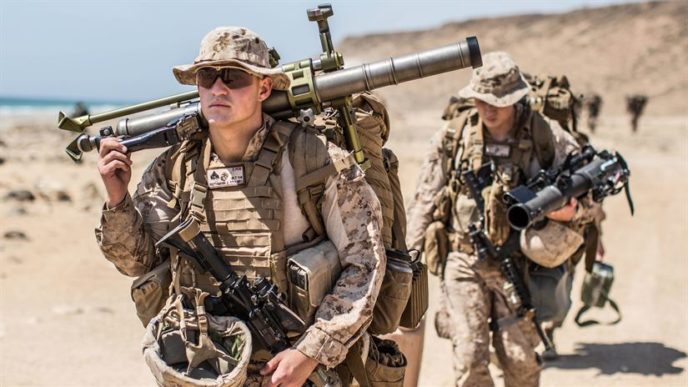
US Marines Protect the Winter Olympics in South Korea From Kim Jong-Un

Hundreds of South Korean and US Marines braved subfreezing temperatures as they took part in winter training exercises on Tuesday.

Photos show shirtless soldiers wrestling, doing press-ups and snow sport exercises in the eastern mountainous region of Pyeongchang, South Korea, some 180 kilometers east of Seoul.

More than 220 South Korean Marines and 220 US Marines took part in the drill, which comes less than two months before the Winter Olympic Games set to be held there in February.

The training exercises began on December 4 at the Mount Hwangbyeong training camp as part of the Korea Marine Exercise Program, Yonhap News agency reported . . .

A spokesman for the US marine unit, the III US Marine Expeditionary Force, told the news agency: ‘This exercise has been held with a focus on enhancing the combined combat capabilities of the South Korean and US Marine Corps in winter war conditions under which temperatures drop to about minus 20C.’ (Read more from “US Marines Protect the Winter Olympics in South Korea From Kim Jong-Un” HERE)

Follow Joe Miller on Twitter HERE and Facebook HERE.

US Bomber Flies Over Korean Peninsula During Military Exercises With South

The U.S. Seventh Air Force flew a B-1B supersonic bomber over South Korea on Wednesday as a part of a joint aerial exercise with the South’s military, South Korean officials confirmed.

South Korea’s Joint Chiefs of Staff said in a statement that the U.S. bomber simulated land strikes on military grounds near the eastern coast, proving its ability to “punish” the North’s aggression.

“Through the drill, the South Korean and U.S. air forces displayed the allies’ strong intent and ability to punish North Korea when threatened by nuclear weapons and missiles,” the JCS said.

The drill involving the B-1B Lancer bomber was part of a five-day joint training exercise called “Vigilant Act,” Reuters reported.

The Seventh Air force has sent other strategic military assets, including six F-22 and 18 F-35 stealth fighter jets. About 12,000 U.S. military personnel are participating in the drill, which started Monday. (Read more from “US Bomber Flies Over Korean Peninsula During Military Exercises With South” HERE)

Follow Joe Miller on Twitter HERE and Facebook HERE.

Trump’s Right at Kim’s Doorstep

President Donald Trump arrived in South Korea on Tuesday for a two-day visit, bringing him near North Korean leader Kim Jong Un on a stop that will also feature talks on a trade deal he says hurts U.S. workers.

The second leg of his five-nation Asia trip includes a meeting with U.S. troops, a joint press briefing with President Moon Jae-in and an address to South Korea’s parliament. In contrast to Trump’s warm relationship with Japanese Prime Minister Shinzo Abe, his dealings with Moon got off to rocky start due to differences over trade and dialogue with North Korea.

“Getting ready to leave for South Korea and meetings with President Moon, a fine gentleman,” Trump tweeted on Tuesday morning. “We will figure it all out!”

Trump and Moon are likely to show a united front against Kim, even while underlying tensions remain. South Korea hosts more than 28,000 U.S. troops and relies on the alliance to deter a North Korean attack.

Pyongyang’s accelerated missile and nuclear weapons program — and a war of words between Trump and Kim — have ratcheted up tensions in North Asia to the highest level in decades. Nowhere is that tension felt more acutely than in Seoul, with a metropolitan area of more than 25 million people and a location in striking range of the regime. (Read more from “Trump’s Right at Kim’s Doorstep” HERE)

Follow Joe Miller on Twitter HERE and Facebook HERE.

Report: Trump Ready to Dump S. Korean Trade Deal

At a time when tensions in the Korean Peninsula are increasingly high, President Donald Trump is reportedly planning to end a free trade deal with South Korea

According to The Washington Post, which cited unidentified sources “close to the process,” the decision is far along but not final, although it could be announced next week.

The Wall Street Journal also reported Trump is considering pulling out the deal.

The White House confirmed to The Post that the deal is being discussed, but would not comment further.

The Post said some of Trump’s advisers are opposed to the move. It named national security adviser H.R. McMaster, Defense Secretary James Mattis and National Economic Council Director Gary Cohn as being against the deal ending.

South Korea has been working closely with the United States to oppose North Korea’s missile program, but that that partnership could be impacted if the nations begin a trade war.

The South Korean trade agreement has been in effect since 2012.

If the United States were to withdraw, goods imported from South Korea could cost more, because the U.S. could slap heavy tariffs upon them. Cars, cell phones and various electronic items are all major imports form South Korea.

U.S. action could spur a similar response from South Korea, making U.S. products more expensive in that country.

U.S. trade representative Robert E. Lighthizer said in July that since 2012, the U.S. “trade deficit in goods with Korea has doubled from $13.2 billion to $27.6 billion, while U.S. goods exports have actually gone down. This is quite different from what the previous Administration sold to the American people when it urged approval of this Agreement. We can and must do better.”

In June, Commerce Secretary Wilbur Ross made the administration’s concerns public as Trump sought to renegotiate the deal.

“There are a lot of very specific problems,” Ross told South Korean President Moon Jae-in on June 30.

“For many, many years, the United States has suffered through massive trade deficits….we’ll be changing that,” Trump said during his part of the June 30 meeting with Moon.

“The fact is that the United States has trade deficits with many, many countries, and we cannot allow that to continue,” Trump added at the time. “And we’ll start with South Korea right now.” (For more from the author of “Report: Trump Ready to Dump S. Korean Trade Deal” please click HERE)

Follow Joe Miller on Twitter HERE and Facebook HERE.

Impeachment Controversy Stokes Uncertainty Ahead of South Korean Election

The next South Korean presidential election is scheduled to be held on or before Dec. 20, 2017. However, there is a possibility that South Korea will have its election in advance because of President Park Geun-hye’s impeachment, which led to her immediate suspension.

Park’s impeachment must be ratified by the Constitutional Court within six months in order to become permanent. If the Constitutional Court votes to ratify, South Korea must then hold new presidential elections within 60 days.

Potential candidates are already starting to declare their intention to run for president, including a major South Korean opposition leader, Moon Jae-in.

However, there are concerns among experts in South Korea and the U.S that progressive opposition parties are attempting to reverse current South Korean foreign policies that have been pragmatic on North Korea and have seen an improvement in U.S.-Japan-South Korea trilateral relations.

Moon, the leading progressive candidate, has persistently expressed a desire to strengthen ties with China and reopen its banner of “inter-Korean dialogue.” He also suggested he would renegotiate and review the comfort women agreement and the General Security of Military Information Agreement with Japan.

During his interview earlier this month, Moon said, “The Kaesong Industrial Complex has to be resumed immediately, and the deployment of Terminal High Altitude Area Defense has to be left as a task for the next government.”

Moon also said he will “visit North Korea first” before the U.S. if he wins the election. This statement caused a public controversy and stoked the flames of a scandal that had been dogging Moon for several months.

In a recent memoir, former Foreign Minister Song Min-soon claimed that Moon was responsible for South Korea’s decision to abstain from a 2007 U.N. resolution vote on North Korea’s human rights situation after listening to Pyongyang’s opposition. At the time, Moon was chief of staff to President Roh Moo-hyun.

The question of Moon’s “suspicious security standards” has limited his increasing popularity, even as he has benefited from the recent impeachment. But according to a poll from Realmeter, Moon was still leading with a 23.7 percent support rate in early December.

There is speculation, however, that Moon will face a challenge from another progressive candidate, Lee Jae-myung, the mayor of a satellite city of Seoul. Lee ranks third in the polls and has a 14.9 percent support rate. In response to Moon’s earlier statement, Lee said he would “visit the U.S. first.” But his foreign policy proposals do not seem to vary much from Moon’s.

U.N. Secretary-General Ban Ki-moon is currently polling ahead of Lee and behind Moon with 20.5 percent of popular support. He has not spoken much about his decisions at the U.N. or his policy views because his tenure as U.N. chief has not yet expired.

But Ban is considered to be the only moderate conservative candidate who has a chance over Moon. If the conservative party manages to recover from the recent scandal, it will probably reassemble under Ban, who is considered favorable to the U.S.

The South Korean presidential race is a multicandidate field. The two most likely scenarios are: Ban vs. Moon or Ban vs. Lee. Whether Moon or Lee compete as progressive candidates, Ban will have a hard fight considering the current political atmosphere in South Korea.

The next South Korean election is important because it may affect the future of U.S.-Korean relations. If the progressive candidate wins, South Korea might pivot to China, reverse pragmatic policies against North Korea that enforce U.N. resolutions, and raise tensions against Japan—all policy moves that contravene U.S. national interests.

In this period of relative political uncertainty, the U.S. should reassure its extended guarantee of deterrence to its allies, encourage an improving relationship between South Korea and Japan, and affirm its dedication to enhancing sanctions and targeted financial measures to increase pressure on the North Korean regime. (For more from the author of “Impeachment Controversy Stokes Uncertainty Ahead of South Korean Election” please click HERE)

Follow Joe Miller on Twitter HERE and Facebook HERE.

US Security Benefits When Japan, south Korea Share Intelligence

South Korea recently announced it would restart negotiations with Japan for a military and intelligence sharing agreement. Washington should encourage this growing security cooperation.

Moon Sang-gyun, spokesman for South Korea’s Ministry of National Defense, said Sept. 27 that North Korea’s “nuclear and missile threats are escalating by the day, so our security situation is becoming more critical.”

My own recent private discussions with government officials in Seoul confirmed South Korea’s intent to move forward on the agreement, formally called a General Security of Military Information Agreement (GSOMIA).

The GSOMIA would be the first military pact between Seoul and Tokyo since 1945. Though historic, the agreement is simply a legal framework of required methods to protect classified information that allows for the bilateral exchange of intelligence about North Korea’s nuclear, missile, submarine, and conventional force threats as well as potential military and cyberattacks.

History Impeded Progress

While Washington has strong alliances with both South Korea and Japan, the security relations between Seoul and Tokyo have been extremely limited due to territorial disputes and bitter historical animosities dating to Japan’s brutal, 35-year occupation of the Korean Peninsula between 1910 and 1945.

In June 2012, South Korea and Japan were within an hour of signing a General Security of Military Information Agreement, but Seoul canceled at the last moment. The reasons: fierce domestic criticism and legislative backlash over the secretive nature of the talks and the prospect of signing a pact with Korea’s former colonial oppressor.

The head of the opposition party at the time accused the South Korean government of seeking “to give access without restriction to military facilities and intelligence in seeking to forge a military intelligence treaty with a country that invaded our nation in the past.”

In reality, under the planned agreement Seoul and Tokyo would retain authority for deciding what data are shared.

Despite the collapse of the agreement, Seoul and Tokyo continued to quietly improve bilateral security relations. They exchanged observers during military exercises and engaged in trilateral naval and missile defense training exercises with the United States.

The U.S., South Korea, and Japan signed a limited intelligence sharing agreement in December 2014, but it still required Washington to be the intermediary for information provided by Seoul and Tokyo. While that agreement was an improvement, it still didn’t enable effective, real-time security cooperation during a crisis or attack.

Recent progress was enabled by the December 2015 bilateral agreement on South Korean women forced into sexual slavery—they were known euphemistically as “comfort women”—during the 1910-1945 Japanese occupation.

The landmark agreement was a stunning success achieved through diplomatic perseverance, as well as political courage by Japanese Prime Minister Shinzo Abe and South Korean President Park Geun-hye to push back against nationalist elements in their respective countries.

This past March, the U.S., Japanese, and South Korean leaders pledged to increase military cooperation against the growing North Korean threats.

On Oct. 14, South Korean Defense Minister Han Min-koo explained that “the need has heightened” for the bilateral agreement because of North Korea’s two nuclear tests and breakthrough successes on several missile systems in 2016.

Seoul is also probably more receptive given China’s heavy-handed threats of economic, diplomatic, and military pressure against the U.S. in deploying the missile defense system known as Terminal High Altitude Area Defense, or THAAD, in South Korea.

Critical for Allied Security

A bilateral General Security of Military Information Agreement between America’s critical northeast Asian allies would improve deterrence and defense capabilities against Pyongyang’s escalating nuclear and missile threats. Currently, for example, U.S. military officers must turn off live feeds from South Korean or Japanese sensors when representatives of the other ally enter a command or intelligence center.

Removing the intelligence-sharing constraints would be in South Korea’s national interests, since it would enable access to North Korean threat data from Japan’s high-tech intelligence satellites, AEGIS ships, and early warning and anti-submarine aircraft. South Korea could provide information on the North’s missiles detected by long-range air search radar.

Both South Korea and Japan have extensive, highly capable militaries. Given Pyongyang’s large submarine fleet and successful launch of a submarine-launched ballistic missile this year, coordinated trilateral anti-submarine and counter-mining operations are increasingly important.

The GSOMIA also is necessary for a comprehensive allied missile defense system in Asia. Integrating South Korea, Japanese, and U.S. warning sensors and tracking radars would enhance real-time missile defense security for all three countries. However, to date, South Korea has refused to integrate its Korea Air and Missile Defense system into the more comprehensive and effective allied ballistic missile defense system.

Despite the clear and present danger from North Korean missiles, South Korea insists on maintaining an independent and less capable missile defense system to protect its citizens and U.S. forces in Korea against the North’s nuclear, biological, and chemical missile attacks.

In addition to signing the agreement, South Korea should integrate its missile defense system into the comprehensive allied system with linked sensors to improve deterrence and defense capabilities for the forces of all three countries.

What Washington Should Do

U.S. interests in Asia—ensuring regional stability, protecting maritime freedom of navigation, and peaceful resolution of disputes—benefit from greater multilateral cooperation.

Washington therefore should continue policies to augment bilateral and trilateral military cooperation efforts with Seoul and Tokyo, particularly in missile defense against the North Korean threat.

Strong trilateral security cooperation also can affirm recently improving South Korea-Japanese relations and form the basis for addressing other regional and global security challenges.

The U.S. will remain the guarantor of regional stability and should:

• Publicly highlight the need for greater South Korean-Japanese military and diplomatic cooperation as a vial component of comprehensive security efforts against North Korea’s growing military threat. While the immediate need is on missile defense and anti-submarine operations, Japan and South Korea should discuss potential joint peacekeeping missions, counterterrorism, counterpiracy, and disaster response operations.

• Step up trilateral military exercises to increase transparency, augment familiarity of operations necessary during a crisis, and improve combined capabilities.

• Continue to affirm unequivocal military support for South Korea and Japan, including the U.S. extended deterrence guarantee of the nuclear umbrella, missile defense, and conventional forces.

• Maintain robust, forward-deployed military forces in South Korea, Japan, and the Western Pacific to deter, defend, and defeat security threats to U.S. national interests and American allies. The U.S. presence also should allay South Korean concerns over Japan’s defense reforms and slowly growing security role.

• Privately counsel both South Korea and Japan to make progress on implementing the December 2015 “comfort women” agreement and refrain from comments and actions that could incite nationalist responses in either country.

• Propose an annual trilateral meeting of the three countries’ foreign and defense ministers (a “2+2+2 meeting”) to develop a joint strategic vision and integrate roles, missions, and capabilities.

A Necessity

U.S. national interests and ability to defend them are enhanced by greater cooperation among our allies. This is particularly true between South Korea and Japan, which recently have overcome strained bilateral relations.

The growing military capabilities of North Korea and China, and their willingness to use them to test international resolve, have increased tensions and the risk of military incidents or clashes.

While the actions by Pyongyang and Beijing are inimical to allied interests, they have crystalized the necessity that South Korea and Japan overcome historic differences to address current and future threats.

Washington should welcome and encourage growing South Korean-Japanese security cooperation. (For more from the author of “US Security Benefits When Japan, South Korea Share Intelligence” please click HERE)

Follow Joe Miller on Twitter HERE and Facebook HERE.

North and South Korea Trade Artillery Fire as Tensions Soar

Part-HKG-Hkg10203886-1-1-0By Lim Chang-Won. South and North Korea traded artillery fire across their heavily militarised border on Thursday, in a rare exchange that left no casualties but pushed already elevated cross-border tensions to dangerously high levels.

North Korea followed up with an ultimatum sent via military hotline that gave the South 48 hours to dismantle loudspeakers blasting propaganda messages across the border or face further military action . . .

Direct exchanges of fire across the inter-Korean land border are extremely rare, mainly, analysts say, because both sides recognise the risk for a sudden and potentially disastrous escalation between two countries that technically remain at war.

Thursday’s incident came amid heightened tensions following mine blasts that maimed two members of a South Korean border patrol earlier this month and the launch this week of a major South Korea-US military exercise that infuriated Pyongyang.

In a detailed press briefing later in the day, the South’s defence ministry said the nuclear-armed North initially fired a single artillery round over the border shortly before 4:00pm (0700 GMT). (Read more from “North and South Korea Trade Artillery Fire as Tensions Soar” HERE)

__________________________________________________________

Rival Koreas Trade Artillery, Rocket Fire at Border

By Hyung-Jin Kim. South Korea fired dozens of shells Thursday at rival North Korea after the North lobbed a single rocket round at a South Korean town near the world’s most heavily armed border, the South’s Defense Ministry said.

The Defense Ministry said in a statement that its artillery shells landed at the place where North Korea had fired its rocket. There were no other immediate details from the military and no reports of injuries. It appeared that North Korea did not respond to South Korea’s returned fire.

North Korea had previously threatened to attack South Korean loudspeakers that have been broadcasting, for the first time in 11 years, anti-Pyongyang propaganda messages across their shared border. Pyongyang also restarted its own loudspeakers aimed at the South.

About 80 residents in the South Korean town where the shell fell, Yeoncheon, were evacuated to underground bunkers, and authorities urged other residents to evacuate, a Yeoncheon official said, requesting anonymity because he wasn’t authorized to speak to the media.

In the nearby border city of Paju, residents were asked to stay home. On Baeknyeong Island near the Koreas’ disputed western sea boundary — the scene of several bloody skirmishes in recent years — residents in villages near a site where South Korea operates one of its loudspeakers were also evacuated, according to island officials. (Read more from this story HERE)

__________________________________________________________

North Korea Declares “Quasi-State of War” Today on South

Photo Credit: CNN

Photo Credit: CNN

By Stars and Stripes. North Korean leader Kim Jong Un declared his front-line troops in a “quasi-state of war” Friday and ordered them to prepare for battle against South Korea in response to an exchange of artillery fire on the border the day before. . .

Tensions on the Korean peninsula ratcheted up after two South Korean soldiers were maimed on Aug. 4 by land mines planted along the Demilitarized Zone. A U.N. Command investigation determined the mines had been planted by the North along a known South Korean patrol route. Pyongyang has denied involvement.

In response to the attack, South Korea resumed anti-Pyongyang broadcasts through loudspeakers along the border, and the North retaliated with its own broadcasts. North Korea demanded the broadcasts end by Friday evening.

On Thursday North Korea fired an artillery round into Yeoncheon near the DMZ. The South responded by firing dozens of shells at the point of origin of the North’s round, according to the Ministry of National Defense statements reported by Yonhap News.

While the two Koreas have traded fire several times in recent years, this marked the most serious incident since the North’s sinking of the Cheonan warship in 2010, killing 46 sailors, and its shelling of the Yeonpyeong island later that year that left four dead. (Read more from this story HERE)

Follow Joe Miller on Twitter HERE and Facebook HERE.

North Korea threatens imminent strikes against South, warns US

downloadNorth Korea on Saturday threatened South Korea with “indiscriminate” military strikes unless it halts cross-border propaganda broadcasts, and issued fresh nuclear weapons warnings against the United States.

The threats came amid escalating military tensions on the Korean peninsula following a landmine attack South Korea blamed on the North and ahead of a major South Korea-US joint military exercise condemned by Pyongyang.

They also coincided with celebrations in both Koreas to mark the 70th anniversary of the Korean peninsula’s 1945 liberation from Japanese colonial rule.

Initially there were hopes the anniversary might be an opportunity for some sort of inter-Korean rapprochement, but instead ties have spiralled downwards to the familiar accompaniment of angry rhetoric and mutual recrimination.

After three landmine blasts maimed two South Korean soldiers on border patrol, Seoul this week resumed high-decibel propaganda broadcasts across the heavily-militarised frontier, using batteries of loudspeakers that had lain silent for more than a decade. (Read more from “North Korea Threatens Imminent Strikes Against South, Warns US” HERE)

Follow Joe Miller on Twitter HERE and Facebook HERE.