Posts

Establishment Media Fumbles Supreme Court’s Decision on Idaho Abortion Law

The establishment media prematurely reported a Supreme Court order dismissing a crucial case involving Idaho’s pro-life law and the Biden administration’s controversial ER abortion mandate.

The Biden administration’s Department of Health and Human Services (HHS) issued a regulation under the Emergency Medical Treatment and Labor Act (EMTALA), mandating that hospitals provide abortions if deemed necessary to stabilize a pregnant woman’s medical emergency, overriding state laws. Idaho’s Defense of Life Act, a pro-life law, stood in direct opposition to this mandate.

The administration’s aggressive push led to a federal district court in Idaho issuing a preliminary injunction in favor of HHS. Idaho subsequently appealed to the Ninth Circuit. In an uncommon move, the Supreme Court granted “cert before judgment,” agreeing to review the case before the appellate court’s decision.

The decision was accompanied by several opinions, reflecting the deep divisions within the court:

Justice Ketanji Brown Jackson argued against dismissal, advocating for the court to strike down Idaho’s pro-life law in favor of the Biden administration’s abortion mandate.

Justice Elena Kagan, joined by Justice Sonia Sotomayor, expressed their intent to rule that the EMTALA regulation preempts Idaho law but agreed with the dismissal for procedural reasons.

Justice Samuel Alito, supported in part by Justices Clarence Thomas and Neil Gorsuch, opposed the dismissal, favoring Idaho’s pro-life law and criticizing the court’s reluctance to address the issue head-on.

Justice Amy Coney Barrett, joined by Chief Justice John Roberts and Justice Brett Kavanaugh, formed the deciding block, aligning with the dismissal but leaving the broader legal questions unresolved.

The establishment media’s premature and inaccurate reporting on the Supreme Court’s decision underscores a troubling trend of misinforming the public on crucial issues. By jumping the gun, they not only failed to provide a clear picture of the court’s decision but also contributed to the confusion surrounding an already contentious issue.

The establishment media’s premature reporting on the Supreme Court’s decision regarding Idaho’s pro-life law and the Biden administration’s abortion mandate is a glaring example of media incompetence and bias.

The Fight Against Child Mutilation Makes It to the Supreme Court

Maybe you’ve heard the saying, “The purpose of a system is what it does.” It’s a phrase that was coined by a professor named Stafford Beer as a way of helping people understand complex systems. It was originally about cybernetics, but it’s increasingly being used in the context of American politics.

That’s because you’ll often hear convoluted explanations to justify various policies, when all you really have to do is look at the end result that those policies are producing. The benefit of Beer’s approach is that, at the risk of maybe oversimplifying some things, it short-circuits all the rationalization and B.S. that we’re all used to hearing. And if there’s one skill that the politicians and academics have perfected — whether they’re talking about immigration or criminal justice reform or anything else — it’s drowning us in doublespeak so that we don’t look at the obviously evil and destructive results of their policies. Sometimes things really aren’t that complicated. Sometimes you don’t need experts and studies to decide on a course of action.

That’s especially true in the case of so-called “transgender medical care” for children, which really means injecting children with sterilizing cross-sex hormones and puberty blockers that can cause early-onset osteoporosis. In some cases, it also means amputating body parts from children — so-called “top surgery” for minors is legal in many states, and used to be legal in many more. No other civilization throughout human history has done anything like this, and for good reason. There’s no need to analyze the “intent” of people who promote a practice like this. The purpose of a system is what it does. The end result of their policy is that children are being mutilated. No further discussion is necessary.

Of course, this isn’t how our courts work. They generally take their time when it comes to ruling on major policy issues — if they ever decide to weigh in all. But eventually, on the most important issues, things come to a head. The various appellate courts disagree, creating a “circuit split,” and ultimately the Supreme Court feels compelled to step in. That’s happening now in the area of so-called “trans medicine.” And it brings us to what could very well be the most significant Supreme Court case since Dobbs. This could be a long overdue decision — and it’s worth a close look, especially since the ruling could come down in a matter of months.

(Read more from “The Fight Against Child Mutilation Makes It to the Supreme Court” HERE)

Today’s String of Supreme Court Decisions Blew Up Another Liberal Narrative (Again)

The Supreme Court has not yet decided on the presidential immunity case involving former President Donald Trump, which could wreck the pending trials from Special Counsel Jack Smith on January 6 and classified document indictments. At the same time, the string of decisions today did unravel another trite liberal talking regarding our third branch of government: it’s a rogue, right-wing machine that’s out to destroy America.

The three decisions today obliterated that narrative. There were no 5-4 decisions, and some concurring and dissenting opinions were—wait for it—made up of diverse company. Law professor Jonathan Turley had a lengthy Twitter thread about today’s rulings:

..We have the first case. It is Moore!

…Another shattering of the narrative of a hopelessly ideologically divided court. 7-2 decision. This is the tax case that I thought we might get today. It addresses the scope of the taxation powers.

…Court rules that taxpayers who own shares in foreign corporations can be constitutionally required to pay a one-time tax on their share of the corporation’s earnings…In his dissent, Thomas notes that the Court avoided the “wealth tax” issue with a biting couple lines: “Even as the majority admits to reasoning from fiscal consequences, it apparently believes that a generous application of dicta will guard against unconstitutional taxes in the future. The majority’s analysis begins with a list of nonexistent taxes that the Court does not today bless, including a wealth tax.”…

[…]

..We have the second opinion. It is CHIAVERINI ET AL. v. CITY OF NAPOLEON, OHIO, ET, a Fourth Amendment malicious prosecution case.

…This is a Justice Kagan decision that holds “the presence of probable cause for one charge in a criminal proceeding does not categorically defeat a Fourth Amendment malicious prosecution claim relating to another, baseless charge.”…

…Once again, the critics of the Supreme Court will be disappointed with the diverse majority of Roberts, Sotomayor, Kavanaugh, and Barrett joining Kagan in the 6-3 decision…

…We have the third decision. It is Diaz v. US and authored by Thomas. Justice Gorsuch joins Sotomayor and Kagan in dissent.

The court holds that an expert testifying about how ‘most people” have a particular mental state is not an opinion about the defendant and therefore does not violate federal evidentiary rules.

(Read more from “Today’s String of Supreme Court Decisions Blew Up Another Liberal Narrative (Again)” HERE)

Supreme Court Finds No First Amendment Violation in Denying ‘Trump Too Small’ Trademark

The Supreme Court held Thursday that the United States Patent & Trademark Office’s (USPTO) denial of a trademark for the phrase “Trump too small” did not violate the First Amendment.

T-shirt maker Steve Elster brought the lawsuit to challenge the USPTO’s denial of trademark protections for the phrase under the Lanham Act, a law that restricts the registration of trademarks that include the name of a “living individual.” Justice Clarence Thomas wrote in the court’s opinion that the “names clause” of the law “does not facially discriminate against any viewpoint” and has “deep roots” in historical tradition.

“No matter the message a registrant wants to convey, the names clause prohibits marks that use another person’s name without consent,” Thomas wrote.

The phrase is a nod to Republican Florida Sen. Marco Rubio’s crude joke about Trump’s “small hands” during a 2016 presidential debate, which Elster explained in court documents he adopted to express “that some features of President Trump and his policies are diminutive.”

“The Lanham Act’s names clause has deep roots in our legal tradition,” Thomas continued. “Our courts have long recognized that trademarks containing names may be restricted. And, these name restrictions served established principles. This history and tradition is sufficient to conclude that the names clause—a content-based, but viewpoint-neutral, trademark restriction—is compatible with the First Amendment.” (Read more from “Supreme Court Finds No First Amendment Violation in Denying ‘Trump Too Small’ Trademark” HERE)

Photo credit: Gage Skidmore via Flickr

Supreme Court Poised to Agree With Trump: Former Presidents Are Immune From Some Prosecutions

By Breitbart. A majority of Supreme Court justices sympathized with Donald Trump’s attorneys’ arguments that a president does enjoy some level of immunity that endures past the term of office.

The court heard oral arguments regarding if Trump is immune from prosecution on charges of attempting to overturn the results of the 2020 election, as Special Counsel Jack Smith claims.

A federal trial court ruled in Smith’s favor that Trump is not immune from prosecution, but Smith’s prosecution in D.C. has been on hold until the Supreme Court weighs in, likely in late June.

Arguments revealed that a majority appears to agree that presidents do enjoy some scope of immunity after their term in office, but the ultimate question will be the establishment of a standard.

If the Court institutes a test, it would vacate (i.e., strike) the lower court decision that former presidents have no immunity, sending that case back to trial court. That court would then undergo a painstaking point-by-point analysis on each fact to determine if immunity exists. (Read more from “Supreme Court Poised to Agree With Trump: Former Presidents Are Immune From Some Prosecutions” HERE)

_______________________________________________

Supreme Court Struggles With Immunity for Presidents Over Official Acts

By Washington Times. Supreme Court justices clashed Thursday over former President Donald Trump’s claims of “absolute immunity” from prosecution for his official acts in the White House as they sorted through competing dangers of an unleashed president on the one hand or a crippled commander in chief on the other.

Justices seemed to agree that some presidential conduct is immune from prosecution, but they sparred over where to draw the line and what it would mean for presidents long after Mr. Trump’s case is decided.

“We’re writing a rule for the ages,” said Justice Neil M. Gorsuch, a Trump appointee.

The court’s liberal-leaning justices were the most skeptical of Mr. Trump’s claims.

“The founders did not put an immunity clause in the Constitution,” said Justice Elena Kagan, an Obama appointee. “Not so surprising. They were reacting against a monarch who claimed to be above the law. Wasn’t the whole point the president was not a monarch, and the president was not supposed to be above the law?” (Read more from “Supreme Court Struggles With Immunity for Presidents Over Official Acts” HERE)

Photo credit: Flickr

Supreme Court To Hear Arguments On Whether Trump Has Immunity From Federal Prosecution

The Supreme Court is set to hear oral arguments on Thursday about whether former President Donald Trump can invoke presidential immunity to shield himself from federal prosecution.

The court agreed to take the case in February after the U.S. Court of Appeals for the District of Columbia Circuit panel ruled against an immunity claim Trump had asserted to shield himself from special counsel Jack Smith’s 2020 election case. Trump has contended that presidential immunity is necessary to ensure that presidents are able to do their jobs without fear of political retaliation.

“If a President does not have Immunity, the Opposing Party, during his/her term in Office, can extort and blackmail the President by saying that, ‘if you don’t give us everything we want, we will Indict you for things you did while in Office,’ even if everything done was totally Legal and Appropriate. That would be the end of the Presidency, and our Country, as we know it, and is just one of the many Traps there would be for a President without Presidential Immunity,” Trump posted on Truth Social last Friday.

“Obama, Bush, and soon, Crooked Joe Biden, would all be in BIG TROUBLE. If a President doesn’t have IMMUNITY, he/she will be nothing more than a ‘Ceremonial’ President, rarely having the courage to do what has to be done for our Country,” the former president added. “This is not what the Founders had in mind! Protect Presidential Immunity.”

The Supreme Court will hear arguments on “whether and if so to what extent does a former president enjoy presidential immunity from criminal prosecution for conduct alleged to involve official acts during his tenure in office.” (Read more from “Supreme Court To Hear Arguments On Whether Trump Has Immunity From Federal Prosecution” HERE)

Photo credit: Flickr

New York Supreme Court Justice Dismisses Trump Juror Amid Concerns Over Public Identity

New York Supreme Court Justice Juan Merchan made an unexpected decision on Thursday, dismissing a previously approved juror from Donald Trump’s criminal trial after she expressed worries about her identity being revealed to the public, as court reporters disclosed.

Court reporters had initially published descriptions of the jurors after Judge Merchan seated seven of them following the selection process, during which potential jurors are subjected to 42 questions and scrutiny of their social media accounts. The New York Times reported on the incident, highlighting the challenges in selecting a jury for the trial of the polarizing former president:

The dismissed juror conveyed her concerns about potential public exposure to Judge Merchan, who has maintained the anonymity of prospective jurors but acknowledged that they had divulged information such as their employers during court proceedings.

Following her dismissal, Judge Merchan directed reporters to refrain from divulging the workplaces of prospective jurors, asserting his legal authority to restrict the news media from disclosing such identifying information.

Donald Trump’s unprecedented criminal trial commenced on Monday with the commencement of jury selection, marking the third day of the process on Thursday, with expectations of concluding early next week. The trial necessitates a total of 18 jurors.

Axios provided descriptions of the seven jurors chosen on Tuesday:

1. The foreman, a sales professional residing in Harlem but hailing from Ireland.

2. An oncology nurse and native New Yorker.

3. A corporate lawyer originally from Oregon.

4. A self-employed IT consultant with roots in Puerto Rico, residing on the Lower East Side.

5. A lifelong New Yorker employed as a teacher, who was unaware of Trump’s involvement in three other cases.

6. A software engineer employed by Disney.

7. A lawyer residing on the Upper East Side.

Photo credit: Gage Skidmore via Flickr

U.S. Supreme Court: State Can Enforce Ban on Sex Changes for Children

The United States Supreme Court awarded Idaho emergency relief that will allow the state to enforce its ban on doctors performing sex-change operations on children and providing them with sex-change drugs.

In a 6-3 decision on Monday, the Supreme Court ruled that the lower appellate court had gone too far when it blocked Idaho from enforcing the law altogether. The decision, however, does not settle the question of whether the law is constitutional.

The lower court had blocked the state from enforcing any part of the law in response to a lawsuit that challenged the constitutionality of the rules. The lawsuit is still ongoing, but the order had been preventing the law from going into effect while both sides litigated the constitutionality of the law in court.

Per the Supreme Court’s decision, Idaho can broadly enforce the law and is only blocked from enforcing it against the plaintiffs who are named in the lawsuit until the litigation is settled.

Idaho Attorney General Raúl Labrador, a Republican, praised the Supreme Court’s decision in a statement Monday. (Read more from “U.S. Supreme Court: State Can Enforce Ban on Sex Changes for Children” HERE)

Photo credit: Flickr

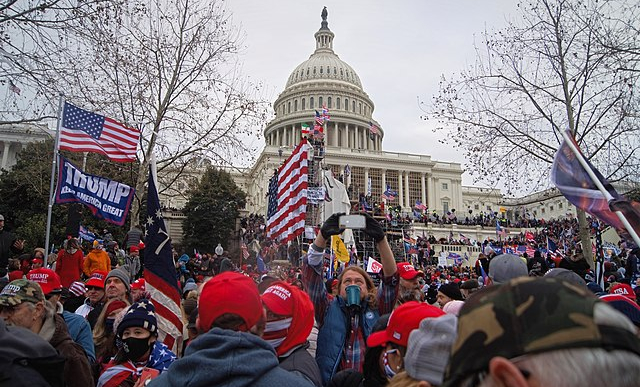
Supreme Court to Review Feds’ Use of Obstruction Charge Against Jan. 6 Defendants, Trump

The fate of hundreds of Jan. 6 defendants lies with the Supreme Court, which will hear a case Tuesday arguing that the obstruction law under which they were charged was never meant to apply to the attack on the U.S. Capitol.

If the justices rule that prosecutors have stretched the law too far, then it could also help former President Donald Trump, who faces conspiracy charges under another section of the same law.

At issue is a law passed in 2002 in the wake of the Enron scandal and aimed at giving the government new tools to go after those who obstruct an official proceeding.

The Biden administration says the Electoral College vote count taking place at the Capitol in 2021 while the mob raged counts as an official proceeding.

Joseph Fischer, one of those convicted under the law, says the statute was intended to snare people who try to destroy evidence of corporate fraud cases, such as document shredding. What went on at the Capitol that day falls far outside that, his lawyers argue. (Read more from “Supreme Court to Review Feds’ Use of Obstruction Charge Against Jan. 6 Defendants, Trump” HERE)

Arizona Upholds 1864 Law Restricting Nearly All Abortions

In a landmark decision, the Arizona Supreme Court has ruled to uphold a longstanding law dating back to 1864, which severely limits abortions in the state, permitting them only in cases where the life of the mother is at risk. The ruling came as the culmination of the case Planned Parenthood of Arizona v. Mayes/Hazerigg, following arguments presented before the court in December.

The 1864 law not only prohibits nearly all abortions but also imposes harsh penalties, including prison sentences of two to five years for abortion providers. The court was tasked with determining whether the more recent 15-week abortion limit, enacted in March 2022, supersedes the older statute. While the justices refrained from ruling on the constitutionality of the 1864 law, they delivered a 4-2 decision, with one recusal, affirming its enforceability over the 15-week limit.

In the majority opinion authored by Justice John Lopez, the court clarified that its decision was rooted in statutory interpretation rather than moral or public policy considerations regarding abortion. The ruling emphasized that in the absence of any federal or state law explicitly prohibiting the operation of the 1864 law, it remains enforceable.

However, the court also exercised caution, staying the total enforcement of the law for 14 days to allow parties involved to determine their course of action. Furthermore, the case was remanded to trial court for potential consideration of remaining constitutional challenges.

The ruling comes at a time when pro-abortion activists in Arizona are pushing for a constitutional amendment to establish a right to abortion. The coalition Arizona for Abortion Access recently announced surpassing the required signatures for the proposed amendment to qualify for the November ballot, reflecting ongoing efforts in multiple states to secure abortion rights.

Photo credit: Flickr