
Posts

The Unstoppable PR Machine Fed by Your Taxes

A new report commissioned by Sen. Mike Enzi, R-Wyo. (F, 58%), who chairs the Senate Budget Committee, found that government agencies spend about $1.5 billion every year on advertising and public relations. It may take a minute for the absurdity of that to sink in. Still not there? Maybe an analogy will help.

Suppose the mafia were to stop by your place of business and shake you down for a few hundred bucks. Then the next day, you see an ad on the side of a bus featuring a smiling mobster urging you to support your local protection agency. That’s essentially what is happening here.

It’s important to remember that the government has no money of its own. Everything it spends, it must first take from the people who earned it. We euphemistically call this legal pillaging “taxation,” but don’t let the terminology fool you. A shakedown is a shakedown, whether done by a tax collector or a guy with a baseball bat in a back alley.

Being robbed of the hard-fought fruits of our labors is bad enough, but the PR spending adds insult to injury. The government is taking our money for the express purpose of trying to convince us that it’s okay to take our money. George Orwell’s Big Brother would be so proud. The least it could do would be to take a page from the Soviet Union’s book and name this PR machine “the Ministry of Propaganda.” But I suppose that would be a bit too honest.

Of the money spent, we are told, about a $1 billion goes directly to advertising campaigns, trying to sell us on the benefits of programs we hate, like Obamacare and the Environmental Protection Agency. The other half a billion goes to pay the salaries of public relations professionals, who each make on average about $90,000 a year. Presumably these people are charged with smoothing over the government’s numerous errors, many of which cost American lives, like when a gun-running operation in Mexico backfires or when an American ambassador is killed overseas because of the secretary of State’s unwillingness to send the requested help. I suppose someone got paid a lot of money to come up with the “It was because of an Internet video” story. Pretty sweet gig if you can get it.

Indeed, the State Department was listed as among the biggest spenders on PR, pretty convenient for the former secretary who now happens to be running for president. If only all candidates for public office could have the use of taxpayer dollars to cover up their mistakes.

Among the other biggest spenders are the EPA, the Federal Election Commission, and the Consumer Financial Protection Bureau. These agencies are supposed to be non-partisan and represent all Americans, but of course, they are biased in their own favor as well as the policies of the incumbent administration. Part of representative democracy means that our tax dollars will be spent on things we disagree with, but spending them on ads telling us that we should agree is manipulative and undemocratic.

All this should only reinforce what we already know: Government is a self-perpetuating entity. It exists to continue its existence. It feeds on taxpayers so that it can continue to feed on them. And when it grows fat like a swollen tick, its appetite only increases. Your tax dollars at work, America! (For more from the author of “The Unstoppable PR Machine Fed by Your Taxes” please click HERE)

Follow Joe Miller on Twitter HERE and Facebook HERE.
Tax Dollars at Play: Recent Chart-Topping Hits of Fraud and Abuse

On Thursday, a report issued by the Inspector General of the Department of Defense slammed a former senior adviser to U.S. Secretary of Defense Ash Carter for using a government credit card on sexual escapades, alcohol abuse and other illegal actions.

According to the report, Army Major General Ronald Lewis illegally spent nearly three thousand of the taxpayers’ dollars. According to Politico, Carter had this to say:

At the Pentagon, Carter said he was briefed on findings from the investigation, but “will defer any further comment on the report pending the Army’s review.”

“As I said when I first learned about allegations of misconduct against Maj. Gen. Lewis and removed him as my senior military assistant, I expect the highest possible standards of conduct from the men and women in this department particularly from those serving in the most senior positions,” Carter said in a statement. “There is no exception.”

While Lewis’ actions are an obvious violation of the public trust, his three thousand dollars in taxpayer abuse is small potatoes compared to other ways the public loses out to corrupt government officials and corrupt civilians abusing the system.

Here are a few recent examples:

Sickening Medicaid Mischief From a CBS News report Tuesday about Medicaid abuse:

Baby boomers are expected to need more in-home care as they age, but federal investigators are now raising an alarm over what they call persistent fraud and abuse in Medicaid-funded personal care services. Investigators from the Department of Health and Human Services Office of Inspector General are once again criticizing Medicaid for not cracking down in this area, saying the government needs better regulations to prevent patient neglect and fraud cases. Estimates of questionable billing since 2012 total more than $600 million, reports CBS News correspondent Anna Werner.

Sin City Spending Spree The 2012 escapades of the General Services Administration cost taxpayers over $800,000 on parties and other spending in Las Vegas.

Sure, They Could Use Good PR, But … The federal government has averaged nearly one billion per year in “public relations” spending over the last decade, according to a new report by the Government Accountability Office. Some of that money goes to public service ads, like the Centers for Disease Control’s ads encouraging HIV/AIDS safety by promoting condoms and art…but not abstinence.

Booty Calls With Taxpayer Booty Senator David Vitter (R-LA) used a government phone to chat with a prostitute. That use of taxpayer dollars was a major reason he lost his race for governor last year.

Forget His Phone and Pen, How About His Golf Clubs and Swimming Trunks? President Obama was pressed by reporters in 2012 when he appeared to combine official trips and campaign trips. The former may be paid for by taxpayers; the latter must be privately funded. Then there’s the Obama Family Vacation Fund, known as the U.S. Treasury. Investor’s Business Daily estimates that their R&R has cost us over $70 million.

“Federal Fumbles” Finally — in keeping with his predecessor, retired Senator Tom Coburn, Oklahoma Republican James Lankford published a “Federal Fumbles” report that highlighted 100 ways taxpayer money was wasted by the federal government. One example was the use of six million dollars “to repair a building that remains unsafe.”

This is a quick and dirty list of outrageous offenses, and hardly the most expensive ones. Health care spending by the Feds is rife with abuse, as is the Pentagon’s budget. And over $100 billion is lost to “improper payments” each year, even as big corporations snag tens of billions each year through legal handouts from Congress.

The next time someone says we need to raise taxes, just point out that we’re funding sexcapades, swindles, booze and billion-dollar boondoggles. Stopping that comes long before taking more of your hard-earned money. (For more from the author of “Tax Dollars at Play: Recent Chart-Topping Hits of Fraud and Abuse” please click HERE)

Follow Joe Miller on Twitter HERE and Facebook HERE.

The Insane Hidden Tax Burden Quietly Eating up Your Paycheck

There are few things I dislike more than paying taxes. As Americans, a third of all your hard earned dollars is confiscated by the U.S. government. Most of us get to determine what we do with our money – but not when it comes to taxes.

However, there is the argument that taxes are a function of our democratic system. Those taxes are the result of laws implemented by freely elected representatives. If anything, we — the voters — are as much to blame for the muddied tax codes as are the nitwit politicians we elect.

But not all taxes feel Constitutional, and not all taxes are the result of our representative government — particularly the taxes paid in the form of regulatory costs. Regulations increase the cost of everything — including the cost of our housing, clothing and food. In fact, they even impact our wages. What makes this form of tax so nefarious is that rarely do our elected representatives get to have a say in the matter; rather, America’s regulatory state is overseen by an authoritarian administrative state, ruled by unelected bureaucrats.

Nobel Prize economist, F.A. Hayek lamented the dangers of these unelected bureaucrats, which he called the “public administration movement,” in his book The Constitution of Liberty. Hayek believed these bureaucrats were often antagonistic, if not ignorant of, the rule of law, directing “[T]heir heaviest attacks against the traditional safeguards of individual liberty, such as the rule of law, constitutional restraints, judicial review and the conception of a “fundamental law.””

These bureaucrats have designed a labyrinth of rules and regulations that silently consume our life, and our paychecks, with little repercussion or accountability. Bureaucrats don’t follow laws, they make them. If you don’t like some new Washington regulation – too bad.

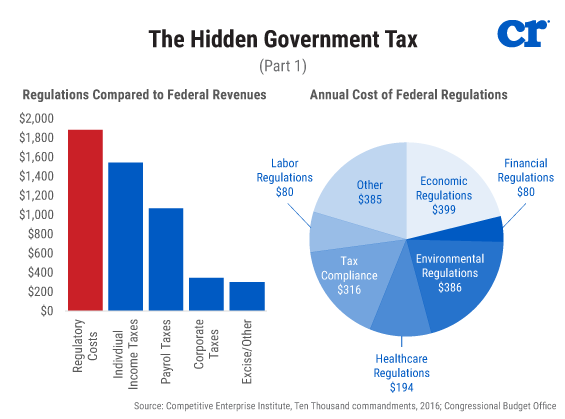
Recently, the Competitive Enterprise Institute (CEI) released a regulatory study called Ten Thousand Commandments that analyzed the cost of regulations. The report finds that federal regulations cost the U.S. economy over $1.9 trillion. To put that into perspective, if you add up the federal income taxes we pay, or $1.62 trillion, our regulatory tax is nearly $300 billion more!

20160505HiddenTax1

For most of us, the word “trillions” is often left out of your every day vernacular. But we shouldn’t be naïve to the punitive burden this cost levies on each American. CEI helps illustrate the severity of that burden. They took the total regulatory costs in the U.S. and compared them to the entire economies of other countries.

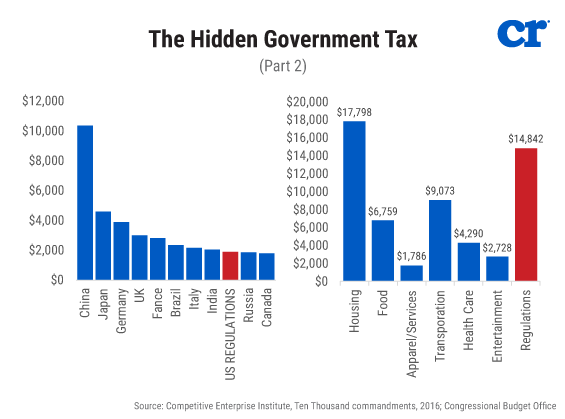
The results show that if U.S. regulations were its own country, it would rank ninth in the world. That means Americans face a regulatory burden that is just behind the entire economy of India, but larger than all the productivity of Russia.

Economic thinking ultimately assumes these costs get passed onto individuals and consumers – you! Therefore, CEI analyzed the regulatory burden for each individual U.S. household. In doing so, they determined the “cost” to each household was $14,842 per year. That is roughly 22 percent of the average income in the United States.

CEI also demonstrates how this impacts the family budget. In the U.S., housing is the costliest expense to each household. After that, you would think it was food or clothing, perhaps transportation and health care. But you would be wrong; instead it is regulations.

20160505HiddenTax2

Most troubling is the the nature of our regulatory system. They are designed by rogue and unelected bureaucrats. Regulations effectively become laws with little oversight or accountability.

This isn’t a small problem. Take for example your elected representatives in Congress. In 2015, CEI finds that Congress enacted 114 laws (that’s probably too many). However, unelected bureaucrats issued 3,410 rules in that same year. In other words, the “fourth” branch of government that is unaccountable issued 30 regulatory decrees for every one law passed by Congress. That’s simply insane.

In total, there are 178,277 pages in the Code of Federal Regulations which outline the 94,000 rules currently on the books. The cost to enforce all these regulations comes at a massive price. CEI finds that federal agencies spent $63 billion in taxpayer dollars to administer and police this regulatory enterprise.

As bad as this seems, it’s about to get worse. There are currently 3,297 new regulations in the implementation phase. Of this total, CEI finds that 218 are considered “economically significant,” a definition the government uses when a regulation will have an economic impact of $100 million or more.

The hidden regulatory tax is becoming dangerous to American democracy. The regulatory apparatus is out of control. Over the past 23 years, the number of regulations has increased by 2,060 percent. Individuals that are not elected, or confirmed by elected representatives, should not have such great authority and power over our lives.

The idea of living in a constitutional republic ruled by an unaccountable administrative state is an oxymoron. Nowhere in the Constitution are administrative agencies granted legislative privilege to create rules and enforce them by limiting the people’s rights and liberties, or to exact taxes upon the populace.

It’s time we take back our government from bureaucrats; it’s time we put an end to this crushing hidden tax. (For more from the author of “The Insane Hidden Tax Burden Quietly Eating up Your Paycheck” please click HERE)

Follow Joe Miller on Twitter HERE and Facebook HERE.
$1.48 Trillion: Government Collects Record-High Taxes in First Half of FY 2016

downloadInflation-adjusted federal tax revenues hit a record $1.48 trillion for the first half of fiscal year 2016, but the federal government still ran a $461 billion deficit during that time, according to the latest monthly Treasury Department statement.

Treasury receipts include tax revenue from individual income taxes, corporate income taxes, social insurance and retirement taxes, unemployment insurance taxes, excise taxes, estate and gift taxes, customs duties, and other miscellaneous items.

In the first half of fiscal 2016, which included the months of October, November, December, January, February, and March, the amount of taxes collected by the federal government outpaced the first half of all previous fiscal years, even after adjusting for inflation. The 2016 fiscal year begins on Oct. 1, 2015, and runs through Sept. 30, 2016.

The federal government collected $1,476,218,000,000 in the first half of fiscal year 2016. Most of the $1.48 trillion came from individual income taxes, which comprised almost half of that total, totaling $675 billion. (Read more from “$1.48 Trillion: Government Collects Record-High Taxes in First Half of FY 2016” HERE)

Follow Joe Miller on Twitter HERE and Facebook HERE.
Taxpayers Billed $1.4 Million for Obama’s Argentina Trip

President Barack Obama’s two-day visit to Argentina, where he tangoed and downplayed the differences between capitalism and communism, cost taxpayers nearly $1.4 million.

The president traveled to Argentina last week after his two-day stop in Cuba. The visit racked up substantial costs for hotels, transportation, and advance bathroom maintenance, according to government contracts signed by the State Department and Department of Homeland Security.

Lodging for the president and White House staff totaled $115,588, while conference rooms cost $35,584. Another contract for hotel rooms cost $31,585.

U.S. Secret Service costs associated with the trip included $120,782 for hotel rooms at the Hyatt Park in Buenos Aires and $707,801 for transportation.

Use of Marine One, the presidential helicopter, during Obama’s trip cost $44,611. Other transportation costs included contracts worth $68,597, $23,304, $4,789, $8,212, and $24,955. (Read more from “Taxpayers Billed $1.4 Million for Obama’s Argentina Trip” HERE)

Follow Joe Miller on Twitter HERE and Facebook HERE.

Watch: Bernie Sanders Gives Blunt Answer When Asked If He Will Raise Taxes

By Jon Street. Democratic Sen. Bernie Sanders gave a very blunt answer Monday night when asked at the CNN town hall in Des Moines, Iowa, if he would raise taxes if elected president.

CNN anchor and town hall moderator Chris Cuomo had asked Sanders if he would raise taxes to help pay for his “Medicare for all” program, also commonly referred to as a single-payer program.

(Read more from “Bernie Sanders Gives Blunt Answer When Asked If He Will Raise Taxes” HERE)

______________________

Sanders: ‘We Will Raise Taxes, Yes We Will’

By Jonathan Easley. Vermont Sen. Bernie Sanders may have provided Hillary Clinton with campaign advertisement fodder at Monday night’s Democratic presidential forum in Iowa, acknowledging that his healthcare plan will require raising taxes . . .

“We will raise taxes, yes we will,” Sanders declared, calling criticim of his plan “disingenuous.”

But Clinton allies were already taking to Twitter to hammer Sanders for the remarks.

(Read more from “Sanders: ‘We Will Raise Taxes, Yes We Will'” HERE)

Follow Joe Miller on Twitter HERE and Facebook HERE.

$765,645,000,000: Taxes Set Record Through December

The federal government took in a record of approximately $765,645,000,000 in tax revenues in the first three months of fiscal 2016 (Oct. 1, 2015 through Dec. 31, 2015), according to the Monthly Treasury Statement released today.

That equaled approximately $5,107 for every person in the country who had either a full or a part-time job in December.

It is also an increase of about $24,288,810,000 in constant 2015 dollars from the $741,356,190,000 in revenue (in constant 2015 dollars) that the Treasury took in during the first three months of fiscal 2015. (Read more from “$765,645,000,000: Taxes Set Record Through December” HERE)

Follow Joe Miller on Twitter HERE and Facebook HERE.

After Taxes, a $4,800 Salary Grants Nearly Same Take-Home Pay as a $21,000 Salary

After taxes and entitlement program benefits are accounted for, a single parent with a salary of $4,800 earns nearly the same take-home pay as a single parent with a $21,000 salary, according to a report from the Tax Foundation.

The report, titled “Income Tax Illustrated,” evaluates two examples of a single-parent family with one child. In one example, a single parent earns $4,800 in annual salary before taxes, but after accounting for entitlements, this family’s take-home earnings climbs to $22,090. Benefits included in this calculation comes from Medicaid, Temporary Assistance for Needy Families, the Children’s Health Insurance Program, food stamps, and the Housing Choice Voucher program . . .

“As low-income households earn more money, not only do their tax burdens grow rapidly, but they also receive fewer benefits from federal social assistance programs,” the report says. “In fact, individuals who move to higher paying jobs sometimes end up with less overall disposable income, after taxes and transfers” . . .

“The federal government’s system of taxes and assistance programs for low-income families is not very well-designed,” said Scott Greenberg, an analyst at the Tax Foundation. “For households making under $30,000, there are a number of transfer programs and tax credits that phase out simultaneously, making it difficult for these families to increase their take-home incomes by moving to a higher-paying job.” (Read more from “After Taxes, a $4,800 Salary Grants Nearly Same Take-Home Pay as a $21,000 Salary” HERE)

Follow Joe Miller on Twitter HERE and Facebook HERE.

$2,883,250,000,000: Federal Taxes Set Record Through August

money-ap_photo-j_scott_applewhite-2The federal government raked in a record of approximately $2,883,250,000,000 in tax revenues through the first eleven months of fiscal 2015 (Oct. 1, 2014 through the end of August), according to the Monthly Treasury Statement released Friday.

That equaled approximately $19,346 for every person in the country who had either a full-time or part-time job in August.

It is also up about $198,425,330,000 in constant 2015 dollars from the $2,684,824,670,000 in revenue (in inflation-adjusted 2015 dollars) that the Treasury raked in during the first eleven months of fiscal 2014.

Despite the record tax revenues of $2,883,250,000,000 in the first eleven months of this fiscal year, the government spent $3,413,210,000,000 in those eleven months, and, thus, ran up a deficit of $529,960,000,000 during the period.

According to the Bureau of Labor Statistics, total seasonally adjusted employment in the United States in August (including both full and part-time workers) was 149,036,000. That means that the federal tax haul so far this fiscal year has equaled $19,345.99 for every person in the United States with a job. (Read more from “$2,883,250,000,000: Federal Taxes Set Record Through August” HERE)

Follow Joe Miller on Twitter HERE and Facebook HERE.

Expatriates Choosing to Leave the U.S. Rather Than Pay Taxes

102344610-78532484.530x298More Americans renounced their citizenship and terminated their long-term residency in the first three months of the year than ever before, courtesy of the crackdown in foreign tax rules.

The upsurge subsided some in the second quarter but has been ongoing since the Treasury Department and the Internal Revenue Service began aggressively enforcing tax rules for American expatriates. The crackdown on the Foreign Bank Account Report is fresh, though the law has been in existence since 1970. Under the law, U.S. taxpayers are required to file if they held one or more foreign accounts totaling more than $10,000 over the course of a year.

“Many people have been getting caught up on their U.S. tax filings and then renouncing,” said Andrew Mitchel, an international tax lawyer who analyzes Treasury Department data.

For a U.S. citizen or resident alien, the rules for filing income, estate and gift tax returns and paying estimated taxes are generally the same whether one is in the country or abroad. A person’s worldwide income is subject to U.S. income tax, regardless of where he or she resides.

The Foreign Account Tax Compliance Act is intended to ensure that the Internal Revenue Service obtains information on accounts held abroad by U.S. taxpayers at foreign financial institutions. (Read more from “Expatriates Choosing to Leave the U.S. Rather Than Pay Taxes” HERE)

Follow Joe Miller on Twitter HERE and Facebook HERE.