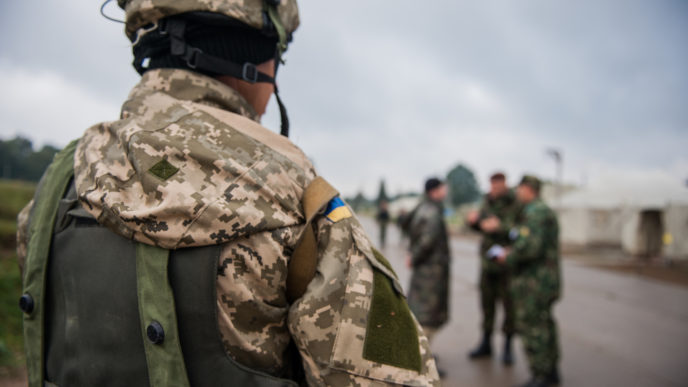
Posts

‘We Need to Know We’re Not Alone’: Ukraine’s Soldiers Carry the Burden of a Nation at War

As the war in Ukraine nears its third calendar year, Ukrainian troops remain entrenched along a static front line in eastern Ukraine where they exchange small arms and artillery fire with combined Russian-separatist forces every day.

More than 21 months after it was signed, the cease-fire is a charade. The war may be at a lower intensity due to the cease-fire’s loosely adhered-to rules—but there is still very much a war in eastern Ukraine.

Combat is ongoing and intense throughout the Donbas—Ukraine’s embattled southeastern territory on the border with Russia. And civilian and military casualties still occur daily.

For many Ukrainian soldiers, war has become a way of life.

“I am at home now, this is my family,” Andriy, a 30-year-old soldier in the Ukrainian army’s 92nd Mechanized Brigade, told The Daily Signal from a front-line position in the embattled town of Marinka.

Andriy has continuously served in combat since the war began in spring 2014. He asked that his last name not be used due to security concerns.

The Ukrainian troops believe in the justice of their cause, yet, there is a pervasive sense of disappointment, bordering on betrayal, expressed by many front-line soldiers toward their civilian leadership in Kyiv.

“We are fighting for our land, to defend every centimeter of our country,” Dimitry Karamushka, a 30-year-old soldier in the 92nd Brigade, told The Daily Signal in Marinka. “We are not fighting for our government.”

The 92nd Brigade recently rotated to Marinka from a previous combat deployment outside the separatist stronghold of Luhansk. The unit comprises a mix of both draftees and volunteers, with some soldiers having served continuously in combat, with only periodic breaks of a week or two to go home, since spring 2014.

Ukrainian forces are dug in, battle-hardened, and better equipped and armed than they were a year ago. Conditions have improved, but supply shortages are still common, and the Ukrainian troops are still largely left to fend for themselves to provide many basic necessities—such as electricity.

“More than ammunition, we need to know we’re not alone,” Andriy said. “We are fighting two wars. One against Russia, and the other against the government in Kyiv.”

Casus Belli

Ukraine’s deployed troops remain committed to their cause, and treat the war as an existential fight for the country’s independence against what they call a Russian invasion of their homeland.

“We can’t leave the war and go to Kyiv,” Karamushka said. “It would mean surrender to Russia. And what would it mean to all the people who died?”

“We are standing for our territory,” said Alexandr Chernov, a chaplain in the 92nd Brigade. “Everyone wants peace. But peace will only come after victory.”

Chernov paused, smiled, and then added: “And when [Russian President Vladimir] Putin is gone.”

Ukraine’s military has been locked in a static, frontal war against a combined force of pro-Russian separatists and Russian regulars since the second, current cease-fire—called Minsk II—was signed in February 2015.

Today, at some places in and around Marinka, less than 300 meters (about 1,000 feet) of no man’s land divide the opposing camps.

“The situation here is stabilized,” said Vsevolod Chernetskyi, a 22-year-old soldier and Raven drone operator, in near perfect English. “We are in the same positions as a year ago, the Russians and us. It’s mostly artillery now.”

The war has killed about 10,000 Ukrainians and displaced about 1.7 million people, according to various reports from humanitarian organizations.

The conflict began in spring 2014 when Russian-backed separatists formed two breakaway republics in the Donbas.

Despite denials from Moscow, numerous news reports have shown that Russian troops are fighting among the separatists, that Russian military commanders command and control separatist forces, and that Russian weapons and ammunition continue to feed the war effort.

Through binoculars from the roof of the 92nd Brigade’s outpost in Marinka, this correspondent observed a Russian flag flying over a building across no man’s land on the combined Russian-separatist side of the contact lines.

According to Ukrainian military intelligence estimates, there are about 5,000 to 7,500 Russian troops currently deployed in the Donbas. About 55,000 Russian military personnel are also forward deployed to locations within Russia near the Ukraine border.

Combined Russian-separatist forces in eastern Ukraine currently control more tanks than Germany’s armed forces, and the Donbas is replete with Russian surface-to-air missile systems.

“I don’t feel we are winning,” Chernetskyi said. “The Russian forces are much stronger than ours. They can always provide more artillery than us, better tanks, more drones.”

During breakfast, this correspondent remarked to Chernetskyi how the shooting had stopped in time for both sides to take their morning meal.

Chernetskyi replied that the combined Russian-separatist forces operate on Moscow time, one hour ahead of Kyiv’s time zone.

“They eat an hour before us,” he said.

He paused a beat and then added: “They’re always one step ahead of us.”

Differences

The corner of an artillery-blasted apartment building in Marinka is marked by a spray-painted word in Russian. In English it translates to “For what?”

Approximately 5,000 civilians have fled Marinka since the war began, comprising about half of the town’s pre-war population of 10,000.

Daytime is usually relatively peaceful here. Civilians mill about outdoors, pedestrians are on the sidewalks. There’s an outdoor market where one can buy goods ranging from produce to clothing.

Across town, there is the sound of hammering as workers repair buildings damaged by shelling. They replace shattered windows and reconstruct crumbled walls.

There is a daily rhythm to the war, which conceals the brunt of the fighting from the intergovernmental organization responsible for overseeing the cease-fire.

Monitors from the Organization for Security and Cooperation in Europe, or OSCE, do not travel through the war zone at night due to security restrictions.

At night, consequently, the war begins in earnest.

“There is almost no artillery during the day, because the OSCE is here,” Chernetskyi, the 22-year-old Raven operator, said.

Winter sunsets in eastern Ukraine come early, around 4:30 p.m. As darkness falls there is, at first, only the occasional sound of a mortar explosion or an artillery shot, and the every-so-often burst of a machine gun or Kalashnikov.

As the hours pass, the pace and intensity of the shooting slowly builds like the different sections of an orchestra chiming in.

At the nocturnal peak of the fighting, typically around midnight, tracers cut across the night sky, the flashes and booms of mortar and artillery explosions come several times a minute, and there is a nearly constant background din of small arms fire.

This correspondent witnessed such a scene in Marinka on the night of Nov. 21. The Ukrainian soldiers on scene, as well as several civilians from the area, said the intensity of the fighting on that night was “normal.”

While casually smoking a cigarette in the night, one soldier jokingly recommended that this correspondent return “when things really get hot.”

Spartan

When U.S. troops go to war, they usually enjoy the support of specialized units—such as the Army Corps of Engineers, the Navy Seabees, or Air Force Civil Engineers—dedicated to building and maintaining base infrastructure, even in the most austere locations.

For deployed Ukrainian troops, however, this task is a collective effort, in which the diverse skills each soldier brings to the war are identified and utilized for the common good.

One example. A 92nd Brigade soldier with a university electrical engineering degree illegally tapped into the local power grid to provide electricity for the outpost in Marinka—effectively stealing electricity from the same government that had sent him to war.

The power still frequently goes out, however. Wood-burning furnaces provide heat to stave off the winter cold and cook food.

Soldiers say the military has improved on its deliveries of basic necessities such as water and foodstuff during the past year.

Yet, non-essential food items like honey, sugar, and coffee are still provided by civilian volunteers. As are other more vital supplies, including most soldiers’ body armor, boots, and winter underwear.

Weapons and ammunition are not a problem, although the soldiers complain about the quality of their armaments—some of which date back to World War II, almost all of which are Cold War vintage.

The soldiers in Marinka still lack basic sanitation. They use a wooden outhouse as a toilet—a miserable proposition in eastern Ukraine’s frigid winters.

The soldiers’ diets mainly comprise traditional Ukrainian foodstuff—including copious amounts of buckwheat, bread, potatoes, and salo (cured slabs of pork fat). Sweetened condensed milk is another troop favorite.

At night, the soldiers sometimes enjoy a moonshine popular throughout the front lines called Avatar; a reference to one’s facial complexion after over-indulging.

Nearly everyone smokes. At night, as the not-too-distant battles rages, the soldiers stand casually outside for as long as they can tolerate the cold to enjoy a cigarette or two. They are desensitized to the war, able to instantly and instinctively tell when the shooting is near enough to pose a real threat.

As at other front-line Ukrainian positions across the war zone, the items hung on the interior walls are a testament to the life stories of these men at war.

Kalashnikovs and body armor hang beside Orthodox religious icons, and posters of soccer stars and beautiful women. Letters from home share tabletops with grenades and bullets.

Outside the few scattered buildings in which the soldiers are holed up, a collection of tanks and armored personnel carriers are scattered under concealment.

At dawn, this correspondent joined a brief patrol into no man’s land in an armored personnel carrier from the 1970s called a BMP. The foray was cut short when the Ukrainian driver spotted enemy forces.

The ebb and flow of life here is likely not too different than it was for the soldiers who fought for this land in World War II.

Except for the presence of smartphones and a few laptops—and the U.S.-made Raven UAV the unit operates—the war-fighting technology and the circumstances of day-to-day life here would not be out of place seven decades ago.

“We want people to know that this war could happen in other places in Europe,” Chernov, the chaplain, said. “We have to stop Russia here.”

Red to Blue

The soldiers (the majority of whom are millennials) reject their country’s Soviet military heritage in favor of closer ties with the U.S. and NATO.

On Soviet battle maps, red icons (for the Red Army) symbolized friendly forces, and enemy forces were blue.

After the current war in the Donbas began, Ukrainian forces flipped the colors of their icons to match NATO maps, in which the colors are reversed.

The move was a practical step in bringing Ukraine’s military in line with NATO standards (part of a larger effort to foster closer ties with the Western alliance), but it was also a symbolic pushback against Russia.

The soldiers consider the United States to be an ally, and they want American military support. Many, however, oppose the idea of direct U.S. military intervention.

“American help is OK,” Andriy, the 30-year-old soldier from Kharkiv, said. “But we need to learn how to do this on our own. We shouldn’t rely on other countries for help. We need to fight this war on our own.”

There is a symbolic value to U.S. support that the soldiers exploit to rattle their enemies.

The Punisher skull symbol—a comic book emblem made popular among soldiers by Navy SEAL Chris Kyle of “American Sniper” fame—is painted on Ukrainian armored fighting vehicles in Marinka.

As at other locations along the front lines, the Ukrainian soldiers in Marinka did not have encrypted communications. They shared the airwaves with their enemies on off-the-shelf walkie-talkies.

A common Russian propaganda line is that U.S. troops are deployed and fighting alongside the Ukrainians. (There are, in fact, no U.S. troops fighting in the Ukraine conflict.)

Sometimes, as a joke, a Ukrainian soldier fluent in English will speak on the open airwaves, pretending to be a Navy SEAL, or a U.S. Marine. The gag usually elicits a flurry of incensed responses from their enemies, the Ukrainian soldiers said.

The Raven

One overt sign of U.S military support for Ukraine is the 92nd Brigade’s use of the U.S.-made Raven drone. The small drone is tossed in the air like a giant paper airplane.

The U.S. gave 24 Ravens in all to the Ukrainian military, and the drones are scattered throughout various units.

Chernetskyi trained on the Raven with the U.S. Army for three weeks in Huntsville, Alabama.

The Raven is a non-offensive weapon, but Ukrainian forces use it for artillery spotting.

While not a game-changer on the battlefield, the Raven does afford the Ukrainians some advantages over the modified off-the-shelf drones they also use.

“It’s useful mostly because it can fly at night,” Chernetskyi said.

The Raven is still susceptible to Russian jamming, however.

“The Russians can jam it, no problem,” Chernetskyi said. “It was made for Afghanistan, and the Taliban didn’t have jamming.”

Defenders of the Motherland

Some soldiers expressed frustration that their commanders were stuck in antiquated habit patterns from the Cold War, making them resistant to commonsense changes implemented from the bottom up, which could streamline the war effort.

Andriy brought out a thick stack of worn paper maps of the Marinka area. Each map was thoroughly marked in pen and marker notations, indicating enemy and friendly positions.

The troops complained that this pile of maps, enough to fill a wheelbarrow, could be condensed into a single app for a tablet or a file on a laptop.

An electronic version could be continuously updated and overlaid with other information, such as weather or locations where civilians are observed, the soldiers said.

Perhaps most frustrating of all for the front-line troops is the disconnect between life on the front lines and the rest of the country, where daily life seems to carry on unaffected by the war.

While front-line soldiers shiver in sub-zero temperatures, enduring artillery and sniper fire, in Kyiv—a 9-hour journey from the front lines by car and rail—there were Black Friday sales going on at the city’s many shopping malls last weekend.

(Ukraine does not celebrate Thanksgiving, yet Black Friday is a major shopping event.)

Over the weekend, the malls in Kyiv were crammed with bargain-hunting patrons in stores like The Gap, Columbia Sportswear, and Zara. Christmas lights and trees are going up around town.

Bars and restaurants in Kyiv remain busy. At more popular places, you can’t get in without a reservation on the weekends. The city’s trendy speakeasy-style, craft cocktail bars are always packed. One would hardly know this is the capital city of the country home to Europe’s only ongoing land war.

“Everyone should know our story,” Chernetskyi said.

The soldiers are not generally resentful that life is going on outside the war. In fact, many say that’s what they’re fighting for; a sign that the Russian threat has been kept at bay.

Yet, the head-spinning contrast with life on the front lines sparks feelings of unequally shared sacrifice among the troops and combat veterans.

“It is war here,” Evgeniy Varavin, a 27-year-old soldier from Kharkiv, said from Marinka.

“Some civilians look at soldiers and don’t understand why we’re fighting,” Varavin, who was a construction worker before the war, continued. “I don’t pay attention to what civilians say. My parents are proud of me, but they’re worried. They don’t understand why I came back for the second time. But how can I work back home in Kharkiv when there is war, and while my comrades are here? My soul is here.” (For more from the author of “‘We Need to Know We’re Not Alone’: Ukraine’s Soldiers Carry the Burden of a Nation at War” please click HERE)

Follow Joe Miller on Twitter HERE and Facebook HERE.

‘Hope Is Not Enough’: Ukrainian University Students Prepare for War

The young man never told anyone he was going to war.

The 20-year-old student at Kyiv’s Taras Shevchenko National University slipped away in June 2014 to join a civilian paramilitary group fighting in eastern Ukraine.

The young man, whose name was Sviatoslav Horbenko, was a star pupil at the university’s Institute of Philology, where he studied Japanese. When he transferred from a university in Kharkiv, a city in eastern Ukraine, during his third year, he had to retake 17 exams.

He aced them all.

“There was no bellicose air about him,” said Serhiy Yanchuk, an associate professor at Taras Shevchenko University and coordinator of the university’s Students Guard, a volunteer militia comprising students and faculty.

“He never acted or behaved aggressively for his personal cause,” Yanchuk said. “He was friendly, warm hearted, and an easy-going person. One would surely want to be a friend of such a guy.”

“He was an exceptional student,” said Ivan Bondarenko, a professor who heads the university’s Institute of Philology. “And he was an inspiration to all of us.”

Horbenko’s angular features and piercing eyes distinguished him physically, reflecting the intensity of his inner convictions. His work ethic and natural intelligence set him apart from his peers academically, inspiring high hopes for the future among those who knew him well.

Horbenko’s father, Olexander Horbenko, is a surgeon. He volunteered to treat wounded protesters in Kyiv during the 2014 revolution.

The younger Horbenko was active in pro-revolution groups in Kharkiv, where he was studying at the time. As the revolution became violent in February 2014, Olexander Horbenko encouraged his son to transfer to Kyiv to continue his studies due to the threat of reprisals against protesters by authorities in Kharkiv.

At his father’s behest, the younger Horbenko moved to Kyiv and settled into life and his studies at Taras Shevchenko National University.

And then, a few months after the war began in the summer of 2014, Sviatoslav Horbenko disappeared. Without telling his friends, family, or teachers, he joined Right Sector, a civilian volunteer battalion, to fight at the battle for the Donetsk airport.

Olexander Horbenko ultimately was able to track Sviatoslav down at boot camp. The father tried to dissuade his son from going to war. But Sviatoslav was determined.

“That was my last meeting with him alive, our unforgettable conversation,” Olexander Horbenko later said. “Sviatoslav considered defending his fatherland as his duty, and he developed the strong bonds of military comradeship.”

At their parting, the elder Horbenko placed a necklace with an icon and a cross around his son’s neck. It was the same necklace worn by his own father—Sviatoslav’s grandfather—during World War II when he fought the Nazis. And Olexander had worn it as he weathered sniper fire on the Maidan during the revolution.

“And I let him go,” Olexander Horbenko said. It was the last time he saw his son alive.

In September 2014, Sviatoslav Horbenko stepped onto the battlefield for the first time. One month later, on Oct. 3, 2014, he ran into the line of fire to rescue a wounded comrade.

While Horbenko dragged the man to safety, a tank shot at them. A piece of shrapnel from the round went into Horbenko’s neck, slicing his carotid artery. He was dead within minutes. As for the soldier he had run out to save—he survived.

“Death takes the best of us,” said Denys Antipov, an instructor at Taras Shevchenko University and a veteran of the war in eastern Ukraine.

Because Horbenko served in a civilian volunteer battalion, he is not officially recognized as a combatant by the Ukrainian government. He has not received any posthumous decorations, and his family has not received the compensation of about $23,000 that typically is given to the families of fallen soldiers.

“His family feels really humiliated by such ignorance,” said Yanchuk, the professor who coordinates the university’s Students Guard.

Hell and Cyborgs

The second battle for the Donetsk airport, for which Horbenko volunteered, was fought at close quarters, and it was brutal.

Opposing troops sometimes holed up on different floors of the same building. For months, soldiers on both sides endured near constant shelling, tank shots, rocket attacks, close-quarters gunfights, and even hand-to-hand fighting, according to some Ukrainian soldiers who fought in the battle.

Ukrainian soldiers had taken control of the airport in May 2014, during the opening weeks of the war. That September, weeks after the conflict’s first cease-fire, combined Russian-separatist forces launched an offensive—comprising heavy armor, artillery, and rocket attacks—to take back the airport.

What followed was an apocalyptic showdown that lasted until January 2015.

The Ukrainians gave the nickname “cyborgs” to their soldiers who fought at the Donetsk airport—a reference to the science fiction beings that are a fusion of man and machine. It alluded to the superhuman grit required to endure such intense and brutal fighting, and a mechanical ability to endure endless fear and suffering.

Donetsk’s Sergey Prokofiev International Airport was rebuilt in 2011 for the Euro 2012 soccer championships. More than 1 million passengers passed through the facility in 2013, the year before the war started, on airlines including Lufthansa and Aeroflot.

The new terminal was stylish and modern. It featured manicured landscaping, polished floors, and chic metal detailing. A bellwether, many hoped, for Ukraine’s more prosperous future.

As the war in Ukraine evolved from skirmishes to artillery and tank battles in 2014, the Donetsk airport became a key prize. The opposing sides fought savagely for its control. Artillery and rocket attacks reduced the modern buildings to gutted ruins of crumbling concrete and twisted rebar.

Runways and the surrounding open spaces were churned into a cratered lunarscape, reminiscent of images of no man’s land from World War I battles like the Somme or Verdun.

The charred skeletons of planes littered the tarmac. The physical destruction evidenced the intensity of the battle, and the hellish conditions soldiers on both sides endured.

Surrounding villages like Pisky, about 1 mile from the airport perimeter, where Ukrainian troops staged for battle and fired artillery, also were reduced to demolished ghost towns by reciprocal separatist artillery, rockets, and tanks.

Yet, even amid the bloodletting, the opposing sides were able to demonstrate fleeting acts of humanity. Soldiers who fought at the airport described short truces, during which officers ventured out to collect the dead. Enemies walked among each other, their desire to kill undimmed, but held in check to honor the fallen men under their command.

Pro-Russian separatists, commanded and supported by Russian regulars and armed with Russian weapons, ultimately won control of the airport in January 2015. Ukrainian forces pulled back to nearby villages where they dug in for a protracted, static, long-range battle.

Two years later, Ukrainian forces still are entrenched on the periphery of the airport. Both sides fight from trenches and abandoned, artillery-blasted homes and buildings in a daily, tit-for-tat exchange of artillery and sniper fire.

The fighting has de-escalated from the death spiral of the winter of 2014-2015, but it hasn’t ended.

‘We Shouldn’t Give Up’

The students filled the hallway at the appointed hour. They squeezed, shoulder to shoulder, leaving a pocket of empty space in front of the table with the flowers, which was next to a poster with a picture of Sviatoslav Horbenko and some details about his life.

Behind the table and the poster was the entrance to the room at Taras Shevchenko University’s Institute of Philology that was named in Horbenko’s honor.

It was the second anniversary of Horbenko’s death. Some students held flowers. Others stood quietly, with their hands clasped in front of them.

“He would have made a good professor, a good husband,” Antipov, a 27-year-old teacher and war veteran, told the students gathered at the memorial ceremony.

“Do whatever you can to help our country,” Antipov told them. “But the most important thing you can do is to study, so that his death wasn’t in vain.”

Down the hall from the ceremony was a wall display featuring pictures of students and faculty who served in past military conflicts, including Lyudmila Pavlichenko, a Ukrainian sniper for the Red Army credited with 309 kills in World War II.

Horbenko’s picture is now among the others.

“History constantly repeats,” Antipov said.

Grassroots Defense

About 200 students and faculty from Taras Shevchenko National University died fighting in World War II. The history of students volunteering for war dates back to the Battle of Kruty in 1918, during the Russian Civil War.

About 300 students, along with about 100 free Cossacks, mobilized to defend Kyiv against a force of about 5,000 Bolsheviks. The students holed up at the Kruty railway station on the outskirts of the city, but eventually were overwhelmed.

More than half of the combined force of students and Cossacks died in the battle. Kyiv ultimately fell to the Bolsheviks and, along with the rest of Ukraine, was incorporated into the Soviet Union.

The legacy of the students who fought at the Battle of Kruty inspired the formation in 2014 of the group called the Students Guard. Under the direction of Yanchuk, approximately 200 students and faculty members have received military training as part of an auxiliary guerrilla force dedicated to Kyiv’s defense.

“Our goal is to train students to take up arms in the event of an emergency,” Yanchuk, the coordinator, said.

Life in Kyiv is moving on from the war, even though it hasn’t ended yet and the front lines are only a six-hour train ride from Ukraine’s capital city.

There is a film festival in Kyiv this week. The hip underground speakeasies in the city center are filled every night with patrons sipping on craft cocktails while jazz bands play covers of American songs.

At the Art-Zavod Platforma on the left bank, a former Soviet industrial space is now an art flea market and a venue for food festivals and concerts nearly every weekend.

The coffee bars in central Kyiv perpetually are filled with hipsters and students. The foreign journalists who used to be an ubiquitous presence largely have left. Only a few stalwart holdouts remain, convinced that the forgotten conflict in the east still holds the potential to spiral into something much worse.

“Here in Kyiv, the mass media, the political leadership tries to make the war look far away,” said Vasyl Yutovets, a student at Taras Shevchenko University and commander of the Students Guard. “We try to remember that the war is far from over. The threat is growing day by day.”

Yet, despite the distractions of youth, and many Ukrainians’ blind eye to the ongoing combat in the east, some students haven’t forgotten about the war.

“The hardest part is not going to the front line,” said Yutovets, who served in Ukraine’s National Guard and is a veteran of the war.

“But returning is hard, too,” Yutovets said, adding:

I can’t imagine doing nothing while our country is suffering. We are still hopeful for our future. When the war began, it was very easy to get to the front lines. We realized, then, it was our duty to support the war.

Civilian defense battalions like the Students Guard are also a hedge against further Russian aggression, Yanchuk said.

“When [Russian President Vladimir] Putin encounters the possibility of fighting territorial defense battalions, militias, or even students, it acts as a deterrent,” Yanchuk said.

Yanchuk served in Ukraine’s armed forces for three years and took part in peacekeeping operations in Kosovo. He also participated in joint training events with the U.S. military at bases in Louisiana, North Carolina, and Texas.

Yanchuk leverages his military experience and his personal connections with Ukrainian military instructors to organize training events for the Students Guard.

The group conducts weekend training events, including first-aid courses, field training exercises, and weapons training. The group also runs specialty courses, including training on mines and booby traps, tactical mountaineering, and a basic sniper course.

Ownership

The Students Guard at Taras Shevchenko University is another instance of Ukrainians’ enterprising solutions to their country’s myriad problems independent of official government channels.

“Civil society is two, or three, or five steps ahead of the government,” Yanchuk said. “Civil society is winning the war, despite all efforts from Ukrainian and Russian politicians.”

In eastern Ukraine, grassroots humanitarian groups have popped up to address the needs of Ukraine’s 1.7 million internally displaced persons as a result of the war. Across the country, veterans’ groups have formed to help returning soldiers reintegrate into civilian life and deal with the psychological consequences of combat.

And as fighting in the Donbas continues, volunteer civilian territorial defense battalions remain ready to defend their respective cities in the event of a Russian invasion.

Harkening back to the legacy of partisan groups of World War II, Ukrainians took their country’s defense largely into their own hands in the opening months of the war in 2014.

As the pro-Russian separatists and their Russian military handlers seized town after town in eastern Ukraine, some feared a march on Kyiv, which could have split the country in two. In the eyes of many Ukrainians who volunteered to fight, the war in the Donbas had become an existential battle for the country’s survival.

The Ukrainian military was at that point a ragtag force. Its soldiers were a motley mix of draftees and recruits; equipment reserves had been depleted by decades of plundering by corrupt oligarchs and arms dealers.

With the regular army on its back foot, civilian volunteer battalions formed out of the remnants of protest groups active during the revolution. These paramilitary groups mainly comprised young men with no military experience, although some veterans from the Red Army, including Afghanistan veterans, also were in the ranks.

“There was a real chance the front could have collapsed in 2014,” Antipov said. “Nobody knew what was going to happen. So, many young people wanted to train for guerrilla warfare.”

Initially armed with hand-me-down weapons from local police forces, or collected from the enemy dead, the volunteer battalions stalled the combined Russian-separatist march across eastern Ukraine.

“There was no army in 2014,” Antipov said. “In my opinion, the volunteer battalions were the only reason we kept our independence. Why else would the Russian tanks have stopped in 2014?”

Then, in August 2014, thousands of Russian regulars streamed into eastern Ukraine to reverse the Ukrainian offensive. At the time, it looked like Ukraine was facing a full-scale Russian invasion.

“We were concerned in the summer of 2014 of how far Putin was willing to go,” former U.S. Ambassador to Ukraine Geoffrey Pyatt told The Daily Signal in an earlier interview.

“If the Russians broke through, there was no stopping them,” Pyatt said. “We were concerned that Putin was deploying enough force to mass an invasion.”

Although hundreds of miles from the front lines, some in Kyiv began to prepare for a partisan, guerrilla defense of the city.

Spray painted signs indicating the nearest bomb shelter became ubiquitous—they still are. City authorities issued instructions on how to use the metro as a bomb shelter.

Officials across the country made similar preparations for war. The Ukrainian military built anti-tank trenches around Kharkiv in eastern Ukraine, the country’s second-largest city. And local officials and civilian groups built a network of fortified checkpoints around Dnipro (formerly Dnipropetrovsk), Ukraine’s fourth-largest city.

Ultimately, Ukraine’s cobbled-together military was able to thwart the combined Russian-separatist advance at several key places, including the battle for Mariupol. Today, many credit the civilian volunteer battalions with turning the tide of war and fundamentally reshaping the Kremlin’s strategic objectives in Ukraine.

“It was Ukraine’s improvised army that held it all together [in 2014],” Pyatt, the former U.S. ambassador to Ukraine, said.

Scars

Later, after the ceremony to honor Horbenko, members of the Students Guard gathered in a nearby lecture hall to speak with this foreign correspondent.

Yanchuk was among the students and faculty members. He wore a pressed suit and tie and carried himself with military bearing as he explained the history and the mission of the Students Guard by giving a PowerPoint presentation that would make any U.S. military officer proud.

Yanchuk never met Sviatoslav Horbenko, yet he spoke reverently about the young man, explaining how the courage and sacrifice of Ukrainian millennials could finally put an end to Ukraine’s generational cycle of war and revolution.

Yanchuk posthumously enlisted Horbenko in the Students Guard in 2015.

“The war leaves scars,” Yanchuk said. “Both physical and moral.”

The 39-year-old teacher and Ukrainian army veteran then beamed with pride as he talked about the students who volunteered for the Students Guard, and their willingness to spend weekends training for their country’s defense.

“In the U.S., college life is associated with fraternities and parties,” Yanchuk said. “For these students, they have to seriously consider the possibility of fighting to defend their homes from a Russian invasion.”

The students were initially reluctant to speak openly about their fears and hopes. But they began to speak freely (and mostly in English), revealing a resilient hope that life will get better.

“My hope is very strong,” said Olga Makhinya, a student at Taras Shevchenko University and a member of the Students Guard. “I want to live in a united Ukraine. My native country, without war, without problems.”

But there was also a pervasive sense that the struggle is far from over. Their youthful, romantic vision of the future was moderated by a sober cynicism born from a collective exposure to violence.

“The time of idealistic and romantic people is over,” Yutovets said. “Now is the time to be pragmatic. We shouldn’t give up.”

Many of the young people gathered in the lecture hall that day had witnessed lethal violence, whether on the front lines in the Donbas, as the veterans had, or during the 2014 revolution. They shared a common bond and a collective sense of sacrifice.

“We don’t have faith,” said Viacheslav Masniy, a 24-year-old Ph.D. student and a veteran of the war in the Donbas. “Faith is to pray and wait. We are willing to struggle. We are tired of hiding our identity, like our parents did in the Soviet Union.”

These students and faculty considered the conflict in the Donbas to be a fight for their country’s independence from Russia and freedom to foster closer ties with Western Europe.

“Our enemies are not fighting for their freedom,” Masniy said. “They are fighting to destroy our country. They don’t believe we are a nation, or that we are a state.”

But Ukraine’s better future will not happen automatically. The students and faculty, mostly in their early and mid-20s, repeated a commonly held opinion among Ukraine’s millennials—that the “Homo Sovieticus” mindset of the older generations is beyond fixing, and real change in Ukraine will be possible only when the younger generations, for whom the Soviet Union is not a living memory, take power.

“I think that the future of our country depends on our generation,” said Olga Svysiuk, a student at Taras Shevchenko University and a member of the Students Guard.

“Our example shows other people that we can change the situation for the better,” Svysiuk said. “We can change everything, if we want to do it.”

“We don’t just need heroes,” Masniy said. “We need to build a country.” (For more from the author of “‘Hope Is Not Enough’: Ukrainian University Students Prepare for War” please click HERE)

Follow Joe Miller on Twitter HERE and Facebook HERE.

‘The War Won’t Be Over Soon’: Ukraine’s Long Fight Against Russia for Freedom

For more than two years, Ukraine’s military has been fighting a ground war against a combined force of pro-Russian separatists and Russian regulars in the Donbas, Ukraine’s embattled southeastern territory.

As Ukraine prepares for the 25th anniversary of its independence from the Soviet Union this Wednesday, the ongoing war in the Donbas highlights how the post-Soviet country is still fighting to establish its freedom from Russian vassalage.

“The dream of Ukrainian independence existed in the USSR, but we couldn’t talk about it,” Kovbel Vasyl Vasyliyovych, a 62-year-old Ukrainian soldier, told The Daily Signal. “The environment was one in which you only tried to survive. You didn’t express yourself. I feel like now I can finally express sentiments that I’ve had bottled up inside me my whole life.”

The war in Ukraine is a bizarre, paradoxical fusion of antiquated fighting methods with modern technology. It is a trench warfare battle, where heavy artillery is fired every day and drones orbit overhead. Small units engage each other in no man’s land, but there are no serious attempts to take new ground. The war is static, governed in its intensity by the terms of the Minsk II cease-fire. It’s like two boxers sparring at half speed, sparing themselves for the main event.

It has been nearly 100 years since the Russian Civil War began, sparking events that led to the consolidation of Ukraine into the Soviet Union—a loss of independence that lasted until Aug. 24, 1991. Today, many Ukrainian soldiers say they are still fighting for Ukraine’s independence from Moscow.

“The separatists are the weapons of the Russians,” Borys Antonovich Melnyk, a 75-year-old Ukrainian volunteer soldier and Red Army veteran, said in an interview.

“They were turned by Russian propaganda against Ukraine,” Melnyk said. “They are Russia’s weapons. They are the weapons, not the reasons. This is not only a war against the separatists, this is a war against Russia.”

It has also been about 100 years since combat airpower made its debut over the trenches in World War I. Today, Ukraine’s air force now sits on the ground while its soldiers dodge artillery and tank shots.

And despite the front lines ending on the Sea of Azov, there is no naval component to the war, either.

The last major offensive in the war was in February 2015. In the days after the signing of the second cease-fire, known as Minsk II, combined Russian-separatist forces sacked the strategic rail hub town of Debaltseve, seizing it from Ukrainian government control.

Since the Debaltseve battle, periodic upticks in violence predictably spur flurries of media speculation about whether a major Russian offensive is looming. Yet, the war has not changed in any meaningful way in more than a year and a half. No significant territory has changed hands, and the opposing camps have made scant progress toward achieving a diplomatic solution to the conflict.

And periodic spats between Kyiv and Moscow, such as the Aug. 10 border skirmishes in Crimea, underscore how the conflict retains the potential to quickly spiral into something much worse.

>>>After Crimea ‘Incursions,’ Russia and Ukraine Step Back From All-Out War

Today, U.S. and Ukrainian intelligence sources estimate the combined Russian-separatist army has about 45,000 troops inside Ukrainian territory, with about 45,000 more Russian soldiers staged in Russia along the western border with Ukraine. Russia also has about 45,000 military personnel stationed inside occupied Crimea. Ukraine has deployed about 100,000 soldiers to its eastern territories.

“The Russian people are not the enemy,” Vasyliyovych said. “Half of my relatives and friends live in Russia. It’s a political war. The Soviet propaganda is still there. And [Russian President Vladimir] Putin still uses it the same way as they did in the USSR.”

Ad Hoc War

The Ukrainian army’s 92nd Brigade is hunkered down in trenches and in the basements of abandoned homes scattered throughout the artillery-blasted ruins of the village of Pisky, on the outskirts of the separatist-controlled Donetsk airport in eastern Ukraine.

Squads of Ukrainian soldiers on patrol carry at least one radio among them. The radio, usually an off-the-shelf Motorola, is their advance warning system for incoming artillery.

Spotters posted in front-line trenches continuously peer across no man’s land through binoculars and telescopes. When they observe artillery fired in the Ukrainians’ direction, they have a few precious instants to radio a warning—the word “hole”—on a common frequency. That’s the cue for all who hear it to take cover or to lay down flat on the ground if caught in the open.

The radios the Ukrainian soldiers use are not encrypted. Therefore, they share the airwaves with their enemies. Due to the lack of encrypted radios and how frequently Ukrainians change their positions, which precludes setting up hardline communications, the Ukrainians sometimes use runners to carry handwritten messages scribbled on sheets of torn paper among various front-line posts.

In calm periods of bemusement, the Ukrainian troops listen to radio chatter transmitted from the opposite side of no man’s land; they pick out Russian accents from Moscow, or St. Petersburg. The Ukrainians often chime in on the radio, employing the full breadth of the Russian language’s copious lexicon of curse words to taunt and mock their enemies.

At night, the dark sky is cut by the streaking red lights of tracer fire. And there is the frequent whirring sound from the motors of Russian drones orbiting overhead. The Ukrainian soldiers call them “sputniks.”

During downtime, the soldiers scroll through their Facebook pages on their smartphones. They listen to music or watch movies on their laptops. They try not to cluster together when on their cellphones, however, due to reports of Russian signals technology that can pick out clusters of cell signals as a way to target artillery.

The soldiers use an app, loaded onto a tablet and developed by university students in Kyiv, for plotting enemy artillery positions on a Google Earth map of the battlespace.

Without the possibility of airborne medevac, ground evacuation is the only hope for survival if a soldier is wounded. Understanding the long odds against survival if wounded severely, many Ukrainian soldiers carry a grenade under their body armor as a means to commit suicide if they are ever mortally wounded.

During the day, tanks on both sides periodically come out from their camouflaged hiding spots to lob a few artillery rounds across no man’s land. Snipers take frequent potshots, and other weapons like automatic grenade launchers are often used.

In 2012, Ukraine was the world’s fourth largest arms exporter, selling more than $1.344 billion worth of conventional arms, according to a report from the Stockholm International Peace Research Institute.

Yet, apart from weapons and ammunition, almost all of the Ukrainian soldiers’ kits, food, and clothing are brought to the front lines by civilian volunteers. Many Ukrainian soldiers have used their own money to buy uniforms and body armor off the internet. One soldier said his wife gave him a body armor vest for his birthday.

Civilian volunteer groups raise money from internet campaigns to purchase items like individual first aid kits, sleeping bags, boots, and food for soldiers deployed to the front lines. Volunteers, usually with no military training, deliver these supplies, exposing themselves to the same risks of artillery and sniper fire as the soldiers they are supporting.

One Dimensional Fight

The southern terminus of the front lines is in the seaside town of Shyrokyne, on the Sea of Azov.

In the industrial city of Mariupol, about 20 minutes by car west of the front, the beaches are lined with troop barricades, barbed wire, and mines. It is a scene reminiscent of fortifications in Normandy during World War II.

Separatist territory comprises about 20 miles of shoreline on the Sea of Azov (running from Shyrokyne to the Russian border), but there is currently no naval dimension to the conflict.

Air power is also almost nonexistent. The Ukrainian air force was grounded as a condition of the first cease-fire signed in September 2014. The Donbas is now among the most heavily defended airspaces on Earth. The area is replete with modern Russian surface-to-air missile systems, posing a grave threat to Ukraine’s Cold War-era warplanes.

The July 17, 2014, downing of Malaysia Airlines Flight 17 over separatist-held territory by a Russian BUK surface-to-air missile, killing all 288 people aboard, highlighted the threat to aircraft in the region.

Three days prior to the downing of MH17, a Ukrainian An-26 transport plane flying at more than 21,000 feet over eastern Ukraine was brought down by a surface-to-air missile—the crew survived. A month earlier, on June 14, 2014, a Ukrainian IL-76 transport plane was shot down near the Luhansk airport in separatist-controlled territory, killing 49 soldiers and crew.

According to news reports, combined Russian-separatist forces shot down seven Ukrainian fighter and attack aircraft, three transport aircraft, and at least nine helicopters over eastern Ukraine prior to the first cease-fire.

Ukraine has not lost any aircraft to enemy fire after September 2014 due to the halt in air operations. Yet, according to the Ukrainian military, Russian air defense forces are still moving into eastern Ukraine.

On Saturday, the Ukrainian Defense Ministry’s Main Intelligence Directorate reported that Russia had deployed a mobile air defense division to the Donbas, comprising 12 TOR-M2U short-range air defense missile systems and 170 personnel.

Additionally, combined Russian-separatist forces in eastern Ukraine currently have more tanks than the arsenals of France and the United Kingdom put together, according to Ukrainian defense officials.

Life Goes On

In Ukraine’s capital of Kyiv one would hardly know there was a land war going on within a day’s drive from the city’s bustling cafés and restaurants. There are new art spaces popping up across town, live music in the bars, festivals in the streets. It feels like a carefree summer in any European capital.

Kyiv’s main thoroughfare, Khreshchatyk, will be closed for a military parade on Wednesday as part of Independence Day celebrations.

Many Ukrainian soldiers admit they don’t want civilian life to grind to a halt because of the war. They say it is a testament to their military service and the promise of the 2014 revolution that normal life carries on despite the war.

Kyiv’s ubiquitous hipsters, the new coffee shops, the packed arena concerts featuring bands like the Red Hot Chili Peppers and Muse make it feel like the revolution’s promise of a more Western European way of life is inching toward reality. Ukrainian millennials wishfully describe Kyiv as the “New Berlin.”

Yet, beneath the surface, life is harder in Ukraine than it was prior to the 2014 revolution. The country’s economy is struggling. Wages have remained stagnant despite the fact that the hryvnia, Ukraine’s national currency, has plummeted to less than a third of its pre-revolution value against the dollar.

Corruption is still rampant, from government halls to the minutia of daily life, like getting in to see a doctor. And the war is no closer to a long-term solution today than when the second cease-fire was signed on Feb. 12, 2015, more than a year and a half ago.

The conflict is quarantined to the Donbas region, which comprises less than 15 percent of Ukraine’s total landmass. And for many Ukrainians, the day-to-day hardships of the economic downturn trump concerns about the conflict, which has little tangible impact on daily life outside of the war zone. News reports from the front lines have consequently faded from Ukraine’s domestic headlines.

Waning public attention to the war has left many returning veterans feeling isolated and frustrated when they return home. There is a feeling among many veterans and active-duty soldiers that they are fighting in a forgotten war. Not only forgotten by the world’s media, but by Ukrainians themselves.

“The war won’t be over soon,” Melnyk, the 75-year-old Ukrainian soldier, said. “I don’t know when. Maybe Putin knows. Maybe [Ukrainian President Petro] Poroshenko knows. But I don’t think it will be over soon.” (For more from the author of “‘The War Won’t Be Over Soon’: Ukraine’s Long Fight Against Russia for Freedom” please click HERE)

Follow Joe Miller on Twitter HERE and Facebook HERE.

Russia Preparing for War: Country Prepares To Deploy Troops To Ukraine [+video]

vladimir-putin_2759865bBy Mac Slavo. The second Ukrainian ceasefire appears to have fallen apart as reports from around the country indicate that heavy fighting has resumed.

Though Western media has yet to report on activity that began Sunday, independent journalists and eye witnesses have been updating social networks with photos, videos and first-hand accounts.

It’s all-out war in the Ukraine with multiple Ukrainian cities now under attack by rockets, mortars and heavy artillery fire.

Other sources note that as many as 50,000 Russian military personnel have massed either inside of Ukraine or directly on its border, with heavy armor, including T-90A tanks making their way to the hot zones:

Ukrainian activists on August 14-15 published photos of the Russian amour on their Facebook page. Military authorities in Ukraine believe the number of Russian troops within and close to its borders has risen to more than 50,000, raising fears of a substantial escalation in the conflict raging in Ukraine’s eastern regions.

russian-invasion-twitter

(Read more from “Russia Preparing for War: Country Prepares To Deploy Troops To Ukraine” HERE)

_______________________________________________

Russia ‘Preparing for War’ Against Britain and Nato as Ukraine Conflict Escalates

By Patrick Maguire. A leading European think tank has said a Russian military exercise in March demonstrated that Russia “is actively preparing for a conflict with Nato”.

The European Leadership network also claimed a similar exercise by Nato in June indicated that the two powers were training their forces to get to grips with each other’s strengths and military plans . . .

The warning came just a day after defence secretary Michael Fallon warned the Russian separatists in Ukraine could seize more territory, and that the “red hot” conflict was set to escalate.

But the minister, who is currently in Ukraine, dismissed claims of an imminent war with Putin’s Russia – but said he could not see an end to the conflict “any time soon” . . .

The defense secretary yesterday announced that Britain is to expand its program of “non-lethal” assistance to train Ukraine’s armed forces to deal with improvised explosive devices and mines. (Read more from “Russia ‘Preparing for War’ Against Britain and Nato as Ukraine Conflict Escalates” HERE)

Follow Joe Miller on Twitter HERE and Facebook HERE.

Traders Made Millions on Stocks After Hacking Press Releases

140513142456-nyse-trading-floor-1024x576A group of stock traders teamed with two Ukrainian-based computer hackers to make $100 million in illegal profits by gaining access to hundreds of press releases of many leading U.S. companies and trading on the stolen news before it became public.

All told 16 individual stock traders, and 14 businesses profited from the illegal trades, according to civil charges from the Securities and Exchange Commission. Nine of those individuals, including the two hackers, also face federal criminal charges. One federal indictment was unsealed in New Jersey and the other in Brooklyn on Tuesday.

The three press release distributors that were hacked were Marketwired, PR Newswire and Business Wire. They are widely used by the nation’s largest corporations to announce earnings reports, mergers and acquisitions, and other news that moves their stock. Business Wire is owned by Warren Buffett’s Berkshire Hathawa. (BRKA)

The trades were linked to news releases from a wide range of companies including Boeing (BA), Hewlett Packard (HPQ, Tech30), Ford Motor (F), Bank of Amercia (BAC) and Home Depot (HD). The hacking took place between 2010 and 2015, according to authorities.

Authorities said that five of the stock traders facing criminal charges were arrested at their homes in the U.S. on Tuesday morning. Two hackers, and two other traders who face criminal charges are in the Ukraine, although international arrest warrants have been issued for them. Seven other stock traders accused of profiting from the scheme live in Russia and the Ukraine and face only the civil charges at this time. (Read more from “Traders Made Millions on Stocks After Hacking Press Releases” HERE)

Follow Joe Miller on Twitter HERE and Facebook HERE.

Russia Continues Aggressive Stance, Demands Removal of American Nuclear Weapons from Europe

VPBy Newsmax. Russia called for a ban on American nuclear weapons in parts of Europe, saying the U.S. is breaking an international agreement by holding joint nuclear training missions with NATO allies that don’t possess such weapons.

Using ships and airfields as well as training crews from non-nuclear states from the North Atlantic Treaty Organization in such exercises is “in direct contradiction to the letter and spirit” of the Nuclear Non-Proliferation Treaty, or NPT, ministry spokesman Alexander Lukashevich said in a statement on its website. (Read more from “Russia: US Must Remove Its Nuclear Weapons from Europe” HERE)

____________________________________________________________

Vladimir Putin’s ‘Night Wolves’ Biker Gang Storms Ukraine

By Mary Chastain. Russian President Vladimir Putin’s biker gang, the Night Wolves, is causing a ruckus in east Ukraine as it lends a hand to the pro-Russian rebels and Russian soldiers.

“My love for my homeland, for my territory, is my life,” announced Vitali, the leader of the east Ukraine branch.

The Night Wolves originated in Russia in 1983 and is very close to Putin, who even rode with them during a bike festival in August 2011.

“I’m a Night Wolf, not a rebel,” claimed Vitali. “I’m just defending my homeland.”

Vitali, who also goes by “Prosecutor,” is based in Lugansk. The headquarters includes “two charred Ukrainian tank turrets” as decoration items at the entrance. He said his men destroyed the tanks “during a battle with government troops” and calls them their “trophies.” The majority of the members in Lugansk are from Ukraine, but some members from Russia leaked in. (Read more from this story HERE)

Follow Joe Miller on Twitter HERE and Facebook HERE.

Reports of Massive Explosion in Ukraine, Likely not Tactical Nuke, but Obama Shaken [+videos]

Ukraine: Artillery Fire, Not ‘Tactical Nuke’ Attack, Sets Off Large Donetsk Explosion

[Editor’s note: A number of sites, such as Alex Jones’ Info Wars, suggested that the explosion was nuclear, but that seems to be a stretch. Nuclear detonations create significant EMP (electro-magnetic pulse) that would almost certainly have destroyed the electronic cameras recording the events.]

On Sunday night, a series of YouTube videos appear to show a large explosion in Donetsk, Ukraine (several can be watched here). However, it wasn’t a “tactical nuclear weapon,” as some social media users claimed, but just a big blast–reportedly Ukrainian army artillery fire hitting an ammunition depot held by the rebel Donetsk People’s Republic.

Videos that were uploaded Feb. 8 show a massive explosion going off in the distance, with an orange-red fireball lighting up the night sky.

While many details remain unclear, preliminary reports say it was a an artillery attack on a weapons depot owned by the breakaway Donetsk People’s Republic. According to Ukrainian news site TSN.ua, right-wing politician Dmitry Yarosh said the blast killed about “200 terrorists,” destroyed 20 Grad rockets, and trucks filled with ammunition. (Read more from about the reports of a tactical nuke in Ukraine HERE)

_______________________________________________

New York Times Warn About Russia “Nuclear Saber Rattling” in Ukraine

By JOHN J. MEARSHEIMERFEB. The possibility that Mr. Putin might end up making nuclear threats may seem remote, but if the goal of arming Ukraine is to drive up the costs of Russian interference and eventually put Moscow in an acute situation, it cannot be ruled out. If Western pressure succeeded and Mr. Putin felt desperate, he would have a powerful incentive to try to rescue the situation by rattling the nuclear saber.

Our understanding of the mechanisms of escalation in crises and war is limited at best, although we know the risks are considerable. Pushing a nuclear-armed Russia into a corner would be playing with fire.

Advocates of arming Ukraine recognize the escalation problem, which is why they stress giving Kiev “defensive,” not “offensive,” weapons. Unfortunately, there is no useful distinction between these categories: All weapons can be used for attacking and defending. The West can be sure, though, that Moscow will not see those American weapons as “defensive,” given that Washington is determined to reverse the status quo in eastern Ukraine.

The only way to solve the Ukraine crisis is diplomatically, not militarily. Germany’s chancellor, Angela Merkel, seems to recognize that fact, as she has said Germany will not ship arms to Kiev. Her problem, however, is that she does not know how to bring the crisis to an end. (Read more from this story HERE)

See also Putin Threatens to Use Nukes in Ukraine

_______________________________________________

Matt Drudge Warns that “Obama Knows Something Terrible is Coming”

In a tweet yesterday, Matt Drudge said this about Obama’s Grammy appearance:

Machine Gun Granny Ready to Fight Russian Backed Rebels (+video)

This Ukrainian grandma packs a punch!

Newly trained Kateryna Bilyk, 68, said she decided to take up arms after seeing the horrific carnage left behind when Russian-backed separatists clashed with pro-Ukraine fighters, Central European News reported.

“I wanted to set an example to show young people that no matter how old you are, you can make a difference, and that was why I decided to sign up,” said the mother of three and grandmother of five.

“I have lived here all my life and we survived the Nazi occupation and the Soviets, and I believe in standing up for what’s right and making sure we never see occupation again,” said Bilyk, of Zhidaev.

Nataliya Ishenko, an army spokeswoman, said the assault rifle-wielding grandma had received the same training as other young recruits and passed all the marksmanship tests. (Read more about the Ukraine grandma who is ready to fight Russian rebels HERE)

Follow Joe Miller on Twitter HERE and Facebook HERE.
Pro-Russia Separatists Destroy Airport, Massacre 12 in Bus Attack in Ukraine

Pro-Russian separatists unleashed a series of bomb attacks Tuesday in eastern Ukraine, leveling a key airport in Donetsk, killing 12 in an attack on a passenger bus and almost certainly dooming a short-lived cease-fire, according to reports.

A senior State Department official confirmed to Fox News that the separatists destroyed the government-held airport in eastern Ukraine Tuesday afternoon.

The facility has been “flattened” and the air control tower was “decimated,” the official said. “They are now fighting over rubble.”

Maria Ivanovna, a local retiree, told The Associated Press she has become desensitized to the blasts and drew an arc with her arm to show how shells fly over her home toward the airport.

“We will survive the same way we did after World War II. Ration cards for bread; 11 ounces for children; 800 grams for factory workers and 1,200 grams for miners,” she said. (Read more from the story “Pro-Russia Separatists Destroy Airport” HERE)

Follow Joe Miller on Twitter HERE and Facebook HERE.
Obama: We Have No Strategy to Fight ISIS; Ukraine Wasn’t Invaded

Photo Credit: TownHall

Photo Credit: TownHall

Speaking from the White House Briefing room on Thursday, President Obama touched on a whole host of foreign challenges facing the nation.

Most significantly, perhaps, he noted that Secretary of State John Kerry will soon be heading to the Middle East to “build a coalition” to help meet the growing threat of ISIL.

“I am confident that we can and we will,” he intoned.

He also noted that he had asked Secretary of Defense Chuck Hagel — and his joint chiefs of staff — to furnish him with “a range of options” to finally deal with these violent and bloodthirsty terrorists.

“Clearly ISIL had come to represent the very worst elements in the region that we have to deal with collectively,” he said.

Read more from this story HERE.