Posts

Here’s How Trump Responded to Dem’s Impeachment Meeting

The Trump administration responded to Democrats’ push for impeachment over a phone call that President Donald Trump had with Ukraine by announcing that the administration will be releasing the whistleblower complaint and the Inspector General report to Congress and will let the whistleblower testify in front of Congress.

“The White House is preparing to release to Congress by the end of the week both the whistleblower complaint and the Inspector General report that are at the center of House Democrats’ impeachment inquiry,” Politico reported. “The move shows the level of seriousness with which the administration is now approaching the House’s new impeachment proceedings.”

The Washington Times reported that the administration “reportedly has dropped its objection to Congressional Democrats getting testimony from the whistleblower whose leak started the Ukraine phone-call issue.”

The move comes after Trump announced on Tuesday that he is going to release on Wednesday the full unredacted transcript of his phone call with Ukraine. . .

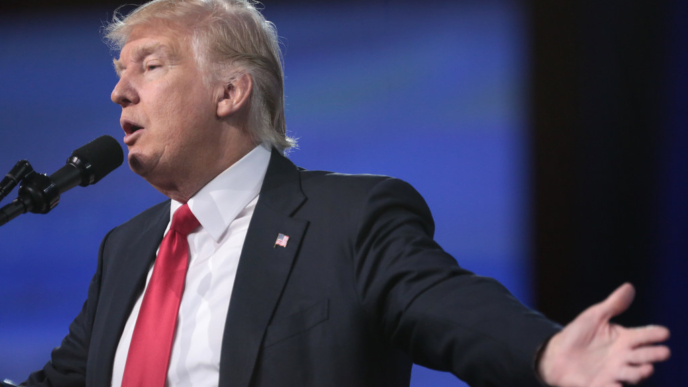
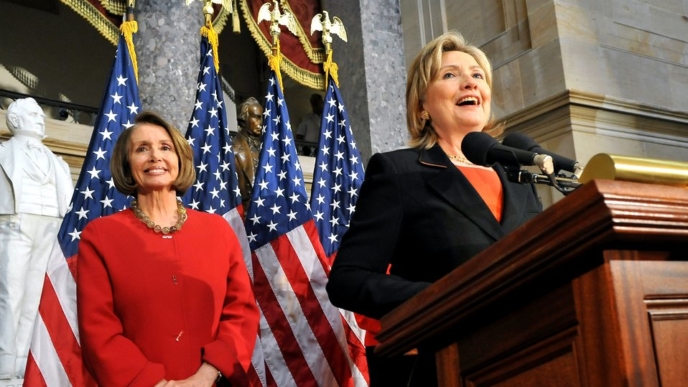
Trump responded to the developments from Democrat House Speaker Nancy Pelosi that the Democrats plan to push ahead with impeachment in a series of tweets noting that Democrats have not even seen the transcript of the call.

(Read more from “Here’s How Trump Responded to Dem’s Impeachment Meeting” HERE)

Follow Joe Miller on Twitter HERE and Facebook HERE
Alleged 2016 Election Interference: Senator Calls for Investigation Into Biden Ukraine-Connection (VIDEO)

Senate Judiciary Committee Chairman Lindsey Graham (R-SC) called on Sunday for the Department of Justice to investigate “all things Ukraine” after a scandal involving Democrat presidential candidate Joe Biden has made national news in recent days.

The Republican appeared on Fox News’ “Sunday Morning Futures” with host Maria Bartiromo where he called for the DOJ to investigate the Biden-Ukraine connection the same way that the DOJ investigated the Trump-Russia connection.

“Joe Biden said everybody’s looked at this and found nothing,” Graham said. “Who is everybody? Nobody’s looked at the Ukraine and the Bidens. Nobody’s looked at the role the Ukraine played in the 2016 election.”

“Do you think the media in America would really look at it and report on it if there was something bad for the Bidens or are they unduly interfered in the 2016 election?” Graham continued. “I’m calling for somebody in the Justice Department to look at all things Ukraine. We have looked at all things Russia and Trump, his family, everything about his family, every transaction between the Trump campaign and Russia.” Graham said.

“Now it’s time to see whether or not the Ukrainians released information regarding Manafort, who was Trump’s campaign manager. What relationships, if any, did the Biden world have to the Ukraine,” Graham continued. “What role, if any, did the Ukraine play in the 2016 election? So nobody’s looked at this, but somebody should. So I’m hoping the Department of Justice will look at the Biden-Ukraine connection like we looked at the Trump-Russia connection.”

(Read more from “Alleged 2016 Election Interference: Senator Calls for Investigation Into Biden Ukraine-Connection” HERE)

Follow Joe Miller on Twitter HERE and Facebook HERE
Bombshell Collusion: DNC Reached out for Dirt on Trump, Ukraine Embassy Confirms

By The Hill. The boomerang from the Democratic Party’s failed attempt to connect Donald Trump to Russia’s 2016 election meddling is picking up speed, and its flight path crosses right through Moscow’s pesky neighbor, Ukraine. That is where there is growing evidence a foreign power was asked, and in some cases tried, to help Hillary Clinton.

In its most detailed account yet, Ukraine’s embassy in Washington says a Democratic National Committee insider during the 2016 election solicited dirt on Donald Trump’s campaign chairman and even tried to enlist the country’s president to help.

In written answers to questions, Ambassador Valeriy Chaly’s office says DNC contractor Alexandra Chalupa sought information from the Ukrainian government on Paul Manafort’s dealings inside the country, in hopes of forcing the issue before Congress. . .

Chaly says that, at the time of the contacts in 2016, the embassy knew Chalupa primarily as a Ukrainian-American activist, and learned only later of her ties to the DNC. He says the embassy considered her requests an inappropriate solicitation of interference in the U.S. election.

“The Embassy got to know Ms. Chalupa because of her engagement with Ukrainian and other diasporas in Washington D.C., and not in her DNC capacity. We’ve learned about her DNC involvement later,” Chaly said in a statement issued by his embassy. “We were surprised to see Alexandra’s interest in Mr. Paul Manafort’s case. It was her own cause. The Embassy representatives unambiguously refused to get involved in any way, as we were convinced that this is a strictly U.S. domestic matter. (Read more from “Bombshell Collusion: DNC Reached out for Dirt on Trump, Ukraine Embassy Confirms” HERE)

__________________________________________________

Ukraine Embassy Says DNC Operative Reached out for Dirt on Trump in 2016

By Fox News. Ukraine’s embassy wrote that a Democratic National Committee (DNC) insider reached out in 2016 seeking dirt on President Trump’s team, according to a bombshell new report Thursday that further fueled Republican allegations that Democrats were the ones improperly colluding with foreign agents during the campaign.

Ambassador Valeriy Chaly said DNC contractor Alexandra Chalupa pushed for Ukraine’s then-President Petro Poroshenko to mention Paul Manafort’s ties to Ukraine publicly during a visit to the U.S., and sought detailed financial information on his dealings in the country, The Hill reported. At the time, Manafort was Trump’s campaign chairman. . .

Chaly continued: “All ideas floated by Alexandra were related to approaching a Member of Congress with a purpose to initiate hearings on Paul Manafort or letting an investigative journalist ask President Poroshenko a question about Mr. Manafort during his public talk in Washington, D.C.” . . .

However, Chalupa acknowledged that she met with “representatives of the Ukrainian Embassy,” but said the topic of conversation was an “Immigrant Heritage Month women’s networking event.” She also told CNN that when Manafort was named Trump’s campaign chairman, she flagged for the DNC that Manafort had worked with the Russian-backed Viktor Yanukovych, Ukrainian’s president at the time.

Federal Election Commission (FEC) records confirm that Chalupa’s firm provided various services to the DNC in 2016, and that the DNC paid Chalupa more than $412,000 from 2004 to 2016. Chalupa had other clients besides the DNC during that period. (Read more from “Ukraine Embassy Says DNC Operative Reached out for Dirt on Trump in 2016” HERE)

Follow Joe Miller on Twitter HERE and Facebook HERE

Pentagon, State Dept. Submit Proposals to Arm Ukraine Against Russia in New Provocation

As the Syrian military moves farther east and clinches yet more territory from America’s terrorists, the United States establishment is now moving to escalate its provocations in another part of the world – Ukraine. Of course, despite the fact that Russia has launched a massive military operation to protect its strategic interests in Syria, the U.S. terror establishment is attempting to provide more arms and equipment to fascists in Ukraine in a clear effort to push NATO literally up to the Russian border.

It is currently being reported by numerous corporate outlets such as The New York Times that both the Pentagon and the State Department are proposing a plan to the White House that would see the U.S. supply Ukraine with anti-tank missiles and other arms. The transfer would also include antiaircraft systems described as “defensive weaponry.”

Fighting between Ukrainian fascist forces allied with Ukraine proper and pro-Russian separatists in the Donbass region has escalated in recent days and the proposal comes amidst an atmosphere of tension between the U.S. and Russia, itself being escalated by a monstrous and telling sanctions bill passed by Congress and an order by Putin to reduce diplomatic staff with the United States as a response.

As of yet, no decisions have been made by the White House but plans have been submitted by both the State Department and the Pentagon. The New York Times, citing an unnamed Defense Department official said it was not clear whether or not Trump had even been briefed about the proposal.

While any sane individual would oppose such a proposal (even Obama refused to send in a similar type of weaponry being proposed today, instead opting for “nonlethal” aid), the American Deep State and the U.S. Congress have become virtually united in insanity, bringing along a sizeable portion of the American public along with them. Donald Trump is a known wildcard but, as his Tomahawk missile launch against Syria demonstrated, his wildcard behavior very easily translates to provocations that could result in a thermonuclear third world war.

Having failed to get only a moderate escalation in the Ukrainian theatre of provocation, the same Deep State elements are now attempting to restart the issue with Trump.

Reasonable people across the world can agree that any decision to further arm Ukrainian fascists in order to provoke Russia and push NATO even closer to the Russian border is not only a bad idea, it is potentially catastrophic. We should urge the President to roundly reject such insanity. (For more from the author of “Pentagon, State Dept. Submit Proposals to Arm Ukraine Against Russia in New Provocation” please click HERE)

Follow Joe Miller on Twitter HERE and Facebook HERE.

Ukrainian President Credits US Help in Defense Against Russia

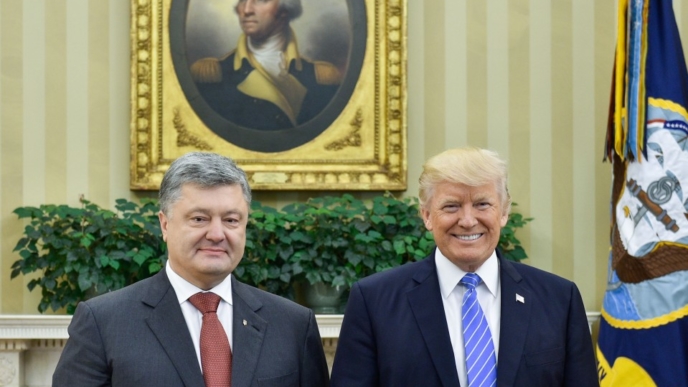
Ukrainian President Petro Poroshenko said the United States has been a “co-sponsor of this story of success” in helping his country fight for freedom against Russian aggression, as he sat with President Donald Trump in the Oval Office Tuesday.

Trump and national security adviser H.R. McMaster had a “drop-in” of a White House late morning meeting between Poroshenko and Vice President Mike Pence.

Ahead of the meeting, the Treasury Department announced sanctions against 38 individuals and organizations that U.S. authorities determined had helped Russia in its annexation of the Crimean Peninsula.

“We’re really fighting for freedom and democracy,” Poroshenko said in front of reporters in the Oval Office after the private meeting, according to the press pool report.

The Ukrainian leader talked about U.S. support for security and defense of his country of 45 million people.

“I’m absolutely confident that today is a story of success and I’m proud to have you, Mr. President, and the United States as the co-sponsor of this story of success,” he said.

Critics have accused Trump of being overly sympathetic with Russian President Vladimir Putin’s regime and slow to denounce the invasion. Trump has said he wants Russia’s help in combatting the Islamic State, a Sunni terrorist group.

Trump spoke broadly during his comments with Poroshenko.

“It’s a great honor to be with President Poroshenko of the Ukraine, a place that we’ve all been very much involved in and we’ve been seeing it and everybody’s been reading about it,” Trump said. “And we’ve had some very, very good discussions. It’s going to continue throughout the day and I think a lot of progress has been made.”

The official White House readout of the meeting said Trump and Poroshenko “discussed support for the peaceful resolution to the conflict in eastern Ukraine and President Poroshenko’s reform agenda and anti-corruption efforts.”

Regarding the new sanctions, Treasury Secretary Steven Mnuchin was more direct.

“These designations will maintain pressure on Russia to work toward a diplomatic solution,” Mnuchin said in a statement. “This administration is committed to a diplomatic process that guarantees Ukrainian sovereignty, and there should be no sanctions relief until Russia meets its obligations under the Minsk agreements.”

In 2014, Russia invaded the Crimean Peninsula, and working with pro-Russian separatist militias in Ukraine, annexed the region. The conflict began after Kremlin-backed Ukrainian President Viktor Yanukovych was rejected by the public. The conflict has led to more than 10,000 deaths, 23,000 wounded, and 1.8 million displaced.

During the public appearance, Trump also addressed the death of American Otto Warmbier, who was imprisoned in North Korea. Warmbier died Monday shortly after returning home in a coma. Trump seemed to lay some blame on the Obama administration for not resolving the matter sooner.

“It’s a disgrace what happened to Otto. It’s a total disgrace what happened to Otto. It should never, ever be allowed to happen,” Trump said. “And frankly, if he were brought home sooner, I think the results would have been a lot different. He should have brought home that same day. The results would have been a lot different. What happened to Otto is a disgrace.” (For more from the author of “Ukrainian President Credits US Help in Defense Against Russia” please click HERE)

Follow Joe Miller on Twitter HERE and Facebook HERE.

Ukraine’s Former Top Spy Goes after a New Enemy: Corruption

Ukraine’s former top security official has gone from tracking down Russian spies to fighting what he perceives to be the country’s greatest threat—corruption.

“The question is, are we going to survive or not?” Valentyn Nalyvaichenko told The Daily Signal from his offices in Kyiv, Ukraine’s capital.

Nalyvaichenko, 50, is the former head of the Security Service of Ukraine, or SBU, which is Ukraine’s successor agency to the Ukrainian Soviet Socialist Republic’s branch of the KGB, the Soviet Union’s main security agency.

“At stake is survival of the country,” Nalyvaichenko said. “At stake is whether we’ll finally get rule of law and a functioning state instead of chaos, corruption, weakness, and [being] not capable to defend our territory and the country. So, at stake is the country, its independence.”

During his interview with The Daily Signal, Nalyvaichenko wore a well-appointed suit and tie. He spoke fluent English, evidence of his university degree in linguistics.

His affable demeanor and emotive manner of talking hinted more to his background as a diplomat and member of parliament than his years in charge of Ukraine’s successor agency to the KGB.

Nalyvaichenko led the SBU for the first time from 2006 to 2010. He took over the security agency for a second time on Feb. 24, 2014, two days after deposed former Ukrainian President Viktor Yanukovych fled to Russia in the closing days of the revolution.

Nalyvaichenko has also served as a member of parliament and as Ukraine’s deputy minister of foreign affairs.

Nalyvaichenko’s 2015 departure from the SBU was controversial. In June 2015, while the security agency was investigating high-level Ukrainian officials for financial crimes, Ukrainian President Petro Poroshenko sacked Nalyvaichenko from his leadership post at the SBU.

Today, Nalyvaichenko is the leader of two upstart anti-corruption political platforms: the Justice Civil-Political Movement, and the Nalyvaichenko Anti-Corruption Movement.

“Our people, our common people, are suffering because of corruption, corruption at the top,” Nalyvaichenko said, pounding his fist on the table for emphasis.

“I really like what [Winston] Churchill said in the Second World War,” Nalyvaichenko said. “‘If you’re going through hell, keep going.’ If we’re corrupt it doesn’t mean we have to say, ‘OK, we’re a failed state.’ No, it’s not true.”

Purge

True to his diplomatic roots, Nalyvaichenko recently traveled to Washington to present evidence to Congress about Russia’s involvement in the war in eastern Ukraine and to press for U.S. assistance in anti-corruption efforts.

As part of his anti-corruption platform, Nalyvaichenko has called for the FBI to investigate the financial crimes of Ukraine’s current and former political leaders.

He also wants U.S. and EU prosecutors to oversee the adjudication of corruption investigations, and for the U.S. to press Ukrainian officials to make Ukraine’s newly minted National Anti-Corruption Bureau independent from the executive and judicial branches.

Nalyvaichenko said Ukraine has a chance to “show for the whole world, especially to the Russian people, that there is an opportunity, there is a plan B, to such nations after the Soviet Union time to be democratic, to be not corrupt, to live in a not corrupt state, to be independent.”

“Ukraine belongs to the Western world,” he added.

Nalyvaichenko added that Ukraine has “several months, two or three months” to show real progress in anti-corruption measures before Western partners begin to break ranks on measures such as maintaining punitive sanctions against Russia.

“It will be no tolerance from the new administration in the United States,” Nalyvaichenko said. And next year, “there might be many changes in the European Union,” he said. “That’s, I think, what is at stake when we’re talking about the European Union and the United States.”

Within Ukraine, Nalyvaichenko’s strategy is to reach out to civil society leaders working at the grassroots level. He wants to convince Ukrainians to believe in the democratic process, despite a quarter-century of oligarchic thug rule after the fall of the Soviet Union.

To that end, Nalyvaichenko’s two anti-corruption organizations—which comprise 10,000 activists across Ukraine—have provided pro bono legal assistance to more than 3,000 Ukrainian citizens involved in court cases against allegedly corrupt government officials.

Nalyvaichenko’s groups have also given free medical care to more than 9,000 civilians in the war zone.

“If you would like to stop Russian aggression, if you would like to get back not only territories but people … we have to show them what?” Nalyvaichenko said. “Believe me, not Kalashnikovs and not tanks. We have to show them a better life.”

Lifestyle

That better life has not yet materialized for many Ukrainians.

For one, the hryvnia, Ukraine’s national currency, is currently less than one-third its value against the dollar from before the revolution. Wages have not concurrently risen to match the falling currency, dramatically reducing Ukrainians’ spending power.

Also, corruption still taints almost every aspect of Ukrainian life. University students in Kyiv, as an example, say it’s still common practice to pay their professors a bribe to pass exams.

According to an October 2016 public opinion poll conducted by the International Republican Institute, and funded by the government of Canada, 30 percent of Ukrainians surveyed who had visited a doctor in the previous 12 months said they paid a bribe for service.

Among those who interacted with the police, 25 percent said they paid a bribe.

A large part of Ukraine’s economy is off the books—what Ukrainians refer to as the “shadow economy.” Ukraine’s Economic Development and Trade Ministry said the shadow economy was 40 percent of the country’s gross domestic product in 2015.

This black market economy robs the government of valuable tax revenue. It also leaves many returning combat veterans, many of whom were drafted, no legal recourse to recover their jobs at the conclusion of their military service.

Many veterans previously worked off the books and were paid in cash so their employers could skirt payroll taxes.

According to the 2016 International Republican Institute study, 72 percent of Ukrainians surveyed said the country was moving in the wrong direction, while 11 percent said the country was on the right track.

As a point of comparison, a year prior to the revolution in May 2013, 69 percent of Ukrainians surveyed said the country was moving in the wrong direction, and 15 percent said the country was moving in the right direction.

According to the same poll, 73 percent of Ukrainians disapprove of Poroshenko’s performance as president, and 87 percent of Ukrainians have an unfavorable opinion of their parliament.

Nalyvaichenko said he no longer has faith in Poroshenko.

“For me this is not personal,” he said. “Whoever becomes president or prime minister is immediately part of a corrupt and not transparent system. Immediately they are reproducing the same Soviet or simply corrupt practices and environment … So, to get rid of that, to dismantle, to change the system, to reboot the country [we need to] get new people with absolutely different minds and mentality into the governmental offices.”

A New Fight

Nalyvaichenko is among a new breed of Ukrainian reformers who have emerged after the 2014 revolution.

Among Nalyvaichenko’s allies is former Georgian President Mikheil Saakashvili, who resigned as governor of Ukraine’s Odesa Oblast in November. The move was a protest against what Saakashvili claimed was stonewalling by Poroshenko and the majority of Ukraine’s political class in implementing anti-corruption reforms.

Saakashvili has since launched his own anti-corruption, opposition party called Wave.

“We had a revolution with lots of casualties,” Saakashvili told The Daily Signal in an earlier interview. “And every time a revolution happens, people have a right to expect revolutionary changes.”

One bright spot for Ukraine is its budding civil society. Across the country, political activists and humanitarian workers, including many millennials, have enabled the spread of democratic norms and are pushing for government accountability at the grassroots level.

“Across the country there is real willingness at the local level, at the grassroots level to stop corruption,” Nalyvaichenko said. “Fifteen or 20 years ago it was unimaginable that Ukraine would have such a powerful civil society.”

He continued:

I remember my parents and how modest the family used to be. How we young, young kids in Zaporizhia and other regions dreamed about another life. And to really have a chance with a free market, with the rule of law … for our children to create a new country with more opportunities. Our better future is here, and we should fight for that. I will not take no for an answer—from anyone.

Sacked

As head of the SBU, Nalyvaichenko endeavored to purge the security agency of its Soviet KGB past. He booted many personnel who had served in the SBU when it was the Ukrainian Soviet Socialist Republic’s branch of the KGB.

Nalyvaichenko spearheaded an effort to open up the SBU’s KGB archives, launching fresh investigations into Soviet crimes in Ukraine, including Joseph Stalin’s organized mass famine in the 1930s known as the Holodomor.

He also hunted down and expelled Russian spies in Ukraine who were working for Russia’s successor agency to the KGB, the Federal Security Service of Russia, or FSB.

“With SBU, what I started with was to stop KGB practices,” Nalyvaichenko said. “I was the first and only chief of the SBU who actually started to detain FSB officers in Ukraine.”

The intent of Nalyvaichenko’s personnel scrub at the SBU went beyond security concerns. He wanted to shed the agency of its “Soviet mindset.”

To fill out the SBU’s thinned ranks, Nalyvaichenko tapped young political activists and reformers who had no living memory of life in the Soviet Union.

“That is my approach and my understanding of how it could be done in all the country,” Nalyvaichenko said, explaining how his SBU scrub could be used as a model for nationwide reforms.

The solution to beating corruption in Ukraine, according to Nalyvaichenko, is to elevate a new generation of political and business leaders.

“Let the generation shift happen in Ukraine,” Nalyvaichenko said. “For the new generation to be in the offices, to let them finally rule the country … it’s high time to finally stop with old practices.”

Nalyvaichenko’s second term as head of the SBU came at a tumultuous time for Ukraine. In the months following the February 2014 revolution, Russia launched a hybrid invasion of Ukraine’s Crimean Peninsula, ultimately annexing the territory.

Russia followed up the seizure of Crimea with a proxy war in the Donbas. A combined force of pro-Russian separatists and Russian regulars was on the march in eastern Ukraine in 2014, and there were worries then that Ukraine could be cleaved in two, or that Russian forces massed on Ukraine’s borders might stage a large-scale invasion.

In Kyiv, the post-revolution government was at the time trying to establish its legitimacy and follow through on the pro-democratic promise of the revolution.

Meanwhile, officials were piecing together a military campaign out of the remnants of Ukraine’s armed forces, which had been gutted by decades of corruption and purposeful neglect.

Amid all of this, Nalyvaichenko pushed to prosecute corrupt government officials.

A New Fight

In Ukraine, opinions diverge about the hierarchy of threats facing the country.

A nearly three-year-old war between Ukrainian troops and a combined force of pro-Russian separatists and Russian regulars continues to simmer in the Donbas, Ukraine’s embattled eastern territory on the border with Russia.

About 10,000 Ukrainians have so far died in the conflict, which has also displaced about 1.7 million people. The war cost Ukraine an equivalent 20 percent of its gross national product in 2015, according to a 2016 report by the Institute for Economics and Peace.

The February 2015 cease-fire has failed. Military and civilian casualties still occur almost every day from landmines, artillery fire, rocket attacks, and small arms gun battles.

Ukraine’s military has rebuilt itself since 2014, but many front-line soldiers complain that after nearly three years of combat, they still aren’t getting basic supplies.

Despite the war’s cost in blood and treasure, Nalyvaichenko said the greatest threat facing Ukraine today is not on the battlefields of the Donbas, but within Kyiv’s government halls.

“If you don’t understand how deep and how destroying the corruption is, you’ll never win the war,” Nalyvaichenko said. “This system, as I understand it, is not workable anymore. And because of war, because of Russian aggression, we now understand why. We simply, as a country, as a nation, have no time and no space anymore to continue with such corrupt practices.”

There is, however, a countervailing, quieter faction, particularly among Ukraine’s military brass, which says the war effort should take priority over any anti-corruption crusades.

Ukrainian military officials who spoke to The Daily Signal on background cautioned against ambitious anti-corruption agendas while the country is still at war.

And, according to the October 2016 International Republican Institute poll, most Ukrainians consider the war to be the biggest threat to the country.

Of the Ukrainians surveyed in the poll, 53 percent said the war in the Donbas was the country’s most important issue, compared with 38 percent who singled out corruption as the top issue.

“The tens of thousands of Russian soldiers, tanks, and artillery sitting along Ukraine’s southern and eastern borders are Ukraine’s sole existential threat,” Alexander Motyl, professor of political science at Rutgers University-Newark, wrote in OZY. “If [Russian President] Vladimir Putin gives the command, they could invade and possibly destroy large parts of the country. Corruption, by comparison, could eviscerate Ukraine’s institutions, but only in the long term.”

Outsider

As SBU chief, Nalyvaichenko spearheaded an investigation into a June 8, 2015, fire at an oil depot near Vasylkiv, Ukraine. The investigation allegedly implicated government officials in financial crimes, according to Nalyvaichenko’s account of events.

The investigation also revealed the undisclosed involvement of a Russian company in the oil depot.

Nalyvaichenko said he personally presented Poroshenko with the evidence and pushed for the issuance of arrest warrants.

Then, on June 15, 2015, Poroshenko fired Nalyvaichenko as head of the SBU. And three days later, Ukraine’s parliament voted to approve Nalyvaichenko’s ouster.

“That’s why I decided to be outside the government,” Nalyvaichenko said. “I really understood and understand for sure that to be subordinated and to fight the corruption, which is above you, is impossible. You become a part of this corrupt group of people, or you are outside. Here’s a red line. For me it was a clear decision.”

The Poroshenko administration declined a request for comment for this article. But, in an emailed statement to The Daily Signal, the SBU defended its track record of investigating and prosecuting corrupt officials.

“After the Revolution of Dignity, state leadership gave a clear indication to law enforcement authorities to begin the real fight against corruption, regardless of position, party affiliation, and the number of stars on one’s epaulets,” the SBU wrote in its statement to The Daily Signal.

According to the SBU, the security agency investigated 673 Ukrainian officials for corruption in 2016, compared with 545 in 2015, and 359 in 2014. The SBU said its investigations led to 256 convictions in 2016, an increase from 184 in 2015, and 181 in 2014.

“This suggests an increase in the intensity of the intelligence agencies in this cause,” the SBU said in its statement.

Nalyvaichenko acknowledged that Ukraine has made some progress in fighting corruption, but he said the past few years of investigations have largely targeted mid- and low-level government officials.

“The worst thing, I think, is that no single person from the top of the previous government [has been] prosecuted,” Nalyvaichenko said. “No single trial, or public hearings, or other procedures were organized by this government, by these officials. That’s I think the worst thing for the country and for Ukrainians.” (For more from the author of “Ukraine’s Former Top Spy Goes after a New Enemy: Corruption” please click HERE)

Follow Joe Miller on Twitter HERE and Facebook HERE.

Ukraine’s Plan to Manufacture US M16 Combat Rifles Hits a Snag Over Ammunition

Kalashnikov assault rifles are among the most iconic symbols of the Soviet military.

Weapons such as the AK-47, the AKM, the AK-74, and the AK-103 are ubiquitous reminders of the Red Army’s legacy among the modern militaries of former Warsaw Pact countries and Soviet client states.

Also, the contemporary, worldwide use of Kalashnikovs by terrorists and insurgent groups offers grim evidence of the widespread proliferation of Soviet weapons during and after the Cold War.

On Jan. 3, as part of a long-term plan to adopt NATO military standards, Ukraine took a step toward ditching this Soviet military carryover.

Ukroboronprom, Ukraine’s nationalized defense industry conglomerate, announced a partnership agreement between the Ukrainian defense manufacturer Ukroboronservis and the U.S. company Aeroscraft to produce in Ukraine a variant of the U.S. M16 assault rifle.

“The M16 project was conceived some time ago, as the Ukrainian armed forces, border guards, and National Guard will with time switch to NATO standards,” Aeroscraft founder and CEO Igor Pasternak said during a Jan. 3 press conference in Kyiv.

The M16 variant Ukraine will produce is called the WAC47.

The catch: The WAC47 uses Soviet ammunition, not the standard NATO 5.56×45 mm cartridge.

However, the Ukrainian production of Soviet-caliber M16s plan is a first step toward adopting NATO military standards—a goal Ukrainian President Petro Poroshenko directed the military to achieve by 2020.

The WAC47 can be modified to use NATO ammunition, and “switching calibers” was one of the reasons Ukroboronprom listed to justify its decision to build its M16 variant.

“For our country and the Ukrainian army, M16 production in Ukraine is a real step towards Euro-Atlantic structures,” Ukroboronprom said in a statement published to its website.

By the time Ukraine fully adopts NATO military standards, its military will have a stockpile of M16s that can be modified to use NATO ammunition.

According to Ukroboronprom, interoperability problems Ukrainian troops have faced while on joint operations with NATO troops spurred the decision to produce the American assault rifle.

“Ukrainian soldiers are already participating in joint maneuvers with NATO,” Ukroboronprom said on its website. “And in each case, one of the problems is logistics.”

Ukrainian troops deployed to support NATO’s mission in Afghanistan, for example, had to borrow German assault rifles from Lithuanian troops due to ammunition incompatibility issues.

There is no standard assault rifle among NATO countries, only an agreement to use the same caliber small arms ammunition. NATO Standardization Agreement No. 4172 sets the standard small arms caliber at 5.56×45 mm.

In theory, troops from NATO countries could swap ammunition in combat, even if they use different weapons.

NATO Standards

The M16 became the standard infantry weapon for the U.S. military in 1967. U.S. versions of the weapon use the standard NATO cartridge.

However, the WAC47 (the M16 version to be produced by Ukraine) is designed for 7.62×39 mm ammunition used by Soviet weapons such as the AK-47 and the AKM assault rifles.

Ukraine plans to adopt NATO military standards by 2020. Consequently, the Ukrainian weapons will have to be retroactively modified to use NATO ammunition.

According to weapons experts consulted by The Daily Signal, the WAC47 can be modified to take the NATO 5.56×45 mm cartridge, but it might be cost prohibitive.

“Rechambering a rifle for a cartridge different than it was originally designed for can be done in some circumstances,” Dakota Wood, senior research fellow for defense programs at The Heritage Foundation, told The Daily Signal.

“A lot of expense that simply implies it would be cheaper to buy new rifles designed for common NATO ammo,” Wood said.

In order to modify Ukrainian M16s to use NATO ammunition, the bolt and barrel will have to be replaced, Brian Summers, a U.S. Army veteran and weapons expert, told The Daily Signal.

“The only items that would have to be replaced are what I would describe as items that would normally be replaced based on use,” Summers said. “The magazines are ammo specific, and would have to be changed to the specific caliber.”

The M16 rifle has two main components—an upper and a lower receiver. According to Summers, for a Soviet-caliber M16 to use NATO ammunition, only the upper receiver has to be modified by replacing the bolt and barrel.

The M16 weapons system is “one of the most versatile weapon platforms in configuration and caliber,” Summers said. “Your troops essentially can train on one platform and when switching over to a new caliber do not need to be retrained in a new weapons system … Core of the platform, lower receiver, does not change and any optics can be moved.”

In the 1990s, Colt Defense LLC, the original M16 producer, produced a special civilian version of the military assault rifle designed to use Soviet 7.62×39 mm ammunition.

“I own this variant and if I want to fire 5.56 mm [NATO ammunition], I simply switch the upper receiver with 5.56 mm bolt and mags,” Summers said. “Two minutes to change.”

The Ukrainian M16 deal is not the first time a foreign weapon modified to use Soviet ammunition has been mass produced in Ukraine.

Ukrainian weapons manufacturer RPC Fort produces a version of the Israeli Tavor assault rifle, which the Israel Defense Forces chose to replace the M16.

Israeli Tavors use standard NATO 5.56×45 mm ammunition. The Ukrainian variant, however, uses Soviet 5.45×39 mm ammunition, but can be modified to use NATO cartridges.

Soviet Surplus

The Ukrainian military is embroiled in a nearly three-year-old proxy war against pro-Russian separatists and Russian regulars in the Donbas, Ukraine’s embattled southeastern territory on the border with Russia.

Since the war began in early 2014, Ukraine has embarked on a crash course to rebuild, resupply, and modernize its military.

According to Ukrainian news reports, pro-Russian separatists captured Ukraine’s only small arms ammunition manufacturer, the Luhansk cartridge plant, in 2014.

Since then, the Ukrainian military has relied on Soviet-era stockpiles to supply its troops in combat.

In June 2016, a group of top Ukrainian military officials announced a plan to develop domestic ammunition manufacturing.

“The ammunition reserves inherited by our country from the Soviet Army … are not unlimited, while their significant part has been thoughtlessly recycled or sold at a time when no one was thinking that we would be engaged in a war,” Oleksandr Turchynov, secretary of the National Security and Defense Council of Ukraine, said, according to Ukrainian news reports.

“This is a crucial large-scale task, and we have no other option but to implement it as soon as possible, for our country’s security directly depends on it,” Turchynov said.

Ukroboronprom’s 2016-2017 product catalogue does not include 7.62×39 mm or 5.45×39 mm ammunition—the two calibers most widely used by Ukraine’s armed forces.

According to arms experts, Ukraine currently has about 1 million AK-74 assault rifles and RPK-74 light machine guns in service. Both weapons use Soviet 5.45×39 mm ammunition.

NATO Standards

On May 20, 2016, Poroshenko, Ukraine’s president, signed a comprehensive military reform plan called the Strategic Defense Bulletin.

The document calls for a total revamp of Ukraine’s military doctrine, training, and operations to ultimately achieve the “full membership in NATO.”

“We have finally abandoned the system of the Soviet army and started to build truly efficient armed forces,” Poroshenko said. “It is very important for me, because it is evidence that Ukraine and NATO speak the same language and understand each other well.”

The Strategic Defense Bulletin directs the Ukrainian military to adopt NATO standards by 2020. It also singles out Russia as the No. 1 national security threat.

Ukrainian M16 production is a step—albeit a largely symbolic one—toward divorcing Ukraine from its Soviet military past by ditching Soviet weapons systems, thereby inching the country toward NATO interoperability.

“Every country that has teared itself away from Russia’s orbit, went or is going through this difficult stage, taking many years and demanding great effort,” Ukroboronprom, the Ukrainian defense industry conglomerate, said in a statement published to its website.

Resale Value

Ukraine will produce M16s for use by its armed forces, as well as for export. The deal, therefore, is a piece of a larger plan to reform and expand Ukraine’s defense industry.

Joint ventures with foreign partners is a key part of reforming Ukraine’s defense industry.

“Weapon manufacture in accordance with NATO standards is an important part of the development and reform of the Ukrainian defense industry,” said Serhiy Mykytyuk, head of Ukroboronservis, according to a statement posted to the Ukroboronprom website.

Aeroscraft, the American firm partnering with Ukroboronservis to produce M16s, is a California-based aviation company specializing in lighter-than-air aircraft—including airships intended for U.S. military use.

Pasternak, Aeroscraft’s founder and CEO, was born in Soviet Kazakhstan and founded his first company, Aeros Ltd., in Ukraine. He immigrated to the U.S. in 1994, according to a biography published on Aeroscraft’s website.

Ukrainian officials also want to make Ukraine one of the world’s top arms exporters.

“Ukraine is rapidly increasing its military capacities,” Poroshenko wrote in the introduction to the 2016-2017 Ukroboronprom product catalogue. “To become among the world’s top-five arms exporters is our strategic objective.”

In 2014, Ukraine was among the world’s top ten arms exporting nations, according to the Stockholm International Peace Research Institute. (For more from the author of “Ukraine’s Plan to Manufacture US M16 Combat Rifles Hits a Snag Over Ammunition” please click HERE)

Follow Joe Miller on Twitter HERE and Facebook HERE.

How Russia’s Cyberattacks Have Affected Ukraine

Ukraine’s May 25, 2014, presidential election was a pivotal moment for the country.

A revolution that February, in which more than 100 died, had overthrown pro-Russian President Viktor Yanukovych.

Two weeks prior to the election, on May 11, pro-Russian separatists in the eastern Ukrainian cities of Donetsk and Luhansk declared their independence from Kyiv.

At the time of the vote, separatist forces, receiving weapons and financing from Moscow, were on the march, taking town after town across eastern Ukraine.

The country as a whole was still reeling from the body blow of losing the Crimean Peninsula to Russia that March. And with a war brewing in the east, Ukraine’s new pro-Western government was under pressure to cement its legitimacy and restore faith in the democratic process.

There were fears of an all-out Russian invasion or a combined offensive by pro-Russian separatists and Russian regulars advancing as far as the Dnieper River, cleaving Ukraine in two.

Officials advised citizens in Kyiv to use the city’s metro in case of a Russian aerial bombardment or artillery blitz. Spray-painted signs on the sides of buildings pointing to the nearest bomb shelter became ubiquitous in cities across Ukraine.

And as Ukraine’s regular army—decimated by decades of neglect and corruption—was on its heels in the Donbas, legions of civilian volunteer soldiers banded into partisan militias and set out for the front lines.

“There was a real chance the front could have collapsed in 2014,” Denys Antipov, a Ukrainian army veteran, told The Daily Signal. “Nobody knew what was going to happen. It was a war for our independence.”

The survival of Ukraine as a sovereign, democratic nation was at stake. And the presidential election needed to go smoothly—thus making it a prime target for a Russian cyberattack.

Four days prior to the election, on May 21, 2014, a pro-Russian hacktivist group called CyberBerkut launched a cyberattack against Ukraine’s Central Election Commission computers.

According to Ukrainian news reports, the attack destroyed both hardware and software, and for 20 hours shut down programs to monitor voter turnout and tally votes.

On election day, 12 minutes before polls closed, CyberBerkut hackers posted false election results to the election commission’s website. Russia’s TV Channel One promptly aired the bogus results.

Ukrainian officials said the cyberattack didn’t affect the outcome of the election because Ukraine used paper ballots. The votes were counted by hand.

Ukrainian investigators later uncovered evidence that CyberBerkut hackers had penetrated the election commission’s computers in March, more than two months prior to the election.

“I believe that we should not underestimate the ability of hackers—especially those that enjoy state sponsorship—to disrupt the political process of a country,” wrote Nikolay Koval, who served as chief of Ukraine’s Computer Emergency Response Team during the 2014 revolution, in a 2015 NATO report on Russia’s cyberwar in Ukraine.

No Silver Bullet

When Russia went to war with Georgia in 2008, it launched cyberattacks against Georgian government computers and media websites.

“In Georgia, cyberattacks were closely coordinated with Russian military operations,” wrote James Andrew Lewis, senior fellow at the Center for Strategic and International Studies, in the NATO report.

“The internet has become a battleground in which information is the first victim,” Reporters Without Borders said in a statement published to the group’s website in August 2008 during the Russo-Georgian War.

Cyberwarfare was not, however, a “silver bullet” for Russia in Georgia. Likewise, Russian cyberattacks in Ukraine have been, so far, mostly used to create chaos and increase the fog of war, rather to effect any militarily significant outcome.

“The most notable thing about the war in Ukraine, however, is the near-complete absence of any perceptible cyberwar,” wrote Martin Libicki, a RAND Corp. analyst, in the NATO report.

“In particular, there are two major forms of cyberattack that have not taken place in the Russo-Ukrainian conflict: attacks on critical infrastructure and attacks on defense systems,” Libicki added.

Yet, according to news reports, since 2014, Russia has maintained a low-level cyberoffensive against Ukraine, targeting banks, railroads, the mining industry, and power grid.

Military communications and secure databases have also been attacked, according to Ukrainian officials. Pro-Russian hackers have also leaked stolen, sensitive information from Ukrainian government networks and the accounts of government officials to the internet.

And according to a report by LookingGlass, a U.S. cybersecurity firm, a Russian cyber espionage campaign called “Operation Armageddon” allegedly began targeting Ukrainian government, law enforcement, and military officials in 2013.

“It is evident that Russia has fully embraced cyber espionage as part of their overall strategy to further their global interests,” the LookingGlass report said.

Yet, according to Lewis, Russia’s cyberattacks on Ukraine have achieved little.

“The incidents in Ukraine did not disrupt command and control, deny access to information, or have any noticeable military effect,” Lewis, the Center for Strategic and International Studies senior fellow, wrote.

He added, “Cyberattacks are a support weapon and will shape the battlefield, but by themselves they will not produce victory.”

Despite its limitations, cyberwarfare was a key component of Russia’s “hybrid warfare” playbook in Ukraine. Online disinformation campaigns helped cloud Western media reports about Russia’s direct involvement in military operations in Crimea and the Donbas.

“Information campaigning, facilitated by cyber activities, contributed powerfully to Russia’s ability to prosecute operations against Ukraine in the early stages of the conflict with little coordinated opposition from the West,” Keir Giles, associate fellow of the Russia and Eurasia Programme and director of the Conflict Studies Research Center at Chatham House, wrote about Russian hybrid warfare.

“Russia, more than any other nascent actor on the cyberstage, seems to have devised a way to integrate cyberwarfare into a grand strategy capable of achieving political objectives,” Giles added.

A ‘Part of Daily Life’

Even though Russian cyberattacks were not decisive on the battlefields of Georgia and Ukraine, Moscow has aggressively used cyber means to target foreign political processes and to spread propaganda.

Russia’s military intervention in Ukraine was accompanied by a wave of cyberattacks, chiefly comprising distributed denial of service attacks, on government and business organizations in Poland and Ukraine, as well as the European Parliament and the European Commission.

Russia has also launched cyberattacks against the governments of countries across Europe, including the Netherlands, Estonia, Germany, and Bulgaria.

“Russia considers itself to be engaged in full-scale information warfare, involving not only offensive but defensive operations—whether or not its notional adversaries have actually noticed this happening,” Giles, the Chatham House expert, wrote.

In 2007, Estonia faced a monthlong cyberattack, which targeted government computer networks, the media, and banks.

“The cyberattacks in Estonia, composed of service disruptions and denial of service incidents, could best be compared to the online equivalent of a noisy protest in front of government buildings and banks,” Lewis wrote. “They had little tangible effect, but they created uncertainty and fear among Estonian leaders as they were considered a precursor to armed Russian intervention.”

Bulgaria’s Central Election Commission was hit by a cyberattack in October this year, during local and municipal elections.

The attack was a distributed denial of service attack similar to what Russian hackers used in Ukraine, Georgia, Estonia, and Poland. It included 530,000,000 visits to the commission’s website in 10 hours. (Bulgaria has a population of 7.2 million.)

Russian hackers have also targeted Western European governments. Germany’s domestic intelligence agency, BfV, said in May that Kremlin-linked hackers had targeted Germany’s parliament. And in May, Russian hackers targeted German Chancellor Angela Merkel’s Christian Democratic Party.

Merkel has been a firm proponent of maintaining EU sanctions against Russia for its military interventions in Ukraine. The German chancellor is up for re-election in 2017.

A cyberattack on Deutsche Telekom, a German telecommunications company, in November spurred German officials to publicly address the Russian cyberthreat.

The head of Germany’s foreign intelligence service, Bruno Kahl, warned that Russian hackers might target next year’s German presidential elections.

“We have evidence that cyberattacks are taking place that have no purpose other than to elicit political uncertainty,” Kahl told the German newspaper Süddeutsche Zeitung in November.

“The perpetrators are interested in delegitimizing the democratic process as such, regardless of who that ends up helping,” Kahl said. “We have indications that [the attacks] come from the Russian region.”

And without specifically blaming Russia for the Deutsche Telekom attack, Merkel said, “Such cyberattacks, or hybrid conflicts as they are known in Russian doctrine, are now part of daily life, and we must learn to cope with them.”

According to news reports, a Russian cyber espionage campaign also targeted the Netherlands-based international investigation into the Malaysia Airlines Flight 17 shootdown over eastern Ukraine, as well as the World Anti-Doping Agency investigation into Russian Olympic athletes.

“Russian strategic culture focuses on war as political activity; for cyberpower to have a truly strategic effect, Russia believes that it must contribute directly to shaping political outcomes by altering the political perceptions of their opponents to better suit their interests,” James J. Wirtz, dean of the School of International Studies at the U.S. Naval Postgraduate School, wrote in the NATO report on Russia’s cyberwar in Ukraine.

Cold War Tradecraft

In 2014, cyberattacks linked to Russian hacking groups increased on U.S. government computer networks.

U.S. officials in Europe have also been the target of Russian cyberattacks.

In February 2014, a disparaging phone conversation between Geoffrey Pyatt, U.S. ambassador to Ukraine, and Victoria Nuland, U.S. assistant secretary of state for European and Eurasian Affairs, was uploaded to YouTube.

The U.S. government pinned the bugging of the phone conversation and its online release on Russia.

“I would say that since the video was first noted and tweeted out by the Russian government, I think it says something about Russia’s role,” former White House press secretary Jay Carney said at the time.

“Certainly we think this is a new low in Russian tradecraft,” Jen Psaki, the State Department’s press secretary at the time, said in response to the leaked phone call.

Russia’s cyberwar strategy draws on Soviet tradecraft. The USSR conducted clandestine operations around the world to extend Soviet influence and undermine the legitimacy of, and sow chaos within, Western democracies.

These tactics included leaking false information to foreign media outlets.

“The Soviets always tried to influence both friend and foe; the Russians are doing the same,” Steven Bucci, a visiting fellow at The Heritage Foundation who served for three decades as an Army Special Forces officer, told The Daily Signal in an earlier interview.

War, or Something Else?

The U.S. government currently has no clear definition for when a cyberattack crosses the threshold from a crime or an act of espionage to an act of war.

And, so far, Russian cyberattacks on NATO countries like Bulgaria, Estonia, Germany, Poland, and the U.S. have not spurred NATO’s invocation of Article V—the Western military alliance’s collective defense protocol.

The U.N. Charter is also ambiguous about when a cyberattack merits a kinetic military response.

“Skeptics rightly claim that in cyberwar, no one dies,” Kenneth Geers, ambassador of NATO’s cybersecurity center and a senior fellow at the Atlantic Council, told The Daily Signal. “But to some degree, our concept of national security must evolve with technology.”

In a 2011 White House report, the Department of Homeland Security listed 16 “Critical Infrastructure Sectors,” which, if destroyed, would have a “debilitating effect on security, national economic security, national public health or safety, or any combination thereof.”

The list comprised infrastructure assets like power grids, air traffic control systems, and dams. The country’s electoral process was not listed as a critical infrastructure sector to be protected from cyberattacks.

The Democratic and Republican national committees are nonprofit organizations, which are responsible for financing and organizing their own cybersecurity.

Geers argued, however, that the government has a responsibility to secure the DNC and RNC email servers because they have national security value.

“In some way, the U.S. government will define these servers as ‘critical infrastructure’ and articulate some level of responsibility for protecting them,” Geers said. “The U.S. government is responsible for protecting our country and its citizens, and that certainly includes the security of our democracy, especially from foreign power manipulation.”

According to Bucci, the alleged Russian hacking of the DNC over the summer was espionage and falls well short of the threshold required to merit a military response.

“The U.S. government has never defined an act of war in cyber,” Bucci said. “This would not be close in anyone’s book. It’s not a crime either. It’s spying. The release of the purloined emails is for influence.”

The White House’s 2011 “International Strategy for Cyberspace” alluded to the use of military force to retaliate against a cyberattack.

According to the report: “When warranted, the United States will respond to hostile acts in cyberspace as we would to any other threat to our country. We reserve the right to use all necessary means—diplomatic, informational, military, and economic—as appropriate and consistent with applicable international law, in order to defend our nation, our allies, our partners, and our interests. “

In testimony before the House Armed Services Committee on June 22, Thomas Atkin, acting assistant secretary of defense for homeland defense and global security, said the Pentagon has no clear-cut threshold for when a cyberattack becomes an act of war.

Cyberattacks could merit a military response if there was an “act of significant consequence,” Atkin told Congress.

“As regards an act of significant consequence, we don’t necessarily have a clear definition,” Atkin said. “But we evaluate it based on loss of life, physical property, economic impact, and our foreign policy.”

“Computer network operations, even when they are this daring, are closer to covert action than traditional warfare,” Geers said, referring to the alleged Russian hacking of the DNC.

“Only the president can decide” when a cyberattack becomes an act of war, Geers added. (For more from the author of “How Russia’s Cyberattacks Have Affected Ukraine” please click HERE)

Follow Joe Miller on Twitter HERE and Facebook HERE.

‘We Need to Know We’re Not Alone’: Ukraine’s Soldiers Carry the Burden of a Nation at War

As the war in Ukraine nears its third calendar year, Ukrainian troops remain entrenched along a static front line in eastern Ukraine where they exchange small arms and artillery fire with combined Russian-separatist forces every day.

More than 21 months after it was signed, the cease-fire is a charade. The war may be at a lower intensity due to the cease-fire’s loosely adhered-to rules—but there is still very much a war in eastern Ukraine.

Combat is ongoing and intense throughout the Donbas—Ukraine’s embattled southeastern territory on the border with Russia. And civilian and military casualties still occur daily.

For many Ukrainian soldiers, war has become a way of life.

“I am at home now, this is my family,” Andriy, a 30-year-old soldier in the Ukrainian army’s 92nd Mechanized Brigade, told The Daily Signal from a front-line position in the embattled town of Marinka.

Andriy has continuously served in combat since the war began in spring 2014. He asked that his last name not be used due to security concerns.

The Ukrainian troops believe in the justice of their cause, yet, there is a pervasive sense of disappointment, bordering on betrayal, expressed by many front-line soldiers toward their civilian leadership in Kyiv.

“We are fighting for our land, to defend every centimeter of our country,” Dimitry Karamushka, a 30-year-old soldier in the 92nd Brigade, told The Daily Signal in Marinka. “We are not fighting for our government.”

The 92nd Brigade recently rotated to Marinka from a previous combat deployment outside the separatist stronghold of Luhansk. The unit comprises a mix of both draftees and volunteers, with some soldiers having served continuously in combat, with only periodic breaks of a week or two to go home, since spring 2014.

Ukrainian forces are dug in, battle-hardened, and better equipped and armed than they were a year ago. Conditions have improved, but supply shortages are still common, and the Ukrainian troops are still largely left to fend for themselves to provide many basic necessities—such as electricity.

“More than ammunition, we need to know we’re not alone,” Andriy said. “We are fighting two wars. One against Russia, and the other against the government in Kyiv.”

Casus Belli

Ukraine’s deployed troops remain committed to their cause, and treat the war as an existential fight for the country’s independence against what they call a Russian invasion of their homeland.

“We can’t leave the war and go to Kyiv,” Karamushka said. “It would mean surrender to Russia. And what would it mean to all the people who died?”

“We are standing for our territory,” said Alexandr Chernov, a chaplain in the 92nd Brigade. “Everyone wants peace. But peace will only come after victory.”

Chernov paused, smiled, and then added: “And when [Russian President Vladimir] Putin is gone.”

Ukraine’s military has been locked in a static, frontal war against a combined force of pro-Russian separatists and Russian regulars since the second, current cease-fire—called Minsk II—was signed in February 2015.

Today, at some places in and around Marinka, less than 300 meters (about 1,000 feet) of no man’s land divide the opposing camps.

“The situation here is stabilized,” said Vsevolod Chernetskyi, a 22-year-old soldier and Raven drone operator, in near perfect English. “We are in the same positions as a year ago, the Russians and us. It’s mostly artillery now.”

The war has killed about 10,000 Ukrainians and displaced about 1.7 million people, according to various reports from humanitarian organizations.

The conflict began in spring 2014 when Russian-backed separatists formed two breakaway republics in the Donbas.

Despite denials from Moscow, numerous news reports have shown that Russian troops are fighting among the separatists, that Russian military commanders command and control separatist forces, and that Russian weapons and ammunition continue to feed the war effort.

Through binoculars from the roof of the 92nd Brigade’s outpost in Marinka, this correspondent observed a Russian flag flying over a building across no man’s land on the combined Russian-separatist side of the contact lines.

According to Ukrainian military intelligence estimates, there are about 5,000 to 7,500 Russian troops currently deployed in the Donbas. About 55,000 Russian military personnel are also forward deployed to locations within Russia near the Ukraine border.

Combined Russian-separatist forces in eastern Ukraine currently control more tanks than Germany’s armed forces, and the Donbas is replete with Russian surface-to-air missile systems.

“I don’t feel we are winning,” Chernetskyi said. “The Russian forces are much stronger than ours. They can always provide more artillery than us, better tanks, more drones.”

During breakfast, this correspondent remarked to Chernetskyi how the shooting had stopped in time for both sides to take their morning meal.

Chernetskyi replied that the combined Russian-separatist forces operate on Moscow time, one hour ahead of Kyiv’s time zone.

“They eat an hour before us,” he said.

He paused a beat and then added: “They’re always one step ahead of us.”

Differences

The corner of an artillery-blasted apartment building in Marinka is marked by a spray-painted word in Russian. In English it translates to “For what?”

Approximately 5,000 civilians have fled Marinka since the war began, comprising about half of the town’s pre-war population of 10,000.

Daytime is usually relatively peaceful here. Civilians mill about outdoors, pedestrians are on the sidewalks. There’s an outdoor market where one can buy goods ranging from produce to clothing.

Across town, there is the sound of hammering as workers repair buildings damaged by shelling. They replace shattered windows and reconstruct crumbled walls.

There is a daily rhythm to the war, which conceals the brunt of the fighting from the intergovernmental organization responsible for overseeing the cease-fire.

Monitors from the Organization for Security and Cooperation in Europe, or OSCE, do not travel through the war zone at night due to security restrictions.

At night, consequently, the war begins in earnest.

“There is almost no artillery during the day, because the OSCE is here,” Chernetskyi, the 22-year-old Raven operator, said.

Winter sunsets in eastern Ukraine come early, around 4:30 p.m. As darkness falls there is, at first, only the occasional sound of a mortar explosion or an artillery shot, and the every-so-often burst of a machine gun or Kalashnikov.

As the hours pass, the pace and intensity of the shooting slowly builds like the different sections of an orchestra chiming in.

At the nocturnal peak of the fighting, typically around midnight, tracers cut across the night sky, the flashes and booms of mortar and artillery explosions come several times a minute, and there is a nearly constant background din of small arms fire.

This correspondent witnessed such a scene in Marinka on the night of Nov. 21. The Ukrainian soldiers on scene, as well as several civilians from the area, said the intensity of the fighting on that night was “normal.”

While casually smoking a cigarette in the night, one soldier jokingly recommended that this correspondent return “when things really get hot.”

Spartan

When U.S. troops go to war, they usually enjoy the support of specialized units—such as the Army Corps of Engineers, the Navy Seabees, or Air Force Civil Engineers—dedicated to building and maintaining base infrastructure, even in the most austere locations.

For deployed Ukrainian troops, however, this task is a collective effort, in which the diverse skills each soldier brings to the war are identified and utilized for the common good.

One example. A 92nd Brigade soldier with a university electrical engineering degree illegally tapped into the local power grid to provide electricity for the outpost in Marinka—effectively stealing electricity from the same government that had sent him to war.

The power still frequently goes out, however. Wood-burning furnaces provide heat to stave off the winter cold and cook food.

Soldiers say the military has improved on its deliveries of basic necessities such as water and foodstuff during the past year.

Yet, non-essential food items like honey, sugar, and coffee are still provided by civilian volunteers. As are other more vital supplies, including most soldiers’ body armor, boots, and winter underwear.

Weapons and ammunition are not a problem, although the soldiers complain about the quality of their armaments—some of which date back to World War II, almost all of which are Cold War vintage.

The soldiers in Marinka still lack basic sanitation. They use a wooden outhouse as a toilet—a miserable proposition in eastern Ukraine’s frigid winters.

The soldiers’ diets mainly comprise traditional Ukrainian foodstuff—including copious amounts of buckwheat, bread, potatoes, and salo (cured slabs of pork fat). Sweetened condensed milk is another troop favorite.

At night, the soldiers sometimes enjoy a moonshine popular throughout the front lines called Avatar; a reference to one’s facial complexion after over-indulging.

Nearly everyone smokes. At night, as the not-too-distant battles rages, the soldiers stand casually outside for as long as they can tolerate the cold to enjoy a cigarette or two. They are desensitized to the war, able to instantly and instinctively tell when the shooting is near enough to pose a real threat.

As at other front-line Ukrainian positions across the war zone, the items hung on the interior walls are a testament to the life stories of these men at war.

Kalashnikovs and body armor hang beside Orthodox religious icons, and posters of soccer stars and beautiful women. Letters from home share tabletops with grenades and bullets.

Outside the few scattered buildings in which the soldiers are holed up, a collection of tanks and armored personnel carriers are scattered under concealment.

At dawn, this correspondent joined a brief patrol into no man’s land in an armored personnel carrier from the 1970s called a BMP. The foray was cut short when the Ukrainian driver spotted enemy forces.

The ebb and flow of life here is likely not too different than it was for the soldiers who fought for this land in World War II.

Except for the presence of smartphones and a few laptops—and the U.S.-made Raven UAV the unit operates—the war-fighting technology and the circumstances of day-to-day life here would not be out of place seven decades ago.

“We want people to know that this war could happen in other places in Europe,” Chernov, the chaplain, said. “We have to stop Russia here.”

Red to Blue

The soldiers (the majority of whom are millennials) reject their country’s Soviet military heritage in favor of closer ties with the U.S. and NATO.

On Soviet battle maps, red icons (for the Red Army) symbolized friendly forces, and enemy forces were blue.

After the current war in the Donbas began, Ukrainian forces flipped the colors of their icons to match NATO maps, in which the colors are reversed.

The move was a practical step in bringing Ukraine’s military in line with NATO standards (part of a larger effort to foster closer ties with the Western alliance), but it was also a symbolic pushback against Russia.

The soldiers consider the United States to be an ally, and they want American military support. Many, however, oppose the idea of direct U.S. military intervention.

“American help is OK,” Andriy, the 30-year-old soldier from Kharkiv, said. “But we need to learn how to do this on our own. We shouldn’t rely on other countries for help. We need to fight this war on our own.”

There is a symbolic value to U.S. support that the soldiers exploit to rattle their enemies.

The Punisher skull symbol—a comic book emblem made popular among soldiers by Navy SEAL Chris Kyle of “American Sniper” fame—is painted on Ukrainian armored fighting vehicles in Marinka.

As at other locations along the front lines, the Ukrainian soldiers in Marinka did not have encrypted communications. They shared the airwaves with their enemies on off-the-shelf walkie-talkies.

A common Russian propaganda line is that U.S. troops are deployed and fighting alongside the Ukrainians. (There are, in fact, no U.S. troops fighting in the Ukraine conflict.)

Sometimes, as a joke, a Ukrainian soldier fluent in English will speak on the open airwaves, pretending to be a Navy SEAL, or a U.S. Marine. The gag usually elicits a flurry of incensed responses from their enemies, the Ukrainian soldiers said.

The Raven

One overt sign of U.S military support for Ukraine is the 92nd Brigade’s use of the U.S.-made Raven drone. The small drone is tossed in the air like a giant paper airplane.

The U.S. gave 24 Ravens in all to the Ukrainian military, and the drones are scattered throughout various units.

Chernetskyi trained on the Raven with the U.S. Army for three weeks in Huntsville, Alabama.

The Raven is a non-offensive weapon, but Ukrainian forces use it for artillery spotting.

While not a game-changer on the battlefield, the Raven does afford the Ukrainians some advantages over the modified off-the-shelf drones they also use.

“It’s useful mostly because it can fly at night,” Chernetskyi said.

The Raven is still susceptible to Russian jamming, however.

“The Russians can jam it, no problem,” Chernetskyi said. “It was made for Afghanistan, and the Taliban didn’t have jamming.”

Defenders of the Motherland

Some soldiers expressed frustration that their commanders were stuck in antiquated habit patterns from the Cold War, making them resistant to commonsense changes implemented from the bottom up, which could streamline the war effort.

Andriy brought out a thick stack of worn paper maps of the Marinka area. Each map was thoroughly marked in pen and marker notations, indicating enemy and friendly positions.

The troops complained that this pile of maps, enough to fill a wheelbarrow, could be condensed into a single app for a tablet or a file on a laptop.

An electronic version could be continuously updated and overlaid with other information, such as weather or locations where civilians are observed, the soldiers said.

Perhaps most frustrating of all for the front-line troops is the disconnect between life on the front lines and the rest of the country, where daily life seems to carry on unaffected by the war.

While front-line soldiers shiver in sub-zero temperatures, enduring artillery and sniper fire, in Kyiv—a 9-hour journey from the front lines by car and rail—there were Black Friday sales going on at the city’s many shopping malls last weekend.

(Ukraine does not celebrate Thanksgiving, yet Black Friday is a major shopping event.)

Over the weekend, the malls in Kyiv were crammed with bargain-hunting patrons in stores like The Gap, Columbia Sportswear, and Zara. Christmas lights and trees are going up around town.

Bars and restaurants in Kyiv remain busy. At more popular places, you can’t get in without a reservation on the weekends. The city’s trendy speakeasy-style, craft cocktail bars are always packed. One would hardly know this is the capital city of the country home to Europe’s only ongoing land war.

“Everyone should know our story,” Chernetskyi said.

The soldiers are not generally resentful that life is going on outside the war. In fact, many say that’s what they’re fighting for; a sign that the Russian threat has been kept at bay.

Yet, the head-spinning contrast with life on the front lines sparks feelings of unequally shared sacrifice among the troops and combat veterans.

“It is war here,” Evgeniy Varavin, a 27-year-old soldier from Kharkiv, said from Marinka.

“Some civilians look at soldiers and don’t understand why we’re fighting,” Varavin, who was a construction worker before the war, continued. “I don’t pay attention to what civilians say. My parents are proud of me, but they’re worried. They don’t understand why I came back for the second time. But how can I work back home in Kharkiv when there is war, and while my comrades are here? My soul is here.” (For more from the author of “‘We Need to Know We’re Not Alone’: Ukraine’s Soldiers Carry the Burden of a Nation at War” please click HERE)

Follow Joe Miller on Twitter HERE and Facebook HERE.

‘Hope Is Not Enough’: Ukrainian University Students Prepare for War

The young man never told anyone he was going to war.

The 20-year-old student at Kyiv’s Taras Shevchenko National University slipped away in June 2014 to join a civilian paramilitary group fighting in eastern Ukraine.

The young man, whose name was Sviatoslav Horbenko, was a star pupil at the university’s Institute of Philology, where he studied Japanese. When he transferred from a university in Kharkiv, a city in eastern Ukraine, during his third year, he had to retake 17 exams.

He aced them all.

“There was no bellicose air about him,” said Serhiy Yanchuk, an associate professor at Taras Shevchenko University and coordinator of the university’s Students Guard, a volunteer militia comprising students and faculty.

“He never acted or behaved aggressively for his personal cause,” Yanchuk said. “He was friendly, warm hearted, and an easy-going person. One would surely want to be a friend of such a guy.”

“He was an exceptional student,” said Ivan Bondarenko, a professor who heads the university’s Institute of Philology. “And he was an inspiration to all of us.”

Horbenko’s angular features and piercing eyes distinguished him physically, reflecting the intensity of his inner convictions. His work ethic and natural intelligence set him apart from his peers academically, inspiring high hopes for the future among those who knew him well.

Horbenko’s father, Olexander Horbenko, is a surgeon. He volunteered to treat wounded protesters in Kyiv during the 2014 revolution.

The younger Horbenko was active in pro-revolution groups in Kharkiv, where he was studying at the time. As the revolution became violent in February 2014, Olexander Horbenko encouraged his son to transfer to Kyiv to continue his studies due to the threat of reprisals against protesters by authorities in Kharkiv.

At his father’s behest, the younger Horbenko moved to Kyiv and settled into life and his studies at Taras Shevchenko National University.

And then, a few months after the war began in the summer of 2014, Sviatoslav Horbenko disappeared. Without telling his friends, family, or teachers, he joined Right Sector, a civilian volunteer battalion, to fight at the battle for the Donetsk airport.

Olexander Horbenko ultimately was able to track Sviatoslav down at boot camp. The father tried to dissuade his son from going to war. But Sviatoslav was determined.

“That was my last meeting with him alive, our unforgettable conversation,” Olexander Horbenko later said. “Sviatoslav considered defending his fatherland as his duty, and he developed the strong bonds of military comradeship.”

At their parting, the elder Horbenko placed a necklace with an icon and a cross around his son’s neck. It was the same necklace worn by his own father—Sviatoslav’s grandfather—during World War II when he fought the Nazis. And Olexander had worn it as he weathered sniper fire on the Maidan during the revolution.

“And I let him go,” Olexander Horbenko said. It was the last time he saw his son alive.

In September 2014, Sviatoslav Horbenko stepped onto the battlefield for the first time. One month later, on Oct. 3, 2014, he ran into the line of fire to rescue a wounded comrade.

While Horbenko dragged the man to safety, a tank shot at them. A piece of shrapnel from the round went into Horbenko’s neck, slicing his carotid artery. He was dead within minutes. As for the soldier he had run out to save—he survived.

“Death takes the best of us,” said Denys Antipov, an instructor at Taras Shevchenko University and a veteran of the war in eastern Ukraine.

Because Horbenko served in a civilian volunteer battalion, he is not officially recognized as a combatant by the Ukrainian government. He has not received any posthumous decorations, and his family has not received the compensation of about $23,000 that typically is given to the families of fallen soldiers.

“His family feels really humiliated by such ignorance,” said Yanchuk, the professor who coordinates the university’s Students Guard.

Hell and Cyborgs

The second battle for the Donetsk airport, for which Horbenko volunteered, was fought at close quarters, and it was brutal.

Opposing troops sometimes holed up on different floors of the same building. For months, soldiers on both sides endured near constant shelling, tank shots, rocket attacks, close-quarters gunfights, and even hand-to-hand fighting, according to some Ukrainian soldiers who fought in the battle.

Ukrainian soldiers had taken control of the airport in May 2014, during the opening weeks of the war. That September, weeks after the conflict’s first cease-fire, combined Russian-separatist forces launched an offensive—comprising heavy armor, artillery, and rocket attacks—to take back the airport.

What followed was an apocalyptic showdown that lasted until January 2015.

The Ukrainians gave the nickname “cyborgs” to their soldiers who fought at the Donetsk airport—a reference to the science fiction beings that are a fusion of man and machine. It alluded to the superhuman grit required to endure such intense and brutal fighting, and a mechanical ability to endure endless fear and suffering.

Donetsk’s Sergey Prokofiev International Airport was rebuilt in 2011 for the Euro 2012 soccer championships. More than 1 million passengers passed through the facility in 2013, the year before the war started, on airlines including Lufthansa and Aeroflot.

The new terminal was stylish and modern. It featured manicured landscaping, polished floors, and chic metal detailing. A bellwether, many hoped, for Ukraine’s more prosperous future.

As the war in Ukraine evolved from skirmishes to artillery and tank battles in 2014, the Donetsk airport became a key prize. The opposing sides fought savagely for its control. Artillery and rocket attacks reduced the modern buildings to gutted ruins of crumbling concrete and twisted rebar.

Runways and the surrounding open spaces were churned into a cratered lunarscape, reminiscent of images of no man’s land from World War I battles like the Somme or Verdun.

The charred skeletons of planes littered the tarmac. The physical destruction evidenced the intensity of the battle, and the hellish conditions soldiers on both sides endured.

Surrounding villages like Pisky, about 1 mile from the airport perimeter, where Ukrainian troops staged for battle and fired artillery, also were reduced to demolished ghost towns by reciprocal separatist artillery, rockets, and tanks.

Yet, even amid the bloodletting, the opposing sides were able to demonstrate fleeting acts of humanity. Soldiers who fought at the airport described short truces, during which officers ventured out to collect the dead. Enemies walked among each other, their desire to kill undimmed, but held in check to honor the fallen men under their command.

Pro-Russian separatists, commanded and supported by Russian regulars and armed with Russian weapons, ultimately won control of the airport in January 2015. Ukrainian forces pulled back to nearby villages where they dug in for a protracted, static, long-range battle.

Two years later, Ukrainian forces still are entrenched on the periphery of the airport. Both sides fight from trenches and abandoned, artillery-blasted homes and buildings in a daily, tit-for-tat exchange of artillery and sniper fire.

The fighting has de-escalated from the death spiral of the winter of 2014-2015, but it hasn’t ended.

‘We Shouldn’t Give Up’

The students filled the hallway at the appointed hour. They squeezed, shoulder to shoulder, leaving a pocket of empty space in front of the table with the flowers, which was next to a poster with a picture of Sviatoslav Horbenko and some details about his life.

Behind the table and the poster was the entrance to the room at Taras Shevchenko University’s Institute of Philology that was named in Horbenko’s honor.

It was the second anniversary of Horbenko’s death. Some students held flowers. Others stood quietly, with their hands clasped in front of them.

“He would have made a good professor, a good husband,” Antipov, a 27-year-old teacher and war veteran, told the students gathered at the memorial ceremony.

“Do whatever you can to help our country,” Antipov told them. “But the most important thing you can do is to study, so that his death wasn’t in vain.”

Down the hall from the ceremony was a wall display featuring pictures of students and faculty who served in past military conflicts, including Lyudmila Pavlichenko, a Ukrainian sniper for the Red Army credited with 309 kills in World War II.

Horbenko’s picture is now among the others.

“History constantly repeats,” Antipov said.

Grassroots Defense

About 200 students and faculty from Taras Shevchenko National University died fighting in World War II. The history of students volunteering for war dates back to the Battle of Kruty in 1918, during the Russian Civil War.

About 300 students, along with about 100 free Cossacks, mobilized to defend Kyiv against a force of about 5,000 Bolsheviks. The students holed up at the Kruty railway station on the outskirts of the city, but eventually were overwhelmed.

More than half of the combined force of students and Cossacks died in the battle. Kyiv ultimately fell to the Bolsheviks and, along with the rest of Ukraine, was incorporated into the Soviet Union.

The legacy of the students who fought at the Battle of Kruty inspired the formation in 2014 of the group called the Students Guard. Under the direction of Yanchuk, approximately 200 students and faculty members have received military training as part of an auxiliary guerrilla force dedicated to Kyiv’s defense.

“Our goal is to train students to take up arms in the event of an emergency,” Yanchuk, the coordinator, said.

Life in Kyiv is moving on from the war, even though it hasn’t ended yet and the front lines are only a six-hour train ride from Ukraine’s capital city.

There is a film festival in Kyiv this week. The hip underground speakeasies in the city center are filled every night with patrons sipping on craft cocktails while jazz bands play covers of American songs.

At the Art-Zavod Platforma on the left bank, a former Soviet industrial space is now an art flea market and a venue for food festivals and concerts nearly every weekend.

The coffee bars in central Kyiv perpetually are filled with hipsters and students. The foreign journalists who used to be an ubiquitous presence largely have left. Only a few stalwart holdouts remain, convinced that the forgotten conflict in the east still holds the potential to spiral into something much worse.

“Here in Kyiv, the mass media, the political leadership tries to make the war look far away,” said Vasyl Yutovets, a student at Taras Shevchenko University and commander of the Students Guard. “We try to remember that the war is far from over. The threat is growing day by day.”

Yet, despite the distractions of youth, and many Ukrainians’ blind eye to the ongoing combat in the east, some students haven’t forgotten about the war.

“The hardest part is not going to the front line,” said Yutovets, who served in Ukraine’s National Guard and is a veteran of the war.

“But returning is hard, too,” Yutovets said, adding:

I can’t imagine doing nothing while our country is suffering. We are still hopeful for our future. When the war began, it was very easy to get to the front lines. We realized, then, it was our duty to support the war.

Civilian defense battalions like the Students Guard are also a hedge against further Russian aggression, Yanchuk said.

“When [Russian President Vladimir] Putin encounters the possibility of fighting territorial defense battalions, militias, or even students, it acts as a deterrent,” Yanchuk said.

Yanchuk served in Ukraine’s armed forces for three years and took part in peacekeeping operations in Kosovo. He also participated in joint training events with the U.S. military at bases in Louisiana, North Carolina, and Texas.

Yanchuk leverages his military experience and his personal connections with Ukrainian military instructors to organize training events for the Students Guard.

The group conducts weekend training events, including first-aid courses, field training exercises, and weapons training. The group also runs specialty courses, including training on mines and booby traps, tactical mountaineering, and a basic sniper course.

Ownership

The Students Guard at Taras Shevchenko University is another instance of Ukrainians’ enterprising solutions to their country’s myriad problems independent of official government channels.

“Civil society is two, or three, or five steps ahead of the government,” Yanchuk said. “Civil society is winning the war, despite all efforts from Ukrainian and Russian politicians.”

In eastern Ukraine, grassroots humanitarian groups have popped up to address the needs of Ukraine’s 1.7 million internally displaced persons as a result of the war. Across the country, veterans’ groups have formed to help returning soldiers reintegrate into civilian life and deal with the psychological consequences of combat.

And as fighting in the Donbas continues, volunteer civilian territorial defense battalions remain ready to defend their respective cities in the event of a Russian invasion.

Harkening back to the legacy of partisan groups of World War II, Ukrainians took their country’s defense largely into their own hands in the opening months of the war in 2014.

As the pro-Russian separatists and their Russian military handlers seized town after town in eastern Ukraine, some feared a march on Kyiv, which could have split the country in two. In the eyes of many Ukrainians who volunteered to fight, the war in the Donbas had become an existential battle for the country’s survival.

The Ukrainian military was at that point a ragtag force. Its soldiers were a motley mix of draftees and recruits; equipment reserves had been depleted by decades of plundering by corrupt oligarchs and arms dealers.

With the regular army on its back foot, civilian volunteer battalions formed out of the remnants of protest groups active during the revolution. These paramilitary groups mainly comprised young men with no military experience, although some veterans from the Red Army, including Afghanistan veterans, also were in the ranks.

“There was a real chance the front could have collapsed in 2014,” Antipov said. “Nobody knew what was going to happen. So, many young people wanted to train for guerrilla warfare.”

Initially armed with hand-me-down weapons from local police forces, or collected from the enemy dead, the volunteer battalions stalled the combined Russian-separatist march across eastern Ukraine.

“There was no army in 2014,” Antipov said. “In my opinion, the volunteer battalions were the only reason we kept our independence. Why else would the Russian tanks have stopped in 2014?”

Then, in August 2014, thousands of Russian regulars streamed into eastern Ukraine to reverse the Ukrainian offensive. At the time, it looked like Ukraine was facing a full-scale Russian invasion.

“We were concerned in the summer of 2014 of how far Putin was willing to go,” former U.S. Ambassador to Ukraine Geoffrey Pyatt told The Daily Signal in an earlier interview.

“If the Russians broke through, there was no stopping them,” Pyatt said. “We were concerned that Putin was deploying enough force to mass an invasion.”

Although hundreds of miles from the front lines, some in Kyiv began to prepare for a partisan, guerrilla defense of the city.

Spray painted signs indicating the nearest bomb shelter became ubiquitous—they still are. City authorities issued instructions on how to use the metro as a bomb shelter.

Officials across the country made similar preparations for war. The Ukrainian military built anti-tank trenches around Kharkiv in eastern Ukraine, the country’s second-largest city. And local officials and civilian groups built a network of fortified checkpoints around Dnipro (formerly Dnipropetrovsk), Ukraine’s fourth-largest city.

Ultimately, Ukraine’s cobbled-together military was able to thwart the combined Russian-separatist advance at several key places, including the battle for Mariupol. Today, many credit the civilian volunteer battalions with turning the tide of war and fundamentally reshaping the Kremlin’s strategic objectives in Ukraine.

“It was Ukraine’s improvised army that held it all together [in 2014],” Pyatt, the former U.S. ambassador to Ukraine, said.

Scars

Later, after the ceremony to honor Horbenko, members of the Students Guard gathered in a nearby lecture hall to speak with this foreign correspondent.

Yanchuk was among the students and faculty members. He wore a pressed suit and tie and carried himself with military bearing as he explained the history and the mission of the Students Guard by giving a PowerPoint presentation that would make any U.S. military officer proud.

Yanchuk never met Sviatoslav Horbenko, yet he spoke reverently about the young man, explaining how the courage and sacrifice of Ukrainian millennials could finally put an end to Ukraine’s generational cycle of war and revolution.

Yanchuk posthumously enlisted Horbenko in the Students Guard in 2015.

“The war leaves scars,” Yanchuk said. “Both physical and moral.”

The 39-year-old teacher and Ukrainian army veteran then beamed with pride as he talked about the students who volunteered for the Students Guard, and their willingness to spend weekends training for their country’s defense.

“In the U.S., college life is associated with fraternities and parties,” Yanchuk said. “For these students, they have to seriously consider the possibility of fighting to defend their homes from a Russian invasion.”

The students were initially reluctant to speak openly about their fears and hopes. But they began to speak freely (and mostly in English), revealing a resilient hope that life will get better.

“My hope is very strong,” said Olga Makhinya, a student at Taras Shevchenko University and a member of the Students Guard. “I want to live in a united Ukraine. My native country, without war, without problems.”

But there was also a pervasive sense that the struggle is far from over. Their youthful, romantic vision of the future was moderated by a sober cynicism born from a collective exposure to violence.

“The time of idealistic and romantic people is over,” Yutovets said. “Now is the time to be pragmatic. We shouldn’t give up.”

Many of the young people gathered in the lecture hall that day had witnessed lethal violence, whether on the front lines in the Donbas, as the veterans had, or during the 2014 revolution. They shared a common bond and a collective sense of sacrifice.

“We don’t have faith,” said Viacheslav Masniy, a 24-year-old Ph.D. student and a veteran of the war in the Donbas. “Faith is to pray and wait. We are willing to struggle. We are tired of hiding our identity, like our parents did in the Soviet Union.”

These students and faculty considered the conflict in the Donbas to be a fight for their country’s independence from Russia and freedom to foster closer ties with Western Europe.

“Our enemies are not fighting for their freedom,” Masniy said. “They are fighting to destroy our country. They don’t believe we are a nation, or that we are a state.”

But Ukraine’s better future will not happen automatically. The students and faculty, mostly in their early and mid-20s, repeated a commonly held opinion among Ukraine’s millennials—that the “Homo Sovieticus” mindset of the older generations is beyond fixing, and real change in Ukraine will be possible only when the younger generations, for whom the Soviet Union is not a living memory, take power.

“I think that the future of our country depends on our generation,” said Olga Svysiuk, a student at Taras Shevchenko University and a member of the Students Guard.

“Our example shows other people that we can change the situation for the better,” Svysiuk said. “We can change everything, if we want to do it.”

“We don’t just need heroes,” Masniy said. “We need to build a country.” (For more from the author of “‘Hope Is Not Enough’: Ukrainian University Students Prepare for War” please click HERE)

Follow Joe Miller on Twitter HERE and Facebook HERE.