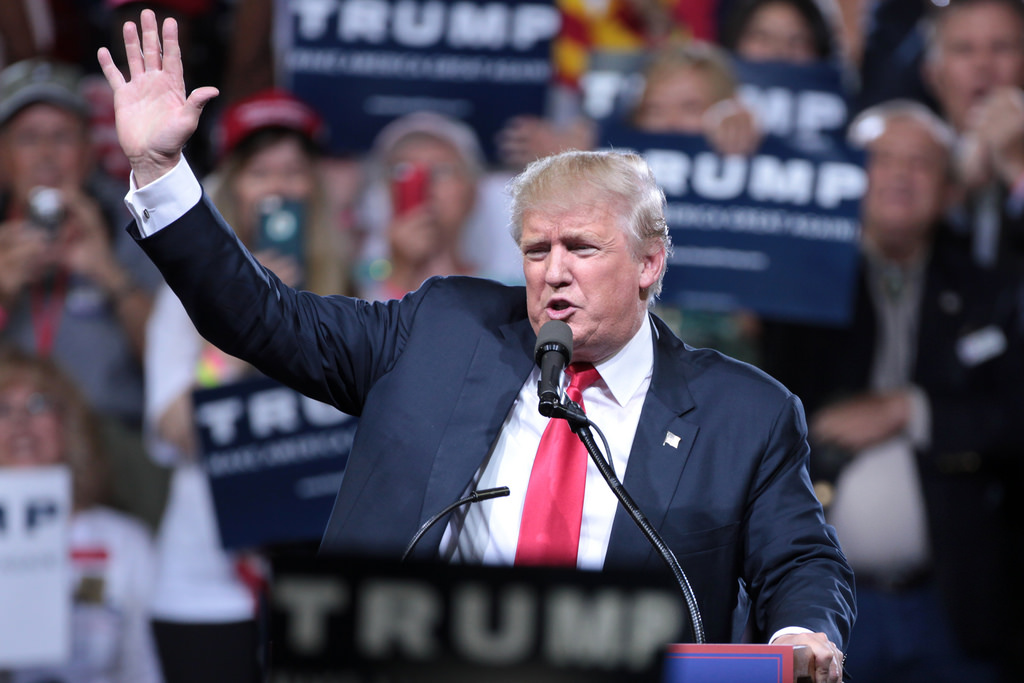
4 Reasons Why Trump Could Still Win the Election
My Democratic friends are all smiles these days. They are happily spiking the election football, but are they doing so on the one-yard line? For it might be too early to write off Donald Trump.
Here are four reasons why “President Donald J. Trump” could still happen.
1. Polls show Trump within striking distance
The polling data are not good for Trump, yet polls don’t win elections — votes do. The polls indicate that Trump is going to lose, but the Republican nominee has repeatedly made the point that the turn-out model being used to gauge who is actually going to head to the polls may be flawed. And he may be right.
With only 270 electoral votes needed to secure the election, RealClearPolitics (RCP) has Clinton/Kaine with 272 as of this writing — but a large number of the ticket’s electoral votes are states still listed in the “undecided” category.
As of this writing, RCP average has the national vote at 45.8 percent for Hillary Clinton and 39.9 percent for Trump, with Libertarian candidate, Gary Johnson, pulling 5.6 percent and Green Party candidate, Jill Stein, at 2 percent. One obvious problem with the polling data being used to gauge support is the inflated numbers for Johnson and Stein. Both ran in the last presidential cycle, and — when the final results were in — Johnson received just 0.99 percent and Stein 0.36 percent of the national vote. It is hard to believe that these two candidates will jump approximately 4 percent and 1.6 percent, respectively.
Looking back at 2012, the polling data was inflated for Johnson and Stein. A CNN poll released on September 10, 2012 had Johnson polling at 3 percent and Stein at 1 percent with likely voters at 4 percent and 2 percent, respectively. Those numbers didn’t pan out then, and we should expect the same distortion in this election.
Currently, Nat Silver’s site, FiveThirtyEight, has Trump with only a 15.3 percent chance of victory. Its map has Clinton winning Nevada, Arizona, Florida, North Carolina, Ohio, and Iowa in a blowout election. But when you drill down into the numbers, FiveThirtyEight has Clinton up only 3.1 percent in Florida, 0.6 percent in Ohio, and 0.3 percent in Arizona. Those low percentages indicate a very close race that are not reflected in the low probability the website gives Trump.
Looking into Johnson’s numbers state by state, it appears that there may be defects to Silver’s calculations as well. FiveThirtyEight has Johnson at 3.9 percent in Florida, yet he received only 0.5 percent in actual votes in 2012. The same flaw also exists in predictions for Ohio: Johnson has 5.7 percent there, yet in 2012 he pulled only 0.9 percent in actual votes. Arizona is even more extreme. FiveThirtyEight is predicting a 6.1 percent vote for Johnson in the state, yet he received 1.39 percent in actual votes in 2012.
This throws all of the swing states into question and may indicate a bias toward third-party candidates that does not really exist in states that have already been allocated to Clinton.
Furthermore, FiveThirtyEight incorrectly predicted that Trump had no chance of getting the Republican nomination, so it seems more than possible it might have this one wrong too. Silver wrote the following on November 23, 2015:
So, could Trump win? We confront two stubborn facts: first, that nobody remotely like Trump has won a major-party nomination in the modern era. And second, as is always a problem in analysis of presidential campaigns, we don’t have all that many data points, so unprecedented events can occur with some regularity. For my money, that adds up to Trump’s chances being higher than 0 but (considerably) less than 20 percent. Your mileage may vary. But you probably shouldn’t rely solely on the polls to make your case; it’s still too soon for that.
Also, look at recent polls from the LA Times and Investor’s Business Daily, and they have Trump ahead.
All of these data points speak to the fact that this race is still undecided.
2. It’s the economy, stupid
The economy sucks, and traditionally the old James Carville adage “It’s the economy, stupid” rings true on Election Day. The American people may be evenly divided on the record of President Barack Obama, yet no one is happy with the state of the economy.
Alex Wagner detailed this at “The Atlantic” on October 21, 2016 in his piece, “Why Economic Growth Is So Lackluster”:
U.S. economic growth is anemic, and the country needs to do something about it, quickly. This was one of the central themes of the third presidential debate. “China is growing at 7 percent. And that for them is a catastrophically low number. We are growing — our last report came out, and it is right around the 1 percent level,” Trump said Wednesday night. “Look, our country is stagnant.”
Trump is right that U.S. growth has not been very impressive of late, especially when compared to rates of the past. Though the United States gross domestic product (GDP) grew at a rate of more than 3 percent for much of the 1980s and 1990s, the rate has slowed significantly since the recession, according to the Bureau of Economic Analysis. In the second quarter of this year, for instance, GDP increased at a rate of just 1.4 percent. After a recession, an economy should come roaring back, but this time around, it hasn’t, and that’s left many concerned about the state of the economy. GDP growth, economists say, helps raise wages and living standards, and increases the size of the entire economic pie — making it possible for more people to have a bigger share.
The American middle class feels squeezed, and people in lower income brackets are hurting. Right or wrong, they blame the federal government for their woes and get enraged by politicians who claim that the economy is doing great. President Obama is constantly bragging that he is responsible for bringing unemployment numbers down, but people who are hurting don’t give a rip about economic numbers. They care about making rent or mortgage payments.
Trump’s economic plans include a massive tax cut that will help the engine of our economy create jobs. Trump also wants to reduce the regulatory burden that is holding back many small businesses. Whether you agree or not, he has tagged the Bill Clinton era’s North American Free Trade Agreement (NAFTA) as one reason why the Rust Belt is in depression.
The one poll number that points favorably to Trump is from CNN/ORC and has Trump over Clinton as the candidate who would better handle the economy. That just may be the tie breaker when voters make last-minute decisions.
3. Hillary is extremely unpopular
Nothing can help Hillary’s serious lack of popularity and the fact that there is a massive trust deficit between her and the voters. From her bogus claim that she was under sniper fire as first lady when she landed in Bosnia to her ever-changing lies about the handling of classified information while head of the State Department to her flip-flopping on the Trans Pacific Partnership trade deal, voters just don’t trust Hillary.
In addition to not being trustworthy, she’s just not funny or likeable. Remember Hillary’s wipe-with-a-cloth joke about hidden emails and a secret server that bombed spectacularly? WikiLeaks disclosures also show she’s tough to deal with as a person, and her staff questions her judgment.
There is also very little enthusiasm for Hillary’s candidacy. The embarrassingly low turnout at her rallies — and for those of her surrogates — speaks to the problem. Just look at how poorly she did in the primaries against Sen. Bernie Sanders, I-Vt. (F, 17%). If Hillary had been challenged by a high-profile Democrat like Sen. Elizabeth Warren, D-Mass. (F, 18%) or Vice President Joe Biden, she surely would not have won the nomination.
Hillary’s ‘unlikeability’ may outweigh or matter more than Trump’s own high negatives when it comes to Election Day.
4. Trump’s message resonates with voters who hate Congress and the political elite
Donald Trump has run a nontraditional campaign. He beats the drum that he can “Make America Great Again,” and that is a powerful slogan. Trump has campaigned against politicians in Washington from both parties. Most Americans agree — they loathe politicians at the national level.
RCP polling shows that the 64 percent of American people believe the country is on the wrong track, while other polling indicates that an enormous 35.4 percent of the electorate may vote for change. The congressional approval rating is even worse, with only 15.2 percent approving of the work of politicians in D.C. These numbers indicate that the American people may want to flip the bird to Washington and elect a bombastic individual who will come to Washington and create political bedlam.
Hillary is part of the political establishment that the American people hate. One could argue that Hillary Clinton is the poster child for insider Washington establishment rage. She has lived her life in the D.C. political bubble for decades and has no connection to average Americans. That is why she makes dumb political pronouncements, such as when she said that she would put “a lot of coal miners and coal companies out of business.”
Is there a silent majority in America that is willing to go into the election booth, look over both shoulders, then grin while voting for Donald Trump as a way to tell Washington to GFY? We shall see.
When your smiling liberal friends try to rub in the idea of Hillary being sworn in on January 20, 2017, tell them to simmer down and wait for the actual tally of the votes. (For more from the author of “4 Reasons Why Trump Could Still Win the Election” please click HERE)
Follow Joe Miller on Twitter HERE and Facebook HERE.