Progressives Think They Can Alter Reality. They’re Wrong.

We will never understand liberals and progressives until we recognize that they often see reality as a social construct subject to being challenged and changed.

For example, throughout the world, boys and girls have different toy preferences. Typically, boys like to play with cars and trucks, whereas girls prefer dolls.

Liberals explain this with the assertion that boys and girls are socialized and encouraged to play with different types of toys by their parents, peers, and “society.”

Growing scientific evidence suggests that toy preferences have a biological origin. Even studies of male and female primates find that they exhibit similar toy preferences.

Despite the growing evidence of biological determinism, liberals have managed to intimidate toy sellers into getting rid of the labels “toys for boys” and “toys for girls.”

Another reality issue that’s extremely annoying to liberals and progressives is chromosomal sex determination.

The XX/XY sex determination system is found in humans. Females have two of the same kind of sex chromosome (XX), whereas males have two distinct sex chromosomes (XY). This chromosomal reality is seen as limiting, annoying, and an artifact of a patriarchal, chauvinistic society.

So liberals and progressives want to change it. Say you are an XY (male) individual but would like to conduct your affairs in a facility designated for XX (female) individuals, such as a ladies’ room. You can satisfy your desire by claiming that you are transgender — that is, you’ve switched from one gender to another. Therefore, if one has XY chromosomes, he can behave as if he were an XXer.

Plus, there is the expectation of being addressed according to one’s chosen gender. The Minneapolis Police Department has a new rule that requires officers to address transgender people using their preferred names and pronouns. When an XYer is arrested but claims he is a woman, I wonder whether the police will place him in a cell with XXers.

Just how far the Minneapolis authorities will go is in question; maybe they, too, believe that reality is optional.

Another part of reality that liberals and progressives find difficult to accept is the fact that equality among humans is the exception and inequality the norm.

If one were to list the world’s top 30 violinists of the 20th century, at least 20 of them would be of Jewish ancestry. Jews constitute no more than 3 percent of the U.S. population but 35 percent of American Nobel Prize winners. One wonders what liberals would propose to promote equality in violin excellence and winning a Nobel Prize.

By the way, liberals and progressives love to attend classical concerts, where there is a virtual absence of racial diversity.

Year after year, blacks of West African descent walk away with all of the prizes in the Olympic 100-meter run. The probability of such an outcome by chance is all but zero.

It must be a reality — namely, genetic physiological and biomechanical characteristics — that causes blacks to excel in certain sports (e.g., basketball, football, and track) and spells disaster for those who have aspirations to be Olympic-class swimmers.

Somehow liberals and progressives manage to cope with some realities but go ballistic with others. They cope well with black domination of basketball, football, and track and with the near absence of black performers in classical concerts. They also accept the complete absence of women in the NFL and NBA.

They even accept geographical disparities. For example, not a single player in the NHL’s history can boast of having been born and raised in Hawaii, Louisiana, or Mississippi.

The reality that they go ballistic on is the reality that we are not all equally intelligent. There are many more male geniuses than female, and median male IQ is higher. Liberals might argue bias in the testing. Men are taller on average than women. If liberals don’t like that, would they accuse the height-measuring device of being biased?

The lesson liberals need to learn is that despite their arrogance, they do not have the power to alter reality. (For more from the author of “Progressives Think They Can Alter Reality. They’re Wrong.” please click HERE)

Follow Joe Miller on Twitter HERE and Facebook HERE.

4 Key Things to Know About Building Trump’s Border Wall

President-elect Donald Trump has legal authorization to move forward on his core campaign promise of building a border wall; he just needs the money to do it.

Trump said he still intends to require Mexico to pay for the wall, but needs congressional appropriation to expedite the process.

Here are four things to know about the border wall.

1. Legal Authorization

The Secure Fence Act of 2006 authorized a 700-mile, double-layered border fence along the U.S.-Mexican border to keep illegal immigrants from entering the United States.

The measure had broad bipartisan support and passed the House by a vote of 283 to 183 in September of that year. It then passed the Senate a couple of weeks later with a vote of 80-19. President George W. Bush signed the bill on Oct. 26.

A fence might seem short of Trump’s promise of a “big, beautiful, powerful wall.” However, Ira Mehlman, spokesman for the Federation of Americans for Immigration Reform, a pro-border enforcement group, said he believes it is essentially in line with Trump’s pledge.

“Fence or wall or barrier, he called for securing the border,” Mehlman told The Daily Signal. “His campaign was about fulfilling the promise of the 2006 law.”

2. How Much of the Wall Is Already Built?

The first layer of the planned double-layered wall is a little over half finished, as is much of the fence to stop vehicles, but the second layer still has a long way to go.

In May 2011, President Barack Obama asserted the border fence is “now basically complete” because the primary and vehicle fencing has been built. PolitiFact said this was “mostly false,” because the secondary fencing was such a key aspect of the fence. When finished, the complete wall is supposed to be wide enough to drive a truck between the two layers.

The Department of Homeland Security has completed 353 miles of primary pedestrian fencing, which runs directly along the border and is intended to prevent crossings on foot. The department also completed another 300 miles of vehicle fencing, which prevents motorized vehicles from crossing.

However, just 36 miles of secondary fencing is finished. This fencing runs behind the primary fencing, usually separated by a patrol road that allows the Border Patrol to monitor the area between fences. Another 14 miles of tertiary pedestrian fencing, which runs behind the secondary fencing, is intended to prevent attempts to cross the border on foot.

Mehlman said these May 2015 numbers on the wall are the most recent, and are about the same as the 2012 numbers regarding miles complete.

The cost of building that much of the existing fence was $2.3 billion, according to the Department of Homeland Security.

3. How Will Congress Pay for It?

Since Congress doesn’t have to pass a stand-alone bill for the wall, the Republican majority reportedly intends to make it part of an appropriations bill that must pass by the end of April. Most media reports are not putting a finite figure on the cost other than in the billions.

The most ambitious estimate was $11 billion, said Jessica Vaughan, director of policy studies at the Center for Immigration Studies, a pro-border enforcement think tank.

She told The Daily Signal she expected it would be less, adding that number is small compared to the estimated $50 billion taxpayers spend each year on illegal immigration costs, from crime to welfare benefits.

Since so many Democrats, including Senate Democratic Minority Leader Charles Schumer of New York, voted for the Secure Fence Act, Republicans reportedly believe they will have a political advantage in pushing the appropriation through. Further, Democrats won’t likely want to shut down the government over stopping the wall, according to Vaughan.

“I don’t think it will be politically difficult for Schumer or others to change their position on border security because so many have already done a total reversal on border security,” Vaughan said. “But shutting down the government, that is something they were severely critical of the Republicans for doing and this would be a popular bill.”

4. Could Mexico Really Pay?

For now, the Trump transition team is not getting into specifics as to when the Mexican government would cover the cost of the wall.

“There will be ongoing discussions with Congress on how to fund and organize [the wall],” Trump transition team spokesman Sean Spicer told reporters Friday during a conference call.

The notion of getting some form of reimbursement from Mexico shouldn’t be outright dismissed, Vaughan said.

“It’s hard for me to see the Mexican government agreeing to write a check for the U.S. wall, but the Trump administration could find ways to extract revenue by withholding remittance, by seizing the assets of Mexican crime syndicates, or reducing foreign aid,” Vaughan said. “It’s not only Mexico. It could be other countries in Central America.” (For more from the author of “4 Key Things to Know About Building Trump’s Border Wall” please click HERE)

Follow Joe Miller on Twitter HERE and Facebook HERE.

Ryan: Reconciliation Bill Will Block Planned Parenthood Funding

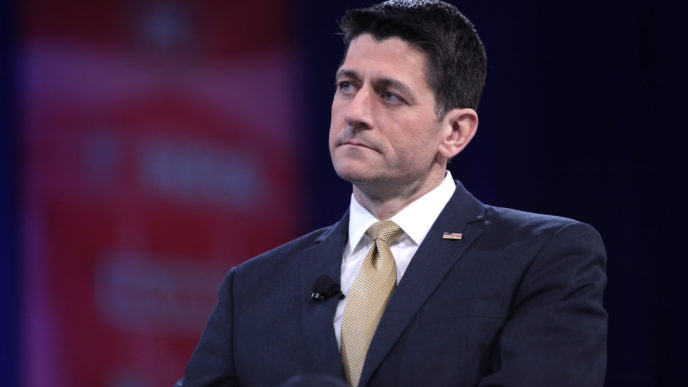
Stopping the stream of federal funding to Planned Parenthood, the nation’s largest abortion provider, will be part of the upcoming budget reconciliation package, House Speaker Paul Ryan said during a press briefing Friday.

This important announcement maintains the strong policy stance Congress took in the 2015 reconciliation bill that would have repealed Obamacare and stopped federal Medicaid funding to Planned Parenthood.

While that bill was vetoed by President Barack Obama, the outlook is much different now with the inauguration of a new president and the start of a new Congress committed to repealing Obamacare and defunding Planned Parenthood.

If the reconciliation bill is crafted as it was in 2015, it would make Planned Parenthood affiliates ineligible from receiving Medicaid reimbursements for one year after the enactment of the bill. Such federal reimbursements constitute a significant portion of the roughly $500 million in government funds sent to the nation’s largest abortion provider each year.

Federal funding could still flow to the many other qualified health care providers that offer the same services as Planned Parenthood affiliates, plus additional services, without entanglement in abortion. In fact, the last reconciliation bill increased funding for these community health centers.

Taxpayer money should not be used to fund elective abortion providers such as the Planned Parenthood Federation of America affiliates. Ending such tax funding has become even more urgent in light of serious and disturbing press coverage of Planned Parenthood representatives discussing the sale of body parts of aborted babies.

Of course, a reconciliation bill isn’t the only tool at Congress’s disposal with regard to defunding Planned Parenthood. To cut off all federal funding streams to Planned Parenthood, Congress should use the appropriations process to disqualify Planned Parenthood affiliates not only from receiving any federal Medicaid reimbursements, but also from receiving grants under specific discretionary programs, like Title X family planning.

Just this week, the Select Investigative Panel on Infant Lives issued its final report, which recommended that Congress defund Planned Parenthood. The Daily Signal’s Kelsey Harkness has highlighted six other disturbing findings in the panel’s report, which further underscores why Planned Parenthood should not receive taxpayer funding.

A reconciliation bill that makes Planned Parenthood affiliates ineligible to receive Medicaid reimbursements is an encouraging step toward ending federal funding for the nation’s largest abortion provider. (For more from the author of “Ryan: Reconciliation Bill Will Block Planned Parenthood Funding” please click HERE)

Follow Joe Miller on Twitter HERE and Facebook HERE.

New Legislation Could Open up Health Care Options After an Obamacare Repeal

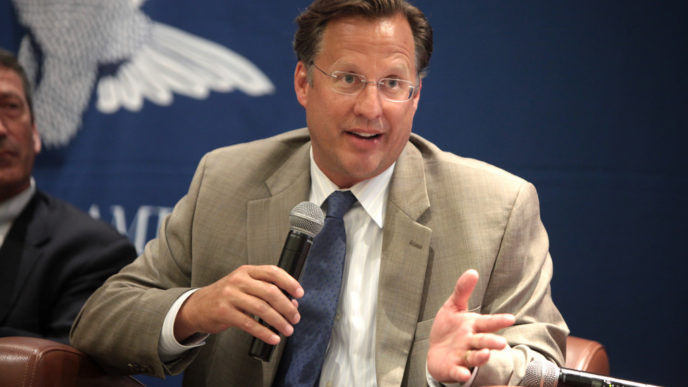
Rep. Dave Brat, R-Va., has introduced a bill in the House that, if passed, will allow individuals to decide how they want their health care funds to be spent, without the influence of the government or health insurance providers.

Brat said that the health savings account legislation is a way for lawmakers to prove to the American people that they have a plan to replace Obamacare after repealing it.

“First and foremost, we are putting through one of the biggest public policy initiatives of the decade with an Obamacare repeal,” Brat told The Daily Signal in a phone interview. “And so that has become very important to people, what you are going to replace it with. People want assurances that they are going to be better off.”

Labeled the Health Savings Account Expansion Act, or H.R. 247, “this bill equalizes the tax treatment for health insurance and care between different ways of paying for it,” according to a statement from Brat.

Mia Heck, the director of the health and human services task force at the American Legislative Exchange Council, or ALEC, told The Daily Signal that health savings accounts help individuals plan for their future.

“A health savings account (HSA) is a pre-tax medical savings account available for taxpayers who are enrolled in a high-deductible health plan,” Heck said in a statement provided to The Daily Signal. “The high-deductible health plan serves as catastrophic coverage, while encouraging individuals and families to save money to use toward future medical expenses. Funds deposited into an HSA are not subject to federal income tax.”

According to Brat, health insurance accounts enable consumers to shop around for plans that best suit their needs.

“Instead of having to get coverage approved from the government, an employer, or an insurance company, people will be able to use their [health savings account] funds directly for the products and services that they value,” Brat said.

Sen. Jeff Flake, R-Ariz., has reintroduced a companion bill in the Senate.

Flake said that the Health Savings Account Expansion Act puts individuals in charge of their health care decisions without penalty from the government or their insurance provider.

“[Health savings accounts] give consumers greater control over their health care dollars by providing them with a tax-advantaged savings option for their medical expenses,” Flake said in a speech Wednesday on the Senate floor. “This means that the dollars they work so hard to save can grow over time, tax-free, and be withdrawn, tax-free, for qualified medical expenses.

The Health Savings Account Expansion Act includes several reforms, according to Brat’s website.

First, it enlarges contribution limits to $9,000 to $18,000 per year for people who file single or jointly.

Second, it removes restrictions imposed by Obamacare for items that are purchased over the counter.

Third, it permits users to allocate health savings account funds to pay their health insurance premiums and other health care costs, such as doctor visits.

Fourth, it simplifies regulations “by eliminating the high-deductible health plan mandate.”

This legislation, according to Brat, is a free-market solution to the health care crisis.

“People are going to be very rational when it comes to allocating your own dollars that the doctor or whatever service you are going for,” Brat told The Daily Signal.

Brat sees his proposed legislation as a way to plan for the future and address the problems Obamacare has created.

“The reason Obamacare policy is so important is because it is right in the middle of Social Security and the Medicare crisis,” Brat said. “Both of those programs are insolvent in 12 years. And the kids won’t get any of those programs if we don’t do something about this.”

The campaign of President-elect Donald Trump has also spoken favorably of health savings accounts.

His presidential campaign website stated that they would be of “great benefit” to individuals. (For more from the author of “New Legislation Could Open up Health Care Options After an Obamacare Repeal” please click HERE)

Follow Joe Miller on Twitter HERE and Facebook HERE.

How Trump’s Presidency Could Retool the Auto Industry

President-elect Donald Trump’s public campaign to push U.S. companies to make their products in America is already having an impact, especially on one of his favorite targets: the auto industry.

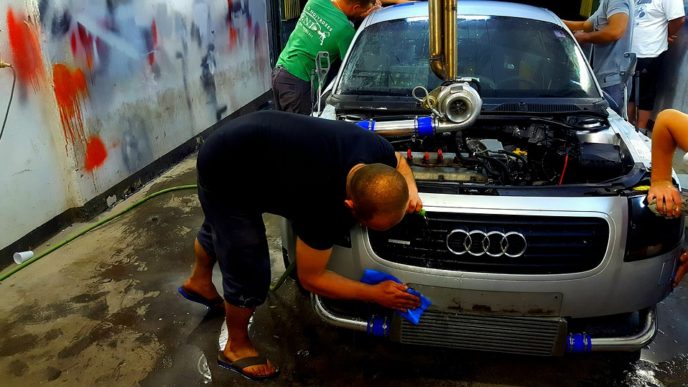
On Tuesday, Ford Motor Co., the nation’s second-largest automaker, said it will cancel a plan to build a small-car assembly plant in Mexico that Trump has criticized, and instead expand a Michigan plant, creating 700 local jobs.

A few hours earlier, Trump had threatened to impose tariffs on cars built by General Motors Co. in Mexico, writing on Twitter: “Make in the U.S.A. or pay big border tax!”

In response to Trump’s attack against GM for selling Chevrolet Cruzes assembled in Mexico to U.S. car dealers, America’s largest automaker quickly defended itself. GM noted that almost all of the 190,000 Cruzes sold here last year actually were made at a factory in Lordstown, Ohio.

Experts say these actions, even if not directly attributable to Trump, showcase potential changes ahead for the auto industry, a sector that is ascendant after selling a record 17.55 million new cars in the U.S. last year.

“It’s bullying, and I don’t think it’s a sustainable way to do business, but Trump’s approach is being reinforced,” Dan Ikenson, who researches international trade and investment policy at the Cato Institute, told The Daily Signal in an interview. “He hasn’t taken the oath of office yet, and he has affected hundreds of millions — if not billions — of dollars in investment decisions, and thousands of jobs.”

Observers of the auto industry contend that investment decisions made by companies such as Ford reflect long-term business goals more than influence from the incoming administration.

Ford Chief Executive Mark Fields said “the primary reason” his company scrapped a $1.6 billion factory slated for San Luis Potosi, shifting production to an existing plant in Mexico, “is just [that] demand has gone down for small cars.”

The new jobs in the Michigan plant, meanwhile, mostly will support Ford’s production of self-driving and electric cars, which the company expects to be popular in the future.

“The U.S. auto industry is clearly at the top of the best cycle we’ve ever had, and even before the presidential election, the industry is acting differently in response to that,” Bernard Swiecki, an analyst at the Center for Automotive Research in Ann Arbor, Michigan, told The Daily Signal in an interview. “We are now plateauing, meaning the building boom in Mexico will slow because the boom was designed to fill the need for capacity.”

Swiecki added:

I don’t think in any of these decisions Trump’s advocacy will be the main driver. The real driver will always be the business case. In the Ford decision, the business case lined up this way, and if at the same time you can curry some political favor with the president, you will take that.

No matter the motive, Swiecki and other experts say, the increasingly globalized auto industry is paying attention and taking the president-elect’s statements seriously.

Trump has vowed repeatedly to impose tariffs on vehicles imported into the United States from Mexico.

Trade experts agree that presidents have wide latitude to impose penalties on imports, at least temporarily, including restricting imports if they pose a national security risk under the International Emergency Economic Powers Act of 1977.

Edward Alden, who studies trade policy at the Council on Foreign Relations, argues that targeting a single company with a tariff would be more controversial, and unprecedented.

“There is nothing that prevents the president from claiming that Ford’s investing in Mexico constitutes a national industrial emergency and to move forward with sanctions,” Alden told The Daily Signal in an interview. “It would be a gross distortion of emergency power, but Trump has indicated he is not terribly constrained by norms and expectations.”

Trump also has frequently criticized and promised to renegotiate the North American Free Trade Agreement (NAFTA), a deal that went into force in 1994 under which the United States does not impose tariffs on products imported from Mexico and Canada.

Alden said that since the mid-1960s, the auto industry has been integrated across North American borders, starting with the Auto Pact of 1965, a trade agreement between the U.S. and Canada that allowed for tariff-free imports and exports.

“If you really try to create a build-it-in-America auto industry, you have to undo more than 50 years of history,” Alden said, adding:

The auto supply chain operates on a continental basis. If Trump blows that up by increasing the price of an imported vehicle with tariffs, it could reduce overall vehicle sales and cause manufacturers’ costs to increase substantially. This would force a massive restructuring of the industry.

Imported vehicles have become central to the American market, equaling more than 40 percent of annual volume.

Since the U.S. recession, automakers have committed big investments to new plants in Mexico to take advantage of cheap labor.

According to the Center for Automotive Research, of the 11 assembly plants announced to be built in North America since 2009, nine were planned for Mexico.

The nonprofit, independent research center reported that from 2013 to late 2016, carmakers invested $68.5 billion in North America, a total that includes new plants as well as expansions and updates to existing facilities.

Seventy-two percent, or $49.4 billion, of that investment went to the U.S.

While American car companies say they have moved jobs to Mexico to remain competitive, they also invested in the U.S., creating jobs in design and engineering or in plants making parts for Mexican factories.

“The idea that something is made in the U.S. or made in Mexico is an outdated notion,” Bryan Riley, a trade policy analyst at The Heritage Foundation, told The Daily Signal. “With cars, whether final assembly is in the U.S., Mexico, or somewhere else, you have components from all over the world.”

Riley added:

That is something that benefits Americans. You don’t want to go on a path that we are better off if we make everything in the U.S. We are much better off to say Americans have the freedom to spend and invest money where they want, and no one in Washington, D.C., should be interfering with those decisions.

(For more from the author of “How Trump’s Presidency Could Retool the Auto Industry” please click HERE)

Follow Joe Miller on Twitter HERE and Facebook HERE.

From Transgender 101 Class to Puppies for Stress Release, Is the Naval Academy Going off the Deep End?

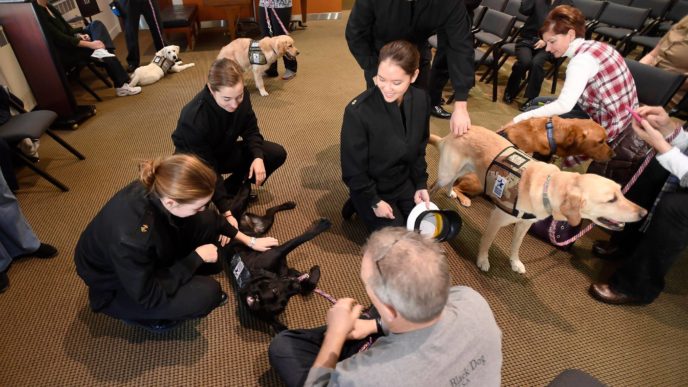
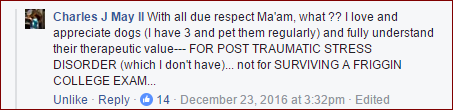
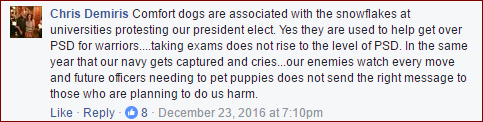
Last November, the Naval Academy offered “Transgender 101” classes to staff and Midshipmen. A few weeks later, after having lost to Army 17-14 (their first loss in 15 years), the Midshipman are provided puppies for stress relief during finals. While no one thinks ill of a Midshipman in uniform petting a puppy in downtown Annapolis, the image of needing man’s best friend for stress relief during finals at the Naval Academy isn’t sitting too well with many of their Facebook followers, most of whom are associated with the Navy – fans, old salts, and many USNA grads.

Puppies and other furry friends are of course a great salve for many things – hospital patients, lonely elders, the blind, and more recently, those who suffer from PTSD. So the specter of requiring a salve for something that Midshipman have been doing since 1845 doesn’t quite compute when compared to those who have really suffered in the face of a relentless enemy.

Negative comments ranged the gamut –

comment1

comment2

comment3

comment5

comment6

There were also plenty of light-hearted comments busting on the hard-liners, and who doesn’t love a puppy? But what is the mission of the Academy ? It’s to produce warriors who are not afraid of the enemy and are willing to lay their life on the line.

newsflash%2c-impose-stress

Is softness accepted at the Academy? Last September, LT David Nartker (USNA 2011) was issued a punitive letter of reprimand for his role in the capture of two USN boats by Iran in January 2016, for violating Article 92, “failing to obey an order or regulation”.

The entire event was attributed to “failure at every level”, to include the critical junior leadership level and to a “lax culture for US Navy sailors,” in a devastating report from military investigators”.

comment4

And while the Navy often gets chided in good fun for safe surroundings, the SEALS and sailors face grave danger daily all across the globe. Anyone stationed in or close to the Middle East is in harm’s way just for being an American, let alone one in uniform. The USS Cole was bombed in a terrorist attack in Oct 2000, with the loss of 17 sailors and 39 injured. And last January’s embarrassing capture of two Navy boats is testament that a Naval Academy graduate’s “moment of truth” is going to come without notice, and his or her training – in toughness – will make or break the engagement.

Don’t forget that Naval Academy graduates also serve in the Marines, the same Marines which have produced General James “Mad Dog” Mattis (Central Washington U, 1971), recently nominated by President Elect Trump for Secretary of Defense and General John Kelly, commissioned as a second lieutenant via Officer Candidate’s School in 1975, and recently nominated for Secretary of Homeland Security. ’62 USNA graduate John Ripley, Colonel USMC, is memorialized at the Academy for heroism in stopping he North Vietnamese Army’s advance into South Vietnam.

While all of these men embody toughness, no doubt they have compassion for their countrymen and especially their troops. But would they encourage furry friends as a means for building toughness to lead a strong military?

Compassion and diplomacy are critical characteristics for officers at all levels. So is toughness. The ability to handle stressful combat situations is based on training in handling stress, not on looking for the nearest puppy or kitten as soon as the stress level goes up. Let’s hope the Naval Academy doesn’t forget this.

Finally, one thing you should never do is give your enemy “talking points” about your weakness. One can only imagine the West Point cadets salivating at this gift of ridicule and humor, to be on national display in Philadelphia on December 9 this year.

west-point-field-day

Follow Joe Miller on Twitter HERE and Facebook HERE.

Was the Video Torture of a Handicapped “Trump Supporter” Really a Love Crime?

Chicago police just couldn’t decide whether the kidnapping and video-livestreamed torture of a learning disabled white man constituted a hate crime or just kids being “stupid.” As Fox 32 reported:

The footage shows the suspects kicking, hitting and cutting the hair of the victim while he was gagged. Shouts of “F*** Trump!” and “F*** white people!” can be heard in the background.

At one point, the victim is held at knife point and told to curse President-elect Donald Trump. The group also forces the victim to drink water from a toilet.

The victim was held hostage for at least 24 hours and as long as 48 hours.

The American Mirror commented: “To listen to the initial reaction of Chicago Police Superintendent Eddie Johnson, the filmed shock attack on a white special needs resident … was just kids being kids.” It quoted Johnson:

Some of it is just stupidity. People just ranting about something they think might make a headline. … At this point we don’t have anything concrete to point to to suspect it’s a hate crime, but we’ll keep investigating and let the facts guide us on how this concludes.

Now, there is good reason to question the whole idea of a “hate crime.” Why should it matter from a legal point of view precisely why a criminal attacks someone and violates his right to life, liberty, or property? Was the record-setting murder spree that engulfed Democrat-run Chicago in 2016 — which largely saw non-whites killing non-whites — a wave of “love crimes,” since those murders weren’t racially motivated?

But granting that the legal category of hate crime does exist, why was there the slightest reluctance to label what these four vicious young people did a hate crime? They used racial epithets (check), targeted a member of another race (check), and forced him at knife point to denounce a white politician (check). It sounds like it fits the bill.

What would have happened if four white kids from Donald Trump’s native Queens had reacted to Barack Obama’s election in 2008 by kidnapping a handicapped black teen and forcing him to damn Obama at knife point? The entire racial grievance industry, the mainstream media, and the federal government would have swung into action to address a “national crisis” of white-on-black political violence.

What Matters Isn’t the Victim, but the “Narrative”

The media reactions to this crime were different, to say the least. The iconic Washington Post let columnist Callum Borchers blow right past the horror inflicted on a helpless, imprisoned American, to focus on the dangerous “pro-Trump” “narrative” which this attack could be used to bolster — the idea that just as white people can target black people for crimes, it can also work the other way around. We see here the mind of an ideologue, trapped in its little Habitrail, scurrying left and right to avoid the plain and ugly facts and obtain its little pellet of “social justice.”

Why did it take many long hours for Chicago police to classify this obvious hate crime as a hate crime, and charge the attackers accordingly? Indeed, they might not have done so without the explosion of public comment, admirably led by Paul Joseph Watson, a gadfly at Alex Jones’ InfoWars:

Only Whites Can Be Racist, Got It?

Why is there a double standard on hate crimes? For the same reason that leftists deny that black hatred for whites (or Asians or Jews) can constitute racism:

Because whites have all the institutional power in society, and “racism” is defined as an act that perpetuates institutional power. So when black rioters targeted Korean grocers during the Los Angeles riots, beat them bloody, called them “gooks” and burned their businesses, what they were doing wasn’t “racist.” You have to call it something else.

I had this principle of cultural Marxism carefully explained to me at an official gathering called by the Catholic Diocese of Baton Rouge, which priests and church employees were forced to attend, back in the early 90s. Clearly someone in the church had taken his Saul Alinsky training and put it to use.

It’s a gross oversimplification to lump together all people of the same ethnic group as having the same power or “privilege.” White coal-miners in Appalachia who have been put out of jobs by Obama administration regulations clearly have less institutional power than my black classmates from Yale enjoy. To lump people together in broad racial categories and grant them different treatment under law… that in fact sounds more like the classical definition of racism. (For more from the author of “Was the Video Torture of a Handicapped “Trump Supporter” Really a Love Crime?” please click HERE)

Follow Joe Miller on Twitter HERE and Facebook HERE.

Unlikely Allies? Ted Cruz and Lindsey Graham Join Forces to End the UN’s Taxpayer Gravy Train

Republican offices in the Senate are fully committed to bringing legislation forward to stop full or partial U.S. funding to the United Nations. A bill that withdraws commitments to the U.N., or puts in place conditions for further support, can be expected in the next couple weeks, Senate sources confirmed to Conservative Review.

Senate offices have become irate with the international body’s treatment of the state of Israel in particular. And they have expressed dismay with how the U.N. as a whole has continued to act against American interests.

A bipartisan bill is expected to pass Congress Thursday or Friday condemning the United Nations for its anti-Israel approach. However, to several congressional offices, merely objecting to another wrongful U.N. vote is not enough to change the institution’s tyrannical behavior.

Senators Lindsey Graham, R-S.C. and Ted Cruz, R-Texas are building a coalition to bring forward these efforts on the Senate side. Their offices are currently drafting the legislation, which is expected to be made public in the coming weeks.

Graham and Cruz’s proposal and other defund-U.N. efforts have already received public support from Sens. John McCain, R-Ariz., Tom Cotton, R-Ark., Marco Rubio R-Fla., and James Lankford, R-Okla. Additionally, Sen. Rand Paul, R-Ky., has supported the dissolution of the U.N. in its entirety.

The move comes after the United Nations decided to pass a late December resolution demonizing Israel, which the Obama administration let through thanks to their abstention at the Security Council. The resolution castigated Israel on “settlements” and falsely claimed that Israel’s holiest sites and cities belonged to Palestinians.

The United Nations costs the American taxpayer over $3 billion a year, not including the hundreds of millions of dollars in lost real estate value on the Manhattan East Side from the U.N. headquarters and countless diplomatic buildings.

“As the Chairman of the Subcommittee on Foreign Operations of the Senate Appropriations Committee, I oversee the United States assistance to the United Nations. The United States is currently responsible for approximately 22 percent of the United Nations total budget,” Sen. Graham said before the resolution, warning there would be severe consequences for the continued bullying of Israel.

“If the United Nations moves forward with the ill-conceived resolution, I will work to form a bipartisan coalition to suspend or significantly reduce United States assistance to the United Nations,” he added.

On the House side, Conservative Review has learned that GOP leadership is discussing with conservative legislators potential strategies that would result in a vote coming to the floor in late January.

Leadership has “made a commitment” to propose additional avenues later in January that will provide more direct pathways toward expressing “Congress’ displeasure with the U.N. action,” a conservative House member tells Conservative Review.

BuzzFeed reports that members of President-elect Donald Trump’s transition team have not yet committed one way or another when it comes to U.N. funding. Before the international body voted to condemn Israel, Trump took to Twitter to express his disgust with the U.N., and pledged to have Jerusalem’s back once he got into office. Trump has also been highly critical of the Obama administration’s series of attacks against Israel.

Currently, the United States continues to fund several anti-American U.N. institutions, including UNRWA, which has embedded itself with Palestinian terrorists; UNESCO, which denies Jewish and Christian claims to the Holy Land; and the U.N. Human Rights Council, which has a membership roster that includes the most dictatorial nations in the world. (For more from the author of “Unlikely Allies? Ted Cruz and Lindsey Graham Join Forces to End the UN’s Taxpayer Gravy Train” please click HERE)

Follow Joe Miller on Twitter HERE and Facebook HERE.

How Black Democrats Stole Votes in Alabama… And Jeff Sessions Tried to Stop It

The Left has lobbed many false charges at Sen. Jeff Sessions, R-Ala. (C, 78%), Donald Trump’s nominee for attorney general. But perhaps the most outrageous claim is that he tried to suppress African-American voters in 1985 by pursuing a voter fraud prosecution in Perry County, Alabama.

The bogus accusation would be laughable, were it not such a familiar tactic. But this is just another instance of so-called “progressives” going all out to protect their own — even when the victims are black voters.

Perry County is a rural county of about 10,000 residents in west-central Alabama in an area known as the Black Belt for its dark, rich soil. Its population is majority black (68.7 percent, according to the 2010 census) and overwhelmingly Democratic (Barack Obama received 73 percent of the vote in 2008). The key to winning any local office in Perry County is to win the Democratic primary.

Perry County has long been plagued by accusations of voter fraud in local elections. As former Alabama Democratic congressman Artur Davis said, “The most aggressive contemporary voter suppression in the African American community” that he saw in Alabama was “the wholesale manufacture of ballots, at the polls and absentee, in parts of the Black Belt.”

On April 20, 1983, a local county grand jury (with a majority of black members and a black foreperson) issued a report concerning problems in the balloting process that targeted the “aged, infirmed, or disabled.” The grand jury called for the “vigorous prosecution of all violations of the voting laws” and requested “the presence and assistance of an outside agency, preferably federal, to monitor our elections and to ensure fairness and impartiality for all.”

But Sessions, the U.S. Attorney in the region, did not open a federal investigation into the 1982 election. In his Senate Questionnaire for the attorney general nomination, he explains that he was hoping it wouldn’t be necessary, that the county grand jury report would cause local activists to “conform to the law.” Unfortunately, that did not happen.

Instead, as LaVon Phillips, a black legal assistant in the Perry County district attorney’s office, later testified, her office received numerous complaints during the 1984 election cycle. Black voters and incumbent black officials reported that voters were receiving absentee ballots they had never requested. Moreover, she testified that local candidate Albert Turner was illegally picking up absentee ballots from voters.

A handwriting expert concluded that Turner had written in his own name on some of the absentee ballots. Other black voters had gone to the polls only to be told that someone had already voted in their names by absentee ballot.

What was happening? Perry County was embroiled in an intense political fight pitting one set of black Democratic candidates against another. But one side was apparently willing to do anything to win.

All of this culminated in the 1984 Democratic primary in which key county commission seats, as well as the tax assessor’s post and other local offices, were on the line. With one exception, all the serious candidates were black.

A week before the primary, Sessions said he received a call from District Attorney Roy Johnson informing him that two black Democratic candidates opposed by Turner — Reese Billingslea and Warren Kinard — “were convinced that fraud was occurring in the election.” Turner and others were collecting large numbers of absentee ballots that “were being taken to a central headquarters where the ballots were altered to ensure that they were marked for candidates endorsed by Turner.”

Billingslea and Kinard had information that the altered ballots would be taken to the county post office the night before the election to be mailed. They were “extremely concerned about the election and believed it was being stolen from them.” And sure enough, the night before the election, Turner and his wife Evelyn showed up at the post office with more than 300 ballots, while their co-conspirator Spencer Hogue, showed up with 170. All told, Turner and his minions mailed 504 of the 729 absentee ballots cast in the election.

According to Sessions, FBI analysis showed that at least 75 of the ballots had been altered, and 25 voters said they had not given their ballots to the Turners or Hogue for mailing. One African-American family of six voters (the Sheltons) testified that they had not given permission to change their votes — particularly since the candidate they had originally voted for was their cousin! Ultimately, Turner admitted changing the Sheltons’ absentee votes.

A 34-page federal grand jury indictment filed on Jan. 25, 1985 lays out in great detail the actions of the Turners and Hogue in the voter fraud case. The object of the conspiracy was to elect the candidates they had “supported and endorsed.” According to the indictment, they used Evelyn Turner’s position as a notary public to witness absentee ballots falsely in furtherance of the conspiracy.

The indictment also gives the lie to the spurious claim recently made by former Massachusetts Gov. Deval Patrick, a member of the Turner/Hogue defense team. In a letter to the Senate Judiciary Committee, Patrick claims that Sessions based the case on the legal theory that it was a federal crime “for someone to help someone else to vote or to advise them how they should vote — even if and when they ask for such help.” As the indictment makes clear, that was not the theory of the case.

Neither the Turners nor Hogue were prosecuted for assisting voters. The indictment charges them with picking up absentee ballots to “open and fraudulently change those ballots that had not been marked for candidates supported and endorsed” by the defendants. They were prosecuted for allegedly casting “false, fictitious, spurious and fraudulently altered absentee ballots.”

Yet somehow, the Left would have us believe that this was a racist prosecution.

It’s a totally fabricated claim, spun from thin air by Sen. Ted Kennedy and his allies to block the 1986 appointment of Sessions to the federal bench and now resurrected by the NAACP and Democrats.

A Dec. 28, 2016 interview with Craig Donsanto confirms the deception. Now retired, Donsanto was the long-time head of the Election Crimes Unit inside the Justice Department’s Public Integrity Section of the Criminal Division of the U.S. Department of Justice. Donsanto, who is now retired, was well-known in the U.S. election community and was a nationally recognized expert on election crimes.

Donsanto wrote the Justice Department’s manual on “Federal Prosecution of Election Offenses,” which is distributed to the 93 U.S. attorney’s offices across the country. During his more than 40 years as a prosecutor, Donsanto was the go-to authority inside the Justice Department for all election crime prosecutions — including the Perry County case. No one could file such a case without getting his OK.

Donsanto remembers the Perry County case well. Indeed, he was in Alabama at the federal courthouse when the grand jury voted to return the indictment, thereby initiating the formal charges.

“No federal prosecutor faced with the evidence seen by the grand jury would have failed to take the case and go forward with the prosecution,” Donsanto told me. “The evidence in the case was overwhelming. I was there with the other assistant U.S. attorneys and not one dissented — everyone thought it was a solid case. I told Jeff Sessions to go forward with the case.”

Donsanto did more than that. He helped prepare the indictment.

Donsanto is highly offended by any claims that the prosecution was racist. The federal prosecutors were “trying to protect black voters who were having their votes stolen,” he notes. Moreover, the investigation was initiated only after local black voters and candidates complained to the Justice Department. When asked about the fact that a jury found the defendants not guilty, Donsanto says that as a former federal prosecutor, he respects the jury system.

But there is no question in Donsanto’s mind that, given the overwhelming evidence of wrongdoing, this was an example of “jury nullification.” The defendants, he notes, “were local civil rights activists, and the jury was not going to find them guilty no matter what they did.”

How otherwise could one account for the jury, for example, discounting the testimony of all six members of the Shelton family that Turner had changed their ballots without their permission or knowledge?

The false claim of racism to cover up wrongdoing and the power struggle between black Democrats in Perry County, as well as the methods used to steal absentee ballots, is eerily similar to another voter fraud prosecution conducted by the Justice Department in nearby Greene County, Ala., 10 years later. Craig Donsanto was also intimately involved in that prosecution.

Greene County has almost the same size population as Perry County and is 80 percent black. Just like in the Perry County case, the Justice Department received calls from black Democratic candidates who said their election was being stolen through absentee ballot fraud by other black candidates and activists.

Suitcases full of absentee ballots were brought to the county post office the day before the 1994 election. The result of the federal investigation showed that the defendants submitted hundreds of fraudulent absentee ballots created through an assembly line process that forged signatures, altered ballots, and convinced some voters to sign blank ballots.

Fortunately, jury nullification did not happen in Greene County. Eleven local officials and activists were eventually convicted. But just as in Perry County, the Greene County defendants and civil rights organizations like the NAACP and the Southern Christian Leadership Conference (whose treasurer was convicted in this case) falsely alleged that the prosecution was a racist conspiracy intended to suppress black voters through “Gestapo” tactics. The NAACP Legal Defense Fund even defended some of the vote stealers, and NAACP officials met with Attorney General Janet Reno to try to convince her to drop the prosecution.

John Kennard, the first black official ever elected in Greene County, was one of the candidates who first contacted the FBI. He was outraged by the accusations made against the prosecutors and by the intercession of civil rights organizations on the side of the voter fraud conspirators instead of on behalf of the black candidates whose votes had been stolen.

In an angry letter to Julian Bond, then chairman of the NAACP, Kennard wrote that helping the vote stealers was “tantamount to … defending the policemen that used the fire hoses and dogs, and Eugene ‘Bull’ Conner in Birmingham, in the early 1960s.” According to Kennard, the defendants “knew they had a fail-safe way out, when all else fails … cry racism, intimidation and pretend they are victims when they were the perpetrators of this crime.”

In Perry County, Jeff Sessions and the other Justice Department lawyers were trying to protect black voters from having their right to vote stolen — a precious right that those voters had fought very hard to obtain during the civil rights battles of the 1950s and 1960s. Unfortunately, a jury let the defendants off despite the evidence in the case, including testimony from black residents of the county about how their ballots had been altered and changed without their permission. And that is the real tragedy of this case.

As Craig Donsanto says, this was a prosecution intended to preserve and protect the right to vote, something to which he dedicated his entire professional career. Anyone who claims this was a racist prosecution by Jeff Sessions is, according to Donsanto, “a liar and a political opportunist of the worst kind.” (For more from the author of “How Black Democrats Stole Votes in Alabama… And Jeff Sessions Tried to Stop It” please click HERE)

Follow Joe Miller on Twitter HERE and Facebook HERE.

How Obamacare ‘Repeal and Replace’ Became a ‘Bait and Switch’ Monstrosity

Earlier this week, we warned that absent a major course correction, Republicans plan to keep the insurance regulations — the most onerous part of Obamacare, which is responsible for permanently destroying the insurance market.

Hence there is no repeal of most of Obamacare, just the funding mechanisms, such as the subsidies and the individual mandate. Worse, they are considering preserving some of the tax increases of the law in order to fund “the replacement” of the subsidies with … subsidies in-all-but-name-only (on top of the $1 trillion we spend on federal-run health care, not including state expenditures).

Earlier today, CQ posted an article which confirms these suspicions — that “Republicans consider keeping some Obamacare taxes intact” (subscription required):

Ways and Means Chairman Kevin Brady, R-Texas, whose committee has jurisdiction over the law’s taxes in the House, suggested the issue is part of the ongoing discussion, but that no decisions had yet been made.

“As we look at the deal, as we look at the numbers, and more importantly, the step-by-step approach to make health care more affordable, the taxes themselves become a part of that discussion,” Brady said. “Truly, no decisions have been made yet. We’re looking at the universe of options there.”

A Senate staffer suggested a similar discussion had come up among members this week.

Whether they ultimately keep some of the taxes or give into conservative pressure to include all Obamacare taxes in the repeal bill, the die is already cast on their “replace” bill. It is quite evident that they plan to create a massive entitlement built on top of preserving the insurance regulations and therefore are in need of an enormous pot of savings and revenues to fund the new scheme. The truth is the lobbyists for the health care industry want to continue a massive stream of subsidies and that is driving much of this perfidy:

Several lobbyists indicated that waiting to repeal some of the law’s more unpopular taxes, like the Cadillac tax, could entice some interest groups to work more closely on the replacement effort. It would also increase the savings associated with repealing the legislation, which could change the negotiation dynamics.

The mix of not repealing the price-hiking insurance regulations and replacing the existing subsidies with a new form of subsidies is a toxic combination. In fact, it is simply a bait-and-switch of the existing core of Obamacare.

I would define the main component of Obamacare in one sentence as follows: Require that private insurance companies offer coverage that is actuarially insolvent and unsustainably expensive and then offer massive taxpayer subsidies for families to afford those unsustainable plans, which in turn artificially inflates the price of insurance even more, which in turn engenders an even greater need for subsidization.

That is essentially the general cycle of government intervention in a nutshell, most dramatically embodied through Obamacare in particular. And that is essentially what will result from the GOP bait-and-switch plan to maintain the insurance regulations and concoct massive subsidies through refundable tax credits.

This plan will not only raise the cost of health care/health insurance and engender a greater need for government subsidization of unaffordable “private” plans, but it will also distort the health care market in general for the existing government-run programs, such as Medicaid.

The cost of covering an individual in the subpar Medicaid program was $3,247 per individual in 2011 before Obamacare was enacted. In 2015, according to data from the Department of Health and Human Services, the cost of enrolling an individual in Medicaid doubled to $6,366 per individual. And that is only for the second year of implementation. The cycle of regulation, public funding, overutilization, and lack of ability to peg the cost to the service has created a circuitous death spiral of unaffordable costs and unsustainable subsidies.

This cycle of failure is nothing but a handout to hospitals and insurers. Anyone concerned with helping the most people and creating a sustainable pro-growth economy would focus on lowering costs through deregulation, limiting subsidization, restoring insurance to its original purpose, and empowering individuals to have portable control over their own destiny through expanded HSAs.

Yet, Republicans are pursuing the elusive utopian goal of universal coverage (Obamacare in-all-but-name-only) because that has long been the official position of K-Street and the Chamber of Commerce. A more efficient socialism is good for their clients.

Nothing about this past election has changed the political barometer and priorities of GOP leaders in Congress. It’s one big bait-and-switch. It is now up to the president-elect and his likely influential vice president to make good on their promise to fully repeal Obamacare and replace socialism with the free market. (For more from the author of “How Obamacare ‘Repeal and Replace’ Became a ‘Bait and Switch’ Monstrosity” please click HERE)

Follow Joe Miller on Twitter HERE and Facebook HERE.