13 of Trump’s Cabinet Nominees Await Senate Approval, Leaving Agencies Without a Leader

President Donald Trump moved at a blistering pace to fulfill several campaign promises during his first week in the White House. At the other end of Pennsylvania Avenue, however, 13 of his Cabinet nominees continue to wait for confirmation votes.

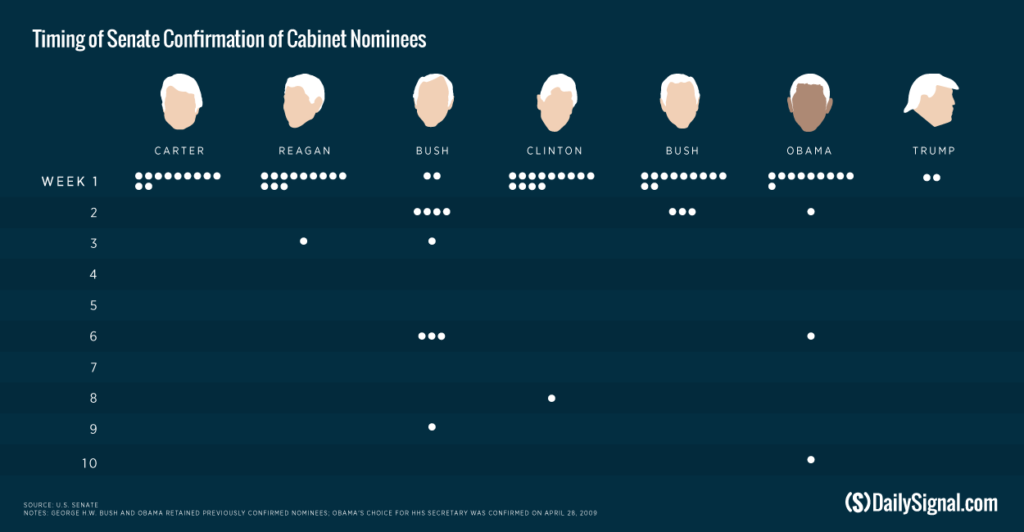
Obama had 11 of his 15 Cabinet secretaries in place after his first week. Trump has two.

Trump begins his second week with the same number of Cabinet secretaries as last week: two. That number should at least double by Tuesday after the Senate votes to confirm Rex Tillerson for secretary of state and Elaine Chao for secretary of transportation.

The slow pace of confirmations is delaying Trump’s ability to implement his agenda, several former administration officials told The Daily Signal.

It’s also a sharp contrast from President Barack Obama’s early days. Trump’s Democrat predecessor had 11 of his 15 Cabinet secretaries in place after his first week (including Robert Gates, who remained as defense secretary from the prior administration).

Five of the past six presidents—Jimmy Carter, Ronald Reagan, Bill Clinton, George W. Bush, and Obama—had nearly their entire Cabinet installed by their second week in the White House. President George H.W. Bush faced delays, but he had the advantage of retaining three of Reagan’s Cabinet secretaries.

This week’s planned confirmation votes on Tillerson and Chao, coupled with committee action on several other nominees, should generate some movement after the GOP-controlled Senate made little progress last week. (See list at bottom for this week’s schedule.)

Last week, Republicans left town for a three-day retreat in Philadelphia, but they did confirm two non-Cabinet officials: Mike Pompeo to lead the CIA and Nikki Haley as U.S. ambassador to the United Nations. On Jan. 20, Inauguration Day, the Senate approved James Mattis for defense secretary and John Kelly for homeland security secretary.

Democrats have vowed to mount a fight against at least eight of Trump’s nominees, including Tillerson. Due to a rules change that Democrats made in 2013 while they were in the majority, however, they lack the votes to ultimately defeat Trump’s nominees. It now takes a simple majority to confirm nominees, and Republicans control 52 seats compared to the Democrats’ 48. Senate Minority Leader Chuck Schumer still can employ delaying tactics, though.
170120_Confirmation-Timing-1024x532

Such delays could stall the Trump administration’s ability to implement policies or carry out executive orders, said Don Devine, director of the Office of Personnel Management under Reagan.

“This is a president who wants change, and he has got to get his nominees confirmed as soon as possible if he is going to get that change,” Devine told The Daily Signal.

Continuity of government is usually not a problem, but implementing the president’s agenda is, said Becky Norton Dunlop, the Ronald Reagan distinguished fellow at The Heritage Foundation. Dunlop served in the Reagan administration at the White House, Justice Department, and Interior Department.

“From the standpoint of taking control of the government, it’s important for the president to employ people to act,” Dunlop told The Daily Signal.

Most of Trump’s nominees ultimately will be confirmed, Dunlop said. She said this is just an effort by Schumer, D-N.Y., to curb their effectiveness. The minority leader knows that the longer it takes for Trump’s nominees to win Senate approval, the later they’ll start implementing the new president’s agenda.

“This is a way to damage these nominees that might have a more conservative agenda under President Trump and discourage them from moving forward aggressively,” Dunlop said.

For example, Tom Price, the Georgia congressman who Trump nominated to lead the Department of Health and Human Services, will play a crucial role when it comes to dismantling Obamacare.

One of Trump’s first actions directed his administration to rework the health care law’s numerous regulations. But without a secretary in place, there’s no one leading the charge at the agency.

Price, like Tillerson, is on Schumer’s list of eight nominees who Democrats oppose. The others include Betsy DeVos for education secretary, Steve Mnuchin for treasury secretary, Andrew Puzder as labor secretary, and Jeff Sessions for attorney general. Schumer’s list also includes Scott Pruitt to head the Environmental Protection Agency and Mick Mulvaney for the Office of Management and Budget, although they aren’t part of the Cabinet.

The remaining unconfirmed Cabinet nominees include Ben Carson for housing and urban development secretary, Rick Perry for energy secretary, Sonny Perdue for agriculture secretary, Wilbur Ross for commerce secretary, David Shulkin for veterans affairs secretary, and Ryan Zinke for interior secretary.

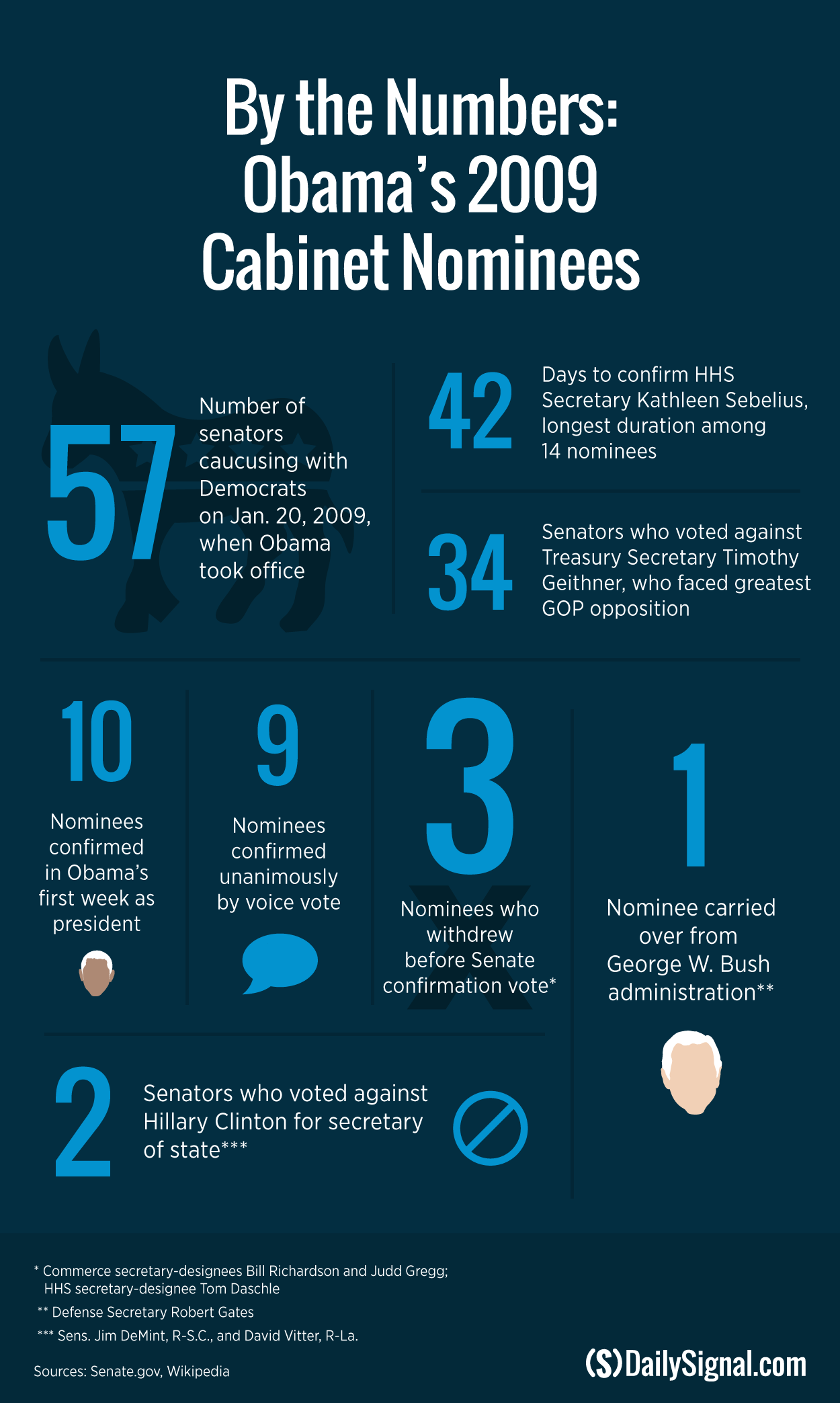
Republicans were in the Senate minority in 2009 when many of Obama’s nominees won quick confirmation without obstruction or delay. In fact, nine of Obama’s nominees were approved by voice vote, meaning Republicans didn’t even request a roll-call tally.
170103_2009-cabinet-picks_v3

Despite having 57 Democrat senators on Jan. 20, 2009, Obama’s final Cabinet secretary wasn’t confirmed until April 28 of that year. Two of his picks for commerce secretary withdrew, as did former Senate Majority Leader Tom Daschle, whom Obama picked to lead the Department of Health and Human Services.

The vacancy hampered the health agency when the swine flu outbreak occurred, recalled Tevi Troy, who served as a deputy secretary at HHS during the George W. Bush administration.

“It is a problem because these agencies are not able to be totally effective without a secretary at the top of the agency giving direction to assistant secretaries for the entire agency,” Troy told The Daily Signal.

During the interim period before a Cabinet secretary is confirmed, the acting agency head could be either a career employee or a political appointee designated by the previous administration. Either way, the White House designates someone to work with the acting secretary during the interim.

“The tradition has been that in the first day or the first week, a lot of nominees are confirmed,” Troy said. “My view is that if a nominee is both ethical and qualified, then the Senate should defer to the president’s choice for a Cabinet nominee.”

Schedule for Week of Jan. 30

Monday: Senate confirmation vote for Rex Tillerson, secretary of state; Senate Finance Committee vote on Steven Mnuchin’s nomination for treasury secretary

Tuesday: Senate confirmation vote for Elaine Chao, secretary of transportation; Senate Judiciary Committee vote on Jeff Sessions’ nomination for attorney general; Senate Energy and Natural Resources Committee vote on Ryan Zinke for interior secretary and Rick Perry for energy secretary

Wednesday: Senate Homeland Security and Governmental Affairs Committee vote on Mick Mulvaney for director of the Office of Management and Budget (Mulvaney also needs approval from the Senate Budget Committee) (For more from the author of “13 of Trump’s Cabinet Nominees Await Senate Approval, Leaving Agencies Without a Leader” please click HERE)

Follow Joe Miller on Twitter HERE and Facebook HERE.

Chief Justice Roy Moore’s Lonely Fight against Judicial Tyranny

[Editor’s note: if you want to help Roy Moore in his fight against judicial tyranny, radical gay activists, and agents of the Southern Poverty Law Center, please go HERE]

U.S. federal courts have aggressively attacked state sovereignty over the past several decades. Whether it was this week’s decision on Texas’s simple voter ID law, numerous recent orders trumping local laws with “transgender” rights, 2015’s radical homosexual marriage opinion, or even the more distant Roe v. Wade decision of 1973, States’ rights are in a full and prolonged retreat.

Why? No elected leaders seem interested in taking a real stand to push back against judicial tyranny. No one, that is, save Alabama’s Chief Justice Roy Moore.

Many remember Justice Moore as the “Ten Commandments Judge” who defied a federal judge’s order in 2003 to remove a massive granite replica of the commandments from the rotunda of Alabama’s judicial building. Elected Chief Justice by the citizens of Alabama two years before, Moore argued that the federal order was unlawful, infringing on his State’s sovereign rights. He also maintained that “to acknowledge God cannot be a violation of the Canons of Ethics. Without God there can be no ethics.” But Alabama’s Court of the Judiciary – composed mostly of lawyers – didn’t buy it and promptly removed the chief justice from office.

Fast forward to 2012. Roy Moore ran for Chief Justice once again and, much to the surprise of the media and political elites, first defeated the incumbent Republican in the primary and then went on to win the general election against a Democrat who had outspent him 6 to 1. The Establishment was mortified.

It wasn’t too long before Chief Justice Moore was embroiled in controversy again. This time, the catalyst was the US Supreme Court’s outrageous Obergefell decision which purportedly forced every State in the union to issue marriage licenses to homosexuals. Justice Moore felt this horrendously reasoned decision – literally based on feelings rather than any legal precedent – threatened the democratic fabric of the nation (prior to federal court action on marriage, most States had resoundingly rejected attacks on the institution of marriage. By the time of the Obergefell decision, only 11 States had voluntarily passed laws legalizing homosexual marriage).

Honoring his oaths to the US Constitution and Constitution of the State of Alabama, West Point graduate Roy Moore believed he was duty-bound to resist a decision that Justice Antonin Scalia disparaged as being equivalent to “the mystical aphorisms of the fortune cookie” and “lacking even a thin veneer of law.”

Perhaps in the most inflammatory language the US Supreme Court has ever seen from one of its own justices, Scalia also attacked the lawless decision for robbing “the People of the most important liberty they asserted in the Declaration of Independence and won in the Revolution of 1776: the freedom to govern themselves.

Chief Justice Moore agreed. Although he did not call for revolution, he did issue an order as the chief administrative officer of the Alabama courts to judicial officers responsible for marriage licenses explaining that the US Supreme Court’s Obergefell decision had not trumped state law. On the first page of this administrative order, Justice Moore quoted from prior decisions of the United States and Alabama Supreme Courts regarding marriage:

In 1885 the Supreme Court of the United States described marriage as “the union for life of one man and one woman in the holy estate of matrimony; the sure foundation of all that is stable and noble in our civilization; the best guaranty of that reverent morality which is the source of all beneficent progress in social and political improvement.” Murphy v. Ramsey, 114 U.S. 15, 45. The Alabama Supreme Court similarly stated that “‘[T]he relation of marriage is founded on the will of God, and the nature of man; and it is the foundation of all moral improvement, and all true happiness.'” Goodrich v. Goodrich, 44 Ala. 670, 675 (1870).

Justice Moore then cited recent federal appellate and district cases which recognized Obergefell did not directly invalidate state marriage laws in all 50 states. Given this precedence, and since Alabama was not a party to Obergefell, Chief Justice Moore ordered that “Alabama probate judges have a ministerial duty not to issue any marriage license contrary to the Alabama Sanctity of Marriage Amendment or the Alabama Marriage Protection Act.”

The left was incensed. David Cohen, president of the infamous hate group, the Southern Poverty Law Center (the same group whose follower attempted to slaughter Christians in an attack on the Family Research Council’s DC headquarters), made a complaint to Alabama’s Judicial Inquiry Commission. The Commission then tried to convince the State’s attorney general to draw up charges against Chief Justice Moore, but he refused. Unbelievably, the Commission then hired the Southern Poverty Law Center’s ex-director to draft charges against the Chief Justice. In a subsequent four-hour show trial, the lawyer-dominated “jury” then convicted Chief Justice Moore of violating the Canons of Judicial Ethics because of his response to the US Supreme Court’s Obergefell decision. He was suspended without pay until the end of his term of office.

Chief Justice Moore appealed this de facto termination of his judgeship. In support of his appeal, the United States Justice Foundation has filed briefing attacking the justice’s unlawful removal from office (USJF also came to the Chief Justice’s aid in an earlier 2015 case where he sued by a group of homosexuals). USJF noted in its brief that “no one can deny the revolutionary nature of the Obergefell decision” and that its lawlessness was revealed by the fact none of the five US Supreme Court justices who supported it “even bothered to respond to a single point expressed by any one of the four dissenters.”

Attacking the decision as “the product of a naked vote of the political will of a bare majority,” USJF went on to observe that marriage has always been viewed by the courts “as exclusively within the jurisdictions of the states.” The lack of legal justification for the decision was transparent in Justice Kennedy’s repeated statements that “new insights and societal understandings” supported striking down state laws on marriage. USJF noted that these statements proved that Justice Kennedy

knew that there was no original or textual basis for his decision in the U.S. Constitution; that he was not interpreting, but rather imposing his will on the U.S. Constitution; that in doing so he was elevating the power of the majority of U.S. Supreme Court justices above the text of the Constitution; that he was usurping the People’s right to govern themselves by setting out permanent rules in a written constitution; that he was usurping the People’s right to amend their Constitution pursuant to the provisions of Article V; … that he was instituting an era of the rule of man over the rule of law; … and that he was usurping the role of states — as well as the legislative function — to impose on them a new law of domestic relations.

In other words, this was no run-of-the-mill-decision that legal minds could reasonably disagree on. It was a tyrannical, unconstitutional grab for power likely unprecedented in Supreme Court jurisprudence. Given Chief Justice Moore’s courageous resistance to this lawlessness, he should have been championed – rather than terminated – as Alabama’s top judge.

With your help, USJF will continue to fight this battle on behalf of Roy Moore and will join in other fights critical to returning our institutions to the Rule of Law. Please partner with USJF by donating HERE. Your gifts are tax deductible.

Follow Joe Miller on Twitter HERE and Facebook HERE.

A Powerful Week Under a Pro-Life President

During my bus ride to the March for Life this morning, I found myself gratefully reflecting on the good work the pro-life movement has been doing over the past week.

Only days after the conclusion of Barack’s Obama’s presidency, we are witnessing an unprecedented barrage of pro-life activity in Washington D.C. Despite being a very recent convert on the pro-life issue, Trump may be presiding over the most energetically pro-life White House since Roe v Wade.

Let’s look at the week leading up to the March for Life, one day at a time.

This Week of Life and Hope

On Sunday, the 44th anniversary of Roe v Wade, NBC News reported that “a Trump administration official” told the network it was “a shame that the March for Life, which estimates the same number of marchers” as the pro-abortion Women’s March, “will not get anywhere near the same amount of coverage that this march got – and those pro-life members were NOT welcome at the Women’s March.”

On Monday, President Trump reinstated the Mexico City Policy, cutting off American taxpayer funding for abortions abroad. In a fuming press release, leading abortion provider Marie Stopes International reacted to Trump’s decision by providing some stats that are music to pro-life ears: “In 2017, USAID funding would have helped us reach 1.5 million women in some of the poorest, most underserved countries in the world.” (Read between the lines: That’s 1.5 million poor women whose children MSI won’t be able to abort.)

On Tuesday, the House voted 238-183 for H.R. 7, the No Taxpayer Funding for Abortion and Abortion Insurance Full Disclosure Act of 2017, which would make the Hyde Amendment permanent law, ending all federal funding of abortion and banning the use of Obamacare subsidies to obtain insurance coverage for abortions. The new legislation has yet to pass through the Senate, but the White House made a point of boosting its chances with a public promise: “The Administration strongly supports H.R. 7. … If the President were presented with H.R. 7 in its present form, he will sign the bill.”

Also on Tuesday, White House Press Secretary Sean Spicer mentioned the March for Life to the White House press pool on national television, promising that the pro-life cause was “very important” to the president, and that there would be a “heavy administration presence” at the March.

On Wednesday, President Trump shamed the press to its face for the deliberate, yearly media blackout of the March for life. In a conversation with the President, ABC News interviewer David Muir seemed to be aiming for a “gotcha” moment when he confronted Trump for supposedly not paying enough attention to the pro-abortion Women’s March that occurred in Washington D.C. the previous week.

“Could you hear them from the White House?” asked Muir.

“No, I couldn’t hear them but, the crowds were large,” the president replied, “but you’re gonna have a large crowd on Friday too, which is mostly pro-life people.”

Muir visibly tensed up.

“You’re gonna have a lot of people coming Friday,” Trump continued breezily, “and I will say this, and I didn’t realize this, but I was told, you will have a very large crowd of people, I don’t know as large or larger, some people said it’s going to be larger, pro-life people. And, they say the press doesn’t cover them.”

“I don’t want to compare crowd sizes,” Muir said, before trying to change the topic. “No, you shouldn’t,” Trump interjected, and repeated the complaint: “but let me just tell you, what they do say is that the press doesn’t cover them.”

On Thursday, President Trump again drew attention to the March for Life, and again embarrassed the press by calling out the obvious bias of refusing to cover it. This time, his comments had the advantage of coming during the nationally televised GOP Retreat in Philadelphia.

“By the way on Friday, a lot of people are going to be showing up to Washington,” the president said in what seemed to be an extemporaneous aside in the middle of his address.

Lot of people. You know the press never gives them the credit that they deserve. They’ll have three hundred-, four hundred-, five hundred-, six hundred-thousand people—you won’t even read about it. When other people show up, you read bigtime about it. Right? So it’s not fair, but … nothing fair about the media.

On Friday, of course all of this culminated in the national March for Life in Washington D.C., the largest annual human rights march in the world, with tens of thousands attending every year, often despite harsh winter weather conditions. The Washington Post — but not its headline writers — described this year’s assembly as “massive.”

“This is a new day, a new dawn for life,” said White House counselor Kellyanne Conway.

Not only was Conway a featured speaker, but for the first time a sitting vice president addressed the March for Life. In his beautiful, gentle speech Mike Pence declared, “Life is winning again in America.”

Later, as I marched, I was disappointed (if not surprised) at how few network news organizations were present. But unlike in past years, the White House not only took notice of the March, but publicly took note of its plight as a worthy human rights event purposely stifled by the powerful and the press.

“1000s gathered in DC to stand up for life & adoption and @CNN refers to them as ‘demonstrators’ #MarchForLife,” tweeted White House spokesmn Sean Spicer.

President Trump himself weighed in, tweeting, “The #MarchForLife is so important. To all of you marching — you have my full support!”

Later, in an interview with CBN News, the President spoke of his imminent Supreme Court nomination. “Evangelicals, Christians will love my pick and we’ll be represented very, very fairly.”

Beyond the March for Life

There is still much to be done for the pro-life cause in 2017, but it can’t be denied we are off to a hopeful start. Pro-life Americans should all look to President Trump and the Republican majorities in the halls of power, reminding them continually of the commitments we fully expect them to deliver on, including the defunding of Planned Parenthood, and the nomination of a pro-life Supreme Court Justice, which Trump promises to announce next Thursday.

Again, this amount of pro-life advocacy from the White House is unprecedented, and inspires a lot of hope for the pro-life cause. In fact, if we keep up our efforts and President Donald Trump continues to keep his promises, 2017 will be the pro-life movement’s most successful year to date. (For more from the author of “A Powerful Week Under a Pro-Life President” please click HERE)

Follow Joe Miller on Twitter HERE and Facebook HERE.

Don’t Forget: WE Are the Checks and Balances on Trump’s Executive Actions

In his first few days in office, President Donald Trump has attacked the presidency with gusto, issuing a slew of executive actions on everything from a federal hiring freeze to the long promised border wall. Maybe he is eager to prove himself effective, maybe he wants to get started fulfilling campaign promises, or maybe this kind of energy will be typical of his administration even after the new starts to wear off. It’s impossible to say.

So far, the response from the Right has largely been to cheer for the new president. Many on the Right have applauded his zeal to get things done, especially things that conservatives have been asking for so long. After all, easing the burden of Obamacare is certainly important, and the hiring freeze is well within the rights of the executive branch as well as a much needed check on the size of government.

But before we engage in too public jubilation, I would advise conservatives and libertarians to be a bit more circumspect in their praise. The danger of hypocrisy, and of turning into the mirror image of our ideological opponents, is a real one.

Barack Obama was routinely criticized by the Right for his executive overreach and apparent contempt for Congress. His “I’ve got a pen and a phone” comment sent chills down the spine of anyone who valued limited government. He started wars without congressional approval, acted unilaterally on immigration enforcement, and frequently used regulations in place of laws to push forward his agenda. Conservatives howled and liberals sat smugly silent, pleased that “their guy” was doing whatever it took to get around that obstructionist “party of no” in the minority.

Now the situation is reversed. Democrats are in the minority, and are freaking out about Trump’s executive actions. Republicans, on the whole, have either been silent or celebratory, as Trump uses the power of the executive branch to move his agenda forward.

So what’s wrong with that? Politics is all about getting your agenda passed by any means necessary, and resisting that of your opponents, right? Maybe for some people, but there is at least a large share of conservatives and libertarians who operate under a principled belief that too much government power is dangerous, regardless of who happens to be in office. Giving the executive branch unchecked authority may work out well some of the time, but that can come back to bite you when the other side inevitably regains power, as Democrats are learning now.

The founders very specifically created a system with built in checks and balances, a separation of powers, a process by which no one branch of government — much less one person — could do too much damage before the others would rein him in. This is the process that led to America becoming the world’s greatest success story, creating previously unheard of wealth and freedom for its people. This process matters. It could even be argued that it matters more than results, because once the process collapses, there’s nothing to stand in the way of tyranny and oppression, as we see in other undemocratic countries the world over.

This process is what allowed Republicans to block Obama’s Supreme Court nomination, something almost all conservatives will agree was a good thing. Without it, we’d have Merrick Garland on the Supreme Court right now, with who knows what consequences for the laws of the country. But you can bet that when Trump names his own nominee, and Democrats try to resist, a lot of the same people who cheered Mitch McConnell, R-Ky. (F, 40%) for blocking Garland will change their tune, calling for the Senate to change its rules and approve the nominee with a simple majority. This is shortsighted thinking.

Not all of Trump’s actions so far have been overreach. Some are well within his purview, and I must admit that I’m pleased with some (though certainly not all) of the policies. For example, putting temporary freeze on hiring within the executive branch is constitutional, and appropriate to be addressed by the chief executive. However, demanding that the Keystone pipeline be built with only U.S. made steel is something that Congress should be responsible for, not the president. Once Trump gets into the habit of having everything he wants, with no resistance from Congress, the courts, or the people, there will be nothing to stop him from legislating from the White House.

You can’t have it both ways. Either you believe in limited government, or you don’t. That belief shouldn’t change with the inhabitant of the White House, or else it’s no true belief at all. (For more from the author of “Don’t Forget: WE Are the Checks and Balances on Trump’s Executive Actions” please click HERE)

Follow Joe Miller on Twitter HERE and Facebook HERE.

No, Rahm Emanuel, Chicago Doesn’t Need More Funding. It Needs You to Support Police

On Tuesday evening, President Donald Trump tweeted the early crime statistics for Chicago in 2017, noting that murders are already “up 24% from 2016” in the city. Trump warned that if Chicago leaders fail to effectively address the city’s skyrocketing murder rate, he will have the federal government intervene:

Tuesday’s tweet marked the second time this month that Trump has called attention to the city’s disgraceful body count and Mayor Rahm Emanuel’s failure to effectively address it. Trump tweeted the 2016 crime statistics for Chicago earlier this month, again with a vague, yet ominous warning of federal intervention:

On Wednesday, Rahm Emanuel —Chicago’s progressive mayor, and former Obama chief of staff — offered a smug response to Trump’s criticism: If federal intervention means more money, bring it on.

“Chicago, like other cities that are dealing with gun violence, wants to partner with federal law enforcement entities in a more significant way than we are today — whether that’s the FBI, the DEA, and the ATF,” Emanuel said, per USA Today.

“I still firmly believe that part of that solution is resources to police and resources that can come in technology and that space. Over the years, the federal government when it comes to after school (programs), summer jobs and investment in kids has walked away, while we’ve had to step up and take responsibility.”

Emanuel has used the “not enough funding” excuse countless times during his mayoral tenure, raising taxes and passing expensive gun control legislation that has drained the already-bankrupt city, with virtually nothing to show for it.

Chicago’s crime epidemic has little to do with money and everything to do with the failure of city officials to support police. Because of this failure, the Chicago Police Department has experienced what City Journal contributing editor Heather Mac Donald calls “the Ferguson effect: the phenomenon of police officers in high-crime areas backing off of proactive policing, resulting in the emboldening of criminals.”

Many officers have commented on the stifling effect this abandonment has had on department morale. Speaking to The New York Times last month, Dean Angelo Sr., president of Chicago’s Fraternal Order of Police union, condemned what he perceives to be the politicization of policing by city officials. He added that many Chicago leaders are “more anti-police in their platform as opposed to being anti-crime.”

Poor community-police relations are just part of the many cultural problems the city of Chicago is facing. Other issues include family breakdown, gang culture, failing public schools, and apathetic and/or clueless community leaders. All of this points to Mayor Rahm Emanuel’s gross failure to “step up and take responsibility” (to use his own words) for the citizens of Chicago.

The best thing the Trump administration can do is continue to call attention to Rahm Emanuel’s failure to serve the people of Chicago, and to be a strong advocate for police everywhere. It’s something the Obama administration certainly failed to do, and it wouldn’t involve lining the greedy pockets of the notorious Chicago political machine. (For more from the author of “No, Rahm Emanuel, Chicago Doesn’t Need More Funding. It Needs You to Support Police” please click HERE)

Follow Joe Miller on Twitter HERE and Facebook HERE.

Dept. Of Ed. Admits More Money Isn’t Fixing America’s Schools. Will We Change Course?

There’s an old joke about a drunk man, stumbling about under a streetlamp looking for a dropped set of keys. When a helpful passerby asks if that’s where he dropped them, the drunk replies, “No, but the light’s better over here.” It’s hard not to feel that government bureaucrats take a similar approach to tackling the problem of education. They throw money at the problem, not because that’s what works, but because that’s what they know how to do.

A recent report from the Department of Education concluded that, after $7 billion of new federal spending since the end of the Bush administration, student outcomes haven’t improved at all. No Child Left Behind, Head Start, Race to the Top, Common Core, all the ridiculous federal initiatives we were told needed to be imposed on us “for the children” have amount to a big fat pile of nothing.

And we’re $7 billion poorer for it.

This report is not an outlier or an anomaly. Previous research has concluded the same thing. A study from the Cato Institute found that 40 years of increased education spending hasn’t resulted in positive changes in student performance. The Head Start program, in its own self-evaluation, concluded that any benefits conferred by the program on early childhood performance disappear over time.

So what are we to conclude after pouring billions of dollars into education and getting nothing in return? We know what the Democrats’ answer will be. It’s the same as ever. It’s not that spending doesn’t work, it’s that we haven’t spent enough. Never mind that the U.S. already has the highest per-student spending of almost any country in the world. Only an endless flow of cash can make our children smarter.

Or, we could take a more rational approach, realize that what we’re doing isn’t working, and try something else. Only a fool throws good money after bad. Only a mad man does the same thing over and over again while expecting different results. Instead of continuing to tax the people to pay for a bloated Department of Education that doesn’t, and can’t deliver on its promises, we should close down the entire failed institution. Maybe we should let states, localities, and parents decide how to educate their children free from the influence of federal meddling.

Democrats make a big show of being practical, empirical, science-based, and doing what works. How many more studies will it take to convince them that the Department of Education has failed our children long enough? (For more from the author of “Dept. Of Ed. Admits More Money Isn’t Fixing America’s Schools. Will We Change Course?” please click HERE)

Follow Joe Miller on Twitter HERE and Facebook HERE.

The Left’s Politics: Exclusion in the Name of Inclusion

Politics is, in part, a mathematical art: Its practitioners only win by accruing enough voters to carry elections.

It is therefore odd that the Left continues to subtract voters from its ranks. Deliberately. And it does so in the name of “inclusion.”

In a Gallup Poll taken in May 2016, 41 percent of Democrats identified as moderate or conservative on social issues. Yet clearly, the national Democratic Party is veering hard Left on such matters as abortion, same-sex marriage, and transgender “rights.”

Rejecting Life

Consider the 2016 Democratic Party platform on abortion. It reads as if written by a clenched fist in a mailed glove: “We believe unequivocally … that every woman should have access to quality reproductive health care services, including safe and legal abortion — regardless of where she lives, how much money she makes, or how she is insured. We believe that reproductive health is core to women’s, men’s, and young people’s health and well-being. We will continue to stand up to Republican efforts to defund Planned Parenthood health centers. … We will continue to oppose — and seek to overturn — federal and state laws and policies that impede a woman’s access to abortion, including by repealing the Hyde Amendment.”

1984’s Ministry of Truth could not have decreed it better.

Federal funding for abortion. An end of all state restrictions on abortion-on-demand, through the ninth month of pregnancy (even Roe allows for the possibility of state laws against such). And abortion (“reproductive health”) is “core” to “health and well-being.” This is chillingly reminiscent of a statement by the co-founder of what became the National Abortion Rights Action League, Lawrence Lader, who wrote in 1973 that abortion is “central to everything in life and how we want to live it.”

Abortion is the most wrenching and disturbing example of the Democrats’ sharp turn to the Left, yet in terms of the political calculus employed by the DNC, it is emblematic of a certain stubborn denial of reality.

A Marist College poll released on January 23 found that “there is a clear bi-partisan consensus on limiting abortion to — at most — the first trimester, with a majority of Clinton supporters (55 percent) and more than nine in 10 Trump supporters (91 percent) saying they support such limits.”

The poll also found that “Among Americans overall, nearly three-quarters (74 percent) want abortion restricted to, at most, the first trimester. Among those who want restrictions, 74 percent want the Supreme Court to rule in favor of those restrictions. This equates to about 55 percent of Americans who support such action by the court.”

Based on these data, is it hard to surmise why Hillary Clinton and her denizens could not win in the Midwest, large regions of the industrial North, or, of course, the South?

Rejecting Labor

Social issues are just one aspect of the Democrats’ battle plan of subtraction. President Trump is now making substantial inroads with the leaders of organized labor, traditionally one of the Democratic Party’s most reliable constituencies. “Today, President Donald J. Trump gave continued hope to thousands of skilled craft construction professionals in America’s heartland for whom the Keystone XL and Dakota Access pipeline projects have been an economic lifeline,” said North America’s Building Trade Unions in a statement following their meeting with the President on January 24.

This follows former President Obama’s cancellation of these key energy projects over the past few months.

This follows the widely-reported abandonment of millions of lower-middle income voters to the Republican Party. As long-time Democrat insider Tad Devine said in a National Public Radio interview shortly after the November election, “those middle-class workers thought that our party was not speaking to them, to their issues, to their concerns, to their priorities — that we were not in touch with them the way we should have been.”

Those workers didn’t just think that — they knew it. As former Labor Secretary Robert Reich, a man of the Left, wrote right after the Trump victory, “Democrats have occupied the White House for 16 of the last 24 years, and for four of those years had control of both houses of Congress. But in that time they failed to reverse the decline in working-class wages and economic security.”

The political viability of the Democratic Party is dubious, at best. “Obama … managed to hold a coalition of leftist and centrist Democrats together, but that is already crumbling,” writes David Graham in The Atlantic. “There will be great pressure for the party to adopt a vision that draws on the populist success of both Trump and Sanders, but that pressure will meet opposition from party insiders as well as from the educated, well-to-do whites on whom the party increasingly depends.”

In 2013, President Obama rescinded his invitation to respected Evangelical pastor Louis Giglio to pray at his second inauguration because Giglio had once preached that marriage is the union of one man and one woman (a position held by orthodox Jews and Christians since the beginning of their faiths). Because he was not “inclusive” enough, Giglio was excluded.

Exclusion is not how to build winning political coalitions. But in taking radical stances on a host of issues, alienation has become the Democrats’ stock-in-trade.

It is far too premature to write the final obituary of the party of FDR, JFK, Bill Clinton and Barack Obama. But a first draft, at least, might be worth having on hand. (For more from the author of “The Left’s Politics: Exclusion in the Name of Inclusion” please click HERE)

Follow Joe Miller on Twitter HERE and Facebook HERE.

Remembering Auschwitz: Survivors Lay Wreath at Execution Wall in Memory of Holocaust Victims

I’ve seen nothing close … to Belsen. The dead and the dying lay close together. I picked my way over corpse after corpse in the gloom, until I heard one voice that rose above the gentle, undulating moaning. I found a girl. She was a living skeleton. Impossible to gauge her age, for she had practically no hair left on her head and her face was only a yellow parchment sheet with two holes in it for eyes. She was stretching out her stick of an arm, and gasping something. It was ‘English, English, medicine, medicine.’ And she was trying to cry but had not enough strength. And beyond her, down the passage and in the hut, there were the convulsive movements of dying people. Too weak to raise themselves from the floor. They were crawling with lice and smeared with filth. … I had to look hard to see who was alive and who was dead. — Richard Dimbleby, reporter for the BBC, touring Belsen Concentration Camp just after it was liberated by the British, 1945

Today is Holocaust Remembrance Day, in memory of the liberation of the Auschwitz-Birkenau concentration camp, 72 years ago today, by troops of the Soviet Union. It’s more than that, though. It’s also in memory of the 6 million Jews (1.1 million at Auschwitz alone) who lost their lives during Hitler’s “Final Solution.” Germany’s Foreign Minister Frank-Walter Steinmeier pointed out that the name “Auschwitz” represents all the death camps and the whole of Nazi “persecution and murder machinery” that still stand as part of Germany’s history, reported The Telegraph.

During the height of Hitler’s regime, about 12,000 Jews were slaughtered daily by shooting and gassing — others died of starvation or disease. Dimbleby reported that thousands were dying from typhus, typhoid, diphtheria, pneumonia, dysentery or childbirth fever and 25,000 were starving. There was a “smell, sickly and thick, the smell of death and decay, corruption and filth,” he said.

Today, inside the gate that says “Arbeit macht frei” (Work sets you free), about 40 Auschwitz survivors placed wreaths at the execution wall, lit candles, prayed and remembered those who died there so many years ago. Survivors wore striped scarves, to commemorate the prison uniforms the Jews were given upon their arrival at the camp.

Janina Malec’s parents were killed at the execution wall. She survived the camp. Malec told the PAP news agency that, “as long as I live I will come here,” adding that the trip each year is a “pilgrimage.” The former Auschwitz concentration camp is now the world’s largest cemetery.

Israeli Vice-ambassador Ruth Cohen-Dar attended a separate commemoration at Warsaw’s Ghetto Heroes Memorial. Polish Prime Minister Beata Szydlo wrote a letter to Friday’s participants in the ceremony, stating, “As each year, on January 27, the anniversary of the liberation of the Auschwitz-Birkenau Nazi-German Concentration and Death Camp, we bow our heads before the victims of Nazi terror and genocide, and unite in joint remembrance and mature responsibility for such events never to occur again.” She then paid homage to her countrymen who tried to save Jews from the concentration camps, calling them “Righteous Among the Nations.”

Cohen-Dar reminded attendees that 6 million Jews (1.5 million children) were killed during the Holocaust and it is “a duty to preserve the memory of the victims, also for future generations.” She wondered aloud, “We can only imagine what Poland and Warsaw would be like if they were all with us today.” (For more from the author of “Remembering Auschwitz: Survivors Lay Wreath at Execution Wall in Memory of Holocaust Victims” please click HERE)

Follow Joe Miller on Twitter HERE and Facebook HERE.

Trump Pledges ‘Lasting Support’ to US Relations With Britain

President Donald Trump on Friday pledged America’s “lasting support” to the U.S.’ historic “special relationship” with Britain after he emerged from his first meeting with British Prime Minister Theresa May, leader of an ally who seeks to nudge the populist president toward the political mainstream.

May, who said the meeting was the start to building their relationship, announced that Trump had accepted an invitation from Queen Elizabeth II for a state visit later this year with his wife, first lady Melania Trump.

Trump sought to charm May, noting during his first news conference as president that, “by the way, my mother was born in Scotland.” (Read more from “Trump Pledges ‘Lasting Support’ to US Relations With Britain” HERE)

Follow Joe Miller on Twitter HERE and Facebook HERE.
On March for Life Week, Trump and Congress Take Steps to Defend Life

This was a big week for the pro-life community.

President Donald Trump and the House of Representatives started the week by taking action to defend life and ensure that taxpayer dollars are not entangled with abortion, both at home and abroad. Then on Friday, tens of thousands of Americans converged on Washington, D.C., for the 44th annual March for Life.

On Monday, Trump reinstated the life-affirming Mexico City policy, which ensures that American taxpayers do not fund international organizations that perform or promote abortions. Since 1984, this policy has been enforced by every Republican president and rescinded by every Democratic president.

Trump’s recently published presidential memorandum indicates that not only is he reinstating the Mexico City policy, he is strengthening it.

As explained by The Daily Signal, it is long-standing policy for the United States to prohibit funding for abortion in international programs.

Without the Mexico City policy, abortion giants like the International Planned Parenthood Federation are eligible to receive millions of taxpayer dollars designated for non-abortion-related activities—but, because money is fungible, this frees up other funds for performing or promoting abortion abroad.

The Mexico City policy closes this loophole by requiring recipients of U.S. aid dollars to certify that they will not perform or actively promote abortion as a method of family planning.

Previous iterations of the policy have applied to U.S. Agency for International Development and State Department funds. The Trump memo expands the policy by instructing the secretary of state and secretary of health and human services to extend the policy to funds “furnished by all departments or agencies.”

Likewise, previous iterations of the policy have applied to nongovernmental organizations that provide services abroad. The Trump memo indicates that the policy will also apply to other international organizations, such as the United Nations Population Fund.

The memo directs the secretary of state to ensure U.S. taxpayer dollars do not fund organizations or programs that “support or participate in the management of a program of coercive abortion or involuntary sterilization.”

Trump is right to include this direction in the memo. During the Obama administration, the U.S. sent over $250 million in taxpayer dollars to the United Nations Population Fund, despite continued assertions that the fund has been involved in China’s coercive two-child policy.

On Tuesday, the House of Representatives passed the No Taxpayer Funding for Abortion Act by a bipartisan vote of 238-183.

In a speech on the House floor, the bill’s sponsor, Rep. Chris Smith, R-N.J., explained that the legislation makes the Hyde Amendment and other current abortion funding prohibitions permanent and government-wide; ensures that Obamacare (until it is repealed) conforms with the Hyde Amendment; and until a new plan year begins, ensures full disclosure, transparency, and the prominent display of the extent to which any health insurance plan on the exchange covers abortion to empower people to opt out.

Smith also noted that H.R. 7 passed the House in 2014 and 2015, under veto threat from President Barack Obama. The Trump administration, on the other hand, released a statement saying that if presented with H.R. 7, Trump would sign the bill into law.

The majority of the American people do not support the use of tax dollars to fund abortion in the U.S., and it is now time for the Senate to act and permanently codify this life-saving policy.

The tens of thousands of Americans who gathered for the March for Life on Friday came with a message of compassion, hope, and expectation. They are creating a culture of life in America, and they expect their government to reflect this by passing robust policies that respect the dignity of every human being. (For more from the author of “On March for Life Week, Trump and Congress Take Steps to Defend Life” please click HERE)

Follow Joe Miller on Twitter HERE and Facebook HERE.