An Appeal to the President and Vice-President to Reconsider Their LGBT Strategy

Dear Mr. President and Mr. Vice-President,

I write this letter as a supporter and advocate, not a critic or adversary. As someone who voted for you and who regularly calls on millions of Americans to pray for you. I also write this with the understanding that you have been elected to serve the American people as a whole and not just one particular faction of Americans.

The great challenge, however, is one that you must deal with on a daily basis: When you stand up for what you believe is right — be it securing our borders or nominating a solid pro-life justice to the Supreme Court — you will alienate a certain number of Americans who oppose your policies and choices. That is inevitable, although regrettable, but if there is any political leader on the planet who is more concerned with acting on convictions than with pleasing people, it is you.

And this brings me to the heart of this appeal.

While you have consistently positioned yourself as a friend of the LGBT community during your campaigning, having Peter Thiel speak at the Republican National Convention and holding up a “LGBT’s for Trump” flag at one of your rallies, you have never positioned yourself as a champion of the gay and transgender agenda.

Conversely, you have most certainly positioned yourself as a champion of religious freedom, and you know that without the vote of conservative Christians (with whom I identify), you could not have gained the presidency. In that respect, we are a unique and important part of your constituency and some of your strongest supporters.

In your first weeks in office, we have been tremendously heartened by some key choices you have made, and we were encouraged by the forcefulness of your speech at the National Prayer Breakfast. It is clear that our religious liberties are very important to you, and they should be, since they are at the very foundation of our nation.

We were also encouraged to hear that you were considering legislation that would have protected religious groups from the negative effects of one of President Obama’s executive orders, namely, the order that put sexual orientation and gender identity on a par with skin color and ethnicity, as if gay was the new black or as if a man identifying as a woman was the same as him being Asian or Hispanic.

As it turns out, you decided to uphold Mr. Obama’s pro-LGBT activism, meaning, that while standing strongly for religious liberty you are unintentionally undercutting that very same liberty.

Mr. President, I truly believe that you desire to stand with LGBT Americans and you do not want to see them hurt or attacked by others, and I second your sentiments wholeheartedly. At the same time, your actions will potentially punish conservative Christians and others for simply living out their faith. Not only so, but I believe you will soon learn that there is no appeasing LGBT activists and that as long as you demonstrate loyalty to your conservative Christian base, you will be considered their enemy.

To make matters worse — and here I turn my appeal to Mr. Pence — when the vice president recently appeared on ABC News with George Stephanopoulos, discussing this very issue, Mr. Pence responded to a pointed question about this action by stating that “throughout the campaign, President Trump made it clear that discrimination would have no place in our administration.” He added, “I think the generosity of his spirit, recognizing that in the patriot’s heart, there’s no room for prejudice, is part of who this president is.”

Mr. Vice President, I know you are a committed Christian yourself, but may I ask if you are saying that it is prejudiced and discriminatory for someone to believe that it’s best for a child to have a mother and father (rather than two fathers or two mothers)? That it is prejudiced and discriminatory to believe that marriage is the union of a man and a woman (and therefore not the union of two men or two women)? That it is prejudiced and discriminatory to believe that a 15-year-old boy who believes he is a girl should not be allowed to play on the girls’ sports teams or share their locker rooms and shower stalls?

Last year in England, a 42-year-old Christian evangelist was handing out gospel pamphlets on the street when a 19-year-old gay teen asked him what his God said about homosexuality. The preacher quoted Genesis to him, explaining that God made Adam and Eve to reproduce and have children.

Subsequently, the preacher was arrested and held in custody overnight and “accused of threatening or abusive behaviour ‘aggravated by prejudice relating to sexual orientation’ — despite not swearing or using any form of offensive language.”

Vice President Pence, with all due honor, I ask you: Do you see how your choice of words reinforces the same mentality that led to the arrest of this Christian evangelist, specifically, that his actions were allegedly “aggravated by prejudice relating to sexual orientation”?

And President Trump, with the utmost respect, I ask you: Do you see how the executive order you upheld is a step in the wrong direction, a direction that ultimately leads to discrimination against Christians?

I’m quite aware, Mr. President, that the case in England is different than the federal legislation that you signed, but having monitored the trajectory of LGBT activism for more than a decade, I can assure you that you will not win the widespread support of the LGBT community until you distance yourself from the evangelical Christians who helped elect you and who gave you wise counsel throughout your campaign. In other words, you will not be viewed as a real friend of the LGBT community until you side with gay activism at the cost of Christian liberties.

May I ask you to give these matters your prayerful consideration, inviting some of your most trusted spiritual advisors for input as well? And may I ask you, at the least, to go ahead and write the executive order we were expecting, namely the one enshrining our religious liberties?

If you put religious liberties first, it will be for the good of the nation as a whole.

If you side against these precious liberties, it will hurt the nation as a whole.

May God Himself give you wisdom. You have my prayerful support. (For more from the author of “An Appeal to the President and Vice-President to Reconsider Their LGBT Strategy” please click HERE)

Follow Joe Miller on Twitter HERE and Facebook HERE.
Obama’s Lasting, Damaging Legacy: Leftist Judges

Barack Obama may lose his Obamacare legacy when Congress repeals and replaces it, but he has left the nation a far bigger and more damaging legacy. Sen. Charles Schumer (D-NY) gloated in 2014, “one of the most profound changes this Congress made was filling the bench” with Obama’s appointments of federal judges. He went on: “This will affect America for a generation, long after the internecine battles on legislative issues are forgotten.”

Obama is proud of his record. “I am — not to brag — but I have transformed the federal courts from a diversity standpoint with a record that’s been unmatched,” he said. That is mostly true. A scholar of judicial appointments, Sheldon Goldman, observed that “The majority of Obama’s appointments are women and nonwhite males.” Though only 43 percent of his appointments were women, the former president appointed 11 openly gay judges, more than 10 times as many than any other president. (President Clinton appointed lesbian Deborah Batts as a judge on the U.S. District Court for the Southern District of New York in 1994.)

Why does this matter? Everyone focuses on the Supreme Court. But the Supreme Court hears fewer than 100 cases a year. The lower federal courts handle about 135,000 per year. The vast majority of cases decided by the lower courts become law in their respective circuits. A liberal bench there means a huge number of liberal decisions affecting almost every aspect of American life.

Obama’s Liberal Legacy

Obama got 329 federal judges appointed to the circuit and district courts, all lifetime appointments. The Daily Signal characterizes the change in composition of the courts as a revolution that has been “comprehensive, dramatic, and under the radar.” Liberal legal analyst Jeffrey Toobin says Obama’s legal legacy is especially strong in the areas of same-sex marriage and blocking voter identification laws.

When Obama entered office in 2008, only one of the 13 United States Courts of Appeals had more Democratic appointed judges than Republican. 99 circuit court judges had been appointed by Republicans, 65 by Democrats. Now, nine of the appeals courts have more Democratic-appointed judges.

One-third of judges currently serving on the federal bench were appointed by Obama. He got two more judges confirmed than George W. Bush did during his two terms as president. Carrie Severino, chief counsel for Judicial Crisis Network, observed that “Obama was just very aggressive in getting those spots filled.”

Obama appointed left-leaning judges. He stealthily appointed judges who appeared to be non-ideological but then ended up “on the same side as outspoken liberals,” according to conservative legal experts quoted by Politico. The Ethics and Public Policy Center‘s Ed Whelan, for example, noted that between one of Obama’s leftist appointments and his “moderate” appointments, “on a broad range of matters there’s not a dime’s worth of difference.”

But did the Republicans object? Over 200 of Obama’s nominees were confirmed unanimously. Ken Cuccinelli, president of the Senate Conservatives Fund, said Senate Republicans “handed over the keys to the judiciary without a fight.” Republicans successfully filibustered just two nominees.

Not all senators completely caved. Sen. Richard Burr (R-NC) has continued to block one of Obama’s nominees for district court, even though the judgeship has been vacant since 2005. Texas senators Ted Cruz and John Cornyn, both Republicans, objected so strongly to many Obama nominations that many of the vacancies are now considered “judicial emergencies” due to large caseloads.

Changes in the Courts of Appeals

The United States Court of Appeals for the D.C. Circuit (informally considered the 13th circuit) is considered the second most powerful court in the country, after the Supreme Court. It hears cases involving the federal government.

When Obama assumed office, the court consisted of six judges appointed by Republican presidents, three named by Democrats, and two vacancies. When Senate Republicans objected to three of Obama’s nominees for that court, Democrats invoked the “nuclear option.”

On November 21, 2013, the Democratic majority shut down the ability of Senate Republicans to filibuster Obama’s judicial nominees. The rule requiring 60 votes to bring up a nominee for a confirmation vote was interpreted to only require 51.

Democrats successfully pushed through the three judges, as well as a fourth later on, changing the composition to a 7-4 split in favor of Democratic appointees. How did this affect the court’s decisions? The new court rejected a challenge to Obamacare in Halbig v. Burwell. In another decision, an Obama appointee cast the deciding vote upholding the Federal Communication Commission’s Net Neutrality censorship regulations.

When Obama took office, the United States Court of Appeals for the Fourth Circuit had more Republican-appointed judges. It was known as one of the most conservative circuit courts in the country, encompassing West Virginia, Virginia, North Carolina, and South Carolina. Obama’s appointees changed the balance.

Two Obama appointees out-voted a Reagan appointee on a three-judge panel to rule against North Carolina’s voter identification law. They also held that a transgender student (a male identifying as female or vice versa) must be allowed to use the opposite sex’s restrooms and showers. One of the two justices was confirmed by the Senate in a 96-0 vote. Severino says the Fourth Circuit “is now on the cutting edge of liberal activism.”

But He Couldn’t Change the Supreme Court

Obama couldn’t change the composition of the Supreme Court, however. It remains divided between conservative and liberal judges, with Anthony Kennedy in the middle. Obama merely replaced two left-leaning judges with Sonia Sotomayor, the first Hispanic justice, and Elena Kagan, his former solicitor general.

Republicans in the Senate prevented Obama from replacing the late Antonin Scalia last year. That would have changed the balance. They refused to bring Obama’s nominee Garland Merrick up for a vote. The senators argued that the decision should be left to the next president.

The left had hoped SCOTUS Justices Ruth Bader Ginsburg and Stephen Breyer would retire during Obama’s terms so he could replace them with liberal justices. Breyer is 78. Ginsberg is 83 and suffers from health issues. They didn’t, but are thought likely to retire during Trump’s first term, and almost certainly during his second if he has one.

The Pendulum Swings Back

When Republicans took over the Senate in 2015, they stopped the easy approval process, leaving 86 district court and 17 circuit court vacancies for Trump to fill. In contrast, Obama only had 59 total vacancies to fill when he became president. Just 22 appointments were confirmed during the Senate’s 2015-16 session. Senate Majority Leader Mitch McConnell let 25 nominations expire instead of scheduling confirmation votes.

With Republicans in control of the Senate and Donald Trump as president, it should be fairly easy to confirm right-leaning judges. Democrats knew when they implemented the nuclear option that it would eventually be used against them. Trump has said he will encourage McConnell to use it if Democrats filibuster Neil Gorsuch, his pick to replace Justice Scalia. (For more from the author of “Obama’s Lasting, Damaging Legacy: Leftist Judges” please click HERE)

Follow Joe Miller on Twitter HERE and Facebook HERE.

This Woman’s Minimum Wage Story Shows the Left’s Troubling Mindset

JoAnn Wise thinks she wasn’t treated well.

In an op-ed published Tuesday by The Washington Post, Wise writes, “I already know what Trump/Puzder economics look like because I’m living it every day. Despite giving everything I had to [labor secretary pick Andy] Puzder’s company for 21 years, I left without a penny of savings, with no health care and no pension.”

Wise worked for 21 years at Hardee’s, which is one of the chains Puzder leads as head of CKE.

“In 1984, I was hired as a cashier at Hardee’s in Columbia, S.C., making $4.25 an hour. By 2005, 21 years later, my pay was only at $8 an hour,” she writes.

“That’s a $3.75 raise for a lifetime of work,” Wise adds. “Adjusted for inflation, it’s only a 2-cent raise.”

Already, the left has jumped on Wise’s story:

But what’s left unaddressed in Wise’s op-ed is: Why didn’t she leave Hardee’s?

Wise says she asked for raises multiple times and was denied. Perhaps she did deserve a raise. Maybe she should have been promoted further. (She mentions being promoted in her first year, but not after.)

But no one forced Wise to stay with Hardee’s for 21 years without a significant raise. She could have switched jobs to somewhere her talents would have been recognized and/or she could have pursued additional training to be a more attractive candidate for jobs that required more skills and paid more.

I don’t know Wise’s full story, and perhaps there were personal circumstances that made switching jobs or acquiring new training difficult to do. Certainly, she sounds like a hardworking individual.

But does that mean she deserved a higher salary?

I worked at Burger King for two summers in high school, which I realize is a far shorter span than Wise’s. Nonetheless, it certainly gave me a new appreciation for the work of fast-food employees.

It was often tough work, and I don’t remember with fondness simultaneously taking orders, filling orders, and making change at the drive-thru, all while a clock monitored how long each transaction took to make sure it didn’t rise above a certain average time.

But was it work that should have given me a salary enough to support myself and a family?

Underlying Wise’s argument is the thesis that any full-time job, regardless of how few skills it requires, should pay enough for an adult to be self-supporting and, with a partner’s salary, raise children. She writes:

… even with my husband’s salary as the head cook at Fort Jackson, we relied on food stamps and Medicaid. We were two full-time-employed adults; we shouldn’t have had to turn to the government, but we had kids to raise, and so we were left with no other choice.

That’s a thesis the left largely seems to have embraced, particularly with the rise of the movement for $15 an hour wages for fast-food employees. In his 2013 State of the Union, President Barack Obama also made the case for that viewpoint, stating, “Even with the tax relief we put in place, a family with two kids that earns the minimum wage still lives below the poverty line. That’s wrong.”

But it’s a thesis with troubling implications.

For one thing, it’s not clear companies will respond to higher minimum wages by simply hiring the same number of people at the new wage level. There’s already concerns that fast-food restaurants will turn to more and more automation, such as having people order via machines.

In a report issued last year, my former Heritage Foundation colleague James Sherk predicted that a $15 an hour federal minimum wage would eliminate “approximately 7 million full-time-equivalent jobs by 2021.”

In addition, not everyone who is looking for work needs to be able to support themselves and a family.

When I was 15 and working my first summer at Burger King, I knew I needed some money—and I also knew a first (non-babysitting) job would give me valuable skills. In fact, a lot of minimum wage workers are in a similar situation, according to a 2013 Heritage Foundation report:

Many support raising the minimum wage because they want to help low-income Americans get ahead, but minimum-wage earners are not much more likely to live in poverty than are most other Americans: Less than 1 in 4 live in a family with earnings below the poverty line. Two-thirds work part-time, and most are between 16 and 24 years old.

But raising the minimum wage could have the effect of eliminating jobs—which would make it harder for teens and young adults to get that crucial first job, which often helps them get the next better paid job.

Sure, I would have loved to make more than $6.75 an hour at Burger King (minimum wage in California at the time)—but I would also have rather made that than not had the job at all, because it had become automated.

It’s important to have low-skill, first jobs available so young adults can learn skills about teamwork and responsibility—and ultimately move on to jobs that pay enough to support themselves and a family.

There are also other ways to help situations like Wise’s besides hiking the minimum wage. Better schools and overall better educational opportunity for all Americans, via school choice policies, could help ensure most Americans are better equipped to do well in the working world, or advance in higher ed.

Costs that families must bear could be driven down by eliminating certain regulations—for instance, “Corporate Average Fuel Economy standards add $3,800 to the cost of an average new car,” noted The Heritage Foundation’s Salim Furth in a report last year.

There are certainly changes that could help make lives for working families in America easier. But raising the minimum wage is a policy that is more likely in the long run to hurt, rather than help, many working Americans. (For more from the author of “This Woman’s Minimum Wage Story Shows the Left’s Troubling Mindset” please click HERE)

Follow Joe Miller on Twitter HERE and Facebook HERE.

White House Says Trump Won’t Rush Obamacare Replacement

President Donald Trump will use his business skills to negotiate lower prices and foster more competition in the health care market—but he doesn’t want to rush things, White House press secretary Sean Spicer said Tuesday.

Spicer declined to give a specific timeline for seeing Congress repeal and replace the law, saying that Democrats rushed the passing of Obamacare and Republicans should not rush the replacement.

“I think we can have this done legislatively sooner rather than later. But I think the implementation is going to be a little bit longer. It was a big, big bill that the Democrats had,” Spicer told reporters during a press briefing Tuesday. “As you recall, they told us they could read it after they passed it. We are now going through this to make sure we can do this in a very responsible way.”

The Daily Signal asked if the president agreed with House Speaker Paul Ryan, R-Wis., that the Obamacare law cannot be tinkered with or repaired but must be scrapped for something fundamentally different.

“What we’re focused on is the end solution,” Spicer told The Daily Signal. “We’ve been very clear over and over again that the president is going to repeal and replace [Obamacare], and that what Americans will get at the end of this is a health care solution, as I’ve said before over and over again, is going to give them a lower cost solution with more options.”

Spicer said that Trump’s vision is what was “promised in the first place,” but not delivered by Obamacare.

“The president being able to approach this in the businesslike manner that he’s done so successfully in the past is going to ensure that he negotiates prices and that we look at those businesslike practices, force competition among and other things that will help lower costs,” Spicer continued.

Ryan has previously said Congress can repeal and replace Obamacare in March or April. However, during an interview on Fox News with Bill O’Reilly aired before the Super Bowl, Trump said, “I would like to say, by the end of the year, at least the rudiments, but we should have something within the year and the following year.”

And Ryan on Tuesday talked about repealing the law this year.

Other reporters Tuesday pressed Spicer on the timeline for Congress repealing and replacing the law.

Spicer said the president and Republican congressional leaders are on the same page. But he stressed it would be a mistake to rush a repeal bill, as Democrats did in passing the Affordable Care Act in 2010.

“It’s a mammoth bill what they passed,” Spicer said. “We’ve got to make sure we do this right. We don’t want to end up with the same results the Democrats did. They rushed it through, no one was able to read the bill, premiums have skyrocketed, access and options have gone down. We need to make sure we understand we don’t do this in a way that ends up with the same result.” (For more from the author of “White House Says Trump Won’t Rush Obamacare Replacement” please click HERE)

Follow Joe Miller on Twitter HERE and Facebook HERE.

Trump Faces Senate Boycotts on Nominees That Bush, Obama Didn’t

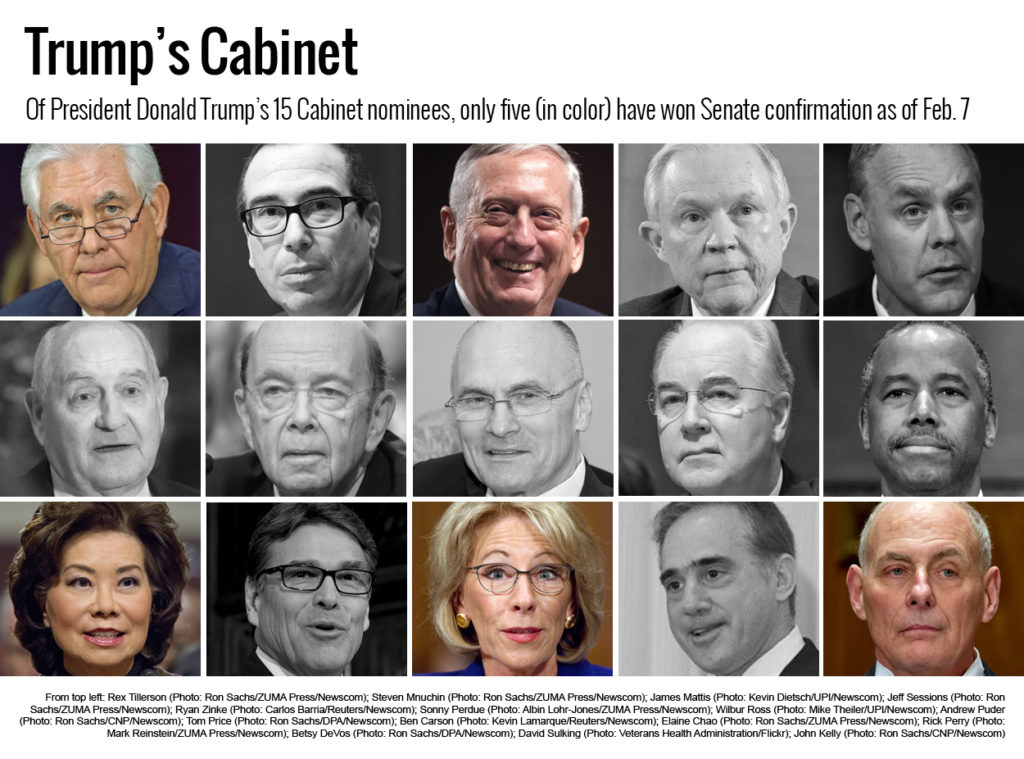
Since the Senate started holding hearings on President Donald Trump’s Cabinet and Cabinet-level nominations, Senate Democrats have employed a variety of tactics to delay the votes needed for Trump to put the government’s leaders in place.

Republicans have called Democrats’ actions “unprecedented,” but are they?

A review by The Daily Signal of committee actions for first-term Cabinet and Cabinet-level nominees dating back to the initial days of President George W. Bush’s administration—the earliest for which electronic congressional records could be found—shows that efforts from the minority party to tie up nominations are rare and a break from Senate tradition.

“In the Senate, there’s a presumption that the president is entitled to pick the Cabinet,” Jack Pitney, a political science professor at Claremont McKenna College in California, told The Daily Signal.

“Things are different given the general polarization of the Senate and the specific atmosphere that we’re seeing in the early weeks of the Trump administration,” Pitney said.

By the start of the new year, Senate Democrats had mapped out their plan to stall confirmation votes for eight of Trump’s Cabinet nominations and draw out the confirmation process into March.

And since Trump’s Jan. 20 inauguration, Democrats serving on three Senate committees have stalled votes by boycotting meetings—that is, refusing to show up. For Trump’s two predecessors, some nominees passed out of their respective committees without any objection from either party.

But not only are Democrats stalling votes at the committee level—the first stop for a presidential nominee requiring Senate confirmation—the minority party is expected to employ other tactics to stymie approval of nominees once they advance to the Senate floor.

“President Trump has the fewest Cabinet secretaries confirmed at this point than any other incoming president since George Washington,” Senate Majority Leader Mitch McConnell, R-Ky., said Tuesday. He called on Democrats to end “the unprecedented delay” holding up confirmation of Trump’s nominees.

170207_TrumpNominees-1024x759

The recent actions of Senate Democrats break from Senate tradition and split from the precedent members of both parties set for past presidents and their agency leads.

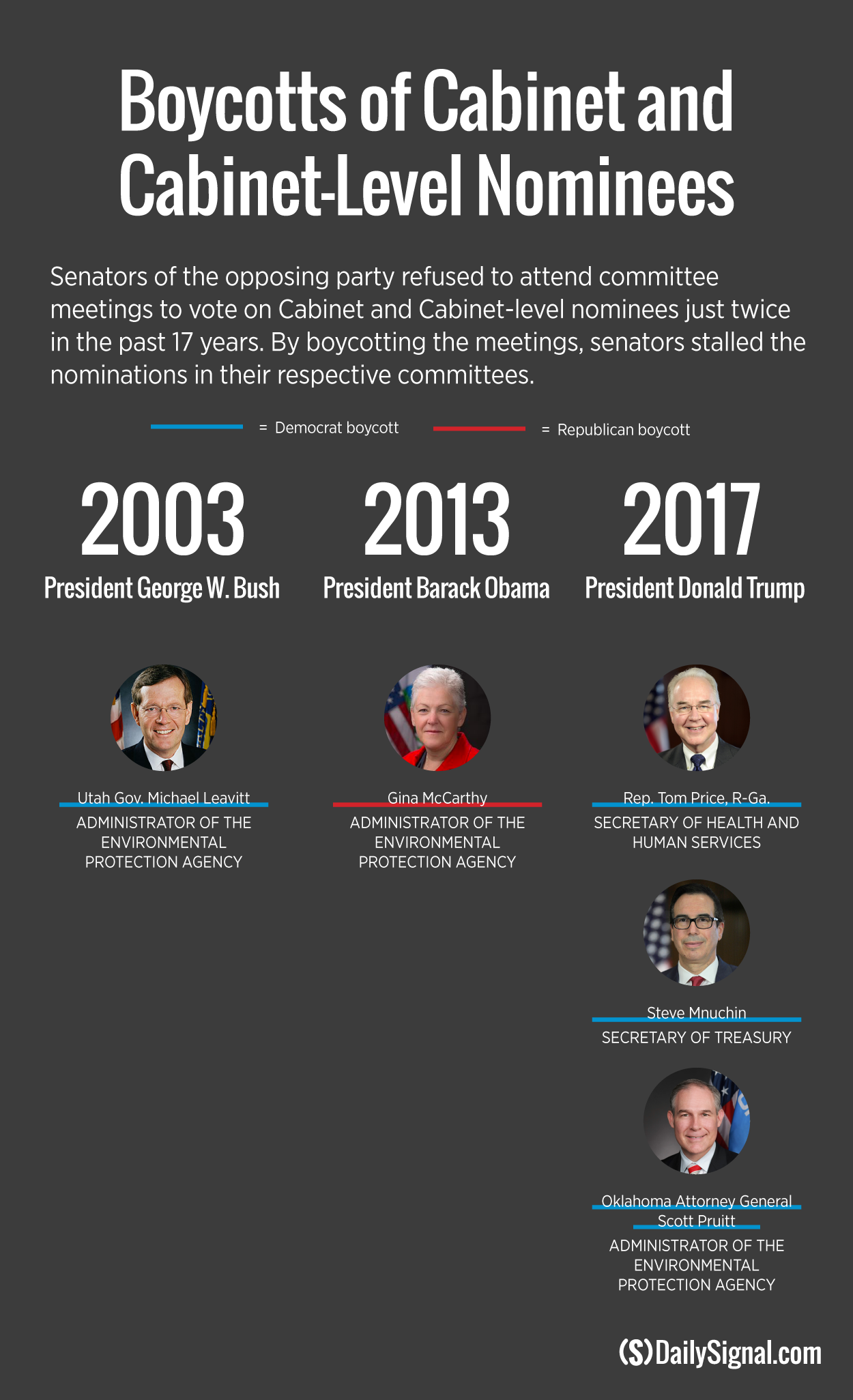
In fact, senators in both parties boycotted just two Cabinet-level nominees over the past 17 years, and neither were during a president’s first term.

Trump Administration Nominees

Last month, Democrats on the Senate Judiciary Committee made lengthy speeches to delay a vote on Trump’s nominee for attorney general, Sen. Jeff Sessions, R-Ala.

Judiciary Chairman Chuck Grassley, a Republican from Iowa, ultimately delayed the committee’s vote on Sessions by one day. The panel then voted along party lines to advance Sessions’ nomination, 11-9.

In more blatant displays of disapproval for Trump’s Cabinet nominees, Democrats on two Senate panels boycotted committee votes on three nominees: for the secretaries of both Health and Human Services and Treasury, and for the administrator of the Environmental Protection Agency.

Trump nominated Rep. Tom Price, R-Ga., to head the Department of Health and Human Services, Wall Street executive Steve Mnuchin to lead the Department of Treasury, and Oklahoma Attorney General Scott Pruitt to serve as administrator of the Environmental Protection Agency.

The Finance Committee oversees the Price and Mnuchin nominations, and the Environment and Public Works Committee oversees the Pruitt nomination.

Last month, Democrats on both committees refused to appear at meetings held to vote on the nominees.

For the Finance Committee, Democrats’ boycott represented a first: In modern history, the panel never before boycotted a confirmation vote.

In addition to boycotting the vote by the Environment and Public Works Committee, Democrats tasked with overseeing Pruitt’s nomination submitted 1,078 questions to the Oklahoma attorney general.

Because Democrats refused to show up, they forced Republicans to delay votes on Price, Mnuchin and Pruitt.

170207_Cabinet-Boycotts_v5

Obama Administration Nominees

In 2013, at the beginning of President Barack Obama’s second term, all eight Republicans on the Environment and Public Works Committee boycotted a committee vote on Gina McCarthy, his pick to lead the Environmental Protection Agency.

GOP senators also asked McCarthy to respond to 1,075 written questions about the agency she sought to lead.

After Republicans dropped their boycott, McCarthy, who replaced Lisa Jackson at the EPA, ultimately advanced to the Senate in a 10-8 vote along party lines.

By comparison, Jackson received 157 questions from Senate Republicans after her initial confirmation hearing in 2009.

After Obama tapped agency heads during his first term, Republicans and Democrats took swift action to confirm his nominees.

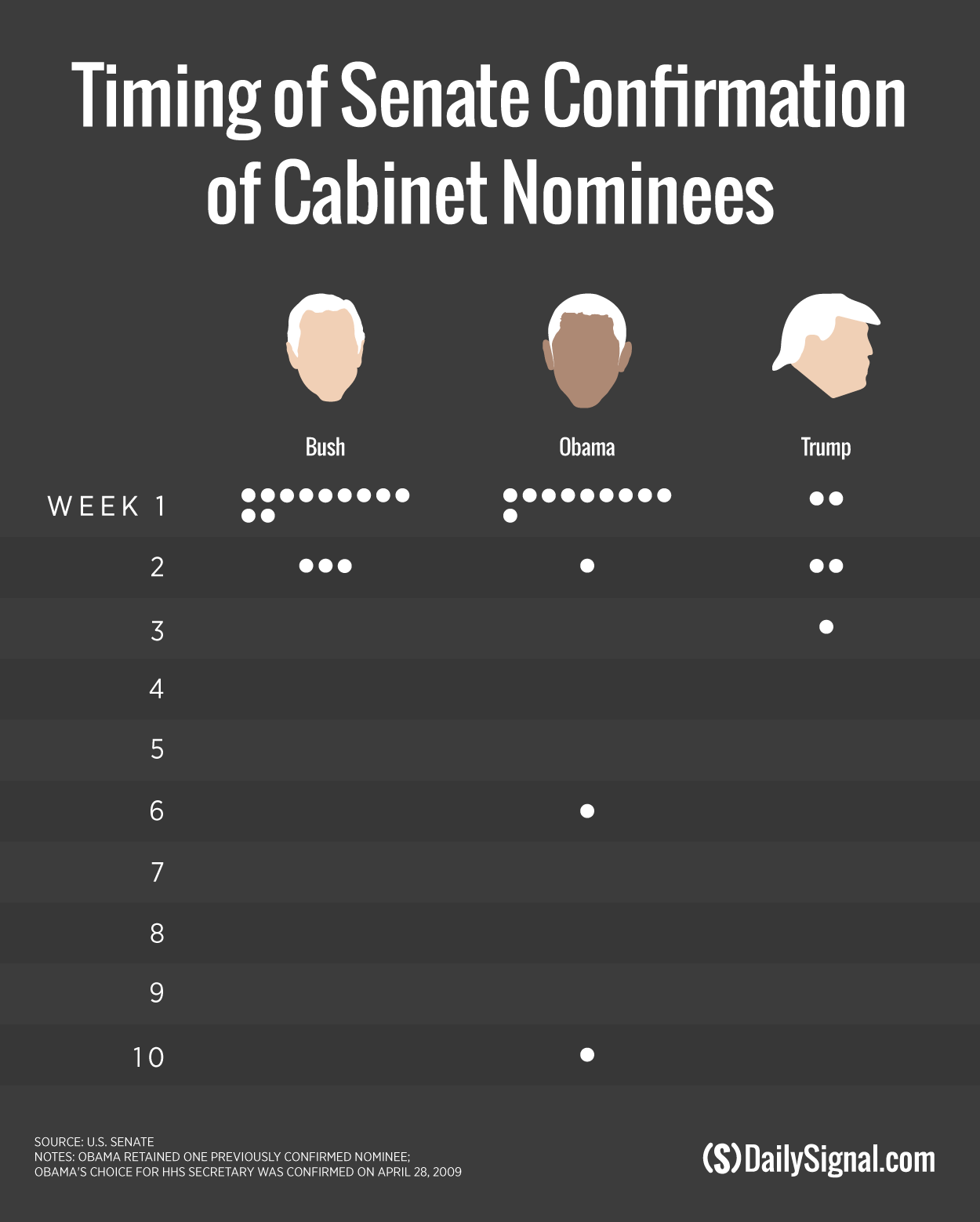
The Senate unanimously confirmed seven of Obama’s Cabinet and Cabinet-level nominees immediately after his inauguration, and many received bipartisan support at the committee level.

Secretary of State Hillary Clinton, for example, won approval from the Foreign Relations Committee after a 16-1 vote.

Obama’s pick for attorney general, Eric Holder, also received support from both sides of the aisle. Holder advanced to the Senate floor after the Judiciary Committee’s 17-2 vote.

The Senate confirmed six more of Obama’s selections in the week following his inauguration.

170207_Cabinet-Confirmation-Timing_v3

Bush Administration Nominees

More than two year into President George W. Bush’s first term, Senate Democrats mounted opposition to his pick to lead the EPA, Utah Gov. Michael Leavitt.

Bush selected Leavitt in 2003 to replace his first EPA administrator, Christine Todd Whitman, and Democrats sought to tie up Leavitt’s nomination by refusing to attend a committee meeting to advance his nomination.

Senate Democrats later asked Leavitt a total of 305 questions after his confirmation hearing.

Once Democrats allowed his nomination to proceed, the Environment and Public Works Committee approved Leavitt by a bipartisan vote of 16-2.

Like Obama, the Senate confirmed eight of Bush’s nominees on his Inauguration Day.

Bush’s most controversial nominee, John Ashcroft for attorney general, faced opposition from Democrats on the Judiciary Committee. However, Ashcroft advanced to the Senate floor after a 10-8 vote.

Opening the Door

Though the opposition to Trump’s Cabinet nominees is unprecedented, Pitney, of Claremont McKenna, said it’s likely such attempts to stall nominations will continue.

“You’re not going to get away from the polarization any time in the next few years,” he said. “What we’re seeing now is just the latest chapter of a story that’s been unfolding for decades.” (For more from the author of “Trump Faces Senate Boycotts on Nominees That Bush, Obama Didn’t” please click HERE)

Follow Joe Miller on Twitter HERE and Facebook HERE.
It’s Time to Restore Free Speech to American Churches

For more than 60 years, the federal government has been sticking its nose where it doesn’t belong, threatening to punish houses of worship and their leaders for what they say.

The Free Speech Fairness Act was introduced in Congress earlier this week and, if enacted, would go a long way toward ending that.

Ever since 1954, when Congress enacted the Johnson Amendment, the IRS has been telling churches that it has the power to monitor their speech.

Under that law, if pastors or other clergy say anything that (in the government’s opinion) is “on behalf of (or in opposition to) any candidate for public office,” the feds can begin taxing them and potentially bring about their financial ruin.

The history behind that speech-censoring law is not what you might expect.

Most people might assume that it was part of secularists’ relentless efforts to “separate church and state.” But the story that history tells is quite different.

In the 1950s, then-Sen. Lyndon B. Johnson, D-Texas, faced stiff criticism from nonreligious nonprofit organizations. In order to silence their attacks against his future campaigns, he introduced a bill to ban all nonprofit groups from speaking for or against political candidates.

Interestingly enough, churches weren’t even the target of his proposal.

But regardless of Johnson’s intent, houses of worship nevertheless find themselves squarely within that law’s reach. And for well over half a century, they’ve had to continually wonder when their speech on some of the most pressing political issues of the day might trigger IRS scrutiny.

This tramples on the rightful role of churches.

Pastors, priests, and other clergy are called to instruct their congregants in all areas of life. The holy texts of the Abrahamic faiths have implications for everything in life, including politics and how to vote.

As Christian theologian and former Prime Minister of the Netherlands Abraham Kuyper wrote, “There is not a square inch in the whole domain of our human existence over which Christ, who is Sovereign over all, does not cry, ‘Mine!’”

The Johnson Amendment, however, carves out portions of this domain and labels them off-limits for churches unwilling to incur steep financial penalties.

The Johnson Amendment’s scope is sometimes misunderstood. It doesn’t just prohibit clergy from telling congregants who to vote for; it reaches beyond that, threatening to punish all houses of worship for saying anything that the IRS might deem to be in favor of, or in opposition to, a political candidate.

That vague guidance makes it impossible for religious leaders to know what crosses the line and what doesn’t.

Consider these scenarios: What if a pastor states in a sermon that a politician is unfit because his or her personal morality is not in line with the Bible’s teachings? Or what if a rabbi remarks that a politician’s immigration proposals do or do not honor the lessons of his faith’s sacred texts?

It’s not clear whether one, neither, or both of these examples cross the line.

But this we do know—churches and other houses of worship shouldn’t have to worry about this.

They should be free to speak on personal morality, immigration policies, and countless other issues as they relate to anything, including political candidates, and they should be free to do so without fear of government punishment.

The Free Speech Fairness Act would put an end to religious leaders’ playing this guessing game.

It would tell the federal government to stop scrutinizing what churches say about political candidates, and it would lift the muzzles that now cover America’s pulpits on the many issues that often cross into the realm of politics.

The often misunderstood idea of “separation of church and state” is a common objection to bills like the Free Speech Fairness Act. But those sorts of arguments have it exactly backwards: The Free Speech Fairness Act would actually restore (rather than undermine) a proper division between the government and the church.

Currently, bureaucrats are empowered to monitor pastors’ sermons. What could be a greater governmental intrusion into a church’s operations than that?

By removing a primary basis upon which the IRS inspects what clergy say, the Free Speech Fairness Act would put the government back in its proper place.

Over six decades ago, Texas politician Lyndon Johnson set off a chain of events that invited federal officials to meddle where they didn’t belong. The Free Speech Fairness Act says it’s high time we sent them packing. (For more from the author of “It’s Time to Restore Free Speech to American Churches” please click HERE)

Follow Joe Miller on Twitter HERE and Facebook HERE.
This Muslim Country Has Had Its Very Own ‘Muslim Ban’ Since 2011

The Middle East country of Kuwait issued its own “Muslim ban” in 2011, citing the “instability” from several terror hotbeds in the Middle East.

The revelation follows President Donald Trump’s executive order that placed a temporary suspension on visa issuances from the countries of Syria, Iraq, Iran, Yemen, Libya, Somalia, and Sudan. The presidential decision has faced extremely heavy scrutiny from across the political spectrum, with opponents claiming it to be inhumane, unconstitutional, and un-American.

The executive order’s proponents say the temporary ban is necessary to protect the country from national security threats, reminding it only affects a tiny portion of Muslim-majority nations.

Kuwait — where Islam is the state religion and 80 percent of the population is Muslim — has had a supposed “Muslim ban” in place since 2011 to stop visa issuances to citizens of Syria, Iraq, Iran, Pakistan, and Afghanistan. According to a report in Al Alaraby, individuals from these countries “will not be [AK1] able to obtain visit, tourism or trade” visas. Additionally, “Passport holders from the countries will no lot be allowed to enter the Gulf state while the blanket ban is in place and have been told not to apply to visas,” the report adds.

Kuwait has seen several incidents where foreigners attempted, and succeeded, at executing terrorist attacks. The most deadly occurred in June 2015, when an Islamic State suicide bomber detonated his vest at a Shia mosque in Kuwait City, killing 27 and injuring 227 people.

The five countries listed in the Kuwait visa ban are known breeding grounds for Islamic militants.

War-ravaged Syria and Iraq are home to ISIS, al Qaeda, and several Iran-backed jihadi militia groups. In 2011, when the civil war in Syria first erupted, Kuwait issued a visa ban for all Syrians.

Afghanistan and Pakistan is home to al Qaeda, ISIS,Taliban, the Haqqani Network, and dozens more Sunni terror groups.

And Iran is the world’s foremost state sponsor of terror, according to a 2016 report by the Obama State Department.

After this so-called “Muslim ban,” will Kuwait face international blowback of its own from prioritizing its national security? Will this have any effect on the perception of Pres. Trump’s executive order? (For more from the author of “This Muslim Country Has Had Its Very Own ‘Muslim Ban’ Since 2011” please click HERE)

Follow Joe Miller on Twitter HERE and Facebook HERE.
Mitch McConnell FINALLY Served a Purpose for GOP/Conservatives

First, let me this out of the way straight away — this is not a joke.

I swear it.

I have to begin with that caveat because those of you who regularly listen to my show, or read my column, would likely believe I was engaging in grade A trolling had I not. Or you might suspect I’ve gone mad as a hatter. For what I’m about to say undeniably goes against my default setting where the senior senator from the commonwealth of Kentucky is concerned.

Yes, that would be Mitch McConnell R-Ky. (F, 40%). Or “Ditch” as I once coined him long ago for being the chief playwright of what became known as “failure theater.” The man whose relationship with conservatives has been, well, complicated, to be kind. But today is no time to dwell on the past. Today is a time for giving credit where credit is due.

So here it is, Mitch McConnell, and again, I mean this in all seriousness: thank you. (Editor’s note: we disagree. McConnell is a snake and, although he’ll occasionally throw us a bone, is absolutely unredeemable. You can bet your last dollar that anything McConnell does that is “conservative” either was already going to happen or helps advance his own crony-capitalist interests; he is despicable, largely responsible for the disastrous state our nation is in)

It was you who stood in the breach after President Obama nominated Merrick Garland to replace Antonin Scalia following his death last February. That left nearly a year before a new president would be sworn in. In fact, Garland’s name ultimately was entered into nomination for more than twice as long as any Supreme Court nominee that came before him.

“Obstruction,” the Democrats cried. And they continue to do so now as they prepare to torpedo President Trump’s nomination of Neil Gorsuch to replace Scalia.

But when the real obstruction has been decades upon decades of judicial usurpations of the legislative process, McConnell sat down at the high stakes poker table and played a stone-cold hand. He bet he would get just the jackpot he needed when that river card was flipped. A “Trump card” if you will.

So now here we are, with a chance to at least hold the line on the Supreme Court, and perhaps even set the stage for a return to something resembling the jurisprudence of our Founding Fathers. And now if you’re one of those applauding the Gorsuch appointment, you owe McConnell a doth of the cap as well.

That’s not to say McConnell and conservatives are suddenly bosom buddies. There’s still a lot of water under that bridge. Still, the importance of what the Senate Majority Leader did here cannot be understated, and had he not done it the possibility exists the ideological balance of the nation’s highest court could’ve been generationally impacted.

Ronald Reagan once famously had a plaque with the following words inscribed on it in the oval office: “It’s amazing what you can do when you don’t care who gets the credit for it.” In that spirit, if Ted Cruz, R-Texas (A, 97%) and Lindsey Graham, R-S.C. (F, 30%) can stand shoulder-to-shoulder on MSNBC when they share common ground, we can thank McConnell for standing shoulder-to-shoulder with us here.

This time DC did listen to us, and we should acknowledge when that happens at least as much as we do when it doesn’t. Here’s to hoping this is the start of a trend.

Thanks again, Mitch. (For more from the author of “Mitch McConnell FINALLY Served a Purpose for GOP/Conservatives” please click HERE)

Follow Joe Miller on Twitter HERE and Facebook HERE.

EXPLOSIVE: Soros Group Funded Numerous Republicans Proving DC Has but One Party

Employees of a hedge fund founded by the king of the Institutional Left, billionaire and Democratic Party mega-donor George Soros, donated tens of thousands of dollars to top Republicans who fought against President Donald Trump in 2016, donation records compiled by the Center for Responsive Politics show.

Soros Fund Management, a former hedge fund that serves now as an investment management firm, was founded by progressive billionaire George Soros in 1969. It has risen to become one of the most profitable hedge funds in the industry. Employees of the firm are heavily involved in backing political candidates giving millions upon millions to groups that were supporting failed 2016 Democratic presidential nominee Hillary Rodham Clinton for the presidency.

But more importantly, perhaps, than the unsurprising giant lump sums of cash funneled into Democratic Party and Clinton coffers is the revelation thanks to the Center for Responsive Politics that employees of the Soros firm—now run by his son Robert Soros—pumped tens of thousands of dollars into the campaigns of top anti-Trump Republicans over the course of 2016. . .

[I]t is significant that Soros executives are making a play inside the GOP. Perhaps even more significant is the type of Republican they aim to prop up: pro-amnesty, pro-open borders on trade, and generally speaking anti-Trump. A pattern emerges when looking at the policies of the Republicans that these Soros Fund Management executives support financially.

The biggest recipient of Soros-connected cash in the GOP was none other than House Speaker Paul Ryan, who repeatedly attempted to undermine Trump over the course of the election. According to the records available online, the Soros firm’s workers gave $10,800 to Ryan. Included in that are two separate May 2, 2016, donations from David Rogers, a then-employee of Soros Fund Management who lives in New York City. Rogers left the Soros Fund Management firm right around that time. (Read more from “EXPLOSIVE: Soros Group Funded Numerous Republicans Proving DC Has but One Party” HERE)

Follow Joe Miller on Twitter HERE and Facebook HERE.

How to Tell the Difference Between Trump and Obama’s Refugee EOs? Trump Actually Follows the Law

It didn’t take long for liberals to make a moral, legal, and philosophical equivalent between Trump’s executive order protecting national sovereignty and security and Obama’s executive amnesty shredding Congress’ plenary power over immigration.

The arguments go something like this:

Well, why was it a problem when Obama took executive action on immigration and not Trump?

If it were OK for a district judge to put a restraining order on Obama’s executive amnesty, why can’t a district judge put an injunction on Trump’s?

The answer is very simple: statute, the Constitution, and national sovereignty. It’s a difference between night and day.

Trump is trying to do the job the Constitution and Congress have authorized him to perform

Rooted in our history and tradition, our immigration laws are — generally speaking — written to give the president broad authority to ratchet down immigration as needed, not to ratchet it up without a full debate in Congress over such a proposition.

Consent-based immigration is rooted in the notion, “governance by the consent of the governed” — that through their elected representatives, the people have control over who comes into the country.

As we’ve noted before, Congress rightfully delegated restrictionist authority to the president under section 212(f) of the Immigration and Nationality Act in the clearest terms imaginable. That should end the discussion.

Moreover, almost each component of the immigration order is double covered by another statute. Under existing law unanimously passed by Congress (8 U.S. Code § 1735), any foreign national from state sponsors of terror (at the time of the original law in 2002, that included five of the seven countries on Trump’s list) are not to be granted visas forever (not just for 90 days, as Trump has proposed).

As for refugees, the president was specifically given the power to set the cap and criteria for who is let in as a refugee (more so than any other area of immigration) under 8 U.S.C. 1157. The notion that a president can’t place a moratorium on refugees (in this case, from any country, not just Muslim-majority ones) until we have a better vetting system in place, defies comprehension.

Most egregiously, Judge James Robart — who should be impeached — said that Trump’s prioritization of persecuted religious minorities is unconstitutional(!!), even though it is literally required by current law and the entire spirit of refugee status in the first place. From Section 8 U.S.C. 1101(a)(42)(A):

The term “refugee” means (A) any person who is outside any country of such person’s nationality … and who is unable or unwilling to return to … that country because of persecution or a well-founded fear of persecution on account of … religion [among other things] …[.]

And as I’ve noted before, Democrats have long used the “Lautenberg Amendment” to extract Jews from the former Soviet Union and Iran in a very strict, religious litmus test.

Now contrast Trump’s act of following the spirit and letter of the law, protecting American security, and preserving American sovereignty with Obama’s unilateral nullification of immigration law. Not only did Obama violate section 1225(b)(2)(A) of the INA, which requires ICE agents to place all illegal aliens into removal proceedings, but he also created his own immigration program and offered positive benefits to people here against the national will: He offered them affirmative legal status with Social Security cards, work permits, and thousands of dollars in refundable tax credit welfare payments.

As I’ve said before, giving rights to aliens is the quintessential example Hamilton used to contrast a president from a king. “[T]he one [a president] can confer no privileges whatever; the other [a king] can make denizens of aliens, noblemen of commoners; can erect corporations with all the rights incident to corporate bodies,” wrote Hamilton in Federalist #69.

Now the courts are also acting like a king — making denizens out of aliens, just like Obama did. Trump is using delegated authority to not make denizens out of aliens. Whether or not you favor mass migration from Somalia is a matter of policy prudence, but not subject to legal dispute.

Thus, when Judge Andrew Hanen issued a temporary restraining order against Obama’s amnesty (following by a permanent injunction) in a 123-page scholarly opinion, he was following the law and the Constitution, unlike Judge Robart.

To be clear, I personally agree that a district judge should not be able to issue a nationwide injunction (outside the court’s jurisdiction) on national policy, and at the time I was consistent in my warning to Republicans that they use Congress — not the courts — to fight Obama. Either way, the reason why Obama’s amnesty was unconstitutional is because it violated statute, not just because Judge Hanen said so.

On the other hand, Trump followed statute, yet Judge Robart gave no explanation for throwing out settled law or why the plaintiffs would succeed on the merits before issuing his restraining order.

Perforce, in either case, judges aren’t the law of the land. The laws duly passed by Congress pursuant to our Constitution, history, and tradition are the laws of the land. Trump followed them; Obama nullified them in a way even King George couldn’t do.

The bottom line is that the only hypocrisy on this issue is coming from the Left because it doesn’t like the history, traditions, and laws of our immigration system. It’s fine for the Left to complain about our laws. It’s not OK to change them through the president or the courts without approval from Congress. Trump, on the other hand, is applying the existing law. It’s time for liberals to learn how to read. (For more from the author of “How to Tell the Difference Between Trump and Obama’s Refugee EOs? Trump Actually Follows the Law” please click HERE)

Follow Joe Miller on Twitter HERE and Facebook HERE.