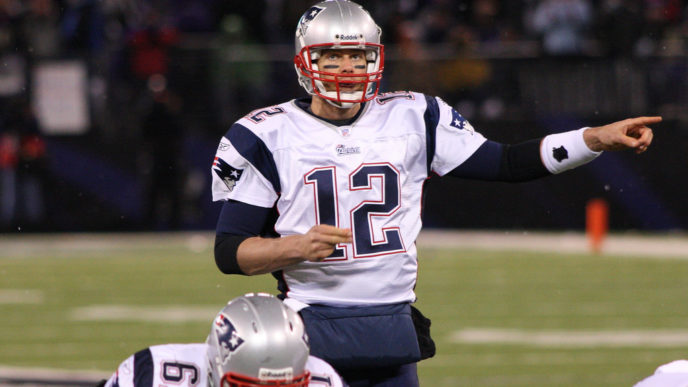
The Patriots Didn’t Just Beat the Falcons. They Crushed the Liberal Media

History was made Sunday night when the New England Patriots came back from a 21–3 halftime deficit in Super Bowl 51 to pull an historic and stunning overtime victory, defeating the Atlanta Falcons 34 to 28.

Patriots fans are understandably exuberant. Atlanta fans are beyond dejected. And the liberal media is eating crow.

You see, prior to the game, the liberal media had determined that quarterback Tom Brady’s friendship with Donald Trump made it unacceptable to root for the Patriots, unless of course you are a bigoted, racist, homophobic deplorable.

On Feb. 1, The New York Times ran an expose on “The uncomfortable love affair between Donald Trump and the New England Patriots.” The piece attempted to shame the Patriots by pointing out the team’s ties to the president and noted that “no small number of fans are convinced that the Patriots (like Trump) achieve their victories through dubious means and wish they would just go away and get off their TVs forever.”

The New York Daily News praised Bill Maher for an “epic rant” in which the progressive comedian and host of “Real Time with Bill Maher” went on a profanity-laced tirade declaring his opposition to a Patriots’ victory.

“The Falcons are playing a team where the owner, the coach and the star quarterback all love Donald Trump,” said Maher. “So I’d really like for them to lose by a score of a million f–king thousand to none.”

The Los Angeles Times ran an op-ed by sports documentary producer Kelly Candaele declaring his support for the Falcons on the basis of the “loathsome politics” of Tom Brady, Bill Belichick, and Robert Kraft.

SB Nation brought up the controversy between President Trump and Congressman John Lewis, D-Ga. (F, 22%) — who represents part of Atlanta — declaring the Super Bowl was “Donald Trump vs. the city of Atlanta.”

Slate even ran an explainer titled “How to pull for the Patriots in the Age of Trump.” But look closely at the URL on that piece and you’ll see an alternative headline poses a moral quandary to Slate’s audience: “Is it morally acceptable to root for the New England Patriots in the Super Bowl?”

One of the big moral questions Slate tackles is: “Is it cool to like a football team because its owner and some of its players like a politician I disagree with?” Truly the philosophical question for the times we live in.

A less philosophical individual called for a “boycott” of the Patriots way back in November.

For a while, it looked like the Falcons were indeed going to crush the Patriots. And progressive Twitter couldn’t have been happier.

And then, in an uncanny election night parallel, things began to turn around on the liberals. With a strip-sack, a miracle catch, and a tenacious drive by Tom Brady, the Pats turned the game around for the win in overtime.

Things were looking a lot like Election Night.

The annoying liberals rooting for a Patriots defeat, they were all wrong.

But the best reaction to the Patriots win is captured with one deleted tweet.

Eat crow, lefties.

Eat. Crow. (For more from the author of “The Patriots Didn’t Just Beat the Falcons. They Crushed the Liberal Media” please click HERE)

Follow Joe Miller on Twitter HERE and Facebook HERE.

NOAA Whistleblower Claims Data Were ‘Adjusted’ to Make Global Warming Seem Worse

A scientist-whistleblower has accused the National Oceanographic and Atmospheric Administration (NOAA) of diddling with temperature data, adjusting it so that it better accorded with political desires.

The Daily Mail is reporting that Dr John Bates, a now-retired climate data expert, late of the National Centers for Environmental Information (NCEI), a branch of NOAA, claimed the agency “breached its own rules on scientific integrity when it published the sensational but flawed report, aimed at making the maximum possible impact on world leaders including Barack Obama and David Cameron at the UN climate conference in Paris in 2015.”

Bates said that Thomas Karl, who was until recently the director of NCEI, was “insisting on decisions and scientific choices that maximised warming and minimised documentation … in an effort to discredit the notion of a global warming pause, rushed so that he could time publication to influence national and international deliberations on climate policy” (ellipsis original).

The data, Bates claimed, was never “subjected to NOAA’s rigorous internal evaluation process.” When Bates complained, “His vehement objections to the publication of the faulty data were overridden by his NOAA superiors in what he describes as a ‘blatant attempt to intensify the impact’ of what became known as the Pausebuster paper.”

Karl and eight others authored the “Pausebuster” paper, “Possible artifacts of data biases in the recent global surface warming hiatus.” It reported “an updated global surface temperature analysis that reveals that global trends are higher than those reported by the Intergovernmental Panel on Climate Change, especially in recent decades” and which claimed “These results do not support the notion of a ‘slowdown’ in the increase of global surface temperature.”

The “slowdown,” or rather the non-increase in global temperatures for almost two decades, was notable in satellite data. It was also noticed in surface-based data, until that data was statistically adjusted by Karl and others. These adjustments of surface records, which are not uncommon, are also curious. It usually happens that older data are lowered, and recent data pushed higher, making it appear that temperatures are increasing. Are these adjustments legitimate, or the result of confirmation bias, or potentially fraudulent?

How dramatic are the adjustments? As the Daily Mail reports, “The Pausebuster paper said while the rate of global warming from 1950 to 1999 was 0.113C per decade, the rate from 2000 to 2014 was actually higher, at 0.116C per decade.”

This is three-thousandths of a degree higher. Three-thousandths. To appreciate the magnitude, it helps to say it aloud: three-thousandths of a degree. And not just three-thousandths of a degree, but three-thousandths of a degree per every ten years. If panic at the news of higher temperatures was your first reaction, ensure it is panic in slow motion.

The global rate is the product of land and sea measurements. On the sea adjustments, “Thomas Karl and his colleagues … tripled the warming trend over the sea during the years 2000 to 2014 from just 0.036C per decade — as stated in version 3 — to 0.099C per decade.”

Even assuming this correction is valid, the final result is only a tenth of a degree a decade. If the global sea temperature really is caused to act like a straight upwards line, which is physically extremely doubtful, then after ten years, the temperature at sea will be one-tenth of a degree (on average) warmer than previously thought. Make that panic super-slow motion.

But even then, it’s not likely the correction is right.

But Dr. Bates said this increase in temperatures was achieved by dubious means. Its key error was an upwards ‘adjustment’ of readings from fixed and floating buoys, which are generally reliable, to bring them into line with readings from a much more doubtful source — water taken in by ships. This, Dr. Bates explained, has long been known to be questionable: ships are themselves sources of heat, readings will vary from ship to ship, and the depth of water intake will vary according to how heavily a ship is laden — so affecting temperature readings.

Bates said, “They had good data from buoys. And they threw it out and ‘corrected’ it by using the bad data from ships.”

Similar statistical manipulations were done to land-temperature data, with adjustments being of the same low level. Bates not only questioned the timing and direction of adjustments, but said the programs used to make them were “highly experimental” and “afflicted by serious bugs.”

Karl “admitted” to the Daily Mail that “the data had not been archived when the paper was published,” making replication by colleagues impossible or difficult. Karl also said “the final, approved and ‘operational’ edition of the [data] would be ‘different’ from that used in the paper’.”

Even assuming all is aboveboard, what most don’t realize is that surface temperature measurements are not static; they change year to year. These changes induce uncertainty, which has so far been badly underestimated. This is why claims of thousandths of a degree change are, at best, dubious, and are more likely subject to large uncertainties. (For more from the author of “NOAA Whistleblower Claims Data Were ‘Adjusted’ to Make Global Warming Seem Worse” please click HERE)

Follow Joe Miller on Twitter HERE and Facebook HERE.

Chuck Schumer’s Hypocrisy on Trump’s Supreme Court Nominee

This weekend, President Donald Trump criticized U.S. District Judge James Robart for his halt of the president’s immigration order — a ruling issued without any accompanying legal analysis.

Now, key Senate Democrats are threatening to use the remark against Judge Neil Gorsuch, Trump’s nominee for the Supreme Court.

Senate Minority Leader Chuck Schumer, D-N.Y., wants to use Trump’s remark to raise the bar “even higher” for Gorsuch’s confirmation. Both Schumer and Sen. Patrick Leahy, D-Vt., now promise to question Gorsuch’s “ability to be an independent check” on the executive branch.

Seemingly unaware of the obvious hypocrisy, Schumer, Leahy, and other Democrats are accusing Trump of questioning Robart’s legitimacy while doing the same to Gorsuch, a U.S. Court of Appeal judge.

To question Gorsuch’s ability to remain “independent” is to question his ability to do his job as a judge.

These Democrats also seem to have forgotten that they cheered President Barack Obama’s attempt to bully the Supreme Court during his 2010 State of the Union address, when he denounced and falsely characterized the court’s Citizens United decision while the justices sat yards away.

Chief Justice John Roberts said he found Obama’s intimidation “very troubling.” Yet it was Schumer, sitting directly behind the justices in the House chamber, who rose with his Democrat colleagues to vigorously applauded Obama’s remarks.

Senate Republicans did not threaten to raise the bar for Justice Elena Kagan, when Obama nominated her to the Supreme Court just months after his controversial State of the Union address.

Republicans could have argued that Obama’s unprecedented criticism of the justices cast doubt on Kagan’s independence and made her confirmation more problematic. But they didn’t.

Senate Democrats would be well advised to follow this example by focusing on Gorsuch’s record and qualifications, rather than using the process to express their unhappiness with Trump. (For more from the author of “Chuck Schumer’s Hypocrisy on Trump’s Supreme Court Nominee” please click HERE)

Follow Joe Miller on Twitter HERE and Facebook HERE.

House Intelligence, Foreign Affairs Committee Possibly Compromised by Rogue IT Staff

Three brothers who managed office information technology for members of the House Permanent Select Committee on Intelligence and other lawmakers were abruptly relieved of their duties on suspicion that they accessed congressional computers without permission.

Brothers Abid, Imran, and Jamal Awan were barred from computer networks at the House of Representatives Thursday, The Daily Caller News Foundation Investigative Group has learned.

Three members of the intelligence panel and five members of the House Committee on Foreign Affairs were among the dozens of members who employed the suspects on a shared basis. The two committees deal with many of the nation’s most sensitive issues and documents, including those related to the war on terrorism.

Also among those whose computer systems may have been compromised is Rep. Debbie Wasserman Schultz, the Florida Democrat who was previously the target of a disastrous email hack when she served as chairman of the Democratic National Committee during the 2016 campaign.

The brothers are suspected of serious violations, including accessing members’ computer networks without their knowledge and stealing equipment from Congress. (Read more from “House Intelligence, Foreign Affairs Committee Possibly Compromised by Rogue IT Staff” HERE)

Follow Joe Miller on Twitter HERE and Facebook HERE.

Trump’s Executive Order on Immigration Is Both Legal and Constitutional

If you want to see the difference between a federal judge who follows the rule of law and a federal judge who ignores laws he doesn’t like in order to reach a preferred public policy outcome, just compare the two district court decisions issued in Washington state and Massachusetts over President Donald Trump’s immigration executive order.

Contrary to the “travel ban” label, the executive order temporarily suspended the granting of visas from seven failed and failing countries that are supplying many of the terrorists plaguing the world.

Despite what Judge James Robart of the Western District of Washington says, Trump acted fully within the statutory authority granted to him by Congress. The temporary restraining order issued by Robart on Feb. 3 is unjustified and has no basis in the law or the Constitution.

This fact is obvious from an examination of his seven-page order, which contains absolutely no discussion whatsoever of what law or constitutional provision the president has supposedly violated. That temporary restraining order is now on an emergency appeal before a panel of the 9th U.S. Circuit Court of Appeals.

Contrast that with the 21-page opinion issued by Massachusetts District Court Judge Nathaniel Gorton that was also issued on Feb. 3.

Unlike Robart, who totally ignored the federal statute (8 U.S.C. §1182(f)) cited by Trump in his executive order, Gorton bases his decision denying the temporary restraining order on an examination of the extensive power given to the president under that statute, which gives the president the authority to suspend the entry of any aliens or class of aliens into the U.S. if he believes it “would be detrimental to the interests of the United States.” And he can do so “for such period as he shall deem necessary.”

That is exactly what the president has done. The order signed on Jan. 27 on “Protecting the Nation From Foreign Terrorist Entry Into the United States” suspends for 90 days the issuance of visas to anyone trying to enter the U.S. from seven countries that even the Obama administration identified as “countries of concern” because of their terrorism histories.

This has been done, as Gorton explains and as the administration has made clear, in order to “ensure that resources are available to review screening procedures and that adequate standards are in place to protect against terrorist attacks.”

As Gorton notes, “the decision to prevent aliens from entering the country is a ‘fundamental sovereign attribute’ realized through the legislative and executive branches that is ‘largely immune from judicial control.’”

As the U.S. Supreme Court said in 2004 in U.S. v. Flores-Montano, “The government’s interest in preventing the entry of unwanted persons and effects is at its zenith at the international border.”

In this case, Congress—which under the Constitution has complete authority over immigration—passed a statute providing the president the authority to suspend the entry of aliens into the country.

According to Gorton, in “light of the ‘plenary congressional power to make polices and rules for exclusion of aliens … which pursuant to 8 U.S.C. 1182(f), has been delegated to the president, the court concludes that the government’s reasons, as provided in the [executive order], are facially legitimate and bona fide.”

No federal judge, including Robart, has the authority to substitute his judgment for that of the president when it comes to making a decision on what is detrimental to the national security and foreign policy interests of the nation.

But that is exactly what he did.

Robart’s opinion ends with a claim that seems like a joke.

He says that “fundamental” to his work is “a vigilant recognition that [the court] is but one of three equal branches of our federal government. The work of the court is not to create policy or judge the wisdom of any particular policy promoted by the other two branches.”

Instead, says Robart, his job is “limited” to “ensuring that the actions taken by the other two branches comport with our country’s laws, and more importantly, our Constitution.”

Yet Robart provides no discussion of the Constitution or the federal statute that applies to this executive order and the actions of the president.

Given that there is no legal basis for his decision and the issuance of a temporary restraining order, the only basis for his decision is his judgment on the “wisdom” of Trump’s executive order.

Gorton recognized the public policy choices being made with this executive order. He discussed the “considerations of both sides with respect to a balancing of the hardships” involved.

On one side, the government is trying to implement “an effective immigration regime that ensures the safety of all Americans,” something that is “undoubtedly difficult.” On the other side, there is a “hardship to the professional and personal lives” of aliens trying to enter the country.

But it is not up to a judge to make that policy choice. The judge’s only role is to review whether the president’s action is authorized by the Constitution and federal law.

There is no question that the executive order meets both of those requirements. We can only hope that the 9th Circuit Court of Appeals follows the law and does not make the same mistake that Robart made. (For more from the author of “Trump’s Executive Order on Immigration Is Both Legal and Constitutional” please click HERE)

Follow Joe Miller on Twitter HERE and Facebook HERE.

Liberals Likely to Use Courts to Thwart Trump Agenda

After the president scolded judges for not ruling his way, some critics accused him of seeking to intimidate an independent judiciary.

That was in 2010, after the State of the Union address when President Barack Obama rebuked the attending Supreme Court justices over the Citizens United free speech and campaign finance case. Some Obama critics also said they felt he was threatening the Supreme Court in 2012 ahead of its ruling on the Obamacare law.

Some legal analysts anticipate the case will be a harbinger of things to come in challenging President Donald Trump’s policies through the courts, as Democrats face diminished power in Congress and could increasingly use the judicial system to block the president’s policies.

Federal courts frequently ruled against Obama’s executive actions during his eight years in office. However, Trump is getting a fast start on clashing with courts after a federal judge in Seattle placed a temporary restraining order nationally on the executive order to restrict immigration from seven Middle Eastern countries that have been designated as terrorist hot spots.

In response to the immigration ruling, Trump tweeted that U.S. District Judge James L. Robart was a “so-called judge,” prompting Democrats such as Senate Minority Leader Charles Schumer of New York to say Trump has a “disdain for an independent judiciary that doesn’t always bend to his wishes.”

Schumer even stretched this criticism into the upcoming Supreme Court nomination debate, claiming the attack on Robart “raises the bar even higher” for the confirmation of Neil Gorsuch over the question of judicial independence.

“That could be a flawed argument because broadly speaking, Gorsuch is probably more skeptical of executive power than Merrick Garland would have been,” said Ilya Shapiro, a senior fellow in constitutional studies at the libertarian Cato Institute, referring to Obama’s nominee to the high court who the Senate did not confirm in 2016.

Shapiro told The Daily Signal in a phone interview he thought Trump’s attack on Robart was inappropriate, but not unheard of.

“It was improper for a president to question the authority of the independent judiciary, but it’s not really different from President Obama calling out the Supreme Court at the State of the Union or in seemingly trying to pressure Justice [John] Roberts on Obamacare,” Shapiro said.

Federal judges should by no means be immune from criticism, said Hans von Spakovsky, a senior legal fellow at The Heritage Foundation. He believes Robart, the Seattle judge, issued a ruling outside the law.

“Judges should not be criticized for fulfilling their constitutional role, but if a judge oversteps that constitutional role and acts as a super legislator, then that judge’s reasoning should be criticized,” von Spakovsky told The Daily Signal.

Litigation and “judge shopping” will likely continue throughout the administration as a means to stop Trump’s agenda, von Spakovsky predicted.

This could be a successful strategy for the left, said Curt Levey, a constitutional law expert with the Committee for Justice, a nonprofit legal group, and FreedomWorks, a conservative advocacy group.

With 94 U.S. district courts, it’s possible for liberal advocacy groups to file suits across the country, particularly with issues such as immigration that have a large pool of potential clients, and gain a sweeping national decision out of just one district court decision, Levey told The Daily Signal.

Levey anticipates an increase in environmental groups suing the administration after Obama-era Environmental Protection Agency regulations are rolled back.

“Democrats don’t have a lot of power in Congress, but they still have governors and state attorneys general and many private outside groups,” Levey said. “These outside groups can’t legislate, but they can sue by themselves.”

It was Washington state Attorney General Robert Ferguson who brought the case on behalf of his state against the Trump executive order.

With regards to the pending case on immigration restrictions from the seven Middle Eastern countries, Levey described this as contrasting somewhat with the Obama executive actions.

Typically, he said, the question with Obama executive actions were about whether the president had the constitutional authority to enact them. In the case of Trump, the question at hand is “negative rights,” or an argument about what the government cannot do with regards to individuals.

The U.S. Court of Appeals for the 9th Circuit did not put an emergency stay on the temporary restraining order, as the Trump administration petitioned, thus preserving the district court ruling. The appeals court asked challengers of the immigration restriction to file written arguments by 4 a.m. Monday and asked Justice Department lawyers to reply by 6 p.m. the same day. The court will then schedule a hearing on whether the hold on the policy will remain in place.

Democrats are almost certain to apply this pending case and other potential cases to the confirmation hearing of Gorsuch, currently a 10th Circuit Court of Appeals judge. In his full statement over the weekend, Schumer said:

The president’s attack on Judge James Robart, a [George W.] Bush appointee who passed with 99 votes, shows a disdain for an independent judiciary that doesn’t always bend to his wishes and a continued lack of respect for the Constitution, making it more important that the Supreme Court serve as an independent check on the administration. With each action testing the Constitution, and each personal attack on a judge, President Trump raises the bar even higher for Judge Gorsuch’s nomination to serve on the Supreme Court. His ability to be an independent check will be front and center throughout the confirmation process.

As for intimidating the judiciary, Levey said he isn’t concerned.

“What seems to be getting so much coverage is Trump threatening the judiciary, but if senators pressure Gorsuch to promise to vote for X or he won’t get confirmed, that’s equally a threat from Congress,” Levey said. (For more from the author of “Liberals Likely to Use Courts to Thwart Trump Agenda” please click HERE)

Follow Joe Miller on Twitter HERE and Facebook HERE.

Republican Lawmakers yet to Deliver Early Wins for Trump

When the 115th Congress arrived Jan. 3, the majority had an ambitious agenda. With Republicans in control of the House and Senate, and soon the White House, it was the first time in 10 years they could advance their policy agenda unobstructed by Democrats.

Yet a month later, the GOP-led Congress has produced just three bills for President Donald Trump to sign: a waiver allowing retired Marine Gen. James Mattis to serve as defense secretary, a joint resolution repealing the Obama administration’s stream protection rule, and another resolution reversing a Securities and Exchange Commission rule pertaining to energy companies.

Republicans have delayed action on campaign promises such as repealing Obamacare and defunding Planned Parenthood.

In the Senate, Republicans are struggling to overcome Democrat delays in confirming Trump’s Cabinet nominees.

Senate Majority Leader Mitch McConnell said those delays have made the Senate’s job unnecessarily difficult. In a statement provided to The Daily Signal, the Kentucky Republican said:

Democrat obstruction has reached such extreme levels that the smallest number of Cabinet officials have been confirmed in modern history at this point in a presidency. It’s a historic break in tradition, a departure from how newly elected presidents of both parties have been treated in decades past.

The result is growing frustration among conservatives that the GOP isn’t moving quickly enough to capitalize on Trump’s first 100 days and the limited window of opportunity in Washington.

This week, for instance, the House will work just two days due to a Democrat retreat. Last month, Republicans decamped for three days for their own retreat in Philadelphia.

Last year, when House Speaker Paul Ryan outlined his “A Better Way” agenda, the Wisconsin Republican billed it as the GOP’s blueprint for the coming year.

“This is our game plan for 2017,” Ryan told reporters in October.

A month later, after Trump’s victory in November, a jubilant Ryan boasted about the forthcoming “dawn of a new unified Republican government.”

“If we are going to put our country back on the right track, we have got to be bold and we have to go big. This country is expecting absolutely no less,” Ryan said in November. “We want to make sure we hit the ground running in January, so we can deliver on the new president’s agenda.”

In December, Ryan told CBS News’ “60 Minutes” that “the first bill we’re going to be working on is our Obamacare legislation.”

And while the House took the first step Jan. 13 by approving a resolution establishing the framework for repeal, lawmakers missed their Jan. 27 deadline to draft the Obamacare repeal legislation.

A senior congressional aide told The Daily Signal that Republicans are determined to “provide Obamacare relief for struggling Americans.”

“The Senate began consideration the first day of the new congressional session,” the aide said of the drive to repeal and replace Obamacare, adding:

After [the Senate passed] that resolution, which is the start of the repeal process, the House passed the resolution immediately upon receiving it. House committees are now writing the reconciliation [bill] to repeal and potentially even include some replace.

Ryan also said defunding Planned Parenthood would be included in the budget reconciliation package, just as it was in a 2015 bill the Republicans passed and President Barack Obama vetoed early in 2016.

The latest timeline, according an internal House schedule leaked last week, suggests the reconciliation bill could be considered in March—although it could slip until April.

Congress’ lack of progress on the Obamacare repeal and Planned Parenthood defunding stand in contrast to the activity of the 111th Congress during Obama’s first weeks in office.

In 2009, Obama signed into law three significant bills passed by the Democrat-led Congress. They included the American Recovery and Reinvestment Act, a $787 billion economic stimulus package; the Lilly Ledbetter Fair Pay Act, which proponents said would end pay discrimination against women; and the Children’s Health Insurance Program Reauthorization Act, which provided states with new funding and programming for children’s health care coverage through Medicaid.

Congress introduced each bill either right before or soon after Obama was sworn into office; Obama signed them within his first 36 days.

Congress passed the Lilly Ledbetter bill Jan. 27, the children’s health bill Feb. 4, and the stimulus package Feb. 13.

So far in the 115th Congress, lawmakers passed the Mattis waiver, approved a resolution undoing requirements for coal mining operations, and approved another resolution loosening restrictions on the extraction of natural resources.

In his first two weeks as president, Trump has kept busy despite the lack of congressional activity. He signed eight executive orders, including one that begins the process of dismantling Obamacare.

The budget reconciliation bill passed by Congress in 2015 repealed Obamacare and defunded Planned Parenthood. Although that bill could not repeal the entirety of Obamacare due to Senate rules, it could dismantle a large portion.

Rachel Bovard, a former Senate aide who is director of policy services at The Heritage Foundation, said Congress could have presented a repeal bill to Trump on Jan. 20, the day he took the oath of office.

“Congress has been a disappointment so far, considering the fact that there is unified control of the government,” Bovard told The Daily Signal. “Congress could have had an Obamacare repeal bill on Trump’s desk at 12:01 p.m. on Inauguration Day, especially if they’d used the 2015 repeal bill that passed both Houses.”

“There is no excuse for the lack of action,” she added. “And, indeed, by delaying it, they’ve allowed the debate to get muddled, slowed the momentum considerably, and in doing so made the task that much harder.”

With midterm elections coming Nov. 6, 2018, some conservatives argue that Republicans have no place to hide.

“The Washington, D.C., Republicans are out of excuses,” Drew Ryun, national director of the Madison Project, a conservative political action committee, said in an email to The Daily Signal. Ryun added:

There are no more electoral goal posts to move. They have the House, the Senate, and with Trump in the White House. For years they have campaigned on the promises of repealing Obamacare and defunding Planned Parenthood.

Unfortunately for them, their inaction is proving two things: They may really be a party without ideas as well as one that pays lip service to its base with no intent of action. This is a dangerous position for them to be in, with midterms just around the corner.

(For more from the author of “Republican Lawmakers yet to Deliver Early Wins for Trump” please click HERE)

Follow Joe Miller on Twitter HERE and Facebook HERE.

Why Congress Is Right to Undo Obama-Era Education Rules

Last week, the House Committee on Education and the Workforce took an important step toward rescinding some of the most burdensome regulations levied under the Every Student Succeeds Act (the replacement for the No Child Left Behind Act) by the Obama administration Department of Education.

Reps. Brett Guthrie, R-Ky., and Todd Rokita, R-Ind., formally introduced resolutions of disapproval under the Congressional Review Act for two of the Obama administration’s prescriptive regulations: rules governing teacher preparation programs and rules governing accountability under the Every Student Succeeds Act.

These resolutions of disapproval would prevent the Department of Education from implementing the rules or any substantially similar rules without congressional approval.

As Lindsey Burke and I argued in a recent paper concerning regulatory overreach under the Every Student Succeeds Act, scrapping the law’s regulations written by the Obama administration’s Department of Education through use of the Congressional Review Act would help remove some of the prescription layered onto the act.

While congressional architects envisioned the law as a vehicle for curtailing some of the federal overreach that had been created through No Child Left Behind, the regulations were not written in the same spirit.

Rescinding these regulations is a good first step. But in addition, Congress should pursue policies that genuinely restore state and local control in education in a way that the Every Student Succeeds Act fell short of accomplishing.

Proponents hailed this education law as one that would limit power from Washington, restoring state and local control of education by eliminating many of No Child Left Behind’s onerous requirements.

However, while it eliminated provisions like Adequate Yearly Progress and Highly Qualified Teacher mandates—one-size-fits-all standards that put Washington in the driver’s seat of education—the Every Student Succeeds Act kept in place a complex federal framework of oversight and high levels of spending.

Importantly, states were not given the option to opt out of the law through reforms such as the A-PLUS (Academic Partnerships Lead Us to Success) Act—a long-held conservative policy priority.

President Barack Obama’s Department of Education under Secretary John King took the prescriptive law and proceeded to write regulations that magnified that law’s shortcomings. The regulations narrowed possibilities for state flexibility, complicated decisions, increased paperwork, and generally wrapped states ever more tightly in a web of federal rules.

Ignoring statutory prohibitions, the Department of Education added qualifications to accountability indicators, dictated the methodology for weighing indicators, and inserted unnecessary reporting requirements.

Some of the rules were breathtakingly meddlesome, including one that dictated to the precise dollar amount states must invest in each school that needs improvement.

Many state boards of education, state superintendents, and other state leaders used the comment period on this accountability rule to illustrate how this level of federal prescription would negatively impact their state, their students, and their school finances.

Some state officials, like Randy Dorn, Washington state’s superintendent of public instruction, compared the rule to the draconian system under No Child Left Behind: “[I]n some instances, it seems like a return to the archaic measures required under No Child Left Behind.”

Other states, like South Dakota, suggested that the federal Department of Education was hopelessly out of touch with their needs and concerns:

We find the estimates submitted to the Office of Management and Budget to be wildly out of sync with the effort the [South Dakota Department of Education] will need to undertake to integrate data systems and report the require data. In particular, this is true because there are not decreased reporting requirements in other areas. This will be a significant feat, in particular for a state that is minimally funded and minimally staffed; the burden compliance will place on our staff should not be underestimated.

The specific needs of each state and local community cannot be met or anticipated by agency bureaucrats from Washington, D.C.

Regulations that are used to clarify points of confusion in a statute are necessary, but the use of regulation to prescribe the day-to-day operations of local schools is an overreach of federal power, particularly when the needs of each community are so unique.

The resolutions of disapproval are an important first step to limiting federal encroachment in local decision-making.

Now, Congress should take the opportunity to allow states to totally opt out of the Every Student Succeeds Act, and to put dollars toward their own state and local priorities. (For more from the author of “Why Congress Is Right to Undo Obama-Era Education Rules” please click HERE)

Follow Joe Miller on Twitter HERE and Facebook HERE.

Ronald Reagan, Donald Trump and Abortion

Wine, as it ages, becomes sweeter and more flavorful, as we all know. In our own memories, the past also has that ability. It appears to be hard-wired into human nature. Think about your own childhood. The events that most of us choose to remember, especially involving other people, are usually good. I see this at reunions. I look at a person that I did not necessarily like, but give them a hug and recall only the good things about them. It’s sincere, a sort of “forgive-and-forget”. If this is part of our human nature, we can thank God.

But “We learn from History that Man does not learn from History.” Maybe that is the bad side to this. So, let us make an honest assessment of that supposedly prolife icon, Ronald Reagan, regarding the abortion issue.

That Reagan’s rhetoric uplifted and gave legitimacy to the prolife movement is perhaps his greatest legacy. He is the only sitting president, to my knowledge, who wrote a book, entitled Abortion and the Conscience of the Nation. He took advice in writing it, but Pat Buchanan says it is entirely Reagan’s work, and came from the heart.

His record as governor of California was not good, signing liberal abortion statutes into law in the 60s. He disowned those actions forthrightly as he campaigned in 1980, and prolifers flocked to him — naively expecting that Roe v. Wade might be overturned under a Reagan presidency.

Then came Reagan’s chance to demonstrate his commitment with a supreme court vacancy. He made history by nominating … Sandra Day O’Connor, whose record on the issue was terrible, a sort of Arizona Goldwater conservative, who detested socialism but thought abortion on demand all nine months of pregnancy was just fine. At the time, there was a breathless shock throughout the prolife movement, and conservative columnists called the O’Connor appointment a betrayal. Why pander to your political enemies, who will not support you, anyway?

O’Connor won the appointment, then shocked everyone in the first abortion-related decision she had the chance to rule upon, by stating “Roe v. Wade is … unworkable…” and “… is on a collision course with itself.” Reagan was suddenly redeemed, and the thought was, at the time, that he had pulled a brilliant fast one on the abortion promotion crowd.

But O’Connor proved to be malleable, and her legacy will live on as a justice who held the line on Roe, especially with the absurd Casey decision of 1992, when the supreme court declared itself to be an interested party in maintaining Roe, so that, basically, it would not lose face as an institution!

It is true, Reagan nominated Scalia and Bork, but also gave us Anthony Kennedy, a swing vote that kept Roe intact. Bork was defeated without a strong Reagan defense and Scalia’s brilliance never changed the balance of the court. While the Roe majority was whittled away, it was never killed. The prolife chant, “7-2, 6-3, 5-4!” has been frozen now for decades.

Donald Trump, whose prolife bona fides are recent and questionable, appears to be a better instrument in this kulturkampf over western civilization’s future. He has come to power by defying and ignoring the zeitgeist of socialism, liberalism and feminism, is far from a perfect role model, yet appears to understand which side his bread is buttered.

But, constitutional ignorance still reigns supreme. The courts are not the only way to intercept Roe. Yet, I recall with searing accuracy Reagan’s press conference reply: “Well, my oath of office requires that I enforce all supreme court decisions. Even those I disagree with.”

It must be proclaimed that this is utter nonsense. A quick reading of the Federalist Papers shows the promise that the courts provided merely opinions, while the executive has the power of enforcement, was lost on the Reagan White House.

Or, maybe they wanted it kept on the QT.

And, then there is Congressional authority over the court, with Article III, Section 2: a prolife Congressional majority could, immediately, remove the courts from abortion and all other troublesome social issues, and return them where they belong: a matter of states’ rights.

Nullification is being used, right now, over federal marijuana laws. Prolifers need to put pressure on not only their local legislators, but also Congressional representatives to remind them of all this.

And it is my guess that Donald Trump, who is obviously no constitutional scholar, would actually do it if it was explained to him. Like St. George, he is not going to tip-toe about in the dark like a frightened child, afraid of the Dragon, but may instead find the courage to slay it.

Let us pray!

Follow Joe Miller on Twitter HERE and Facebook HERE.

Hypocrite McConnell Says There’s No Money For Trump’s Vote Fraud Investigation. What’s He Afraid Of?

Senate Majority Leader Mitch McConnell (R-Ky.) on Sunday said he doesn’t want to spend federal funds to investigate what President Trump claimed was massive voter fraud in the 2016 presidential election. . .

“I don’t think we ought to spend any federal money investigating that. I think the states can take a look at this issue. Many of them have tried to tighten their voter rolls, tried to purge people who are dead,” [McConnell stated]. . .

The president announced on Jan. 25 that he would ask for “a major investigation” into voter fraud, including a review of people who are registered to vote in two states and people who are deceased but still on voter rolls. (read more about the vote fraud investigation McConnell is trying to avoid HERE)