Alaska Right to Life Endorses Pro-Life Joe Miller Against Pro-Abortion Incumbent Lisa Murkowski in Race for US Senate

Anchorage Alaska, September 7th, 2016 – Alaska’s only Statewide group focused solely on the pro-life issue released an endorsement this morning of US Senate candidate Joe Miller. The endorsement comes on the heels of the announcement from Miller that he will again be challenging US Senator Lisa Murkowski, one of the nation’s most notoriously pro-abortion Republicans.

“Miller has consistently held a pro-life position and has viewed the tragedy of abortion as the genocide that it is” said Christopher Kurka, Alaska Right to Life’s Executive Director. “Once elected he will continue to be a true champion for the pre-born in the US Senate. Joe Miller is exactly the caliber of man we need fighting for the weakest of Alaskans in the Senate,” Kurka continued.

With the general election only a little over 7 weeks away, Kurka said he is “calling on every life-loving Alaskan to throw their support behind the only pro-life candidate for US Senate. It’s time for Murkowski to be replaced with someone who will take their oath of office seriously and do whatever they can to end the genocide of abortion that is taking the lives of millions of the most vulnerable of Americas populace – the pre-born.”

Murkowski is well known as being a pro-choice Republican, earning a 80% approval rating in 2014 from NARAL Pro-Choice America. Murkowski defends her support of Planned Parenthood, the organization that just last year was exposed in undercover videos showing their illegal sale of baby parts, by saying ” I believe Planned Parenthood provides vital services to those in need and disagree with their funding cuts…”

“Senator Murkowski should remember that there are other organizations out there whose sole mission is to assist women in need, especially those in unplanned pregnancies. These organizations don’t receive federal funding and they offer their services at no cost to their clients. Planned Parenthood is an abortion marketing machine and certainly doesn’t have the best interest of women at heart.” Kurka said later.

“We are excited to have a pro-life option on the ballot for US Senate this November and appreciate Joe Miller’s willingness to take on the fight once again. Alaska Right to Life’s Political Action Committee is proud to endorse him.” Kurka finished, reminding voters that election day is Tuesday, November 8th and adding, especially for loyal Republican party voters, that “principles should win out over political parties every time”.

Conservative Joe Miller Challenges Most Liberal GOP Senator up for Re-Election

The rematch for the U.S. Senate seat in Alaska six years in the making is on.

Joe Miller, the 2010 Republican nominee for the position, announced on Tuesday that he will oppose incumbent Lisa Murkowski running as a Libertarian, though pledging to caucus with the Republicans if he prevails in November.

“Alaskans deserve a real choice,” Miller said in a release. “The choice between a Democrat, a Democrat-backed independent, and a Republican-In-Name-Only – who has been one of Barack Obama’s chief enablers – is no choice at all.”

The statement noted that while Murkowski billed herself as “the Conservative Voice for Alaska” during the Republican primary season (a slogan that has since been taken down from her website), the political branding does not match the record.

“Murkowski is the most liberal ‘Republican’ up for re-election having voted with Pres. Obama 72 percent of the time during the last session of Congress, second only to Sen. Susan Collins of Maine,” Miller related.

The candidate also cites an “F” grade on the Conservative Review’s scorecard of votes and a 34 percent lifetime voting record with Heritage Action. The average for Republican senators is currently 58 percent, with conservatives like Sen. Ted Cruz, R-Texas, and Mike Lee, R-Utah, earning 97 and 100 percent, respectively.

Miller shocked the political world in 2010 when he pulled off perhaps the greatest upset victory of the entire federal election primary season, defeating Murkowski.

Fairbanks Assemblyman Lance Roberts looks back at what Miller was able to accomplish with a sense of wonder. “It is amazing to me that he did it in a short time, and he had not had a political office before,” he said. “He did a yeoman’s job.”

The former federal magistrate judge and West Point graduate announced just four months before Election Day, with no statewide name recognition and just $100,000 in his campaign coffers, which he put up himself. Murkowski had over $3 million on hand.

Miller garnered the support during the primary of former Alaska Gov. Sarah Palin, former Arkansas Gov. Mike Huckabee and many other prominent conservatives.

After her loss in late August, Murkowski went back on her campaign pledge to support the Republican primary winner and announced a write-in bid to hold on to a seat her family has held since the early 1980s.

A raucous campaign followed, which included some missteps by the green Miller and his campaign staff.

Though the tea party favorite and his team appeared to regain their footing by late October, based on polling showing a tight race going into Election Day, Murkowski edged out Miller, 39 to 35 percent, with the Democrat candidate, Scott McAdams, taking 23 percent.

As reported by Western Journalism, there is a strong conservative base within the Last Frontier’s GOP, as evidenced in the presidential primary results earlier this spring. Cruz won the state in a upset, taking 36 percent of the vote, followed by Donald Trump with 33.5 percent, Rubio with 15 percent and Dr. Ben Carson with 11 percent. In other words, non-establishment Republicans accounted for at least 80 percent of the primary vote total in the state.

“People have been really grumbling about Murkowski,” since the 2010 race, said Bill Keller, who was co-chairman of Cruz’s campaign in Alaska.

In 2016, similar dynamics appear to be in play, with now four candidates vying for the seat including Miller, Murkowski, Democrat Ray Metcalfe and left-of-center independent Margaret Stock.

It is very likely the race will come down to Miller and Murkowski, once again. (For more from the author of “Conservative Joe Miller Challenges Most Liberal GOP Senator up for Re-Election” please click HERE)

Follow Joe Miller on Twitter HERE and Facebook HERE.

Do Primary Elections in Alaska Work?

According to the Alaska Division of Elections, Alaska taxpayers will pay roughly $2,000,000 to help state political parties choose their nominees this year (note: this does not count the presidential race, which does not use the state primary process). For the price of $2 million in state funding, we should expect an election process that works, and that benefits all Alaskans, right? It seems a fair assumption, but it is also a naïve one. If the past three election cycles are any example, Alaska’s current primary election process has trouble meeting either expectation, which is one of the reasons fewer and fewer candidates are entrusting their bid for office to Alaska’s primary election process.

Of course, in one sense, it is easy to say that the process has worked for the politicians and candidates who emerged victorious from last month’s primary. Winning candidates can often be counted on to defend the process that led to their own election, even when that process utterly fails to deliver for most Alaskans. However, it should be noted that neither Alaska’s governor, lieutenant governor, nor senior US senator won their election through the primary election process. In fact, all three participated in that process and then abandoned it in order to get elected. If bypassing the primary election process worked for three of Alaska’s senior elected officials, why should other candidates not do likewise? And in fact that is what we are seeing today, as candidates openly consider write-in campaigns after primary losses, or bypass the primary entirely by running independent of a party label.

Even as a candidate who was successful in last month’s primary, I would argue that it is fairly easy to see that the current primary election process is not working, and that it needs to be one of the places we look to make cuts in next year’s legislative session. Let us set aside entirely the matter of whether Alaska’s elections are being executed properly. They aren’t, and that will likely be the final nail in the coffin of Alaska’s primary system, but even if they were being executed flawlessly today, I would still have to conclude that Alaska’s current primary election system has failed to deliver.

Voter Participation

According to numbers from the Division of Elections, 12% of Alaskans participated in the 2016 primary election (17% of registered voters). Our senior US senator received support from 5.4% of Alaskans (7.7% of registered voters), which pundits have already hailed as a landslide win. Obviously, her opponents received even less support. But these numbers alone do not tell the whole story.

Primary election participation in Alaska during presidential years has been in free fall since 2008. That year, voter turnout was 40.62%. By 2012, that number had dropped to 25.34%. Now in 2016, that number has dipped to 17.28%, less than one tenth of one percent away from the lowest voter turnout ever recorded and published by the Division of Elections in a federal election cycle.

Public Confidence

While primary election voter turnout is impacted by many factors, of greatest concern to me personally is the impact felt by changes in public trust and confidence in the primary process itself. Simply put, compared to 2008, voters today have less reason to believe that the results of primary elections will be maintained by the candidates and political parties involved. While the results of primary elections used to be a reliable indicator both of which party would be supporting a general election candidate, and of who would be appearing on the general election ballot for that party, today that is no longer the case. Let us review some notable examples, examples that many Alaskan voters will not soon forget:

* In 2010, after pledging to support whichever candidate won the Republican Primary, Senator Murkowski lost her race for the Republican Primary. Instead of supporting the outcome of the primary election, she began negotiations with the Alaska Libertarian Party to appear on the ballot as a Libertarian. When those negotiations failed, she pursued a successful campaign as a write-in candidate, a campaign co-chaired by Democrat Byron Mallott with public support from a number of Republican Party leaders.

* In 2014, after a previous bid for Governor in the Republican Primary was unsuccessful, Gov. Bill Walker returned to the campaign trail as an independent candidate, with running mate Craig Fleener. In the primary election, Byron Mallott won the Democrat Nomination for governor and Hollis French won the Democrat Nomination for Lt. Governor. After the primary election, Mallott replaced Fleener and began campaigning as an independent, and neither Democrat nominee advanced to the general election as a Democrat.

In fact, over the past three primary elections, Alaskan voters have witnessed a number of cases where candidates campaigned under a different party in the general election than they did in the primary, where voters changed party registration to influence the primary election of another party on behalf of their own party, where party leaders supported candidates other than their party’s own nominees, and where the actual results of primary elections seemed to matter very little, as losing candidates either threatened or pursued write-in campaigns, and winning candidates were not assured of support even from their own party. In this type of environment, how do state-financed primary elections continue to make sense?

Party Discipline

This Saturday, the Republican Party will attempt to remove one of its own elected party leaders, Dave Bronson, from office. Ironically, the charge against him is that he has been encouraging voters to support, for US Senate, the candidate who best reflects the Platform of the Republican Party (note: the fracas arose because that candidate is not the candidate who won the Republican primary). Yet, while discipline may exist for party leaders who break ranks in defense of their party’s platform, there does not yet seem to be any corresponding move to pursue discipline for Republican politicians whose official acts undermine the Republican Platform, or who campaign against their party’s own nominees after losing in the primary.

Those trying to make sense of all this should realize that party leadership usually changes biennially, and those currently serving as party officers are likely to be different from those who held those positions two, four or six years ago. However, it does bear mention in the 2010 case, that Sen. Murkowski has had a vote in all official state party business since 2002, and at no point since 2002 has she lost that vote or had her representative removed from party office. In fact, when it comes to official voting leaders of the state party, she has been the one constant.

Conclusion

Perhaps it was once the case that state-funded primary elections served the public by bringing clarity to voters about what candidates of a particular party believed and the positions they would likely hold in office. However, today’s primary election process seems to do more to confuse than to clarify.

When candidates no longer reflect the platform and values of their party, when those who win primary elections do not end up being supported by their party in the general election, when parties ask some of their nominees to drop-out (and others to join competing tickets), when candidates and voters no longer have confidence that the results of the primary election will be honored and maintained by political parties and fellow candidates, then you have all the ingredients for a confusing, dysfunctional system that most voters could simply do without.

Tell me, why should I vote in the primary, if the results of the primary election may not even matter? 83% of registered Alaskan voters chose not to participate this year. They had more important things to do with their time. At some point we need to step back and conclude that the state should not be subsidizing such a dysfunctional process, certainly not to the tune of $2,000,000 every election.

Follow Joe Miller on Twitter HERE and Facebook HERE.

Russia Will Deploy a Division of Troops About 50 Miles From the US

At a recent event, Russian Defense Minister Sergei Shoigu said that a division of troops would be stationed in Chukotka, Russia’s far-east region, just slightly more than 50 miles from Alaska.

“There are plans to form a coastal defense division in 2018 on the Chukotka operational direction,” said Shoigu.

He said that the deployment was “to ensure control of the closed sea zones of the Kuril Islands and the Bering Strait, cover the routes of Pacific Fleet forces’ deployment in the Far Eastern and Northern sea zones, and increase the combat viability of naval strategic nuclear forces.”

Japan and Russia dispute ownership of the northern Kuril Islands, where Russia plans to deploy missile-defense batteries. The Bering Strait is the narrow waterway that separates Alaska from Russia. (Read more from “Russia Will Deploy a Division of Troops About 50 Miles From the US” HERE)

Follow Joe Miller on Twitter HERE and Facebook HERE.

Alaska’s Head of Division of Elections Co-Chaired Murkowski’s Corrupt 2010 Write-In Vote, Now Facilitating Vote Fraud and Illegal Land Grabs

As many Alaskans already know, the recent primary election had substantial discrepancies in District 40 where incumbent Benjamin Nageak was running for reelection. It is no secret that the present Walker administration had targeted Benjamin because, as a Democrat, he lined up and caucused with the majority Republicans.

Director of Elections, Josephine Bahnke, in reference to one of the biggest Election Day glitches (both party ballots being handed to voters), dismissed it as no big deal since voters still used only one ballot. But how about the idea that it is against the law to hand a registered Democrat a Republican ballot? And then, most strange of all is Lt. Governor Byron Mallott’s dismissal of the entire mess, with flippant statements, even though his main responsibility is to preside over and ensure the integrity of Alaska elections.

So , let’s dig a little into the Lt. Governor’s background for answers. In recent years, Byron Mallott has worked closely with our senior Senator Lisa Murkowski to violate the terms of ANILCA (Alaska National Interest Lands Conservation Act). The Lt. Governor, a former Sealaska Native Corporation CEO, supported legislation with Murkowski that would move more public land into the jurisdiction of Sealaska Native Corporation, a direct violation of ANILCA.

ANILCA defines the relationship of the federal government and the State of Alaska regarding land use and Alaska sovereign rights. This has been the mutual agreement since 1980. The only state agency that could bring public focus to these violations was CACFA, or the Citizens Advisory Council for Federal Areas. Unsurprisingly, Byron Mallott was not a fan of CACFA.

Looking the Governor’s recent line item vetoes, one must ask why of 120 boards and commissions, Governor Walker chose to defund only one, CACFA. I would suggest it is the close relationship he enjoys with Byron Mallot. I will also suggest that if Lisa Murkowski retains her senate seat, we will see legislation from her which will attempt to advance land holdings for Sealaska Native Corporation, again, in violation of ANILCA but without the strong oversight of CACFA.

And, on this subject, how can any reasonable person think that Lt. Governor Byron Mallott will preside over the November election in a fair and impartial manner when he was the co-Chair for Lisa Murkowski’s write-in campaign in 2010? Are we to assume that all is well in the Division of Election hen house with the fox presiding over the outcome?

This is the fodder of third-world countries. We must demand that our State government function with integrity and respect for the will of the people. We must demand election integrity if we intend to secure a quality legislature, both State and national, to represent “We the People” in a manner which operates within the rule of law. It is past time, Alaska.

Follow Joe Miller on Twitter HERE and Facebook HERE.

Tricare Now Covering Transgender Treatment Options

The U.S. military’s Tricare health care system now covers transgender military family members and retirees, despite the official policy not yet going live, a top official said.

“I’m not going to wait for the final policy,” Navy Vice Adm. Raquel Bono, head of the Defense Health Agency, said in a wide-ranging interview with Military.com on Thursday atJoint Base Elmendorf-Richardson . . .

The policy, published for public comment in the Federal Register in February, will allow for hormone therapy and mental health counseling for “gender dysphoria,” the clinical term for those who identify as a different gender than the sex they were assigned at birth. Tricare is prohibited by law from covering sex-change surgery.

A ban on openly serving transgender troops was lifted by Defense Department officials in June. By Oct. 1, officials will issue a handbook for commanders and all those affected by the new policy, as well as medical guidance for providing transition care to transgender troops. As part of the new policy, military medical facilities will provide hormone treatment, counseling and sex-change surgery when deemed “medically necessary” . . .

In the meantime, Bono said, Tricare is working with its regional contractors to grant approval for transgender treatment that will be covered under the new policy. If the contractor will not approve it, the admiral said she will do so herself. (Read more from “Tricare Now Covering Transgender Treatment Options” HERE)

Follow Joe Miller on Twitter HERE and Facebook HERE.

Voter Fraud Suspected in Alaska – Again

LT. GOV. BYRON MALLOT HAS SOME EXPLAINING TO DO

On election night, all results in Alaska were slow to be posted. But the results from District 40 were the slowest to arrive. In fact, they never did arrive that night after the polls closed at 8 pm. This was the first time since pre-internet days that election observers can remember such delays.

Election watchers monitoring the postings by the Division of Elections were scanning the website for updates, to no avail.

There were precincts missing and it was too close to call. At one point Ben Nageak was up by 30 votes, and then he was down by just 5.

The three villages missing were Shungnak, Kaktovik, and Point Hope.

Because it’s the North Slope, one can expect things to be a bit slower. But 22 hours late in reporting results from a village? That’s dog-sled speed. And this was a summer day.

SHUNGNAK DID NOT REPORT UNTIL ALL OTHER VOTES WERE IN

What is unusual about the Shungnak reporting is that it came in well after all the other results were posted, and the votes went 48 for Dean Westlake, and 2 for Ben Nageak.

Westlake has been heavily favored by the Alaska Democratic Party over their incumbent Nageak, also a Democrat. Vast sums of money, including a big fundraiser by the Alaska Governor Bill Walker’s surrogate Robin Brena, have poured into the Westlake race.

The governor wants to get rid of Nageak, because he caucuses with the bipartisan majority that the governor does not control.

SHUNGNAK TURNOUT: 62.9 PERCENT

Even more unusual is that the voter turnout in Shungnak was nearly 63 percent, with the turnout for Democrats nearly 30 percent, making it either the most civic-minded community in Alaska…or perhaps there’s another explanation.

Shungnak has 159 registered voters, with 46 of them registered Democrats, 17 registered Republicans, and the rest fall into the “variety pack” categories. Fully 100 Shungnak voters actually cast a ballot.

It took 22 hours for the Shungnak results to be reported, leading observers to wonder if someone had withheld the ballots until all the others were reported.

As of this writing, Rep. Ben Nageak is trailing behind challenger Dean Westlake, with just five votes separating them. Districtwide, Westlake has 765 votes to Nageak’s 760 for the District 40 House seat.

We’re not ready to call this race, but if there was ever an example of how every vote counts, this is it. It also may be an example of voter fraud.

REPUBLICAN VOTERS WERE DISCOURAGED BY ELECTION WORKERS

Yesterday, Must Read Alaska received reports that for registered Republicans in District 40, voting was not a civic breeze. They tell us that election workers told them that if they wanted to vote the Democrats’ ballot, where Westlake and Nageak faced off, their ballot would be put into the “questioned ballot” stack.

Our sources are reporting that there are at least 40 of these questioned ballots in Barrow.

All of this raises questions about ballot custody, ballot security, and a possibly rigged election.

As for the other two villages that reported late, they are:

Kaktovik, where of the 33 votes, 4 went to Dean Westlake and 29 went to Benjamin Nageak. (The result is not surprising because this is Nageak’s hometown.)

Point Hope, where of the 19 votes, 6 went to Westlake and 13 went to Nageak.

Here’s a snapshot of the District 40 results:

Screen-Shot-2016-08-18-at-11.31.49-AM

HISTORIC RESULTS: LOTS OF VOTING IN SHUNGNAK

An analysis of voter history in Shungnak shows that they know how to turn out the vote.

Screen-Shot-2016-08-18-at-1.58.10-PM

ONE THEORY: BOTH BALLOTS

If 100 actually people voted, we see that 50 voters in Shungnak picked the Republican ballot, and 50 picked the Democratic ballot, according to the precinct results. In every other village in that region, the breakdown was much more weighted toward the Democratic ballot.

With a total of 100 cards cast, it appears that the election officials allowed 50 voters to vote two ballots — both the Democratic and Republican ballots.

For example, they could vote for Lisa Murkowski for Senate on one ballot, and Cean Stevens on the other. But only one of those ballots had the Westlake-Nageak matchup on it, which is why there are only 50 votes recorded for that race.

Not only does Shungnak have an extraordinarily high turnout, but the numbers simply don’t add up. (For more from the author of “Voter Fraud Suspected in Alaska – Again” please click HERE)

Follow Joe Miller on Twitter HERE and Facebook HERE.
What the Media Sycophants Won’t Tell You About Murkowski’s Primary Victory

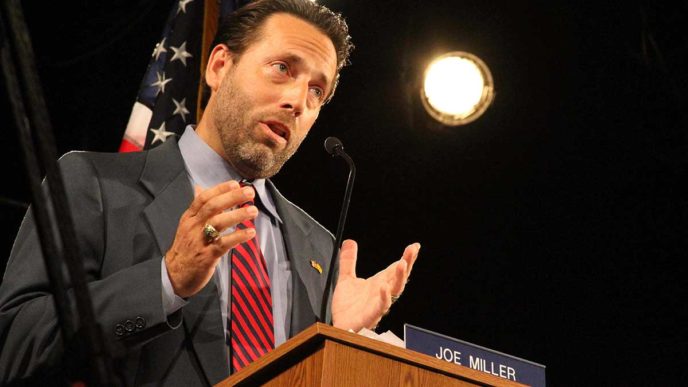
At first glance Lisa Murkowski’s Republican Primary election victory seems pretty impressive. But it is anything but the grand comeback story the Establishment media would have you believe.

Consider the competition.

Paul Kendall, local political activist, conspiracy buff, and self-acclaimed expert of all things futuristic. Nobody considers him a serious candidate, and I mean nobody. Yet he received almost 8% of the vote. No campaign, no advertising, a website that still reads “under construction” the day after the election. He wouldn’t even respond to media questions about his campaign platform.

Thomas Lamb, blue collar worker, Air Force veteran, local blogger, unsuccessful candidate for the Alaska State House, and all around good guy. But his campaign consisted of a few scattershot radio ads and social media. He garnered between 5-6% percent of the vote.

Bob Lochner, a veteran and former mechanic who works on the North Slope. He didn’t have a traditional campaign, and spent a grand total of about $20K, reportedly most of it on signs, pocket Constitutions, and campaign expenses. Unlike his fellow challengers, Bob had the good fortune of being from the Mat-Su Valley where the highest concentration of conservatives in the state reside. He garnered a very respectable 15%.

All good men I’m sure, but the obvious truth is that Lisa Murkowski didn’t have a legitimate challenger. Still almost 29% of the electorate from her own party wouldn’t vote for the sitting US Senate Energy and Natural Resources Chair in a state whose lifeblood is the energy industry, and that doesn’t include those who voted and chose to leave the Senate portion of their ballot blank.

So what do the numbers really say? I’m glad you asked.

Lisa Murkowski decided to run against her party’s nominee in the last cycle, ostensibly because only a small number of Alaskans voted for the nominee and that sample wasn’t representative of the state. Joe Miller’s 55,878 votes were only 11.5% of registered voters at the time. So maybe she had a point?

Well, neither of Alaska’s sitting US Senators have ever won that many votes in a Republican primary, nor represented that much of the electorate in a general election. (Dan Sullivan received 44,740 votes, 9% of registered voters in 2014.

In 2004 Lisa Murkowski won a contested primary with – wait for it – 45,710 votes, just 9.98% of registered voters.

Fast forward to 2016. With 99.8% of precincts reporting, Lisa Murkowski cruises to an overwhelming landslide victory with 71% percent of the vote – drumroll – and a grand total of 35,208 votes, just 6.8% of registered Alaska voters.

And that was after she spent an astonishing $4.6 million, or over $130 per vote!

Not since 1974 when Alaska dominated by Democrats and Mike Gravel was a sitting United States Senator has a Republican nominee won less votes. Joe Miller’s 32% second place finish in the three-way 2014 primary garnered more votes.

Clearly, by Senator Murkowski’s standards, this is not a legitimate outcome, and clearly isn’t representative of the Alaska electorate.

Perhaps Alaskans deserve another choice in the general election. After all, isn’t that the gospel according to Lisa Murkowski?

Follow Joe Miller on Twitter HERE and Facebook HERE.
Lifelong, Conservative Alaskan Acquires Rights to Most of Nome Gold Fields, Expects Huge Returns

Earlier this summer, Andrew Lee and a business partner purchased 26 State of Alaska offshore mining leases from a South African mining company. This purchase grants them exclusive mining rights to over 16,500 acres of the shallow sea floor of the Bering Sea, and returns these leases to local control.

Combined with another purchase earlier this spring, Lee now has an ownership stake in nearly two thirds of the offshore Nome gold field. “This feels like a huge victory for the little guy,” said Lee. “Eleven years ago I had one hobbled together eight-inch dredge on the Rec Area, now I have rights to most of the ground.”

Among the several State of Alaska Recreational Mining Areas, open to anyone for a small fee, two are offshore of Nome. One created in 1998 is 320 acres for eight-inch and smaller suction dredges. In 2010, a second 250 acres area was added, limited to six-inch dredges. Gold dredging operations are classified by their suction intake diameter, and water pump horsepower.

Andrew Lee got his start hunting gold as a teenager, going with his father to open mining areas near the family homestead in South Central Alaska. “We had a small in-stream sluice, a small inner tube mounted suction dredge and a few hand tools,” Lee recalls. “We never found enough gold to pay for fuel, but everyone has to start somewhere.”

According to the 1999 publication “Handbook of Marine Mineral Deposits” some of this area was mined by the world’s largest bucket line dredge, the Bima, collecting over 118,000 troy ounces on 530 acres from 1987 to 1990. Lee added, “The Bima only mined 3%, the other 97% hasn’t been worked.”

“The amount of previous mining is minuscule,” says Jim Halloran an Alaska geologist familiar with Nome. “There is considerable volume that would take many lifetimes to mine.” Having studied the extensive exploration data, Halloran adds, “The key is to find the best ground. The pay is in the top yard of the seafloor and can be as thick as six yards.”

“We need to go bigger, much bigger than anything that exists in Nome now,” said Lee when asked how he plans to capitalize on the untapped resource. “Think of an operation that can produce twenty times as much gold per year as the Christine Rose,” a reference to Nome’s most famous offshore gold mining operation. “My gold mining company, Tagiuk Gold, LLC is going to make this happen.”

“I have the expertise and the land, now I’m looking into ways to raise the rest of the funds needed.” One idea he explains is to take prepaid orders for gold, in order to fund the startup costs. Similar to how various gadget makers have used sites like Kickstarter. “I would like to sell my gold direct to the American individual, right now I’m exploring the interest and legalities of doing that.”

Andrew Lee’s gold mining company, Tagiuk Gold, LLC can be contacted through their website, tagiukgold.com

***This is a sponsored article by our advertiser, Tagiuk Gold***

Follow Joe Miller on Twitter HERE and Facebook HERE.

AK First Lady Donna Walker’s Heavy Hand on Bloggers

Last month, two staunchly conservative Alaska political websites posted a 2014 letter attributed to then-candidate Bill Walker, in which he stated he’d cut spending by 16 percent, not touch Permanent Fund dividends, and other claims.

These were claims heard from Walker during his campaign and are not a surprise to those who follow politics, although the grammar in the letter leaves something to be desired. The posting of the letter was, evidently, to hold the governor accountable for his actions now that he has the power of the veto pen.

Walker, we know, has primarily made cuts in the capital budget, and he has cut Alaskans’ Permanent Fund dividends in order to preserve state programs, such as the Department of Health and Social Services, where the actual workforce has been cut by just one percent.

What was a surprise is that Donna Walker has contacted both of the blogs and has asked or strongly suggested that the letter be taken down. The letter is not from the governor, she says.

“I was just really surprised,” said David Boyle, who writes at the Alaska Policy Forum. First Lady Donna Walker showed up at the office unannounced, accompanied by her daughter, Lindsay Walker Hobson, who was the spokesperson for Walker’s campaign for governor. Both Walker and Hobson are attorneys and both were part of the Walker, Richards LLC law firm, which has since been sold to Robin Brena.

According to Boyle, Mrs. Walker said the letter is a fake and strongly suggested to him that it be removed from the website.

Boyle has reviewed the letter and says it contains the exact ideas that Walker espoused in a private meeting with United For Liberty in 2014, at the home of Dave Cuddy.

Over at the Restoring Liberty web site, Michael Chambers writes about receiving the Walker article back in 2014, and the process he used to post it:

The first week of September 2014, candidate Walker was solicited by United For Liberty to submit an article for our October 2014 newsletter. The deadline was September 22 for final submission. A member of UFL accepted the editor’s task to put together the final product. This same member was also working with the Walker team to assist in assembling a narrative to be put in the newsletter. He worked diligently and put the entire newsletter together and submitted to me the entire PFD file to publish on United For Liberty’s website. Following is a letter I sent candidate Walker on October 9th thanking him for the submitted article and asking him to consider submitting one more for a possible additional newsletter before the election (he submitted an additional article on October 15, 2014, but I did not publish it as I did not have one from incumbent Governor Parnell and I wanted to give each candidate fair coverage)

That web site, too, was contacted by Donna Walker, who said the letter is a fake. Here’s what Joe Miller’s website has to say about being contacted by Alaska’s First Lady:

“Over the past week, the governor’s wife has sent me a series of emails claiming that the article submitted to UFL in the October newsletter was not authorized by the candidate. These communications were apparently prompted because recent excerpts of Bill Walker’s quotes from this article in our newsletter have appeared in various publications online, including Joe Miller’s Restoring Liberty article: Governor Walker Steals $666 Million From Alaska’s Families, Time to Recall the Liar. She calls the article ‘bogus,’ specifically complaining about the ‘mass distribution of the bogus article that has wrongly been attributed to Bill…”‘

Was the article authorized by candidate Walker or was it authorized by his campaign?

We don’t know, but when the First Lady of Alaska shows up unannounced to attempt to have material removed from a website, she is treading on the First Amendment, which states government “shall make no law…abridging the freedom of speech, or of the press; or the right of the people peaceably to assemble, and to petition the government for a redress of grievances.”

The First Lady of Alaska may not be an official arm of the Governor’s Office, but she has her own page on the State of Alaska website, she has her own State of Alaska email address, and she has her State staff and protection detail. She is also very much a part of the Governor’s policy team.

First Lady Donna cannot separate herself, at this point, from being part of the government, nor can she separate herself from being part of the Bill Walker re-election effort, which is clearly underway.

Follow Joe Miller on Twitter HERE and Facebook HERE.