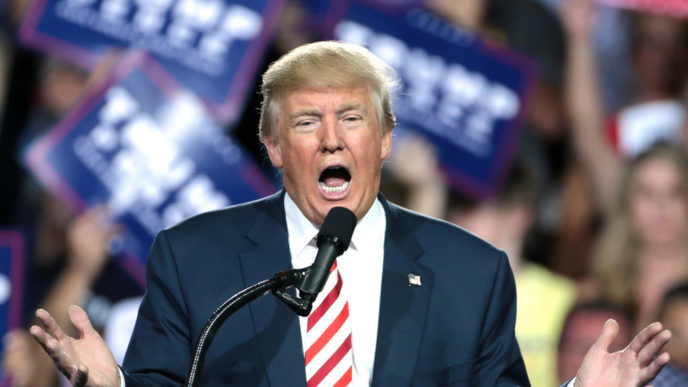
Two civil rights organizations brought separate lawsuits against President Donald Trump’s order banning transgender people from serving in the military Monday.
The complaints allege a variety of constitutional violations and seek injunctions barring the order’s enforcement while it is adjudicated in the courts.
The first suit was brought by the ACLU in the U.S. District Court for the District of Maryland. It names Trump, Secretary of Defense Jim Mattis, as well as the secretaries of the Army, Navy, and Air Force. The plaintiffs in the ACLU action include six active duty servicemen in various stages of gender transition who are currently receiving hormone therapy and related medical care. Several of the plaintiffs have done extended tours in Afghanistan.
“Our lawsuit argues that the ban violates the constitutional guarantees of equal protection and substantive due process by singling out transgender individuals for unequal and discriminatory treatment,” said Chase Strangio, a staff attorney with the ACLU’s LGBT and HIV Project. (Read more from “Lawsuits Pile up Over Trump’s Transgender Recruitment Ban” HERE)
https://joemiller.us/wp-content/uploads/Donald_Trump_2016_RNC_speech_4_cropped-1.jpg528751Joe Millerhttps://joemiller.us/wp-content/uploads/logotext.pngJoe Miller2017-08-28 18:42:322017-08-28 18:42:32Lawsuits Pile up Over Trump’s Transgender Recruitment Ban
Leave it to the federal government to make a costly mistake, obscure it for decades at taxpayer expense, and then try to claim it was a success.
In 2016, Johnston’s frankenia—a wiry, blue-green, roughly 1 to 2-foot-tall shrub with tiny oblong leaves—was taken off the endangered species list. The Fish and Wildlife Service’s endangered species database reports the happy plant was “delisted” because it had recovered.
It seems strange that such good news did not get much attention, and that the Fish and Wildlife Service only put out a press release in the southwestern U.S.
The reason it was not more publicized is probably because the whole thing is a farce. The species did not recover—it never was endangered in the first place.
When the Fish and Wildlife Service added this plant to the endangered species list in 1984, the agency reported it could only find about 1,000 of them in a few southern Texas counties, and that there was concern about “grazing pressure” on the hapless plant.
But surveys conducted after 1984 found a wealth of Johnston’s frankenia—over 4 million by one account and over 9 million by another—enough that biologists probably quit trying to guess.
The Fish and Wildlife Service hailed the “recovery” of the plant, saying, “The threats to this species have been eliminated or reduced to the point that the species has recovered … ”
That sounds a lot like a doctor claiming his patient is cured after realizing a terminal diagnosis was totally wrong.
When the Fish and Wildlife Service removes a species from the list, it is to attribute the action to either recovery, data error, or extinction. It’s clear Johnston’s frankenia was never “recovered” because it was never in desperate condition at all.
The Fish and Wildlife Service’s annual expenditure reports indicate that $670,000 were spent on Johnston’s frankenia between 1998 and 2014 alone. This includes nearly $250,000 shelled out by Customs and Border Protection in 2008 in order to avoid adversely affecting the plant.
Even more troubling than the expenditures is the fact that the government knew the plant was just fine when it made them. I know this because I petitioned the Fish and Wildlife Service to remove the species from the list as a mistake in 1997, citing data familiar to the service.
A half-decade later in 2003, the Fish and Wildlife Service finally announced a proposal to delist the species, stating that it was “not able to act on this petition upon receipt due to the low priority assigned to this activity … ”
The effort to deregulate the plant somehow ground to a halt until the Fish and Wildlife Service announced in 2011 that it was reopening the public comment period on the proposal to take this species off the list.
By January of 2016, the Fish and Wildlife Service finally removed the plant from the endangered list.
It took the agency decades to correct this mistake, and when it finally did, it was dishonest.
Because the Fish and Wildlife Service calls the plant “recovered,” it is required to monitor the species after taking it off the list. This requirement was intended to make sure species that actually belonged on the endangered list don’t slip back into an imperiled state.
The Fish and Wildlife Service has a 28-page monitoring plan that explains how the agency will keep a vigilant watch over the frankenia. It will spend $100,000 over nine years to conduct remote sensing at 20 sites and on-site assessments at nine sites.
And, as explained in the Federal Register, the Fish and Wildlife Service will make sure that threats, including “substantial human persecution,” are not visited upon the plant.
Of course, this is all an absurd waste. These measures do nothing but paper over the agency’s decadeslong mistake.
But after promulgating dozens of pages in the Federal Register costing perhaps $500 a pop, producing a 55-page recovery plan, and imposing hundreds of thousands of dollars on agencies that have other important things to do, what’s another nine years of monitoring to hide embarrassing facts from the public?
The Fish and Wildlife Service’s press release regarding removal of the plant from the endangered species list states, “The goal of the service is to make implementation of the Endangered Species Act less complex, less contentious and more effective.”
Nice idea—but how does the service now expect to have any credibility with landowners whose role in species conservation is crucial?
Smart public policies cannot be made when the government is producing patently fake information. The secretary of the interior should correct the record for Johnston’s frankenia. (For more from the author of “This ‘Endangered Species’ Story Was Government-Sponsored Fake News” please click HERE)
The ongoing controversy about the federal government’s role in managing land may soon come to a head.
Earlier this month, in accord with a presidential executive order issued in April, Interior Secretary Ryan Zinke delivered recommendations to the president on national monument lands that are being reviewed by his department.
Details about the report—whether lands should be reduced, and if so, which ones—are expected from the White House in the coming days.
The highly anticipated report has stirred a great deal of angst this summer, particularly among environmental activists who are convinced the Interior’s review is an unprecedented ploy to sell off or sully federal lands.
For example, luxury outdoor retailer Patagonia argued the following in its first ever television ad: “Public lands have never been more threatened than right now because you have a few self-serving politicians who want to sell them off and make money.”
Beautiful scenes of the Grand Tetons, Yosemite, and Zion pan across the screen as the company urges viewers to defend these lands and hold Zinke accountable.
The Patagonia commercial and much of the conversation this summer have been muddled with hyperbole and misinformation. It’s worth taking a step back to understand the issue.
Who’s Involved
In April, President Donald Trump requested that Zinke review all presidential national monument designations or expansions since 1996. In particular, Trump requested review of designations of areas over 100,000 acres and/or those that were “made without adequate public outreach and coordination” to determine if revisions were necessary.
Other presidents have reviewed and altered national monuments—among them Presidents William Howard Taft, Woodrow Wilson, Calvin Coolidge, Harry Truman, and Ike Eisenhower.
What’s at Issue
The subject of Interior’s report is presidential use of the Antiquities Act of 1906. The law allows presidents to unilaterally designate federal lands as “historic landmarks, historic and prehistoric structures, and other objects of historic or scientific interest.” These designations change how land is managed and who has access to it.
Trump is considering the need to reduce the size of, or altogether eliminate, some of these monuments.
Contrary to what the Patagonia commercial and many others would imply, reducing the size of a national monument or even rescinding its status does not open up the federal land to be overrun by oil interests or clear cut by the foresting industry.
Federal lands are managed by a web of laws determining who can do what and when. For example, at least nine other laws also address artifact preservation on federal lands.
The Lands in Question
Perhaps where environmental groups most mislead the public is in explaining which lands are being reviewed. National monuments are distinct from other land designations like national parks, which are created by Congress.
Zinke’s review covered 27 national monuments, mostly in the western United States, though some are located in New England and in offshore federal waters. In other words, this debate has nothing to do with the Grand Tetons, Yosemite, or Zion—all of which are national parks.
It’s also worth keeping in mind that the federal government owns hundreds of millions of acres in America. To put that in perspective, that’s about the same size as all of Western Europe.
Why Trump’s Upcoming Decision Matters
The reason this 110-year-old law has become so contentious is complicated.
In part, it has to do with past presidents abusing the purpose of the law. The Antiquities Act directs the president to protect artifacts on federal lands according to the “smallest area compatible with proper care and management of the objects to be protected.”
However, in recent history the Antiquities Act has instead been used to pull vast swathes of land out of use.
President Barack Obama in particular used this power aggressively. The Sutherland Institute reports that 66 percent of all national monument acreage was designated so under the Obama administration, and 25 percent under President George W. Bush.
It also has to do with ensuring quality management of lands. It is no secret that the Department of Interior is facing $15.4 billion in maintenance backlogs, and $11.9 billion of that is in the National Park Service alone.
Holly Fretwell of the Property and Environment Research Center reports that “[o]nly 40 percent of park historic structures are considered to be in “good” or better condition and they need continual maintenance to remain that way.”
The “why” also has to do with who should get the most say in decision-making.
The Patagonia ad encourages people to oppose changes to national monuments because “this [land] belongs to all the people in America—it’s our heritage.” But this glosses over decades and generations’ worth of contentious debate about who “our” refers to.
Does it refer to fly fishermen, hunters, hikers, and bikers as Patagonia would have its customers believe? Does it refer to the Native Americans and locals who are directly impacted by federal land management decisions, but who have little say in the matter?
Are American natural resource industries to be excluded from the collective “our”?
If Congress doesn’t like what the Trump administration is doing, it ought to act to clarify the law. Zinke rightly noted that “the executive power under the Act is not a substitute for a lack of congressional action on protective land designations.”
At the very least, Congress ought to amend the law to give states more say in the matter.
Land management decision-making has been contentious for decades. Shifting more control from Washington to those with direct knowledge of the land in question and a clear stake in the outcome of decisions would be a step in the right direction. (For more from the author of “Why Trump’s Upcoming Decision on Federal Lands Matters” please click HERE)
Celebrity televangelist Joel Osteen is under Twitter fire for not opening his church to victims of Tropical Storm Harvey.
Osteen is the head of Lakewood Church in Houston, which is housed in The Summit–the former NBA stadium of the Rockets, which holds 16,800 people.
The storm, which started out as a Category 4 hurricane but was reduced to a tropical storm once it hit land, has showered Texas with more than 30 inches of rain, has left 300,000 people without power and displaced 30,000 in temporary shelters across the state. FEMA is expecting as many as 450,000 potential disaster victims.
Lakewood Church’s Facebook page on Sunday said the church was “inaccessible due to severe flooding,” though the message doesn’t clarify whether the church itself is flooded. Pictures of the church purportedly taken since Harvey made landfall seem to show that it is less affected than other areas of Houston. Here’s a photo:
Front of @JoelOsteen's huge Lakewood Church in Houston at 11 am. Closed due to "flooding". Person who took it asked to be anonymous. pic.twitter.com/gOndOncFuC
https://joemiller.us/wp-content/uploads/Joel_Osteen_Preaching.jpg15362304Joe Millerhttps://joemiller.us/wp-content/uploads/logotext.pngJoe Miller2017-08-28 18:27:262017-08-28 18:27:26Joel Osteen Slammed for Not Opening Church to Flood Victims
New information has come to light on a Detroit-area Muslim convert who was building an arsenal of weapons and ammunition, all funded by a radical imam in Maryland.
The Detroit jihadist, 30-year-old Sebastian Gregerson, has been behind bars since last summer and is awaiting sentencing, but the imam who bankrolled his arsenal still walks free.
Gregerson, according to FBI filings in U.S. district court in Detroit last week, has now been linked to at least one other jihadist, 26-year-old Yusuf Wehelie, who was born in Minnesota to parents who migrated to the U.S. compliments of the United Nations-U.S. State Department refugee resettlement program.
Wehelie had traveled to the Middle East and boasted to undercover FBI agents that he had thought through plans to blow up a military recruitment center in Virginia if he could not join ISIS.
Gregerson was nearly as ambitious in his plans to become a “soldier” for Allah. (Read more from “‘Soldier of Allah’ Faces up to 10 Years in Prison for Arsenal” HERE)
https://joemiller.us/wp-content/uploads/allah-2070024_960_720.jpg540960Joe Millerhttps://joemiller.us/wp-content/uploads/logotext.pngJoe Miller2017-08-28 18:20:222017-08-28 18:20:22‘Soldier of Allah’ Faces up to 10 Years in Prison for Arsenal
The first thing former Maricopa County, Arizona, Sheriff Joe Arpaio asked when he was told he had received a presidential pardon for contempt of court over going beyond what a judge set as a limit for chasing down potential criminals was whether or not it was fake.
He said, after all, that he was experienced in fake government documents.
According to the Arizona Republic newspaper, Arpaio’s lawyer, Mark Golden, delivered an emailed copy of Friday’s presidential pardon to Arpaio while the former sheriff was celebrating at a birthday event for his wife, Ava.
The pardon reads: “I, Donald J. Trump, President of the United States of America, To all to whom these presents shall come, greeting: Be it known that this day, I, Donald J. Trump, President of the United States, pursuant to my powers under Article II, Section 2, Clause 1, of the Constitution, have granted unto Joseph M. Arpaio a full and unconditional pardon.”
Arpaio’s response, the report said, “Is this a fake?” (Read more from “Sheriff Joe Asks If Trump Pardon Is Real” HERE)
https://joemiller.us/wp-content/uploads/28703294976_a45cd1cc69_b.jpg6831024Joe Millerhttps://joemiller.us/wp-content/uploads/logotext.pngJoe Miller2017-08-28 18:16:282017-08-28 18:16:28Sheriff Joe Asks If Trump Pardon Is Real
An Arizona university professor has been suspended over controversial comments he made about Black Lives Matter activists nearly a year ago.
Professor Toby Jennings of Grand Canyon University ignited a firestorm recently after the university posted a link to a ministry forum from last September in which he said that some members in the Black Lives Matter group “should be hung.”
“They are saying things that are not helpful in any shape or form or human dignity or flourishing,” the African-American professor said during the forum, which was videotaped.
GCU officials told Fox 10 Phoenix that Jennings was advised that his comments during the forum, called “God’s concern for the poor: What’s missing in social justice,” were offensive, but it was not brought up to the school’s top executives.
However, members of the Black Lives Matter movement were outraged when it was shared recently. (Read more from “Controversial Black Lives Matter Comment Results in Suspension of University Professor” HERE)
https://joemiller.us/wp-content/uploads/17130711447_af938eb8a1_b.jpg5761024Joe Millerhttps://joemiller.us/wp-content/uploads/logotext.pngJoe Miller2017-08-27 22:10:512017-08-28 11:33:21Controversial Black Lives Matter Comment Results in Suspension of University Professor
The Trump administration will bring back the movement of surplus military equipment to local law enforcement.
Documents obtained by Fox News reveal President Trump will sign an executive order reversing an Obama-era policy which restricted local police agencies’ ability to get access to gear such as armored personnel carriers, grenade launchers and other military-grade equipment.
Trump’s executive order will restore “The full scope of a longstanding program for recycling surplus, lifesaving gear from the Department of Defense.”
The document continues, “The gear recycled through the Department of Defense’s 1033 program includes everything from ammunition and vehicles to office supplies… Under that program, assets that would otherwise be scrapped can be repurposed to help state, local, and tribal law enforcement better protect public safety and reduce crime.”
The policy change will be announced by Attorney General Jeff Sessions during a speech to the national conference of the Fraternal Order of Police in Nashville, according to a source familiar with the plan. (Read more from “Trump Plans to Lift Obama-Era Ban on Giving Local Police Military Equipment” HERE)
https://joemiller.us/wp-content/uploads/President_Obama_of_USA-2.jpg650962Joe Millerhttps://joemiller.us/wp-content/uploads/logotext.pngJoe Miller2017-08-27 22:04:502017-08-27 22:04:50Trump Plans to Lift Obama-Era Ban on Giving Local Police Military Equipment
Researchers in Denmark believe that we should add lithium to drinking water because studies show it may reduce dementia.
You simply can’t make this up. Adding fluoride, a neurotoxin, according to The Lancet medical journal, to our water isn’t enough.
The BBC reported that a study, at the University of Copenhagen, looked at the medical records of 73,731 Danish people with dementia and 733,653 without the mental disease.
They then tested the tap water in 151 areas of the country and some how these “experts” came to the conclusion that lithium, which is an alkaline metal, is good for the brain’s health at certain concentrations to prevent dementia.
The results, published in JAMA Psychiatry, alleged to show moderate lithium levels (between 5.1 and 10 micrograms per litre) increased the risk of dementia by 22% compared with low levels (below five micrograms per litre).
However, the article continues to say that the scientists found “drinking water with the highest lithium levels (above 15 micrograms per litre) had a 17% reduction in risk.”
The researchers said:
This is the first study, to our knowledge, to investigate the association between lithium in drinking water and the incidence of dementia.
Higher long-term lithium exposure from drinking water may be associated with a lower incidence of dementia.
What’s failed to be mentioned in the article is that lithium is used as an additive to extend the life and performance of alkaline batteries and in autogenous welding and brass welding, as well as having well-known harmful long-term side effects.
Lentech listed the risk of lithium exposure, especially noting the inhaling/ingestion of lithium:
Effects of exposure to Lithium: Fire: Flammable. Many reactions may cause fire or explosion. Gives off irritating or toxic fumes (or gases) in a fire. Explosion: Risk of fire and explosion on contact with combustible substances and water. Inhalation: Burning sensation. Cough. Laboured breathing. Shortness of breath. Sore throat. Symptoms may be delayed. Skin: Redness. Skin burns. Pain. Blisters. Eyes: Redness. Pain. Severe deep burns. Ingestion: Abdominal cramps. Abdominal pain. Burning sensation. Nausea. Shock or collapse. Vomiting. Weakness.
Effects of short-term exposure: The substance is corrosive to the eyes, the skin and the respiratory tract. Corrosive on ingestion. Inhalation of the substance may cause lung oedema. The symptoms of lung oedema often do not become manifest until a few hours have passed and they are aggravated by physical effort. Rest and medical observation is therefore essential. Immediate administration of an appropriate spray, by a doctor or a person authorized by him/her, should be considered.
This comes after the Environmental Working Group, an environment watchdog, released a searchable database of all the harmful chemicals in our drinking water and surprise, surprise lithium was included in that list.
The group noted that “ingesting too much lithium can lead to symptoms like abdominal pain, diarrhea, nausea, and vomiting.”
Still, the medical community wants to try to push adding lithium to our water because they believe it will help depression. There is no better word to describe such an idea other than insanity.
“In high doses, or even at low doses in some people, lithium can be toxic, so it is important that people consult with their doctor before they consider taking it as a supplement,” James Pickett, of the Alzheimer’s Society charity told New Scientist.
He’s exactly right; everyone’s body has a different chemical make-up, which is why you shouldn’t put foreign chemicals into your body because no person’s body reacts the same.
Lithium was also included in early recipes of the soda 7UP but was not included in the final product.
Another study found that “exposure to lithium via drinking water and other environmental sources may affect the thyroid function,” stressing the need to screen water for lithium. (For more from the author of “BBC Promotes Putting Lithium in Drinking Water to Combat Dementia” please click HERE)
https://joemiller.us/wp-content/uploads/basin-1502544_960_720.jpg530960Joe Millerhttps://joemiller.us/wp-content/uploads/logotext.pngJoe Miller2017-08-27 21:42:512017-08-27 21:42:51BBC Promotes Putting Lithium in Drinking Water to Combat Dementia
Antifa violence broke out once again in Berkeley, California, this weekend.
On Sunday, a small number of supporters of President Trump decided to gather in the left-wing college town following the cancellation of two similar demonstrations in the area the day before. The reason for the cancellations was due to the large number of violent threats the pro-Trump organizers received.
The day Trump supporters actually showed up in the Bay Area gave leftists the chance to make good on their threats.
The scenes on the ground in Berkeley showed black-masked, red flag-waving thugs taking over the city and assaulting anyone they deemed to be a Nazi. It was a stark contrast to the heroic image Antifa has earned from journalists and politicians in the weeks since the violence in Charlottesville. (Read more from “The Establishment and Antifa Go Hand in Hand” HERE)
https://joemiller.us/wp-content/uploads/Monza-graffiti-zona-antifa.jpg12241632Joe Millerhttps://joemiller.us/wp-content/uploads/logotext.pngJoe Miller2017-08-27 21:33:462017-08-27 21:33:46The Establishment and Antifa Go Hand in Hand