Delaying Marriage and Parenthood: The Consequences of ‘Emerging Adulthood’

Arguably the most consequential cultural shift of the past 50 years that too many people are unaware of is the rise of what demographers call “median age at first marriage.”

Two simple numbers, one for men and the other for women, tell a great deal about where marriage and family rank among our culture’s priorities.

Growing Up, Then and Now

In 1950, the median ages for first marriages were 22.8 years old for men and 20.3 years old for women. As late as 1970, the median ages were 23.2 for men and 20.8 for women. And then those ages started rising, and they’re still going up. The figures as of 2013: 29 and 27, respectively.

What’s going on here? What does it mean? Those questions are raised in an important new study by the Census Bureau.

The study, entitled “The Changing Economics and Demographics of Young Adulthood: 1975-2016,” opens with a sobering conclusion: “What was once ubiquitous [for younger Americans’] during their 20s is now not commonplace until their 30s. Some demographers believe the delays represent a new period of the life course between childhood and adulthood, a period of ‘emerging adulthood.’” (For more from the author of “Delaying Marriage and Parenthood: The Consequences of ‘Emerging Adulthood'” please click HERE)

Follow Joe Miller on Twitter HERE and Facebook HERE.

North Korea Open To US Talks Under ‘Conditions’

A top North Korean diplomat said Saturday that Pyongyang would be willing to meet with the Trump administration for negotiations “if the conditions are set.”

Choi Sun-hee, the top North Korean diplomat who handles relations with the U.S., spoke briefly to reporters in Beijing en route to Pyongyang. She was traveling from Norway, where she led a delegation that held an informal meeting with former U.S. officials and scholars.

Choi did not elaborate on what the North’s conditions are, but her comments raise the possibility of North Korea and the U.S. returning to negotiations for the first time since 2008, when six-nation talks over Pyongyang’s nuclear weapons program fell apart. Read more from “Delaying Marriage and Parenthood: The Consequences of ‘Emerging Adulthood'” HERE)

Follow Joe Miller on Twitter HERE and Facebook HERE.

US Prepares to Ban Something You’d Never Expect on Flights to Europe

The U.S. is expected to broaden its ban on in-flight laptops and tablets to include planes from the European Union, a move that would create logistical chaos on the world’s busiest corridor of air travel.

Alarmed at the proposal, which airline officials say is merely a matter of timing, European governments held urgent talks on Friday with the U.S. Department of Homeland Security.

The ban would affect trans-Atlantic routes that carry as many as 65 million people a year on over 400 daily flights, many of them business travelers who rely on their electronics to work during the flight. (Read more from “US Prepares to Ban Something You’d Never Expect on Flights to Europe” HERE)

Follow Joe Miller on Twitter HERE and Facebook HERE.

New Marine Corps Ad on Women in Combat Sparks Heated PC Debate

The Marine Corps’ first-ever recruitment video showing a woman in combat quickly devolved into a spat about political correctness after it was posted to Facebook.

The recruitment commercial, called “Battle Up,” shows a young girl confronting bullies, playing rugby and then evolving into a Marine later in life, at which point she leads other Marines and engages in a firefight through an ambush. The final scene shows her helping the homeless. Marine Capt. Erin Demochko, who served in Afghanistan, played the woman.

The video has already racked up almost half a million views after being posted to the Marine Corps’ official Facebook page Friday.

Almost as soon as the commercial appeared on Facebook, conversation devolved into a spat about political correctness. The first comment by Facebook user Chris Clark reads: “had to be a chick…tired of all this political correct bull****…. now let all the man haters come out of the woodwork…”

Immediately, the Marine Corps page responded and said: “That’s not a “chick”, Chris. You’re watching a Marine.” (Read more from “New Marine Corps Ad on Women in Combat Sparks Heated PC Debate” HERE)

Follow Joe Miller on Twitter HERE and Facebook HERE.

Comedian Jim Gaffigan’s Wife’s Experience With Tumor ‘Strengthened My Faith in God’

Comedy writer Jeannie Gaffigan suffered from headaches, dizziness and coughing fits for months. The wife of comedian Jim Gaffigan chalked it up to her busy lifestyle and having five kids. But when she started to lose her hearing, Jeannie decided to get it checked out. Doctors found a tumor the size of an apple.

The benign tumor was wrapped around her brain stem. “I was a ticking time bomb, waiting to be paralyzed,” the 47-year-old told People magazine recently. On April 18, Jeannie underwent a nine-hour surgery to remove the tumor.

Jim said he thought maybe they would have removed the majority of the tumor, but they were elated when they found out all of it was removed. She also didn’t have any damage to her cranial nerves. Her doctor said that if she’s clear at her three-month check she will be cured.

“My whole life has changed,” said Jeannie. “The people who have come out of this have shown me how loved I am.”

The couple experienced an outpouring of help and love from friends and family. “People are so generous,” said Jim, “it’s really made me believe that there’s hope for humanity.”

Drawing Closer to the Lord

Already a devout Catholic, Jeannie said the ordeal has brought her even closer to God.

“Every thing has completely strengthened my faith in God,” says Jeannie. “Because I told God, I said, ‘God, I’m not ready to go. I have work to do. Please help me.’”

Jim said it was a miracle that they found the doctor they did. It’s a miracle that the entire tumor was removed. It’s a miracle that her progress has been so swift. Still, she has a long way to go. She had pneumonia at the hospital and is now recovering at home with a tracheotomy and feeding tube. “The progress has been pretty amazing, but we’re far from normal,” said Jim.

Jeannie is convinced something good will come out her health crisis. “There’s just going to be so much to come out of this for me. All of this is a miracle.” She wants to comfort others as well. “I want to help people get through the worst news that you can get.” (For more from the author of “Comedian Jim Gaffigan’s Wife’s Experience With Tumor ‘Strengthened My Faith in God'” please click HERE)

Follow Joe Miller on Twitter HERE and Facebook HERE.

The Huge Unrecognized Mistake We’re Making With Our Kids

Growing up is dangerous. Nearly all of us make it through anyway.

My daughter, Lisa, sprained her ankle 17 times while she was growing up. A few months ago she ran a half-marathon. She suffered a serious concussion in high school, and an even more serious one during college: it interfered with her cognitive processes for well over a year. Still she graduated from Miami University last December, a semester ahead of her peers.

Kids can fight their way through a lot. To see how parents protect them these days, though, you’d think making it all the way to adulthood was a rare event. We do everything in our power to protect them from every possible danger. Too much, on the whole, I’d say.

My generation has made its share of mistakes, but I think overprotecting our kids might be one of the worst — and least recognized — errors we’ve committed along the way.

We Forgot How We Grew Up

We thought it was so important to keep our kids safe, but we forgot how we grew up ourselves. My brother and I used to ride our bikes three times a week to play golf at a small course four or five miles away. It was just the two of us. We were no older than our early teens, as I recall.

Once I decided it would be an adventure to walk the seven miles home from junior high school, rather than taking the bus. I told my parents I’d be home late that day, and they said “Fine, enjoy your walk.”

My friends and I used to play hide-and-seek with flashlights, long after dark, across our entire neighborhood.

Adventures like that could never happen today. I never see kids waiting alone for the school bus in the morning; there’s always a mom or dad watching from inside a car nearby. It’s gotten so bad that not long ago a “concerned citizen” filed a report with Manitoba’s Child and Family Services against a mom who let her kids play inside their own fenced back yard.

Kids Need To Face Challenges On Their Own

Those who never have problems don’t learn what it’s like to solve problems. Kids who never face challenges on their own don’t get any practice in overcoming them on their own.

Granted, school counts as a challenge for most, but it’s a heavily supervised one. The same goes for athletics: there’s always a lot of adults around.

I never played Little League ball when I was growing up. I envied the kids who got real uniforms to wear, and had real bases to run around. But that didn’t stop my friends and me. There was a vacant lot on our block; nothing there but tall grass. We got permission from the owner to cut the grass and build a backstop. We made our own ball field there.

I was all of nine years old that summer. Some of the other kids might have been as old as 12 or 13. I don’t remember any adults helping us with any of it. We had a problem and our parents let us solve it.

I don’t know how my generation lost track of how important that kind of thing was for us when we were kids. I suppose we got badly spooked by stories of strangers stealing children. We forgot that there was a far more likely danger that our kids would grow up stunted in their ability to face real problems, if we kept them protected all the time.

I can’t help wondering if that’s a large part of the reason college students today are so shrill in their demand for “safe spaces.” Some of them — many of them, maybe — have always lived inside safe spaces. Someday they’ll graduate, and there won’t be anyone around to enforce that “safety” for them. They won’t be ready for it.

Growing Up To Do Something Worthwhile

Doctors have discovered a link between having a lot of dirt on your hands as a child, and being free of allergies and asthma as an adult. Even more obvious is the link between facing challenges while young and growing up to do something significant.

Our son has a great job, but he went through a lot getting there: two seasonal jobs that lasted only as long as they lasted, three jobs that he genuinely needed to leave because his bosses had seriously misrepresented the pay and working conditions, one job that he wasn’t suited for and was let go from, and another hard-working early morning job he didn’t like very much but persevered in anyway. There wasn’t a lot of “safety” for him on the way to the work he’s doing now.

“I Can’t Stand To Watch, and I Can’t Stand Not To Watch”

Our daughter’s locker partner in high school, Taylor, was an Olympic hopeful gymnast. She practiced hours every day, and suffered more than one broken bone, getting to the point of competing at level 10. There is no level 11; if you get to that stage you’re on the national team.

We went to one of her meets. When she was on the balance beam I watched her dad as closely as I did her. I wanted to know what it felt like to see your daughter doing tumbling routines on a four inch-wide hunk of timber. I asked him afterward, and he told me, “I can’t stand to watch, and I can’t stand not to watch. It’s really hard — but I’m so proud of her.”

A few weeks later I saw an old friend of mine whose son, daughter-in-law and grandchildren were serving in Nigeria as medical missionaries. There was considerable violence going on in their region at the time. I asked the dad how it felt. His answer sounded almost exactly like Taylor’s dad: “I really wish they weren’t there, but I know it’s right, and I am so proud of them.”

Growing Up To Make A Difference

I’m no child psychologist, but I’m pretty sure kids will have a hard time growing up to take great risks to change the world if they haven’t taken risks to play in their neighborhoods.

Next week my daughter will be marrying an Army lieutenant. He was assigned to the National Guard after his commissioning, but he’s pulling hard to go on active duty. I know it’s going to be tough on Lisa, if and when he’s deployed to an active battle zone, but I know she’ll make it. As the dad, I know it’s going to be hard on me, too. I’m sure I’ll say “This is so hard to live with. I can’t stand it!” But I will be — as I already am — so proud of them both. (For more from the author of “The Huge Unrecognized Mistake We’re Making With Our Kids” please click HERE)

Follow Joe Miller on Twitter HERE and Facebook HERE.

Paris and Washington Send a Message to Moscow: No Sanctions Relief Until Russian Troops Leave Ukraine

The Kremlin’s gambit to secure sanctions relief by redrawing the political landscapes in Europe and the United States has, so far, been a failure.

In 2014, the U.S. and the European Union levied punitive economic sanctions on Moscow for its invasion of Ukraine’s Crimean Peninsula and subsequent proxy war in eastern Ukraine. New presidential leadership in Washington and Paris have both made clear this year that the sanctions will stay in place until the Kremlin fulfills its commitments in implementing the Ukraine cease-fire, known as the Minsk II agreements.

Those commitments include the withdrawal of all Russian troops from Ukrainian territory, the return of Ukrainian control over its border with Russia in the Donbas, and unhindered access for international monitors in the conflict area.

“We will not submit to Russia or Mr. Putin’s values, as they are not the same values as ours,” French President-elect Emmanuel Macron said during the campaign, referring to Russian President Vladimir Putin.

Macron, a 39-year-old pro-European centrist, was elected president in a May 7 landslide over his pro-Russian, anti-EU rival, Marine Le Pen. Macron is set to enter office on Sunday.

Meanwhile, U.S. Secretary of State Rex Tillerson pressed for the full implementation of the Minsk agreements during a Wednesday meeting in Washington with Russian Foreign Minister Sergei Lavrov.

“Sanctions on Russia will remain in place until Moscow reverses the actions that triggered them,” U.S. State Department spokeswoman Heather Nauert said in a statement following the meeting.

Consequently, there will be no workaround for the Kremlin to avoid fulfilling its Minsk II commitments. And, so far, neither the EU nor the U.S. has been willing to make concessions about Ukraine for tighter cooperation with Russia in combatting the Islamic State terror group in Syria.

“The [Trump] administration should be wary of getting distracted by Russia and [Bashar] Assad in Syria at the expense of countering Russia’s continued aggression in Europe,” Daniel Kochis, policy analyst in European affairs at The Heritage Foundation, told The Daily Signal.

Setback

Macron’s victory over Le Pen in the May 7 French presidential election was widely perceived to be a setback to Putin’s efforts to influence Europe’s political future through a hybrid campaign of propaganda and cyberattacks.

Macron’s opponent, Le Pen, represented the pro-Russia, anti-EU National Front party.

In November 2014, according to French news reports, the National Front received a 9 million euro ($9.8 million) loan from the Russian-owned First Czech-Russian Bank, part of a larger 40 million euro request.

During the 2017 campaign, Le Pen said she would lift sanctions on Moscow. She praised Putin, criticized U.S. policy regarding Ukraine and Russia, and traveled to Moscow to meet with the Russian leader on March 24.

“Regarding Ukraine, we behave like American lackeys,” Le Pen told the Polish news site Do Rzeczy. “The aim of the Americans is to start a war in Europe to push NATO to the Russian border.”

“I will not accept to have my behavior dictated by Mr. Putin, and that is the difference with Mrs. Le Pen,” Macron said during the campaign.

In the last two days of the campaign, Macron’s campaign said it had been the target of a massive computer hack that dumped internal campaign emails online. Multiple independent investigations cited in news reports claimed the hackers had ties to Russian military intelligence. Moscow denied it was involved.

Without conclusively pinning the Macron campaign hack on Russia, U.S. National Security Agency Director Michael Rogers told Congress on Tuesday that the spy agency had warned French authorities about the threat of a Russian cyberattack before the election.

“If you take a look at the French election … we had become aware of Russian activity,” Rogers told the Senate Armed Services Committee. “We had talked to our French counterparts prior to the public announcements of the events publicly attributed this past weekend and gave them a heads-up: ‘Look, we’re watching the Russians, we’re seeing them penetrate some of your infrastructure.’”

On May 8, the day after the French election, Putin made a conciliatory overture to Macron, urging Franco-Russian cooperation on shared security challenges such as combatting terrorism.

“The citizens of France have trusted you with leading the country at a difficult time for Europe and the whole world community,” Putin told Macron in a telegram, according to Russian news reports.

“The growth in threats of terrorism and militant extremism is accompanied by an escalation of local conflicts and the destabilization of whole regions,” Putin said in the message. “In these conditions it is especially important to overcome mutual mistrust and unite efforts to ensure international stability and security.”

Across the Pond

In Washington, the election of President Donald Trump has not resulted in any significant change in U.S. policy regarding sanctions on Moscow.

On Wednesday, Trump met with Lavrov, Russia’s foreign minister, as well as Ukraine’s foreign minister, Pavlo Klimkin, in the Oval Office during separate appointments.

Trump subsequently published pictures of his meetings with both Klimkin and Lavrov on Facebook, along with the message: “Yesterday, on the same day – I had meetings with Russian Foreign Minister Sergei Lavrov and the FM of Ukraine, Pavlo Klimkin. #LetsMakePeace!”

“The United States is ready to be further involved in making Russia implement Minsk agreements,” Klimkin said following the meeting with Trump, according to Ukrainian news reports.

Klimkin also suggested the U.S. might join the Minsk II negotiations, known as the Normandy format, which currently comprises leaders from Ukraine, Russia, Germany, and France.

Meanwhile, on Tuesday—one day before Lavrov’s Oval Office meeting with Trump—a Russian fighter jet flew within 20 feet of a U.S. Navy reconnaissance aircraft over the Black Sea, NBC News reported Friday.

Speaking to reporters in Moscow on Friday, Russian presidential aide Yuri Ushakov blamed the current tensions between Russia and the U.S. on Trump’s predecessor, former President Barack Obama.

“Naturally, we do not expect that all problems—and there are quite a few of them—will be resolved overnight, because Obama and his team have left the gravest legacy on the Russian track and clearing away these obstructions will be extremely difficult,” Ushakov said, according to the Russian news agency TASS.

“Russia is open for dialogue with the United States in various spheres, including Syria and any other areas where our interests meet or can meet,” Ushakov said.

A History of Violence

Russia’s failure to achieve sanctions relief has not had a cooling effect on the Ukraine war. Overall, the conflict is stuck in a cyclical pattern of waxing and waning violence.

On May 7, the same day that French voters went to the polls to choose their next president, combined Russian-separatist forces fired more than 150 mortars at Ukrainian positions throughout the war zone, according to Ukrainian military officials.

On that day, one Ukrainian soldier was killed in combat; another soldier died in a military hospital due to wounds from a sniper shot on April 30. During the preceding week, four Ukrainian soldiers were killed due to enemy fire, and 40 were wounded.

Ukrainian military forces are engaged in a three-year-old proxy war with Russia in the Donbas, Ukraine’s embattled southeastern territory on the Russian border.

Along a 250-mile-long front line, Ukrainian troops are entrenched within a network of trenches and fortified fighting positions. Across no man’s land, they face a combined force of about 35,000 pro-Russian separatists and approximately 5,000 Russian regulars, according to Ukrainian and NATO intelligence estimates.

Artillery and rocket attacks, tank shots, and small arms gunfights are still daily occurrences. As are casualties, both military and civilian, on opposite sides of the conflict. At some places, no man’s land is only a few hundred meters wide—close enough for the enemy camps to hear each other talking.

The Minsk II cease-fire prohibits the use of heavy weapons above certain calibers within prescribed buffer zones around the front lines. The cease-fire also prohibits both sides from taking new ground or using airpower.

However, the war never ended. About one-third of the war’s 10,000 deaths have occurred since Minsk II went into effect in February 2015.

The international organization tasked with monitoring the cease-fire, the Organization for Security and Cooperation in Europe, or OSCE, has suspended operations in the war zone after an American paramedic attached to one of its patrols was killed in a landmine blast on April 23 in separatist-controlled territory.

The paramedic, 36-year-old Joseph Stone, was the first OSCE patrol member killed while on duty in eastern Ukraine.

“The restrictions have reduced the geographical scope of our patrols and have entailed a grounding of our mid-range unmanned aerial vehicles,” Alexander Hug, principal deputy chief monitor of the OSCE Special Monitoring Mission to Ukraine, said during a press briefing in Kyiv.

“All of which means we are unable to monitor and report on facts, including violations, to the extent that we usually do,” Hug said. “The OSCE SMM imposed these restrictions in order to protect our unarmed civilian monitors.”

On Thursday, combined Russian-separatist forces attacked Ukrainian units 28 times, using mortars, small arms, grenade launchers, and heavy armor, Ukrainian Ministry of Defense spokesman Col. Andriy Lysenko told reporters in Kyiv on Friday.

Lysenko said two Ukrainian soldiers were killed and six were wounded during Thursday’s attacks.

“We assess that Moscow’s strategic objectives in Ukraine, maintaining long-term influence over Kyiv and frustrating Ukraine’s attempts to integrate into Western institutions, will remain unchanged in 2017,” Director of U.S. National Intelligence Daniel R. Coats told the U.S. Senate Select Committee on Intelligence during a Thursday hearing.

“Russia largely controls the level of violence, which it uses to exert pressure on Kyiv and the negotiating process,” Coats said. (For more from “Paris and Washington Send a Message to Moscow: No Sanctions Relief Until Russian Troops Leave Ukraine” please click HERE)

Follow Joe Miller on Twitter HERE and Facebook HERE.

Here’s How Far Behind Trump Is on Political Appointments Compared to Obama, Bush

President Donald Trump has begun to move on naming federal judges and will eventually be naming a new FBI director, but more broadly, he remains slow in filling political appointments compared to his predecessors.

Trump has made 85 nominations to the Senate at this point in his presidency as of Friday, according to the Center for Presidential Transition, which tracks presidential appointees. In that same period of his first term, President Barack Obama made 212 nominations, President George W. Bush made 161 nominations, President Bill Clinton made 182 nominations, and President George H. W. Bush made 135 nominees by this point.

Trump, so far, is leaving key management positions unfilled, said Mallory Barg Bulman, vice president of research and evaluation at the Partnership for Public Service, the parent organization to the Center for Presidential Transition.

“Leadership matters a lot, as does having the right people in place,” Bulman told The Daily Signal. “You can’t start the game until the whole team is on the field.”

Trump has no nominee for 460 of the 557 key leadership positions, as of Friday, according to Partnership for Public Service. Trump has nominated 49, announced the nomination of 19, and 29 people have been confirmed.

Earlier this week, White House press secretary Sean Spicer said the administration is taking time to vet employees.

“We’re actually going through the Office of Government Ethics and FBI clearances before announcing most of these individuals,” Spicer said at the Monday press briefing. “And so, there’s a little bit of a difference in how we’re doing this. But we are well on pace with respect to many of these [appointments] to get the government up and running.”

Trump has not yet even named a director to run the Office of Personnel Management, which manages the federal workforce, noted Robert Moffit, a former assistant OPM director under President Ronald Reagan.

“The bottom line is that the president can’t run the federal government out of the White House and secretaries can’t run giant agencies huddled in an executive suite,” Moffit, now a senior fellow for health policy at The Heritage Foundation, told The Daily Signal. “Unilateral disarmament is a victory for the swamp. The swamp creatures have won the fight. Unless you control the bureaucracy, the bureaucracy controls you.”

Moffit, who also worked in the Reagan administration’s Department of Health and Human Services, said Reagan took control of the federal bureaucracy shortly into his presidency.

He said congressional relations is a key area where political appointees should be working, instead of leaving it to career civil service employees in some cases. That’s because, Moffit stressed, it’s the job of the career civil service employees to execute administration policy but the job of political appointees to advocate and explain those policies to Congress.

The president can name about 4,000 political appointees.

Out of that, 1,242 are key leadership positions that need Senate confirmation, according to the Partnership for Public Service. Another 472 political appointees—largely White House staff—don’t require Senate confirmation, according to the partnership. Further, 761 non-career senior executive positions can be filled throughout the executive branch—though not all are presidential appointees. Finally, 1,538 non-career federal employees report directly to a presidential appointee.

The partnership did not have a final number on how many of these positions are filled or unfilled, because it only tracks key leadership positions—most of which require Senate confirmation.

The White House Transition Project measures a different metric, but still finds Trump well behind other presidents going back through Reagan. Trump officially fell behind in March, said Terry Sullivan, a political science professor at the University of North Carolina, Chapel Hill, and the executive director of the project.

Rather than measuring 4,000 jobs, which includes all U.S. marshals, U.S. attorneys, and every inconsequential U.S. ambassador, the White House Transition Project looks primarily at 221 government appointments that are required for the essential function of government, have policy roles, and have the potential to be controversial, Sullivan said.

“This is not a result of a policy predisposition to shrinking government,” Sullivan told The Daily Signal. “He wants a tax cut but he isn’t staffing up the Treasury Department. He doesn’t want more EPA regulations, but he isn’t moving slower or faster with that agency than Veterans Affairs or Health and Human Services, things he cares about.” (For more from the author of “Here’s How Far Behind Trump Is on Political Appointments Compared to Obama, Bush” please click HERE)

Follow Joe Miller on Twitter HERE and Facebook HERE.
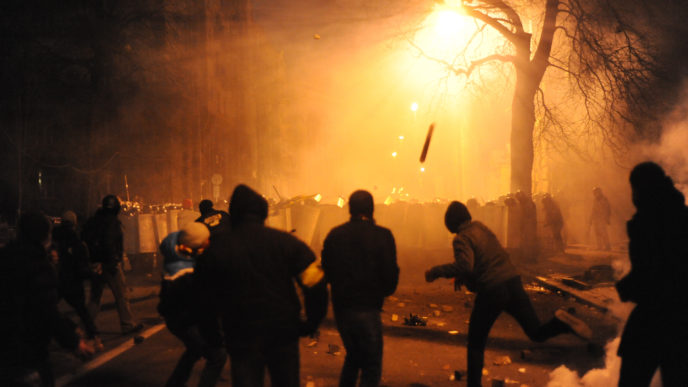
How This Maryland Police Department Is Combating the MS-13 Gang

Two years ago, a suburban Maryland county began to see a dramatic rise in killings attributed to MS-13, an international gang with ties to Central America.

In response, the Montgomery County Police Department assigned Capt. Paul Liquorie, a 23-year veteran of the police force, to lead a centralized street gang unit dedicated to stomping out the violence.

In an interview with The Daily Signal, Liquorie, 49, director of the department’s Special Investigations Division, described law enforcement’s approach to combating MS-13 in this affluent county just outside Washington, D.C.

Since August 2015, Liquorie said, the county has suffered seven MS-13-related homicides.

“The Latino community where MS-13 has a presence is terrified,” Liquorie said.

The Trump administration repeatedly has invoked the threat of MS-13, making the gang a central focus of its effort to enforce immigration laws aggressively.

Liquorie, in a Q&A below, describes MS-13’s increasing “brutality and callousness” and how Montgomery County works with federal law enforcement to find and prosecute the gang’s members.

“Law enforcement won’t tolerate this,” Liquorie said of the violence and other crimes associated with MS-13.

The Daily Signal: How long has MS-13 been present in Montgomery County, and what’s different about their activity in the county now?

Liquorie: It always has been a priority because MS-13 has such a presence here in the county.

What we attribute to MS-13 is that since August of 2015, we’ve had seven MS-13-related homicides where we believe the perpetrators are MS-13 and two victims we believe were MS-13.

One of the things most alarming recently is the number of homicides, and the brutality and callousness by which they occur.

What I mean by that is the reasoning behind the violence may just be someone flashing a gang sign on the internet, or someone who may be believed to be a rival gang member.

The murders are not done in the sense of to gain greater territory or monetary benefits for the gang itself.

Another alarming thing is how [MS-13 leaders] try to get junior members to rise in status. To prove your loyalty in the gang, you will have to commit a homicide to get the full confidence of the gang in your abilities.

What we have seen regularly in recent years is just the brutality of the violence. People are lured into wooded areas, [and] usually stabbed with some sort of edged weapon multiple times.

The other thing we have seen change in recent years is they want anyone who is present to be actively involved in the violence.

Rather than one person stabbing the victim, and two others being there on the periphery, they want everybody to stab the body multiple times to say now we are all equally culpable and you will be less likely to snitch or make a deal with prosecutors because you were also involved.

You are just as culpable.

When someone is shot, there is a level of distance. To stab someone is a very personal act. You have to be up close to that person and be right with them as they are dying.

Q: How has the escalation in violence that you are describing been impacted by the flood of unaccompanied Central American youth who have settled in the area in recent years? Are those recent arrivals targeted for gang recruitment?

A: Even outside the gang, there is a different status [perceived] between these new arrivals, these unaccompanied minors, and established immigrants. That means these kids further become alienated.

They don’t fit in at school. Some of them might not fit in at home. They come here hopefully trying to flee violence in their country, so whoever is their sponsor here, those people, many may be struggling economically already and are taking on this additional economic burden of sponsoring someone else.

The gang can come to you and can fill these voids, and that makes [the new arrivals] very susceptible to be gang members.

We see a grooming process very similar to what you would see with pedofiles to gain people’s trust.

A lot of these kids are in over their heads before they know it.

Q: Are the victims of MS-13 violence randomly targeted? What traits characterize the victims?

A: In the vast majority of them, we have been very successful in prosecuting the perpetrator of these crimes, and we have some [cases] that still remain open, where we hear through our investigation that the victims may have had ties to MS-13.

There is usually some affiliation with the gang. They may not be full-fledged members, but there may be some kind of action by the victim that leads [MS-13] to believe they are a rival gang member.

Q: What kind of crime does MS-13 involve itself with? What drives them to violence?

A: Mexican and Columbian cartels—in the amount of power they hold and the financial holdings they have—have a lock on the drug market. So it’s hard for MS-13 to really get a foothold in the drug market. So they really get whatever local markets are left over—whatever those organizations are willing to allow MS-13 to do.

What you see locally is their main form of revenue is extortion. Originally we would see that limited to underground economies, bordellos—or houses of prostitution—[and] cantinas—or unlicensed bars and restaurants that might serve ethnic food as well as beer and wine.

People without status here usually don’t have IDs to get alcohol, so you have this underground economy that serves this clientele. The gang is not running those businesses, but extorting them, providing quote-unquote “protection.”

What we are starting to see and [are] working on is that MS-13 is extorting from legitimate businesses within the Hispanic community. Anecdotally, you are seeing that with apartment complexes where there are a large amount of Hispanic residents.

[MS-13] are consistently looking for people and saying, “We will provide you protection to live in this community.”

The other case you hear anecdotally is where there are legitimate businesses, beer and wine stores for example, of El Salvadorian descent whose proprietors are being threatened by the gang to provide liquor to them and sell to these illicit cantinas. They use social media to realize who the proprietor of the business is, to figure out who their family members are in El Salvador, and they then threaten to do harm to them.

That is outside the reach of American law enforcement. That’s a very difficult problem to work on.

Q: How do you work with federal law enforcement to combat MS-13?

A: We are working closely with the U.S. Attorney’s Office in recent months. We have a large RICO [Racketeer Influenced and Corrupt Organizations Act] case where we have 15 gang members who have been federally indicted and are being prosecuted.

Just like we do with other federal task forces, we have our [Montgomery County Police Department] members on the joint terrorism task force and DEA [Drug Enforcement Agency] task force. Similarly, we have task forces looking at gang activity as well.

We work with the Department of Homeland Security’s investigations arm to try to look at the gang holistically and target the organization as a whole to include its hierarchy.

Q: What is the Montgomery County Police Department’s approach to combating MS-13?

A: We take a holistic or “whole of government” approach.

We have three pillars: prevention, intervention, and suppression, based on best practices from gang programs throughout the country. What you see in Montgomery County on the preventative side is the Recreation Department of the county government going into neighborhoods where there are at-risk youth, to provide positive alternatives so they don’t fall under the lure of the gang.

Montgomery County [Public] Schools is doing similar things.

Intervention falls under the county’s Health and Human Services Department with street outreach, doing outreach in neighborhoods providing the full gamut of services: social, mental health, and other ways that may strengthen the family network and trying to find what’s best to help the child and family divert from gang activity.

Last is the suppression, that falls on the police. All police officers are tasked with [fighting] criminal activity.

Q: Why is Montgomery County vulnerable to MS-13? In other words, why is MS-13 so active in the county?

A: You see that we have a large enclave in the greater D.C. area of Central Americans and a certain percent, a small percentage, are going to be gang members or targeted by gang members.

I can tell you stories anecdotally where somebody starts into the gang and acquiesces and hopes they can limit their activity in the gang and says, “I will just do enough to be a part of the gang and not be targeted by them anymore.” But that starts the grooming process that goes on. There are others in MS-13 that are attached to the power and influence, but there are some who join the gang reluctantly.

MS-13 has become more prominent locally. We have seen the acts are becoming more isolated in the Hispanic community and that’s the double-edged sword for us. You hear from nonprofit organizations that work in these communities, and from school resource officers, that the Latino community where MS-13 has a presence is terrified. At the same time, that also makes them fearful to come forward to report.

One of the things I have been trying to emphasize is that the community’s silence is the gang’s strength.

Q: The Trump administration has pledged to aggressively target MS-13 and to deport its members. Can tougher immigration enforcement help combat MS-13 in Montgomery County?

A: I don’t really want to go there. But I will say, clearly, if you look not only at Montgomery County, but other law enforcement agencies across the U.S. that have large immigrant populations, they have all taken the same stance that it’s hard enough for the community to come forward to tell us activities that are going on with the gang.

If that same community also fears they will be deported if they come forward, that is just one other factor that prevents us from getting an understanding of what is going on in those communities, and it’s one more reason for the community not to go forward.

Q: How would you assess the progress you have made in combating MS-13? Do you think MS-13 will always have a presence in Montgomery County?

A: I think we are in a good place right now. Some of the things the [Trump] administration has been talking about have been ongoing in Montgomery County and the greater D.C. area.

We are using all our resources at the local and federal level to go after MS-13. The violence, it’s clear to us that it is something that can’t be tolerated in the community.

I don’t know if we can totally eliminate MS-13, but you can target the gang and its hierarchy and put pressure on them.

With every successful prosecution and case we bring that tells [MS-13] that they can’t continue to operate the way they have, we are sending the message that law enforcement won’t tolerate this.

The more successful we have community participation in some of these prosecutions, the more that will help us as well. When the greater community comes forward and says, “Look, we have had enough and we will come to the police to help,” that is a positive sign as well. (For more from the author of “How This Maryland Police Department Is Combating the MS-13 Gang” please click HERE)

Follow Joe Miller on Twitter HERE and Facebook HERE.

The Chilling Reason Why the ACLU Is Warning Against Traveling to Texas

The ACLU issued a “travel alert” in the state of Texas Wednesday, warning “anyone planning to travel to Texas in the near future to anticipate the possible violation of their constitutional rights when stopped by law enforcement.”

The alert was announced in response to the passage of Senate Bill 4, otherwise known as the “papers please” provision. Texas Governor Greg Abbott unexpectedly broadcast himself signing the bill banning sanctuary cities in a Facebook live stream, during which he specifically targeted Travis County Sheriff Sally Hernandez for pushing back against the ban, warning, “This will not be tolerated. There will be consequences.”

The “papers please” law encourages police to demand proof of citizenship during routine traffic stops and “requires Texas law enforcement to comply with the federal government’s constitutionally flawed use of detainer requests, which ask local law enforcement to hold people for U.S. Immigration and Customs Enforcement (ICE), even when they lack the legal authority to do so,” the ACLU notes.

The executive director of Texas’ ACLU made it clear the organization will be challenging the new legislature, saying:

We plan to fight this racist and wrongheaded law in the courts and in the streets. Until we defeat it, everyone traveling in or to Texas needs to be aware of what’s in store for them. The Lone Star State will become a ‘show me your papers’ state, where every interaction with law enforcement can become a citizenship interrogation and potentially an illegal arrest.

According to a press release from the governor’s office, any elected official who does not comply with the draconian measures faces heavy penalties, including jail time, removal from office, and a fine of up to $25,500 for each day of the violation. “Elected officials and law enforcement agencies, they don’t get to pick and choose with laws they obey,” Gov. Abbott claims. Conversely, a competitive grant program will be established by the Governor’s Criminal Justice Division to reward counties and municipalities with financial assistance “to offset the costs” of enforcing immigration laws and honoring or fulfilling immigration detainer requests. In other words, the state of Texas is incentivizing local law enforcement agencies to hunt immigrants.

However, Texas’ top police chiefs have railed against the bill for months, saying the new legislation will endanger public safety. The police chiefs of Austin, Arlington, Dallas, Fort Worth, Houston, San Antonio, and the Texas Police Chiefs Association voiced their opposition in an open letter to the House of Representatives in April, calling SB4 “political pandering that will make our communities more dangerous.”

The letter explains how the law will further damage relations between law enforcement and their communities and leave more violent criminals on the street:Legal immigrants are beginning to avoid contact with the police for fear that they themselves or undocumented family members or friends may become subject to immigration enforcement. Such a divide between the local police and immigrant groups will result in increased crime against immigrants and in the broader community, create a class of silent victims, and eliminate the potential for assistance from immigrants in solving crimes or preventing crime. It should not be forgotten that by not arresting criminals that victimize our immigrant communities, we are also allowing them to remain free to victimize every one of us. When it comes to criminals, we are in this together, regardless of race, sex, religion or nation of origin.

San Antonio Police Chief William McManus expressed his displeasure in a press conference Monday, stating “There’s nothing positive that this bill does in the community or in law enforcement. Austin didn’t seem to want to listen to its law enforcement leaders across the state. And that, to me, is troubling.”

McManus, just one of many law enforcement officials ardently opposed to S.B.4, has been very straightforward about exactly what this new law requires him and his officers to do — and who to target:

We’re talking about folks south of the border. We’re not talking about people we think might be here from Russia or from somewhere else. We’re talking about out people south of the border,” he said. “In order for me to identify someone who I don’t think is from here, it’s either skin color, language or accent. And in order to do, that I’m profiling. So that’s another part of the bill that’s distasteful, to say the least.

However, none of the police chiefs were staunchly opposed to the bill enough to give any indication they would refuse to comply with the “papers please” provision, despite the fact that they believe it to be dangerous. Sheriff Hernandez clearly stated she will comply with the sanctuaries ban if it becomes law— and she believes it will. Well, it has become law, and it officially goes into effect on September 1st, 2017, giving Texas law enforcement some time to remember the Oath of Honor they took, review their code of ethics, and decide whether to follow their consciences or their marching orders. (For more from the author of “The Chilling Reason Why the ACLU Is Warning Against Traveling to Texas” please click HERE)

Follow Joe Miller on Twitter HERE and Facebook HERE.