Left and Right Unhappy With Repeal of North Carolina’s Bathroom Law

A legislative compromise watering down North Carolina’s “bathroom law” leaves access to public bathrooms muddier than ever, conservative opponents of the change say, and it removes the standard of privacy espoused last year by state officials.

“They’ve taken away that baseline of privacy that ensured that [use of] every multi-occupancy restroom, locker room, and shower in the state’s public buildings would be based on a person’s biological sex,” Kellie Fiedorek, counsel at the Christian legal group Alliance Defending Freedom, told The Daily Signal in a phone interview Thursday.

This means, Fiedorek said, that a man won’t be arrested for entering a women’s restroom, unless someone decides to press charges.

“If a male wanted to use the females’ restroom, there’s nothing to really prevent him from doing that, unless someone finds him in there and they want to file a trespass action,” she said.

The state Senate passed the bill Thursday by a vote of 32-16, and the House then passed it 70-48.

The deal, the work of Gov. Roy Cooper, a Democrat, and the Republican leaders of the state Legislature, repeals the bathroom law, also known as House Bill 2.

That law, praised by some and assailed by others, required that individuals use restrooms and locker rooms in schools, public universities, and other government buildings that correspond with their biological sex.

The main provision of the bill reads:

State agencies, boards, offices, departments, institutions, branches of government including the University of North Carolina and the North Carolina Community College System, and political subdivisions of the state, including local boards of education, are preempted from regulation of access to multiple occupancy restrooms, showers, or changing facilities, except in accordance with an act of the General Assembly.

Advocates for lesbian, gay, bisexual, and transgender Americans had labeled the law as hateful and encouraged businesses and tourists to boycott North Carolina as a result.

The state’s Republican governor, Pat McCrory, lost re-election to Cooper by a close margin in November, conceding four weeks later, after signing the bathroom bill into law in March 2016.

Cooper hailed the deal to repeal the law.

“l support the House Bill 2 repeal compromise,” Cooper said. “It’s not a perfect deal, but it repeals House Bill 2 and begins to repair our reputation.”

The bill prevents any local government from adopting or amending an existing law regulating employment practices and public accommodations until Dec. 1, 2020, Fiedorek noted.

Senate Leader Phil Berger, R-Rockingham, and House Speaker Tim Moore, R-Cleveland, helped craft the deal.

“Compromise requires give and take from all sides, and we are pleased this proposal fully protects bathroom safety and privacy,” Berger and Moore said in a joint statement.

U.S. Sen. Thom Tillis, R-N.C., said he approved of the repeal. In a prepared statement, Tillis said:

North Carolina’s brand and continued economic prosperity should not be beholden to the loudest voices on either the far left or the far right who don’t have our state’s best interests in mind. I’m glad that state lawmakers were able to reach a commonsense compromise to repeal House Bill 2.

Democrat lawmakers opposing the measure for not going far enough to protect transgender individuals included state Sens. Jay Chaudhuri of Raleigh; Mike Woodard and Floyd McKissick of Durham; Valerie Foushee of Hillsborough; Jeff Jackson of Charlotte; and Don Davis of Greenville, The News & Observer reported.

But Ryan T. Anderson, a senior research fellow at The Heritage Foundation, told The Daily Signal in an email that North Carolina lawmakers gave in to special interests.

“North Carolina’s political leaders caved to the demands of big business and special interests,” Ryan said, adding:

This is a prime example of what I have called ‘cultural cronyism‘—when the left can’t win on an issue through normal political persuasion, they get progressive big businesses to use their outsized market share to make economic threats to pressure the government to do their bidding—at the expense of the common good.

Jackson tweeted his reason for opposing the measure:

McKissick called the measure a “heartless compromise” and said he “couldn’t support it as a matter of philosophy and principle.”

The Human Rights Campaign, which advocates LGBT rights and calls itself “America’s largest civil rights organization,” called the legislative deal “dangerous”:

The organization also tweeted that lawmakers who supported the measure “betrayed” those who aren’t heterosexual:

(For more from the author of “Left and Right Unhappy With Repeal of North Carolina’s Bathroom Law” please click HERE)

Follow Joe Miller on Twitter HERE and Facebook HERE.

In Ukraine, Russia Weaponizes Fake News to Fight a Real War

As the Russian shells and rockets rained down on them in the front-line town of Debaltseve in February 2015, Ukrainian troops began to receive curious, anonymous SMS messages on their cellphones.

“Your comrades nearby already left their positions, so you should leave yours as well,” one message read.

The messages also claimed that Ukrainian President Petro Poroshenko, as well as Ukrainian military commanders, had “betrayed” the soldiers.

The Ukrainian military later concluded that Russian military forces had taken over the local cellphone network with mobile jamming stations. The SMS messages were part of a psychological operation against Ukrainian troops, not too different in its intent from dropping propaganda leaflets from airplanes, a psychological warfare technique that dates back to World War I as a way to demoralize troops.

“Three years into the Russian aggression, we have experienced every Kremlin method and technique there is,” Poroshenko told The Daily Signal.

“And I should remind that Moscow started its campaigns in Crimea and eastern Ukraine particularly with the subtle manipulation of information,” Poroshenko said. “Tanks, artillery, and hundreds of innocent victims followed later.”

The combined use of propaganda and cyberwarfare to support military operations on the ground are hallmarks of Russian “hybrid warfare.”

In Ukraine, Russian military forces have combined World War I and II-era weapons and tactics—like artillery bombardments, tank attacks, and trench warfare—with weapons unique to the 21st century battlefield, such as cyberattacks and sophisticated propaganda campaigns geared toward TV and internet audiences.

In September 2014, U.S. Gen. Philip Breedlove, then NATO’s top commander, called Russia’s hybrid war in Ukraine “the most amazing information warfare blitzkrieg we have ever seen in the history of information warfare.”

“Fake news is a weapon,” Viktor Kovalenko, a Ukrainian journalist and army combat veteran from the 2015 battle of Debaltseve, told The Daily Signal.

“I saw firsthand how Russians use fake news against the Ukrainian troops on the front line,” Kovalenko, a former professor of journalism at the Taras Shevchenko National University of Kyiv, added. “Via fake news Russians wanted to defeat Ukrainians the same way, effectively, as by artillery and tanks.”

Hybrid warfare is Russia’s modern interpretation of a Soviet military doctrine called “deep battle,” in which military operations extend beyond the front lines deep into an enemy country’s territory in order to hinder its ability to wage war.

And, some say, Russia is tapping into its hybrid warfare arsenal, now battle-tested in Ukraine, to wage a uniquely 21st century style of war against the United States and the European Union.

For its part, the U.S. is currently investigating whether Russia spread fake news and used cyberwarfare to interfere with the 2016 U.S. presidential election.

“Whether it is Ukraine, the EU, or the United States, Russia has the same playbook and goals,” Poroshenko, the Ukrainian president, said. “It employs hybrid warfare—so-called fake news, computer hacking, cyberattacks on critical infrastructure, snap drills, direct military interventions, and so on and so forth—to undermine the Western democracies and break the transatlantic unity.”

Fake News, Real War

In 2014, Kovalenko was conscripted into the Ukrainian army’s 40th Brigade as an active-duty senior lieutenant. In late January 2015, the 40th Brigade was hunkered down in the eastern Ukrainian town of Debaltseve, taking intermittent artillery fire as they skirmished against infantry assaults from a combined force of pro-Russian separatists and Russian regulars.

Then, on Jan. 28, all hell broke loose. A massive artillery, mortar, and rocket bombardment pummeled the Ukrainian troops in and around Debaltseve.

“We had already become accustomed to the sound of distant, sporadic shelling,” Kovalenko wrote in his diary at the time. “But on the evening of 28 January, mortar shells and self-propelled rockets, launched from Russian MLRSs (‘Grads’), began falling on our base so frequently that, as it seemed to me, they were exploding several times per second.”

The only refuge was to seek shelter underground. And that’s what many soldiers and civilians did. And that’s where many of them died.

In late February 2015, weeks after the battle ended, the United Nations reported that the bodies of hundreds of civilians had been found in houses and in cellars throughout Debaltseve. Some were entombed when their homes collapsed onto them due to a direct hit. Others suffocated when incendiary devices sucked the oxygen out of the air.

Altogether, more than 500 Ukrainian civilians died in the battle, according to United Nations and U.S. estimates.

In one bombardment, a piece of rocket shrapnel about the size of a gumball tore through the room in which Kovalenko was sleeping, slicing through his sleeping bag like a razor. Kovalenko was unscathed, but rattled.

“From that night I slept on the bed no more!” Kovalenko wrote. “Two weeks later, on 13 February, the whole bedroom was completely destroyed by enemy mortars and rockets.”

Minutes, seconds; feet, inches. That’s often the threshold between life and death in this kind of materiel war. Your survival often has less to do with your skills as a soldier than just blind luck.

Describing one close call, Kovalenko wrote: “The location of the shell hole in the backyard led me to conclude that I had miraculously survived with God’s help, because at the moment of the explosion I was standing indoors behind a thick concrete wall. But if I hadn’t delayed exiting the apartment, I would have run right into the blast-area of death.”

Seeing Red

As fighting raged in Debaltseve, cease-fire negotiations were simultaneously going on 750 miles away in the Belarusian capital of Minsk.

Ukrainian officials later claimed that the approximately 6,000 Ukrainian troops in Debaltseve faced a combined Russian-separatist force of about 15,000 to 17,000 soldiers, including about 12,000 to 13,000 Russian regulars.

The Kremlin denied it was supporting the separatists or had its own troops fighting in Ukraine. Yet, tellingly, Russian President Vladimir Putin had a place at the cease-fire’s negotiating table alongside Poroshenko, German Chancellor Angela Merkel, and French President Francois Hollande.

A deal was struck in Minsk on Feb. 12. The cease-fire was supposed to go into effect on Feb. 15, but it was dead on arrival. Russian artillery, rockets, and small arms assaults never let up in Debaltseve.

“From early morning till late evening, and sometimes during the nights, they have been shelling, firing and trying to break our defense lines,” Kovalenko wrote in his diary from the battle. “Their attacks couldn’t be possible without support from Russia, which sends them heavy weaponry, lots of ammunition, and military instructors as well.”

Then, on Feb. 18, 2015, suffering heavy casualties, and while under persistent shelling and rocket fire, Ukrainian forces withdrew from Debaltseve. In the ensuing chaos, Ukrainian soldiers who missed the mechanized retreat had to escape on foot, dodging Russian Grad rockets—a multiple-launch rocket system that carpets a targeted area in a hailstorm of shrapnel and explosions.

Today, the town remains under combined Russian-separatist control.

Overall, about 185 Ukrainian soldiers died in the battle, with about another 200 listed as captured or missing.

On Feb. 23, 2015, Ukrainian soldiers taken prisoner in Debaltseve were paraded through the separatist strongholds of Donetsk and Luhansk. It was Defender of the Fatherland Day—a Russian holiday that commemorates the first mass conscription into the Red Army during the Russian Civil War.

“Russian media aggressively labeled the Ukrainians ‘Nazis’ and ‘fascists,’ so that the purported mass parade of [prisoners of war] would awaken memories of how the Soviets happily paraded German prisoners on Red Square, Moscow, in 1945,” Kovalenko wrote.

Hybrid War

More than two years after Minsk II went into effect, daily combat persists along the 250-mile-long front lines in eastern Ukraine’s embattled Donbas region.

A third of the 10,000 Ukrainians who have died in the war were killed after the February 2015 cease-fire was signed. Casualties, both civilian and military, still occur daily on both sides of the conflict. And about 1.7 million Ukrainians remain de facto refugees in their own country due to the war.

The Minsk II cease-fire has largely kept the war in check, and both sides have not made any major offensives in more than two years. But the Ukraine war is not confined to the battlefields of the Donbas.

As airpower did after World War I, Russia’s hybrid war against Ukraine has redefined the boundaries of the modern battlefield.

“Cyberpower has in part replaced many forms of traditional power, from air and submarine power to assassination,” Kenneth Geers, ambassador of NATO’s cybersecurity center and a senior fellow at the Atlantic Council, told The Daily Signal.

Early airpower theorists argued that targeting an enemy country’s industry and infrastructure could destroy its industrial capacity to wage war. That theory was later extended to include targeting civilian population centers to damage morale.

In his 1921 book, “The Command of the Air,” Italian air warfare theorist Giulio Douhet wrote:

No longer can areas exist in which life can be lived in safety and tranquillity, nor can the battlefield any longer be limited to actual combatants. On the contrary, the battlefield will be limited only by the boundaries of the nations at war, and all of their citizens will become combatants, since all of them will be exposed to the aerial offensives of the enemy.

According to a 1945 study by the U.S. Strategic Bombing Survey, “Strategic bombing was the major means by which the Allies were able to strike a direct blow at the morale of German civilians.”

“Bombing did not stiffen morale,” the report added. “The hate and anger it aroused tended to be directed against the Nazi regime.”

Hybrid weapons have not replaced the more tactical uses of combat airpower like close air support, or air interdiction. But hundreds of miles behind the front lines in Ukraine, Russia’s propaganda and cyberattacks have supplanted the strategic use of airpower to effect Russia’s deep battle doctrine.

The war in Ukraine has become a proving ground for Russia’s strategic use of hybrid warfare weapons like propaganda and cyberattacks.

“Ukraine has been an evolutionary step forward,” Geers said, “with examples of digital conflict seen across the spectrum, in every domain, from politics to diplomacy, in military operations, business, critical infrastructure, and social media.”

Russian cyberattacks have targeted Ukraine’s power grid, its biggest international airport, and the country’s 2014 presidential election. And Russian propaganda has targeted the morale of Ukrainian civilians and soldiers.

“Russian propaganda on the territory of Ukraine is part of hybrid war, which is carried out against the Ukrainian people,” Vitaliy Yarema, Ukraine’s former prosecutor general and former first deputy prime minister on security and defense, told The Daily Signal.

“As for today, the situation in Ukraine is still not stable,” Yarema said. “The systematic strikes and protests, which result in destabilizing the socioeconomic and the legal system of the country, are a direct result of Russian propaganda, and threaten no less than open warfare in the east.”

Misinformation

Ukraine’s 2014 revolution overthrew a kleptocratic, pro-Russian ruler. To prevent a similar scenario in Russia, the Kremlin discredited Ukraine’s pro-European revolution as a CIA-sponsored, neo-Nazi coup.

Through propaganda, Russia was able to create a false narrative, painting its 2014 seizure of Crimea and the ensuing conflict in the Donbas as grassroots efforts instigated by disaffected Ukrainians who believed the new government in Kyiv was illegitimate.

In a March 18, 2014, speech at the Kremlin, Putin said Ukraine’s post-revolution government “resorted to terror, murder, and riots.”

“Nationalists, neo-Nazis, Russophobes, and anti-Semites executed the coup,” the Russian president said.

Putin claimed the people of Crimea had turned to Russian for help. “Naturally, we could not leave this plea unheeded,” Putin said. “We could not abandon Crimea and its residents in distress. This would have been betrayal on our part.”

Beginning on April 6, 2014, pro-Russian separatists operating under the watchful eye of Russian intelligence agents and special forces troops took over multiple towns in eastern Ukraine, spawning two breakaway republics—the Donetsk People’s Republic, or DNR, and the Luhansk People’s Republic, or LNR.

Throughout the summer of 2014, Ukraine’s armed forces launched a military operation to stop the separatist takeover of eastern Ukraine and take back lost territory. By July 2014, Ukraine had retaken 23 out of 36 districts captured by combined Russian-separatist forces.

Russian media broadcast a series of reports painting the conflict as a crusade to protect ethnic Russians in eastern Ukraine.

U.S. journalist David Satter described Russia’s propaganda campaign against Ukraine in his 2016 book, “The Less You Know, the Better You Sleep: Russia’s Road to Terror and Dictatorship under Yeltsin and Putin.”

Satter, the first American journalist to be expelled from Russia since the Cold War, wrote:

Among the false reports intended to stoke nationalist hysteria were the story of a three-year-old boy who was allegedly tortured and crucified by the Ukrainian military in Slaviansk, a report on the raising of the levels of the Lopan and Kharkov rivers so that NATO submarines could reach Donetsk, a report on the cancellation of the May 9 World War II commemoration in Kiev and its replacement by a gay pride parade, a report that the Ukrainians had stopped selling bread to Russian speakers, and a report that Petro Poroshenko, the Ukrainian president, was preparing to make Hitler’s birthday a national holiday.

Propaganda ultimately played a key role in Russia’s military campaign against Ukraine; it became an effective recruitment tool.

Within the separatist territories, Russian propaganda spurred tens of thousands of Ukrainians to take up arms against their countrymen. An enlistment office for the separatist republics was opened in Moscow for Russian citizens who wanted to join the war.

And Russia’s false news reports disseminated worldwide via the internet drew foreign fighters to join Russia’s proxy army against Ukraine—including from Serbia, France, Brazil, and the United States.

Even today on the Ukrainian side of the front lines in the Donbas, some villages and towns only receive Russian broadcast television—Ukrainian TV and news programs are unavailable, except by cable.

A New Battlefield

Russian cyberattacks and propaganda are nonlethal weapons of war, complicating the debate on what exactly comprises a proportional response to such methods.

“The adversary is constantly perfecting its hybrid warfare, especially in the cybersphere,” Poroshenko told The Daily Signal, referring to Russia.

“I’m glad to see that our Western partners have acknowledged the threat and started strengthening their cybersecurity,” the Ukrainian president added.

NATO, for its part, has already said cyberattacks are a military threat.

“Cyberspace is an official domain of warfare.” Geers said. “NATO has named cyberattacks, along with ballistic missiles and terrorism, as one of the top three threats to the alliance.”

“The ubiquity, inter-connectivity, and intimacy of computers have made some cyberattacks more powerful than traditional kinetic attacks,” Geers added.

“When you attack a country, it’s an act of war,” U.S. Sen. John McCain, R-Ariz., said during a December 2016 interview on Ukrainian TV, referring to Russia’s alleged operations to influence the 2016 U.S. presidential election.

At a Senate Intelligence Committee hearing Thursday, Sen. Mark Warner, D-Va., said Russian hackers had “weaponized” stolen information during the 2016 election.

Warner said the Senate’s investigation into Russian meddling in the election was meant to hold “Russia accountable for this unprecedented attack on our democracy.”

Yet, despite the rhetoric from both Democrats and Republicans equating Russia’s election meddling with acts of war, the U.S. has not yet retaliated against Russia with conventional military force.

In November 2016, the U.S. House of Representatives passed a bill that included measures to counter Russian propaganda in the U.S. And under former President Barack Obama, the U.S. placed additional sanctions on Russia for its alleged presidential election cyberattacks.

Even in Ukraine after three years of war, Russian websites are not blocked, and many Ukrainians still watch Russian TV channels.

“The Kremlin actively and absurdly exploits democratic freedoms against democracies,” Kovalenko told The Daily Signal.

“Fake news is a major tool in Kremlin’s propaganda to deceive its enemies,” Kovalenko said. “It’s one of the weapons in the information war, relaunched by Moscow in recent years for the first time since the Soviet Union collapsed. Among the foreign enemies is the government of Ukraine. But the Kremlin also wants to deceive Europe and the U.S., to make them weaker.” (For more from the author of “In Ukraine, Russia Weaponizes Fake News to Fight a Real War” please click HERE)

Follow Joe Miller on Twitter HERE and Facebook HERE.

In Shift From Obama, Trump Leans on Military in Fight Against Terrorism

In a break from his predecessor, President Donald Trump is giving more power to the military in carrying out the campaign against the Islamic State, and counterterrorism more broadly.

Military and national security experts say Trump seems to be largely following President Barack Obama’s strategy to defeat the Islamic State, also known as ISIS or ISIL, and other terrorist groups—relying on American special operations to assist local forces who do the bulk of the fighting in countries like Iraq, Syria, and Afghanistan.

But critics of Obama’s approach to fighting ISIS say he and his political aides were too involved with operational and tactical issues, and that Trump’s decision to delegate decisions to the military could allow for faster defeat of the terrorist group.

“I have seen a dramatic shift in a very positive way—away from the political micromanaging of the Obama years to freeing up generals and troops to destroy ISIL and help our partners,” Sen. Lindsey Graham, R-S.C., said in an interview with The Daily Signal.

“The strategy shift to allow more authority to commanders in the battlefield is welcome news to me and bad news for ISIL,” Graham said.

‘Can’t Delegate Risk’

While military leaders, and local forces doing the fighting against ISIS, welcome the opportunity to be more responsive to changes on the battlefield, some experts say Trump is assuming more risk by being hands-off.

Trump has been criticized for what looked to be a quick approval process for the military to conduct a January raid against terrorists from al-Qaeda’s branch in Yemen that resulted in the death of an American commando and several civilians.

Airwars, a nonprofit group that monitors civilian deaths from coalition airstrikes in Syria and Iraq, reports that in the month of March the number of reported civilian fatalities has increased to more than 1,000, from 465 in December, the last full month of the Obama administration.

Most recently, the senior U.S. commander in Iraq, Lt. Gen. Stephen J. Townsend, on Tuesday said that an American airstrike “probably had a role” in leading to the collapse of a building in Mosul that killed potentially hundreds of civilians.

“The Iraqis during the Obama years were constantly complaining we were not being aggressive enough in airstrikes, and I was one who argued the administration was a little too micromanaging,” said Andrew Exum, who was the U.S. deputy assistant secretary of defense for Middle East policy in the Obama administration, in an interview with The Daily Signal.

“The Mosul strike shows that as soon as you take more aggressive action and civilians are killed, it’s not like our Iraqi partners shoulder the blame—the blame falls on the U.S.,” Exum added. “You can delegate authority, but you can’t delegate risk. The risk associated with these types of strikes doesn’t stay at the tactical and operational role. It rapidly comes up to the strategic, political level.”

Pentagon officials have stressed this week that the rules of engagement that govern the military’s decisions around risk to civilians have not changed in the Trump administration.

Townsend did acknowledge the military has moved to speed up the process of providing airstrikes to help Iraqi troops and American special operations advisers in Mosul, with the goal to “decentralize” decision-making. Commanders in the field are able to request airstrikes without waiting for approval from more senior officers.

“This is part of a trend where it appears President Trump will empower Cabinet secretaries more than Obama did,” said Thomas Spoehr, the director of The Heritage Foundation’s Center for National Defense. “If you are in the Pentagon and you are more actively involved in making decisions, it causes you to be reflective because you own that decision. They know you can create more terrorists than you can kill if you cause a bunch of civilian casualties.”

‘There to Help’

Defenders of this approach note that reports of greater civilian casualties come at a time of more intense military operations in Mosul and by forces fighting ISIS in Syria.

Iraqi forces, with the help of the U.S. coalition, have mostly secured the east side of Mosul, Iraq’s second-largest city, but the fight for the west side of the city has entered a different phase, and it’s happening in tight, urban quarters where ISIS fighters purposely locate themselves near civilians.

“You can expect more risk of civilian casualties as the fight develops into confined spaces,” said Graham, who noted he has made 42 trips to Iraq and Afghanistan as a senator. “Mosul is house to house, street to street, and airpower in an urban environment is always tough to deploy. ISIS is an enemy that consciously puts civilians in harm’s way. The people of Mosul know we are there to help.”

Exum said in the Obama administration, the approval process for “dynamic airstrikes”—or those that are made and decided upon as action calls for, and not deliberately pre-planned—“never touched Washington, D.C.”

“The micromanaging criticism really wasn’t about airstrikes,” Exum said. “It was about movement of men, weapons, and material around the battlefield. The Obama administration gave wide, wide latitude to the commander [Gen. Joseph Votel] of U.S. Central Command (CENTCOM) in terms of collateral damage.”

Experts emphasize that Obama also earned pushback for controversial use of airpower, most notably when the U.S. in 2015 struck a hospital run by Doctors Without Borders in Kunduz, Afghanistan, killing staff members and patients.

“In the the Obama years, there were a lot of airstrikes done, a lot of them controversial and close calls,” said Michael O’Hanlon, a national defense and foreign policy expert at the Brookings Institution, in an interview with The Daily Signal.

“Part of what you saw later on in the administration was the White House trying to throw sand in the gears in a way that did not really change the strategy, but reduced the odds of a mistake. Some of us felt this was almost the Obama team trying to be a little too precious. You are trying to persuade yourself there’s this big constraint on our action but in the end you are still pulling the trigger.”

Escalating Military Efforts

Though Trump is not straying too far from Obama’s counterterrorism strategy, experts say they see other signs of the new administration more heavily relying on military power.

Earlier this month, the U.S. sent an additional 400 troops to Syria to assist in the looming fight to take back Raqqa, ISIS’ self-declared capital—a near-doubling of the number of American troops already there.

The amount of U.S. advisers in Iraq supporting the Mosul offensive has also risen in recent months.

The strategy in both these missions hasn’t changed from the Obama administration, where local forces do most of the fighting, and the Americans assist with advising and logistical support.

“The Trump administration seems to be not as hung up on troop numbers, which I think can be healthy as long as there is good transparency between the president and his military leadership,” Exum said.

In addition, the Trump administration has loosened the rules for American special operations raids and airstrikes in Yemen, targeting the al-Qaeda affiliate there. The New York Times reported the U.S. has launched more airstrikes in Yemen this month than during all of last year.

The Times said Thursday that the U.S. has removed similar constraints in Somalia, declaring parts of the country an “area of active hostilities” to intensify fighting against the al-Shabab, a terrorist group linked to al-Qaeda.

The Washington Post reported this week the Trump administration is weighing a proposal by Defense Secretary James Mattis to escalate U.S. involvement in an ongoing war in Yemen between Iranian-backed Houthi rebels and a coalition of Persian Gulf states led by Saudi Arabia.

The Post said Mattis is advocating “limited” U.S. military support to an offensive by the United Arab Emirates to retake a Red Sea port from the Houthis, in a move to more aggressively confront Iran.

“This would be a complete change in attitude and a reversal in policy, and it’s about time someone stood up to the Iranians,” Graham said.

Preparing for ‘Day After’

Brian Katulis, a senior fellow for national security at the Center for American Progress, said Obama’s limited support to the Saudi coalition did little to stem a two-year-old war that has resulted in significant civilian casualties.

But he recommends more broadly that the Trump administration needs to support its increasing military efforts with a “day after” strategy to help resolve underlying political and sectarian disputes that drive violence in places like Iraq, Syria, and Yemen.

Katulis wonders how much Trump will value diplomacy given his budget request that increases military spending and cuts State Department funding.

“The U.S. under successive administrations has not used its leverage to achieve their goals in places like Yemen,” Katulis told The Daily Signal in an interview. “The Trump administration would be making a big mistake of simply escalating some military operations in the absence of linking it to a long-term plan to stabilize the country. We could unwittingly be enmeshed in a campaign that contributes to Yemen’s collapse and humanitarian disaster.”

Graham agrees that Trump must accompany military actions with a diplomatic and political plan.

“You never win a war by bombing and leaving,” he said.

As an example of the approach Graham says the U.S. should take to counterterrorism, the South Carolina senator is calling for the Trump administration—if the American-backed coalition is successful in dislodging ISIS—to leave behind a residual force in Iraq to help the country rebuild.

“The U.S. should be part of an international effort to help the Iraqis hold and reconstruct their territory,” Graham said. “I think President Trump is open-minded to the idea.” (For more from the author of “In Shift From Obama, Trump Leans on Military in Fight Against Terrorism” please click HERE)

Follow Joe Miller on Twitter HERE and Facebook HERE.

Alabama Congressman Files One-Sentence Bill to Repeal ObamaCare

By Fox News. An Alabama congressman introduced a one-sentence bill in the House Friday to repeal ObamaCare.

Republican Rep. Mo Brooks introduced the bill as the Obamacare Repeal Act, AL.com reported.

“Effective as of Dec. 31, 2017, the Patient Protection and Affordable Care Act is repealed, and the provisions of law amended or repealed by such Act are restored or revived as if such Act had not been enacted,” the bill states. (Read more from “Alabama Congressman Files One-Sentence Bill to Repeal ObamaCare” HERE)

___________________________________

After Repeal Failure, GOP Senators Propose ObamaCare Subsidy Patch

By Jessie Hellman. As House Republicans struggle to find a way to repeal ObamaCare, the two GOP senators from Tennessee are looking to temporarily fix an issue that may strike the health insurance exchanges next year.

A bill introduced by Sens. Lamar Alexander and Bob Corker would allow people to use their ObamaCare subsidies to purchase any state-approved plan on the private market if there are no insurers selling policies on the federal exchange in their county.

Big insurers such as UnitedHealth and Aetna have mostly left the individual market over the years, citing financial reasons. Thirty-two percent of counties across the country only have one insurer offering ObamaCare plans.

Meanwhile, 34,000 people living in metro-area Knoxville, Tenn., will have no options on the exchanges after Humana announced it would not participate in 2018.
More insurers may decide to drop out of the market next year given the uncertainty of the GOP’s repeal effort.

“We need to act. We’re talking about giving people peace of mind, particularly if you’re a low-income person and you have a fear that in 2018 you won’t have any health insurance,” Alexander told reporters Thursday. (Read more from “After Repeal Failure, GOP Senators Propose ObamaCare Subsidy Patch” HERE)

Follow Joe Miller on Twitter HERE and Facebook HERE.

Massachusetts Sheriff Demands That Elected Leaders of Sanctuary Cities Be Arrested

A Massachusetts law enforcement official testifying before Congress on Tuesday called for leaders of sanctuary cities to be arrested.

Bristol County Sheriff Thomas Hodgson told the House Subcommittee on Illegal Immigration that sanctuary cities “have become magnets for illegal aliens, some of which have violent criminal records.”

“If these sanctuary cities are going to harbor and conceal criminal illegal aliens from ICE, which is in direct violation of Title 8 of the U.S. Code, federal arrest warrants should be issued for their elected officials,” Hodgson said. “Our citizens would be safer if we never stopped enforcing immigration law and if we never formed or turned a blind eye toward sanctuary cities.”

He also took aim at a Massachusetts legislator who passed along rumors of a planned ICE raid in Brockton on Tuesday and Wednesday . . .

“This is the most outrageous, outrageous example of what is going on across the United States that is undermining my job and every other law enforcement officer in the United States,” he said. (Read more from “Massachusetts Sheriff Demands That Elected Leaders of Sanctuary Cities Be Arrested” HERE)

Follow Joe Miller on Twitter HERE and Facebook HERE.

Riots, Fear, Anger Predicted by AI: Simulation ‘Detects Your Emotions Under Stress’

It is true that how you react to a situation will determine whether or not you achieve a successful outcome.

During an emergency, the strength and resolve of your mindset, and of your psychological state, will ultimately be the driving factor in whether you become a survivor or a victim. Your supplies and plans will be secondary to that. During a large-scale breakdown, keeping calm under stress and resisting crowd forces to join into mayhem will be among the most valued traits.

If the animal overtakes rational man, the battle is lost. Society will immediately devolve into the worst behaviors, and people will get hurt before order is restored.

Now, a new generation of artificial intelligence is using a facial recognition feed of users’ features to detect emotional states during a major crisis scenario (while immersed in a VR simulation). While the software hasn’t evolved to a stable level yet, it is determining the threshold for which violence, chaos and absolute unrest sets in. Experts believe that AI now understands when a person is upset enough to resort to rioting, and may be directing people to keep their calm instead.

via the London Guardian:

An immersive film project is attempting to understand how people react in stressful situations by using artificial intelligence (AI), film and gaming technologies to place participants inside a simulated riot and then detecting their emotions in real time.

[…]Riot was inspired by global unrest, and was specifically inspired by [immersive filmmaker Karen] Palmer’s experience of watching live footage of the Ferguson protests in 2015. “I felt a big sense of frustration, anger and helplessness. I needed to create a piece of work that would encourage dialogue around these types of social issues. Riots all over the world now seem to be [the] last form of [community] expression,” she said.

[…]Designed as an immersive social digital experience, the objective is to get through a simulated riot alive. This is achieved through interacting with a variety of characters who can help you reach home. The video narrative is controlled by the emotional state of the user, which is monitored through AI software in real time.

[…] We see looters, anarchists and police playing their parts and “interacting” directly with us. What happens next is up to us: our reactions and responses determine the story, and as the screen is not enclosed in a headset, but open for others to see, it also creates a public narrative.

Currently,Riot’s pilot interface can recognise three emotional states: fear, anger and calm.

Is there ultimately something we can learn about ourselves in simulations of how we would react under stress, and to the harsh environments of an unstable society during which some actors will resort to ugly extremes?

The emotional state is directly influenced by physiological reactions by the body under stress – and the ultimatum fight or flight response kicks in. As Lizzie Bennett wrote:

The Physiological Basics

Pupils dilate to take in as much light as possible
Blood-glucose levels increase
Veins in the skin contract allowing extra blood flow to the muscles
Smooth muscle relaxes to allow extra oxygen for the lungs
Heart rate increases
Blood pressure increases
Non-essential systems shut down (digestion for example)
The only focus is the task in hand

Such information may be useful to training; and, indeed, a computer-fed feedback loop could help an individual doing repeated simulations to learn to keep calm, maintaining such factors as blood pressure and heart rate under thresholds for calm and sober reactions.

Awareness of these factors may increase your control over them, to aid in your advantage.

The other side of the coin is predictive behavior, real-time surveillance analysis of the population, and the programming of artificial stimuli to make people react. Now they know what makes them tick – and they know what type of event, real or manufactured, might make them react.

“We have been doing research in emotion detection from facial expression, voice, body gesture, EEG, etc for many years,” said Meng. He hopes the project’s success will make people see the benefits of AI, leading to the development of smart homes, building and cities.

The only question is whether they want to provoke a crowd into riots (maybe to demonize the opposition) or whether they want to calm and pacify the crowds (maybe to keep people from caring about the effects of oppressive laws or bad policy).

The near-future now promises to regulate our lives this way – this technology will be used to direct people in real-life living environments, with inputs from smart devices nudging your behavior, socially engineering your meaningful activities, and perhaps your thinking.

How will you prepare for a future of tracking and behavior monitoring? Will it alter your preps, change your thinking or lead you to alternate strategies? (For more from the author of “Riots, Fear, Anger Predicted by AI: Simulation ‘Detects Your Emotions Under Stress'” please click HERE)

Follow Joe Miller on Twitter HERE and Facebook HERE.

The Cumulative Effective Tax Rate

Early Americans would roll over in their graves if they heard about modern-day America’s topsy-turvy departure from many of the hard-won freedoms and liberties of the American Revolution. They would be unable to make sense of all the different taxes we pay today, and especially the government’s legal entitlement to a portion of an American’s labor via an income tax. There was no such tax on labor for the earliest Americans; it was unconscionable to tax someone’s personal property, which one’s labor was then considered. The concept of paying one’s “fair share” did not exist until after mid-20th century.

In general, operating expenses of private corporations and the federal, state and corporate-county municipal governments are passed on to the end users (public) in the form of taxation.

A partial list of the transparent as well as all the unseen hidden taxes include: federal and state income tax, county taxes, federal and state sales tax, accounts receivable tax, alcohol tax, alternative minimum tax, building permit tax, cigarette tax, corporate tax, dog license tax, education tax, estate tax, excise tax on imports, food license tax, fuel permit tax, gift tax, hotel tax, inheritance tax, inventory tax, car rental tax, IRS interest charges, IRS penalties and levies, license tax, labor tax (withholding), marriage license tax, Medicare tax, municipal state tax on insurance premiums, worker’s compensation and unemployment tax, property tax, recreational vehicle tax, sales tax, self-employment tax, road usage tax for truckers, school tax, Social Security tax, Supplemental Security Income (SSI), telecommunications tax, travel tax, utility tax, vehicle licensing registration tax, vehicle sales tax, watercraft registration tax, well permit tax, hospitality tax and last but not least, the hidden tax of inflation of a debt-based central banking system and all finance charges.

I’m sure I must have missed something!

While on a TV talk show in 1981, President Reagan mentioned that 46 different taxes contributed to the price of one loaf of bread. Imagine how many more taxes have been added since then. How many taxes and fees are hidden in an airline ticket? Seldom considered is how the cost of doing business has the effect of decreasing one’s purchasing power as more and different kinds taxes make up the retail price you end up paying.

The retail price accounts as the total of the multiple costs of doing business. Throughout a company’s chain of events from production to sales and marketing, labor costs take a huge bite; they are the wages, taxes and fees imposed on the labor of every employee from the factory-floor worker to CEO. Materials, essential resources, and the interest amounts on a company’s business loans are all rolled into the price you pay.

Americans take a beating from taxes that appear to now exponentially erode earnings (personal property). “Bracket creep,” as it is called, over time automatically moves a taxpayer into new, higher tax brackets. For example, in 1970, private pensions and Social Security retirement were not considered taxable income, though today, they are. These sort of official changes often move people into a higher income bracket with subsequent increased amounts due to state and federal governments.

What if mainstream media routinely reported on the cumulative total of what everyday American pays annually in taxes? Would you connect the dots to the direct impact this has on your personal finances, e.g., actual disposable income and increasing dependence on credit? The addition of all taxes, transparent and not so transparent, (hidden taxes mentioned above, upfront fees and regulation costs of federal and state regulatory compliance, federal fines (like what British Petroleum passed on to consumers after the Gulf oil spill) lead this writer to the educated guess that the average American pays somewhere in the range of a cumulative 30 to 60 percent of their annual gross earnings in taxes, depending on their tax bracket.

Are you powerless when it comes to this topic? I don’t think so. Knowledge is power, and power can lead to informed action. (For more from the author of “The Cumulative Effective Tax Rate” please click HERE)

Follow Joe Miller on Twitter HERE and Facebook HERE.

After Trump Threatens to ‘Fight’ Freedom Caucus, Conservatives Vow to ‘Keep Promises’

After Republicans pulled a bill to repeal and replace Obamacare last week, conservative members of the House Freedom Caucus are shrugging off criticism leveled at them by Republican colleagues — including from President Donald Trump himself.

In a Thursday morning tweet, Trump said the Freedom Caucus “will hurt the entire Republican agenda if they don’t get on the team,” and vowed to “fight” conservative members in 2018 midterm elections.

“When people say the Freedom Caucus is jeopardizing the president’s agenda, guess what jeopardizes the president’s agenda?” said Rep. Andy Biggs, R-Ariz., a freshman Freedom Caucus member. “Losing the House and Senate jeopardizes the president’s agenda. You have to keep your promises and our promises are to repeal Obamacare.”

“The Freedom Caucus is trying to keep our promises,” Biggs said in an interview with The Daily Signal. “I don’t think going to Democrats, especially when they are trying to impeach the president, seems rational or realistic.”

About half of the more than 30 members of the Freedom Caucus joined at least 17 centrist Republicans in refusing to back the GOP leadership’s health care bill.

Centrists worried the bill imperiled too much of Obamacare, and conservatives said it did not go far enough.

Despite the bill’s failure, and signals that the White House wants to move on to other issues, Freedom Caucus members insist they want to work with Trump to craft a bill Republicans can unite around.

“The Freedom Caucus’ job is simple: to do what we promised the American people we’d do,” Rep. Mark Meadows, R-N.C., told The Daily Signal in a statement. “Our group has worked tirelessly to try to improve the AHCA to ensure it will actually bring down costs for everyday Americans. We believe this is our job and our duty and not something we can let fall by the wayside and move on to the next policy battle. We’re open to working with any and everyone that is willing to work toward a solution.”

Freedom Caucus members say it would be a mistake for Trump to rely on Democrats and centrist Republicans to advance other parts of his agenda, including tax reform, and passing a short-term spending bill before April 28.

“There are competing factions in the White House and whoever got Trump’s ear on this one is just not serving him well,” said Rep. Dave Brat, R-Va., a Freedom Caucus member, in an interview with The Daily Signal. “The Democrats aren’t letting any of Trump’s appointments through, and there is no evidence the Democrats will show any taste for repealing Obamacare in any way, shape, or form.”

“The Freedom Caucus is basically the base of the Trump vote,” Brat added. “So whoever is advising him to go back to the old formula that has failed for year after year, that’s just terrible counsel.”

Rep. Raul Labrador, R-Idaho, a founding Freedom Caucus member, seconded that view, warning Trump via Twitter to “remember who your real friends are.”

Biggs insists he still believes Trump shares his conservative principles, and he is hopeful the president decides to follow them.

“The Freedom Caucus more than any group of Republicans in Congress are the ones who supported Trump to be president,” Biggs said. “Some in our group really went out on a limb and took it on the chin and supported Trump because he said he stood for the principle of repealing Obamacare, he stood for building a wall, he talked about a balanced budget, reforming taxes, everything we stand for.”

“Each person has their own level of capacity to accept or reject stress,” Biggs added. “I didn’t run for reelection in 2018. I ran for election in 2016 because I believed certain things, I made the case I would do things, and I have been out here busting my tail trying to do those things. If I can do those things, reelection will take care of itself.”

Some Freedom Caucus lawmakers, however, believe the group demanded too much in the Obamacare debate, and is limiting its relevance moving forward unless it becomes more accommodating.

Rep. Ted Poe, R-Texas, left the caucus over the weekend, and Rep. Trent Franks, R-Ariz., in an interview with Politico, wondered if caucus members overplayed their hand.

“If we see the thing fail completely — nothing but shards around us — then we probably saw the Freedom Caucus overplay their hand… and I say that as a grateful member of the Freedom Caucus,” Franks told Politico.

More cautious members fear that Trump wields a powerful megaphone, and his base of supporters are mostly the Freedom Caucus’ own constituents, meaning conservative lawmakers could be blamed if Republicans fail to repeal and replace Obamacare.

They acknowledge the sensitivity of negotiations, because moving the legislation too far to the right could discourage centrist Republicans, especially those in the Senate who represent states that expanded Medicaid.

Trump again targeted the Freedom Caucus in a Thursday night tweet, this time singling out the group’s leaders.

Yet other Freedom Caucus members embrace the targets on their backs, a hunted position they are used to occupying.

“Trump’s tweets reaffirm that the Freedom Caucus is having a major impact on public policy in Congress — that the Freedom Caucus is not a force to be ignored,” said Rep. Mo Brooks, R-Ala., in an interview with The Daily Signal. “This Twitterverse is the new Washington. I have zero worries about it. If you want me to vote for a piece of legislation, either persuade me it is good for America or change it so that it is good for America.”

Despite apparent cracks in the relationship, Brat maintains that Trump and the Freedom Caucus should form a natural alliance.

“The two themes Trump ran on is the forgotten man and draining the swamp,” Brat said. “The Freedom Caucus is all of that and that’s what we are moving forward on.” (For more from the author of “After Trump Threatens to ‘Fight’ Freedom Caucus, Conservatives Vow to ‘Keep Promises'” please click HERE)

Follow Joe Miller on Twitter HERE and Facebook HERE.

Ex-CIA Director Says North Korea May Be Prepping to Kill 90% of Americans

The mainstream media, and some officials who should know better, continue to allege North Korea does not yet have capability to deliver on its repeated threats to strike the U.S. with nuclear weapons. False reassurance is given to the American people that North Korea has not “demonstrated” that it can miniaturize a nuclear warhead small enough for missile delivery, or build a reentry vehicle for an intercontinental ballistic missile (ICBM) capable of penetrating the atmosphere to blast a U.S. city. . .

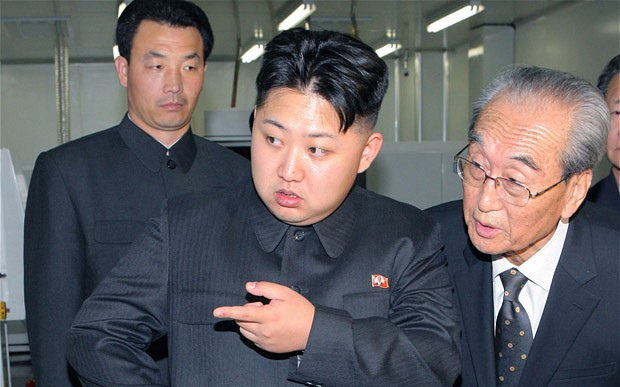
[But] North Korean dictator Kim Jong-Un has been photographed posing with what appears to be a genuine miniaturized nuclear warhead for ballistic missiles. And North Korea does, in fact, have two classes of ICBMs—the road mobile KN-08 and KN-14—which both appear to be equipped with sophisticated reentry vehicles.

Even if it were true that North Korea does not yet have nuclear missiles, their “Dear Leader” could deliver an atomic bomb hidden on a freighter sailing under a false flag into a U.S. port, or hire their terrorist allies to fly a nuclear 9/11 suicide mission across the unprotected border with Mexico. In this scenario, populous port cities like New York, New Orleans, Los Angeles, and San Francisco, or big cities nearest the Mexican border, like San Diego, Phoenix, Austin, and Santa Fe, would be most at risk. . .

In February and March of 2015, former senior national security officials of the Reagan and Clinton administrations warned that North Korea should be regarded as capable of delivering by satellite a small nuclear warhead, specially designed to make a high-altitude electromagnetic pulse (EMP) attack against the United States. According to the Congressional EMP Commission, a single warhead delivered by North Korean satellite could blackout the national electric grid and other life-sustaining critical infrastructures for over a year—killing 9 of 10 Americans by starvation and societal collapse.

Two North Korean satellites, the KMS-3 and KMS-4, presently orbit over the U.S. on trajectories consistent with surprise EMP attack. (For more from the author of “Ex-CIA Director Says North Korea May Be Prepping to Kill 90% of Americans” please click HERE)

Follow Joe Miller on Twitter HERE and Facebook HERE.

Fire Collapses Portion of Interstate Highway in Atlanta

A bridge on Interstate 85 in Atlanta collapsed on Thursday as a fire raged beneath it, authorities said, sending black smoke into the air and briefly causing a fireball before the structure fell in on itself.

There were no immediate reports of casualties in the incident, which snarled traffic for miles (km).

“We are trying to assess the damage and determine how quick we can repair it,” Republican Georgia Governor Nathan Deal told a news conference.

Black smoke billowed so thickly from the bridge in the heart of Atlanta that area residents told local media they thought a storm was coming or that the sun had set early when the fire started at around 6 p.m. local time.

Then flames rose several stories high from under the bridge before a section collapsed around 7:30 p.m., even as dozens of firefighters fought it, causing a brief fireball. (Read more from “Fire Collapses Portion of Interstate Highway in Atlanta” HERE)

Follow Joe Miller on Twitter HERE and Facebook HERE.