Ninth Circuit Forces Arizona to Follow Obama’s Illegal Amnesty, Provide Illegals With Driver’s Licenses

You heard that right. At the same time the Ninth Circuit is flipping federal immigration power on its head and allowing states to block Trump’s lawful order reducing dangerous immigration, it is forcing Arizona to comply with Obama’s executive amnesty and provide illegal aliens with driver’s licenses.

There is no word in the English language to describe this degree of perfidy and hypocrisy. I don’t know how I missed this, but just one week before the Ninth Circuit nullified federal immigration laws and lawfully delegated presidential powers, the full court refused to overturn a three-judge panel that forced Arizona to provide DACA recipients with driver’s licenses.

The rationale of the court? Arizona was preempted by federal immigration powers!!!

“The federal government, not the states, holds exclusive authority concerning direct matters of immigration law,” wrote the radical Judge Harry Pregerson. This opinion to deny the rehearing of the case was joined by 23 of the remaining 28 active judges on the Ninth Circuit … including Judge Michelle Friedland. She wrote the opinion last week saying that states can force the federal government to bring in more immigrants even when the president is acting on iron-clad statutory authority.

Just last week, I detailed how the federal courts are flipping federalism and immigration on its head — upside down, inside out. However, the juxtaposition of these two decisions takes the duplicity to a new level. A few points to consider:

1) Sure, the federal government controls immigration, but which branch? Congress. With Obama’s DACA amnesty, Obama unilaterally nullified federal statutes and created his own immigration program, a program that was explicitly rejected by Congress. Trump, on the other hand, was following a long tradition of delegated authority to ratchet down immigration as needed, in concert with five congressional statutes.

2) Arizona was being asked by illegal aliens, who should never have had standing to sue, to initiate a positive action in order to abide by Obama’s unlawful amnesty. Washington and Minnesota, on the other hand, were given no mandate by Trump’s order. They were the ones burdening the federal government and overriding federal plenary power over immigration.

3) As Scalia noted in Arizona v. U.S., “the naturalization power was given to Congress not to abrogate States’ power to exclude those they did not want, but to vindicate it.” On the other hand, it was designed precisely to prevent liberal states from flooding the rest of the union with immigrants the federal government deemed undesirable, as the Ninth Circuit allowed Washington to do last week.

4) In Texas v. U.S., the Obama administration explicitly argued that states could not get standing to sue against the executive amnesty precisely because, in their view, states were not obligated to issue driver’s licenses! Now the Ninth Circuit is contending that states must give driver’s licenses but have no reason to complain!

5) After ruling that the state of Washington will suffer irreparable harm if Trump exercises his legitimate authority to keep out un-vetted immigrants from war-torn countries, the same panel ruled that “Arizona has no cognizable interest in making the distinction it has for drivers’ licenses purposes.” The fact that almost 30,000 driving offenses have been committed just by the 30,558 criminal aliens Obama released in fiscal year 2014 alone is evidently of no concern to Judge Pregerson, who has replaced jurisprudence with political rants.

6) There is a seamless flow from obtaining a driver’s license to voting via the motor-voter laws. Yet, this same court has prevented Arizona from verifying proof of citizenship in order to register to vote.

7) With at least 630,000 illegals residing in the state, at a cost of $2.4 billion a year, Arizona is left defiled and helpless in protecting its own residents and even their right to vote in untainted elections. Over 10% of the state’s public school population is comprised of illegal alien children. The Arizona Department of Corrections estimates that illegal aliens comprise 17% of its prison population and 22% of all felony defendants in Maricopa County. Arizona has become the drug smuggling capital of the country. From 2010-2015, heroin seizures in Arizona have increased by 207%, while methamphetamine seizures grew by 310%. In FY 2014, there were more pounds of marijuana seized in the Tucson corridor than every other border sector combined. Yet, the state has no “cognizable interest” in fighting a past president’ illegal amnesty, but Washington state has an interest in overturning federal immigration power of an existing president and demanding its own immigrants!?

The courts of Sodom and Gomorrah indeed.

This is why it is foolish for any conservative to suggest that a better prepared Trump administration could have survived the Ninth Circuit. Those judges are willing to use opposing legal theories in order to achieve the “right” political outcome at any and all costs. That is why we need wholesale judicial reform and why it must start with breaking up the Ninth Circuit. Meanwhile, Arizona’s junior senator, Jeff Flake, R-Ariz. (F, 50%) is more bothered by the criticism of these judges than what they are doing to disembowel his own state.

The fact that states are still being forced to issue driver’s licenses to illegal aliens is another reason why Trump must terminate DACA. It’s not merely about the inaction of declining to deport this category of illegal aliens. These illegals are unconstitutionally obtaining Social Security cards, which forces states to issue driver’s licenses. It’s time for Trump and Congress to unite on behalf of Arizona and expose the duplicity of the courts. (For more from the author of “Ninth Circuit Forces Arizona to Follow Obama’s Illegal Amnesty, Provide Illegals With Driver’s Licenses” please click HERE)

Follow Joe Miller on Twitter HERE and Facebook HERE.

Will Trump’s Plan to Drain the Swamp Leave DC High and Dry?

People in Washington, D.C. are worried. Officials in the seat of the federal government have begun to express concern that President Trump’s promise to “drain the swamp” by reducing the federal workforce. There are fears Trump’s plans to cut government spending will harm the city’s economy, increase unemployment, and generally puncture what has historically been a recession-proof bubble of economic activity.

Are they right to be worried? Well, yes and no. Assuming that Trump actually does follow through on his plans to reduce the federal workforce, some people will lose their jobs. Some will move out of the District, and others may even go on public assistance while they look for new sources of income. It will be a rocky road for some government employees, and this disruption will ripple over, at least temporarily, into other industries.

But that does not mean that draining the swamp will be a bad thing, or that it will have a net negative effect on the economy. In fact, we should expect just the opposite. The reason is that government jobs differ from private sector jobs in a fundamental way. In order for a job to exist in the private sector, it must produce something that people value. If a worker is not earning his employer more in revenue than he is costing in wages, the employer can boost profits by firing him. There are undoubtedly some bad businessmen who employ unproductive employees by mistake, but ultimately they will suffer for their ineptitude, and poorly managed businesses will perish as better ones take their place.

Not so with the government. The government worker collects a salary that is forcibly seized from the taxpayers. He needs not generate a profit, satisfy consumer demand, or produce anything of value at all. All he has to do is remain unnoticed by his superiors and he gets to keep collecting a paycheck at the public’s expense.

If these people lose their jobs, their labor will be freed up to engage in more productive pursuits that can actually contribute to society instead of leeching off of it. To understand this, imagine a whole city where everyone is employed digging holes and filling them back in again. If we eliminated all of those jobs, the temporary unemployment would be a hardship for the workers themselves. The resources devoted to the useless activity of hole-digging, however, could be put towards something useful instead, and the workers could devote their talents towards helping their fellow man. It would be indisputable that such a reallocation would be beneficial, in the long run at least. The reallocation that comes from draining the swamp would be comparably desirable.

The great French economist Frederic Bastiat illustrated this phenomenon with what is known as the “Broken Window Fallacy.” The fallacy holds that breaking windows is good for the economy because it provides work for glassmakers. What Bastiat realized was that a society not forced to constantly repair broken windows is free to exert its efforts in other directions. That way we can enjoy the benefit of functioning windows, but also of everything else that extra labor can produce. While bureaucrats in Washington, D.C. aren’t actively breaking windows, they might as well be, for all the harm they cause with overregulation, excessive taxation, and general interference with American economic activity. Ultimately, their loss, in the words of W.S. Gilbert, will be a distinct gain to society at large. (For more from the author of “Will Trump’s Plan to Drain the Swamp Leave DC High and Dry?” please click HERE)

Follow Joe Miller on Twitter HERE and Facebook HERE.

On Valentine’s Day, Remember: The World Gets Love Half-Wrong

Valentine’s Day makes people think about love. What is it? How do I know it’s real? Can it last? Should it last? Here are a few secular definitions of love:

A purpose of human life, no matter who is controlling it, is to love whoever is around to be loved — novelist Kurt Vonnegut

What is love but acceptance of the other, whatever he is — French erotic writer Anaïs Nin

Love is like a fever which comes and goes quite independently of the will — French novelist Stendhal

Love is a fog that burns [away] with the first daylight of reality. — Hip poet Charles Bukowski

So, the world says, love is loving who you’re with, accepting others, fickle, fleeting and unrealistic. That’s not all wrong, but even when it’s true, it’s not the whole truth.

What is Love, Actually?

I’d like to propose a new definition of love. Well, it really isn’t a new definition at all — it’s thousands of years old! Those of us who are Christians are familiar with the Author of love, whose love is perfect and embraces us daily. John defines love, through the example of Christ, like this:

By this we know love, that he laid down his life for us; and we ought to lay down our lives for the brethren — 1 John 3:16

Greater love has no man than this, that a man lay down his life for his friends — John 15:13

Deuteronomy 7:9 gives us an another example of God’s love:

Know therefore that the Lord your God is God, the faithful God who keeps covenant and steadfast love with those who love him and keep his commandments, to a thousand generations [my emphasis]

Love, as God defines it, is steadfast — enduring — to a thousand generations! God’s love has nothing to do with fickle or fleeting emotions. It is true, long-lasting and unconditional. Love is selfless, self-giving — even to the point of laying down our lives for another.

I’m not advocating throwing our lives away, but I am saying — and I believe God is saying — that we must live in such a way that others see Christ in us. His love was sacrificial — He chose to lay down His life for us.

On a Day Like Valentine’s Day

Jesus died on the cross to atone for our wrongdoing, then he rose from the grave and now sits at the right hand of the Father making intercession for us. That is the ultimate meaning of love: sacrificial, enduring and unconditional love poured out for others and to further our Kingdom purpose.

So when we think about a day like Valentine’s Day, let’s remember the definition of true love. It’s not flighty, fickle emotion, but a life that represents and reflects Christ through selfless giving toward others — a love that changes lives and lasts for all time. (For more from the author of “On Valentine’s Day, Remember: The World Gets Love Half-Wrong” please click HERE)

Follow Joe Miller on Twitter HERE and Facebook HERE.

When It Comes to the School Bathroom Debate, Trump Is Delivering on His Promises

At the Grammy Awards Sunday night transgender actor and activist Laverne Cox took the opportunity while introducing Lady Gaga to tell America “Google Gavin Grimm” and “Hashtag I Stand With Gavin.”

Who is Gavin Grimm? That would be the Grimm of Grimm v. Gloucester, a case headed to the Supreme Court in March involving one southern Virginia school district’s refusal to accept Obama’s broad new transgender directives to public schools.

Obama’s administration claimed Title IX’s ban on sex discrimination means Gavin (a girl who identifies as a boy) gets to use the boys’ bathroom. This is the case I flagged in a previous Stream column as an important early marker of the new Trump administration’s willingness to roll back Obama’s lawless legacy that threatens not only the privacy of girls, but the rights of traditional religious schools and charities to refuse to hire gay married teachers or workers.

Trump Leaves Bathroom Debates to the Schools, as Promised

Trump’s acceptance of Obama’s executive order banning discrimination based on gender identity raised real concerns, especially as Trump never promised to push substantive religious liberty protections that conflict with LGBT protections.

Well, Jeff Sessions wasn’t installed as attorney general for more than 24 hours before taking steps to deliver on a key promise Trump did make: to leave the transgender bathroom issue to local schools to handle.

The case is Texas (et al) v. the United States. A federal judge had granted a nationwide injunction preventing the federal government from reinterpreting Title IX’s sex discrimination ban to include sexual orientation and gender identity. The Obama administration then asked the judge to narrow his injunction to only the dozen or so states who were parties to the suit. Oral arguments were scheduled for Valentine’s Day. But the Justice department just withdrew that request to narrow the injunction, mooting that part of the case; the oral arguments are cancelled.

The federal judge’s nationwide injunction stands for now as the Justice Department considers next steps. (Complicating the decision: The defendants in this case are not only the Justice Department, and the Education Department, both of which are under the direct control of the Trump administration, but the Equal Employment Opportunity Commission which is now dominated by Obama appointees. The Trump administration could withdraw, leaving the EEOC as the lone defendant.)

Will Trump Withdraw Obama’s Absurd Guidance?

Both this case and Grimm v. Gloucester rest in part on the legality of the May 13, 2016 guidance letter the Obama administration sent to every public school in America warning them they may risk losing federal funds if they do not permit students who identify as transgender to use the bathroom and shower of their choice.

The Justice Department is not a direct party to this case, but the Obama administration did file an amicus brief supporting Grimm’s argument that a transgender person has a right to use the showers and bathrooms of his or her choice. Among the most absurd of many absurd arguments? The Obama administration claimed including gender “converts” under sex discrimination is like protecting religious converts against religious discrimination.

Look for the Trump administration to withdraw that brief, and write a new one defending the actual meaning of the law as passed in 1972, which clearly did not include broad new LGBT protections.

The next step is for the new Education secretary Betsy Devos to withdraw Obama’s guidelines on Title IX pronto.

Meanwhile on Day 2 of Jeff Session’s tenure as attorney general the verdict has to be: Trump delivered. (For more from the author of “When It Comes to the School Bathroom Debate, Trump Is Delivering on His Promises” please click HERE)

Follow Joe Miller on Twitter HERE and Facebook HERE.
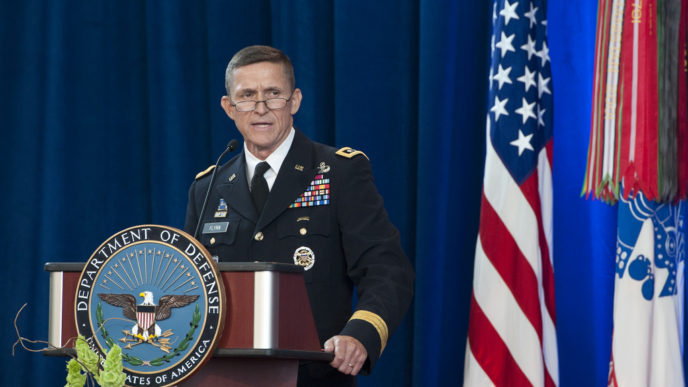
National Security Advisor Michael Flynn Resigns

President Donald Trump’s embattled national security adviser Michael Flynn resigned late Monday night, following reports that he had misled Vice President Mike Pence and other officials about his contacts with Russia. His departure upends Trump’s senior team after less than one month in office.

In a resignation letter, Flynn said he held numerous calls with the Russian ambassador to the U.S. during the transition and gave “incomplete information” about those discussions to Vice President Mike Pence. The vice president, apparently relying on information from Flynn, initially said the national security adviser had not discussed sanctions with the Russian envoy, though Flynn later conceded the issue may have come up.

Trump named retired Lt. Gen. Keith Kellogg as the acting national security adviser. Kellogg had previously been appointed the National Security Council chief of staff and advised Trump on national security issues during the campaign. (Read more from “National Security Advisor Michael Flynn Resigns” HERE)

Follow Joe Miller on Twitter HERE and Facebook HERE.

There Really Is Climate of Violence on Campuses

Time for our News Quiz! How many were arrested and punished in Berkeley among those who rioted, vandalized and violently beat a man with shovels, almost killing him, when the right-wing comedian Milo was to visit that campus?

Hint: The total was the same as the number of student militants menacingly brandishing automatic weapons who violently occupied Cornell’s Willard Straight Hall in 1969 in protest of Cornell’s “racist attitudes” and “irrelevant curriculum.”

Still not sure? Then here, at the risk of being too generous, is another hint. The number of violent actors arrested at Berkeley is the same as the number punished for their violent storming of the stage at the University of Wisconsin, Madison to prevent mild-mannered Ben Shapiro from speaking on the subject of decency, an event at which “Campus police watched but did nothing to stop the interruptions.” Violent students also blocked Shapiro from UCLA.

If you still don’t have it, the number you’re looking for is the usual count of those arrested, expelled or otherwise punished for their use of violence to further political causes at colleges and universities all across this fair country. It is a number fewer than the fingers on your right hand to the left of your thumb.

No more clues. Unless you find the answer too distasteful to admit, you have at least an inkling of this circular figure.

The Violent in Charge

Now that we have finished the first question, it is time for our … Political Science Quiz! Ready?

What do we call those people in a society who are licensed or allowed to use violence?

No hints this time. We call these the people in charge.

Since the violent are in charge, and since folks regularly use violence on college campuses as a means of politics — violence that just as regularly goes unpunished or is countenanced — we can therefore say that there is an officially approved climate of violence many campuses in the United States.

It really is this simple. Violent students (and professors) are in charge, have been in charge, and will continue to be in charge as long as they are allowed to use violence.

Violence in and around universities is so commonplace that its presence is thought natural and necessary. Pepper sprayings, calls for muscle, assaults of speakers calling for free speech (another Berkeley incident), a brawl and students rushing the stage, students occupying by force various campus offices.

These violent actions are not only in protest of freedom and traditional morality. Sometimes plain old-fashioned greed is the excuse. As when students violently burst into and occupied various buildings at University of California at Davis to whine that tuition should not increase.

There isn’t any point in continuing the examples. The reports of violent behavior and temper tantrums of campus denizens appear in the news as often as storm reports, ever since the 1960s. Everybody knows this to be true. Everybody expects it. And except for noting these incidents, as I am doing now, few do anything about them.

Don’t Call Them Snowflakes

The mistake is to label violent, fit-throwing students as they crowd into “safe spaces,” fill their diapers and demand to be changed, with being “snowflakes.” Those who do so, says Anthony Esolen in his new book Out of the Ashes, “are wrong in their diagnosis and inaccurate in their criticism.”

It is also something of a mistake to point at the students and laugh at them for being weaklings. The students hold the hammer, and they know it … in our world of inversions, power is granted to people who claim that they have no power and who resent the greatness of their own forebears. They do not seek “safety.” They seek to destroy. The strong man is bound and gagged, and the pistol is pointed at his head — the seat of reason itself.

On paper, at least, university presidents, deans and trustees are in charge. Almost none of these people, duly accepting their office and possessing the right to administer punishment and keep order, fulfill their duties to maintain order and keep the peace. Sometime these officials share the political goals of the violent on campus, and so excuse the violence.

But often those purportedly in charge do not want the grief associated with doing the right thing. If a president expelled a violent student, the national media would be against him, a large part of his faculty would be against him, the student body would be against him, even the trustees buckling under the weight of publicity would be against him. It is easier to look the other way or issue a non-binding We-Love-Tolerance-And-Repudiate-Violence missive. (For more from the author of “There Really Is Climate of Violence on Campuses” please click HERE)

Follow Joe Miller on Twitter HERE and Facebook HERE.

What Trump Can and Can’t Do to Make Changes to Civil Forfeiture

President Donald Trump’s comments on a procedure that allows law enforcement to seize property sparked much debate in the media and on the internet.

But for stakeholders who oppose the practice, called civil asset forfeiture, the president’s statements presented a learning experience for the country’s chief executive.

Trump’s comments came during a roundtable discussion with county sheriffs last week, where Jefferson County, Kentucky, Sheriff John Aubrey asked the president about efforts to curb law enforcement’s use of civil asset forfeiture.

The question sparked a brief discussion about the tool, which allows law enforcement to seize property and cash if they suspect it’s connected to criminal activity.

In the back-and-forth, Trump questioned why anyone would want to limit the police’s ability to take “a huge stash of drugs,” and ultimately told the sheriffs in attendance they were “encouraged” to take property through civil forfeiture.

The comments satisfied the law enforcement community, who believe that civil forfeiture is a critical tool to curb drug trafficking and money laundering.

“For over 30 years, the asset forfeiture program has allowed law enforcement to deprive criminals of both the proceeds and tools of crime,” Chuck Canterbury, national president of the Fraternal Order of Police, wrote in a December op-ed in The Daily Caller.

“The resources provided by the Equitable Sharing Program have allowed agencies to participate in joint task forces to thwart and deter serious criminal activity and terrorism, purchase equipment, provide training upgrade technology, engage their communities, and better protect their officers,” he continued. “It has been remarkably successful.”

But for civil forfeiture opponents who have been working with policymakers at the federal and state level, Trump’s comments demonstrated a “profound misunderstanding” of the issue, one that left open the door for some explanation from those who want reforms.

“We think if the president knew about the extent of forfeiture abuse across the country, his remarks would’ve been very different,” Darpana Sheth, a senior attorney at the Institute for Justice, told The Daily Signal.

The Institute for Justice, a public interest law firm, is part of a broad coalition of civil forfeiture opponents who believe the tool allows police to seize cash, cars, and property from people who are unaware of any wrongdoing and were never charged with a crime.

At the heart of the issue is the profit incentive opponents say civil forfeiture creates, since laws in half of the states and the federal government let police keep 100 percent of the proceeds from forfeited property.

And while some in law enforcement believe that efforts to reform civil forfeiture laws in the halls of Congress and in state legislatures are rooted in opposition to law enforcement, Sheth said that’s a misconception.

“Civil forfeiture warps law enforcement’s incentives and puts police officers in this untenable position of having to choose going after money rather than criminals,” she said. “They have to be revenue generators rather than fight crime. Once we have adequate reforms, it would free them to focus on fighting crime.”

Still, Trump’s comments left many unanswered questions, and the White House did not return requests for clarification on the president’s stance on the issue.

If Trump did want to put civil forfeiture “back in business,” as he told sheriffs last week, there are some changes he could make.

Movement in Congress

Each state and the federal government have different laws that dictate how local, state, and federal law enforcement agencies can seize and forfeit property using civil forfeiture.

At the federal level, there’s little Trump can do to change civil forfeiture laws without an act of Congress.

Even if lawmakers decided to move forward with reforms, the momentum is for tightening, not loosening, the statutes governing law enforcement’s ability to seize property, said Jason Snead, a policy analyst at The Heritage Foundation who has written extensively about civil forfeiture.

Last year, a bipartisan group of lawmakers in the House and Senate introduced the Due Process Act, which aimed to make it harder for law enforcement to take property from innocent Americans.

The bill stalled in Congress, but Snead said there’s still broad interest from Republicans and Democrats to pass civil forfeiture reform as part of a broader criminal justice reform package.

While President Barack Obama made criminal justice reform a priority of his administration, Trump’s comments injected uncertainty into the debate.

“We might see some movement in the upcoming Congress,” Snead told The Daily Signal. “But the question becomes, ‘What is the administration’s position and would they sign anything?’”

Aside from congressional action, the president and his Justice Department, led by Attorney General Jeff Sessions, do have latitude in the agency’s Equitable Sharing Program.

Under Equitable Sharing, local and state agencies participating in a joint investigation with the federal government can forfeit property under federal forfeiture laws, which are less stringent than those in some states.

The program also allows local and state agencies to keep up to 80 percent of the proceeds from forfeited property.

In 2015, the Justice Department, then led by Attorney General Eric Holder, made a significant change to Equitable Sharing.

The program allowed local and state law enforcement to seize property, which would then be “adopted” by federal agencies. Once the adoption occurred, the property was forfeited under federal law.

But Holder decided to implement a new policy prohibiting the federal government from “adopting” seizures, and today, local and state law enforcement agencies participating in Equitable Sharing have to be working alongside federal agencies to forfeit property under federal law.

That could all change, though, with Sessions in charge at the Justice Department, particularly if he decided to roll back Holder’s changes.

“We would be taking a step back to where we were in 2015,” Snead said.

While a senator from Alabama, Sessions opposed recent attempts to reform federal civil forfeiture laws.

And he said in the past that he was “very unhappy” with criticisms of how civil forfeiture is being used.

But Snead is holding out hope that both Sessions and Trump change their tune on the issue.

“We need to get in front of the president the actual facts on the ground, the extremely limited protections that are in place for property owners, and the fact that there is a financial incentive that can skew the policies and priorities,” he said.

Galvanized

While there is momentum for federal civil forfeiture reform coming from members of Congress, much of the action on the issue is taking place in the states.

Last year, a handful of states—including Florida, California, and Ohio—passed bills to tighten their civil forfeiture laws.

In total, 20 states and the District of Columbia have passed laws reforming civil forfeiture. In more than 12 states, the government must secure a conviction before forfeiting property.

“A lot of the power is in state legislator’s hands,” Snead said. “If they use that power wisely, they can make some dramatic steps.”

Already, state legislators in more than a dozen states like Illinois, Indiana, and Texas are considering legislation to require a criminal conviction before assets can be forfeited.

And Sheth said Trump’s comments likely provided state lawmakers with more motivation to push bills reforming state civil forfeiture laws across the finish line.

“People are galvanized by this,” she said. “These claims that you get that are unrebutted, that these are made up stories, the people who have experienced [civil forfeiture] or know about it know this clearly isn’t true. I think it sparks a kind of outrage.” (For more from the author of “What Trump Can and Can’t Do to Make Changes to Civil Forfeiture” please click HERE)

Follow Joe Miller on Twitter HERE and Facebook HERE.

Trump Terrorism Adviser Says War on ISIS About Ideology

One of the key figures driving President Donald Trump’s national security policy outlined a counterterrorism vision on Monday squarely focused on defeating ISIS beyond the battlefield.

Sebastian Gorka’s view of the ISIS threat melds with many in the White House who believe that the U.S. is engaged in a nontraditional war against radical Islam.

Gorka, and others in Trump’s orbit, allege that previous administrations have not properly combatted the ideology they say fuels terrorism, and that the U.S. government has struggled to define the war it is fighting.

“In this current warfare environment, body bags are not a good metric for winning,” said Gorka, a deputy assistant to the president, during an event at The Heritage Foundation. “You can kill a jihadi high-value target. But what happens if the next day, 20 people volunteer to replace that jihadi? The last 16 years we have become preeminent in exquisite whack-a-mole. Oh, and we are good at it.”

“We look at physical battlefield actions as the metric for success,” Gorka continued. “We have to understand 80 percent of this war will be fought in the mind, and 80 percent of our conflict will be fought in the media domain.”

Early Actions

Gorka, a former Breitbart News national security editor who has held positions at various military educational institutions, did not outline specific policies that transfer his ideas into action.

But some early actions by the Trump administration, and others reportedly being considered for roles in it, reflect a different approach to counterterrorism explicitly focused on “radical Islamic terrorism.”

At the Heritage event, Gorka defended Trump’s controversial executive order temporarily halting refugee admissions, and travel from seven countries the Obama administration and Congress had designated as posing risks of terrorism.

Politico reported Monday that Gorka was one of the few White House staffers consulted ahead of Trump’s order, which has been blocked by the courts.

Lawsuits around the country have alleged that Trump’s order violates the Constitution by intentionally punishing Muslims, and many trial courts blocked aspects of the president’s order.

Gorka, and others in the Trump administration, reject charges of religious intent, and say the chosen countries are sources of terrorism.

“One of the reasons the president signed his executive order [is that] those [targeted] nations are where ISIS and al-Qaeda exist, plus Iran,” Gorka said. “We won’t capture or kill all jihadis. What will happen is they will move. They may go to your neck of the woods. We want to make sure that events like Berlin, like Nice, like Paris, don’t happen in America. We have to understand that ISIS’ battlefront begins when you leave your house in the morning.”

Gorka’s calls for a tougher response against Islamist radicalism are reflected in other moves being considered by the White House.

The Trump administration is reportedly considering re-engineering a Department of Homeland Security domestic counterterrorism program—known as Countering Violent Extremism—to concentrate on Islamic extremism only. Some counterterrorism experts say this singular focus ignores other forms of extremism, and may harm relations between Muslim community groups and the government.

In addition, the Trump administration, according to The New York Times and others, is debating an order to designate the Muslim Brotherhood, an influential Islamist group in the Middle East, as a foreign terrorist organization.

‘Help Muslims Win the War’

Together, these actions and ideas represent an about-face to traditional U.S. strategy embraced by both Republican and Democrat administrations.

Former Presidents George W. Bush and Barack Obama defined the terror threat in narrower terms as they tried to avoid making it seem the U.S. was at war with Islam.

They argued that a more direct focus on radical Islam would feed into ISIS’ narrative that Muslims are not welcome in the West, and encourage more extremism.

Gorka on Monday defended himself against others in the national security establishment who’ve criticized his rhetoric as inflammatory.

“We are not at war with Islam,” Gorka said. “Let me be explicit here. It’s very easy for our detractors to paint us as Islamophobes. It is absolutely wrong. This is a war inside Islam—war for the heart of Islam. Which version will be preeminent? We have to help Muslims win the war for the heart of their own religion.”

Whereas Obama tried to not legitimize ISIS by overstating its power, and said he believed they did not constitute an existential threat to America, Gorka argues the U.S. government needs to take the claims of the terrorist group literally.

“ISIS is different because it succeeds where every jihadi group failed, and it has captured transnational, transregional territory, which by itself means it is a tier one threat to all people who believe in freedom of religion, freedom of expression, democracy, and representative government,” Gorka said. “ISIS has not just rehashed al-Qaeda’s message of jihad. They have really executed an ideological and theological coup.”

“Every time it [ISIS] tweets or goes on Telegram [a messaging service] and says, ‘We are the Islamic State of Iraq and al-Sham [translation of Syria in Arabic],’ they are a sending very powerful message to that man in his mom’s basement, to that Pakistani immigrant on a fiancé visa in San Bernardino,” Gorka added.

‘Deligitimze Ideology’

Gorka, and others in the Trump administration, have so far not outlined specific differences on how to fight ISIS and take back territory it controls in Iraq and Syria.

Late last month, Trump issued a directive ordering his new defense secretary, retired Marine Gen. James Mattis, to submit a strategy within 30 days to defeat ISIS.

But Gorka did signal a pullback from one component of the Obama administration’s counterterrorism strategy: relying on elite special operations forces to conduct raids and kill missions. Obama described this approach as less costly and more efficient than traditional combat operations.

Trump’s first counterterrorism operation using special operations forces, a raid against al-Qaeda’s Yemen affiliate last month, resulted in the death of a Navy SEAL, and civilian casualties.

“In the last eight years, we have tended as a government to look at our special operations capabilities as the easy button,” Gorka said. “That is a wholly fallacious understanding of special operations. The whole point of our bravest of the brave is that they are a tactical level deployment meant to effect strategic results—not a tactical level asset for tactical results. We should go back primarily to do what they were created to do. We should be helping others fight their own fights, not fight their fights for them.”

If Trump follows Gorka’s approach to counterterrorism, he envisions a dramatic result.

“What is victory in this war?” Gorka said. “Sebastian Gorka’s definition of victory is very simple. We will have won when the black flag of jihad, when the black flag of ISIS, is as repugnant across the world as the white peaked hood of the Ku Klux Klan and the black, white, and red swastika of Hitler’s Third Reich.”

“Don’t get me wrong, killing terrorists is great,” Gorka continued. “I am down with killing terrorists. But the ultimate victory will have accrued when we delegitimize the ideology of groups like the Islamic State.” (For more from the author of “Trump Terrorism Adviser Says War on ISIS About Ideology” please click HERE)

Follow Joe Miller on Twitter HERE and Facebook HERE.
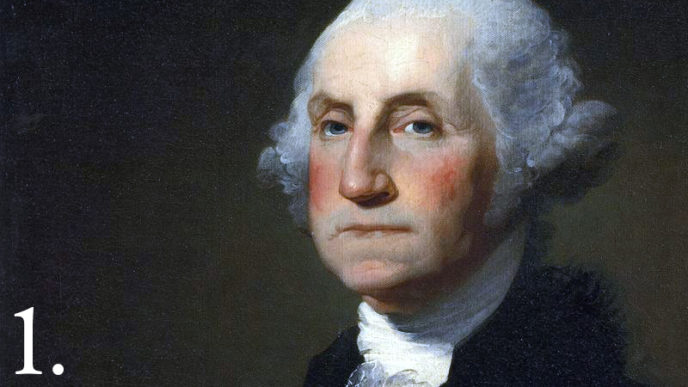
Trump Has Fewest Cabinet Secretaries Confirmed Since George Washington

It took nearly a month, but President Donald Trump is finally operating with at least half of his Cabinet in place. Not since George Washington in 1789 has a newly elected president waited so long.

Twenty-five days after Trump took the oath of office, the Senate on Monday night voted to confirm the eighth and ninth members of his Cabinet: Treasury Secretary Steven Mnuchin and Veterans Affairs Secretary David Shulkin. The six remaining Cabinet nominees will have to wait a while longer.

Why? Unprecedented delays and obstructionism on the part of Democrats have resulted in the most contentious confirmation process in U.S. history, according to a Washington Post analysis. No other president’s nominees have collectively faced similar opposition.

And that’s just the 15 members of Trump’s Cabinet. Other top nominees, such as Rep. Mick Mulvaney to lead the Office of Management and Budget and Scott Pruitt to head the Environmental Protection Agency, continue to wait as well. And then there’s Supreme Court nominee Neil Gorsuch, who could face the biggest battle of anyone.

It’s the consequence of a polarized Washington, where Democrats are in no rush to rubber-stamp Trump’s picks, even though past presidents have been afforded such a courtesy.

“President Trump has the fewest Cabinet secretaries confirmed at this point than any other incoming president since George Washington,” lamented Senate Majority Leader Mitch McConnell last week. “The president deserves to have his Cabinet in place. The American people deserve that, too.”

The Kentucky Republican, a scholar of Senate history, reviewed the records and discovered that prior to the 1950s, most Cabinet nominees faced no opposition at all. (McConnell’s analysis included first-term elected presidents, not those who assumed office after a vacancy.)

In fact, many presidents had their Cabinet nominees in place on Day One. Such was the case beginning in 1881 with President James Garfield and spanning 52 years until President Franklin D. Roosevelt.

Washington, of course, was establishing the office for the first time when he was inaugurated on April 30, 1789. His Cabinet wasn’t confirmed until September 1789.

In recent history, Trump’s predecessors have enjoyed a much faster pace of Cabinet confirmations. At this point in their presidencies, here’s how they compared to Trump:

Barack Obama had 12 of 15 confirmed.

George W. Bush had 14 of 14 confirmed.

Bill Clinton had 13 of 14 confirmed.

George H.W. Bush had 10 of 14 confirmed.

Ronald Reagan had 12 of 13 confirmed.

Jimmy Carter had 11 of 11 confirmed.

Richard Nixon had 12 of 12 confirmed.

John F. Kennedy had 10 of 10 confirmed.

Dwight D. Eisenhower had nine of 10 confirmed.

Monday’s confirmation of Mnuchin and Shulkin gives Trump nine of his 15 Cabinet secretaries. Two of Trump’s nominees—Sonny Perdue for agriculture secretary and Andrew Puzder for labor secretary—haven’t had a committee hearing yet. Puzder’s is scheduled for Thursday, while Perdue, picked Jan. 18, is still awaiting a date.

The confirmation delays have left many agencies without a leader, a situation Democrats know is impeding Trump’s ability to implement his policies.

“This is a president who wants change, and he has got to get his nominees confirmed as soon as possible if he is going to get that change,” Don Devine, director of the Office of Personnel Management under Reagan, told The Daily Signal last month.

Under the leadership of Senate Minority Leader Chuck Schumer, Democrats have kept their promise to delay Trump’s nominees, even if they lack the votes ultimately to defeat them.

Schumer, D-N.Y., specifically targeted eight of Trump’s picks. Five now have been confirmed: Education Secretary Betsy DeVos, Health and Human Services Secretary Tom Price, Attorney General Jeff Sessions, Secretary of State Rex Tillerson, and Mnuchin. The other three targeted are Mulvaney, Pruitt, and Puzder.

Trump has also voiced frustration with the slow progress.

And while the Senate slowly confirms his Cabinet, the time it spends to do so prevents lawmakers from addressing the president’s legislative priorities. Last week, for instance, senators had to wait 30 hours between votes because of Democrat delaying tactics. The Senate confirmed three nominees—DeVos, Sessions, and Price—over the span of a week.

Even those who won Senate confirmation faced “record-setting opposition,” according to The New York Times.

Another delaying tactic Democrats have employed is boycotting the nominees’ committee votes to deny a quorum. Three of Trump’s nominees have faced this treatment—unprecedented for a newly elected president. Obama and Bush nominees faced similar boycotts, but not until later in their presidencies.

In 2009, Obama had 10 Cabinet secretaries confirmed after his first week in office. Nine of those nominees won Senate confirmation by voice vote, where an official tally isn’t recorded.

The Obama nominee who faced the greatest GOP opposition—Timothy Geithner for treasury secretary—was approved 60-34 on Jan. 26, 2009, less than a week after Obama took office.

Like Trump, Obama enjoyed a Senate controlled by his own party. Democrats had 57 senators on Jan. 20, 2009, when Obama took office. Today, Republicans have 52 senators. (For more from the author of “Trump Has Fewest Cabinet Secretaries Confirmed Since George Washington” please click HERE)

Follow Joe Miller on Twitter HERE and Facebook HERE.
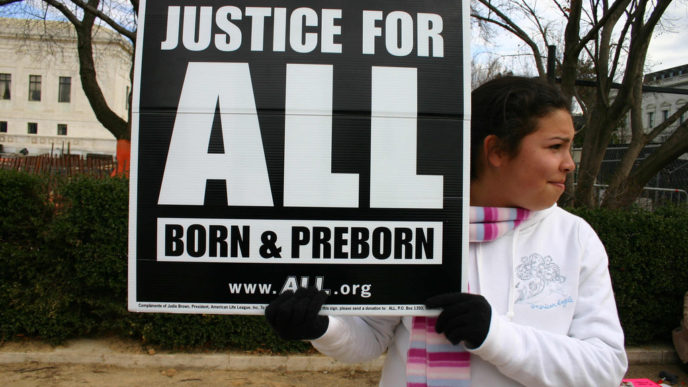
She’s Taking What She Learned on Capitol Hill to a National Pro-Life Group

Autumn Christensen has spent over a decade on Capitol Hill working to advance the pro-life cause, something that has been important to her since she was a girl.

“I grew up in a pro-life family,” Christensen says in an interview with The Daily Signal. “My grandfather prayed outside of abortion clinics in the ’70s.”

“I remember going with my parents and my younger brother to maternity centers at the holidays, volunteering and spending time with women who were experiencing an unplanned pregnancy. So [it’s] sort of in my nature that it’s one of the most important issues.”

Now Christensen’s work in the movement has brought her to a new position as director of policy at the Susan B. Anthony List, or SBA List, a conservative, pro-life policy organization based in Washington. The job means advancing pro-life policies in cooperation with the White House as well as Congress.

Tommy Binion, director of policy outreach for The Heritage Foundation, says Christensen’s new role is a great gain for the pro-life movement.

“Autumn is the definition of a servant leader both on Capitol Hill and within the pro-life movement,” Binion says, adding:

She combines an unmistakable passion for the lives of unborn children with a shrewd understanding of the law and the legislative process … Her years of service will pay dividends as pro-life majorities in the House and Senate work together with a pro-life president for the first time in a long time.

Christensen, 38, was born Autumn Fredericks in Minnetonka, Minnesota, and grew up in Jackson, Mississippi. She graduated in 2001 from Covenant College in Lookout Mountain, Georgia, where she majored in business and history.

She moved to the Hill in 2002 as a staff assistant for Rep. Dave Weldon, R-Fla. She worked on pro-life issues for Weldon, who left office in 2009, and attended weekly staff meetings for the Values Action Team, an organization of pro-family lawmakers founded in the ’90s by Rep. Joe Pitts, R-Pa.

That involvement introduced her to the organization she would work for next—the Congressional Pro-Life Caucus, a coalition of pro-life lawmakers. The caucus is bipartisan but keeps its membership confidential.

She started work as caucus director in October 2005. Her predecessor, John Cusey, had urged her to apply as he prepared to leave for a job in the executive branch. It was “an easy yes,” she says, because she respected the work of the caucus and its chairman, Rep. Chris Smith, R-N.J.

‘An Opportunity to Educate’

“When I first started with the caucus, we had Republican control across the board,” Christensen says. “President [George W.] Bush was in office. Then the Congress changed dramatically to Democratic control, and then President [Barack] Obama’s election and … during the Obama years we were certainly at the height of trying to prevent funding for abortion; we were concerned about the Hyde Amendment being eliminated.”

The Hyde Amendment is a provision, established in 1976 by the late Rep. Henry Hyde, R-Ill., that prohibits use of federal funds for most elective abortions or related health coverage.

Patience is one of the most important virtues for pro-life work, Christensen says.

“We were really in a very on-defense role,” she says. “And then we had the Republican Congress come in [in 2011] and we had opportunities to start moving pro-life legislation. … It always takes time to enact incremental progress toward reversing the effects of Roe v. Wade.”

Roe v. Wade is the 1973 Supreme Court ruling that legalized abortion across the nation.

As director of the Congressional Pro-Life Caucus, Christensen helped craft bills that would prohibit the use of federal funds for abortion and prohibit abortion of babies who are capable of feeling pain.

“They’re not law yet, but the first step is to get them moving through the Congress and have [lawmakers] first take votes on them,” she says. “They’re an opportunity to educate the public about the dangers of abortion [and] what abortion really is.”

Pushing Forward

Her faith informs her perspective, she says, but science influenced her pro-life beliefs.

“I’m an evangelical Christian and that has a big impact on my life and worldview,” Christensen says. “However, my conviction that the unborn are deserving of the same human rights afforded to the rest of us is rooted in biology. ”

Christensen’s husband, David, is vice president of government affairs at the Family Research Council, a conservative public policy organization in Washington, D.C. The couple, who met while working for Weldon, now have a 2-year-old son.

Christensen, who joined SBA List on Jan. 3, is familiar with the struggles that come with advancing the pro-life cause.

She recalls the challenges leading to the 2003 passage and enactment of the Partial-Birth Abortion Ban Act, which prohibits the aborting of a baby after it is partially delivered.

“I was in high school and college [in the mid-1990s] when the Partial-Birth Abortion Ban Act was moving through the House and the Senate, and it was veto after veto from President [Bill] Clinton,” she says. “But even as an average American out there, I knew about partial-birth [abortion] and it was a topic of conversation with friends who had pro-choice views.”

Bills she worked on for the caucus face a similar path, Christensen says.

“You know, we have to continue to push forward and we have to get across that 60-vote hurdle, and we have to get them to a pro-life president’s desk,” she says, adding: “It takes a lot of patience, but each step along the way is both an opportunity to move things forward legislatively and also to educate the public about abortion.”

The Senate requires 60 votes to end debate and bring legislation to the floor for a final vote.

‘Made Such a Difference’

Marilyn Musgrave, a former member of Congress who represented Colorado’s 4th District and now is vice president of government affairs for the Susan B. Anthony List, said the organization is excited that Christensen is part of the team.

“Autumn has been one of the most knowledgeable people on the Hill in regards to … issues we care about,” Musgrave tells The Daily Signal in a phone interview. “She made such a difference on the Hill. We are fortunate to have her on board.”

Christensen says she is optimistic about the future of the pro-life movement, especially due to the large involvement of young people in events such as the March for Life, a yearly rally held in Washington to protest the legalization of abortion.

“We know that Americans are becoming more [pro-life],” Christensen says, pointing in particular to younger Americans “looking at those ultrasound images of their brothers and sisters and their cousins and children and family members.”

“I think that the more we see, the more we know, and the more likely we are to grow into a country that cherishes life and wants to protect all unborn lives,” she says. (For more from the author of “She’s Taking What She Learned on Capitol Hill to a National Pro-Life Group” please click HERE)

Follow Joe Miller on Twitter HERE and Facebook HERE.