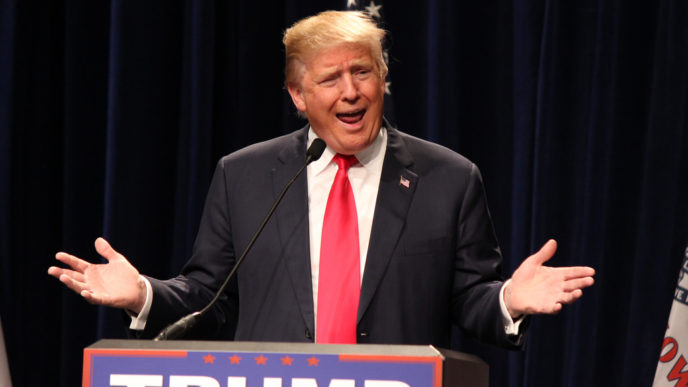
One of President Trump’s longtime friends made a striking move on Sunday: After talking privately with the president over drinks late Friday, Christopher Ruddy publicly argued that Trump should replace his White House chief of staff.
“A lot of people have been saying, ‘Look, Donald has some problems,’ and I think he realizes that he’s got to make some changes going forward,” Ruddy said in an interview with The Washington Post.
Ruddy went on to detail his critique of White House Chief of Staff Reince Priebus: “It’s my view that Reince is the problem. I think on paper Reince looked good as the chief of staff — and Donald trusted him — but it’s pretty clear the guy is in way over his head. He’s not knowledgeable of how federal agencies work, how the communications operations work. He botched this whole immigration rollout. This should’ve been a win for Donald, not two or three weeks of negative publicity.”
(Read more from “Trump Friend Says Priebus Is ‘in Way Over His Head'” HERE)
https://joemiller.us/wp-content/uploads/24120120029_38478f1764_b-2.jpg6831024Joe Millerhttps://joemiller.us/wp-content/uploads/logotext.pngJoe Miller2017-02-12 20:51:282017-02-12 20:51:28Trump Friend Says Priebus Is ‘in Way Over His Head’
As promised, after assuming office President Donald Trump immediately began signing executive orders reversing several policies of the Obama administration — including the famous “travel ban.” And as expected, Democratic politicians and liberal activists objected. As usual, they used the courts to try to get what they couldn’t get politically.
Executive Order 13769, “Protecting the Nation From Foreign Terrorist Entry Into the United States,” put into place a 90-day ban on immigrants and refugees from seven countries known for terrorism. The explanation in the EO stated, “Deteriorating conditions in certain countries due to war, strife, disaster, and civil unrest increase the likelihood that terrorists will use any means possible to enter the United States.”
The president has argued that he was doing what the law allows him to do. The relevant federal statute authorizes the president to suspend immigration as long as necessary in order to protect the country.
Doing What the Law Lets Him Do
The Attorney General of the state of Washington decided to challenge the EO. He apparently went “judge shopping,” and found a sympathetic federal judge in Seattle who had once represented refugees pro bono. Judge James L. Robart did not recuse himself, even though the law requires federal judges to recuse themselves from cases where they have a conflict of interest.
He issued a temporary restraining order halting the ban. The state of Minnesota also joined the lawsuit. The Trump administration appealed to the United States Court of Appeals for the Ninth Circuit, asking for an emergency stay of the TRO. The Ninth Circuit is the most liberal of the federal circuit courts. The economist Thomas Sowell once said that someday that court “may declare the Constitution unconstitutional.”
A three judge panel refused to lift the TRO. In a 29-page decision issued on February 9, the court declared that the EO was not likely to be found constitutional, and the failure to enter a stay would not cause irreparable injury.
The administration asserted that the court doesn’t have the authority to review the EO. “It is beyond question, that the federal judiciary retains the authority to adjudicate constitutional challenges to executive action,” the judges responded.
And they weren’t going to help the administration improve it. “More generally, even if the TRO might be overbroad in some respects, it is not our role to try, in effect, to rewrite the Executive Order.”
The Panel’s Reasoning
How did the panel justify their decision, when the EO seems to be perfectly legal under federal law?
First, the three judges addressed whether the two states had standing to file the lawsuit. In order to bring a lawsuit in federal court, someone must have a personal stake in the issue and show the injury will cause real damage soon that can’t be repaired later.
The panel declared that the states had shown that the ban would hurt their public universities by keeping students from attending and the damage would be irreparable. This has been criticized as a stretch. The connection between the state and immigrants attending its universities affected by the ban isn’t very direct. Nor is the harm imminent, as no immigrants have been stopped yet from attending.
Second, the court addressed the question of whether the ban would succeed on the merits and be upheld by a higher court. The court said it wouldn’t because it wasn’t constitutional.
The panel opined that it violates the due process rights of certain types of immigrants. In particular, the three judges said they “cannot rely upon the Government’s contention that the Executive Order no longer applies to lawful permanent residents.” They also hinted that the ban wasn’t likely to succeed because it constitutes religious discrimination against Muslims.
The court was dismissive of the administration’s claim that the TRO could cause the country irreparable harm. “The Government has pointed to no evidence that any alien from any of the countries named in the Order has perpetrated a terrorist attack in the United States.”
Critics of the decision argue that this ignores the fact that several nationals from those countries have been arrested on suspicion of terrorism. Being killed by terrorists would certainly constitute irreparable harm for the victims.
The President Is Not Pleased
Trump tweeted his outrage that the opinion didn’t even mention the federal law authorizing his EO.
LAWFARE: "Remarkably, in the entire opinion, the panel did not bother even to cite this (the) statute." A disgraceful decision!
If Trump appeals to the U.S. Supreme Court, he could lose there too. With his SCOTUS nominee Neil Gorsuch not yet on the court, it tilts to the left. Even if the swing vote Anthony Kennedy votes with the conservative wing, the result would be a 4-4 split, which means the Ninth Circuit’s decision stands.
Of course, the Ninth Circuit is the circuit court whose decisions are most reversed by the Supreme Court. Even some on the left are criticizing the decision. Liberal Harvard Law Professor Emeritus Alan Dershowitz explained on MSNBC’s Morning Joe that the EO was constitutional, but the legal battle would take too long. He said Trump would be better off rewriting it. The ruling “looks like it’s based more on policy than on constitutionality,” he noted.
Trump is reportedly now redoing the EO to comply with the Ninth Circuit’s opinion. “We’ll be doing something very rapidly having to do with additional security for our country,” he announced during a press conference yesterday. “You’ll see something next week.”
If a court overturns the new order, it will be the first time Washington state sets immigration law for the nation. (For more from the author of “What Is Likely to Happen With Trump’s Travel Ban” please click HERE)
https://joemiller.us/wp-content/uploads/khjkhk.jpg6831024Joe Millerhttps://joemiller.us/wp-content/uploads/logotext.pngJoe Miller2017-02-10 22:32:472017-02-11 21:26:41What Is Likely to Happen With Trump’s Travel Ban
Democrats who used to work on Capitol Hill are helping to disrupt Republican lawmakers’ town hall meetings across the country through a nationwide effort to oppose and “resist” President Donald Trump’s agenda.
They call their group Indivisible Guide, a name that came from an actual guide posted online telling activists how to pressure members of Congress. Among topics: what to say when going to town halls and calling or visiting a member’s office.
Leaders of the organization have loose ties to George Soros, the billionaire hedge fund manager who bankrolls liberal causes, according to the Capital Research Center, a conservative think tank that investigates nonprofits.
However, in an email Friday to The Daily Signal, board members of Indivisible Guide denied financial backing from Soros:
We have received donations from more than 4,000 people since putting a donate button on our site two weeks ago. We think George Soros funds many worthy programs, but he has not funded us. We understand why it’s convenient for Republicans to dismiss widespread popular disapproval as astroturf, but anyone looking at the numbers for the Women’s March and other recent events knows better.
The Capital Research Center argues that Indivisible Guide’s board has indirect ties with left-leaning groups funded by Soros, as well as with other liberal organizations.
“Indivisible is ultra-slick leftist astroturf activism at its finest,” Matthew Vadum, senior vice president at the Capital Research Center, told The Daily Signal in an email. “At least three of the group’s five principals—Ezra Levin, Leah Greenberg, and Angel Padilla—have ties to organizations funded by George Soros. Indivisible is apparently not yet a nonprofit, but plans are in the works to register it as a nonprofit.”
According to Vadum’s research:
Ezra Levin, a former staffer for Rep. Lloyd Doggett, D-Texas, and his wife, Leah Greenberg, are the president and vice president of the Indivisible Guide’s board, respectively.
Levin is also associate director of the Corporation for Enterprise Development, an anti-poverty nonprofit. Melissa Bradley, who sits on that group’s board, previously worked for Green for All, a group founded by liberal commentator and former Obama administration official Van Jones. She was appointed as a Soros Justice Fellow through the Open Society Foundations, which Soros founded.
Greenberg previously worked for Humanity United, which is funded by Soros’s Open Society Institute.
The secretary of Indivisible Guide, Angel Padilla, works for the National Immigration Law Center, which is funded by Soros through his Open Society Foundations. And treasurer Matt Traidi is the research team director for the Service Employees International Union, a major donor to and endorser of Democrat politicians, Capital Research Center notes.
Indivisible Guide boasts that it has disrupted town halls held by Republican lawmakers in Utah, California, Pennsylvania, Indiana, Michigan, and Nebraska. And the group, which amplifies its message over Twitter and other social media, promises it isn’t finished.
Politico reported that local activists shouted down Rep. Justin Amash, R-Mich. Police had to escort Rep. Tom McClintock, R-Calif., at a town hall meeting because of protesters.
One CNN report presented the disruption of a town hall meeting held Thursday night by Rep. Jason Chaffetz, R-Utah, as a sign of a “grassroots” reaction to Trump such as the taxpayer-based tea party movement was against the Washington establishment:
ActBlue, a political action committee that raises millions of dollars for Democrat candidates, also raises money for Indivisible Guide. Its appeal says, in part:
As former congressional staffers and advocates, we want to help provide local activists with information, tools, and support to take action. Most of all we want you to be part of this nationwide movement.
Let us be clear: donating is the last thing we want you to do. If it’s a choice between going to your local group’s meeting or donating to us, please go to the meeting. Really.
The website of Indivisible Guide, also known simply as Indivisible, provides scripts for what activists should say when calling the office of their House or Senate members on various issues—among them opposing senior Trump adviser Steve Bannon’s role in the White House, Trump’s nomination of Neil Gorsuch to the Supreme Court, his refugee policy, and most other policy positions.
The website says:
More than 4,500 local groups have signed up to resist the Trump agenda in nearly every congressional district in the country. What’s more, you all are putting the guide into action—showing up en masse to congressional district offices and events, and flooding the congressional phone lines. You’re resisting—and it’s working. … we want to demystify the heck out of Congress and build a vibrant community of angelic troublemakers.
Longstanding liberal groups MoveOn, the Working Families Party, and the American Civil Liberties Union have joined Indivisible Guide’s effort.
Just two days after Trump’s Jan. 20 inauguration, Indivisible Guide, MoveOn.org, and the Working Families Party organized a teleconference for activists that attracted 60,000 listeners, Politico reported.
Indivisible did another call with the ACLU focusing on Trump’s executive order aimed at increasing the vetting of immigrants from seven terrorism-prone Middle Eastern countries; it drew about 35,000 listeners.
MoveOn.org is conducting “Resist Trump” rallies across the country. The ACLU issued pamphlets about how to demonstrate, including for protesters who attempted to disrupt Washington during Trump’s inauguration.
In running for the Democratic presidential nomination, Sen. Bernie Sanders, I-Vt., called the Working Families Party “the closest thing there is to a political party that believes in my vision of democratic socialism.”
Actor and liberal activist George Takei, of “Star Trek” fame, tweeted Friday:
https://joemiller.us/wp-content/uploads/Soros_talk_in_Malaysia-2.jpg536800Joe Millerhttps://joemiller.us/wp-content/uploads/logotext.pngJoe Miller2017-02-10 22:31:352017-02-10 22:31:35‘Indivisible,’ With Ties to George Soros, sows Division Against Trump, GOP Lawmakers
President Trump needs to deny the Left a victory over his immigration executive order. The court challenge heard by the infamously unconstitutional and extremist 9th Circuit threatens to set a precedent that will codify open borders and leave the president powerless to protect us. Trump can snatch victory from the jaws of defeat and deny the Left their unconscionable and unconstitutional attempted power grab by rescinding this EO and issuing stronger multiple replacements as stand alone orders.
The president cannot lose here. We must protect our borders; keep out the terrorists and rein in out-of-control immigration. It is the signal issue that got him elected. It is also the signal action needed to save this country from the Left’s malevolent intentions. The Left is attempting to subvert our country by simply replacing its population with a more malleable, sympathetic one. Unlike the immigrants of yesteryear, today’s are largely illiterate, welfare-dependent, unwilling to learn our language and definitely hostile to American culture and traditions. And while they are in many cases fleeing conditions created by their countries’ socialist policies, they nonetheless bring socialist ideas with them. As our country has become more “multi-cultural”, it has drifted ever leftward.
This was no mistake.
President Trump can and must rescind this executive order. Despite it’s hesitation, the [en banc] 9th Circuit is virtually guaranteed to agree with the ruling by District Judge Robert Chambers halting Trump’s immigration ban. As the initial complaint was not justified by immigration law, which provides the president clear authority to do what he did, it would set a horrible precedent in eroding the president’s ability to protect the nation. If it goes to the Supreme Court, it will likely lose. Justice Kennedy will side with the leftists. With an 8 person court, even a 4-4 decision would mean the 9th Circuit ruling holds. Even with Trump’s Supreme Court nominee, Neil Gorsuch, a likely Kennedy defection would mean 5-4 for the Left. And support for Trump’s position is not even certain with Gorsuch.
Rescinding the EO would be a victory, not a defeat. First, it would prevent the Left from getting a major win in court that would alter permanently a president’s ability to control our borders. The lawsuit and likely favorable court ruling defy immigration law. They should not be allowed to get away with it. As abominable as it is, the current state of enforcement is better than what would result. The Left would like to thwart Trump’s agenda with endless lawsuits. Their victory here will encourage much more of the same.
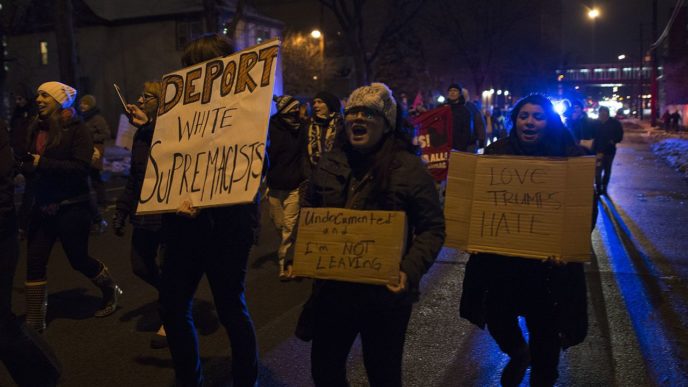
But more importantly, Trump should reissue a score of executive orders that address the same issues as the current one, but make them even more muscular. If the Left is going to play dirty like this, make them pay for it. Give them something they will dislike even more and force them to fight many battles instead of just one. Perhaps that will cool their ardor for obstructionist lawsuits and nationwide, Democrat funded violence that threatens to drag this country into civil war:
1. Replace the 3 month ban on immigration from seven terrorist-producing nations with a 6 month ban on the same seven nations. President Obama issued a six-month ban on refugees from Iraq in 2011. He did so after two Kentucky-based Iraqi refugees were discovered to be former insurgent IED makers. So much for our supposedly infallible vetting process. Despite much-ballyhooed improvements, the current vetting procedure places almost all emphasis on processing refugees as quickly as possible, with few, if any national security safeguards. The seven nations were also first identified by the Obama DHS.
2. Consider expanding the list to all nations of terrorism concern. The State Department keeps a list which formally includes State Sponsors of Terrorism: Syria, Sudan, Iran, and Countries of Particular Concern: Burma, China, Eritrea, Iran, North Korea, Saudi Arabia, Sudan, Turkmenistan, Uzbekistan. Those countries on the DHS list not identified by the State Department, i.e. Somalia, Libya, Yemen and Iraq, should be added to State’s list.
3. Extend suspension of the refugee admissions program (USRAP) to a full year as requested by numerous members of Congress and cities all over the country begging for relief. (It now only lasts 120 days). President Trump does not need an executive order for this. He can simply send a letter to Congress, informing it of his intentions. Refugee caps for FY 2017 would be reduced to zero.
4. Issue all other components of the current EO as separate, standalone orders. Many of these are not challenged by the court in this EO, but are desperately needed. For example: ending the Obama administration’s insane policy of allowing U.S. entry of foreign nationals who have aided terrorists, focusing on those refugee minorities facing the worst persecution (e.g. the Christians that Obama ignored), enacting uniform screening standards for all immigrants, suspending the visa waiver program, completing the Biometric Entry-Exit Tracking System, visa reciprocity, and data transparency.
Trump needs to rescind this executive order to snatch victory out of the Left’s intolerable hands. He needs to replace it with others that will punish the Left for their vicious, relentless, unconstitutional and often illegal tactics, and force them to fight every single item, piece by piece.
https://joemiller.us/wp-content/uploads/Protest_march_against_Donald_Trump_30386000004.jpg9601280Joe Millerhttps://joemiller.us/wp-content/uploads/logotext.pngJoe Miller2017-02-10 22:27:582017-02-11 21:24:58Rescind the Executive Order — and Replace It With Many Tougher Ones
Planned Parenthood makes many lofty claims about its “services” critical to women’s health. But just digging a little deeper into its actual practices and history reveals something much less positive — and a lot more sinister.
As a pro-life blogger and speaker, who escaped abortion myself in Communist China, and chose life for my “imperfect” child, I feel called to expose abortion lies wherever I see them. This weekend, tens of thousands of people will protest Planned Parenthood nationwide; it’s a critical moment to raise awareness of the abortion giant and its misdeeds.
More than any organization in America, Planned Parenthood is responsible for perpetrating lies about abortion — and lies about its own “women’s health” services. There’s no doubt, the public relations strategy of the abortion giant is built on deception.
If the American public really knew the truth about Planned Parenthood, I truly believe most Americans would immediately stop supporting and defending it. That’s why my latest video gives five reasons why Planned Parenthood must stop receiving our tax funding — the entire $553 million dollars they currently receive annually.
In fact, Congress will soon begin debate over a budget reconciliation bill on this issue. We can expect mainstream media to go crazy over this bill, claiming it will harm women’s health. But the truth is, all it will do is halt abortion providers from receiving about 75 percent of their current taxpayer funding for one year. (Read more from “5 Reasons Why Planned Parenthood Must Stop Receiving Our Tax Dollars” HERE)
As the president’s chief strategist Steve Bannon insists, the election of Donald Trump was a victory for “nationalism.” On that observers agree. But that’s where consensus ends. What exactly does that term mean? Is it something that should frighten us? Fill us with hope? Leave us ambivalent, neutral, or watchful? The answer to that crucial question depends both on what we mean by nationalism, and how its resurgence affects both domestic and foreign policy.
Thoughtful commentators on the right have been weighing in on this subject, especially lately. I’ll offer a round-up of their views in a moment. But first I would like to reiterate a distinction I offered here months ago, before it seemed even likely that Donald Trump would win the election. As I wrote then, there are two lodestars of loyalty among American conservatives, which can complement each other but also compete:
The Golden Egg: moral, civic and economic principles that could, in theory, be applied to any country on earth, and to any group of immigrants we admitted to America, however large. These principles are simply true for every human being, and we must insist on that fact. Instead of the left’s relativism and politics of group resentment, these principles offer conservatives an inclusive, persuasive program which should appeal to any voter of good will. You can find an excellent summary of America’s guiding principles right here at The Stream. Key among them are truths such as “Every human being has equal value and dignity,” and “Judeo-Christian religious faith guards our freedom.” If pursued consistently, these principles should always produce a more peaceful, prosperous, free country than would otherwise be possible.
And:
The Goose: real, existing, historically-founded facts that explain why these principles have worked here in America, while failing spectacularly when tried elsewhere — for instance in the Latin American republics that declared independence shortly after the 13 colonies did, wrote similar declarations and comparable constitutions, and degenerated into a 200-year cycle of dictatorships and chaos. The most important of these facts was the dominance of a tolerant, Anglo-Protestant culture grounded in some 800 years of English resistance to oppressive governments. Change this fact too radically or too quickly, and the principles we treasure will wither and die.
America as a Mere Abstraction
Back in 2003, when “Golden Egg” enthusiasts had almost completely captured the thinktanks, magazines, and other institutions of conservatism, I wrote a long “think piece” warning against the dangers of unmoored ideology that neglected the “Golden Goose,” called “America the Abstraction.” Jim Antle saw fit to reach back some 14 years and cite that piece yesterday in The Washington Examiner. (Antle’s piece is itself an excellent starting point for understanding today’s debate—I encourage all to read it.) As I wrote then:
If you are trying to boil down citizenship to its philosophically respectable components, and if ideology is all you are interested in, then it does not really matter where you were born. Or who your parents were. Or whom you love. Or the hymns you know by heart, the folk tales you treasure, the God you worship. None of these merely human matters measures up, ideologically speaking. None of them can be enshrined in a manifesto, or beamed across the world via Voice of America, or exported in music videos. They do not raise the GDP, or lower the interest rate, or increase our command of oil reserves. They cannot be harnessed to drive the engine of globalization. Therefore, to some people, these things do not matter. Such pieties can be harnessed in the run-up to a war, can form part of the Army recruitment ads and propaganda campaigns, and may even find their way into presidential speeches. But essentially there is no difference between a fourth-generation American and an Afghan refugee who just landed at JFK—so long as they both accept the same ideology.
How did we get to this pass? How did conservatism, which once centered on the fierce defense of tradition, religion, and particularism, turn into an ideology — that is, a philosophy in arms, a political system shorn of its ties to real people and places, slimmed down by dropping historical baggage, packaged for export on the global market of ideas? The simple answer is the Cold War. …
The post-war conservative movement labored mightily to craft … a version of Americanism that could be promoted internationally, which Europeans and Asians, Latins and Africans alike could adopt as an alternative to Marxism. …
Increasingly, America was defined according to the most expansive, abstract reading of the Declaration of Independence, combined with a version of market economics well-suited to the unrestricted “pursuit of happiness.” Anything that did not fit that formula tended to fall down the memory hole: the Anglo-Celtic roots of the Founding, the specifically Christian (mostly Protestant) identity of America, the very existence of the Confederacy, and the profoundly Western roots of our culture. …
To conservatives schooled in this mode of argument, restrictions on immigration are simply insane; anyone, anywhere who will sign on to the Declaration of Independence is already an American. Keeping him out makes no more sense than building a Berlin Wall to divide Manhattan’s East Side from its West. Embittered blacks, or religious conservatives, or leftists who do not accept the Cold War ideology of America are not real Americans. An ideological litmus test becomes the standard of citizenship. American foreign policy must cease to pursue the concrete interests of a concrete, national community and become the tool by which an abstract creed is imposed across the world — hindered only by the resistance of the benighted and bigoted, who are fated to end on the ash-heap of history.
A compatible view of these crucial issues comes from Rich Lowry and Ramesh Ponnuru of National Review, who write:
The outlines of a benign nationalism are not hard to discern. It includes loyalty to one’s country: a sense of belonging, allegiance, and gratitude to it. And this sense attaches to the country’s people and culture, not just to its political institutions and laws. Such nationalism includes solidarity with one’s countrymen, whose welfare comes before, albeit not to the complete exclusion of, that of foreigners. When this nationalism finds political expression, it supports a federal government that is jealous of its sovereignty, forthright and unapologetic about advancing its people’s interests, and mindful of the need for national cohesion.
Nationalism Can Be Dangerous
Jonah Goldberg, in the same magazine, respectfully differs, declaring his preference for the Golden Egg:
Our shrines are to patriots who upheld very specific American ideals. Our statues of soldiers commemorate heroes who died for something very different from what other warriors have fought and died for for millennia. Every one of them — immigrants included — took an oath to defend not just some soil but our Constitution and by extension the ideals of the Founding. Walk around any European hamlet or capital and you will find statues of men who fell in battle to protect their tribe from another tribe. That doesn’t necessarily diminish the nobility of their deaths or the glory of their valor, but it is quite simply a very different thing they were fighting for. …
[N]ationalism is healthy in small doses, but we must remember that all poisons are determined by the dose. Because nationalism is ultimately the fire of tribalism, having too much of it tends to melt away important distinctions, from the rule of law to the right to dissent to the sovereignty of the individual. This is why every example of unfettered nationalism run amok ends up looking very much like socialism run amok (and vice versa). The passionate populist desire for unity above all recognizes no abstract barriers to the general will.
Ben Shapiro warns, also at National Review:
Trump’s definition of nationalism is not the conservative definition of nationalism. Conservatives love America because we believe it is a nation founded on an idea. Our interests ought to prevail because our principles ought to prevail: limited government, individual liberty, God-given natural rights, localism in politics, religious freedom, freedom of speech and of the press, and so forth. If America ceased to believe those things or stand for them, we would not deserve to win. “Make America Great Again” would then ring hollow with the same blood-and-soil nationalistic violence of the Old World. If greatness is measured in utilitarian terms rather than ideological ones, nationalism is merely tribalism broadened, a way of valuing the collective over the individual.
America’s Founding Principles, De-Christianized, Can Be Poisonous
Of course, the critics of nationalism are right, up to a point. They correctly warn that an unreflective attachment to hearth and home, totem and tribe can quickly get out of control and erupt in the kind of ugliness we see around the world, which took its most infamous form in Hitler’s Germany.
But that’s not the only kind of danger. Countries bound together only by an abstract ideology can be very dangerous too — as we see not just from the Soviet Union and revolutionary France, but more recently in the empire created by ISIS, and the relentless drive for power of the Muslim Brotherhood.
Goldberg and Shapiro recognize this of course. They read their history, and know that ideologies can be dangerous. They just don’t seem to think that America’s can be. They don’t seem to see that American principles, while truer than most, can also be abused and applied to evil ends.
But isn’t that exactly what happened when our judicial elites declared that our Constitution enshrined the right to abortion? That central to our right of liberty is the right to make up the meaning of the universe exactly as we wish to? (See Casey v. Planned Parenthood.) That same-sex couples have the right to legally recognized marriage because of their human “dignity”?
You and I might rightly say that these are false inferences from our principles, but they are currently the official governing philosophy of the United States legal system. Stripped by judicial intellectuals of their tolerant, Protestant Christian context (the “originalist” reading of the Constitution that Justice Scalia insisted on), our founding principles can prove very dangerous indeed; they were fatal to almost 60 million unborn American children.
Our Founders were fallen men, and their ideas were not divinely revealed from heaven. The profound truths that did emerge in America’s founding were not some brilliant ideas that Enlightenment thinkers came up with and scribbled down. Instead, they emerged over centuries in a very specific context: the Christian soil of England, with its Saxon resistance to political authority and Protestant obsession with spiritual independence. That was the soil the Pilgrims and other English settlers carried over with them on their ships. Scrape it away, replace it with alien sand or secular gravel, and Liberty’s tree might wither. Or to go back to my first metaphor, the Goose might keel over and die. (For more from the author of “Could Moderate Nationalism Save Us From Post-Christian “Americanism”?” please click HERE)
https://joemiller.us/wp-content/uploads/american-flag-1109397_960_720-1.jpg635960Joe Millerhttps://joemiller.us/wp-content/uploads/logotext.pngJoe Miller2017-02-10 21:05:532017-02-10 21:05:53Could Moderate Nationalism Save Us From Post-Christian “Americanism”?
Dr. Eric Walsh’s lawsuit against the State of Georgia came to an end when the state agreed to pay the Seventh-Day Adventist and former state employee $225,000. First Liberty Institute, the non-profit law firm representing Walsh, announced the victory Thursday.
The settlement comes after a nearly three-year legal battle in which Walsh, a lay-minister for his church, accused Georgia of religious discrimination.
Accusations of Religious Discrimination
Walsh, a member of former President Barack Obama’s Presidential Advisory Council on HIV/AIDS and holder of multiple advanced degrees, was hired as a district health director with Georgia’s Department of Public Health in 2014. But officials abruptly fired him after reviewing YouTube videos of sermons he had preached on the weekends.
First Liberty Institute, a national non-profit law firm based in Texas, helped Walsh file a complaint with the Equal Employment Opportunity (EEOC). As The Stream reported last April, Title VII of the 1964 Civil Rights Act prohibits the discrimination of employers based on their religion.
“No one should be fired from their job for something they said in a sermon, First Liberty Senior Counsel Jeremy Dys told The Stream at the time. “It will be fair game to examine the notes you took in church or the Sunday School lesson you prepared during your annual review.”
Six months later, after receiving the EEOC’s go-ahead, Walsh sued the state of Georgia in April of 2016. Georgia responded in September by demanding that Walsh produce “sermon notes and/or transcripts” and “all documents relating to your service as a pastor.”
Dys responded that the demand was intrusive, calling it “an excessive display of the government overreaching its authority and violating the sanctity of the church.”
Victory for Religious Liberty
First Liberty called the settlement a victory for religious freedom. “We are grateful that the State of Georgia agreed to settle the case and acknowledge the right of their employees to express their religious beliefs,” Dys said in a press release.
Dys pointed out that the law was on Walsh’s side. “No one should be fired for simply expressing his religious beliefs,” he said. He called Walsh “a man of courage and conviction who suffered a serious injustice.”
“It’s been a long, difficult journey,” Walsh commented, “but it’s worth it to have my name cleared and to ensure that all Georgia government employees know they have religious liberty.”
Walsh has been working as a medical missionary and as a medical doctor in California since being fired. Now that the lawsuit has ended, Walsh hopes he can continue to care for his community, First Liberty’s Director of Legal Communications Kassie Dulin told The Stream. (For more from the author of “Victory for Christians: Georgia State Employee Fired for Weekend Sermons Prevails” please click HERE)
https://joemiller.us/wp-content/uploads/bible-998150_960_720-2.jpg720960Joe Millerhttps://joemiller.us/wp-content/uploads/logotext.pngJoe Miller2017-02-10 21:00:592017-02-10 21:00:59Victory for Christians: Georgia State Employee Fired for Weekend Sermons Prevails
Education Secretary Betsy DeVos was physically blocked by protesters from entering Jefferson Academy in SW, D.C. Friday morning. This was her first visit to a public school.
The protesters created a barrier to the entrance of the school, and began shouting.
DeVos turned away and walked toward her vehicle while protesters continued to yell, one screaming, “She doesn’t represent anything that they stand for.” Followed by chants, of “shame, shame, shame.” . . .
The Washington Teacher’s Union organized a gathering outside of the school, but were not among the protesters who blocked her. They arrived earlier in the day and greeted DeVos in peace, but with a strong message.
The union, who said they did not support DeVos’ nomination, stated they hoped she would be successful. They said if DeVos succeeds in her new role then everyone succeeds – including all public schools and teachers. (Read more from “Education Secretary Betsy DeVos Physically Blocked by Protesters From Entering D.C. School” HERE)
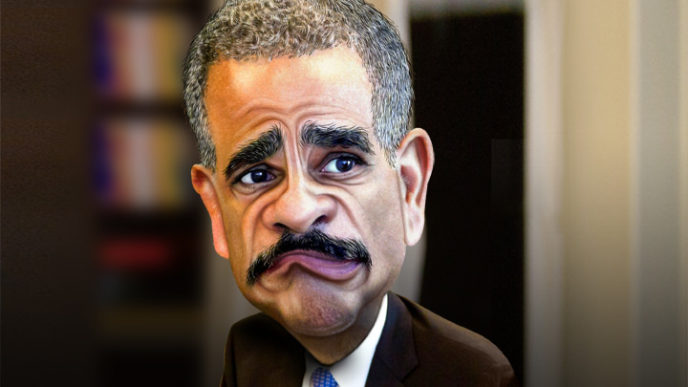
Former Obama Attorney General Eric Holder’s law firm, Covington and Burling, will receive $25,000 a month from the California Legislature.
The fee is in exchange for 40 hours of work each month on providing “legal strategies regarding potential actions of the federal government that may be of concern to the State of California,” according to documents obtained by Judicial Watch.
In response to the documents, Judicial Watch president Tom Fitton said that California legislators are “wasting tax dollars to bankroll another corrupt politician – Eric Holder – under the pretense of attacking the Trump administration.” . . .
Even before Donald Trump was sworn in as president, California State Senators de León (D-Los Angeles) and Rendon (D-Paramount) announced in a joint statement that “…to protect California’s economy and our sensible policies on climate change, health care, civil rights, and immigration,” the Legislature has hired “an expert legal team…led by former United States Attorney General Eric H. Holder Jr.”
The contract with Covington and Burling, which Holder felt “honored” to receive, is limited to the firm providing “legal strategies.” Should the California Legislature wish to use the firm for litigation or public advocacy work, a new “engagement letter” would be required. (Read more from “California to Pay Eric Holder’s Law Firm $25,000 a Month for Anti-Trump ‘Legal Strategies'” HERE)
https://joemiller.us/wp-content/uploads/13900138953_61e93c200c_b-1.jpg504720Joe Millerhttps://joemiller.us/wp-content/uploads/logotext.pngJoe Miller2017-02-10 20:47:222017-02-10 20:47:22California to Pay Eric Holder’s Law Firm $25,000 a Month for Anti-Trump ‘Legal Strategies’
The State of Alaska is continuing its efforts to push educators in encouraging children to experiment with alternative genders including transitioning away from their biological sex.
Late last year the Alaska Department of Education and Early Development partnered with the Department of Health and Social Services to sponsor a conference that included instructing educators on how to assist students — elementary age and older — who wish to transition away from their biological sex and identify otherwise. The conference also urged teachers to keep this information from parents who may take issue with the school enabling their child’s gender experimentation.
In preparation for an upcoming conference this spring on preventing sexually transmitted diseases, the state is continuing its promotion of gender theory in issuing a call last month for presentations on topics such as “Sexual health promotion for LGBTQ individuals” and “LGBTQ inclusivity in the health care setting.”
A Jan. 5 email from Jenny Baker, Adolescent Health Project Coordinator for Alaska’s Division of Public Health, called for abstracts for the upcoming May 8-10 conference in Anchorage.
The conference website states that it will “Bring together public health and health care professionals and providers in the behavioral, medical, social services and education fields” to share the “newest information available on HIV/AIDS, Viral Hepatitis, STDs and related health issues.”
Baker was a featured speaker at the most recent Alaska School Health & Wellness Institute this past October, where she guided teachers and school nurses through ways to advance what she said many might consider to be “controversial” sex education in their school districts.
She told attendees that sexually transmitted infections are on the rise among Alaska’s youth but pregnancies are dropping. She credited the increased use of “birth control, like pills, IUD shot, patch, ring” as a possible reason for the decline in teen pregnancies. Abortion also plays a role, she said, while noting that more measures need to be taken.
During the same workshop Baker acknowledged that “talking about sex education and talking about sex in general is controversial” and that some parents and school boards don’t support it. Nonetheless, she encouraged Alaska educators to push for “comprehensive” sex education that includes explicit instruction on the proper use of a condom, how to procure and utilize a wide range of contraceptives and how to understand and accept gender roles, gender identity and sexual orientation, among other topics. (For more from the author of “Alaska Continues to Push LGBT Agenda in Schools” please click HERE)
https://joemiller.us/wp-content/uploads/Gay_Couple_-_Gay_Parade_2008_in_San_Francisco.jpg14482490Joe Millerhttps://joemiller.us/wp-content/uploads/logotext.pngJoe Miller2017-02-10 20:43:402017-02-10 20:43:40Alaska Continues to Push LGBT Agenda in Schools