The Middle East country of Kuwait issued its own “Muslim ban” in 2011, citing the “instability” from several terror hotbeds in the Middle East.
The revelation follows President Donald Trump’s executive order that placed a temporary suspension on visa issuances from the countries of Syria, Iraq, Iran, Yemen, Libya, Somalia, and Sudan. The presidential decision has faced extremely heavy scrutiny from across the political spectrum, with opponents claiming it to be inhumane, unconstitutional, and un-American.
The executive order’s proponents say the temporary ban is necessary to protect the country from national security threats, reminding it only affects a tiny portion of Muslim-majority nations.
Kuwait — where Islam is the state religion and 80 percent of the population is Muslim — has had a supposed “Muslim ban” in place since 2011 to stop visa issuances to citizens of Syria, Iraq, Iran, Pakistan, and Afghanistan. According to a report in Al Alaraby, individuals from these countries “will not be [AK1] able to obtain visit, tourism or trade” visas. Additionally, “Passport holders from the countries will no lot be allowed to enter the Gulf state while the blanket ban is in place and have been told not to apply to visas,” the report adds.
Kuwait has seen several incidents where foreigners attempted, and succeeded, at executing terrorist attacks. The most deadly occurred in June 2015, when an Islamic State suicide bomber detonated his vest at a Shia mosque in Kuwait City, killing 27 and injuring 227 people.
The five countries listed in the Kuwait visa ban are known breeding grounds for Islamic militants.
War-ravaged Syria and Iraq are home to ISIS, al Qaeda, and several Iran-backed jihadi militia groups. In 2011, when the civil war in Syria first erupted, Kuwait issued a visa ban for all Syrians.
Afghanistan and Pakistan is home to al Qaeda, ISIS,Taliban, the Haqqani Network, and dozens more Sunni terror groups.
And Iran is the world’s foremost state sponsor of terror, according to a 2016 report by the Obama State Department.
After this so-called “Muslim ban,” will Kuwait face international blowback of its own from prioritizing its national security? Will this have any effect on the perception of Pres. Trump’s executive order? (For more from the author of “This Muslim Country Has Had Its Very Own ‘Muslim Ban’ Since 2011” please click HERE)
https://joemiller.us/wp-content/uploads/15021944058_0844ff0f01_b-1.jpg540960Joe Millerhttps://joemiller.us/wp-content/uploads/logotext.pngJoe Miller2017-02-06 21:58:032017-02-11 20:44:34This Muslim Country Has Had Its Very Own ‘Muslim Ban’ Since 2011
First, let me this out of the way straight away — this is not a joke.
I swear it.
I have to begin with that caveat because those of you who regularly listen to my show, or read my column, would likely believe I was engaging in grade A trolling had I not. Or you might suspect I’ve gone mad as a hatter. For what I’m about to say undeniably goes against my default setting where the senior senator from the commonwealth of Kentucky is concerned.
Yes, that would be Mitch McConnell R-Ky. (F, 40%). Or “Ditch” as I once coined him long ago for being the chief playwright of what became known as “failure theater.” The man whose relationship with conservatives has been, well, complicated, to be kind. But today is no time to dwell on the past. Today is a time for giving credit where credit is due.
So here it is, Mitch McConnell, and again, I mean this in all seriousness: thank you. (Editor’s note: we disagree. McConnell is a snake and, although he’ll occasionally throw us a bone, is absolutely unredeemable. You can bet your last dollar that anything McConnell does that is “conservative” either was already going to happen or helps advance his own crony-capitalist interests; he is despicable, largely responsible for the disastrous state our nation is in)
It was you who stood in the breach after President Obama nominated Merrick Garland to replace Antonin Scalia following his death last February. That left nearly a year before a new president would be sworn in. In fact, Garland’s name ultimately was entered into nomination for more than twice as long as any Supreme Court nominee that came before him.
“Obstruction,” the Democrats cried. And they continue to do so now as they prepare to torpedo President Trump’s nomination of Neil Gorsuch to replace Scalia.
But when the real obstruction has been decades upon decades of judicial usurpations of the legislative process, McConnell sat down at the high stakes poker table and played a stone-cold hand. He bet he would get just the jackpot he needed when that river card was flipped. A “Trump card” if you will.
So now here we are, with a chance to at least hold the line on the Supreme Court, and perhaps even set the stage for a return to something resembling the jurisprudence of our Founding Fathers. And now if you’re one of those applauding the Gorsuch appointment, you owe McConnell a doth of the cap as well.
That’s not to say McConnell and conservatives are suddenly bosom buddies. There’s still a lot of water under that bridge. Still, the importance of what the Senate Majority Leader did here cannot be understated, and had he not done it the possibility exists the ideological balance of the nation’s highest court could’ve been generationally impacted.
Ronald Reagan once famously had a plaque with the following words inscribed on it in the oval office: “It’s amazing what you can do when you don’t care who gets the credit for it.” In that spirit, if Ted Cruz, R-Texas (A, 97%) and Lindsey Graham, R-S.C. (F, 30%) can stand shoulder-to-shoulder on MSNBC when they share common ground, we can thank McConnell for standing shoulder-to-shoulder with us here.
This time DC did listen to us, and we should acknowledge when that happens at least as much as we do when it doesn’t. Here’s to hoping this is the start of a trend.
Thanks again, Mitch. (For more from the author of “Mitch McConnell FINALLY Served a Purpose for GOP/Conservatives” please click HERE)
https://joemiller.us/wp-content/uploads/8566778921_7880497455_b-1-1.jpg6831024Joe Millerhttps://joemiller.us/wp-content/uploads/logotext.pngJoe Miller2017-02-06 21:40:212017-02-11 20:57:16Mitch McConnell FINALLY Served a Purpose for GOP/Conservatives
Employees of a hedge fund founded by the king of the Institutional Left, billionaire and Democratic Party mega-donor George Soros, donated tens of thousands of dollars to top Republicans who fought against President Donald Trump in 2016, donation records compiled by the Center for Responsive Politics show.
Soros Fund Management, a former hedge fund that serves now as an investment management firm, was founded by progressive billionaire George Soros in 1969. It has risen to become one of the most profitable hedge funds in the industry. Employees of the firm are heavily involved in backing political candidates giving millions upon millions to groups that were supporting failed 2016 Democratic presidential nominee Hillary Rodham Clinton for the presidency.
But more importantly, perhaps, than the unsurprising giant lump sums of cash funneled into Democratic Party and Clinton coffers is the revelation thanks to the Center for Responsive Politics that employees of the Soros firm—now run by his son Robert Soros—pumped tens of thousands of dollars into the campaigns of top anti-Trump Republicans over the course of 2016. . .
[I]t is significant that Soros executives are making a play inside the GOP. Perhaps even more significant is the type of Republican they aim to prop up: pro-amnesty, pro-open borders on trade, and generally speaking anti-Trump. A pattern emerges when looking at the policies of the Republicans that these Soros Fund Management executives support financially.
The biggest recipient of Soros-connected cash in the GOP was none other than House Speaker Paul Ryan, who repeatedly attempted to undermine Trump over the course of the election. According to the records available online, the Soros firm’s workers gave $10,800 to Ryan. Included in that are two separate May 2, 2016, donations from David Rogers, a then-employee of Soros Fund Management who lives in New York City. Rogers left the Soros Fund Management firm right around that time. (Read more from “EXPLOSIVE: Soros Group Funded Numerous Republicans Proving DC Has but One Party” HERE)
https://joemiller.us/wp-content/uploads/800px-George_Soros_-_Festival_Economia_2012_01.jpg502800Joe Millerhttps://joemiller.us/wp-content/uploads/logotext.pngJoe Miller2017-02-06 21:35:182017-02-11 20:46:22EXPLOSIVE: Soros Group Funded Numerous Republicans Proving DC Has but One Party
It didn’t take long for liberals to make a moral, legal, and philosophical equivalent between Trump’s executive order protecting national sovereignty and security and Obama’s executive amnesty shredding Congress’ plenary power over immigration.
The arguments go something like this:
Well, why was it a problem when Obama took executive action on immigration and not Trump?
If it were OK for a district judge to put a restraining order on Obama’s executive amnesty, why can’t a district judge put an injunction on Trump’s?
The answer is very simple: statute, the Constitution, and national sovereignty. It’s a difference between night and day.
Trump is trying to do the job the Constitution and Congress have authorized him to perform
Rooted in our history and tradition, our immigration laws are — generally speaking — written to give the president broad authority to ratchet down immigration as needed, not to ratchet it up without a full debate in Congress over such a proposition.
Consent-based immigration is rooted in the notion, “governance by the consent of the governed” — that through their elected representatives, the people have control over who comes into the country.
As we’ve noted before, Congress rightfully delegated restrictionist authority to the president under section 212(f) of the Immigration and Nationality Act in the clearest terms imaginable. That should end the discussion.
Moreover, almost each component of the immigration order is double covered by another statute. Under existing law unanimously passed by Congress (8 U.S. Code § 1735), any foreign national from state sponsors of terror (at the time of the original law in 2002, that included five of the seven countries on Trump’s list) are not to be granted visas forever (not just for 90 days, as Trump has proposed).
As for refugees, the president was specifically given the power to set the cap and criteria for who is let in as a refugee (more so than any other area of immigration) under 8 U.S.C. 1157. The notion that a president can’t place a moratorium on refugees (in this case, from any country, not just Muslim-majority ones) until we have a better vetting system in place, defies comprehension.
Most egregiously, Judge James Robart — who should be impeached — said that Trump’s prioritization of persecuted religious minorities is unconstitutional(!!), even though it is literally required by current law and the entire spirit of refugee status in the first place. From Section 8 U.S.C. 1101(a)(42)(A):
The term “refugee” means (A) any person who is outside any country of such person’s nationality … and who is unable or unwilling to return to … that country because of persecution or a well-founded fear of persecution on account of … religion [among other things] …[.]
And as I’ve noted before, Democrats have long used the “Lautenberg Amendment” to extract Jews from the former Soviet Union and Iran in a very strict, religious litmus test.
Now contrast Trump’s act of following the spirit and letter of the law, protecting American security, and preserving American sovereignty with Obama’s unilateral nullification of immigration law. Not only did Obama violate section 1225(b)(2)(A) of the INA, which requires ICE agents to place all illegal aliens into removal proceedings, but he also created his own immigration program and offered positive benefits to people here against the national will: He offered them affirmative legal status with Social Security cards, work permits, and thousands of dollars in refundable tax credit welfare payments.
As I’ve said before, giving rights to aliens is the quintessential example Hamilton used to contrast a president from a king. “[T]he one [a president] can confer no privileges whatever; the other [a king] can make denizens of aliens, noblemen of commoners; can erect corporations with all the rights incident to corporate bodies,” wrote Hamilton in Federalist #69.
Now the courts are also acting like a king — making denizens out of aliens, just like Obama did. Trump is using delegated authority to not make denizens out of aliens. Whether or not you favor mass migration from Somalia is a matter of policy prudence, but not subject to legal dispute.
Thus, when Judge Andrew Hanen issued a temporary restraining order against Obama’s amnesty (following by a permanent injunction) in a 123-page scholarly opinion, he was following the law and the Constitution, unlike Judge Robart.
To be clear, I personally agree that a district judge should not be able to issue a nationwide injunction (outside the court’s jurisdiction) on national policy, and at the time I was consistent in my warning to Republicans that they use Congress — not the courts — to fight Obama. Either way, the reason why Obama’s amnesty was unconstitutional is because it violated statute, not just because Judge Hanen said so.
On the other hand, Trump followed statute, yet Judge Robart gave no explanation for throwing out settled law or why the plaintiffs would succeed on the merits before issuing his restraining order.
Perforce, in either case, judges aren’t the law of the land. The laws duly passed by Congress pursuant to our Constitution, history, and tradition are the laws of the land. Trump followed them; Obama nullified them in a way even King George couldn’t do.
The bottom line is that the only hypocrisy on this issue is coming from the Left because it doesn’t like the history, traditions, and laws of our immigration system. It’s fine for the Left to complain about our laws. It’s not OK to change them through the president or the courts without approval from Congress. Trump, on the other hand, is applying the existing law. It’s time for liberals to learn how to read. (For more from the author of “How to Tell the Difference Between Trump and Obama’s Refugee EOs? Trump Actually Follows the Law” please click HERE)
https://joemiller.us/wp-content/uploads/8567813820_32b8aa4810_b-2.jpg6831024Joe Millerhttps://joemiller.us/wp-content/uploads/logotext.pngJoe Miller2017-02-06 21:33:542017-02-06 21:33:54How to Tell the Difference Between Trump and Obama’s Refugee EOs? Trump Actually Follows the Law
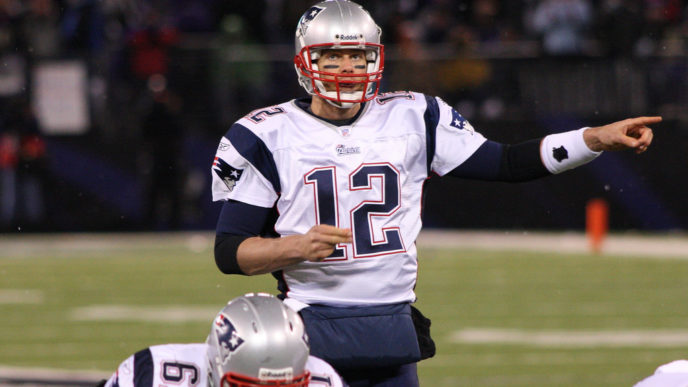
History was made Sunday night when the New England Patriots came back from a 21–3 halftime deficit in Super Bowl 51 to pull an historic and stunning overtime victory, defeating the Atlanta Falcons 34 to 28.
Patriots fans are understandably exuberant. Atlanta fans are beyond dejected. And the liberal media is eating crow.
You see, prior to the game, the liberal media had determined that quarterback Tom Brady’s friendship with Donald Trump made it unacceptable to root for the Patriots, unless of course you are a bigoted, racist, homophobic deplorable.
On Feb. 1, The New York Times ran an expose on “The uncomfortable love affair between Donald Trump and the New England Patriots.” The piece attempted to shame the Patriots by pointing out the team’s ties to the president and noted that “no small number of fans are convinced that the Patriots (like Trump) achieve their victories through dubious means and wish they would just go away and get off their TVs forever.”
The New York Daily News praised Bill Maher for an “epic rant” in which the progressive comedian and host of “Real Time with Bill Maher” went on a profanity-laced tirade declaring his opposition to a Patriots’ victory.
“The Falcons are playing a team where the owner, the coach and the star quarterback all love Donald Trump,” said Maher. “So I’d really like for them to lose by a score of a million f–king thousand to none.”
The Los Angeles Times ran an op-ed by sports documentary producer Kelly Candaele declaring his support for the Falcons on the basis of the “loathsome politics” of Tom Brady, Bill Belichick, and Robert Kraft.
SB Nation brought up the controversy between President Trump and Congressman John Lewis, D-Ga. (F, 22%) — who represents part of Atlanta — declaring the Super Bowl was “Donald Trump vs. the city of Atlanta.”
Slate even ran an explainer titled “How to pull for the Patriots in the Age of Trump.” But look closely at the URL on that piece and you’ll see an alternative headline poses a moral quandary to Slate’s audience: “Is it morally acceptable to root for the New England Patriots in the Super Bowl?”
One of the big moral questions Slate tackles is: “Is it cool to like a football team because its owner and some of its players like a politician I disagree with?” Truly the philosophical question for the times we live in.
A less philosophical individual called for a “boycott” of the Patriots way back in November.
And then, in an uncanny election night parallel, things began to turn around on the liberals. With a strip-sack, a miracle catch, and a tenacious drive by Tom Brady, the Pats turned the game around for the win in overtime.
https://joemiller.us/wp-content/uploads/2311705752_a476279c37_b.jpg7871024Joe Millerhttps://joemiller.us/wp-content/uploads/logotext.pngJoe Miller2017-02-06 21:27:512017-02-11 20:51:42The Patriots Didn’t Just Beat the Falcons. They Crushed the Liberal Media
A scientist-whistleblower has accused the National Oceanographic and Atmospheric Administration (NOAA) of diddling with temperature data, adjusting it so that it better accorded with political desires.
The Daily Mail is reporting that Dr John Bates, a now-retired climate data expert, late of the National Centers for Environmental Information (NCEI), a branch of NOAA, claimed the agency “breached its own rules on scientific integrity when it published the sensational but flawed report, aimed at making the maximum possible impact on world leaders including Barack Obama and David Cameron at the UN climate conference in Paris in 2015.”
Bates said that Thomas Karl, who was until recently the director of NCEI, was “insisting on decisions and scientific choices that maximised warming and minimised documentation … in an effort to discredit the notion of a global warming pause, rushed so that he could time publication to influence national and international deliberations on climate policy” (ellipsis original).
The data, Bates claimed, was never “subjected to NOAA’s rigorous internal evaluation process.” When Bates complained, “His vehement objections to the publication of the faulty data were overridden by his NOAA superiors in what he describes as a ‘blatant attempt to intensify the impact’ of what became known as the Pausebuster paper.”
Karl and eight others authored the “Pausebuster” paper, “Possible artifacts of data biases in the recent global surface warming hiatus.” It reported “an updated global surface temperature analysis that reveals that global trends are higher than those reported by the Intergovernmental Panel on Climate Change, especially in recent decades” and which claimed “These results do not support the notion of a ‘slowdown’ in the increase of global surface temperature.”
The “slowdown,” or rather the non-increase in global temperatures for almost two decades, was notable in satellite data. It was also noticed in surface-based data, until that data was statistically adjusted by Karl and others. These adjustments of surface records, which are not uncommon, are also curious. It usually happens that older data are lowered, and recent data pushed higher, making it appear that temperatures are increasing. Are these adjustments legitimate, or the result of confirmation bias, or potentially fraudulent?
How dramatic are the adjustments? As the Daily Mail reports, “The Pausebuster paper said while the rate of global warming from 1950 to 1999 was 0.113C per decade, the rate from 2000 to 2014 was actually higher, at 0.116C per decade.”
This is three-thousandths of a degree higher. Three-thousandths. To appreciate the magnitude, it helps to say it aloud: three-thousandths of a degree. And not just three-thousandths of a degree, but three-thousandths of a degree per every ten years. If panic at the news of higher temperatures was your first reaction, ensure it is panic in slow motion.
The global rate is the product of land and sea measurements. On the sea adjustments, “Thomas Karl and his colleagues … tripled the warming trend over the sea during the years 2000 to 2014 from just 0.036C per decade — as stated in version 3 — to 0.099C per decade.”
Even assuming this correction is valid, the final result is only a tenth of a degree a decade. If the global sea temperature really is caused to act like a straight upwards line, which is physically extremely doubtful, then after ten years, the temperature at sea will be one-tenth of a degree (on average) warmer than previously thought. Make that panic super-slow motion.
But even then, it’s not likely the correction is right.
But Dr. Bates said this increase in temperatures was achieved by dubious means. Its key error was an upwards ‘adjustment’ of readings from fixed and floating buoys, which are generally reliable, to bring them into line with readings from a much more doubtful source — water taken in by ships. This, Dr. Bates explained, has long been known to be questionable: ships are themselves sources of heat, readings will vary from ship to ship, and the depth of water intake will vary according to how heavily a ship is laden — so affecting temperature readings.
Bates said, “They had good data from buoys. And they threw it out and ‘corrected’ it by using the bad data from ships.”
Similar statistical manipulations were done to land-temperature data, with adjustments being of the same low level. Bates not only questioned the timing and direction of adjustments, but said the programs used to make them were “highly experimental” and “afflicted by serious bugs.”
Karl “admitted” to the Daily Mail that “the data had not been archived when the paper was published,” making replication by colleagues impossible or difficult. Karl also said “the final, approved and ‘operational’ edition of the [data] would be ‘different’ from that used in the paper’.”
Even assuming all is aboveboard, what most don’t realize is that surface temperature measurements are not static; they change year to year. These changes induce uncertainty, which has so far been badly underestimated. This is why claims of thousandths of a degree change are, at best, dubious, and are more likely subject to large uncertainties. (For more from the author of “NOAA Whistleblower Claims Data Were ‘Adjusted’ to Make Global Warming Seem Worse” please click HERE)
https://joemiller.us/wp-content/uploads/Earth_Western_Hemisphere.jpg20482048Joe Millerhttps://joemiller.us/wp-content/uploads/logotext.pngJoe Miller2017-02-06 19:36:412017-02-11 20:49:31NOAA Whistleblower Claims Data Were ‘Adjusted’ to Make Global Warming Seem Worse
This weekend, President Donald Trump criticized U.S. District Judge James Robart for his halt of the president’s immigration order — a ruling issued without any accompanying legal analysis.
Now, key Senate Democrats are threatening to use the remark against Judge Neil Gorsuch, Trump’s nominee for the Supreme Court.
Senate Minority Leader Chuck Schumer, D-N.Y., wants to use Trump’s remark to raise the bar “even higher” for Gorsuch’s confirmation. Both Schumer and Sen. Patrick Leahy, D-Vt., now promise to question Gorsuch’s “ability to be an independent check” on the executive branch.
Seemingly unaware of the obvious hypocrisy, Schumer, Leahy, and other Democrats are accusing Trump of questioning Robart’s legitimacy while doing the same to Gorsuch, a U.S. Court of Appeal judge.
To question Gorsuch’s ability to remain “independent” is to question his ability to do his job as a judge.
These Democrats also seem to have forgotten that they cheered President Barack Obama’s attempt to bully the Supreme Court during his 2010 State of the Union address, when he denounced and falsely characterized the court’s Citizens United decision while the justices sat yards away.
Chief Justice John Roberts said he found Obama’s intimidation “very troubling.” Yet it was Schumer, sitting directly behind the justices in the House chamber, who rose with his Democrat colleagues to vigorously applauded Obama’s remarks.
Senate Republicans did not threaten to raise the bar for Justice Elena Kagan, when Obama nominated her to the Supreme Court just months after his controversial State of the Union address.
Republicans could have argued that Obama’s unprecedented criticism of the justices cast doubt on Kagan’s independence and made her confirmation more problematic. But they didn’t.
Senate Democrats would be well advised to follow this example by focusing on Gorsuch’s record and qualifications, rather than using the process to express their unhappiness with Trump. (For more from the author of “Chuck Schumer’s Hypocrisy on Trump’s Supreme Court Nominee” please click HERE)
Three brothers who managed office information technology for members of the House Permanent Select Committee on Intelligence and other lawmakers were abruptly relieved of their duties on suspicion that they accessed congressional computers without permission.
Brothers Abid, Imran, and Jamal Awan were barred from computer networks at the House of Representatives Thursday, The Daily Caller News Foundation Investigative Group has learned.
Three members of the intelligence panel and five members of the House Committee on Foreign Affairs were among the dozens of members who employed the suspects on a shared basis. The two committees deal with many of the nation’s most sensitive issues and documents, including those related to the war on terrorism.
Also among those whose computer systems may have been compromised is Rep. Debbie Wasserman Schultz, the Florida Democrat who was previously the target of a disastrous email hack when she served as chairman of the Democratic National Committee during the 2016 campaign.
The brothers are suspected of serious violations, including accessing members’ computer networks without their knowledge and stealing equipment from Congress. (Read more from “House Intelligence, Foreign Affairs Committee Possibly Compromised by Rogue IT Staff” HERE)
If you want to see the difference between a federal judge who follows the rule of law and a federal judge who ignores laws he doesn’t like in order to reach a preferred public policy outcome, just compare the two district court decisions issued in Washington state and Massachusetts over President Donald Trump’s immigration executive order.
Contrary to the “travel ban” label, the executive order temporarily suspended the granting of visas from seven failed and failing countries that are supplying many of the terrorists plaguing the world.
Despite what Judge James Robart of the Western District of Washington says, Trump acted fully within the statutory authority granted to him by Congress. The temporary restraining order issued by Robart on Feb. 3 is unjustified and has no basis in the law or the Constitution.
This fact is obvious from an examination of his seven-page order, which contains absolutely no discussion whatsoever of what law or constitutional provision the president has supposedly violated. That temporary restraining order is now on an emergency appeal before a panel of the 9th U.S. Circuit Court of Appeals.
Contrast that with the 21-page opinion issued by Massachusetts District Court Judge Nathaniel Gorton that was also issued on Feb. 3.
Unlike Robart, who totally ignored the federal statute (8 U.S.C. §1182(f)) cited by Trump in his executive order, Gorton bases his decision denying the temporary restraining order on an examination of the extensive power given to the president under that statute, which gives the president the authority to suspend the entry of any aliens or class of aliens into the U.S. if he believes it “would be detrimental to the interests of the United States.” And he can do so “for such period as he shall deem necessary.”
That is exactly what the president has done. The order signed on Jan. 27 on “Protecting the Nation From Foreign Terrorist Entry Into the United States” suspends for 90 days the issuance of visas to anyone trying to enter the U.S. from seven countries that even the Obama administration identified as “countries of concern” because of their terrorism histories.
This has been done, as Gorton explains and as the administration has made clear, in order to “ensure that resources are available to review screening procedures and that adequate standards are in place to protect against terrorist attacks.”
As Gorton notes, “the decision to prevent aliens from entering the country is a ‘fundamental sovereign attribute’ realized through the legislative and executive branches that is ‘largely immune from judicial control.’”
As the U.S. Supreme Court said in 2004 in U.S. v. Flores-Montano, “The government’s interest in preventing the entry of unwanted persons and effects is at its zenith at the international border.”
In this case, Congress—which under the Constitution has complete authority over immigration—passed a statute providing the president the authority to suspend the entry of aliens into the country.
According to Gorton, in “light of the ‘plenary congressional power to make polices and rules for exclusion of aliens … which pursuant to 8 U.S.C. 1182(f), has been delegated to the president, the court concludes that the government’s reasons, as provided in the [executive order], are facially legitimate and bona fide.”
No federal judge, including Robart, has the authority to substitute his judgment for that of the president when it comes to making a decision on what is detrimental to the national security and foreign policy interests of the nation.
But that is exactly what he did.
Robart’s opinion ends with a claim that seems like a joke.
He says that “fundamental” to his work is “a vigilant recognition that [the court] is but one of three equal branches of our federal government. The work of the court is not to create policy or judge the wisdom of any particular policy promoted by the other two branches.”
Instead, says Robart, his job is “limited” to “ensuring that the actions taken by the other two branches comport with our country’s laws, and more importantly, our Constitution.”
Yet Robart provides no discussion of the Constitution or the federal statute that applies to this executive order and the actions of the president.
Given that there is no legal basis for his decision and the issuance of a temporary restraining order, the only basis for his decision is his judgment on the “wisdom” of Trump’s executive order.
Gorton recognized the public policy choices being made with this executive order. He discussed the “considerations of both sides with respect to a balancing of the hardships” involved.
On one side, the government is trying to implement “an effective immigration regime that ensures the safety of all Americans,” something that is “undoubtedly difficult.” On the other side, there is a “hardship to the professional and personal lives” of aliens trying to enter the country.
But it is not up to a judge to make that policy choice. The judge’s only role is to review whether the president’s action is authorized by the Constitution and federal law.
There is no question that the executive order meets both of those requirements. We can only hope that the 9th Circuit Court of Appeals follows the law and does not make the same mistake that Robart made. (For more from the author of “Trump’s Executive Order on Immigration Is Both Legal and Constitutional” please click HERE)
https://joemiller.us/wp-content/uploads/wall-of-bricks-336546_960_720.jpg640960Joe Millerhttps://joemiller.us/wp-content/uploads/logotext.pngJoe Miller2017-02-06 19:25:142017-02-06 19:25:14Trump’s Executive Order on Immigration Is Both Legal and Constitutional
After the president scolded judges for not ruling his way, some critics accused him of seeking to intimidate an independent judiciary.
That was in 2010, after the State of the Union address when President Barack Obama rebuked the attending Supreme Court justices over the Citizens United free speech and campaign finance case. Some Obama critics also said they felt he was threatening the Supreme Court in 2012 ahead of its ruling on the Obamacare law.
Some legal analysts anticipate the case will be a harbinger of things to come in challenging President Donald Trump’s policies through the courts, as Democrats face diminished power in Congress and could increasingly use the judicial system to block the president’s policies.
Federal courts frequently ruled against Obama’s executive actions during his eight years in office. However, Trump is getting a fast start on clashing with courts after a federal judge in Seattle placed a temporary restraining order nationally on the executive order to restrict immigration from seven Middle Eastern countries that have been designated as terrorist hot spots.
In response to the immigration ruling, Trump tweeted that U.S. District Judge James L. Robart was a “so-called judge,” prompting Democrats such as Senate Minority Leader Charles Schumer of New York to say Trump has a “disdain for an independent judiciary that doesn’t always bend to his wishes.”
Schumer even stretched this criticism into the upcoming Supreme Court nomination debate, claiming the attack on Robart “raises the bar even higher” for the confirmation of Neil Gorsuch over the question of judicial independence.
The opinion of this so-called judge, which essentially takes law-enforcement away from our country, is ridiculous and will be overturned!
“That could be a flawed argument because broadly speaking, Gorsuch is probably more skeptical of executive power than Merrick Garland would have been,” said Ilya Shapiro, a senior fellow in constitutional studies at the libertarian Cato Institute, referring to Obama’s nominee to the high court who the Senate did not confirm in 2016.
Shapiro told The Daily Signal in a phone interview he thought Trump’s attack on Robart was inappropriate, but not unheard of.
“It was improper for a president to question the authority of the independent judiciary, but it’s not really different from President Obama calling out the Supreme Court at the State of the Union or in seemingly trying to pressure Justice [John] Roberts on Obamacare,” Shapiro said.
Federal judges should by no means be immune from criticism, said Hans von Spakovsky, a senior legal fellow at The Heritage Foundation. He believes Robart, the Seattle judge, issued a ruling outside the law.
“Judges should not be criticized for fulfilling their constitutional role, but if a judge oversteps that constitutional role and acts as a super legislator, then that judge’s reasoning should be criticized,” von Spakovsky told The Daily Signal.
Litigation and “judge shopping” will likely continue throughout the administration as a means to stop Trump’s agenda, von Spakovsky predicted.
This could be a successful strategy for the left, said Curt Levey, a constitutional law expert with the Committee for Justice, a nonprofit legal group, and FreedomWorks, a conservative advocacy group.
With 94 U.S. district courts, it’s possible for liberal advocacy groups to file suits across the country, particularly with issues such as immigration that have a large pool of potential clients, and gain a sweeping national decision out of just one district court decision, Levey told The Daily Signal.
Levey anticipates an increase in environmental groups suing the administration after Obama-era Environmental Protection Agency regulations are rolled back.
“Democrats don’t have a lot of power in Congress, but they still have governors and state attorneys general and many private outside groups,” Levey said. “These outside groups can’t legislate, but they can sue by themselves.”
It was Washington state Attorney General Robert Ferguson who brought the case on behalf of his state against the Trump executive order.
With regards to the pending case on immigration restrictions from the seven Middle Eastern countries, Levey described this as contrasting somewhat with the Obama executive actions.
Typically, he said, the question with Obama executive actions were about whether the president had the constitutional authority to enact them. In the case of Trump, the question at hand is “negative rights,” or an argument about what the government cannot do with regards to individuals.
The U.S. Court of Appeals for the 9th Circuit did not put an emergency stay on the temporary restraining order, as the Trump administration petitioned, thus preserving the district court ruling. The appeals court asked challengers of the immigration restriction to file written arguments by 4 a.m. Monday and asked Justice Department lawyers to reply by 6 p.m. the same day. The court will then schedule a hearing on whether the hold on the policy will remain in place.
Democrats are almost certain to apply this pending case and other potential cases to the confirmation hearing of Gorsuch, currently a 10th Circuit Court of Appeals judge. In his full statement over the weekend, Schumer said:
The president’s attack on Judge James Robart, a [George W.] Bush appointee who passed with 99 votes, shows a disdain for an independent judiciary that doesn’t always bend to his wishes and a continued lack of respect for the Constitution, making it more important that the Supreme Court serve as an independent check on the administration. With each action testing the Constitution, and each personal attack on a judge, President Trump raises the bar even higher for Judge Gorsuch’s nomination to serve on the Supreme Court. His ability to be an independent check will be front and center throughout the confirmation process.
As for intimidating the judiciary, Levey said he isn’t concerned.
“What seems to be getting so much coverage is Trump threatening the judiciary, but if senators pressure Gorsuch to promise to vote for X or he won’t get confirmed, that’s equally a threat from Congress,” Levey said. (For more from the author of “Liberals Likely to Use Courts to Thwart Trump Agenda” please click HERE)
https://joemiller.us/wp-content/uploads/23773698606_141d58a1a0_b-2.jpg6831024Joe Millerhttps://joemiller.us/wp-content/uploads/logotext.pngJoe Miller2017-02-06 19:21:532017-02-06 19:24:26Liberals Likely to Use Courts to Thwart Trump Agenda