Republican Lawmakers yet to Deliver Early Wins for Trump

When the 115th Congress arrived Jan. 3, the majority had an ambitious agenda. With Republicans in control of the House and Senate, and soon the White House, it was the first time in 10 years they could advance their policy agenda unobstructed by Democrats.

Yet a month later, the GOP-led Congress has produced just three bills for President Donald Trump to sign: a waiver allowing retired Marine Gen. James Mattis to serve as defense secretary, a joint resolution repealing the Obama administration’s stream protection rule, and another resolution reversing a Securities and Exchange Commission rule pertaining to energy companies.

Republicans have delayed action on campaign promises such as repealing Obamacare and defunding Planned Parenthood.

In the Senate, Republicans are struggling to overcome Democrat delays in confirming Trump’s Cabinet nominees.

Senate Majority Leader Mitch McConnell said those delays have made the Senate’s job unnecessarily difficult. In a statement provided to The Daily Signal, the Kentucky Republican said:

Democrat obstruction has reached such extreme levels that the smallest number of Cabinet officials have been confirmed in modern history at this point in a presidency. It’s a historic break in tradition, a departure from how newly elected presidents of both parties have been treated in decades past.

The result is growing frustration among conservatives that the GOP isn’t moving quickly enough to capitalize on Trump’s first 100 days and the limited window of opportunity in Washington.

This week, for instance, the House will work just two days due to a Democrat retreat. Last month, Republicans decamped for three days for their own retreat in Philadelphia.

Last year, when House Speaker Paul Ryan outlined his “A Better Way” agenda, the Wisconsin Republican billed it as the GOP’s blueprint for the coming year.

“This is our game plan for 2017,” Ryan told reporters in October.

A month later, after Trump’s victory in November, a jubilant Ryan boasted about the forthcoming “dawn of a new unified Republican government.”

“If we are going to put our country back on the right track, we have got to be bold and we have to go big. This country is expecting absolutely no less,” Ryan said in November. “We want to make sure we hit the ground running in January, so we can deliver on the new president’s agenda.”

In December, Ryan told CBS News’ “60 Minutes” that “the first bill we’re going to be working on is our Obamacare legislation.”

And while the House took the first step Jan. 13 by approving a resolution establishing the framework for repeal, lawmakers missed their Jan. 27 deadline to draft the Obamacare repeal legislation.

A senior congressional aide told The Daily Signal that Republicans are determined to “provide Obamacare relief for struggling Americans.”

“The Senate began consideration the first day of the new congressional session,” the aide said of the drive to repeal and replace Obamacare, adding:

After [the Senate passed] that resolution, which is the start of the repeal process, the House passed the resolution immediately upon receiving it. House committees are now writing the reconciliation [bill] to repeal and potentially even include some replace.

Ryan also said defunding Planned Parenthood would be included in the budget reconciliation package, just as it was in a 2015 bill the Republicans passed and President Barack Obama vetoed early in 2016.

The latest timeline, according an internal House schedule leaked last week, suggests the reconciliation bill could be considered in March—although it could slip until April.

Congress’ lack of progress on the Obamacare repeal and Planned Parenthood defunding stand in contrast to the activity of the 111th Congress during Obama’s first weeks in office.

In 2009, Obama signed into law three significant bills passed by the Democrat-led Congress. They included the American Recovery and Reinvestment Act, a $787 billion economic stimulus package; the Lilly Ledbetter Fair Pay Act, which proponents said would end pay discrimination against women; and the Children’s Health Insurance Program Reauthorization Act, which provided states with new funding and programming for children’s health care coverage through Medicaid.

Congress introduced each bill either right before or soon after Obama was sworn into office; Obama signed them within his first 36 days.

Congress passed the Lilly Ledbetter bill Jan. 27, the children’s health bill Feb. 4, and the stimulus package Feb. 13.

So far in the 115th Congress, lawmakers passed the Mattis waiver, approved a resolution undoing requirements for coal mining operations, and approved another resolution loosening restrictions on the extraction of natural resources.

In his first two weeks as president, Trump has kept busy despite the lack of congressional activity. He signed eight executive orders, including one that begins the process of dismantling Obamacare.

The budget reconciliation bill passed by Congress in 2015 repealed Obamacare and defunded Planned Parenthood. Although that bill could not repeal the entirety of Obamacare due to Senate rules, it could dismantle a large portion.

Rachel Bovard, a former Senate aide who is director of policy services at The Heritage Foundation, said Congress could have presented a repeal bill to Trump on Jan. 20, the day he took the oath of office.

“Congress has been a disappointment so far, considering the fact that there is unified control of the government,” Bovard told The Daily Signal. “Congress could have had an Obamacare repeal bill on Trump’s desk at 12:01 p.m. on Inauguration Day, especially if they’d used the 2015 repeal bill that passed both Houses.”

“There is no excuse for the lack of action,” she added. “And, indeed, by delaying it, they’ve allowed the debate to get muddled, slowed the momentum considerably, and in doing so made the task that much harder.”

With midterm elections coming Nov. 6, 2018, some conservatives argue that Republicans have no place to hide.

“The Washington, D.C., Republicans are out of excuses,” Drew Ryun, national director of the Madison Project, a conservative political action committee, said in an email to The Daily Signal. Ryun added:

There are no more electoral goal posts to move. They have the House, the Senate, and with Trump in the White House. For years they have campaigned on the promises of repealing Obamacare and defunding Planned Parenthood.

Unfortunately for them, their inaction is proving two things: They may really be a party without ideas as well as one that pays lip service to its base with no intent of action. This is a dangerous position for them to be in, with midterms just around the corner.

(For more from the author of “Republican Lawmakers yet to Deliver Early Wins for Trump” please click HERE)

Follow Joe Miller on Twitter HERE and Facebook HERE.

Why Congress Is Right to Undo Obama-Era Education Rules

Last week, the House Committee on Education and the Workforce took an important step toward rescinding some of the most burdensome regulations levied under the Every Student Succeeds Act (the replacement for the No Child Left Behind Act) by the Obama administration Department of Education.

Reps. Brett Guthrie, R-Ky., and Todd Rokita, R-Ind., formally introduced resolutions of disapproval under the Congressional Review Act for two of the Obama administration’s prescriptive regulations: rules governing teacher preparation programs and rules governing accountability under the Every Student Succeeds Act.

These resolutions of disapproval would prevent the Department of Education from implementing the rules or any substantially similar rules without congressional approval.

As Lindsey Burke and I argued in a recent paper concerning regulatory overreach under the Every Student Succeeds Act, scrapping the law’s regulations written by the Obama administration’s Department of Education through use of the Congressional Review Act would help remove some of the prescription layered onto the act.

While congressional architects envisioned the law as a vehicle for curtailing some of the federal overreach that had been created through No Child Left Behind, the regulations were not written in the same spirit.

Rescinding these regulations is a good first step. But in addition, Congress should pursue policies that genuinely restore state and local control in education in a way that the Every Student Succeeds Act fell short of accomplishing.

Proponents hailed this education law as one that would limit power from Washington, restoring state and local control of education by eliminating many of No Child Left Behind’s onerous requirements.

However, while it eliminated provisions like Adequate Yearly Progress and Highly Qualified Teacher mandates—one-size-fits-all standards that put Washington in the driver’s seat of education—the Every Student Succeeds Act kept in place a complex federal framework of oversight and high levels of spending.

Importantly, states were not given the option to opt out of the law through reforms such as the A-PLUS (Academic Partnerships Lead Us to Success) Act—a long-held conservative policy priority.

President Barack Obama’s Department of Education under Secretary John King took the prescriptive law and proceeded to write regulations that magnified that law’s shortcomings. The regulations narrowed possibilities for state flexibility, complicated decisions, increased paperwork, and generally wrapped states ever more tightly in a web of federal rules.

Ignoring statutory prohibitions, the Department of Education added qualifications to accountability indicators, dictated the methodology for weighing indicators, and inserted unnecessary reporting requirements.

Some of the rules were breathtakingly meddlesome, including one that dictated to the precise dollar amount states must invest in each school that needs improvement.

Many state boards of education, state superintendents, and other state leaders used the comment period on this accountability rule to illustrate how this level of federal prescription would negatively impact their state, their students, and their school finances.

Some state officials, like Randy Dorn, Washington state’s superintendent of public instruction, compared the rule to the draconian system under No Child Left Behind: “[I]n some instances, it seems like a return to the archaic measures required under No Child Left Behind.”

Other states, like South Dakota, suggested that the federal Department of Education was hopelessly out of touch with their needs and concerns:

We find the estimates submitted to the Office of Management and Budget to be wildly out of sync with the effort the [South Dakota Department of Education] will need to undertake to integrate data systems and report the require data. In particular, this is true because there are not decreased reporting requirements in other areas. This will be a significant feat, in particular for a state that is minimally funded and minimally staffed; the burden compliance will place on our staff should not be underestimated.

The specific needs of each state and local community cannot be met or anticipated by agency bureaucrats from Washington, D.C.

Regulations that are used to clarify points of confusion in a statute are necessary, but the use of regulation to prescribe the day-to-day operations of local schools is an overreach of federal power, particularly when the needs of each community are so unique.

The resolutions of disapproval are an important first step to limiting federal encroachment in local decision-making.

Now, Congress should take the opportunity to allow states to totally opt out of the Every Student Succeeds Act, and to put dollars toward their own state and local priorities. (For more from the author of “Why Congress Is Right to Undo Obama-Era Education Rules” please click HERE)

Follow Joe Miller on Twitter HERE and Facebook HERE.

Ronald Reagan, Donald Trump and Abortion

Wine, as it ages, becomes sweeter and more flavorful, as we all know. In our own memories, the past also has that ability. It appears to be hard-wired into human nature. Think about your own childhood. The events that most of us choose to remember, especially involving other people, are usually good. I see this at reunions. I look at a person that I did not necessarily like, but give them a hug and recall only the good things about them. It’s sincere, a sort of “forgive-and-forget”. If this is part of our human nature, we can thank God.

But “We learn from History that Man does not learn from History.” Maybe that is the bad side to this. So, let us make an honest assessment of that supposedly prolife icon, Ronald Reagan, regarding the abortion issue.

That Reagan’s rhetoric uplifted and gave legitimacy to the prolife movement is perhaps his greatest legacy. He is the only sitting president, to my knowledge, who wrote a book, entitled Abortion and the Conscience of the Nation. He took advice in writing it, but Pat Buchanan says it is entirely Reagan’s work, and came from the heart.

His record as governor of California was not good, signing liberal abortion statutes into law in the 60s. He disowned those actions forthrightly as he campaigned in 1980, and prolifers flocked to him — naively expecting that Roe v. Wade might be overturned under a Reagan presidency.

Then came Reagan’s chance to demonstrate his commitment with a supreme court vacancy. He made history by nominating … Sandra Day O’Connor, whose record on the issue was terrible, a sort of Arizona Goldwater conservative, who detested socialism but thought abortion on demand all nine months of pregnancy was just fine. At the time, there was a breathless shock throughout the prolife movement, and conservative columnists called the O’Connor appointment a betrayal. Why pander to your political enemies, who will not support you, anyway?

O’Connor won the appointment, then shocked everyone in the first abortion-related decision she had the chance to rule upon, by stating “Roe v. Wade is … unworkable…” and “… is on a collision course with itself.” Reagan was suddenly redeemed, and the thought was, at the time, that he had pulled a brilliant fast one on the abortion promotion crowd.

But O’Connor proved to be malleable, and her legacy will live on as a justice who held the line on Roe, especially with the absurd Casey decision of 1992, when the supreme court declared itself to be an interested party in maintaining Roe, so that, basically, it would not lose face as an institution!

It is true, Reagan nominated Scalia and Bork, but also gave us Anthony Kennedy, a swing vote that kept Roe intact. Bork was defeated without a strong Reagan defense and Scalia’s brilliance never changed the balance of the court. While the Roe majority was whittled away, it was never killed. The prolife chant, “7-2, 6-3, 5-4!” has been frozen now for decades.

Donald Trump, whose prolife bona fides are recent and questionable, appears to be a better instrument in this kulturkampf over western civilization’s future. He has come to power by defying and ignoring the zeitgeist of socialism, liberalism and feminism, is far from a perfect role model, yet appears to understand which side his bread is buttered.

But, constitutional ignorance still reigns supreme. The courts are not the only way to intercept Roe. Yet, I recall with searing accuracy Reagan’s press conference reply: “Well, my oath of office requires that I enforce all supreme court decisions. Even those I disagree with.”

It must be proclaimed that this is utter nonsense. A quick reading of the Federalist Papers shows the promise that the courts provided merely opinions, while the executive has the power of enforcement, was lost on the Reagan White House.

Or, maybe they wanted it kept on the QT.

And, then there is Congressional authority over the court, with Article III, Section 2: a prolife Congressional majority could, immediately, remove the courts from abortion and all other troublesome social issues, and return them where they belong: a matter of states’ rights.

Nullification is being used, right now, over federal marijuana laws. Prolifers need to put pressure on not only their local legislators, but also Congressional representatives to remind them of all this.

And it is my guess that Donald Trump, who is obviously no constitutional scholar, would actually do it if it was explained to him. Like St. George, he is not going to tip-toe about in the dark like a frightened child, afraid of the Dragon, but may instead find the courage to slay it.

Let us pray!

Follow Joe Miller on Twitter HERE and Facebook HERE.

Hypocrite McConnell Says There’s No Money For Trump’s Vote Fraud Investigation. What’s He Afraid Of?

Senate Majority Leader Mitch McConnell (R-Ky.) on Sunday said he doesn’t want to spend federal funds to investigate what President Trump claimed was massive voter fraud in the 2016 presidential election. . .

“I don’t think we ought to spend any federal money investigating that. I think the states can take a look at this issue. Many of them have tried to tighten their voter rolls, tried to purge people who are dead,” [McConnell stated]. . .

The president announced on Jan. 25 that he would ask for “a major investigation” into voter fraud, including a review of people who are registered to vote in two states and people who are deceased but still on voter rolls. (read more about the vote fraud investigation McConnell is trying to avoid HERE)

The U.S. Military’s Stats on Deadly Airstrikes Are Wrong. Thousands Have Gone Unreported

The American military has failed to publicly disclose potentially thousands of lethal airstrikes conducted over several years in Iraq, Syria and Afghanistan, a Military Times investigation has revealed. The enormous data gap raises serious doubts about transparency in reported progress against the Islamic State, al-Qaida and the Taliban, and calls into question the accuracy of other Defense Department disclosures documenting everything from costs to casualty counts.

In 2016 alone, U.S. combat aircraft conducted at least 456 airstrikes in Afghanistan that were not recorded as part of an open-source database maintained by the U.S. Air Force, information relied on by Congress, American allies, military analysts, academic researchers, the media and independent watchdog groups to assess each war’s expense, manpower requirements and human toll. Those airstrikes were carried out by attack helicopters and armed drones operated by the U.S. Army, metrics quietly excluded from otherwise comprehensive monthly summaries, published online for years, detailing American military activity in all three theaters.

Most alarming is the prospect this data has been incomplete since the war on terrorism began in October 2001. If that is the case, it would fundamentally undermine confidence in much of what the Pentagon has disclosed about its prosecution of these wars, prompt critics to call into question whether the military sought to mislead the American public, and cast doubt on the competency with which other vital data collection is being performed and publicized. Those other key metrics include American combat casualties, taxpayer expense and the military’s overall progress in degrading enemy capabilities. (Read more from “The U.S. Military’s Stats on Deadly Airstrikes Are Wrong. Thousands Have Gone Unreported” HERE)

Follow Joe Miller on Twitter HERE and Facebook HERE.

Trump’s New National Security Adviser Has a Doctorate in Art History. Here’s Why That’s a Good Thing

Lost in the sound and fury of President Trump’s first days in office was the tapping of Victoria Coates to serve as Trump’s senior director for strategic assessments on the National Security Council.

Coates — who has served as the national security advisor for Sen. Ted Cruz, R-Texas (A, 97%) for nearly four years — before that was an adjunct fellow at the Foundation for Defense of Democracies, a foreign affairs advisor for Governor Rick Perry’s 2012 presidential campaign, and director of research for former Defense Secretary Donald Rumsfeld, where she edited Rumsfeld’s autobiography.

Pretty decent national security bona fides, right? Overall, Coates has been working in a very high level of the foreign affairs field for a decade.

But Coates has attained other impressive achievements in another field: art. Coates has a doctorate in Art History from the UPenn, served as a consulting curator for the Cleveland Museum of Art for three years, and recently published a book titled “David’s Sling: A History of Democracy in Ten Works of Art.”

Victoria Coates’ art-related background has opened her up to questions and criticism about her qualifications to advise anyone on national security. In a salty piece for Esquire, Army veteran Robert Bateman took aim at Coates’ liberal arts background, criticizing the fact that she hasn’t worked in the Pentagon, the State Department, served in the military, or written books or articles on national security. As for her work as Donald Rumsfeld’s research director, Bateman said: “Editing the English Language does not exactly make you a National Security expert, does it?”

What Bateman didn’t know or acknowledge was that Coates had written about national security — but had written under pseudonyms. Further, it was the quality of her thoughtful writing on foreign policy that first drew Rumsfeld’s attention. In a 2016 interview, Coates said that she “always had a double track” when it came to art history and national security as intellectual pursuits.

“It was something I’ve always been involved in. My family was politically active, it’s long been a part of my life,” Coates told Breitbart.

So not only does Coates have 10 years of solid, professional national security experience, but her liberal arts background is a help — not a hindrance. The point of a liberal arts degree is to learn how to think critically, so that a person can discern truth. The intensive reading, writing, and thinking involved translates into lifelong skills.

In fact, the Association of American Colleges and Universities has found that “the skills employers value most in the new graduates they hire are not technical, job-specific skills, but written and oral communication, problem solving, and critical thinking—exactly the sort of ‘soft skills’ humanities majors tend to excel in,” Fortune reported.

In his attack piece on Coates in Esquire, Army veteran Robert Bateman says, “Death is permanent. For those who deal in the reality of combat, this is not an abstract issue open to offhand suggestions … based on the advice of Don Rumsfeld’s art-historian editor.”

While no one denies that combat experience makes the reach of foreign policy decisions viscerally real, to argue that a person who has never seen a death in the field can’t understand foreign policy or national security issues and give good counsel on them is unfair. Jeane Kirkpatrick never served in the military, yet was an excellent foreign policy adviser on Ronald Reagan’s 1980 campaign. Reagan then made her the U.S. ambassador to the United Nations.

Most American presidents haven’t had military experience, and most have had liberal arts degrees. President Obama never served in the military, and also was an academic before he ran for Senate — to then almost immediately start running for the presidency. Did Bateman and other Coates critics have a problem with Obama’s lack of visceral foreign policy experience?

Victoria Coates’s strong speaking, writing, and critical-thinking skills will only serve to benefit her on Trump’s National Security Council. And to be sure, if Coates was incompetent or a political lightweight, Sen. Ted Cruz wouldn’t have kept her around. (For more from the author of “Trump’s New National Security Adviser Has a Doctorate in Art History. Here’s Why That’s a Good Thing” please click HERE)

Follow Joe Miller on Twitter HERE and Facebook HERE.

Pro-Life Leadership From the White House Can Change the Course of History. Reagan Did It, and So Can Trump

It has been well-reported that the number of abortions in America has dwindled to below the number of abortions in 1973, the year Roe vs. Wade was decided. But one chart shows how extremely important pro-life leadership in the White House can change the course of history.

The Supreme Court’s 1973 decision in Roe vs. Wade encouraged millions of women to have abortions under the assumption that it was a right guaranteed to them by the United States Constitution. That decision was an absolute abomination and as the number of abortions rose exponentially in the first years after the decision, so too did the moral outrage in the hearts and minds of the people. But in 1980 that number reversed course, and the election of Ronald Reagan just might have changed history.

Ronald Reagan made pro-life arguments every single time the issue of abortion came up in his campaign for president. In one debate against John Anderson, who ran as an independent, (then-President Carter declined the debate) a question having to do with whether a president should be guided by organized religion on issues such as abortion was asked. Reagan defended the GOP platform and stated:

The litmus test that John says is in the Republican platform, says no more than the judges to be appointed should have a respect for innocent life. Now, I don’t think that’s a bad idea. I think all of us should have a respect for innocent life. With regard to the freedom of the individual for choice with regard to abortion, there’s one individual who’s not being considered at all. That’s the one who is being aborted. And I’ve noticed that everybody that is for abortion has already been born. I think that, technically, I know this is a difficult and an emotional problem, and many people sincerely feel on both sides of this, but I do believe that maybe we could find the answer through medical evidence, if we would determine once and for all, is an unborn child a human being? I happen to believe it is.

Reagan stated his pro-life views at a time when abortion was wildly popular, in fact, the most popular in all of American history. His courage in stating his views and connecting with the American people might just have turned the tide on the issue.

What many do not remember about back then was that large numbers of so-called “establishment Republicans” at the time embraced the Supreme Court’s ruling. They accepted it as the “law of the land” and wanted to move on from the issue. Indeed, President George H.W. Bush was a pro-abortion Republican as were Presidents Gerald Ford and Richard Nixon. Ronald Reagan was considered by these pro-abortion Republicans during the 1980 campaign to be “backward” on the issue. Still, he was able to make a clear case for life which helped him harness the issue for the American people.

Reagan biographer Craig Shirley characterized the leadership of Ronald Reagan at this point in history. As he said in an email, “Reagan not only freed millions behind the Iron Curtain but he also saved countless lives by being the first president to put a spotlight on the horrors of abortion.” Ever since, the Republican Party has been pro-life.

That’s why it’s so heartening to see Donald Trump take up the torch of life and run with it.

During the 2016 campaign, Trump’s comments on the subject of abortion were hard to sift through. If he wasn’t going over the top — for example, when he said that the woman has to have some sort of punishment, which made every pro-lifer cringe and denounce him — he was muddling the issue on the importance of defunding Planned Parenthood. Many conservatives had a very difficult time trying to figure out just what he would do as president. But only two weeks into his presidency, Trump has already done some significant things on the pro-life front.

First, Trump knocked down International Planned Parenthood’s recent eight-year-stint of population control experiments worldwide by reinstating Ronald Reagan’s Mexico policy. There has been many accolades for this move, but in fairness, George W. Bush also reinstated the policy when he took office. Trump then nominated a justice for the Supreme Court who has taken a clear pro-life position, even writing, “human life is fundamentally and inherently valuable, and that the intentional taking of human life by private persons is always wrong.”

I would challenge Donald Trump to further the pro-life movement by taking a strong stand on defunding Planned Parenthood. The reinstatement of Reagan’s Mexico City policy is good, really good, but it doesn’t go far enough and people may have it confused with actually defunding the private abortion corporation. There should be no quarter given to an organization as heinous as that one exposed by the Center for Medical Progress as profiting off of the death of millions of children who would not receive a decent burial. Instead, they are used as parts ready to be sold to the highest bidder. The American people clearly are turning away from abortion, they should certainly not be funding the nation’s largest provider and butcher shop.

Presidential leadership is often the key to attitudinal changes. If Donald Trump didn’t convince many that his intentions were true on the issue of life, he may be well on his way. But now that the number of abortions has dropped so significantly, it would be a mistake to believe the issue has taken care of itself.

President Trump must take a cue from Ronald Reagan, remember the American people who, during his campaign, so strongly demanded the defunding of Planned Parenthood, and encourage the Republican Congress to listen to the people who gave them the majority. (For more from the author of “Pro-Life Leadership From the White House Can Change the Course of History. Reagan Did It, and So Can Trump” please click HERE)

Follow Joe Miller on Twitter HERE and Facebook HERE.
Former Muslim Refugee: Think ‘Rationally’ About Dangers of Radical Islam

A former Muslim refugee is asking her fellow American citizens to think “rationally” about the dangers of radical Islam.

“I know what it’s like to fear rejection, deportation and the dangers that await you back home,” Ayaan Hirsi Ali, a former Muslim of Somali origin, writes in the Huffington Post.

Ali writes that she became an American citizen after escaping an arranged marriage and working in the Netherlands at a factory and as an interpreter for abused Muslim women. Overtime, she says she made the decision to leave the religion of Islam because it was “too intolerant of free thought.”

She was “excited” when she heard Trump’s August 2016 speech about combatting the underlying ideology of radical Islam which oppresses women, the LGBT community and other religions. She was also encouraged by his promise to help moderate Muslims who strove to combat radicalism.

Four Types of Muslim Immigrants

“In the course of working with Muslim communities over the past two decades, I have come to distinguish between four types of Muslim immigrants: adapters, menaces, coasters and fanatics,” Ali says.

The adapters are those who adapt to the customs and embrace the freedoms of Western civilization; menaces are often young men who are subject to and then commit crimes of domestic violence; coasters are those who want to take advantage of welfare without working; and fanatics “use the freedoms of the countries that gave them sanctuary to spread an uncompromising practice of Islam.”

Ali writes that some people move from one category to the other over time, which makes it more difficult to distinguish between adapters and troublemakers.

“[T]he problem of Islamist terrorism will not be solved by immigration controls and extreme vetting alone,” she writes. “That’s because the problem is already inside our borders.”

Ali cites surveys which reveal majorities of Sharia-supporting Muslims in Pakistan, Bangladesh and Iraq — whence most Muslim immigrants are expected to come to the U.S. in the coming decades — agree with the death penalty for those who leave Islam.

Ali writes:

Such attitudes imply a readiness to turn a blind eye to the use of violence and intimidation tactics against, say, apostates and dissidents — and a clear aversion to the hard-won achievements of Western feminists and campaigners for minority rights. Admitting individuals with such views is not in the American national interest.

While Ali says she was disappointed in the clumsy implementation of Trump’s temporary travel ban, she still supports the president’s longterm plan of rejecting any would-be immigrants who support terrorist groups or believe in Sharia law over the Constitution.

“American citizens — including immigrants — must be protected from that ideology and the violence that it promotes,” she writes. “But the threat is too multifaceted to be dealt with by executive orders. That is why Trump was right to argue in August for a commission of some kind — I would favor congressional hearings — to establish the full magnitude and nature of the threat.”

“Until we recognize that this ideology is already in our midst, we shall expend all our energies in feverish debates about executive orders, when what is needed is cool, comprehensive legislation,” Ali writes. (For more from the author of “Former Muslim Refugee: Think ‘Rationally’ About Dangers of Radical Islam” please click HERE)

Follow Joe Miller on Twitter HERE and Facebook HERE.

A New Great Awakening Is Unlikely? More Unlikely Than Donald Trump Being Elected President?

We are often too rational for our own good, not willing to believe in the seemingly impossible because, well, after all, it seems to be impossible. But are some of the things we’re afraid to dream about any more unlikely than the election of Donald Trump to the presidency of the United States?

In the morning prayer service the day of the inauguration, evangelical leader James Robison said after addressing Trump, “We believe, dear God, that the stage is set for the next great spiritual awakening, and I believe with all my heart it is absolutely essential.”

Yes, of course, an awakening “is absolutely essential” to our nation, but are we really supposed to believe that “the stage is set for the next great spiritual awakening”? Are we really supposed to believe that the moral and spiritual climate of our nation can be changed? Absolutely.

The Unlikely Surprise of Donald Trump

History tells us it is possible and the unlikely events we’re witnessing before our eyes remind us that anything is possible.

From the perspective of history, if you’ll study past awakenings, you’ll see that they all came after a season of steep spiritual decline, often leading to hopelessness, with many feeling as if “things will only go downhill from here.”

But if God awakened us before, He can do it again and, from the perspective of current events, is it really any harder to believe that God can send another great awakening than it is to believe that a man like Donald Trump could become our president?

Just think about it.

Let’s say I asked you this two years ago: Which is more likely to occur? There will be a spiritual awakening in America or Donald Trump will win the Republican nomination, defeating senators and governors along the way, and then will defeat Hillary Clinton in the general election, getting 81 percent of the white evangelical vote. What would your answer have been? Which would have seemed more likely?

Let’s take it one step further. What if I asked you two years ago, which is more likely to occur? There will be a spiritual awakening in America or Donald Trump will become the darling of the pro-life movement, nominating a solid pro-life conservative to replace Antonin Scalia within two weeks in office?

Certainly a spiritual awakening would have seemed far more believable than what has happened already with President Trump. What stops us, then, from believing for the former if the latter is happening before our eyes?

In an interview in the Star-Telegram, Robison said, “I do believe if [Trump] remains wise — as preposterous as this might sound to some — … he can prove to be as great a president as this nation has ever had.”

For some, this does sound preposterous, but is it any more preposterous that these words came from the mouth of Robison?

After all, during the primaries, Robison had very strong reservations about Trump, urging Dr. Ben Carson not to endorse him. In fact, Robison shared on my radio show that to the very last moment, even as Carson was on stage, about to endorse Trump, the two were talking by phone, with Robison urging him not to give his endorsement.

Ironically, Carson gave his endorsement on the condition that Trump would meet privately with Robison, which he did, for 90 minutes. Afterwards, Robison joked to Trump that it was “the longest you’ve been quiet in your entire life.”

Who would have thought that this staunch opponent of Trump would have become of one of his most trusted spiritual advisors?

The Lesson of Reagan, Thatcher and Pope John Paul II

John Zmirak, a conservative Catholic columnist who holds a Ph.D. in English from Louisiana State University and is a senior editor of The Stream, told me that when he was a student at Yale, his professors uniformly praised communism, making clear that it was communism, not capitalism, that was the key to the world’s future success. They were quite confident that this socialist system was here to stay, with its sphere of influence growing by the decade.

Who would have imagined how dramatically and quickly it would collapse around the globe? And, Zmirak asked, who would have believed that the principal players who would help topple communism would be a former Hollywood actor (Reagan!), a female Prime Minister in England, the daughter of a lay preacher and grocer (Thatcher!), a shipyard worker who became the head of a Polish trade union (Walesa!) and a Polish pope (John Paul II!).

Today, it is a wealthy, former playboy, real estate tycoon and reality TV star who is shaking up the political scene and exposing the biases of the mainstream media.

If this, then, is actually happening, why is it so hard to imagine that God will send a massive spiritual awakening to our nation?

Why not? (For more from the author of “A New Great Awakening Is Unlikely? More Unlikely Than Donald Trump Being Elected President?” please click HERE)

Follow Joe Miller on Twitter HERE and Facebook HERE.
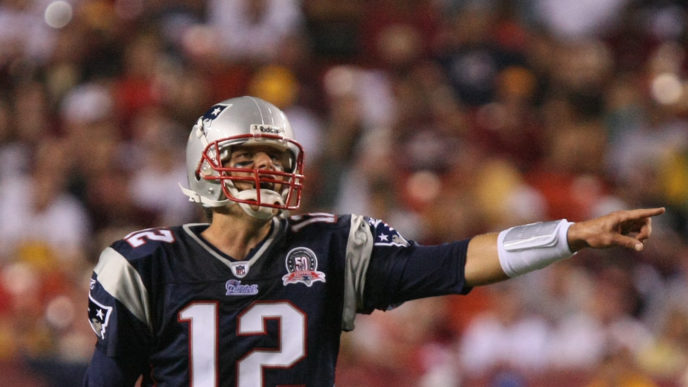
The Super Super Bowl: Patriots Pull off Biggest Super Bowl Comeback Ever!

Tom Brady has a record fifth Super Bowl win for a quarterback after the biggest comeback in the game’s history, and one of the greatest catches.

James White ran 2 yards for a touchdown on the first possession of overtime, and the Patriots came back from 25 points down for a 34-28 win over the Atlanta Falcons in Super Bowl 51.

The Patriots drove to the tying score with help from a unbelievable catch by Julian Edelman, who somehow kept the ball off the turf on a diving grab of a tipped pass that bounced off a defender’s shoe. (Read more from “The Super Super Bowl: Patriots Pull off Biggest Super Bowl Comeback Ever!” HERE)

Follow Joe Miller on Twitter HERE and Facebook HERE.