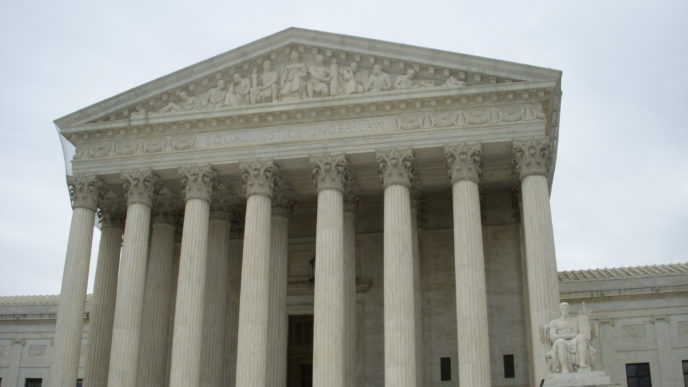
A Closer Look at Neil Gorsuch, an Excellent Choice for the Supreme Court

Tuesday night, President Donald Trump announced his nomination for the Supreme Court vacancy left by the unexpected death of Justice Antonin Scalia last February.

Trump nominated Judge Neil M. Gorsuch of the U.S. Court of Appeals for the 10th Circuit. With this nomination, Trump held to the promise he made on the campaign trail to select a nominee from a list of 21 individuals.

Gorsuch is an eminently qualified and well-respected judge with a record that demonstrates he cares about religious liberty, the separation of powers, and the original public meaning of the Constitution and the laws he interprets. He would be a fine successor to Scalia.

Now, the confirmation process begins for Gorsuch. It can be a harrowing process for a nominee and his family as senators, the media, and others dig into his past—particularly looking for scandals and juicy details that might derail the nomination.

Let’s take a closer look at Gorsuch.

Background

Born in 1967, Gorsuch sits on the Denver-based 10th Circuit Court of Appeals, which has jurisdiction over Colorado, Kansas, New Mexico, Oklahoma, Utah, and Wyoming. He received his bachelor’s degree from Columbia University, his law degree from Harvard University, and his doctorate of philosophy from Oxford University.

(Read about Neil Gosuch’s personal religious background HERE)

But Gorsuch is not the only credentialed member of his family. His mother, Anne Gorsuch Burford, served as the first female head of the Environmental Protection Agency, under President Ronald Reagan.

After serving as a law clerk to Judge David Sentelle of the U.S. Court of Appeals for the D.C. Circuit and Justices Byron White and Anthony Kennedy of the U.S. Supreme Court, Gorsuch joined a prominent D.C. law firm, where he practiced for 10 years.

He then served as principal deputy to the associate attorney general and as acting associate attorney general (the third-highest position) at the U.S. Department of Justice.

In May 2006, President George W. Bush nominated and the Senate confirmed Gorsuch to the 10th Circuit by a voice vote just two months later. His former boss, Kennedy, administered the oath of office.

Before joining the bench, Gorsuch authored “The Future of Assisted Suicide and Euthanasia” (2006), a book that, as Princeton University Press described it, “builds a nuanced, novel, and powerful moral and legal argument against legalization [of assisted suicide and euthanasia], one based on a principle that, surprisingly, has largely been overlooked in the debate—the idea that human life is intrinsically valuable and that intentional killing is always wrong.”

After joining the bench, he co-authored “The Law of Judicial Precedent” (2016) with the highly-respected legal writer Bryan Garner (who co-authored several books with Scalia) and 11 other federal appellate judges.

Gorsuch has also critiqued the left’s increasing preference to resort to the courts instead of the political process to advance its policy goals. In a 2005 op-ed, he wrote:

American liberals have become addicted to the courtroom, relying on judges and lawyers rather than elected leaders and the ballot box, as the primary means of effecting their social agenda on everything from gay marriage to assisted suicide to the use of vouchers for private-school education. This overweening addiction to the courtroom as the place to debate social policy is bad for the country and bad for the judiciary … As a society, we lose the benefit of the give-and-take of the political process and the flexibility of social experimentation that only the elected branches can provide.

Gorsuch has criticized the judicial confirmation process and decried treating would-be judges as “little more than politicians with robes.”

Approach to Judging

During the campaign, Trump pledged to nominate an individual who was “very much in the mold of” Scalia.

One recent study singled out Gorsuch as one of the top judges whose approach to interpreting the law was closest to that of Scalia’s approach. Gorsuch ranked second out of 15 judges in “Scalia-ness,” surpassed only by Utah Supreme Court Justice Thomas Lee.

When it comes to interpreting statutes and the Constitution, a Supreme Court justice must keep uppermost in mind that he did not write the text and should not attempt to rewrite that text through creative “interpretation” to mean something quite different from what was intended by its drafters, but which the justice personally considers more fair, wise, or just.

In other words, a justice should interpret the text and structure of a statute, or the Constitution, based on the original public meaning of that text at the time it was adopted, and should not, under the guise of statutory or constitutional interpretation, impose on the rest of society his own policy preferences based on his perceptions of contemporary values.

Gorsuch gives every indication that he will be just such a justice if he is confirmed by the Senate. He has demonstrated that he understands the proper, limited scope of the judicial power.

During his 10th Circuit confirmation hearing he stated, “The independence of the judiciary depends upon people in both parties being willing to serve, good people being willing to serve who are capable and willing to put aside their personal politics and preferences to decide cases and to follow the law and not try and make it.”

He has since written,

… donning a robe doesn’t make me any smarter. But the robe does mean something … It serves as a reminder of what’s expected of us—what [Edmund] Burke called the ‘cold neutrality of an impartial judge.’ It serves, too, as a reminder of the relatively modest station we’re meant to occupy in a democratic society. In other places, judges wear scarlet and ermine. Here, we’re told to buy our own plain black robes.

In a concurring opinion in 2016, Gorsuch wrote that the Constitution “isn’t some inkblot on which litigants may project their hopes and dreams … but a carefully drafted text judges are charged with applying according to its original public meaning.”

Gorsuch leaves his personal views at home. During his confirmation hearing, Sen. Lindsey Graham, R-S.C., questioned Gorsuch about how his views on assisted suicide and euthanasia would affect his judging.

Each case, Gorsuch said, deserves the “complete attention of the judge without being diverted by personal politics, policy preferences, or what you ate for breakfast.” He later added that he would “follow the law as written and not replace it with [his] own preferences, or anyone else’s.”

In a tribute to Scalia, Gorsuch wrote that “legislators may appeal to their own moral convictions and to claims about social utility to reshape the law as they think it should be in the future,” but that “judges should instead strive (if humanly and so imperfectly) to apply the law as it is, focusing backward, not forward, and looking to text, structure, and history to decide what a reasonable reader at the time of the events in question would have understood the law to be—not to decide cases based on their own moral convictions or the policy consequences they believe might serve society best.”

He quoted Scalia, saying:

If you’re going to be a good and faithful judge, you have to resign yourself to the fact that you’re not always going to like the conclusions you reach. If you like them all the time, you’re probably doing something wrong.

He also wrote that he was “an adherent to the view that outcomes (ends) do not justify methods (means).”

Notable Opinions

Gorsuch has written several notable opinions, some of which are described below, that are likely to be scrutinized during his confirmation hearing.

Gutierrez-Brizuela v. Lynch

Courts will typically defer to an administrative agency’s interpretation of an ambiguous statute if that interpretation is reasonable. Known as “Chevron deference,” this practice is controversial and often criticized by conservatives.

In 2016, Gorsuch authored a separate concurring opinion, explicitly calling Chevron deference into question. He wrote, “ … the fact is Chevron … permit[s] executive bureaucracies to swallow huge amounts of core judicial and legislative power and concentrate federal power in a way that seems more than a little difficult to square with the Constitution of the framers’ design.”

He added, “[m]aybe the time has come to face the behemoth.”

United States v. Ackerman (2016)

When an AOL filter identified what appeared to be child pornography in Walter Ackerman’s email, it forwarded the email to the National Center for Missing and Exploited Children (NCMEC) (a quasi-governmental body), which then completed an investigation and notified the police.

After being indicted by a federal grand jury for possessing and distributing child pornography, Ackerman filed suit, claiming NCMEC violated the Fourth Amendment when it searched his emails without a warrant.

Writing for the majority, Gorsuch determined that the Fourth Amendment applied to NCMEC since its “law enforcement powers extend well beyond those enjoyed by private citizens” and that NCMEC conducted a “search” within the meaning of the Fourth Amendment. The case was remanded for the district court to determine whether the search was nevertheless reasonable.

United States v. Carloss

In this 2016 case, the 10th Circuit held that police did not violate Ralph Carloss’ Fourth Amendment right to be free from unreasonable search and seizure when they walked onto his property to knock on the front door, even though there were four plainly visible “No Trespassing” signs.

Gorsuch dissented, writing that the signs revoked the officers’ implied license to walk onto the property and knock on the front door. He emphasized that under the majority’s bold view, “[a] homeowner may post as many No Trespassing signs as she wishes. She might add a wall or a medieval-style moat, too. Maybe razor wire and battlements and mantraps besides. Even that isn’t enough to revoke the state’s right to enter.”

Hobby Lobby v. Burwell

Gorsuch joined the en banc opinion in this 2013 case challenging the regulation issued pursuant to Obamacare that would force employers to pay for contraception and abortifacients as part of their employee health insurance plans—even if they had a religious objection.

The government argued that there were too many steps between the employer paying for coverage and the employee’s decision to use contraception for an employer’s free exercise of religion to be substantially burdened.

The court rejected this argument. Gorsuch concurred in the decision holding that Hobby Lobby was likely to succeed on the merits of its claim. He wrote that “it is not for secular courts to rewrite the religious complaint of a faithful adherent, or to decide whether a religious teaching about complicity imposes ‘too much’ moral disapproval on those only ‘indirectly’ assisting wrongful conduct.”

Gorsuch also joined 11 other judges in dissent when the full 10th Circuit refused to rehear Little Sisters of the Poor v. Burwell, a similar case involving religious nonprofits. The Supreme Court heard the case last term and in an unusual opinion, agreed that the government could not force employers, such as the Little Sisters of the Poor, to violate their faith.

The consolidated cases were remanded for the lower courts to reconsider the claims brought by the Little Sisters of the Poor and others that the regulations violate their religious exercise in light of the government’s admission that it could indeed provide contraceptive coverage without the Little Sisters’ collaboration.

Also in the religious liberty context, Gorsuch joined a dissent from denial of rehearing en banc in Summum v. Pleasant Grove City, a case involving whether a city could put up a privately donated Ten Commandments monument in a city park to the exclusion of another proposed monument.

The Supreme Court ultimately reversed the 10th Circuit in an opinion by Justice Samuel Alito, relying in part on the dissent. Gorsuch has also dissented from denial of rehearing en banc in two other cases, criticizing the Supreme Court’s confused Establishment Clause jurisprudence.

Planned Parenthood Association of Utah v. Herbert

After national news broke alleging Planned Parenthood harvested and illegally sold the body parts of aborted babies, Utah Gov. Gary Herbert directed state agencies to stop the flow of federal funds to Planned Parenthood in Utah.

In 2016, the 10th Circuit granted Planned Parenthood’s request for a preliminary injunction and ordered the governor to fund Planned Parenthood.

When the 10th Circuit refused to hear the case en banc, Gorsuch dissented, criticizing the panel for applying the wrong standard of review and for relaxing Planned Parenthood’s burden of proof.

The Coming Fight

Gorsuch has a record that demonstrates his fidelity to the Constitution and a proper understanding of the role of courts.

In his announcement this evening, Trump noted that Gorsuch has “outstanding legal skills, a brilliant mind, tremendous discipline, and he’s earned bipartisan support.” Gorsuch is “a man who our country needs badly to ensure the rule of law.”

While Senate Minority Leader Charles Schumer and other Senate Democrats have already announced their intention to try to filibuster any nominee, it will be a hard case for them to make given Gorsuch’s impressive record and clear commitment to the Constitution and the rule of law. (For more from the author of “A Closer Look at Neil Gorsuch, an Excellent Choice for the Supreme Court” please click HERE)

Follow Joe Miller on Twitter HERE and Facebook HERE.

Why the First US Military Raid Under Trump Was in Yemen

Decorated U.S. Navy SEAL William “Ryan” Owens was tragically killed this weekend in Yemen. The first publicly acknowledged U.S. raid under President Donald Trump did not go as smoothly as planned, though the Pentagon labelled the mission — which reportedly killed 14 militants — a success. According to Reuters, the U.S. special ops mission targeted Abdulrauf al Dhabab, a senior al Qaeda leader.

The mission hit a snag when the SEAL team’s V-22 Osprey endured a “hard landing,” injuring at least three service members. Additionally, the SEAL Team 6 crew unexpectedly faced resistance from multiple female jihadis, which vastly complicated the mission and may have resulted in the deaths of civilians caught in the crossfire. However, according to U.S. Central Command, the SEALs secured “information that will likely provide insight into the planning of future terror plots.”

So, was it all worth it? And what brought the nation’s most decorated warriors into Yemen in the first place?

The continuing destabilization of the Middle East nation has created a void filled by the world’s most dangerous terrorists, who use the state to plan missions both domestically and abroad.

Civil War

There is an ongoing civil war in Yemen that has resulted in the deaths of tens of thousands of soldiers, militants, and civilians. Much of the country has become a battleground between a Saudi-led coalition (which includes the United States) and Iran-backed Houthi insurgents. Amidst the chaos, a vacuum has been created that has allowed the local Islamic State and al Qaeda branches to flourish, leaving only the U.S. and its allies to check their vast expansion.

AQAP

Al Qaeda in the Arabian Peninsula (AQAP), which is headquartered in Yemen, is without a doubt the most dangerous al Qaeda affiliate worldwide. The group has managed to control swaths of territory in Yemen and has a global reach that extends to the United States and Europe.

AQAP, which is tasked with coordinating overseas attacks against America and its allies, was designated a Foreign Terrorist Organization by the U.S. in 2010. It has on several occasions managed to infiltrate and carry out terror plots in Western countries. The group urges recruits inside America to “strike at home,” as damaging the U.S. is their most important duty.

Many of AQAP’s devotees are inspired by the late al Qaeda cleric Anwar al-Awlaki, the deceased imam who left America after 9/11 to became the leader of the al Qaeda Yemen branch. Several U.S.-based terrorists, including the shooters at Ft. Hood and Chattanooga drew motivation from Awlaki.

The 2009 Christmas Day “Underwear Bomber” — a Nigerian native who planned on bringing down a commercial jet — carried out his orders directly from AQAP. Thankfully, he failed to detonate his explosives.

Additionally, the tragic 2015 mass killings at the “Charlie Hebdo” offices in Paris was the work of AQAP jihadis.

Islamic State-Yemen

ISIS, like AQAP, also controls territory in Yemen, under the name Wilayat Sanaa — or, the Sanaa Province (of the Islamic State). The group, which seeks to impose a worldwide caliphate under its rule, has successfully conducted massive suicide missions, which have killed hundreds and wounded countless more. Islamic State operations in Yemeni provinces are a relatively new phenomenon, but the terror outfit has shown that it can operate and plan major attacks in the country.

U.S. counterterrorism efforts

America’s counterterrorism strategy in Yemen during the Obama administration relied on drone strikes and small, specialized military raids on jihadi compounds inside the country. In 2015, a U.S. drone strike killed AQAP’s No. 2 in charge. As previously mentioned, al-Awlaki was also taken out thanks to a U.S. drone strike.

Whether the strategy has been a success is a matter of debate. Experts have pointed out that targeted killings of AQAP leaders may temporarily weaken the group, but new leaders will emerge as long as the group has a safe haven in Yemen. Therefore, U.S. officials have expanded the mission to, at times, deploy special ops on the ground for aggressive missions on AQAP strongholds.

As details unfold pertaining to the past weekend’s raid in Yemen, what’s clear is that the country has become the perfect environment to plot jihadi terror against the United States. It appears that President Trump has recognized the threat and dedicated his first mission toward helping to eradicate the menace in the Gulf. (For more from the author of “Why the First US Military Raid Under Trump Was in Yemen” please click HERE)

Follow Joe Miller on Twitter HERE and Facebook HERE.

US Intel Caught Flat-Footed AGAIN as China Successfully Tests 10 Warhead Nuclear Missile

China flight tested a new variant of a long-range missile with 10 warheads in what defense officials say represents a dramatic shift in Beijing’s strategic nuclear posture.

The flight test of the DF-5C missile was carried out earlier this month using 10 multiple independently targetable reentry vehicles, or MIRVs. The test of the inert warheads was monitored closely by U.S. intelligence agencies, said two officials familiar with reports of the missile test. . .

Estimates of China’s nuclear arsenal for decades put the number of strategic warheads at the relatively low level of around 250 warheads. . .

Uploading Chinese missiles from single or triple warhead configurations to up to 10 warheads means the number of warheads stockpiled is orders of magnitude larger than the 250 estimate. . .

The Chinese state television channel CCTV-4 last week broadcast nuclear threats, including graphics showing new DF-41 missiles deployed in northern China and graphics showing the missiles’ strike path into the United States. The Jan. 25 broadcast included a graphic of a 10-warhead MIRV bus for the DF-41. (Read more from “US Intel Caught Flat-Footed AGAIN as China Successively Tests 10 Warhead Nuclear Missile” HERE)

Follow Joe Miller on Twitter HERE and Facebook HERE.

A Few Facts About SCOTUS Pick Neil Gorsuch’s Religion

Judge Neil Gorsuch has been nominated to fill Antonin Scalia’s seat on the Supreme Court. Here are a few facts about his religious history and commitments, including positions important to religious conservatives.

1) Neil Gorsuch attended a Catholic school, the exclusive Georgetown Preparatory School, while his mother Anne served as head of the EPA under President Reagan. The school is run by the Jesuit order. He was student body president his senior year and graduated in 1985. The school makes a point of noting that it was founded the same year as the Supreme Court was established.

He studied at Oxford under the Catholic philosopher John Finnis. Finnis is one of the world’s leading Natural Law thinkers. One of Finnis’s other students, Princeton professor Robert P. George, wrote on his Facebook page that “Judge Gorsuch, whom I know well, is a faithful constitutionalist and extraordinarily well-qualified. President Trump could not have done better. Kudos to him.” Before the nomination, George had written, “He would be a superb Supreme Court justice. He is intellectually extremely gifted and is deeply committed to the (actual) Constitution and the rule of law. He will not manufacture ‘rights’ or read things into the Constitution that aren’t there or read things out of the Constitution that are.”

2) He’ll be the only Protestant on the court. He now attends St. John’s Episcopal Church in Boulder City, Colorado, where his daughters served as acolytes. The church describes itself as “an inclusive, Christ-centered community reaching out to all who are seeking a deeper spirituality and relationship with God and one another.” It has a woman pastor.

3) He opposes the legalization of euthanasia, as he wrote in his book The Future of Assisted Suicide and Euthanasia. Princeton University Press published the book in 2009. Two of the nation’s leading Catholic bioethicists, Princeton’s Robert P. George and Georgetown’s John Keown, praised it.

However, as the Southern Baptist’s Ethics and Religious Liberty Commission noted, “during his confirmation hearing [for the Tenth Circuit] he said he would follow the law rather than personal convictions, and that in his writings he has largely defended existing precedent in these areas.” As one constitutional scholar described Gorsuch’s views:

[He] believes that “any State’s decision to legalize assisted suicide would likely bring with it both benefits and some attendant costs, and, accordingly, the legalization question presents a difficult moral and legal choice.” … In his book, Gorsuch elaborates on these ideas, proposing as a guiding principle the intrinsic value of human life and arguing that “to act intentionally against life is to suggest that its value rests only on its transient instrumental usefulness for other ends.” He suggests a standard that would leave room for patient autonomy while not allowing intentional killing.

4) Gorsuch is taken to be an opponent of abortion, though he’s never written a court decision on the matter. He wrote in his book that “All human beings are intrinsically valuable and the intentional taking of human life by private persons is always wrong.” Also, “To act intentionally against life is to suggest that its value rests only on its transient instrumental usefulness for other ends.” And also:

It is simply not acceptable when we are deciding who is and is not treated as fully human…. It is incompatible with the promise of equal justice under law that any of us should feel at liberty to sit in judgement to decide who is and who is not entitled to the benefits of that promise.

In a footnote to the book, he argued that “Abortion would be ruled out by the inviolability-of-life principle I intend to set forth.” He noted that this depended on another belief. It would be true “if, and only if, a fetus is considered a human life. The Supreme Court in Roe v. Wade, however, unequivocally held that a fetus is not a ‘person’ for purposes of constitutional law.” Observers believe he would find that the fetus is a person.

His one judicial encounter with the issue came in Planned Parenthood of Utah v. Herbert. “Last October,” writes constitutional expert Ed Whelan of the Ethics and Public Policy Center, Gorsuch “dissented strenuously” when the court left standing a order keeping funds going to Planned Parenthood and over-rode the governor’s directive. “Gorsuch faulted the panel for failing to accord the appropriate degree of deference to the district court’s factual findings and for making its own bizarre inferences about the governor’s reasons for acting.”

A negative testimony to his position is NARAL’s reaction. The formerly named National Abortion Rights Action League tweeted, “We will fight hard, we will fight back, and we will #RESIST Neil Gorsuch & Trump’s extreme #antichoice agenda! #StopGorsuch”.

5) He’s an advocate of religious freedom and tolerance. He wrote in his book that “The law … doesn’t just apply to protect popular religious beliefs: it does perhaps its most important work in protecting unpopular religious beliefs, vindicating this nation’s long-held aspiration to serve as a refuge of religious tolerance.”

Gorsuch has “an especially strong record” on this subject, writes Whelan. In 2013, Gorsuch supported Hobby Lobby against the Obamacare mandate to provide conception, a decision upheld by the Supreme Court. Two years later, he supported the Little Sisters of the Poor, an organization of Catholic nuns, against similar requirements.

He “has also written or joined opinions — again, largely vindicated by the Supreme Court — that have criticized doctrines that limit religious expression in public spaces,” writes another legal scholar, Eric Citron, on the SCOTUSblog.

The common thread in these cases is one that matters very deeply to conservatives: a sense that the government can permit public displays of religion – and can accommodate deeply held religious views – without either violating the religion clauses of the Constitution or destroying the effectiveness of government programs that occasionally run into religious objections. In his 2009 concurrence in Pleasant Grove City, Utah v. Summum, Scalia articulated very similar views.

6) Gorsuch is intellectually independent. He’s willing “to rethink constitutional principles from the ground up,” says Jeffrey Rosen of the National Constitution Center, quoted by Politico. “Like Justice Scalia, he sometimes reaches results that favor liberals when he thinks the history or text of the Constitution or the law require it, especially in areas like criminal law or the rights of religious minorities, but unlike Scalia he’s less willing to defer to regulations and might be more willing to second-guess Trump’s regulatory decision.”

7) He loves his wife Louise and two daughters, Emma and Belinda. He dedicated his book to them with the words “Finally, and borrowing in part from P.G. Wodehouse, I thank my wife, Louise, and my daughters, Emma and Belinda, without whose constant love and attention this book would’ve been finished in half the time — but without whom life wouldn’t been half as fully lived.” (For more from the author of “A Few Facts About SCOTUS Pick Neil Gorsuch’s Religion” please click HERE)

Follow Joe Miller on Twitter HERE and Facebook HERE.

Le Monde Labels Breitbart Fake News as Google Bans 200 Sites from Ad Network

No one likes fake news. But that can be bad news, when liberal newspapers and websites use it as an excuse to censor conservative news sources.

Facebook, for example, announced a plan to combat fake news last month, which entails using left-leaning media and fact-checking organizations to analyze stories. Stories that are considered false will be less likely to show up in Facebook’s news feed, will contain a warning flag and will be prohibited from being promoted through an ad.

Who isn’t concerned that left-leaning Facebook users will report conservative articles as fake, left-leaning fact-checkers will rule the articles fake, and journalists who lean to the left will affirm the reports?

Snopes acknowledged that a site called USA Politics Today had only one fake news article on its entire site, which was removed, but Google still banned the site from its advertising network.

Le Monde, Google, Media Matters and Buzzfeed

Last week, the prominent French newspaper Le Monde identified 600 news sites it considers to be fake news, including the popular conservative site Breitbart, until recently led by top Trump aid Steve Bannon. Le Monde‘s fact-checking division Les Décodeurs compiled the list.

Samuel Laurent, head of Les Décodeurs, said some sites may seem normal but are dispelling misinformation on areas like abortion. “You then find out they’re run by Catholic militants,” so are heavily partisan, he said. Sites that contain negative information about Muslims were also included.

The newspaper built a downloadable browser extension that will alert readers to the “truthfulness” of stories on these 600 websites. It is also building a bot for Facebook to identify the stories. The full list has not been made public yet.

Other important sites are doing the same thing. Google decided in the fourth quarter of last year to ban fake news sites from its Google Adsense network. Adsense allows publishers to receive royalties from ads and the company said putting out misleading information violates the program’s terms of usage. The ban targeted sites which impersonate real news organizations through shortened top-level domains, such as by using .co instead of .com. Google did not issue a list of the 200 sites it banned, but at least one of them is a conservative news site.

The left-wing site Media Matters, which aggressively targets conservatives, regularly reports conservative news sites to Google as fake news sites. Media Matters identified 24 of these websites in December. They are mostly familiar conservative websites, including some fairly prominent sites like Right Wing News, Gateway Pundit and Western Journalism (disclaimer: I am a regular contributor to Right Wing News).

Last October, the left-leaning site Buzzfeed identified 30 articles on Right Wing News as fake news. John Hawkins, the owner of Right Wing News, analyzed all of the articles and concluded that 23 of the articles were accurate — but Buzzfeed would only retract three of the false labels.

Media Matters triumphantly announced on January 26 that this list had been whittled down to just over a dozen sites, but most of the sites removed from the list still appear to be a part of the Adsense network. The only site I could determine that was successfully kicked out of the network is USA Politics Today, a fairly popular conservative site. The owner of the site said Google told them the site was banned because two titles of articles on the site were misleading. One of the articles, “BREAKING: Jill Stein Just ENDORSED Donald Trump! Watch Her Obliterate Hillary!” was removed from the site, but Google would not renege. According to the left-leaning, myth-debunking site Snopes, that article was the only fake news on the entire website.

A few of the websites belonging to two notorious creators of fake news—leftists posting false stories designed to fool conservatives—were probably included in this list. Jestin Coler ran Conservative Frontline, National Report and The Denver Guardian last year. All three sites are no longer operating and are devoid of content. Paul Horner was the lead writer for National Report, and went on to start his own fake news sites, including newsexaminer.net and abcnews.com.co. Those two sites are still operating, but do not have any ads from Google Adsense.

A Dangerous Trend

The increase in organizations targeting fake news will harm conservative news sites, since they are being included. The definition of fake news has been expanded from meaning sites that purposely churn out false stories to encompass conservative news the left dislikes. The left is trying to hijack the definition of fake news. The organizations choosing to identify fake news are questionable. Since Le Monde is a news organization itself, should it really be the authority on what news is accurate? It is akin to policing itself and making the rules for the industry.

Melissa Zimdars, a media professor at Merrimack College in Massachusetts, compiled a list of fake news websites last year. A couple of the sites included are fairly popular right-leaning sites, such as Infowars and Conservative Tribune. Even more troubling, she singled out Fox News, one of the most prominent and reputable sites for conservatives, as potentially making the list. “Some sources not yet included in this list (although their practices at times may qualify them for addition), such as The Daily Kos, The Huffington Post, and Fox News, vacillate between providing important, legitimate, problematic, and/or hyperbolic news coverage, requiring readers and viewers to verify and contextualize information with other sources,” she wrote.

It is long overdue for a source on the right to compile a list of fake news sites that doesn’t include conservative news. (For more from the author of “Le Monde Labels Breitbart Fake News as Google Bans 200 Sites from Ad Network” please click HERE)

Follow Joe Miller on Twitter HERE and Facebook HERE.

Former House Freedom Caucus Chairman on Obamacare: ‘Let’s Repeal It as Quickly as We Can’

Several Republican congressmen from the House Freedom Caucus say they want a full repeal and replacement of Obamacare, despite private talk from some GOP lawmakers about a partial repeal.

Reps. Mario Diaz-Balart, R-Fla.; Mark Meadows, R-N.C.; Raul Labrador, R-Idaho; Scott Perry, R-Pa.; Mark Sanford, R-S.C.; and Jim Jordan, R-Ohio; were all present at the January meeting of Conversations with Conservatives, a monthly press Q&A hosted by conservative lawmakers and The Heritage Foundation.

When Jordan was asked how he felt about the progress Republican lawmakers had made on Obamacare, he said, “I’d like to see an acceleration of the front-end repeal side … let’s get rid of [Obamacare], that’s what we told the voters that we were going to do. Let’s repeal it as quickly as we can and let’s have the effective day be not three and four years down the road.”

The congressman from Ohio added, “health care will be better and cost less when Obamacare is gone.”

“Let’s get after it as soon as we can and repeal everything: every tax, every mandate, and most importantly, every single regulation because I believe that’s [what will be] driving down premiums and deductible costs,” concluded Jordan on the issue of an Obamacare repeal.

Perry went on to stress the importance of having an alternative health care plan at or soon after the time of repeal, saying, “I do think that the repeal and the alternative needs to happen at the same [time], or …. with[in] a week or two or something like that.”

Labrador, Perry, Sanford, and Jordan all agreed that Obamacare must be repealed, with Sanford saying, “Just in terms of the political realm, I think as a vote for conservatives, it would be very difficult for any of us, at the end of the day, to not vote yes on repeal, whether it’s concurrent or not with regard to replace.”

Talking about a replacement for Obamacare, Labrador said, “I want to make sure that we’re gonna move to a free-market plan. And I’m encouraging our leadership to take a bold position on this and move as far away from Obamacare and government-centered health care as possible.”

Jordan agreed, saying, “Ideally, we’d like a plan that’s free market-oriented, patient-oriented, doctor-oriented, community-oriented; not [as] Washington-focused as Obamacare.” (For more from the author of “Former House Freedom Caucus Chairman on Obamacare: ‘Let’s Repeal It as Quickly as We Can'” please click HERE)

Follow Joe Miller on Twitter HERE and Facebook HERE.

Acting Attorney General’s Defiance of Trump Shows Politicized Nature of DOJ

The kerfuffle on Monday night over former Deputy Attorney General Sally Yates’ statement criticizing President Donald Trump’s executive order requiring better screening of travelers from failed countries that are the biggest sources of terrorists in the world shows the difference between a Justice Department guided by politics versus the rule of law.

In the statement that Yates circulated inside the Justice Department, she said the department would not defend the executive order against the proliferation of lawsuits being filed against it because she was not “convinced” that that it was “legally defensible.”

Furthermore, she claimed that in addition to her legal responsibilities, she has an obligation to “stand for what is right” and she obviously does not believe this executive order is “right.”

But Yates is wrong.

As the deputy attorney general and acting attorney general, her obligation is to defend federal law and actions taken by the president pursuant to the law when there is a valid basis for doing so, regardless of whether or not she agrees with the president from a public policy standpoint or thinks his action is the “right” thing to do.

There is no question that the president’s executive order is eminently defensible and that he is entitled to have the Department of Justice defend it in court.

In his executive order, the president cites a provision of federal immigration law, 8 U.S.C. §1182(f), which gives him almost unlimited discretion to suspend “the entry of any aliens or of any class of aliens into the United States” if, in his judgment, their entry “would be detrimental to the interests of the United States.”

Since Congress has absolute authority under the Constitution to determine our immigration policy, its delegation to the president of this authority is perfectly constitutional.

Yates’ decision appears to have been primarily motivated by politics, not law, which, no doubt, prompted the action Trump took in firing her almost immediately.

The constitutionality and legality of the executive order is bolstered by the fact that, as even Yates was forced to acknowledge, the order was reviewed by the Justice Department’s Office of Legal Counsel, which concluded that it was “lawful on its face and properly drafted.”

It has long been the job of the Office of Legal Counsel to analyze laws passed by Congress and executive orders issued by the president to determine their constitutionality and determine whether they can be defended in the courts when they are challenged.

As its own website explains, it is Office of Legal Counsel “by delegation from the attorney general” that “provides authoritative legal advice to the president.”

So Yates’ claim that the immigration executive order is legally indefensible flies in the face of the Office of Legal Counsel’s legal opinion—which constitutes the Justice Department’s legal opinion—that the president’s executive order is, indeed, “lawful.”

As a statement released by the White House said, by her refusal to carry out her duty to defend the executive order, Yates “betrayed the Department of Justice.”

It is clear from her statement that Yates took her action because she doesn’t like the executive order as public policy. As the White House statement says, that is because she “is weak on borders and very weak on illegal immigration.”

As former Justice Department official Jack Goldsmith says, if Yates didn’t like this executive order, the proper course for her would be to resign—not tell Justice Department lawyers that they would not be allowed to defend a lawful action of the president.

There is no doubt that Yates is going to be portrayed as a martyr by progressives and the media who don’t like the executive order because she was fired. But she allowed her political views to interfere with her basic professional obligation to enforce the rule of law and to defend an executive order issued by the president that her own department had already concluded was lawfully issued.

She failed in her duty as the acting attorney general and is certainly not a martyr.

Yates has also provided the final confirmation of how politicized the Justice Department became under President Barack Obama. It is going to take a long time and a lot of work for Attorney General-designate Jeff Sessions to restore the department’s professionalism and its reputation. (For more from the author of “Acting Attorney General’s Defiance of Trump Shows Politicized Nature of DOJ” please click HERE)

Follow Joe Miller on Twitter HERE and Facebook HERE.

Newt Gingrich: Trump Is Doing Exactly What He Said He Would Do

Two weeks into his presidency, Donald Trump has been successful in fulfilling many of the promises he campaigned on, but he’s nowhere near finished, former House Speaker Newt Gingrich said.

Speaking Monday at The Heritage Foundation for the final installment in his six-part series on understanding Trump and Trumpism, Gingrich described the president as “the new presidential”—delivering on what he said he would.

Gingrich also addressed those on the left who question Trump’s legitimacy as a president.

“By definition, whatever he does is presidential, it’s just a new presidential,” he said. “So the new presidential tweets. That doesn’t mean he has to give up tweeting and start writing in longhand with a quill pen to think he’s presidential.”

Political elites and left-leaning news media refuse to understand Trump because he isn’t a politician, according to Gingrich.

“He is a business leader who became president. He never became a politician in between,” Gingrich said. “He has no interest in learning how to be a politician. He has every interest in getting things done.”

Gingrich cited Trump’s recent executive order, which will halt individuals from seven countries from entering the United States for 90 days, as yet another incident to infuriate the liberal news media.

“He’s been saying it for 10 months. You would think at some point in the 10 months they would have gone, ‘Oh, what if he actually means it?’” Gingrich said.

The news media’s reporting of the executive order, describing it as a “Muslim ban,” was a “total, dangerous lie,” Gingrich said.

“Every newspaper and every television reporter who said it should be ashamed of themselves,” he said.

According to Gingrich, the media’s irresponsible “lie” sent a signal to over a billion Muslims about something that is “totally false.”

“The largest Muslim country in the world is Indonesia; it’s not touched,” he noted. “The second-largest Muslim country, by the way, is India, it’s not touched. Go down the list.”

While the order was not flawless, Gingrich said, the left would still be outraged, regardless of the timing.

“Do any of you doubt that if he’d done this six weeks from now with prior notice that there would have been demonstrations for days leading up to it?” Gingrich asked.

Trump’s favorability and poll numbers will reflect the media’s biased coverage, Gingrich predicted.

“I guarantee you, for a while, Trump’s poll numbers will be bad. And they’ll be bad because every element of the elite media will lie about him every day.” (For more from the author of “Newt Gingrich: Trump Is Doing Exactly What He Said He Would Do” please click HERE)

Follow Joe Miller on Twitter HERE and Facebook HERE.

California to Consider Enacting Statewide Sanctuary

California may prohibit local law enforcement from cooperating with federal immigration authorities, creating a border-to-border sanctuary in the nation’s largest state as legislative Democrats ramp up their efforts to battle President Donald Trump’s migration policies.

The legislation is scheduled for its first public hearing Tuesday as the Senate rushes to enact measures that Democratic lawmakers say would protect immigrants from the crackdown that the Republican president has promised.

While many of California’s largest cities — including Los Angeles, San Francisco and Sacramento — have so-called sanctuary policies that prohibit police from cooperating with immigration authorities, much of the state does not.

The Democratic legislation, written by Senate President Pro Tem Kevin de Leon of Los Angeles, comes up for debate less than a week after Trump signed an order threatening to withdraw some federal grants from jurisdictions that bar officials from communicating with federal authorities about someone’s immigration status.

The Senate Public Safety Committee considers SB54 Tuesday morning. The Judiciary Committee will also consider fast-tracked legislation that would spend state money, in an amount that has not been disclosed, to provide lawyers for people facing deportation. (Read more from “California to Consider Enacting Statewide Sanctuary” HERE)

Follow Joe Miller on Twitter HERE and Facebook HERE.

Study: Your Life Really Does Flash Before Your Eyes at Death; ‘A Moment Is Like a Thousand Years’

Your life really does flash before your eyes when you die, a study suggests – with the parts of the brain that store memories last to be affected as other functions fail. . .

Participants said that there was rarely any order to their life memories and that they seemed to come at random, and sometimes simultaneously. . .

Those involved in the study said they lost all sense of time, with memories flying back at them from all periods of their life.

One wrote: “There is not a linear progression, there is lack of time limits… It was like being there for centuries. I was not in time/space so this question also feels impossible to answer.

“A moment, and a thousand years… both and neither. It all happened at once, or some experiences within my near-death experience were going on at the same time as others, though my human mind separates them into different events”. (Read more from “Study: Your Life Really Does Flash Before Your Eyes at Death; ‘A Moment Is Like a Thousand Years'” HERE)

Follow Joe Miller on Twitter HERE and Facebook HERE.