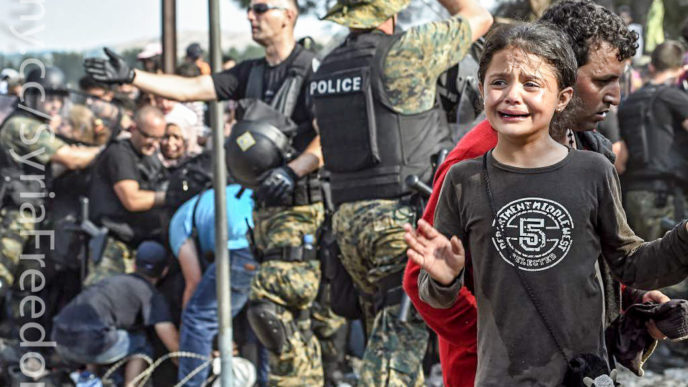
5 Things Bothering Me About the Response to Trump’s Executive Order on Refugees

Have you ever seen America so ablaze with controversy? Protests in the streets; hysteria in the news rooms; chaos and weeping at the airports; cries for impeachment among political leaders — all because of President Trump’s executive order concerning refugees.

Some have openly called for the president’s murder, drawing swift rebuke from others (the original tweet pictured below from @indiaknight has since been deleted):

tweet-1

A well-educated Christian professor in Canada has dubbed Trump an antichrist:

A progressive Christian leader argues that supporting Trump and following Jesus are incompatible:

The leftwing media elite are indignant, with the New York Times branding Trump’s order a “cowardly and dangerous” act of “unrighteousness,” with a host of others echoing similar claims.

On the flip side, rightwing sites like Breitbart feature bold headlines declaring “Terror-Tied Group CAIR [The Council on American-Islamic Relations] Causing Chaos, Promoting Protests & Lawsuits as Trump Protects Nation.”

On Twitter, I asked my followers, “Is Trump’s executive order on the refugees fundamentally unChristian, or is it being misreported by the media?”

In response, 74 percent answered “misreported by the media,” 16 percent said it was “fundamentally anti-Christian,” and 10 percent chose “Other.”

How do we sort this out?

Wading Through the Confusion

In response to the national (actually, international) outcry, President Trump issued a statement Sunday afternoon, restating the rationale behind his order and defending its particulars. In the statement he emphasized that “America is a proud nation of immigrants and we will continue to show compassion to those fleeing oppression, but we will do so while protecting our own citizens and border.” And, he stated, “To be clear, this is not a Muslim ban, as the media is falsely reporting. This is not about religion — this is about terror and keeping our country safe.”

Others, far too numerous to cite here, have disputed his words, and the din on both sides is rising in intensity by the hour. So, rather than try to sort out all the controversies surrounding the executive order, let me share five things that are bothering me about the reaction to Trump’s order.

To be clear, though, we need to separate the executive order itself from the way it was executed, which led to even more chaos, including the momentary banning of green card holders returning to the States and even the alleged detention of a newborn and an 18-month old baby, both American citizens, at Chicago’s O’Hare airport. One can be upset over the initial implementation of the order while still defending the order itself.

Here, then, is what is sticking in my craw.

1.The Left’s Outrage Seems Driven by Hatred Toward Trump

First, I have a hard time believing that suddenly, across America, countless thousands of Americans are upset that Muslim refugees from seven countries will be temporarily banned from entering our country while “extreme vetting” measures are put in place.

Muslims make up about one percent of our population, and many of the Muslims who live here are not from the countries on Trump’s list. Yet suddenly, all across the nation, Americans are outraged that Muslims from countries like Libya and Yemen will be temporarily prohibited from immigrating here.

In my opinion, while some of the outrage is legitimate, much of it is more of an expression of hatred toward Trump than an expression of solidarity with, say, Somali refugees. As to the degree that Islamic groups like CAIR are behind some of the protests, others can decide.

2. Hypocritical Concern: What About Slaughtered Christians in the Middle East?

Second, this massive, loud, national expression of compassion for Muslim refugees strikes me as quite hypocritical when we remember that there have been very few words spoken about the decades-long genocide of Middle Eastern Christians at the hands of radical Muslims. As I tweeted out Saturday night, “Where were all the protests across America as millions of Christians overseas were being slaughtered or sold into slavery or exiled?”

Yet now, we Americans are in a state of frenzy because of the temporary halt on some refugees entering our country. Something is not lining up here.

3. There’s Nothing Wrong With Prioritizing Help for Our Christian Brethren

Third, I don’t understand why some Christian leaders are upset with putting a priority on resettling Christian refugees. (I suggested prioritizing Christian refugees back in November, 2015.) This is the right thing to do scripturally and legally, for at least three reasons.

1) Christians are called to do good to all people, but especially to fellow believers (see Galatian 6:10); so, we continue to help Muslim and other refugees, but as a majority Christian country, we prioritize Christian refugees.

2) Christian refugees really are “the least of these My brethren” in the classic words of Jesus in Matthew 25:31-46, being trapped as a tiny, persecuted minority in the midst of Islamic civil wars and surrounded by Islamic countries, with very few making it to our shores. Sadly, as I noted in 2015, “A friend of mine who pastors a large church in Tennessee traveled to Jordan and spoke with Christian refugees there. Their perception was that American Christians had completely abandoned them.”

3) Legally, the issue is not one of Islamophobia but rather, to quote the executive order directly, a call “to prioritize refugee claims made by individuals on the basis of religious-based persecution, provided that the religion of the individual is a minority religion in the individual’s country of nationality.” This could apply to groups like the Yazidis too, and rightly so. (See here for talk of Safe Zones in countries like Saudi Arabia aiming at helping Muslim refugees.)

4. There is No “Muslim Ban”

Fourth, I have no tolerance for the media’s hysteria and their use of inflammatory phrases like “the Muslim ban.” As David French explained on the National Review (note that French was a well-known Never Trumper):

You can read the entire executive order from start to finish, reread it, then read it again, and you will not find a Muslim ban. It’s not there. Nowhere. At its most draconian, it temporarily halts entry from jihadist regions. In other words, Trump’s executive order is a dramatic climb-down from his worst campaign rhetoric.

Again, French is hardly a defender of Trump, writing that “the ban is deeply problematic as applied to legal residents of the U.S. and to interpreters and other allies seeking refuge in the United States after demonstrated (and courageous) service to the United States.” But he is quite correct in labeling much of the media’s reporting of the order as “false, false, false.”

Similarly, Dan McLaughlin, also posting on the National Review, penned an article titled, “Refugee Madness: Trump Is Wrong, But His Liberal Critics Are Crazy,” stating that the anger at Trump’s new policy “is seriously misplaced.”

I would go as far as saying that some major media players are being downright irresponsible, engaging in the worst type of partisan politics, possibly even endangering lives in the process. I say that because the immigration crisis is volatile enough in itself, as is the presidency of Donald Trump, and some of the media’s irresponsible and inflammatory reporting could easily provoke acts of wanton violence.

5. Evangelicals: Stop Blindly Defending Trump

Fifth and finally, I don’t understand why evangelicals who voted for Trump feel the need to defend everything he does and even how he does it (and I am one who voted for him and who at times has defended him). Not only does this give further fuel to the fire of those critics who claim that we are hurting our Christian witness by supporting him, but it eliminates our high calling to be the president’s “loyal opposition” at times (a phrase used by biblical scholar Yochanan Muffs regarding Israel’s prophets). If we truly care for and support the president, we should demonstrate that by lovingly opposing him when we feel he has done wrong.

In this case, I’m not saying that he has acted wrongly (although, as is self-evident, the implementation of his order was terribly messy and unnecessarily confusing). I’m saying that we can’t simply have a gut level reaction of defending the president against all criticism, even if, in some (many?) cases, he is being unjustly accused.

Let’s put our faith before our politics, lest we make the mistake the religious right made in generations past and become an appendage of the Republican Party.

That said, if you know how to pray, now’s a good time to put those prayers to work. We desperately need God’s gracious intervention to heal our broken land. (For more from the author of “5 Things Bothering Me About the Response to Trump’s Executive Order on Refugees” please click HERE)

Follow Joe Miller on Twitter HERE and Facebook HERE.

What Republican Lawmakers Say About Trump’s Order on Refugees

Republicans in Congress had mixed reactions in the immediate wake of President Donald Trump’s executive order Friday stopping individuals from seven countries where Islamist terrorists operate from entering the country for 90 days.

Some GOP lawmakers, such as Sens. Ben Sasse, R-Neb., and Marco Rubio, R-Fla., expressed concerns about who the order targeted and how it was implemented—but without the force of Democrats’ widespread opposition. The order also temporarily halts entry of refugees.

“The president is right to focus attention on the obvious fact that borders matter,” Sasse said in a statement issued Saturday. “At the same time, while not technically a Muslim ban, this order is too broad.”

Rubio and Sen. Tim Scott, R-S.C., released a joint statement Sunday, saying they support vetting those who want to enter the country, but have qualms.

“After reviewing the recent executive orders, it is clear to us that some of what is being said and reported about the scope and implications of these measures is misleading,” Rubio and Scott said. “However, it is also clear that the manner in which these measures were crafted and implemented have greatly contributed to the confusion, anxiety, and uncertainty of the last few days.”

Rep. Dave Brat, R-Va., is one conservative lawmaker who supports Trump’s action.

“If you follow the facts and the figures, you get a much different story than what the press is talking about,” Brat said in a phone interview with The Daily Signal. Brat said the executive order is a “short-run vetting of migrants from seven countries that were chosen by the Obama administration and by intelligence officials because these seven countries are known to fund and train and export terror.”

Countries affected by the temporary travel ban are Iran, Iraq, Syria, Libya, Somalia, Sudan, and Yemen.

Trump’s executive order also indefinitely pauses the entry of Syrian refugees into the United States, a practice his predecessor, Barack Obama, had accelerated.

In 2015, Obama also imposed restrictions on people who had visited Iran, Iraq, Sudan, or Syria on or after March 1, 2011, as CNN and others reported.

The Obama administration later added Libya, Somalia, and Yemen to the list to address what it called “the growing threat from foreign terrorist fighters,” CNN reported.

Brat said that although some object to Trump’s executive order and argue that individuals from these countries have not committed acts of terror, the executive order is well warranted.

Intelligence officials support further review of individuals traveling from the seven countries, the Virginia Republican said.

“Go ask the intelligence officers if there’s been funding streamed to terrorist groups from these countries, if there’s been training and folks coming in and out of those counties, and they’re actually making their way here hoping to spread terror. And the answer will be a 100 percent yes,” Brat said.

Rep. Jim Jordan, R-Ohio, said the executive order is Trump’s way of making good on his campaign promises.

“[Trump] campaigned on this, he ran on this, and now he is getting to implement this,” Jordan said in an interview Monday morning with Bob Frantz, host of the radio show “The Answer” on WHK-AM, a Cleveland radio station.

Jordan, former chairman of the House Freedom Caucus, said he does not anticipate the order to provoke more violence from terrorists, and that Trump’s move “makes sense.” He said:

This idea that somehow this will make the terrorists mad, my guess is they’re already mad based on what they’ve done to our country, what they’ve done around the world. So let’s focus on common sense. … If you’re going to let [citizens of those nations] in here, you need to make sure that you have thoroughly checked them out and that they are not part of some sort of terrorist organization. I think that makes sense. Let’s make sure we do it right.

Sen. Johnny Isakson, R-Ga., also said Trump is keeping campaign promises, but acknowledged that the order could have been executed more seamlessly.

“President Trump and his administration have been taking steps to fulfill his campaign promises,” Isakson said in a statement provided to The Daily Signal, “and he’s right that we need to strengthen our national security and improve the vetting process for people coming into our country.”

While the intentions were good, Isakson said, the administration should make sure the order doesn’t hurt “law-abiding Americans.”

“I hope that President Trump will consult with the national security team he has assembled with the advice and consent of the Senate, so that security measures are properly implemented and do not infringe on the constitutional rights of law-abiding Americans,” Isakson said.

Rep. Mark Walker, R-N.C., chairman of the Republican Study Committee, said the executive order is “to ensure the safety of every American” but must be tempered with compassion. He voiced support for Trump’s move to “slow things down.”

“We have always been a compassionate nation, and will continue to be a beacon of hope and freedom for the world,” Walker said in a statement provided to The Daily Signal, adding:

The refugee resettlement program is important in keeping with that tradition. But, we also have an obligation to ensure the safety of every American. Top national security officials have admitted that the government is unable to fully vet refugees. We need to slow things down and examine the flaws in the system so that it can be strengthened.

Walker said the Trump administration should, however, quickly clarify any ambiguities.

“The language of the order should not apply to legal, permanent residents of the United States, and if it is being enforced in any other way, the administration should step in swiftly to clarify,” Walker said.

Rep. Louie Gohmert, R-Texas, said in a prepared statement Monday that Trump is using the powers vested in him by Congress and the Constitution.

“The president is acting temporarily and prudently to give his administration and Congress the much-needed time to properly evaluate the refugee program and reform it to ensure that it both helps legitimate refugees and ensures the safety of the American people,” Gohmert said.

Trump’s order is not bias, Gohmert said, but a constitutional vehicle to protect Americans.

“With this president’s action to pause refugee admissions, not based on their religion but on whether there is adequate information to determine if they are a threat, he is constitutionally acting to protect Americans,” Gohmert said.

For other Republican lawmakers, however, the executive order has become a point of contention with the newly inaugurated president.

Sens. John McCain, R-Ariz., and Lindsey Graham, R-S.C., released a joint statement Sunday saying the order could become counterproductive in the fight against terrorism.

“It is clear from the confusion at our airports across the nation that President Trump’s executive order was not properly vetted,” McCain and Graham said. “We are particularly concerned by reports that this order went into effect with little to no consultation with the departments of State, Defense, Justice, and Homeland Security.”

Unlike McCain and Graham, Rep. Ken Buck, R-Colo., said the temporary ban is justified and necessary.

“America welcomes Muslims from 190 countries and temporarily bans all individuals from seven countries,” Buck said in a statement provided to The Daily Signal. “The president’s executive order is a temporary effort that addresses a serious issue with terrorist hot spots.” (For more from the author of “What Republican Lawmakers Say About Trump’s Order on Refugees” please click HERE)

Follow Joe Miller on Twitter HERE and Facebook HERE.

Trump Likely to Name 1 of These 2 Judges to Supreme Court

President Donald Trump returns to prime time Tuesday for the biggest announcement of his presidency so far. He will reveal at 8 p.m. EST his pick for the Supreme Court, widely reported to be one of two federal appeals court judges—Neil Gorsuch or Thomas Hardiman.

Some reports suggest two other appeals court judges, William Pryor and Diane Sykes, still could be in contention.

However, neither of those judges won unanimous confirmation to their current posts. The Senate confirmed Gorsuch by a voice vote in July 2006 and confirmed Hardiman 95-0 in March 2007.

170130_GorsuchHardiman

Unanimous confirmation for past judgeships, however, isn’t likely to prevent Senate Minority Leader Charles Schumer, D-N.Y., from trying to block the nominee, said Carrie Severino, chief counsel for the Judicial Crisis Network.

“It will be hard to say the nominee is out of the mainstream if Schumer has already voted for him,” Severino told The Daily Signal. “But Trump could renominate Merrick Garland and the Democrats would reflexively block it.”

Some Democrats already have threatened to filibuster Trump’s nominee, whoever he or she is.

President Barack Obama nominated Garland, chief judge of the Circuit Court of Appeals for the District of Columbia, to fill the vacancy left after the Feb. 13 death of Justice Antonin Scalia. Senate Republicans refused to advance the nomination in an election year.

It’s not likely Trump will have a high court nominee approved by April, when the Supreme Court probably will hear its last set of cases for the year, said Curt Levey, president of the Committee for Justice.

“With [Supreme Court Justices] Sonia Sotomayor and Elena Kagan, it took about three months,” Levey told The Daily Signal. “I supported stopping the Garland nomination, but the one thing Republicans can’t do is hurry this, or act as if filling the vacancy is urgent. I don’t think the Democrats can filibuster, but they will have to play to their base’s anger over Garland.”

Gorsuch ultimately has a more in-depth history of writing with regard to constitutional rights, separation of powers, and the role of judges, said John Malcolm, director of the Edwin Meese III Center for Legal and Judicial Studies at The Heritage Foundation.

“It will still be a fight, but not be as much of a knock-down, drag-out fight as if [Trump] had chosen Bill Pryor,” Malcolm told The Daily Signal. “Both would be superb Supreme Court justices, and I hope either gets confirmed.”

Here’s a look at the record of Trump’s potential nominees:

Backgrounds

Gorsuch, 49, was appointed by President George W. Bush as a judge on the Court of Appeals for the 10th Circuit in Colorado.

Before that, Gorsuch was a deputy assistant attorney general at the Justice Department. The Harvard Law School graduate clerked for both current Supreme Court Justice Anthony Kennedy and former Justice Byron White.

Bush appointed Hardiman to the Court of Appeals for the 3rd Circuit in Pennsylvania. That’s the same court that Trump’s sister, Judge Maryanne Trump Barry, serves on.

Hardiman, 51, previously was a federal district judge for the Western District of Pennsylvania, a position confirmed by a voice vote of the Senate in October 2003. He received his law degree at Georgetown University.

On Gun Ownership

A Judicial Crisis Network brief noted Gorsuch’s decision in the case of United States v. Games-Perez, where the appeals judge wrote that “there is a long tradition of widespread gun ownership by private individuals in this country.” He added: “The Supreme Court has held the Second Amendment protects an individual’s right to own firearms and may not be infringed lightly.”

For his part, Hardiman rejected a challenge to a law barring felons from owning firearms.

But Hardiman generally has been strong on the Second Amendment.

In the case of Drake v. Filko, Hardiman wrote the dissenting opinion in a ruling upholding a New Jersey law requiring residents have a “justifiable need” to obtain a permit to carry a gun. Citing Supreme Court decisions upholding the Second Amendment, he wrote: “States may not seek to reduce the danger by curtailing the right itself.”

On Religious Freedom

Gorsuch ruled in two major religious liberty cases that came before the 10th Circuit challenging the Obamacare mandate that employers pay for birth control and abortion-inducing drugs for employees, siding with Hobby Lobby and the Little Sisters of the Poor in the two cases.

In a lower-profile case, Yellowbear v. Lampert, Gorsuch ruled in favor of an inmate who said prison officials denied his religious freedom by not accommodating his Native American faith.

In one case, Hardiman wrote the dissenting opinion in favor of a mother and her kindergartener son, who was prohibited from using the Bible as part of a show and tell at school. He wrote that the prohibition “plainly constituted” discrimination based on the family’s viewpoint.

On Free Speech

Gorsuch issued a decision against a Colorado campaign finance law, determining that it unconstitutionally permitted major party donors to make two contributions per election cycle, while limiting minor party candidates to receive just one donation per election cycle. There is “something distinct, different, and more problematic afoot,” he wrote, “when the government selectively infringes on a fundamental right.”

Hardiman ruled against a student’s right to wear a bracelet that said “I [heart] boobies” during a breast cancer awareness campaign at his middle school. He described the case as “close,” but said it “would seem to fall into a gray area between speech that is plainly lewd and merely indecorous.”

In the case of NAACP v. City of Philadelphia, Hardiman ruled that Philadelphia’s ban on noncommercial advertisements at the city’s airport violated free speech rights.

Concerning campaign finance, Hardiman wrote the opinion striking down a Philadelphia law that barred police officers from contributing to the police union’s political action committee. (For more from the author of “Trump Likely to Name 1 of These 2 Judges to Supreme Court” please click HERE)

Follow Joe Miller on Twitter HERE and Facebook HERE.
Globalist Koch Brothers Attack Trump’s Islamic Refugee Ban

By Solange Reyner. An official representing the Koch brothers on Sunday called Donald Trump’s refugee and travel ban “counterproductive.”

“We believe it is possible to keep Americans safe without excluding people who wish to come here to contribute and pursue a better life for their families,” said Brian Hooks, co-chairman of the Koch network. “The travel ban is the wrong approach and will likely be counterproductive . . .

Trump on Friday signed an executive order banning travelers from seven majority-Muslim countries associated with terrorism from entering the country for 90 days. The countries are Iraq, Syria, Iran, Sudan, Libya, Somalia and Yemen. (Read more from “Globalist Koch Brothers Attack Trump’s Islamic Refugee Ban” HERE)

_________________________________________

Gingrich Criticizes Roll-Out of Trump Refugee Plan

By Cathy Burke. A rocky rollout of President Donald Trump’s ban on travelers from seven Muslim-majority nations is making the first test of the new administration’s immigration policy look like an “off-Broadway” performance, according to Newt Gingrich.

In comments to the Washington Post, President Trump’s informal adviser and former House Speaker weighed in on the reported conflict within the administration about the executive order that has triggered widespread protests.

“The problem they’ve got is this is an off-Broadway performance of a show that is now the No. 1 hit on Broadway,” Gingrich told the newspaper.

According to the Post, another area of heated debate within the administration is over the Deferred Action for Childhood Arrivals program, which grants legal protection to illegal immigrants brought to the United States as children. (Read more from “Gingrich Criticizes Roll-Out of Trump Refugee Plan” HERE)

Follow Joe Miller on Twitter HERE and Facebook HERE.

Experts Debate Whether Trump’s Refugee Order Will Make America Safer

With an executive order signed Friday, President Donald Trump delivered on his campaign promise to impose a restrictive U.S. policy toward refugee resettlement and other forms of legal immigration.

By preventing Syrian refugees from entering the U.S. indefinitely, imposing a 120-day suspension on all refugee admissions from anywhere in the world, and temporarily blocking visas from seven Muslim-majority countries, Trump took a different approach than his predecessor with a stated aim to keep extremists out of America.

While some security experts welcome the orders as a short-term way to evaluate and improve U.S. vetting procedures, others worry that limiting American assistance to the most vulnerable of immigrants is detrimental to the fight against terrorism.

“It’s a good short-term measure that allows us to take a step back and look more holistically at immigration and refugee policy, but this is by no means a long-term fix and it would undermine our interests and values if this becomes the new norm,” said Andrew Bowen, a visiting scholar at the American Enterprise Institute, in an interview with The Daily Signal.

Throughout his campaign, Trump targeted the U.S. refugee resettlement program, arguing the government’s vetting system needed to be tougher, especially for Syrians fleeing war and attempting to come to the U.S. His executive order calls for “extreme vetting” of refugees.

The U.S. admitted 84,995 refugees in fiscal year 2016, the most since 1999. The total included more than 12,000 Syrians, making them the second-largest origin group.

“We are establishing new vetting measures to keep radical Islamic terrorists out of the United States,” Trump said Friday at the Pentagon during a ceremony for James Mattis, the new defense secretary. “We want to make sure we aren’t admitting to our country the threats our soldiers are fighting overseas. We only want to admit those to our country who will support our country and love deeply our people.”

Trump’s predecessor, President Barack Obama, countered that the current vetting process for refugees is the most stringent screening for any category of legal immigrant. The process for Syrians has additional layers, and can take up to two years.

There is no known case of a Syrian refugee being involved in a terror plot in the U.S.

“The people who come to the U.S. from Syria are not walking over borders like in Europe,” said Robert Ford, a former ambassador to Syria in the Obama administration who is currently a senior fellow at the Middle East Institute and Yale University.

“They are not taking trains without passports and visas,” Ford told The Daily Signal in an interview. “They are getting on airplanes and screened ahead of time. The public perception that these Syrian refugees are like illegal immigrants sneaking across the border does not pertain to America. We have an ocean between the U.S. and Middle East. There is a whole level of control. I am not saying it’s perfect, but compared to other security risks, it’s manageable.”

But in recent congressional testimony, critics note, FBI Director James Comey said Syrian refugees are particularly hard to screen because the war-torn country has few criminal terrorist and criminal databases to check.

“If we don’t know much about somebody, there won’t be anything in our data,” Comey said, although he assured the screening process has “improved dramatically” over time. “I can’t sit here and offer anybody an absolute assurance that there’s no risk associated with this.”

What the Order Does

Trump’s order imposes an immediate 90-day pause to the legal admission of people seeking visas—for business, family reasons, humanitarian emergencies, or tourism—from Iraq, Iran, Sudan, Libya, Somalia, Yemen, and Syria.

The refugee resettlement program is shut down for four months, and when it returns, Trump proposes to cut the maximum number of refugees allowed into the U.S. in fiscal 2017 from 110,000—as Obama proposed—to 50,000. In 2011 and 2012, Obama admitted less than 60,000 refugees, before ramping up the numbers in recent years.

In addition, once the Trump administration eases restrictions on visas and the refugee program, the government will prioritize those claiming religious persecution, “provided that the religion of the individual is a minority religion in the individual’s country of nationality.” Some observers say this means Trump will prioritize Christian refugees over Muslim ones, but the president is fighting that characterization.

According to the Pew Research Center, the U.S. admitted almost as many Christian refugees (37,521) as Muslim refugees (38,901) in the 2016 fiscal year.

A relatively small number of Syrian Christians have been admitted. Pew reports that about one-half of 1 percent of the refugees admitted in calendar year 2016 from Syria are Christian, even though they make up about 5 percent of the Syrian population.

“To be clear, this is not a Muslim ban, as the media is falsely reporting,” Trump said in a statement Sunday night. “This is not about religion—this is about terror and keeping our country safe. There are over 40 different countries worldwide that are majority Muslim that are not affected by this order.”

Even so, Ford, the former U.S. ambassador to Syria, said blocking immigration from certain Muslim-majority nations legitimizes ISIS’ propaganda that aims to turn Muslims against the West.

“On the one hand, the Trump administration is talking about eradicating radical Islam,” Ford said.

“He is promising a hard-fisted military approach. On the other hand, measures like this will paint the American administration as at best indifferent, and more likely, hostile, to Sunni Muslims in places like Syria and Iraq who feel like they are already under attack. That will fuel jihadi recruitment, whether from individuals living in bombed out cities in Syria or in Lebanon refugee camps.”

‘Improved US Security’

Edward Alden, a senior fellow at the Council on Foreign Relations, told The Daily Signal that since 9/11, the U.S. has implemented enhanced security procedures to a degree that European countries have not.

Today, visa applicants from overseas are fingerprinted and photographed to check their identities against terrorist databases.

The government is better able to ensure identity by intercepting phony passports and inadequate identification, Alden said. It created a comprehensive database of people across the world with known or suspected terrorist history, and it targets people with suspicious travel or other patterns, such as how they communicate and who they are communicating with, including internet conversations.

Alden said information-sharing among allies is the most important factor underlying these security procedures, and he worries Trump’s executive order will harm that effort.

“One of the most important elements in the improved U.S. security we have seen since 9/11 is intelligence cooperation from allied governments and cooperation in particular from moderate Muslims in the United States, and around the world,” said Alden, who is author of “The Closing of the American Border: Terrorism, Immigration, and Security Since 9/11.”

“By targeting a handful of Muslim countries in this fashion, and targeting the most vulnerable segment of this population, this will undermine our ability to solicit cooperation.”

In his executive order, Trump expresses concerns over information-sharing, and threatens to withhold visas from countries deemed insufficiently cooperative.

The president directs the relevant Cabinet agencies to review the vetting process for citizens of all countries where visas are required to travel to the U.S.

If those nations don’t improve their cooperation, they will be added to the list of countries whose citizens are barred from entry to the U.S.

Alden notes that because visa programs are supposed to be reciprocal, many of the affected countries could decide to respond to Trump’s aggressive approach by restricting American travelers.

Already, leaders in Iran and Iraq, two of the countries targeted by Trump’s order, vowed to take retaliatory action against the U.S.

‘Preparing’ for Life After ISIS

James Carafano, a national security expert at The Heritage Foundation, disagrees with this characterization and says that prudency is necessary at a time when the U.S.-led military coalition is making major gains against ISIS in Iraq and Syria.

“What the Trump administration is doing is taking a perfectly practical measure preparing for the time when ISIS is defeated in the Middle East and all those foreign fighters in the region will outflow, potentially targeting the United States,” said Carafano, who was on the Trump transition team. “Trump got elected to look at these things and get ahead of the threat by making sure the American people are adequately protected.”

Ford, and Bowen of the American Enterprise Institute, acknowledge the foreign fighter risk, but they consider the list of targeted nations to be flawed.

The list does not include Muslim-majority countries like Saudi Arabia, where most of the 9/11 hijackers were from. The other hijackers were from United Arab Emirates, Egypt, and Lebanon, none of which are on Trump’s list.

“That list could have been put together better,” Bowen said. “It’s a bit haphazard in that countries like Saudi Arabia and Tunisia, and even European countries like Germany, France, and Belgium, have individuals fighting in Syria and Iraq. If you are going to take this action, individuals from those countries should also be strongly vetted.”

The targeted countries do share common traits.

The U.S.-led military coalition is conducting airstrikes against terrorists in five of the seven targeted countries: Iraq, Syria, Libya, Yemen, and Somalia.

The U.S. government considers three of those countries to be sponsors of terrorism (Iran, Sudan, and Syria), and the Obama administration designated the others as countries of concern (Libya, Somalia, Iraq, and Yemen).

Of 161 people charged with jihadist terrorism-related crimes or who died before being charged, 11 were identified as being from Syria, Iraq, Iran, Libya, Yemen, Sudan, or Somalia—the countries specified in Trump’s order—The Wall Street Journal reported.

Experts note that in recent jihadist terrorist attacks, from San Bernardino to Orlando, American citizens or green card holders have been the perpetrators.

“The biggest threat to our nation is not someone coming from across the border with a visa or as a refugee,” said Mustafa Tameez, who has worked as a consultant for the Department of Homeland Security and State Department on counterterrorism issues. “The threat is from homegrown terrorists, someone who is radicalized over the internet and latches on to ISIS’ message that Islam is incompatible with Western democracy,” Tameez told The Daily Signal in an interview.

The Trump administration has adjusted the refugee policy since its rollout was heavily criticized.

On Sunday night, it said that green card holders would be exempt from the new policy. And the Pentagon reported Monday that it is compiling a list of Iraqis who have aided the U.S. military to determine if they should be exempted from Trump’s order.

“The executive order is not a policy,” said Mark Krikorian, the executive director of the Center for Immigration Studies, in an interview with The Daily Signal. “It’s just hitting the pause button so we can see what policy changes we need to make America safer. That’s what people aren’t getting. This isn’t the end point.” (For more from the author of “Experts Debate Whether Trump’s Refugee Order Will Make America Safer” please click HERE)

Follow Joe Miller on Twitter HERE and Facebook HERE.

Putin’s Russia in Biggest Arctic Military Push Since Soviet Fall

The nuclear icebreaker Lenin, the pride and joy of the Soviet Union’s Arctic great game, lies at perpetual anchor in the frigid water here. A relic of the Cold War, it is now a museum.

But nearly three decades after the Lenin was taken out of service to be turned into a visitor attraction, Russia is again on the march in the Arctic and building new nuclear icebreakers.

It is part of a push to firm Moscow’s hand in the High North as it vies for dominance with traditional rivals Canada, the United States, and Norway as well as newcomer China.

Interviews with officials and military analysts and reviews of government documents show Russia’s build-up is the biggest since the 1991 Soviet fall and will, in some areas, give Moscow more military capabilities than the Soviet Union once had.

The expansion has far-reaching financial and geopolitical ramifications. The Arctic is estimated to hold more hydrocarbon reserves than Saudi Arabia and Moscow is putting down a serious military marker. (Read more from “Putin’s Russia in Biggest Arctic Military Push Since Soviet Fall” HERE)

Follow Joe Miller on Twitter HERE and Facebook HERE.

Muslim Prayer Erupts During Protest at DFW Airport

By Associated Press. Demonstrators have gathered at Dallas-Fort Worth International Airport to protest President Donald Trump’s travel ban barring citizens of seven predominantly Muslim nations from entry into the U.S.

An estimated 200 people held signs and chanted “Let them go!” as they awaited word Sunday on what state representatives for the Council on American-Islamic Relations say are nine people detained at the airport.

(Read more from “Muslim Prayer Erupts During Protest at DFW Airport” HERE)

_____________________________________

Chaos as Pro-Muslim Refugee Protests Erupt at LAX

By Brenda Gazzar and Cynthia Washicko. Throngs of passionate protesters marched, waved signs and staged a sit-in Sunday at Los Angeles International Airport, demanding President Donald Trump lift his executive order affecting refugees as well as certain nationals from seven Muslim-majority countries.

Chanting “Say it loud, say it clear, refugees are welcome here” and “Let them in,” the protesters gathered first at the Tom Bradley International Terminal but then marched around the lower Central Terminal Area, forcing rolling closures of some lanes of traffic.

Flight operations were unaffected and no arrests were made, airport officials said. However, traffic was gridlocked at times trying to get into and out of the airport.

Among the thousands of protesters at the airport was Matthew Pagoaga, 32, of Highland Park, who held a sign adorned with an image of the “Star Wars” character Yoda that read “Fear leads to Anger, Anger leads to Hate, Hate leads to Suffering.”

“There’s never been anything so atrocious in our political system, discriminating against whole groups of people based on religion,” he said. “We can’t protect ourselves by hating other people.” (Read more from “Chaos as Pro-Muslim Refugee Protests Erupt at LAX” HERE)

Follow Joe Miller on Twitter HERE and Facebook HERE.
It Took Just One Week for the NY Times to Blame Trump for ‘Deaths Around the World’

Polemic New York Times columnist Nicholas Kristof reached a new level of outrageous this week with “President Trump’s War on Women Begins,” claiming President Donald Trump will be responsible for “deaths around the globe” after reinstating the “Mexico City policy.” The policy, which prohibits federal tax dollars from going to international organizations that perform or support abortion services, is usually reinstated during Republican administrations.

Kristof believes that Trump upholding his pro-life campaign promises as president is either a deception or “the measure of his delusion.” Because, in Kristof’s mind, it’s logically impossible and inhumane to believe in the pro-life message otherwise. In the leftist columnist’s eyes, the reinstatement of the Mexico City policy is Trump’s “most horrific chicanery.”

Of all the faux pas and unsubstantiated statements from Trump, Nicholas Kristoff thinks that his move to ban taxpayer dollars from paying for the contraception and abortions for women overseas is the worst.

Why? Because we are “increasing the number of abortions and dying women,” and “the victims invariably are among the most voiceless, powerless people in the world.”

There are two problems with Kristoff’s thinking. First, it’s fallacious to think that it’s Americans’ obligation to fund abortion-supporting organization to prevent more, future/hypothetical abortions. Kristoff has written that he “find[s] abortion a difficult issue, because a fetus seems much more than a lump of tissue but considerably less than a human being. Most of us are deeply uncomfortable with abortion, especially in the third trimesters, but we still don’t equate it with murder.”

But many, many Americans do think abortion is morally wrong, because it’s the taking of a life. And even if a fetus doesn’t seem as human as a spry 25-year-old, that doesn’t mean a fetus doesn’t have all the trappings of a human being — it’s just in a particular stage of growth.

So is it just to take the tax dollars of the many Americans who morally object to fund overseas abortions? Especially when even a pro-abortion liberal like Kristof finds the morality of abortion “difficult”? Is it ever morally acceptable to knowingly aid in the killing of a human life in order to prevent an unknown and hypothetical? No.

Second, the voiceless victims Kristof thinks will be hardest hit by the Mexico City policy reinstatement are the women losing access to abortion services. But what about all the unborn children whose lives come to a brutal end in the womb? They are very literally voiceless victims. No mention of them, though, in Kristof’s polemic.

Kristof finishes his piece by calling on all the protesters at the Women’s March last weekend to keep marching, because “it’s about the lives of women and girls.”

Please, Nicholas Kristof, think about all the girls who never got the chance to live because they were murdered in the womb. (For more from the author of “It Took Just One Week for the NY Times to Blame Trump for ‘Deaths Around the World'” please click HERE)

Follow Joe Miller on Twitter HERE and Facebook HERE.
Yes, America, the March for Life Is Still Relevant 44 Years After Roe v. Wade

Of the hundreds of babies callously murdered over the course of years in a flea-bitten torture chamber in west Philadelphia, only seven – identified only by letters of the alphabet – made it to the courtroom.

Alongside their evidence was that of slain Karnamaya Mongar, a 41-year-old refugee from Bhutan, who had died in the same filthy “health clinic” run by mass-murderer and late-term abortionist Kermit Gosnell.

While Washington, D.C., just hosted its 44th March for Life on Friday, those still confused or on the fence about the cause for which so many turn up in the annual pilgrimage might want to turn their attention to “Gosnell: The Untold Story of America’s Most Prolific Serial Killer” from Regnery Publishing, a new book by documentarians Phelim McAleer and Ann McElhinney about these atrocities and Gosnell’s criminal trial that followed.

This the latest product of an investigative project that began with a 2014 crowdfunding campaign to raise money for a movie about Gosnell. The film, which will feature Dean Cain as Detective James Woods, is currently seeking a distributor.

The filmmakers recently told The Christian Post that the reason they opted for both a book and film was that some of the material was far too gruesome for the screen.

“After we decided to make the movie we went to Philadelphia and started interviewing people, and we bought the trial transcripts and started going through them,” McElhinney told CP’s Brandon Showalter. “But we thought, people didn’t know them. And the stories should still be told.”

And the stories are brutal.

Page after page, the story delves into excruciating and heart-rending detail about the horrors woman and child alike endured at Gosnell’s macabre hellhole.

One section of the book outlines in a painful, rhythmic list what befell each of the seven babies for whose murders Gosnell was charged. Per The Daily Signal:

Baby boy A was born and murdered on the same day – July 12, 2008. He was so large, even in a clinic where late abortions were not unusual, that two clinic employees snapped pictures of him on their cell phones …

Baby E was the baby that cried – the one that [one employee] said “sounded like a little alien …”

After baby F jerked its leg to its chest, Gosnell cut its neck with scissors.

Baby G breathed. Gosnell snipped its neck.

The stories go on, each more devastating and horrific than the last, outlining decades of ghoulish gore on unsuspecting women and their helpless, innocent children.

But yet, all of this, all of it … ALL OF IT … went ignored by government authorities for years thanks in large part to the pro-abortion politics of officials like former Pennsylvania Governor Tom Ridge and others.

In the process of writing the book, the atrocities McAleer and McElhinney uncovered actually converted the latter to the pro-life cause, she explains at The Daily Signal.

“I never trusted or liked pro-life activists,” McElhinney writes. “Even at college I thought them too earnest and too religious. I thought the shocking images they showed were manipulative.”

“Reading the testimony and sifting through the evidence in the case in the research for this book and for writing the script of the movie has been brutal. I have wept at my computer. I have said the Our Father sitting at my desk,” she adds. “I am no holy roller—I hadn’t prayed in years—but at times when I was confronted with the worst of this story I didn’t know what else to do.”

For those still confused about why so many people would drive or fly across the country to walk in the cold, rain, and/or snow year after year, this is why. You can attribute malice and misogyny; you can rail against some Marxist concept of a “patriarchy” or old-world theocracy. But none of this is correct.

The people who marched Friday, who come to the National Mall every January are out there for babies A through G — for the women harmed and scarred by the yet uncovered Kermit Gosnells out there. And yes, they’re out there for the children who may had their lives snuffed out more sterile environments, but had them snuffed out nonetheless.

They are why we march. (For more from the author of “Yes, America, the March for Life Is Still Relevant 44 Years After Roe v. Wade” please click HERE)

Follow Joe Miller on Twitter HERE and Facebook HERE.
Let’s Be Real: Obama ‘Barred’ Syrian Christian Refugees

President Trump said he’s righting a wrong in ordering his administration to prioritize refugee applications from Christian minorities in Muslim countries Friday, but critics are declaring the move unfair and “un-American.” Let’s look at what the numbers have to say about the way Christian refugees were treated under President Obama.

The country admitted about the same number of Christian refugees as Muslim refugees in Fiscal Year 2016, according to Pew Research Center figures cited by The New York Times in an effort to refute Trump’s statement. About 38,000 Christian refugees were admitted compared to about 39,000 Muslims.

But this figure is a sum total of refugees worldwide, when Trump was clearly referring to specific Christian minority populations in the Middle East. The way it’s deployed in The New York Times report is incredibly misleading and entirely misses the point.

Previous administrations made it “almost impossible” for Syrian Christian refugees to gain admission, Trump told the Christian Broadcasting Network Friday, although they were “horribly treated” in their country.

“If you were a Muslim you could come in, but if you were a Christian, it was almost impossible,” he said. “I thought it was very, very unfair. So we are going to help them.” (Read more from “Let’s Be Real: Obama ‘Barred’ Syrian Christian Refugees” HERE)

Follow Joe Miller on Twitter HERE and Facebook HERE.