Trump Says He Regrets Remarks That ‘Caused Personal Pain’

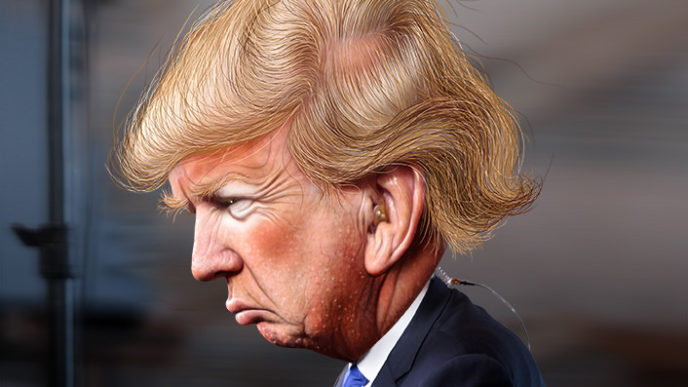
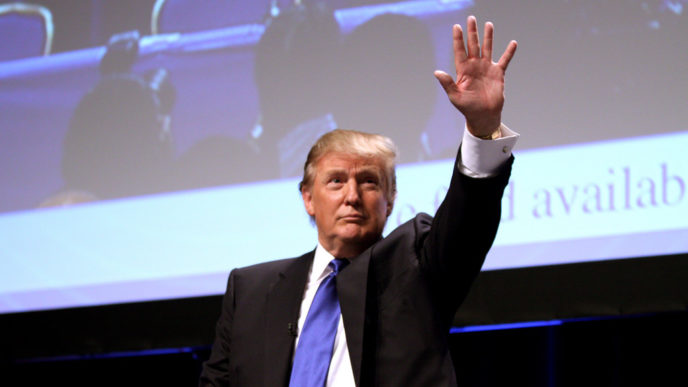
For the first time since declaring his presidential run, Republican Donald Trump acknowledged that his caustic comments may have caused people pain, saying that he regrets some of what he’s said “in the heat of debate.”

A day after announcing a campaign shake-up and as he trails in the polls, the GOP nominee said that he recognized that his comments — which have angered minorities and alienated large swaths of the general election electorate — may have been ill-advised.

“Sometimes in the heat of debate and speaking on a multitude of issues, you don’t choose the right words or you say the wrong thing. I have done that,” the GOP nominee, reading from prepared text, said at a rally in Charlotte, N.C. “And believe it or not, I regret it — and I do regret it — particularly where it may have caused personal pain.” (Read more from “Trump Says He Regrets Remarks That ‘Caused Personal Pain'” HERE)

Follow Joe Miller on Twitter HERE and Facebook HERE.

Hillary Blames Colin Powell for Her Email Scandal

Why did Hillary Clinton use a personal email account with a private server in her home to traffic in state secrets and classified information?

That’s what the FBI wanted to know during its investigation.

Her story to the FBI, according to notes turned over the Congress this week, was that former Secretary of State Colin Powell advised her to do so.

But that, too, was a fib.

It seems another email from 2009 recovered by the FBI reveals she had already decided to use a private email account when she asked Powell about his own practices, the New York Times reports today. (Read more from “Hillary Blames Colin Powell for Her Email Scandal” HERE)

Follow Joe Miller on Twitter HERE and Facebook HERE.
Voter Fraud Suspected in Alaska – Again

LT. GOV. BYRON MALLOT HAS SOME EXPLAINING TO DO

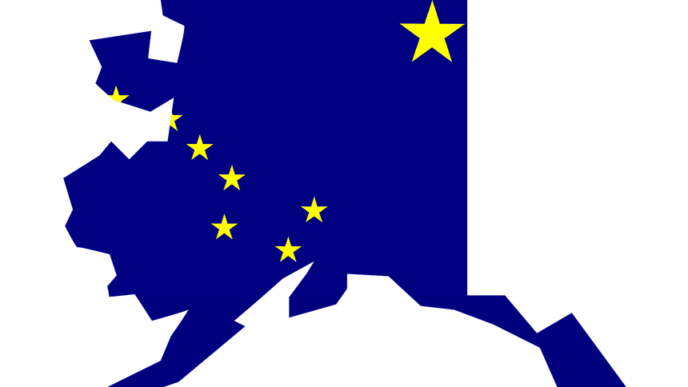
On election night, all results in Alaska were slow to be posted. But the results from District 40 were the slowest to arrive. In fact, they never did arrive that night after the polls closed at 8 pm. This was the first time since pre-internet days that election observers can remember such delays.

Election watchers monitoring the postings by the Division of Elections were scanning the website for updates, to no avail.

There were precincts missing and it was too close to call. At one point Ben Nageak was up by 30 votes, and then he was down by just 5.

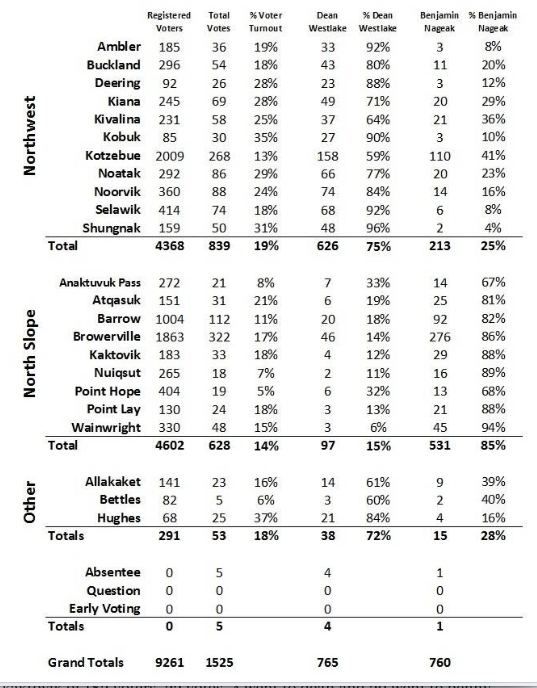
The three villages missing were Shungnak, Kaktovik, and Point Hope.

Because it’s the North Slope, one can expect things to be a bit slower. But 22 hours late in reporting results from a village? That’s dog-sled speed. And this was a summer day.

SHUNGNAK DID NOT REPORT UNTIL ALL OTHER VOTES WERE IN

What is unusual about the Shungnak reporting is that it came in well after all the other results were posted, and the votes went 48 for Dean Westlake, and 2 for Ben Nageak.

Westlake has been heavily favored by the Alaska Democratic Party over their incumbent Nageak, also a Democrat. Vast sums of money, including a big fundraiser by the Alaska Governor Bill Walker’s surrogate Robin Brena, have poured into the Westlake race.

The governor wants to get rid of Nageak, because he caucuses with the bipartisan majority that the governor does not control.

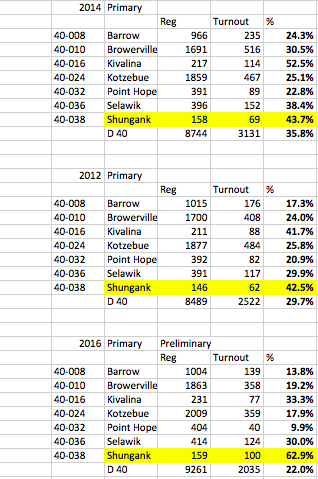
SHUNGNAK TURNOUT: 62.9 PERCENT

Even more unusual is that the voter turnout in Shungnak was nearly 63 percent, with the turnout for Democrats nearly 30 percent, making it either the most civic-minded community in Alaska…or perhaps there’s another explanation.

Shungnak has 159 registered voters, with 46 of them registered Democrats, 17 registered Republicans, and the rest fall into the “variety pack” categories. Fully 100 Shungnak voters actually cast a ballot.

It took 22 hours for the Shungnak results to be reported, leading observers to wonder if someone had withheld the ballots until all the others were reported.

As of this writing, Rep. Ben Nageak is trailing behind challenger Dean Westlake, with just five votes separating them. Districtwide, Westlake has 765 votes to Nageak’s 760 for the District 40 House seat.

We’re not ready to call this race, but if there was ever an example of how every vote counts, this is it. It also may be an example of voter fraud.

REPUBLICAN VOTERS WERE DISCOURAGED BY ELECTION WORKERS

Yesterday, Must Read Alaska received reports that for registered Republicans in District 40, voting was not a civic breeze. They tell us that election workers told them that if they wanted to vote the Democrats’ ballot, where Westlake and Nageak faced off, their ballot would be put into the “questioned ballot” stack.

Our sources are reporting that there are at least 40 of these questioned ballots in Barrow.

All of this raises questions about ballot custody, ballot security, and a possibly rigged election.

As for the other two villages that reported late, they are:

Kaktovik, where of the 33 votes, 4 went to Dean Westlake and 29 went to Benjamin Nageak. (The result is not surprising because this is Nageak’s hometown.)

Point Hope, where of the 19 votes, 6 went to Westlake and 13 went to Nageak.

Here’s a snapshot of the District 40 results:

Screen-Shot-2016-08-18-at-11.31.49-AM

HISTORIC RESULTS: LOTS OF VOTING IN SHUNGNAK

An analysis of voter history in Shungnak shows that they know how to turn out the vote.

Screen-Shot-2016-08-18-at-1.58.10-PM

ONE THEORY: BOTH BALLOTS

If 100 actually people voted, we see that 50 voters in Shungnak picked the Republican ballot, and 50 picked the Democratic ballot, according to the precinct results. In every other village in that region, the breakdown was much more weighted toward the Democratic ballot.

With a total of 100 cards cast, it appears that the election officials allowed 50 voters to vote two ballots — both the Democratic and Republican ballots.

For example, they could vote for Lisa Murkowski for Senate on one ballot, and Cean Stevens on the other. But only one of those ballots had the Westlake-Nageak matchup on it, which is why there are only 50 votes recorded for that race.

Not only does Shungnak have an extraordinarily high turnout, but the numbers simply don’t add up. (For more from the author of “Voter Fraud Suspected in Alaska – Again” please click HERE)

Follow Joe Miller on Twitter HERE and Facebook HERE.

EPA Defies Law Requiring Verdict on Whether Biofuels Work

Environmental Protection Agency (EPA) officials are ignoring a federal law requiring them to report to Congress and the public whether biofuels are helping or harming the environment, a government watchdog reported Thursday.

The Renewable Fuel Standard (RFS) program “is a national policy that requires a certain volume of renewable fuel, also known as biofuel, to replace or reduce the quantity of petroleum-based transportation fuel,” EPA inspector general (IG) official Jim Kohler said in a podcast.

“It was created with the intent to reduce greenhouse gas emissions and expand the nation’s renewable fuels sector while reducing reliance on imported oil,” said Kohler, who is an environmental engineer. But the EPA never completed studies that would show whether biofuels are actually reducing greenhouse gases or otherwise helping the environment.

Forgoing these reports “impedes EPA’s ability to identify, consider, mitigate and make policymakers aware of any adverse impacts of biofuels,” Kohler said. “EPA, Congress and other stakeholders lack key information on biofuel impacts needed to make science-based decisions about RFS and U.S. biofuel policy.”

The required reporting “provides for an objective analysis on the environmental impacts and unintended consequences of U.S. biofuel policy. This analysis is important, given conflicting scientific opinions about biofuel impacts, potential impacts outside of the EPA’s regulatory control, and divergent RFS interests.” (Read more from “EPA Defies Law Requiring Verdict on Whether Biofuels Work” HERE)

Follow Joe Miller on Twitter HERE and Facebook HERE.
College Professors Admit Affirmative Action Is Failing Students, Get Called Racist

Professors at Smith College in Northampton, Mass. are being denounced as white supremacists after private messages were leaked in which they claim affirmative action sets up students for academic failure at the school.

The controversy in question concerns two letters sent by faculty in Smith’s School for Social Work to school administrators. Although the letters were initially private, they were leaked to students at the school by an unknown person, who said they wished to reveal the “violent, racist rhetoric directed toward students of color on the Smith campus.”

The first letter, sent by professor Dennis Miehls, warns that the school was failing in its “gatekeeper” function by admitting too many academically unprepared applicants.

“Why do you, as administrators, continue to offer differential outcomes to students of color, in spite of overwhelming data that demonstrates that many of our students, including white-identified students, cannot offer clients a social work intervention that is based upon competence, skills and ethics,” Miehls said in his letter. Miehls went so far as to call the admissions process “tainted” because of how willing it was to admit unprepared non-white students.

A separate letter, signed only “Concerned Adjuncts,” isn’t as explicit about race, but voices similar concerns that lowered standards for certain groups were setting them up for failure. (Read more from “College Professors Admit Affirmative Action Is Failing Students, Get Called Racist” HERE)

Follow Joe Miller on Twitter HERE and Facebook HERE.
Critics: Scientists Blowing Smoke on ‘Chemtrail’ Study

New scientific data claiming to prove once and for all that “chemtrails” left in the sky by commercial jetliners are mere water vapor is not convincing those who believe something more nefarious is at work in the skies overhead.

Nearly 17 percent of people in an international survey said they believed the existence of a secret government program to spray harmful contaminants into the atmosphere from airplanes. They call them “chemtrails” or ‘”covert geoengineering,” and many websites show purported evidence of widespread chemical spraying linked to harmful impacts on human health and the environment.

The charges led to the first peer-reviewed study published on the subject, and a panel of 77 scientists found they are not the result of governments covertly conducting experiments on the public, WND reported earlier this week . . .

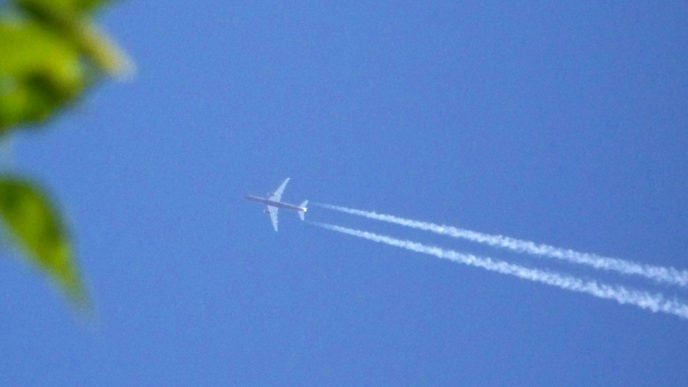
Rather than “chemtrails,” say the researchers, they are actually “contrails,” which is short for condensation that produces water vapor that freezes around aerosols in the aircraft exhaust.

The scientists said they didn’t expect their research to convince the “diehards” who believe in government “conspiracies” but rather sought to provide data for those who hadn’t formed an opinion on the issue. (Read more from “Critics: Scientists Blowing Smoke on ‘Chemtrail’ Study” HERE)

Follow Joe Miller on Twitter HERE and Facebook HERE.
Confirmed: Obama Lied About Paying Ransom to Iran for Hostages!

Breaking news from the Associated Press indicates that the State Department has confirmed the $400 million cash payment to Iran was in-fact contingent on the release of American hostages.

The Obama administration had previously claimed that a $400 million cash payment made to Iran in January was unrelated to the release of American hostages in Iran.

President Obama held a press conference earlier this month in which he explicitly denied paying ransom for hostages.

But this new report raises the question, why did Obama lie? (For more from the author of “Confirmed: Obama Lied About Paying Ransom to Iran for Hostages!” please click HERE)

Follow Joe Miller on Twitter HERE and Facebook HERE.

Trump’s New Campaign Manager Pushed the GOP to Support Amnesty

This week, Donald Trump rolled out his campaign team v3.0. While being very careful to say Putin ally Paul Manafort was keeping his position as campaign chairman, Trump rolled out two new senior hires. Breitbart Chairman Steve Bannon, and pollster Kellyanne Conway. Both bring some baggage to the campaign that may make Trump supporters’ heads turn. Of the two, Conway’s stance on immigration is the larger concern.

For Trump and his supporters, Goldman Sachs has been a favorite target throughout the campaign. The attacks reached a fevered pitch when focused against Sen. Ted Cruz’s wife, Heidi, who used to work at the company. With his hire of Bannon, Trump has turned over the running of his campaign to a former Goldman Sachs banker.

Conway’s past work strikes further to the heart of Trump’s campaign, though. After the Gang of Eight amnesty bill was passed in the US Senate and sent to the House of Representatives, there was a strong push by lobbyists to get the House to act on the legislation. A strong part of that push was lobbying by Facebook founder Mark Zuckerberg’s pro-amnesty group FWD.us. Conway was part of that effort, as CNN reports.

Kellyanne Conway, who was named Trump’s campaign manager Wednesday morning, co-authored a 2014 polling memo for the pro-immigration group FWD.us touting the benefits of a sweeping overhaul bill that would have created a 13-year pathway to citizenship for roughly 11 million undocumented immigrants.

The memo, which was signed by Conway and 15 other GOP pollsters, argued that “most Americans don’t believe deportation is a viable policy” and that there is an “overwhelming consensus” for “some kind of legalization” for people in the United States illegally. The pollsters made the case that there is “broad support” for the bill that Trump now strongly opposes but Hillary Clinton supports.

“Supporting this new immigration reform proposal should be good electoral politics for Republicans,” the memo said.

While conservatives, like Sen. Cruz, R-Texas (A, 97%) and Sen. Jeff Sessions, R-Ala. (C, 78%), were fighting against amnesty for illegals and the Gang of Eight bill, Trump’s new campaign manager was siding with the “masters of the universe” and pushing amnesty. The “key takeaways” of Conway and her colleagues were meant to make it easier for House members to squish on the issue of amnesty.

Conway’s position in 2014 is evocative of Trump’s in 2013. During the debate over the Gang of Eight legislation, Trump told a gathering of DREAMers, per NBC Latino, that they had convinced him to support amnesty for the children of illegal immigrants. This is a position he purportedly no longer holds.

In 2013, Trump also offered support for amnesty after the border was secured, which was the position of those pushing the Gang of Eight legislation.

Trump’s new campaign manager ran cover for the big corporations and establishment pushing on amnesty for illegal immigration. It makes one wonder what Trump supporters think of that. (For more from the author of “Trump’s New Campaign Manager Pushed the GOP to Support Amnesty” please click HERE)

Follow Joe Miller on Twitter HERE and Facebook HERE.
TOP 6 HILLARY EMAILS WE’VE YET TO SEE: Strangely, the Obama Administration is Stonewalling Them

The Washington Examiner’s Sarah Westwood offers an intriguing list of Clinton scandal emails that have yet to be released:

#6: Bill Clinton’s speech schedules: “The State Department has stonewalled a pair of FOIA requests for schedules related to the highly-paid speeches Bill Clinton delivered while his wife served as secretary of state … But the agency is arguing that Bill Clinton’s activities are not subject to disclosure because he was a private citizen during Hillary Clinton’s State Department tenure, even though his activities had enough relevance to her team that they regularly ended up in official inboxes.”

#5: Hillary Clinton’s meeting schedules: “In its FOIA lawsuit, the Associated Press demanded all of Hillary Clinton’s planning material after a review of the schedules initially provided to the news outlet found dozens of donor meetings that were omitted from her official calendar.”

#4: Trans-Pacific Partnership correspondence: “…the State Department has moved to conceal the records of her correspondence about TPP until late November — just weeks after the presidential election… As secretary of state, Hillary Clinton referred to the nascent agreement as the “gold standard” of trade deals before disavowing that support years later while on the campaign trail.”

#3: Deleted emails: “FBI Director James Comey testified in early July that his agents had recovered thousands of work-related emails from Hillary Clinton’s server that the former secretary of state did not not provide in 2014, when she said she provided all official communications.”

#2: Huma Abedin’s emails: “Hillary Clinton faced fresh scrutiny of her interactions with contributors to the Clinton Foundation last week when Judicial Watch released emails provided to the State Department by Huma Abedin, Hillary Clinton’s former deputy chief of staff… For example, the emails made public last week revealed a series of instances in which Clinton Foundation donors sought favors from or an audience with Hillary Clinton’s team in the early months of her time in office.”

#1: FBI investigative files: “Comey accused Hillary Clinton and her aides of engaging in “extremely careless” communications that involved classified material. Notes and testimony from his investigation could pose further problems for the former secretary of state as she tries to characterize questions about the probe as asked and answered.”

Only the most ignorant of partisan ideologues could possibly believe that Hillary’s private email server, her illegally deleted emails, her mishandling of classified information, and her serial lies about the entire matter were anything but an attempt to cover up criminal activity. (For more from the author of “TOP 6 HILLARY EMAILS WE’VE YET TO SEE: Strangely, the Obama Administration is Stonewalling Them” please click HERE)

Follow Joe Miller on Twitter HERE and Facebook HERE.
Security Officials Consider National Hacking of Voting Machines Extremely Unlikely. Here’s Why.

(Editor’s note: although presented with incontrovertible evidence, one of the so-called experts quoted in this article ignored the wide-spread fraud in Alaska’s 2010 Senate election where thousands of ballots were fraudulently submitted to the state’s Division of Elections. With the news today of even more Alaskan fraud, we should read the below conclusions with a very skeptical eye.)

Successful computer hacks at major federal agencies, large corporations, and the Democratic National Committee have sparked concern that clever infiltrators from outside the country might attempt to tinker with the 2016 election results.

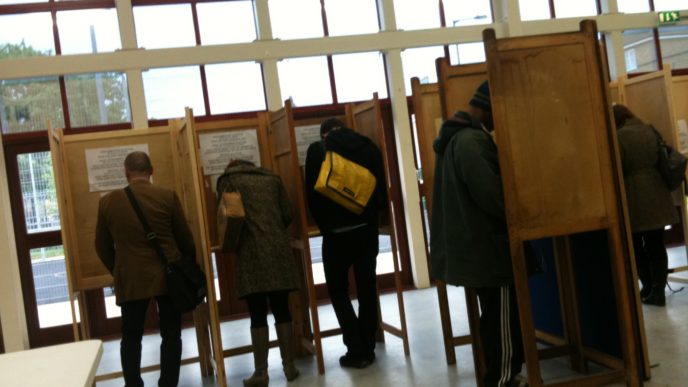
The Department of Homeland Security asserts there is no credible cyberthreat to the 2016 election results, and state election officials and other experts concur that a grand scale hack is extremely unlikely—at least on a national level.

“Recent high-profile hackings and concerns about the integrity of the vote have been on the front page more than once,” Connecticut Secretary of the State Denise Merrill said in a press conference Wednesday.

Merrill, also president of the National Association of Secretaries of State, added:

It’s highly improbable at best that a national election could be hacked. First of all, there is no national system of elections. Our election system is extremely decentralized, It is run [individually] by all 50 states and within those states, the counties are really responsible.

There was a strong push for internet voting, Merrill said, but that’s not something elections officials around the country found prudent.

“We had pressure to do internet voting, then something happens like Target getting hacked, and people say that’s not such a good idea.”

The absence of a national hack threat doesn’t mean zero risk. CBS News reported on a $15 magnetic device, available online, that can be used on individual electronic voting machines. Someone who is knowledgeable could insert the card, reset the machine, and vote more than once.

Hans von Spakovsky, a senior legal fellow at The Heritage Foundation who studies election issues, noted that even at a single polling place, none of the machines are networked. Thus, the scale of the threat is likely less than other voting fraud activities.

“The threat of hacking is greatly exaggerated,” von Spakovsky told The Daily Signal in an interview. “It could be a problem with individual voting machines, but individual electronic voting machines are not part of any national network.”

Nevertheless, lawmakers and commentators raise the possibility, particularly after allegations that the Russian Federal Security Service was behind the hacking of the Democratic National Committee and the Democratic Congressional Campaign Committee in what Sen. Tom Carper, D-Del., said might be an attempt to try to manipulate the U.S. election.

“If these reports are accurate, such an intrusion raises concerns about the ability of foreign actors to interfere in the American political process during the upcoming election, including through cyber attacks targeting electronic voting machines or the information technology of state and local election officials,” Carper, ranking member of the Senate Homeland Security and Governmental Affairs Committee, said in an Aug. 8 letter to Homeland Security Secretary Jeh Johnson.

Carper’s letter noted that in 2004 the U.S. Computer Emergency Readiness Team identified vulnerabilities in voting machines that “would allow malicious actors to modify vote totals.”

And, he wrote, the Argonne National Laboratory in Illinois in 2011 and the Virginia State Board of Elections in 2015 issued reports that “identified issues that left certain electronic voting machines vulnerable to physical or wireless intrusion without detection.”

Carper also said the CIA found that bad actors were attempting to manipulate election outcomes in other countries.

Johnson hosted a conference call Monday with the National Association of Secretaries of State, offering assistance from his department as well as from the Justice Department and the Commerce Department’s National Institute for Standards and Technology (NIST).

In a readout of the call, homeland security officials said:

While DHS is not aware of any specific or credible cybersecurity threats relating to the upcoming general election systems, Secretary Johnson reiterated that DHS, the Election Assistance Commission, NIST, and DOJ are available to offer support and assistance in protecting against cyberattacks.

Johnson told the state election officials that homeland security officials would consider designating voting machines as “critical infrastructure,” a national protection category given to 16 sectors including energy, emergency services, and food supply that the nation depends on to function. The readout added:

As part of the ongoing effort, the secretary also announced that DHS is convening a Voting Infrastructure Cybersecurity Action Campaign with experts from all levels of government and the private sector to raise awareness of cybersecurity risks potentially affecting voting infrastructure and promote the security and resilience of the electoral process.

In a statement Aug. 5, the National Association of Secretaries of State insisted a major hacking effort is extremely unlikely, but that officials should make other efforts to protect the aging electronic machines.

“A national hacking of the election is highly improbable due to our unique, decentralized process,” a statement by the association said. “Each state and locality conducts its own system of voting, complete with standards and security requirements for equipment and software. Most states publicly conduct logic and accuracy testing of their machines prior to the election to ensure that they are working and tabulating properly, then they are sealed until Election Day to prevent tampering. Furthermore, electronic voting machines are not internet-based and do not connect to each other online.”

Still, voices on both the right and the left raised concerns.

The conservative editorial board of Investor’s Business Daily called hacking “a very realistic concern, one that has been raised for years, and if it were to happen, it could have a huge impact, since around 4 in 10 voters will be casting ballots using electronic voting machines this year.”

The editorial added: “The real risk isn’t that Russians or some other foreign government will hack our elections. It’s that homegrown partisan hackers will do so to affect the results in key districts or states.”

Changing results isn’t the only goal for a cyberattack, Lawrence Norden, deputy director of the democracy program at the left-leaning Brennan Center for Justice, wrote in an op-ed for NBC News:

The threats to the integrity of our elections go beyond potential hacks to change the vote count on polling place machines. Attackers could attempt a ‘denial of service’ attack, where machines simply crash more often. In those cases, voters could be forced to wait in line for hours while technicians work to fix machines or replace them. Many would give up and never vote. Alternatively, the systems could be attacked after voting is complete, when results from individual machines are tallied at a central location.

(For more from the author of “Security Officials Consider National Hacking of Voting Machines Extremely Unlikely. Here’s Why.” please click HERE)

Follow Joe Miller on Twitter HERE and Facebook HERE.