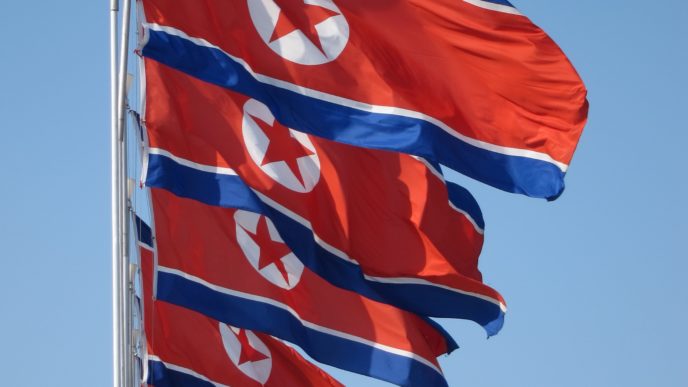
Trump Warns North Korea: ‘Gotta Behave’

A day after a failed North Korean missile test, U.S. President Donald Trump had a message Monday for the North’s ruler: ‘Gotta behave.” At the same time, Vice President Mike Pence warned at the Korean Demilitarized Zone that America’s “era of strategic patience is over.”

Keeping up the verbal volleying, North Korea’s deputy U.N. ambassador accused the United States of turning the Korean peninsula into “the world’s biggest hotspot” and creating “a dangerous situation in which a thermonuclear war may break out at any moment.”

Pence’s visit to the tense DMZ dividing North and South Korea came at the start of a 10-day trip to Asia and underscored U.S. commitment. It allowed the vice president to gaze at North Korean soldiers afar and stare directly across a border marked by razor wire. (Read more from “Trump Warns North Korea: ‘Gotta Behave'” HERE)

Follow Joe Miller on Twitter HERE and Facebook HERE.

Easter and Syrian Genocide: What Americans Can Learn

As Christians in America commemorate Easter, we are reminded of those who celebrate Jesus’ resurrection in places hostile to Christianity. Consider the Middle East Christians facing genocide. In an interview with The Stream, Knights of Columbus spokesperson Andrew Walther suggests there is much we can gain from the strength of those brothers and sisters in the Lord.

A Source of Inspiration

Last year then-Secretary of State John Kerry labeled the mass killing of Christians in the Middle East genocide. Still they remain strong in their faith, said Walther, spokesperson for the Catholic group Knights of Columbus (KoC). “They face the brunt of genocide,” but they’re still hanging on, he said. He added that their strength in the face of hardship and genocide should be a source of inspiration for Christians in the U.S.

They are optimistic about the new Trump administration, too. “I’ve been told by Iraqi Christians [that] they see a new openness in the past few months on the part of the U.S. government. They hope it translates into action,” said Walther.

Most Syrian Christians are still displaced, often in smaller camps that don’t get attention from organizations and governments on hand to help. “Christians don’t end up on the radar,” said Walther. But they’ve seen many Christian areas liberated. Some people are moving home. Just the fact that people are moving back is a good sign, said Walther. “It’s a first step, there’s still a long way to go.” He added that despite the problems in the area, there is a palpable optimism that things will get better.

The Cradle of the Church

In Iraq, the Christian population is down 80 percent since 2003. And in Syria, the Christian population is down about 60 percent since their civil war began in 2011. This is troubling for many reasons, but for Walther it goes back to St. Paul and his conversion. “The Syrian Christians weren’t converted by St. Paul,” he explains. “They baptized St. Paul. The idea that this [group] could disappear should be alarming.” He added that the roots of Christianity could disappear from the cradle of the Church. However, his organization is working hard to make sure that doesn’t happen.

Knights of Columbus

The Knights of Columbus has operated in the area since mid-2014 when ISIS really began taking over the territory. Walther said the KoC provide help through medical clinics, food, housing, catecheses programs among others. Just last month, the KoC pledged nearly $2 million to help the Syrian and Iraqi Christian refugees. The KoC use a variety of ways to help the people survive and rebuild.

But the assistance isn’t just for Christians, he is quick to point out. “Our clinics we fund and programs can’t turn anyone away,” he said, adding that it is a remarkable witness to non-Christians in the area who are served by Christian organizations.

Going On With Their Lives

Walther said he’d really like Americans to learn about the Christians in the area and how they’ve been persecuted for centuries. He also wants people to know that Syrian Christians “really want to go on with their lives, to go home and be full citizens in their country. They don’t want to be second-class citizens or discriminated against.” Much like the Western world, they’d like to celebrate Easter with family and contemplate Jesus’ gift to them of salvation without fear of persecution. But their faith has kept them strong, said Walther.

The Stream asked “What can Americans do?” Americans can pray for their brothers and sisters in the Middle East, said Walther, and help when possible through financial or other means. He adds that their strength in the face of genocide is an incredible testimony for American Christians and non-Christians alike. (For more from the author of “Easter and Syrian Genocide: What Americans Can Learn” please click HERE)

Follow Joe Miller on Twitter HERE and Facebook HERE.

The Possible Upsides of Korea Crisis

Not only is the current showdown with North Korea unlikely to lead to a military conflict, it is likely that all the countries involved will walk away believing they have achieved something for their side. In fact, it could be the perfect storm of crisis diplomacy that’s a win-win for everybody—for now.

Pyongyang gets the world’s attention. Kim family diplomacy requires that the world see its regime as a dangerous, unpredictable menace. Otherwise, why would anybody care to deal with the world’s poorest nation at the far end of the planet?

Usually the annual military parade gets no more attention than a joke on the late-night shows. This time around, Kim Jong Un’s half-serious salute got worldwide coverage. The question for Kim is how to parlay fear-mongering into some kind of strategic advantage.

Seoul and Tokyo got a big reassurance of commitment from Washington, as the U.S. rushed to show both that we’d honor our obligations to mutual defense. Nothing says we care like an armada of ships and a fleet of nuclear-capable bombers.

Beijing used the crisis to establish a rapport with the new U.S. president. Rather than stiff-arm President Donald Trump or play rope-a-dope, President Xi Jinping adopted a let’s make-a-deal attitude.

Washington got to look strong, too. In a little over a week, Trump met with top foreign leaders, including Xi, dealt with the situation in Korea, and handled a crisis in Syria. For a fledgling administration led by a president with little foreign policy chops, that was a damn decent performance.

That Trump navigated through the crisis, so far, so well is a hopeful indicator that he will deliver a mature and responsible foreign policy. Indeed, signs point in that direction.

By giving all the players involved enough space to save face, Washington helped defuse rather than escalate the crisis.

The question is: Where do we go from here?

Getting through the day without starting World War III doesn’t solve the threat of a nuclear-armed North Korea. The White House needs a sustained responsible policy. The Chinese are not going to solve the problem. Kim is never going to voluntarily give up his nukes.

Just talking will get us nowhere. What is needed is a serious long-term plan that might create future opportunities for de-escalation, something Heritage Foundation expert Bruce Klingner was pressing for even before the crisis started.

The good news is that Trump has weathered the challenge so far. The administration is following the right playbook: maximum pressure but not regime change.

But there is more to be done.

For sure, the U.S. needs to send clearer signals that it is not planning to ratchet up tensions.

While the announced part of the next-step policy seems good, the sanctions portion, including enforcing existing U.S. law, might well be put on hold pending action by China. It’s a problem that China always underperforms on its promises. Trump should not wait long for Beijing to deliver before really turning up the heat on sanctions. (For more from the author of “The Possible Upsides of Korea Crisis” please click HERE)

Follow Joe Miller on Twitter HERE and Facebook HERE.

No Refuge on Good Friday: Palestinian Stabs Young Christian Woman to Death in Israel

A 23-year-old Christian tourist was stabbed to death by a Palestinian man as Christians gathered to celebrate Good Friday, ABC News reports. The attack comes as Christians around the world commemorate the day Jesus Christ was crucified and died, rising from the dead three days later on Easter — the highest Christian holy day.

The attack took place on a tram close to the Old City, where tourists from around the world have come to commemorate Easter and Passover. The woman died shortly after she was brought to a medical facility, despite efforts to save her. The 57-year old Palestinian attacker was apprehended by police.

Local media quoted witnesses as saying the man stabbed the woman multiple times. Reports said a pregnant woman was injured when the light rail came to a sudden stop. The attacker was apprehended by officers at the scene, police said.

Reports indicate two others were injured as well.

According to ABC News, Palestinians have killed 42 Israelis and two visiting Americans since September 2015. The Palestinian Authority regularly incites violence and acts of terror against Christians and Jews in Israel.

Governments around the world are taking steps to prevent attacks by radical Islamic terrorists over the Easter holiday. Authorities in Kosovo claim they have already intercepted plans for such an attack. (For more from the author of “No Refuge on Good Friday: Palestinian Stabs Young Christian Woman to Death in Israel” please click HERE)

Follow Joe Miller on Twitter HERE and Facebook HERE.

Rising Tensions on Korean Peninsula Put Region at Risk

When Secretary of Defense James Mattis and Secretary of State Rex Tillerson traveled to Asia earlier this year, the principle objective was to reassure allies that the Trump administration would maintain the U.S. commitment to defend them.

Vice President Mike Pence will now reaffirm that message during his own trip, which comes amid increased fears of an imminent preemptive U.S. attack on North Korea in expectation of a possible nuclear test and/or missile launch.

Pence should explain to our allies the results of the administration’s recently completed North Korea policy review, as well as the results of the U.S.-China summit.

Indications are that the White House will prioritize restrengthening the U.S. military to offset degradations in capabilities incurred from budget cuts over the last several years. Deterrence and defense will also be increased through augmented ballistic missile capabilities.

The White House will also put a strong emphasis on pressuring North Korea, going beyond the timid incrementalism of half-hearted sanctions that President Barack Obama pursued.

While Washington will remain open to holding working-level diplomatic discussions with North Korean counterparts, that channel has already been shut by the North Koreans. Pyongyang shut the “New York Channel” last July, severing the last official communications link.

However, the Trump administration’s intent to more fully implement U.S. laws, including imposing secondary sanctions on Chinese violators, is now on hold pending actions from China to fulfill pledges it made regarding North Korea during the summit.

In the run-up to the summit, Trump vowed to act unilaterally to “solve” North Korea, saying, “If China is not going to solve North Korea, we will.” During the summit, Trump told the press, “We’ve had a long discussion already, and so far I’ve gotten nothing. Absolutely nothing.”

However, after the summit, Trump commented that Chinese President Xi Jinping had “explain[ed] thousands of years of history with Korea. Not that easy. In other words, not as simple as people would think” for China to exert pressure.

Trump assessed that Xi is “going to try very hard” on North Korea.

Trump should be aware that Beijing has frequently promised tougher action on North Korea—including more fully implementing required U.N. sanctions—only to underperform every time.

As such, any behind-the-scenes summit agreement that would delay the U.S. from fully enforcing its laws and increasing pressure on North Korea and its facilitators should have a short expiration date.

Trump enforced Obama’s 2012 red line by attacking a Syrian target responsible for chemical weapons attacks on civilians. But has he now drawn his own red line against North Korea developing an intercontinental ballistic missile?

The president and other senior officials have issued a series of ominous statements suggesting the U.S. could conduct a preemptive military attack on North Korean targets to prevent the regime from completing its quest to develop an ICBM that could threaten the United States with nuclear weapons.

The White House warned that Trump has put North Korea “clearly on notice” and may take “decisive and proportional” action as seen in the airstrikes on Syria.” A senior White House official warned that “the clock has now run out and all options are on the table.”

Tillerson commented that “the situation has intensified and has reached a certain level of threat that action has to be taken.”

National security adviser H.R. McMaster went further, stating that a nuclear-capable North Korea “is unacceptable [and] so, the president has asked us to be prepared to give him a full range of options to remove that threat to the American people and to our allies and partners in the region.”

The redeployment of an aircraft carrier strike group back to the Korean Peninsula heightened speculation about the White House’s plan of action.

If the Trump administration intends to increase sanctions pressure on North Korea while also removing the preemptive attack option from consideration, as some administration officials have privately commented, then the White House’s public statements appear to be out of sync with such a policy.

Moreover, North Korea is not Syria. Pyongyang is capable of a substantial military reprisal against South Korea and Japan using nuclear, chemical, biological, and conventional weapons, jeopardizing millions of citizens in those countries.

A U.S. attack against production or test facilities for North Korea’s nuclear or missile programs could trigger an all-out war with a nuclear-armed North Korea, causing hundreds of thousands of casualties.

Both South and North Korea have announced they would undertake preemptive military strikes on the other if they perceive signs of imminent hostilities.

With all sides leaning further forward on hair-trigger responses, there is greater danger of misinterpreting the other’s intentions, thus fueling tension, intensifying a perceived need to escalate, and raising the risk of miscalculation—including preemptive attack.

Continued U.S. threats could exacerbate the situation or lead to perceptions of Washington as a paper tiger. The uncertainty of U.S. actions, tensions on the Korean Peninsula, and the consequences of such military action are high—and rising. (For more from the author of “Rising Tensions on Korean Peninsula Put Region at Risk” please click HERE)

Follow Joe Miller on Twitter HERE and Facebook HERE.

The Mother of All Bombs the US Just Dropped on ISIS: What You Need to Know about MOAB (+video)

The U.S. military just dropped the world’s largest non-nuclear bomb, the MOAB (officially, Massive Ordinance Air Blast, but better known by its nickname “Mother of All Bombs”), on an Islamic State terror stronghold in Afghanistan.

According to military officials, at 7:32 pm local time, the military dropped a GBU-43 bomb in the Nangarhar province of Afghanistan.

The 22,000-plus pound weapon was developed by the U.S. Air Force at the turn of the century, and has been described as arguably the most powerful non-nuclear ever made. It is the first time the weapon has ever been utilized on the battlefield, U.S. officials said Thursday.

The MOAB serves as a replacement to the Vietnam-era BLU-82 (also known as the “Daisy Cutter”). It is not intended to be used similar to a massive ordnance penetrator (commonly referred to as a “bunker buster”) to crack through heavily armored facilities. Instead, the MOAB is best utilized to target large surface areas (such as wooded areas or large swaths of terrain) that are out in the open.

“The strike was designed to minimize the risk to Afghan and U.S. Forces conducting clearing operations in the area while maximizing the destruction of ISIS-K fighters and facilities,” the statement said.

ISIS-K is short for ISIS-Khorasan, which references the branch of the Islamic State that has a presence in Afghanistan and Pakistan.

General John W. Nicholson, the commander of U.S. Forces in Afghanistan, added:

“As ISIS-K’s losses have mounted they are using IEDs, bunkers and tunnels to thicken their defense … this is the right munition to reduce these obstacles and maintain the momentum of our offensive against ISIS-K.”

The news comes following President Donald Trump’s announcement Wednesday that he is sending National Security Adviser H.R. McMaster to Afghanistan to evaluate the operations there. The president is contemplating whether to send more U.S. troops to the war-stricken country.

The strike took place on the birthday of Thomas Jefferson, who was the first American president to square off against Islamic radicals (the Barbary pirates). (For more from the author of “The Mother of All Bombs the US Just Dropped on ISIS: What You Need to Know about MOAB” please click HERE)

Follow Joe Miller on Twitter HERE and Facebook HERE.

New Turmoil in Middle East Makes Sisi-Trump Ties Even More Important

Given the turmoil of the last few days, it’s fortunate that the presidents of Egypt and the U.S. have begun to reforge the strategic partnership that unraveled under President Barack Obama.

The horrific attacks on Christian churches in Egypt, a declaration of emergency rule, and Syrian President Bashar al-Assad’s gas attack on innocent civilians have set a tense region further on edge. Bringing a measure of stability back is going to require the two leaders to work together.

It’s not surprising that Presidents Donald Trump and Abdel Fattah el-Sisi hit it off without even a round of golf. The two see the world in much the same way.

Both believe the Islamist threat from terrorists and subversive political movements is the top menace to regional stability. Both worry that unsettled states such as Libya, Somalia, Syria, and Yemen will serve as hotbeds for terrorist activity.

Both are intolerant of state-sponsored terrorism as foreign policy as practiced by states such as Iran. Both find Russia’s meddling in the Middle East unhelpful. Both would like to see the Israel-Palestinian peace process get back on track. (Read more from “New Turmoil in Middle East Makes Sisi-Trump Ties Even More Important” HERE)

Follow Joe Miller on Twitter HERE and Facebook HERE.

UN Peacekeepers Caught Running Massive Child Sex Ring — Not One Person Jailed

In a blow to victims of human trafficking worldwide, a massive child sex ring was exposed in Haiti — involving international ‘peacekeepers’ with the United Nations as well as other high-level officials from around the world — and no one is going to jail.

For years, UN peacekeepers, their high-level commanders, and other ‘personnel’ from around the globe came to Haiti for sex with boys and girls as young as 12.

“I did not even have breasts,” said a girl, known as V01 — Victim No, according to a report out of the Associated Press.

After Haiti’s downfall from a tropical paradise resort destination, hundreds of children were left homeless and many of them without parents. This easy prey then attracted the world’s most vile predators.

More than 300 children have come forward in the last decade with these claims and only a tiny fraction of those accused have ever faced any form of accountability.

One of the reasons these sickos aren’t charged is because when it comes to keeping its peacekeepers in check, the UN passes the buck. So, as reports of sexual abuse and child exploitation pour in to the UN (2,000 over just the last 12 years), the countries sending troops either remain ignorant or deliberately refuse to hold these people accountable.

As the Free Thought Project reported earlier this year, UN spokesman Stephane Dujarric explained how they pass the buck in situations like this.

“So obviously we’ll keep an eye on this. But as we’ve said, it is the responsibility of member states to fully investigate and hopefully prosecute crimes. The fight against impunity for these horrendous actions has to be a partnership between the UN and member states,” Dujarric said.
Given the nature of child sex trafficking and its ties to the elite, it is likely that these countries are covering it up as any investigation into these crimes would possibly expose those in positions of power.

According to the report in the AP:

The AP interviewed alleged victims, current and former U.N. officials and investigators and sought answers from 23 countries on the number of peacekeepers who faced such allegations and, what if anything, was done to investigate. With rare exceptions, few nations responded to repeated requests, while the names of those found guilty are kept confidential, making accountability impossible to determine.

The problem of sexual abuse and child exploitation among UN peacekeepers and their leaders has become so rampant that U.N. Secretary-General Antonio Guterres was forced to address it last month.

“Let us declare in one voice: We will not tolerate anyone committing or condoning sexual exploitation and abuse. We will not let anyone cover up these crimes with the U.N. flag,” Guterres said.

However, as the AP points out, these words mean very little given the sheer length of the abuse and the same rhetoric being used repeatedly by the UN.

More than a decade ago, the United Nations commissioned a report that promised to do much the same thing, yet most of the reforms never materialized.

For a full two years after those promises were made, the children in Haiti were passed around from soldier to soldier. And in the years since, peacekeepers have been accused of sexual abuse the world over.

In one particularly grim case in Haiti, a teenage boy said he was gang-raped in 2011 by Uruguayan peacekeepers who filmed the alleged assault on a cellphone. Dozens of Haitian women also say they were raped, and dozens more had what is euphemistically called “survival sex” in a country where most people live on less than $2.50 a day, the AP found.

Mario Joseph, a Haitian lawyer is attempting to change this paradigm. For the past few years, Joseph has fought to get compensation for victims a deadly cholera strain linked to Nepalese peacekeepers that killed an estimated 10,000 people, according to the AP.

Now, he’s taken on the case of the Haitian child sex ring.

“Imagine if the U.N. was going to the United States and raping children and bringing cholera,” Joseph said in Port-au-Prince. “Human rights aren’t just for rich white people.”

U.S. Sen. Bob Corker is also attempting to force accountability among the UN.

“If I heard that a U.N. peacekeeping mission was coming near my home in Chattanooga,” he told AP, “I’d be on the first plane out of here to go back and protect my family.”

Peter Gallo, a former U.N. investigator familiar with the case, explained to the AP how the system is setup in such a way that it seemingly facilitates this abuse.

“It’s an indictment of how the whole U.N. system works,” Gallo told the AP.

In spite of the rampant and unchecked child rape, the United Nations maintains that they are still contributing to the stability in the region.

“I would not say we have achieved everything we set out to do, but we are engaged in a process of continuous improvement that any harmful effect on the local populations could be minimized, if not completely eradicated,” Atul Khare, the U.N.’s head of field support which oversees the conduct and discipline of peacekeepers, said.

However, the locals — who’ve endured nearly a decade of hell at the hands of the organization whose mission is ostensible peace — aren’t buying it.

“I’d like to see my attacker face to face and tell him how he has destroyed my life,” said 21-year-old Melida Joseph who was raped by a UN Peacekeeper. “They’ll look at this as one big joke,” she said. “As far as the U.N. goes, they came here to protect us, but all they’ve brought is destruction.” (For more from the author of “UN Peacekeepers Caught Running Massive Child Sex Ring — Not One Person Jailed” please click HERE)

Follow Joe Miller on Twitter HERE and Facebook HERE.
Saber-Rattling: Russia and Iran Express Rage at US Strikes in Syria

The Russian and Iranian regimes are furious with America’s retaliatory strike against Syrian dictator Bashar al-Assad following his use of weapons of mass destruction.

Last week, President Trump ordered a missile strike on the Syrian base that was reportedly used to launch a chemical weapons attack against an opposition stronghold in the city of Idlib. On Thursday, Trump launched 60 Tomahawk missiles at the base to retaliate against Assad killing of dozen of innocents men, women, and children earlier that week.

Russia and Iran, which are allied with Assad, condemned the military action, and threatened to retaliate if the U.S. “crosses the red lines” again.

Iranian dictator Ali Khamenei slammed the strikes, pushing the conspiracy that the U.S. apparently created the Islamic State terror group.

Iranian President Hassan Rouhani, who presides over the world’s foremost state-sponsor of terrorism, condemned what he called “flagrant U.S. aggression,” and said the strike on the airbase in Syria “benefitted terrorism.” Rouhani also alleged that the Syrian opposition was behind the chemical attacks, not the Assad dictatorship.

“Previous US officials created ISIS, and the current ones are strengthening ISIS or groups like them; however, the danger these terrorist groups present will backfire on Americans,” he said.

Russian autocrat Vladimir Putin teamed up with Rouhani for an additional memo that claimed the strike was “a violation of international law.”

Another statement sent by the “joint command” of Russia and Iran threatened military action against the United States.

“The United States crossed red lines by attacking Syria, from now on we will respond to anyone, including America if it attacks Syria and crosses the red lines,” the statement said. “America knows very well our ability and capabilities to respond well to them … we will respond without taking into consideration any reaction and consequences.”

Russia and Iran have long sided with the Assad regime over opposition forces. Both countries have ground troops in the country fending off threats to Assad. Iran’s Hezbollah proxy is also heavily militarily engaged in the country on the side of the Syrian dictatorship.

Russia and Iran are largely responsible for escalating the complete devastation and chaos in Syria. The two nations have propped up a man who has been responsible for the vast majority of the hundreds of thousands of deaths during the Syrian civil war. Without their help, there’s likely no possibility that Assad would have been able to stay in power.

Russia and Iran’s tough talk should be taken with a grain of salt. The two countries combined have a military that is vastly inferior to that of the United States. It is certainly not in their interests to use kinetic action against America. To attack the United States military, even if framed as a “retaliatory” strike, would draw the two U.S. adversaries into a conflict that would undoubtedly threaten the stability of both authoritarian regimes. (For more from the author of “Saber-Rattling: Russia and Iran Express Rage at US Strikes in Syria” please click HERE)

Follow Joe Miller on Twitter HERE and Facebook HERE.
How Soros Used US Tax Dollars to Consolidate Power in Colombia

In a recent letter to Secretary of State Rex Tillerson, six U.S. Senators asked for an investigation into whether the United States Agency for International Development was promoting the Open Society Foundations’ left-wing policies abroad.

State Department career officials gave the senators the runaround, but if Tillerson does launch the probe, he need look no further than Colombia.

That South American country offers plenty of evidence that U.S. tax dollars are indeed being used to advance George Soros’ agenda—all under the banner of “peace.”

In November 2016, Colombian President Juan Manuel Santos signed a “peace agreement” with the Marxist narco-terrorist group FARC. Though Colombians had earlier rejected the deal in a plebiscite, Santos and the Congress—which his party controls—found a loophole to ratify it, placing it above the Constitution.

The effect of this is that Santos now virtually rules by decree, answering only to an oversight commission—a junta comprised of three terrorists, three Santos cronies, and a few foreign observers.

The separation of powers has been abolished and a new peace tribunal, known as the Jurisdiccion Especial para la Paz has replaced the nation’s courts.

This act to circumvent Colombia’s Constitution was supported by many outside interests, including Scandinavian countries and the Nobel Committee, which awarded Santos the Peace Prize.

Also supportive was the Obama administration—partly through USAID—and Soros-backed nongovernmental organizations, which jointly helped launder the image, atrocities, and fortune of the world’s leading cocaine cartel.

I asked a USAID official last month whether USAID and the Open Society Foundations were coordinating in Colombia. He answered: “USAID is not funding any activities with Open Society in Colombia, directly or through any past or existing mechanism.”

But just scratching the surface of USAID activities tells a different story.

For example, Verdad Abierta, a web-based portal created by Teresa Ronderos, director of the Open Society Program on Independent Journalism, boasts on its website that it receives support from USAID.

Abierta has helped rewrite Colombia’s history, elevating terrorists to the same level as the legitimate police and military forces, and rebranding decades of massacres, kidnappings, child soldiering, and drug trafficking by a criminal syndicate as simply “50 years of armed conflict.”

Fundacion Ideas para la Paz, once led by peace negotiator Sergio Jaramillo, now a member of the oversight “junta,” is funded by the Open Society Foundations and has received more than $200,000 in U.S. tax dollars.

The left-wing news portal La Silla Vacia, another Open Society initiative, also boasts of being a USAID grantee. Its columnist, Rodrigo Uprimny, whose NGO DeJusticia also partners with USAID and Open Society, is considered one of the architects of the peace deal.

Former National Liberation Army terrorist Leon Valencia—Open Society collaborator and grantee—has received at least $1,000,000 in USAID funding through his NGOs Corporacion Nuevo Arco Iris and Paz y Reconciliacion, and left-wing news portal Las Dos Orillas, which he co-founded.

The list goes on. I’ve written in a separate piece about the long history of collaboration between Soros-funded NGOs and the U.S. State Department to undermine Colombia’s institutions, particularly through the work of Human Rights Watch.

While terrorists are rewarded with unelected seats in Congress and impunity, those who combated them will either confess to crimes they haven’t committed or go to jail.

This leads to Soros’ crowning achievement: Of the five commissioners chosen to select the judges for the new peace tribunal, three are key players in Soros’ network.

Diego Garcia-Sayan is chairman of Open Society’s Global Drug Policy Program, Juan E. Mendez is a 15-year veteran of Soros-funded Human Rights Watch, and Alvaro Gil-Robles collaborated with Open Society on the issue of Roma rights, eventually leading to the creation of the European Roma Institute—a joint initiative of the Open Society Foundations and the Council of Europe.

I recontacted USAID with follow-up questions regarding all the above. The press office declined to answer any of them, but a spokesperson did amend the original statement: “USAID is not funding any activities through Open Society in Colombia.”

Understanding the full scope of USAID and Open Society collaboration requires a government investigation. USAID‘s biggest contracts involve agreements with organizations that aren’t always transparent.

Take Chemonics. This USAID contractor received more than $20 million in 2015 alone. Some of that—USAID declined to say how much—went to formalizing relations between illegal miners in Segovia, Antioquia, and Gran Colombia Gold, the concession holder.

While the sustainability and benefits to the environment of the project are not clear (lawlessness in Segovia has intensified), certainly the company benefitted from a trained workforce not stealing its gold—albeit temporarily—courtesy of U.S. taxpayers.

One of the major shareholders of Gran Colombia Gold just happens to be Frank Giustra, a trustee of the Soros-funded International Crisis Group, along with Soros himself.

The six U.S. senators, then, are right to ask for a full accounting of USAID programs. Start with Colombia, where U.S. assistance should be for the purposes of maintaining and strengthening the gains from Plan Colombia. (For more from the author of “How Soros Used US Tax Dollars to Consolidate Power in Colombia” please click HERE)

Follow Joe Miller on Twitter HERE and Facebook HERE.