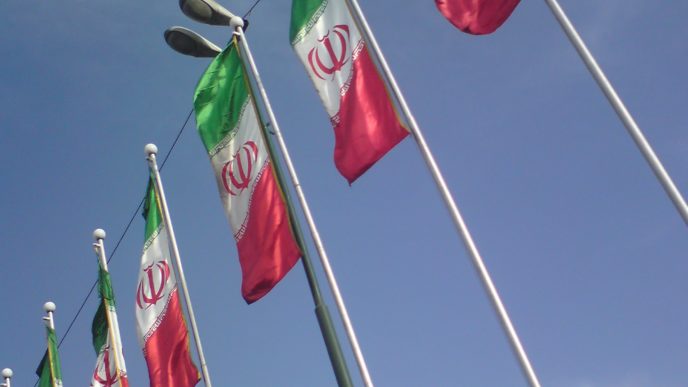
Saber-Rattling: Russia and Iran Express Rage at US Strikes in Syria

The Russian and Iranian regimes are furious with America’s retaliatory strike against Syrian dictator Bashar al-Assad following his use of weapons of mass destruction.

Last week, President Trump ordered a missile strike on the Syrian base that was reportedly used to launch a chemical weapons attack against an opposition stronghold in the city of Idlib. On Thursday, Trump launched 60 Tomahawk missiles at the base to retaliate against Assad killing of dozen of innocents men, women, and children earlier that week.

Russia and Iran, which are allied with Assad, condemned the military action, and threatened to retaliate if the U.S. “crosses the red lines” again.

Iranian dictator Ali Khamenei slammed the strikes, pushing the conspiracy that the U.S. apparently created the Islamic State terror group.

Iranian President Hassan Rouhani, who presides over the world’s foremost state-sponsor of terrorism, condemned what he called “flagrant U.S. aggression,” and said the strike on the airbase in Syria “benefitted terrorism.” Rouhani also alleged that the Syrian opposition was behind the chemical attacks, not the Assad dictatorship.

“Previous US officials created ISIS, and the current ones are strengthening ISIS or groups like them; however, the danger these terrorist groups present will backfire on Americans,” he said.

Russian autocrat Vladimir Putin teamed up with Rouhani for an additional memo that claimed the strike was “a violation of international law.”

Another statement sent by the “joint command” of Russia and Iran threatened military action against the United States.

“The United States crossed red lines by attacking Syria, from now on we will respond to anyone, including America if it attacks Syria and crosses the red lines,” the statement said. “America knows very well our ability and capabilities to respond well to them … we will respond without taking into consideration any reaction and consequences.”

Russia and Iran have long sided with the Assad regime over opposition forces. Both countries have ground troops in the country fending off threats to Assad. Iran’s Hezbollah proxy is also heavily militarily engaged in the country on the side of the Syrian dictatorship.

Russia and Iran are largely responsible for escalating the complete devastation and chaos in Syria. The two nations have propped up a man who has been responsible for the vast majority of the hundreds of thousands of deaths during the Syrian civil war. Without their help, there’s likely no possibility that Assad would have been able to stay in power.

Russia and Iran’s tough talk should be taken with a grain of salt. The two countries combined have a military that is vastly inferior to that of the United States. It is certainly not in their interests to use kinetic action against America. To attack the United States military, even if framed as a “retaliatory” strike, would draw the two U.S. adversaries into a conflict that would undoubtedly threaten the stability of both authoritarian regimes. (For more from the author of “Saber-Rattling: Russia and Iran Express Rage at US Strikes in Syria” please click HERE)

Follow Joe Miller on Twitter HERE and Facebook HERE.

How Soros Used US Tax Dollars to Consolidate Power in Colombia

In a recent letter to Secretary of State Rex Tillerson, six U.S. Senators asked for an investigation into whether the United States Agency for International Development was promoting the Open Society Foundations’ left-wing policies abroad.

State Department career officials gave the senators the runaround, but if Tillerson does launch the probe, he need look no further than Colombia.

That South American country offers plenty of evidence that U.S. tax dollars are indeed being used to advance George Soros’ agenda—all under the banner of “peace.”

In November 2016, Colombian President Juan Manuel Santos signed a “peace agreement” with the Marxist narco-terrorist group FARC. Though Colombians had earlier rejected the deal in a plebiscite, Santos and the Congress—which his party controls—found a loophole to ratify it, placing it above the Constitution.

The effect of this is that Santos now virtually rules by decree, answering only to an oversight commission—a junta comprised of three terrorists, three Santos cronies, and a few foreign observers.

The separation of powers has been abolished and a new peace tribunal, known as the Jurisdiccion Especial para la Paz has replaced the nation’s courts.

This act to circumvent Colombia’s Constitution was supported by many outside interests, including Scandinavian countries and the Nobel Committee, which awarded Santos the Peace Prize.

Also supportive was the Obama administration—partly through USAID—and Soros-backed nongovernmental organizations, which jointly helped launder the image, atrocities, and fortune of the world’s leading cocaine cartel.

I asked a USAID official last month whether USAID and the Open Society Foundations were coordinating in Colombia. He answered: “USAID is not funding any activities with Open Society in Colombia, directly or through any past or existing mechanism.”

But just scratching the surface of USAID activities tells a different story.

For example, Verdad Abierta, a web-based portal created by Teresa Ronderos, director of the Open Society Program on Independent Journalism, boasts on its website that it receives support from USAID.

Abierta has helped rewrite Colombia’s history, elevating terrorists to the same level as the legitimate police and military forces, and rebranding decades of massacres, kidnappings, child soldiering, and drug trafficking by a criminal syndicate as simply “50 years of armed conflict.”

Fundacion Ideas para la Paz, once led by peace negotiator Sergio Jaramillo, now a member of the oversight “junta,” is funded by the Open Society Foundations and has received more than $200,000 in U.S. tax dollars.

The left-wing news portal La Silla Vacia, another Open Society initiative, also boasts of being a USAID grantee. Its columnist, Rodrigo Uprimny, whose NGO DeJusticia also partners with USAID and Open Society, is considered one of the architects of the peace deal.

Former National Liberation Army terrorist Leon Valencia—Open Society collaborator and grantee—has received at least $1,000,000 in USAID funding through his NGOs Corporacion Nuevo Arco Iris and Paz y Reconciliacion, and left-wing news portal Las Dos Orillas, which he co-founded.

The list goes on. I’ve written in a separate piece about the long history of collaboration between Soros-funded NGOs and the U.S. State Department to undermine Colombia’s institutions, particularly through the work of Human Rights Watch.

While terrorists are rewarded with unelected seats in Congress and impunity, those who combated them will either confess to crimes they haven’t committed or go to jail.

This leads to Soros’ crowning achievement: Of the five commissioners chosen to select the judges for the new peace tribunal, three are key players in Soros’ network.

Diego Garcia-Sayan is chairman of Open Society’s Global Drug Policy Program, Juan E. Mendez is a 15-year veteran of Soros-funded Human Rights Watch, and Alvaro Gil-Robles collaborated with Open Society on the issue of Roma rights, eventually leading to the creation of the European Roma Institute—a joint initiative of the Open Society Foundations and the Council of Europe.

I recontacted USAID with follow-up questions regarding all the above. The press office declined to answer any of them, but a spokesperson did amend the original statement: “USAID is not funding any activities through Open Society in Colombia.”

Understanding the full scope of USAID and Open Society collaboration requires a government investigation. USAID‘s biggest contracts involve agreements with organizations that aren’t always transparent.

Take Chemonics. This USAID contractor received more than $20 million in 2015 alone. Some of that—USAID declined to say how much—went to formalizing relations between illegal miners in Segovia, Antioquia, and Gran Colombia Gold, the concession holder.

While the sustainability and benefits to the environment of the project are not clear (lawlessness in Segovia has intensified), certainly the company benefitted from a trained workforce not stealing its gold—albeit temporarily—courtesy of U.S. taxpayers.

One of the major shareholders of Gran Colombia Gold just happens to be Frank Giustra, a trustee of the Soros-funded International Crisis Group, along with Soros himself.

The six U.S. senators, then, are right to ask for a full accounting of USAID programs. Start with Colombia, where U.S. assistance should be for the purposes of maintaining and strengthening the gains from Plan Colombia. (For more from the author of “How Soros Used US Tax Dollars to Consolidate Power in Colombia” please click HERE)

Follow Joe Miller on Twitter HERE and Facebook HERE.

Anonymous US Official: Russia Knew Syrian Chemical Attack Was Coming

The United States has concluded that Russia knew ahead of time that Syria would launch a chemical weapons attack last week, a senior U.S. official says.

The official offered circumstantial elements to back up his claim, but no concrete proof. And others in the Trump administration cautioned that final American determination had been made that Russia had advance knowledge of the attack, which killed more than 80 people and prompted retaliatory U.S. cruise missile strikes.

The senior official said Monday that a drone operated by Russians was flying over a hospital as victims of the attack were rushing to get treatment. Hours after the drone left, a Russian-made fighter jet bombed the hospital in what American officials believe was an attempt to cover up the usage of chemical weapons. (Read more from “Anonymous US Official: Russia Knew Syrian Chemical Attack Was Coming” HERE)

Follow Joe Miller on Twitter HERE and Facebook HERE.

Religious Liberty Increasingly Under Threat in India Amid Surge of Hindu Nationalism

Last week on April 5, a mob of Hindu vigilantes beat a man to death for transporting cattle in northern India.

Cows are sacred in the Hindu religion, but India is a multicultural country with many non-Hindu citizens.

This incident, along with the recent appointment of Hindu nationalist priest Yogi Adityanath as chief minister of Uttar Pradesh on March 19, raises concerns about the state of religious liberty in Uttar Pradesh.

Uttar Pradesh, home to approximately 220 million people, is the most populous state in India. It is also one of the poorest states in India, with three out of 10 people living in poverty within the state.

While Uttar Pradesh is predominantly Hindu, about one-fifth of its population is Muslim, and it also has smaller populations of Christians and other religious minorities. Due to its population and diversity, Uttar Pradesh is viewed as one of the most important electoral states in India.

Since his recent appointment, Adityanath has largely followed Prime Minister Narendra Modi’s platform of targeting corruption and thus far avoided anti-Muslim or inflammatory rhetoric. However, Adityanath’s Hindu nationalist tendencies and previous statements regarding religious minorities is a cause for concern.

In one of his more famous comments, Adityanath accused Muslim men of conducting a “Love Jihad” campaign by converting Hindu women to Islam.

In response, he has called for Hindus to convert 100 Muslim women to Hinduism for every one Hindu woman converted. Even more concerning, he also said for every Hindu man killed, 100 Muslim men should be killed.

These comments become even more troubling when coupled with Adityanath’s arrest record. According to his election affidavit, he admitted to charges of attempted murder and defiling a religious site, in addition to several other charges relating to religious activity.

He also advocated building a Hindu temple on the site of an old, 16th-century mosque. This would be particularly inflammatory because the mosque was torn down in 1992 by Hindu nationalists and the ensuing riots killed about 2,000 people.

Since his appointment, Adityanath has cracked down on the slaughter and transport of cattle within Uttar Pradesh, demonstrating a willingness to act on his rhetoric.

Cows are a key source of meat for the Muslim and non-Hindu residents of Uttar Pradesh, and the crackdown has inflamed tensions between the Hindu and Muslim populations. The recent attack on the man transporting cattle is a perfect example of the danger this tension poses.

India is constitutionally a secular country, with religious liberty enshrined as a main tenet. This is an important consideration for a pluralistic society with a diverse population.

The international community should continue to closely monitor the state of religious freedom in India. Adityanath’s appointment comes amid a deterioration in religious liberty in India.

But it is in Modi’s interest to take a stand for religious freedom for people of all faiths. This shouldn’t be an afterthought. Rather, it should be a core tenet of Modi’s pro-freedom and pro-economic liberalization agenda. (For more from the author of “Religious Liberty Increasingly Under Threat in India Amid Surge of Hindu Nationalism” please click HERE)

Follow Joe Miller on Twitter HERE and Facebook HERE.

Not Just Syria: 5 Huge News Stories to Keep an Eye on Amid the Madness

The world’s eyes and ears have once again turned toward Syria following last week’s chemical weapons attack and U.S. President Donald Trump’s subsequent airstrikes on the Assad government. Mainstream media, independent media, and social media platforms are fixing fierce attention on the ongoing developments.

These events undoubtedly deserve widespread, ongoing scrutiny. From the United States government’s lack of evidence that the Syrian government was behind the chemical attack to the media’s complicity in driving a pro-war narrative and president Trump’s hypocrisy in bombing Syria — after criticizing former president Barack Obama for doing the same thing — further critical analysis of the recent airstrikes is vital.

But even as skepticism toward these events should remain heightened, so should awareness of countless other major developments. Here are five to follow:

1. Trump Appoints Pharmaceutical Consultant to Head the FDA — This week, the president appointed Scott Gottlieb, a pharmaceutical industry insider who has served the boards of multiple pharmaceutical companies, to chair the Food and Drug Administration. Gottlieb currently still works as a consultant for GlaxoSmithKline. He has received $414,000 from GSK, Pfizer, AstraZeneca, Bristol-Myers Squibb, and Valeant Pharmaceuticals. He has also received tens of thousands of dollars in speaking fees from pharmaceutical companies like Merck and Mikart, as well as other corporations — including Goldman Sachs. He has taken several trips through Washington’s revolving door, with brief stints at the FDA mixed in with multiple positions consulting pharmaceutical companies. Trump’s pick follows in the footsteps of Barack Obama, who also appointed a pharmaceutical industry insider to chair the FDA.

2. U.S. Military announces it will deploy 1,500 more troops to Afghanistan this year — The U.S. Army announced last Friday it would send 1,500 Alaska-based troops to Afghanistan as part of Operation Freedom’s Sentinel, an extension of Operation Enduring Freedom, the 13-year war in Afghanistan. The 4th Brigade Combat Team (Airborne), 25th Infantry Division was set to be downsized in 2015, but the Army’s most recent decision nullifies that plan. The Army said the coming deployment is part of a regular rotation but also said it is a response to “emerging mission requirements.”

The Army also activated 1,500 troops last December for Freedom’s Sentinel, suggesting the latest deployment amounts to the continuation of a seemingly endless war in the violence-ravaged country — regardless of who is president

3. WikiLeaks reveals CIA tactics to implant malware in Windows-based computers — On Friday, WikiLeaks continued the release of its Vault7 Series, documents it claims to have hacked from the CIA that detail the extent of the agency’s overreach. Ars Technica reported:

Friday’s installment includes 27 documents related to ‘Grasshopper,’ the codename for a set of software tools used to build customized malware for Windows-based computers. The Grasshopper framework provides building blocks that can be combined in unique ways to suit the requirements of a given surveillance or intelligence operation.

The leaks also included the CIA’s tactics for bypassing anti-virus protection and its use of bank-fraud malware called Carberp. “Once the Carberp source code was leaked in 2013, security experts warned it was akin to ‘handing a bazooka to a child,’” Ars Technica noted.

The leaks follow previous revelations that documented the extent of the CIA’s surveillance abilities, including its capacity to hack into iOs and Android operating systems. Those leaks also revealed the U.S. government was actively working to undermine the security of U.S. tech companies.

The same agency taking it upon itself to hack into private networks has also spent $1 billion annually arming radical rebels in Syria, some of whom have been implicated in the 2013 chemical attack former President Barack Obama used to justify his attempt to bomb the war-torn nation.

4. Tensions between the United States and North Korea continue to escalate — As Trump bombs Syria, the situation on the east Asian peninsula looks like it could devolve into violence, as well. The U.S. is accusing North Korea of aggression over its development of missiles and nuclear weapons — two technologies the U.S. also has at its disposal. However, unlike the United States, North Korea has never used missiles or nuclear weapons against another country. NBC News has reported that the U.S. may move its own nuclear weapons into South Korea as a deterrent to the North. All the hype about North Korean “aggression” should be taken with a grain of salt considering the country hasn’t officially attacked another country outside of Korea ever.

5. Tensions escalate in the South China Sea after Trump meets with Chinese president — Trump was physically meeting with Chinese President Xi Jinping while the Tomahawk missiles began dropping on Syria. We cannot discount the possibility that Trump may have been trying to send China a message of military strength and unpredictability.

The U.S. and China have been on a collision course as China has sought to assert itself defensively in the South China Sea. China has constructed and militarized artificial islands, while the U.S. has positioned its navy for a confrontation in the region. U.S. allies like Japan and the Philippines are locked in a perpetual chess match with China as the powers seek to stake their territorial claims to resources in the China Sea.

China is also North Korea’s closest ally and is viewed as the only entity capable of externally controlling the North. At the time of this article’s publication, China is in the process of moving 150,000 troops to its border with North Korea in preparation for a possible U.S. intervention and the subsequent fallout from it.

***

While the United States starts possibly another war against a sovereign country under Trump’s leadership, it’s important to pay attention to other, equally concerning events unfolding in the U.S. and around the world. While the media and politicians heap praise on Trump for bombing a new country and anti-war marchers take to the streets, we must inform ourselves now and take action before further U.S.-sanctioned carnage engulfs the world and before domestic corruption usurps our rights and freedoms at home. (For more from the author of “Not Just Syria: 5 Huge News Stories to Keep an Eye on Amid the Madness” please click HERE)

Follow Joe Miller on Twitter HERE and Facebook HERE.

The Palm Sunday Attacks in Egypt Are Horrid, but They Too Will Fail

Once again, the holiest week of the Christian calendar has begun with an attack on the Body of Christ in the form of two bomb blasts at Palm Sunday events in Egypt. One of the more striking images shows the blood of the martyrs splattered across the floor of a Coptic Church.

Currently, the death toll stands at 49, according to Egyptian state media reports. 18 people were killed in a blast in Alexandria, while at least 27 were killed and 78 injured in an explosion in a church in the northern city of Tanta.

ISIS has claimed responsibility for the attack, issuing a statement in Arabic in its wake, saying: “The Crusaders and their apostate followers must be aware that the bill between us and them is very large, and they will be paying it like a river of blood from their sons, if God is willing.”

These actions ought to fill all people of good will with sorrow and righteous anger for the souls taken from this world. The blood of the innocents has once again been spilled, and this injustice cries out to God.

This, like other attempts to attack Christians as they worship, is as quixotic as it is detestable; If there ever were a thought that could be described as being on the “wrong side of history,” it is the idea that somehow martyrdom will somehow weaken the Christian faith.

Of course, this isn’t happening in a vacuum. Christian persecution is on the rise on the global stage and now three quarters of the world’s population lives without the fundamental human freedom to believe, according to European Union Special Envoy Jan Figel in October on the International Day of Freedom of Religion or Belief.

“Therefore, those who believe that humanity should prevail can, and should do, much more for freedom of religion,” Figel told Premier Christian Radio last year. “We are witnesses of a systematic and mass murder, martyrdom and persecution on several territories.”

Even a casual observer of global headlines cannot deny that these new Egyptian martyrs are not alone.

However, regardless of what engine of persecution brings torment or what form it takes, we all suffer together when the dictates of the human conscience are trod underfoot.

What’s puzzling is what these oppressors plan to achieve with attacks like these. Their motivation has to be either rooted in arrogance or ignorance. Do the attackers believe that these attempts will prove more successful than the two thousand years of even worse persecution? Are these two IEDs more potent that the persecutions of Nero and Diocletian? Do they believe themselves more ferocious than the communists, fascists, and countless others that came before them in the 20th century alone?

Last year, when a similar blast in Pakistan carried out by similarly barbaric actors punctuated the news of Easter weekend, I referenced the masterful portrayal of Monsignor O’Flaherty in the 1983 film, “The Scarlet and the Black.” These words seem just as poignant now as they were then – perhaps even more.

When confronting SS officer Herbert Kappler in the dead of night in the ruins of the Roman Coliseum, O’Flaherty give the Nazi operative a quick history lesson:

Kappler: There will be a new order in Europe. We are evacuating Rome now, but that means nothing. We’ll be back. The Third Reich is the future.

O’Flaherty: How many murderous dictators have taught that kind of rubbish? Just look around you, Kappler. You’re standing where your ancient friends used to entertain themselves, watching lions tear the Christians to pieces. But the Church is still here. A lot of broken stones like these, in a few years that’s all that’ll be left of your ‘Third Reich.’

Time proved the good Monsignor right. Kappler’s murderous ideology and all those like him now sit smoldering on the ash heap of history; in time, the same will be true for the thugs who detonated those bombs in Egypt over the weekend.

The Church, however, will be just fine – just as She always has been. (For more from the author of “The Palm Sunday Attacks in Egypt Are Horrid, but They Too Will Fail” please click HERE)

Follow Joe Miller on Twitter HERE and Facebook HERE.
Trump Speaks With Egyptian President on Church Bombings

The White House says President Donald Trump has spoken with the Egyptian president following the recent church bombings to express his confidence that Egypt will do what it can “to protect Christians and all Egyptians.”

The White House said that Trump spoke with President Abdel-Fattah el-Sissi on Sunday “to convey his deepest condolences to Egypt and to the families who lost loved ones in the heinous terrorist attacks against Christian churches on Palm Sunday.”

The statement adds: “The president also expressed his confidence in President el-Sisi’s commitment to protect Christians and all Egyptians.” (Read more from “Trump Speaks With Egyptian President on Church Bombings” HERE)

Follow Joe Miller on Twitter HERE and Facebook HERE.
President Trump: Find Peace in Syria by Looking to Switzerland

We’re all Syria buffs now. We’re barraged with conflicting reports, atrocity stories, and carefully nurtured narratives. They all seem to goad us to back a major U.S. involvement in that country. (Can you spell “q-u-a-g-m-i-r-e”?) So let’s step back and think for a minute.

How much hope is there for a country where citizens speak three quite different languages? Where they hold starkly opposed religions — each of which damns the members of the other as heretics or infidels? Where religious or ethnic atrocities on each side feed into a history of bitterness?

We are speaking now not of Syria, but of Switzerland.

How Switzerland Solved the Syrian Problem

That’s right, one of the richest, most peaceful countries on earth. The Swiss have low taxes, minimal government, and the most democratic constitution in human history. Citizens’ religious freedom, property rights, gun rights, and freedom of speech are protected even better than in America. Most of a Swiss person’s taxes go to his town, not the federal government. Any citizen can collect signatures to force a national referendum to change the laws.

But Switzerland was once a lot like Syria. Its ethnic factions engaged in vicious attacks and bloody vengeance. Its churches used to whip their members into mutual holy war. Catholics would march with the Eucharist in elaborate processions through Protestant towns. This risked armed attacks by Calvinists. So young Catholics formed shooting clubs. They would march alongside their priests, brandishing rifles. As recently as 1847, the Catholics and Protestants fought a brief civil war that ended with the Jesuits expelled and banned from the country.

Localism über Alles

So what was it that rescued Switzerland from turning out like Syria? What could President Trump learn from the Swiss success story? The answer is simple. Localism and decentralization saved Switzerland. They could save Syria. In fact, a peace plan based on these principles is currently on the table, at the Russian-sponsored Astana talks — which the U.S. so far is boycotting.

True American “federalism” is fine example of localism in action. Let Maine and Mississippi, California and Colorado, make most of their own laws. Suit laws to the values and habits of their citizens. In the teachings of the popes, this idea is called “subsidiarity.” It is designed to keep political power as close as possible to the citizens whom it impacts. You can debate most of your tax burden at your local town meeting.

For more on subsidiarity, see the chapter we wrote about it in The Race to Save Our Century.

Protection for Each Region and Minority Group

Rebuilding after the 1847 civil war, the Swiss did not look to the rigidly centralized government of France. Instead, they modeled themselves on the still quite loosely knit United States. They embedded in their new constitution protections for the rights of every region, and left most of the political power in each region’s hands.

There were some, of course, who wanted a powerful central government that could impose one faction’s wishes on everyone. The Swiss who thought like this had welcomed Napoleon’s invasion. But the country’s deep divisions made such a scheme impossible. At least without a tyrannical government willing to batter the Catholics and Calvinists, French and German speakers, city-folk and farmers, into sullen, begrudged submission.

Reject 20th Century Statism and Centralism

Of course, that is what Bashir Assad’s harsh secular government has done in Syria. He repressed the Sunni majority, while protecting his own embattled (Alawite) minority, along with Christians and other smaller groups. Brutal coercion is likewise the program of Islamist rebels backed by Turkey and Saudi Arabia. Forcibly homogenizing peoples and regions is the model of twentieth century statehood: A powerful central government, dedicated to “national greatness,” crams one ideology down the throat of every hamlet and village.

That’s the model Western powers imposed on the Middle East, along with crackpot borders that took no account of ethnic or religious differences, in the Sykes-Picot agreement in 1916.

A Unified Democracy is Not an Option

Up till now, the only alternative to thuggish, centralized nationalism of the sort practiced by Assad (and before him, Saddam Hussein) has been Islamist theocracy. Islamists like the al Qaeda factions now covet power in Syria. They also wish to impose a single creed and way of life on vibrant, diverse regions. The difference is that Islamists look to sharia as the source of all law and order. That’s bad news for religious minorities. That’s why millions of Alawites and Christians now look for protection either to Assad, or to Kurdish militias.

If Assad were to reconquer Syria, he would brutally crush Islamists and make life hell for religious Sunnis.

If the U.S. topples Assad and lets “nature” take its course, murderous theocrats linked to al Qaeda would do the same to Alawites, Shiites, and Christians.

If Turkey has a strong hand in the settlement, the government it sponsors will crush the Kurdish militias, who seek autonomy for their distinct and long-suffering nation.

There is no prospect of a strong, centralized government that would honor human rights and democracy. That’s not an option in a nation this religiously and culturally fractured. Whoever holds the whip hand of a powerful national government will crush and subdue the others. That is why each side fights so brutally. It’s why most of the factions, including Assad but not the Christians and Kurds, have resorted to chemical weapons.

Restart the Russian-Backed Peace Talks

There is a better way. The peace talks at Astana, stalled for now, envisioned a Swiss-style solution for Syria. Each of the regions now controlled by one faction or other would form a kind of “canton,” with most of the powers that normally go to a central state. These cantons would be linked by a loose confederation, designed to keep peace among them. (Some other Alawite, not Assad, should be its figurehead.) People unhappy in the canton where they ended up would likely vote with their feet, and move to a friendlier region.

The Swiss model is already present in Syria. The Federation of Northern Syria, led by Kurds allied with Christians and tolerant Arabs, is composed of self-governed cantons in voluntary association. It’s the one part of Syria where women take part in politics, all religious groups are free, and power stays close to the people. The Stream‘s Johannes de Jong has written in depth on how federalism works now in this part of Syria.

Such a plan isn’t perfect. It will frustrate the ambitions of every group. And that’s the point. Because in Syria today such ambitions often include erasing minority rights, forcing people to change religions, or simply wiping them out.

Or We Could Just do Iraq All Over Again

In Iraq we tried another plan: Seize power from brutal, secular nationalists. Then spend trillions to set up a fragile central democracy, and leave. That’s what gave us ISIS, and left most of Iraq either in ruins and cleansed of Christians, or ruled by intolerant Shiites who obey the Islamic Republic of Iran. There is no constituency for tolerant, democratic central government in the Arab world. That is why such a government does not exist. Anywhere.

We could deny that fact, for ten or twenty years, and have another Afghanistan on our hands. Or we could admit it, and leave behind a howling wasteland like Iraq.

How about this: Instead of trying this brutal, foolish plan yet again with yet another country, why don’t we look to a model that actually works? Maybe Switzerland, instead of the U.S. or Russia, should lead the Syrian peace talks. (For more from the author of “President Trump: Find Peace in Syria by Looking to Switzerland” please click HERE)

Follow Joe Miller on Twitter HERE and Facebook HERE.

Dramatic Escalation in Syria

According to Syrian media sources, the Russian government has taken measures to guarantee more security for its forces in case of possible attack regarding the recent U.S. Tomahawk air strikes on the Shayrat air base on April 7.

At this moment, two Russian all-purpose jets capable of spotting and intercepting cruise missiles are barraging in the Eastern Mediterranean. Moreover, the Russian forces are ready to carry out retaliatory strikes on the U.S. ships that launch cruise missiles if they attack the Russian military objects (including Khmeimim and Tartus bases).

Meanwhile, the Russian military advisors have arrived at the Syrian bases equipped with the anti-aircraft defense systems to assist Assad’s forces to counter cruise missiles strikes.

The United States fired dozens of cruise missiles at a Syrian air base on Friday from which it said a deadly chemical weapons attack had been launched earlier in the week, escalating the U.S. role in Syria and drawing criticism from Assad’s allies including Russia and Iran.

“What America waged in an aggression on Syria is a crossing of red lines. From now on we will respond with force to any aggressor or any breach of red lines from whoever it is and America knows our ability to respond well,” said the statement.

The joint command center also said the presence of U.S troops in northern Syria where Washington has hundreds of special forces helping the Syrian Democratic Forces (SDF) to oust Islamic State was “illegal” and that Washington had a long-term plan to occupy the area.

The regional alliance said the U.S. cruise missile strikes on a Syrian base killed dozens of civilians would not deter their forces from “liberating” all of Syrian territory.

It’s notable that the British paper Daily Mail has removed an article titled “The United States supported the plan to carry out a chemical attack in Syria and blame Assad regime” dated January 29, 2013.

Meanwhile, thousands took to the streets to protest against the U.S. airstrikes against Syria yesterday. Protesters from all across the country made it clear that they will not stand for U.S. aggression in Syria, in a direct clash with the recent actions ordered by the Trump administration.

As the U.S continues to intervene in Syria, the majority of protesters expressed their concerns saying that money spent on these weapons of mass destruction, should rather go towards funding, “jobs, schools and healthcare.” The Tomahawk missiles that struck Syria in the first wave of airstrikes reportedly cost $60 million USD in total as one Tomahawk missile is valued at approximately $1 million USD. (For more from the author of “Dramatic Escalation in Syria” please click HERE)

Follow Joe Miller on Twitter HERE and Facebook HERE.

Shocking Video Shows Moment Suicide Bomb Blast Rips Through Egyptian Coptic Christian Church

HORRIFYING CCTV footage shows the moment a blast from a suicide bomber ripped through a church in Alexandria as attacks on two religious sites in Egypt claimed the lives of at least 47 people.

Hundreds were injured as bombs ripped through two Coptic Christian churches within hours of each other in attacks claimed by ISIS.

Egyptian media has beamed CCTV footage of the Alexandria bombing and reporting that a man seen in a blue jumper is a suspect.

Two clips show the man approach the main gate to St. Mark’s cathedral, before being turned away and directed toward a nearby metal detector.

The man then passes a female police officer chatting to another woman and enters the metal detector before an explosion engulfs the area sending debris flying. (Read more from “Shocking CCTV Shows Moment Suicide Bomb Blast Rips Through Egyptian Coptic Christian Church” HERE)

Follow Joe Miller on Twitter HERE and Facebook HERE.