What to Know About the Fiscal Hawk Trump Chose as Budget Director

President-elect Donald Trump chose one of the most outspoken fiscal conservatives in Congress, Rep. Mick Mulvaney, to be director of the Office of Management and Budget.

Mulvaney, a South Carolina Republican, is a founding member of the House Freedom Caucus, the most conservative group in Congress. He has pushed to cut both domestic and defense spending since being elected to the House in 2010 as part of the tea party wave.

“It is a great honor to be appointed director of the Office of Management and Budget,” Mulvaney said in a statement. “The Trump administration will restore budgetary and fiscal sanity back in Washington after eight years of an out-of-control, tax-and-spend financial agenda, and will work with Congress to create policies that will be friendly to American workers and businesses.”

If the Senate confirms Mulvaney, 49, as budget director, he will help shepherd Trump’s agenda through Congress, including drafting the president’s first budget, guiding repeal of Obamacare, enacting tax reform, and potentially, passing a major infrastructure spending package.

“We are going to do great things for the American people with Mick Mulvaney leading the Office of Management and Budget,” Trump said in a statement. “Right now we are nearly $20 trillion in debt, but Mick is a very high-energy leader with deep convictions for how to responsibly manage our nation’s finances and save our country from drowning in red ink.”

Here are four things to know about Mulvaney.

1. Not Afraid to Fight the Establishment

In 2011, as the U.S. was on the brink of default, Mulvaney voted against raising the debt ceiling, insisting that its passage be paired with “Cut, Cap and Balance,” a measure that would have slashed spending and imposed a constitutional amendment to balance the budget.

He also helped lead an effort to defund Obamacare that resulted in a 16-day government shutdown in 2013.

At the start of his second term in 2013, Mulvaney declined to support the re-election of then-House Speaker John Boehner, abstaining from the vote in protest.

2. Founder of the Freedom Caucus

After he lost his campaign in 2014 to become chairman of the Republican Study Committee—the largest group of House Republicans—Mulvaney helped organize a splinter group, the Freedom Caucus, to push the chamber further to the right.

The Freedom Caucus attracted national attention in 2015 when it pushed Boehner into early retirement.

As budget director, Mulvaney will be a key figure in repealing federal regulations implemented by the Obama administration.

Recently, the Freedom Caucus released a list of 232 regulations that it wants Trump to repeal, including ones dealing with climate change, nutrition, immigration, labor, and energy.

3. Willingness to Work With Leadership, Democrats

Mulvaney has allied with Republican leaders and Democrats on some issues.

On defense issues, he has opposed the use of a separate war funding account known as overseas contingency operations, a budgetary maneuver used to avoid spending caps to fund military and anti-terror operations abroad, such as the military campaign against ISIS.

He’s called the account a “slush fund.” Trump, meanwhile, has promised to invest more in the military and escalate the fight against ISIS.

Mulvaney, who speaks Spanish, has also worked on immigration reform, and he said that he supports legal status for some of the estimated 11 million immigrants living in the U.S. illegally.

He’s friendly with House Speaker Paul Ryan, R-Wis., and was among three members who gave nominating speeches for Ryan in the House GOP leadership election last month.

During his run for Republican Study Committee chairman, Mulvaney told The Daily Signal how he balances his rabble-rousing instincts with dealmaking on issues he cares about.

“I don’t think it’s the role of the RSC chair to be a shill for leadership,” Mulvaney said. “This is not a leadership position. This is separate and apart from that. So I think it’s incumbent upon the chairman to walk that fine line between working with leadership sometimes and pushing back at them at others. And I think I’ve shown the ability to do that. You have to have that credibility. What’s the best way to move the larger conference to the right?”

4. Personal, Professional Background

Mulvaney serves on the Financial Services Committee and the Oversight and Government Reform Committee. He first entered politics in 2006, when he was elected to the South Carolina House. Before that, he was a private-practice lawyer and businessman, working in his family’s home-building business, and helping run a regional restaurant chain.

Mulvaney has a degree in international economics from Georgetown University and a law degree from the University of North Carolina at Chapel Hill.

He was born in Alexandria, Virginia, but grew up in Charlotte, North Carolina, before moving to South Carolina.

His House office is decorated with South Carolina sports memorabilia. Mulvaney is Roman Catholic. He is married with three children, a set of triplets. (For more from the author of “What to Know About the Fiscal Hawk Trump Chose as Budget Director” please click HERE)

Follow Joe Miller on Twitter HERE and Facebook HERE.

The Most Important Cabinet Member You’re Not Paying Attention To

President-elect Trump is nearly finished filling out his Cabinet. One of the remaining spots — and in my opinion, the most important — remains undecided. The position in question? The director of the Office of Management and Budget (OMB).

The individuals who serve in Trump’s Cabinet will get the opportunity to oversee the agency or department within their specialized domains, like, for example, the Department of Defense, or the Environmental Protection Agency. But unlike those positions, the director of OMB gets the opportunity to keep tabs on each individual government agency.

That’s because OMB is specifically tasked with allocating the federal budget to the various agencies, as well as monitoring agency performance and providing financial management. OMB is also required to, “coordinate and review all significant Federal regulations by executive agencies,” — no easy task for a government that loves to spend money and promulgate never-ending regulations.

Since OMB is also responsible for drafting and formatting the President’s budget, this also allows this office to be intimately involved in all the policy and spending priorities for the entire federal government.

Although the director of OMB is not treated with the same eminence as those who run the State Department or the Department of Defense, few Cabinet positions are as important as the individual in charge of the budget office for these very reasons.

Some of the individuals chosen to join Trump’s Cabinet are controversial. For example, Trump’s choice for the deputy secretary of state postition, John Bolton, has been met with consternation by many in the liberty movement, such as Senator Rand Paul, R-Ky. (A, 92%) for his stance on issues like bombing Iran and supporting the Iraq war.

Still, conservatives and small-government Republicans should be optimistic about the names currently being floated for director of OMB. The first name floated was former Senator Tom Coburn. Coburn was an astute study of the budget during his days in the Senate, and was referred to by CNN as “a former US Senator from Oklahoma, who turned his Senate career into a crusade against government spending.”

He was also the champion of eliminating government waste, even in programs considered sacrosanct, like the military; he was a long-time advocate of fixing the Pentagon’s broken budget by demanding an audit. But Coburn also made that his mission government-wide, and was well known for publishing detailed reports on government waste.

Another promising name, and small government warrior, that has been mentioned is Congressman Mick Mulvaney, R-S.C. (A, 94%). One of the more conservative members of Congress, he is a member of the Freedom Caucus.

This often means that Mulvaney stands on principle against his own party. For example, when Republican leaders proposed the Bipartisan Budget Act — a bill to hamstring spending restraints by $63 billion — it was Mulvaney that spearheaded opposition to the deal.

In addition, Mulvaney has long advocated for a balanced budget, lower taxes, and eliminating corporate cronyism, like the Export-Import bank.

Among some of the other promising names that have been mentioned is David Malpass, a strong conservative economist by training, and a former high-ranking Reagan and George H.W. Bush official. Malpass also shares the list of names with Eric Ueland, a long-time budget staffer on the Senate Budget Committee.

The current list of conservative individuals under consideration for this position deserves more attention than perhaps any time since President Truman took office. That’s because this OMB director will have a daunting challenge in controlling government spending and debt, more than ever before. Consider the article by the Committee for a Responsible Federal budget, titled, “Trump Will Face Highest Debt-to-GDP Ratio of Any New President Since Truman.”

By our estimates, the national debt will total about 77 percent of Gross Domestic Product (GDP) when Trump takes office, compared to 103 percent when Truman took office at the end of World War II, 58 percent when Eisenhower took office, and 46 percent when Clinton took office.

And yet, it’s not even fair to compare the debt under Truman with that of Obama. The debt that materialized under Franklin D. Roosevelt and Harry Truman was almost solely related to the one-time expenses of fighting World War II. As you can see in the graph, once the war was over, the debts were quickly whittled away. That’s not the case today. Instead, our debts are becoming increasingly structural; the result of promised entitlement spending like Social Security and Medicare.

So really, the task that confronts today’s budget head will be far more daunting than anything that faced Truman. Consider this; by 2021, Social Security and Medicare alone will consume half of every dollar the government brings in. Whereas Truman could allocate surplus dollars to paying down the debt instead of buying tanks, post WWII, the budget director under Trump must decide between taking on more debt and tackling the acrimonious challenge of entitlement reform.

Still, conservatives deserved a good list of names to run what may become the most important office in the White House, and Trump has made a wise selection so far. This is what conservatives fought for. This is where we can make the government small again, and scale back Obama’s absurd regulations. (For more from the author of “The Most Important Cabinet Member You’re Not Paying Attention To” please click HERE)

Follow Joe Miller on Twitter HERE and Facebook HERE.

SHOCKER: U.S. Deportations Fall to Lowest Level in 10 Years

Unexpectedly:

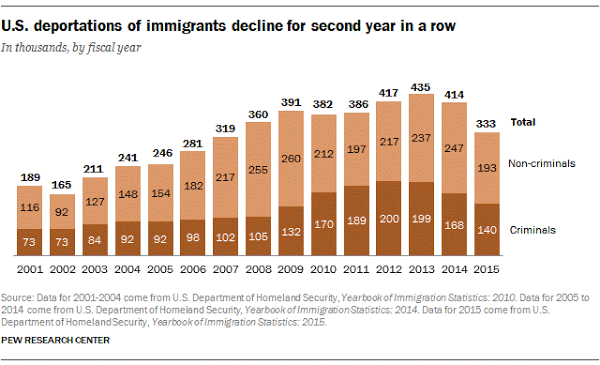
The Obama administration deported 333,341 unauthorized immigrants in the 2015 fiscal year, a decline of about 81,000 (or 20%) from the prior year, according to newly released data from the Department of Homeland Security. The number of deportations fell for the second year in a row and reached its lowest level since 2007…

ft_16-12-15_deportations_removals_fy20151

…Deportations of immigrants with a criminal conviction fell 17% between fiscal 2014 and 2015, from 168,000 to 140,000. It is only the third time that the number of deportations of immigrants with a criminal conviction has fallen since at least 1981.

Kate Steinle could not be reached for comment. (For more from the author of “SHOCKER: U.S. Deportations Fall to Lowest Level in 10 Years” please click HERE)

Follow Joe Miller on Twitter HERE and Facebook HERE.
Busted: Deceitful Media Lied About Trump’s Speech in 3 Racially Charged Headlines

With all the recent consternation from the mainstream media over the prevalence of “fake news,” and the constant grumblings about the dangers that low-information voters present, you’d think the media would take care extra care in their reporting these days.

Wrong.

The Chicago Tribune published a piece covering President-elect Donald Trump’s Thursday rally in Hershey, Pa. And, as it turns out, the story’s headline is a complete lie. The Tribune’s headline:

“Trump calls on Pennsylvania crowd to cheer African-Americans who ‘didn’t come out to vote.’”

Again — a complete falsehood. It says to the reader that Trump encouraged the crowd to cheer for black people who stayed home on Election Day — an overtly racially-charged act. But Trump did not say what the Tribune claims.

Watch for yourself (The comment in question is at the 6:48 mark. Trump begins his discussion of the black vote at the 6:20 mark):

“They didn’t come out to vote for Hillary,” Trump said.

Trump was not asking people to applaud the non-participation of black citizens; he was commending those who did not vote for his opponent — a corrupt, lying, nasty woman.

But the media has a narrative to sell to the people who don’t read past headlines. And so the New York Daily News writes:

“SEE IT: Donald Trump on ‘Thank You’ tour thanks ‘smart’ African-Americans for not voting in 2016 election.”

And Raw Story says:

“Trump tells Pennsylvania fans they can thank African-Americans for not voting in November election.”

And “journalists” push that narrative.

In their hatred of Donald Trump, the mainstream media are perfectly willing to fabricate news (or blatantly mislead, at the very least) if it makes the president-elect look like the evil, racist, monster that they insist he is. And the media does this despite the ease with which relevant facts disprove their narratives.

What is most confounding of all, though, is that the gaffe-prone Donald Trump says enough stupid things that they shouldn’t have to make up “news.” For instance, Trump recently said that African-American voters not showing up to the polls was “almost as good” as those who showed up to vote for him.

“The African American community was great to us,” Trump told a crowd in Grand Rapids, Mich., last week. “They came through, big league. Big league. And frankly if they had any doubt, they didn’t vote. And that was almost as good because a lot of people didn’t show up. Because they felt good about me.”

See, there in Grand Rapids was when Trump said something similar to what the media are implying Trump said this week. They didn’t have to lie about Trump’s comments in Pennsylvania to make their point. But they did lie in their headlines. In their efforts to spread misinformation, The Chicago Tribune and company have embarrassed themselves at the height of this fake-news hysteria.

I don’t consider myself a journalist; I’m a commentator. And so I’ll offer this comment: The point of journalism, it seems to me, is to simply report the facts and truth. It is to inform people of “the real story” when others attempt to spread lies or hide the truth.

The reason people are falling for “fake news” is because the self-proclaimed truth-tellers in MSM are willfully spreading lies. If you are a member of the mainstream media and you want people to believe in you again, stop twisting the facts. Stop pushing narratives.

Start telling the truth. (For more from the author of “Busted: Deceitful Media Lied About Trump’s Speech in 3 Racially Charged Headlines” please click HERE)

Follow Joe Miller on Twitter HERE and Facebook HERE.

Electors: Don’t Let Has-Been Actors Convince You to Flout the Will of the People

For eight long years, the Democratic party has cheered the abuse of executive authority by the president it elected — including executive orders that flouted our immigration laws, and mandates from federal agencies such as the Dept. of Health and Human Services that shredded religious liberty. Democrats confirmed three far-left judicial activists to the U.S. Supreme Court, who duly rewrote the Constitution to invent a “right” to same sex marriage. Indeed, whenever they can muster five votes on the Court, the left turns SCOTUS into a permanent Constitutional convention, making up new rights as it goes along, in the teeth of the will of the voters and the text of our founding document.

Democrats led the way in crippling Congress via “continuing resolutions,” which strip the House of Representatives of its power of the purse, preventing the up-or-down votes on specific pieces of funding that should restrain executive abuses. Instead, the Republicans faced only two choices: pay for Obama’s policies, or shut down the whole government and face the blame when seniors don’t get their Social Security checks.

Suddenly, We Have a Constitution. Who Knew?

But eight long years later, the left lost an election that was supposed to give it the chance to fully pack the Supreme Court to carve in stone the will of elites from Harvard to Hollywood, then open wide the borders to flood the country with newly minted Democrats. So leftists have discovered that the United States actually has a written Constitution. Some have started reading it. The same men and women who claim that this document should be strained and stretched like saltwater taffy when it suits the sexual Zeitgeist have become Antonin Scalia-style “originalists.” They have learned — perhaps from reading the playbill for the musical Hamilton — that at one point some of our Founders intended the Electoral College to serve a deliberative purpose.

The Electoral College That Never Was.

And yes, that is true. Both Alexander Hamilton and James Madison expected the electors chosen by each voting district in the nascent United States to meet in their states’ capitals and calmly, reflectively choose from a list of candidates the person they thought best suited to serve as president. After all, how would ordinary voters from Maine to Georgia know enough about the candidates, in those days of horses and buggies traveling bad roads threatened by Indians?

However, this deliberative step was not specifically mandated in the Constitution, and the rise of political parties right after the retirement of George Washington replaced its function: Now Federalists or Democratic Republicans would deliberate in advance, and nominate qualified candidates. The states, jealous of their influence, soon started passing laws that made elections winner-take-all: instead of congressional districts picking electors, most were elected statewide as early as the 1830s. At no point since the election of John Adams have the electors in fact exercised the role of debating and choosing the president. Instead they are simply a mechanism for enacting the voters’ will. That may not be what Hamilton or Madison had in mind, but it’s perfectly Constitutional. Has been for more than 200 years. And it’s the assumption on which millions of voters in 2016 cast their ballots.

Martin Sheen is Now a Constitutional Scholar… So is that Shrink from Law & Order.

And now some fading actors have made a video to put pressure on members of the Electoral College, asking them to overturn the result of the recent U.S. election because … well, Donald Trump is unfit for office, in their considered thespian judgment.

Of course this is nothing more than the latest dirty trick by the Democrats to attempt to hijack this election. Having run through a long list of scapegoats, from the American FBI to the Russian FSB, the Clinton machine has one more “Hail Mary” pass to throw: Try to sway the electors who were chosen to support Donald Trump — in all but a few states electors’ names don’t even appear on the ballot — to do something else, despite what voters wanted.

Tell the People to Shut Up and Follow Orders.

That’s a very strong impulse nowadays, as John O’ Sullivan wrote in National Review — where he notes that in posh European circles the very word “populist” is treated as an obscenity. It reeks of the grubby “people.” In Britain, Eurocrats are grabbing at every possible obstacle to stop the march of Brexit — even blaming the referendum on … guess who? Vladimir Putin! In Switzerland, that nation’s highest court has overturned a national referendum on policies toward Muslims — a staggering abuse of power in the most democratic country on earth, which is virtually run by plebiscite. Elites in Europe that strong-armed their countries into the European Union now want to arrogate power to unelected bodies within the EU, and take more and more areas of policy out of the hands of voters.

That was not the intent of our Founding Fathers when they crafted the Electoral College. Instead, what they meant to accomplish was to distribute power widely, to guarantee that each state in the Union would receive a voice of its own, and prevent the people of a single populous state (back then it was Virginia — today it’s California) from imposing its will on every corner of the country. The system they created works admirably well, so long as electors remember that they were not chosen for their knowledge or expertise. They were picked to back the candidate chosen by the people who voted for them on election day. To do anything else for any reason would be a simple betrayal of trust. (For more from the author of “Electors: Don’t Let Has-Been Actors Convince You to Flout the Will of the People” please click HERE)

Follow Joe Miller on Twitter HERE and Facebook HERE.

Social Security Needs Real Reform, Not Just a New Commission

Social Security was a fact of life in 20th-century America, but it may soon reach a critical fork in the road.

In less than two decades from now, Social Security’s combined trust fund will be exhausted. If no action is taken to reform this major program, benefits will suddenly be indiscriminately reduced by 23 percent.

To begin to address this concern, Rep. Tom Cole, R-Okla., and Rep. John Delaney, D-Md., have proposed the Social Security Commission Act of 2015, which would create a bipartisan commission to resolve Social Security’s solvency challenges.

To succeed, such a commission should include an action-forcing deadline with enforcement provisions.

Every day that passes without Congress making reforms to Social Security, the reform options become more drastic and more of the burden is passed on to future generations. Yet Congress and the president continue to avoid the problem and push it down the road.

The goal of the Delaney-Cole commission would be to issue recommendations that extend Social Security’s solvency for another 75 years.

The commission would be made up of 13 members, with three being appointed by each of the House and Senate party leaderships, and the chair being appointed by the president. The commission would need a supermajority of nine votes to send its recommendations to Congress.

The idea for a bipartisan Social Security commission was inspired by the Greenspan Commission from the early 1980s. In 1981, President Ronald Reagan created the Greenspan Commission whose recommendations led to bipartisan support for the Social Security Amendments of 1983 that extended Social Security’s solvency for 50 years.

However, this newly proposed commission lacks the action-forcing moment that the Greenspan Commission had.

When the Greenspan Commission released its recommendations in January 1983, the Social Security combined trust fund was projected to run out of funds in July 1983—meaning benefit checks would not go out on time. Congress had motivation to accept the Greenspan Commission’s recommendations or otherwise face delayed or reduced Social Security benefit checks for beneficiaries.

The Delaney-Cole bipartisan Social Security commission lacks this immediate action-forcing moment to motivate members of Congress to adopt reforms. In its absence, members of Congress have little motivation or political cover to adopt benefit changes to a very popular program.

This commission could help to educate the public, which is desperately needed after a campaign that was predicated on misinformation in regards to Social Security.

The president-elect was off when he claimed in the campaign, “If we are able to sustain growth rates in [gross domestic product] that we had as a result of the Kennedy and Reagan tax reforms, we will be able to secure Social Security for the future.”

This simply is not true. Social Security problems arise not from poor economic growth, but primarily from demographic changes. Social Security relies on current workers financing benefits for current retirees.

Today, women are having fewer children and people are living longer, causing demographic shifts that strain Social Security’s finances. In 2016, the U.S. fertility rate fell to a record low.

The aging of the baby boomers means more individuals will be drawing Social Security benefits. By 2029, 20 percent of the population will be age 65 and older—up 13 percent from the current population.

Moreover, Social Security’s current benefit design means that benefits grow with wages and inflation. As the economy grows, benefits too will become more costly.

In the meantime, some lawmakers have begun introducing concrete proposals to reform Social Security. For example, Rep. Reid Ribble, R-Wis., introduced the Save Our Social Security Act, which included reforms that increased the payroll tax cap, raised the retirement age, and provided a minimum anti-poverty benefit.

While an imperfect bill—particularly because it increases Social Security’s size, instead of limiting the program by targeting benefits more effectively—it puts reforms on the table for discussion.

Recently, Rep. Sam Johnson, R-Texas, introduced the Social Security Reform Act of 2016. The bill includes commonsense solutions such as gradually raising the retirement age, targeting benefits for those most in need by reducing benefits for spouses and children of high-income earners, and replacing the cost-of-living adjustment with a more accurate measure of inflation.

This plan presents a reasonable, targeted, and fiscally responsible approach to reform Social Security.

Social Security, Medicare, Medicaid, Obamacare, and other health care programs total 52 percent of all federal spending and they are growing rapidly. These programs are the main drivers of our nearly $20 trillion national debt. Tackling them will require strong political leadership.

At a recent event hosted by the Committee for a Responsible Federal Budget, Delaney suggested pairing the Social Security commission to a deal to raise the debt ceiling in March.

Without any real enforcement, such a commission could be easily abused by Congress to save face when raising the debt ceiling with no meaningful cuts or reforms.

A Social Security commission could be helpful, but only if it includes action-forcing provisions. Otherwise, a commission will serve as an excuse for policymakers to say they are doing something about Social Security’s shortfalls without actually doing anything. (For more from the author of “Social Security Needs Real Reform, Not Just a New Commission” please click HERE)

Follow Joe Miller on Twitter HERE and Facebook HERE.

Navy Vet Creates 7-Point Plan to Fix the VA. But He Needs Your Signature by Christmas.

Since 2015, there have been at least a dozen reported cases of military veteran suicide on Veterans Administration medical facility grounds. The most recent occurred just before Thanksgiving, when Army Sgt. John Toombs, who served in Afghanistan, hanged himself on the grounds of the Alvin C. York VA Medical Center in Murfreesboro, Tenn.

In a viral video recorded hours before he ended his life at the age of 32, Toombs, who suffered from PTSD and depression, claims he was kicked out of a drug treatment program for “trivial reasons.”

Like many of his peers, Joe Schmitt, a Navy veteran and hospital corpsman, is fed up with way the government has failed servicemen and women. After hearing of Sgt. Toombs’ untimely death, he decided to do something about it.

Schmitt has authored not one, not two, but seven petitions asking the White House to address what he believes are major flaws in the VA. Why seven? WhiteHouse.gov has an 800-word limit for petitions. To get around this, Schmitt created a separate petition for each proposed area of reform:

Leadership employment requirements

Intern employment expectations

Veteran health care education

Release of records upon death

Higher accountability for VA employees

Drug and alcohol treatment programs

Termination of redundant studies that waste VA money

In order for the White House to consider all of these reforms, he will need a total of 700,000 signatures by Jan. 3.

Schmitt, a Brooklyn native who joined the Navy in 1986 at age 17, has had to deal with the flawed VA system in the wake of a traumatic brain injury (TBI) he suffered after an IED explosion in Afghanistan in 2011.

Speaking to Conservative Review, he noted that the reforms listed above had long been on his mind, but John Toombs’ untimely death was “the straw that broke the camel’s back.”

Schmitt said he actually had two chance encounters with Toombs.

The first encounter was at a local bar in Tennessee. Schmitt, who currently resides in Tennessee, recalls “talking to a kid from the Tennessee National Guard that was telling me about his PTSD and his drug problem, and how he wanted to better himself for his daughter.”

At the time, Schmitt advised Toombs to get honest with himself and get the help he needed to “have a decent life.”

The second and last time he saw Toombs was when he went to drop off paperwork at the Alvin C. York center.

“He was sitting on a couch there, and it had to have been after he’d gotten kicked out of the program, because he did not look happy at all,” Schmitt said. “And then when I see him in the video, I’m like, ‘Oh my God … that was him.’”

Toombs’ death was a wakeup call for Schmitt, who says he’s had to deal with incompetent VA personnel who overlook or ignore serious medical problems. He has gone so far as to spend $9,000 of his own money to seek external medical services at a TBI clinic in Maryland.

“It kind of irritates me that you can bring in individuals who are refugees from another country, or have someone who is here illegally, and they can get top medical care,” he told CR. “But you have all of these veterans who’ve sacrificed so much, and it’s a struggle for them to get care.”

Schmitt explained that many veterans who are fed up with the Veterans Administration end up homeless, addicted to drugs, or worse, as in the case of Sgt. Toombs.

“Here’s the thing,” he explained. “When it comes to John Toombs, PTSD is the main cause of the addiction, because the veterans are trying to self-medicate. So, yeah, you’ve got to treat the addiction. But you need to treat the PTSD as the primary cause, and then work a recovery system around that.”

Joe Schmitt said he doesn’t think the majority of VA health care providers “really, truly understand” veterans. Part 6 of his petition addresses this point.

“You know how some people have workplace sensitivity courses? Well, they should have something like that regarding veterans, where providers try to understand the world of a veteran, and what makes them different from a civilian,” he said.

“I can sit there and direct my care because I’m a corpsman,” he said. “But what happens to these guys who don’t have the background — or don’t know any better — that put their blind trust and faith in a system that’s supposed to be there for them? And it fails them?”

“You don’t have suicides in [regular] hospitals around the country,” he continued. “But the fact that you have the 12 suicides since 2015, on VA property … that’s a personal thing. That’s a personal message.”

That is why Schmitt drafted his seven-part petition – in the hope of preventing similar incidents from happening.

“The veterans and our service members sacrifice so much, and we ask so much from them,” he said. “They’re all heroes in the fact that they raised their hand and said, ‘Look, U.S. military, send me wherever you’re going to go.’”

Schmitt created a Facebook event for the petition, including links to each of the seven parts and a record of the 12 veteran suicides since 2015. (For more from the author of “Navy Vet Creates 7-Point Plan to Fix the VA. But He Needs Your Signature by Christmas.” please click HERE)

Follow Joe Miller on Twitter HERE and Facebook HERE.

Electoral College Survey Shows Electors Will Stand by Trump

There are some Republican members of the Electoral College who wish they were not voting for President-elect Donald Trump on Monday.

However, an Associated Press survey of more than 300 electors has found that Trump opponents’ dreams to use the Electoral College as the final place to block Trump’s ascent to the White House have little hope of becoming reality.

Although the electors admit to an unprecedented wave of pleas to change their votes, AP noted that electors cited everything from the law, to duty, to loyalty to cast their votes for Trump.

Trump won 306 electoral votes on election night, far above the 270 needed to win election Monday, when the electors will gather in their respective state capitals to vote.

For Trump to lose, at least 37 electors would need to forsake him. AP reported that only one Republican elector told AP he won’t vote for Trump.

Many are solidly behind the president-elect.

“Hell will freeze and we will be skating on the lava before I change,” said Republican Tom Lawless of Tennessee. “He won the state and I’ve pledged and gave my word that that’s what I would do. And I won’t break it.”

Republican elector Jim Skaggs of Kentucky said he will swallow his concerns and vote for Trump.

“His personality worries me,” Skaggs said. “He is not open-minded. I hope he is far better than I think he is.”

Misgivings aside, he said, “I fully intend to vote for Donald Trump. I think it’s a duty.”

Although being an elector is usually a very low-key role in America’s political process, electors told AP that has not been the case with Trump’s election.

“Let me give you the total as of right now: 48,324 emails about my role as an elector,” said Brian Westrate of Wisconsin. “I have a Twitter debate with a former porn star from California asking me to change my vote. It’s been fascinating.”

Although efforts to stop Trump have been organized, they have not been effective, said some electors.

“We got a stack of letters from idiots,” said Republican elector Edward Robson of Arizona.

Fellow Arizona GOP elector Carole Joyce said the deluge has been profound.

“They’ve caused me great distress on my computer, that’s for sure,” she said.

“I average anywhere from a thousand to 3,000 emails a day. And I’m getting inundated in my regular mailbox out front — anywhere from 17 to 35 letters a day coming from Washington state, Oregon, all around the country. Hand-written, some of them five or six pages long, quoting me the Federalist Papers, the Constitution, asking me again out of desperation not to vote for Donald Trump,” she said.

Joyce was philosophical about the fuss.

“… that’s their right,” she said. “I’ve had nothing threatening, I’m happy to say. The election is over. They need to move on.” (For more from the author of “Electoral College Survey Shows Electors Will Stand by Trump” please click HERE)

Follow Joe Miller on Twitter HERE and Facebook HERE.
Don’t Blame the Fed for Raising Interest Rates, Blame It for Not Raising Them Sooner!

The news that the Federal Reserve is raising interest rates by a quarter of a percent is likely to inspire a variety of reactions, depending heavily on one’s political philosophy and one’s view of monetary policy. Those on the Left are likely to want low interest rates to persist indefinitely, believing that such an environment will encourage borrowing and spending, and therefore stimulate the economy. Those on the Right will probably welcome higher interest rates as encouraging saving and being beneficial to investors. Trump supporters will probably see the Fed’s actions as a partisan attempt to damage the president-elect, knowing that higher interest rates are usually accompanied by a short-term hit to the stock market. There is very probably some truth to this last accusation. Rather than speculate on motivations, let’s take a step back and examine how the control of interest rates actually works and what the effects are.

The chief function of the Federal Reserve is to regulate the quantity of money in the economy. While the media loves to talk about how the Fed controls interest rates, the bank can’t actually dictate the rates that banks offer. Instead, they influence these rates indirectly by either increasing or decreasing the amount of money in circulation. Pumping more money into the economy tends to drive rates down, while less money tends to mean higher interest rates. This is an important insight because it shows that the Fed can’t actually keep interest rates near zero forever. There is a limit to how much they can increase the money supply without causing catastrophic rises in prices.

Many people think that increasing interest rates is bad for the economy, because stock market indices like the Dow Jones usually fall as interest rates rise. But the stock market is not the economy, only one piece of it. The reason the stock market does well with low interest rates is that investors seeking a return on their money have no other option than to buy stock — low interest rates make other investments unattractive. Conversely, when interest rates rise, interest bearing accounts become comparatively more profitable, and people take money out of the stock market to reinvest in something safer. The decline in stock prices is not necessarily a signal of economic weakness, but merely reflects a reallocation of funds from one investment to another.

In short, changing the money supply changes people’s behavior, or at least changes the incentives to which they respond. Once you realize that the entire economy runs based on people responding to the right incentives, it’s easy to see how the process of centrally controlling the money supply can go very badly wrong. If the Fed sends the wrong signals, it can lead to massive amounts of money being invested in the wrong places. When those investments fail, the result is an economy-wide recession.

This is why most libertarians — with Ron Paul being the most prominent example — strongly oppose the Federal Reserve’s meddling in the economy. By holding interest rates down to artificially low levels for such a long period of time, the Fed encourages lots of borrowing, with the implication being that most Americans are saving their money to be spent later. Otherwise, why would there be so much cash in bank vaults to be borrowed? But this assumption leads businesses into making bad decisions, because that savings doesn’t really exist, and people are in fact spending their money now rather than later. You can imagine the disaster that would befall a business planning for future spending that will never come. Now imagine that thousands of businesses are falling into the same error, all because of signals sent by the Federal Reserve, and you have a recipe for economic calamity.

That brings us back to the original question. Should the Fed raise interest rates? Short answer: Yes. They’ve been too low for far too long. Slightly longer answer: The Fed should get out of the business of deciding what the “right” interest rate is, and let market forces set rates instead. This is the only way we’ll avoid the painful consequences of misinformation, bad investments, and future recessions. (For more from the author of “Don’t Blame the Fed for Raising Interest Rates, Blame It for Not Raising Them Sooner!” please click HERE)

Follow Joe Miller on Twitter HERE and Facebook HERE.

Fearmongering Harry Reid Is Spewing Lies About Obamacare

Democrats have lied about Obamacare from the beginning, but outgoing Senate Minority Leader Harry Reid, D-Nev., apparently intends to tell the biggest lie of all as he exits the Washington scene.

In an interview about whether Republicans in Congress would make good on their promise to repeal and replace the Affordable Care Act, Reid said, “You get rid of Obamacare, people are going to die.”

President Barack Obama’s promise that if we liked our doctor we could keep our doctor turned out not to be true, and so did his pledge that health care premium costs would go down. As millions of Americans eventually found out, they went up.

But a politician failing to keep his promises, as egregious as those two were, pales in comparison to Reid’s outrageous and baseless comments that “people are going to die” if the failing law is repealed and replaced.

Perhaps what Reid should consider are the real-life stories of people who have lost their lives because of Obamacare.

People like Frank Alfisi, who was refused dialysis in the emergency room because of a new Medicare regulation put in place via Obamacare. Or Julie, a mother of four, who delayed seeking medical attention waiting for her new government-approved insurance to kick in because her family’s private health care had been canceled. Or Linda, a Nevada woman who was delayed in getting treatment for a brain tumor because of enrollment snafus in her state’s Obamacare exchange.

Though Reid offered no proof for his comments, he seemed to suggest that repealing the unaffordable Affordable Care Act would cause the health care insurance marketplace to collapse—and that this was the GOP’s plan, stating, “Can you think of … something more cold and calculated than that.”

Yet, it is because of Obamacare that next year, 33 states will have fewer insurers offering individual coverage on the exchanges than they did this year.

The country’s largest health care provider, UnitedHealthcare, announced last April that it was pulling out of the majority of the exchanges due to high costs. Humana also says it is cutting back, and Blue Cross Blue Shield has already moved to reduce its offerings in several states.

If Reid is so concerned about the collapse of the health care marketplace, perhaps he and his pal House Minority Leader Nancy Pelosi, D-Calif., should have read the Obamacare bill before they, without one Republican vote, passed it.

And let’s be clear about one other matter.

The majority of new health care enrollments via Obamacare came by putting people on Medicaid. And as studies show, not only do patients with Medicaid receive poorer care than those who have private insurance, but because of low reimbursement rates, more and more doctors are refusing to accept Medicaid patients, meaning individuals on Medicaid are having a harder time finding primary care doctors and specialists to treat them.

So just because someone has been given a Medicaid card with their name on it doesn’t mean they are able to get the health care they need. All Obamacare has done is added millions more people to a program that was already failing the people it is supposed to serve.

Democrats’ refusal to see the truth about Obamacare and how it is hurting the American people is one of the main reasons Republicans won the presidency and retained control of both the House and Senate.

Somebody needs to tell Harry. (For more from the author of “Fearmongering Harry Reid Is Spewing Lies About Obamacare” please click HERE)

Follow Joe Miller on Twitter HERE and Facebook HERE.