Facebook’s Reliance on Liberal Fact-Checkers Means Your News Is About to Be Censored

Facebook doesn’t think you know what’s “fake news” and what’s not.

In an announcement Thursday, the social media giant said it was going to crack down on fake news through a variety of ways, including letting users report what they deem to be fake news.

But one item on Facebook’s list of methods to crack down was particularly concerning:

We’ve started a program to work with third-party fact-checking organizations that are signatories of Poynter’s International Fact-Checking Code of Principles. We’ll use the reports from our community, along with other signals, to send stories to these organizations. If the fact-checking organizations identify a story as fake, it will get flagged as disputed and there will be a link to the corresponding article explaining why.

When you look at the signatories on the Poynter list, you’ll find seven from the United States: ABC News, The Washington Post, Snopes, Associated Press, FactCheck.org, Climate Feedback, and Politifact.

Aha.

Talk about the devil being in the details. These are hardly unbiased fact-checkers—conservatives have raised alarms about several of them. Let’s go through some examples:

1). Snopes. You may have heard that the terrorist who murdered 49 people and injured dozens more at the Pulse nightclub in Orlando, Florida, was a Democrat. That’s for a reason: Omar Mateen was registered as a Democrat. Yet Snopes took issue with that characterization, saying it was “undetermined” because Mateen’s “U.S. political affiliation (if any) at the time of the shooting is unknown.”

Snopes’ Kim LaCapria continued:

However, being a member of any particular political party involves expressing an ongoing allegiance to that party and its principles: one could be pegged as a Democrat (or a Republican, or a member of any other party) if he ran for office as a member of that party, exclusively campaigned or raised money for that party and its candidates, or consistently voted for that party’s candidates. But there’s no evidence that Mateen materially supported any particular political party, nor do we know how he voted (or whether he ever voted at all).

All we know is that 10 years ago he registered as a Democrat, and voter registration is an imperfect indicator that governs nothing more than which party’s primary a citizen is eligible to vote in …

What?

It’s hard to make sense of this, but it basically boils down to: No one can be labeled a member of any party unless they consistently have run for office, donated money, or voted for that party’s candidates (something that could never be proved, incidentally, since we have secret ballots).

Which is a ridiculous standard. Look, I’m someone who is registered Republican to vote in the primaries, and who has plenty of quibbles with the GOP, and yet I would agree if I were identified as a Republican by a news site, it would be true—because I am registered as a Republican.

2). Politifact. Back in June, Donald Trump said, “Crime is rising.” Politifact blasted this claim as “pants on fire.” Then the American Enterprise Institute’s Sean Kennedy looked into the facts, noted Politifact had looked at statistics ending in 2014, and wrote: “The FBI’s preliminary 2015 figures actually do show crime rising in most categories across the country between 2014 and 2015.” Politifact responded … that it stood by its rating.

3). The Washington Post. Here’s a fun one: in 2015, Sen. Ted Cruz, R-Texas, said that “we, right now, have more words in the IRS code than there are in the Bible.” The Post looked at the claim and wrote, “The literally translated King James Version of the Bible contains just over 800,000 words. There are as many as 3.7 million individual words in the IRS tax code.” So Cruz deserves a true rating, right? Wrong—at least according to The Post, which went on to say: “This is a nonsense fact, something that is technically correct but ultimately meaningless.”

So perhaps in the new Facebook era, the Orlando terrorist being a Democrat, Trump discussing the rise in crime, and Cruz saying the IRS code has more words than the Bible would all be buried as “fake news” … despite being true.

Other U.S. organizations listed in the Poynter directory Facebook says it will rely on are Climate Feedback (which I’m not familiar with, but at a cursory glance does not appear to be challenging the liberal groupthink on climate change), and ABC News (home to George Stephanopoulos, who worked for the Clinton White House, and oh, didn’t disclose he had donated to the Clinton Foundation).

There is undoubtedly “fake news” online—and consumers should work to be responsible about sharing information, fact-checking themselves claims that seem spurious.

And Facebook, of course, is a private company that legally can do what it wants regarding its content.

But while Facebook legally can crack down on “fake news,” it’s unfortunate it has chosen to do so, particularly by relying on liberal organizations’ fact-checks as the arbiters.

It’s clear that the system Facebook has announced is much more likely to result in crackdowns on conservative outlets than liberal outlets—which is bad news for all of us conservatives on Facebook. (For more from the author of “Facebook’s Reliance on Liberal Fact-Checkers Means Your News Is About to Be Censored” please click HERE)

Follow Joe Miller on Twitter HERE and Facebook HERE.

Why 209 Is the Most Significant Number Behind Trump’s Victory

Since her op-ed in the Washington Post last week lamenting “the way Trump won,” Clinton Communications Director Jen Palmieri has done a turn on a host of cable news shows, demanding “introspection” from the Trump team for supposedly winning by appealing to, and empowering, white supremacists.

Ms. Palmieri, it seems, has taken her sour grapes and disguised them as a self-righteous crusade against the very “deplorables” that cost her boss the election.

Ms. Palmieri’s op-ed and subsequent comments read like a calculated exercise in self-delusion; the kind where people construct an alternate reality to live in because reality itself is too difficult to accept. In this instance, Palmieri takes the existence of white supremacy in America as somehow proof that Donald Trump rode to power on its back.

While that might make a more comfortable world for Palmieri to live in — one where she doesn’t have to acknowledge the weaknesses of her own candidate — the electoral facts of this election simply do not bear that out.

Perhaps no detail illustrates this more than the number 209. That’s the number of counties that voted to send Barack Obama to the White House (and not just once, but twice), that flipped to support Trump — and overwhelmingly so.

Again, those are counties that voted for Trump after overwhelmingly supported a black president for two election cycles. If this election was indeed a cover for empowering white supremacists, how does Palmieri explain this statistic?

Aside from how impressive that number is, there are equally unimpressive numbers for Hillary Clinton. In fact, Palmieri might do well to heed the number six. That’s the number of counties that never supported Obama, but voted for Clinton. Yes, just six.

If Palmieri can’t discern the message embedded in those numbers, it’s this: Her candidate failed to reach reliable Democratic voters, but even worse, utterly failed to convince anyone else to join her team.

It wasn’t some bizarre pact with the Ku Klux Klan (an organization that Trump has disavowed) that put Trump in the White House. Nor was there an uprising of white supremacist voters for Donald Trump — or any popular upsurge for Trump at all, in fact. He received about as many votes as Mitt Romney did in 2012. Votes for Trump were just better distributed throughout traditionally blue states in the industrial Midwest — and that was crucial to his victory.

Even more damning for Ms. Palmieri’s claims of empowered sects white supremacists is that Trump actually did better with black and Hispanic voters than Romney did. As one pollster noted in recent analysis,

With Barack Obama off the ticket – and Ms. Clinton on it – higher percentages of both [black and Hispanic voters] voted Republican last month. Black voters helped Mr. Trump even more by staying home. In crucial Michigan and Wisconsin, Ms. Clinton received an estimated 129,000 fewer of their votes than Mr. Obama, more than Mr. Trump’s combined margin of victory in two states. [Emphasis added.]

Ms. Palmieri can bemoan the negative aspects of American society all she wants, but the simple fact is, that’s not why Donald Trump won.

Rather, the post-election analysis shows that Trump simply went to states that Hillary Clinton spent little time in instead taking them for granted. In Michigan and Wisconsin — traditionally blue states that went to Trump — Clinton’s campaign was drastically under resourced.

Per one report, Michigan had one-tenth the canvasser capacity utilized by then-Senator John Kerry during his 2004 presidential race. The same poor ground game cost Clinton Pennsylvania. As tellingly is where the candidates chose to spend the most time in the last 100 days of the election. Trump made 133 visits to Florida, Pennsylvania, Ohio, North Carolina, Michigan and Wisconsin. Clinton made 87.

These electoral statistics don’t even begin to address the quality of candidates and their messaging, and the role that played in the election. Trump may have lacked the 30 years of political experience of Clinton; often much less polished, unfiltered, and politically incorrect.

In fact, it’s perhaps exactly what the voters were hungry for: a candidate that appealed to those voters who felt displaced, disenfranchises, and looking for real change (not the type promised by Senator Barack Obama back in 2008).

As for Hillary Clinton, she could not have been a more status-quo candidate. Moreover, she failed entirely to reach voters in rural areas, a constituency Democrats have long taken for granted. But without a compelling economic strategy, or any strategy really — except to promise another Obama-term — the Clinton campaign did little to sway them.

In fact, Politico reported that Clinton’s campaign team had one staffer dedicated to rural outreach — based in Brooklyn.

Despite Palmieri’s hysterics, perceived support from the fringe of American society is not responsible for electing Trump. Palmieri may not agree with all the Trump team’s rhetorical tactics. Indeed, some disagreement should in fact be expected, but her inability to recognize the strategic failures of the campaign she ran, not to mention the poor quality of her own candidate, should be evidence that Democrats are nothing but sore losers. (For more from the author of “Why 209 Is the Most Significant Number Behind Trump’s Victory” please click HERE)

Follow Joe Miller on Twitter HERE and Facebook HERE.

Northeast Awaits Bitter Cold Blanketing the Midwest

As the season’s first bitter cold spell gripped the Upper Midwest on Wednesday, schools and officials farther east braced for the icy blast to spread their way as early as Thursday.

People in North Dakota, Minnesota and Wisconsin were under a wind chill advisory Wednesday from the National Weather Service, as were parts of Montana, Wyoming, South Dakota, Iowa, Illinois, Indiana and Ohio.

Wednesday’s highs ranged from 20 to 30 degrees below average in the northern U.S., according to the weather service. The temperature was 4 below in Fargo, North Dakota, early Wednesday, and a daylight reprieve in the single digits was short-lived, with lows Thursday morning forecast to be around minus-12. Duluth, Minnesota, was forecast for an overnight low of minus-5. (Read more from “Northeast Awaits Bitter Cold Blanketing the Midwest” HERE)

Follow Joe Miller on Twitter HERE and Facebook HERE.

Dems Scramble to Prevent Their Own from Defecting to Trump

Senate Democrats have been scrambling to prevent two of their members from taking a post in the Trump administration, trying to prevent any defection that could bolster Republicans’ control of the chamber.

They recently launched a “full court press” to retain Sens. Joe Manchin, of West Virginia, and Heidi Heitkamp, of North Dakota, after each met with Republican President-elect Donald Trump, one senior Senate Democrat told Fox News.

Manchin now appears less likely to bolt — after saying he wants to remain in the Senate and being passed over for Energy secretary — which puts the focus squarely on Heitkamp.

The first-term lawmaker, who faces reelection in 2018 in a conservative state, still appears in the running for the Agriculture secretary post.

A Trump transition team source told Fox News the president-elect “really wants her” for the job. (Read more from “Dems Scramble to Prevent Their Own from Defecting to Trump” HERE)

Follow Joe Miller on Twitter HERE and Facebook HERE.
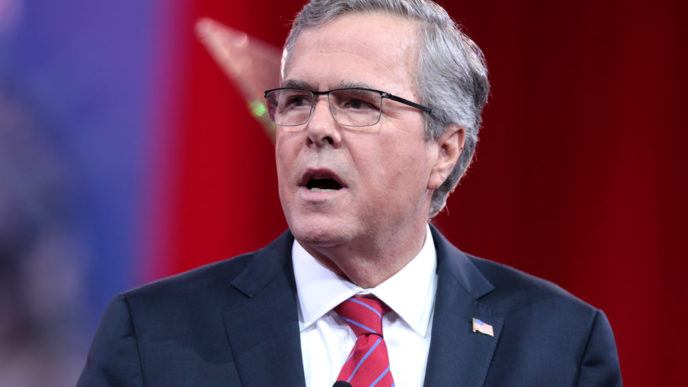
Jeb Bush Expresses Doubt Over Russian Influence in Presidential Election

Former Florida Gov. Jeb Bush made it clear Monday night that he takes claims of Russian meddling in the presidential election with a grain of salt.

“The Ruskies are out there sticking things in people’s brains?’ I mean, come on,” Bush said during an appearance Monday in Kingsport, Tenn.

Bush, a candidate in the Republican primary, said the election was not about who the Russians wanted to win, but who America’s voters chose.

“They [the Russians] had a candidate that they thought would be better than Hillary Clinton, but they didn’t influence the election. The American people made up their minds on this,” he said.

Bush also refused to join the chorus of criticism over Trump’s secretary of state choice, Exxon Mobil CEO Rex Tillerson, who has conducted business with Russia and was honored by Russia for his partnership efforts. He said that upcoming hearings will get to the truth.

“My guess is what they’ll find is a guy with vast experience. A patriot. … Someone who will represent the U.S. really, very well,” he said.

Bush, who was a foil for Trump’s jabs throughout the Republican presidential primary process, noted that his opinion of Trump is shifting.

“I didn’t vote for him. I made it clear I wasn’t going to support him. In my mind at that time I didn’t think either candidate passed the threshold of who should be sitting behind that desk in the Oval Office,” Bush said.

“Now, he’s won. My hope and prayer each and every day is that he understands the incredible opportunity he has to serve, that he has a servant’s heart and that he leads,” he added.

Bush said the difference between campaigning and governing will be a test for Trump.

“It’s going to be tough. I hope he realizes his words have big consequences,” he said. “There are a lot of people counting on the restoration of economic lift.”

Bush has even found reason to sound cautiously optimistic.

“He’s appointed some really solid, committed conservatives to his cabinet and for that I’m very grateful,” Bush said. “Our economy has lagged behind because of over regulation and I think his appointments suggest that he’s serious about draining the swamp. So I’m excited about that.”

Bush also said he looks forward to a better healthcare system.

“Obamacare will be repealed, but this is somewhat a question of semantics. You can’t repeal it completely,” Bush said, adding that parts of Obamacare will remain in any new healthcare system. “My guess is this is going to take a few years, so you’ll see, hopefully, something that takes the power out of Washington and empower people to make these decisions.” (For more from the author of “Jeb Bush Expresses Doubt Over Russian Influence in Presidential Election” please click HERE)

Follow Joe Miller on Twitter HERE and Facebook HERE.

6 Months After the Orlando Attack, Has the FBI Forgotten About the Terrorist’s Wife?

Six months ago, 29-year-old Omar Mateen walked into the Pulse nightclub in Orlando and committed the deadliest single-shooter mass shooting in American history.

The ISIS-inspired Mateen — born in New York to Afgan parents — stormed into the LGBT club on June 12 and massacred 49 people, wounding 53 more.

Evidence remains that his second wife and now-widow, Noor Salman, was an accomplice to the crime. Yet, she remains free and is believed to be in hiding somewhere in the United States.

For reasons unclear, federal authorities have not yet pressed charges against Salman and have kept the American people in the dark concerning this case since June.

Here’s what we know about the Palestinian-born Salman’s ties to the worst terrorist attack on American soil since 9/11.

Before the attack

Before the shooting, Salman reportedly drove with her husband all the way to Orlando — an hour drive from their home in Fort Pierce — to case several sites. That included the Pulse nightclub, she admitted to the FBI in the aftermath of the attacks.

At around the same timeframe, she was with Mateen when he stocked up on ammunition. Prior to the jihad at Pulse nightclub, Mateen added Salman to his life-insurance policy and made sure she had access to his bank accounts, additional reporting states.

The night of terror

Salman, 30, reportedly told the FBI that on the night of the attack that she feared her husband would do something horrible. But she did not alert authorities.

Moreover, Mateen specifically told his wife he was going to “carry out a jihadist attack.” Salman, however, has denied any prior knowledge of the Orlando plot.

“FBI investigators don’t believe Noor Salman was a co-conspirator in the attack that killed 49 people Sunday morning at Pulse,” CNN reported.

After the attack

Noor Salman reappeared in public view a few days later. With a grey sweater pulled over her face, she walked into the home she shared with Mateen and their 3-year-old son to gather their belongings.

Local news outlet WFTV reported on June 14 that Salman could be on the verge of arrest and charged as an accessory to the crime, but that arrest never happened.

On June 20, Attorney General Loretta Lynch shockingly revealed that she had no idea about Salman’s whereabouts. “I believe she was going to travel but I do not exactly know her location now,” Lynch stated. Her statement led to speculation that Salman had fled the country for Jordan or the West Bank. But it appears she is still somewhere in the United States.

The interview

Noor Salman broke her long silence in an exclusive interview with The New York Times on Nov. 1.

“She has moved three times since the attack, hoping to avoid the news media, and asked that her current location not be disclosed,” the Times story, with a dateline of “Washington,” reported.

Salman still denies any involvement or advance knowledge of the jihadi onslaught. That is in direct conflict with previous reports.

“A law enforcement official told ABC News that she may have known something about the incident in advance but claims she tried to talk him out of the assault,” ABCNews.com reported on June 14.

She admitted in the NYT interview she knew Mateen had shown increasing signs of radicalization. Officials who secured his electronic records said he would frequently watch sermons by the late al Qaeda preacher Anwar Al Awlaki, and ISIS propaganda.

The New York Times positions Salman as a victim of Mateen’s domestic abuse who was simply “too busy trying to survive.” Nowhere in the interview does she discuss her reported comments to federal officials about casing possible attack sites with her late husband, and other evidence connecting her to the crime, claiming her lawyer would not let her discuss it.

“How can someone be capable of that?” Salman told the Times, concluding her interview, having addressed none of the circumstantial evidence connecting her to the crime.

What’s next?

A 2013 study of terror incidents in the United States and Europe found that in 64 percent of cases, relatives and/or friends had advance knowledge of the coming terror. Is Noor Salman a member of the 64 percent?

The FBI has not updated any information pertaining to Noor Salman’s status since late June. There is no publicly available information regarding a possible investigation, and when Conservative Review contacted the FBI to ask about any update to the case, a spokesperson said the Pulse investigation is still ongoing, and that policy does not permit them to comment on any ongoing investigation.

Our government has left the American people completely in the dark about a possible co-conspirator to the worst terror attack since 9/11. (For more from the author of “6 Months After the Orlando Attack, Has the FBI Forgotten About the Terrorist’s Wife?” please click HERE)

Follow Joe Miller on Twitter HERE and Facebook HERE.

Conservatives Split From GOP Leaders Over Timing of Obamacare Repeal

GOP lawmakers on Capitol Hill are committed to using a budget tool called reconciliation to send a bill repealing Obamacare to President-elect Donald Trump’s desk.

Though Republicans are settled on getting rid of the Affordable Care Act, fault lines have emerged between GOP lawmakers who disagree on when exactly the health care law should be repealed and, to a lesser extent, which Obamacare provisions to include in the reconciliation bill.

On one side are Republicans like Sens. Orrin Hatch of Utah and Susan Collins of Maine, who have said they would like to see enactment of Obamacare’s repeal delayed until 2019 or beyond, which would give the GOP-led Congress time to craft, pass, and implement a replacement for the health care law.

“I’d like to do it tomorrow, but reality is another matter sometimes,” Hatch, who chairs the Senate Finance Committee, told The Washington Post. “We have to live with the real world, and the real world right now is that the Democrats won’t help with anything.”

But opposite those Republicans are conservatives like Reps. Mark Walker and Mark Meadows, both from North Carolina, who want to see repeal enacted in the first few months of Trump’s administration.

“We need to show some urgency,” Walker told The Daily Signal. “I won’t put it in how many days, but over the first few months, the repeal needs to be enacted out of the gate.”

Unlike Walker, who will take over as chair of the Republican Study Committee next year, Meadows has mapped out a timeline to repeal the health care law within Congress’ first 100 days, then pass and implement a replacement over a span of roughly 17 months.

“We need to have a very aggressive timeline on repeal,” Meadows, who recently took over as chairman of the House Freedom Caucus, told The Daily Signal. “What I would be hopeful for is a replacement that would come shortly after that, but to combine the two would be a mistake in that it would slow down the repeal process.”

Republicans plan to use reconciliation—which allows a bill to pass the Senate with just 51 votes—to repeal Obamacare, and are looking to pass a reconciliation bill during the first days of the 115th Congress, which begins Jan. 3.

They now have the support of the White House.

During an interview with radio host Hugh Hewitt on Wednesday, Reince Priebus, President-elect Donald Trump’s incoming chief of staff, signaled that the Trump administration agrees that Congress should use reconciliation within the administration’s first nine months to repeal Obamacare.

“We’re probably going to lead with Obamacare repeal and replace,” Priebus told Hewitt. “Then we’ll have a small tax reform package at the end of April. So I think what you’re looking at between two tax reform packages and reconciliation in the first nine months … what essentially comes down to three basically different budget packages.”

Though most agree that the dismantling of the 2010 health care law should come before Congress starts to tackle the proposal to replace Obamacare, others say that a delayed enactment for repeal occurring in 2019 or beyond would ease the transition for those currently enrolled in plans purchased on the exchanges.

Under Meadows’ timeline, leaders in the House and Senate would draft reconciliation instructions—which tell budget leaders what to include in the bill—and pass the legislation within their first 14 legislative days.

Repeal would then take place within the first 100 days, which Meadows said would provide insurers time to begin crafting plans for 2018 that aren’t required to adhere to the insurance mandates created by the Affordable Care Act.

Those regulations, opponents of the health care law say, caused the cost of premiums to rise.

Under Meadows’ plan, implementation of a replacement would happen over the span of roughly 17 to 18 months, which would allow the Trump administration to work through new regulations for the 2019 plan year.

“Adjusting in six months, that’s a herculean leap,” Meadows said. “Adjusting in a 17- to 18-month time frame is certainly something that all the insurance providers can do, and they’ve been asked to do much more in adjusting to the Affordable Care Act with less specificity coming from the Department of Health and Human Services.”

Already, Meadows said he is seeking input from at least two insurance providers on a viable plan to repeal and replace the law.

While the North Carolina Republican believes their contribution will present congressional leaders with a “compelling case” as to why the law needs to be rolled back quickly, he’s adamant that leaving it in place for even a few years will hurt consumers.

“A gradual wind down will still create perverted markets with regards to health insurance,” Meadows said. “I don’t know of any argument that would suggest that a three- to five-year wind down will make it less onerous on the American people.”

A Place to Start

Budget leaders and staff are already discussing what should be included in the reconciliation bill that would repeal Obamacare, and they’re using the legislation crafted in 2015 and subsequently passed by Congress as a blueprint.

That reconciliation bill repealed the individual and employer mandates, Medicaid expansion, and Cadillac and medical device taxes. The legislation also stripped the government of its authority to operate the federal and state-run exchanges, and lessened the fine for failing to comply with the mandates to $0, which was needed to abide by Senate rules.

Through that legislation, Republicans already charted a successful course for repealing Obamacare, one that received the stamp of approval from the Senate parliamentarian.

But both Walker and Meadows, along with Sen. Mike Lee, R-Utah, believe that the bill crafted next year should go further.

“That’s the minimum,” Walker said of the 2015 bill. “That needs to be the starting place, not the ending place.”

In an op-ed for National Review, Walker and Lee called for the next reconciliation bill to also repeal Obamacare’s insurance mandates, which include the essential health benefits requirement, the ban on limiting or denying coverage to consumers with pre-existing conditions, and the contraception mandate.

“When government bureaucrats and politicians decide that every insurance policy must cover free doctor visits and abortifacients, Americans who don’t need those options end up paying more for products they don’t want,” Walker and Lee wrote. “That’s great for the insurance companies, but not for taxpayers or consumers.”

Abortifacients are drugs that cause abortions.

There is skepticism as to whether a repeal of the insurance mandates would pass muster with the Senate parliamentarian, who has the authority to strike out parts of a reconciliation bill.

But the trio of Republicans believe that lawmakers should at least attempt to eliminate the mandates.

“To leave some of these aspects in place is not an excuse the American people are ready to accept,” Meadows said.

Dissent

Both Meadows and Walker told The Daily Signal that though they would like to see a reconciliation bill for next year go further than that passed in 2015, they would still support a bill that mirrors the one crafted more than one year ago.

But Sen. Rand Paul, R-Ky., is threatening the GOP’s ability to pass the budget resolution—one that would include the reconciliation instructions to repeal Obamacare.

In an op-ed in Time, Paul pledged to vote against the budget resolution.

“I will not vote for any budget that doesn’t have a plan to balance, regardless of what is attached to it, and I’m calling on other conservatives in the Senate to take the same stand,” the Kentucky Republican said.

Just 51 votes in the Senate are needed for the budget to pass, and Republicans hold 52 seats in the 115th Congress.

Democrats and independents hold a total of 48 seats, so if Paul and one other GOP senator decide not to support the fiscal roadmap, Vice President-elect Mike Pence would be the tiebreaker.

But waiting for Pence to vote would mean the bill repealing Obamacare couldn’t be voted on until after he and Trump are sworn into office on Jan. 20.

So far, it doesn’t appear that Paul has support from other conservatives.

Meadows and Walker said they support Paul’s calls for a balanced budget, but wouldn’t go so far as to oppose the budget resolution that would be the vehicle for Obamacare’s repeal.

“Am I with him in terms of believing that a debt ceiling increase and a future budget must balance and must be on a path to balancing? Without a doubt,” Meadows said, “so it may be more a tactical question of difference versus a strategic question that we differ on.”

Additionally, many conservatives in both chambers, including Lee, voted in support of the budget resolution for 2016 specifically because it instructed congressional leaders to draft a reconciliation bill repealing Obamacare. (For more from the author of “Conservatives Split From GOP Leaders Over Timing of Obamacare Repeal” please click HERE)

Follow Joe Miller on Twitter HERE and Facebook HERE.
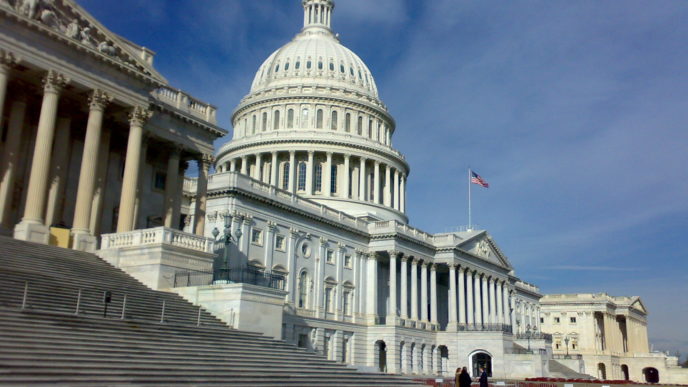
Term Limits Would Infuse Congress With ‘New Blood,’ Lawmakers Argue

Two conservative lawmakers plan to fight for term limits in the next Congress, saying the effort will foster accountability and complement President-elect Donald Trump’s promise to “drain the swamp.”

Sen. Ted Cruz, R-Texas, and Rep. Ron DeSantis, R-Fla., announced they will introduce a constitutional amendment that would limit members of the House to three two-year terms and members of the Senate to two six-year terms.

“This is the same amendment that Donald Trump endorsed during his campaign,” DeSantis said in a phone interview Tuesday with The Daily Signal. “It is the same amendment that is supported by groups like U.S. Term Limits Inc.”

Enacting term limits, DeSantis said, will “force new blood into the Congress.”

DeSantis and Cruz formally unveiled the initiative in an op-ed published Friday by The Washington Post.

The lawmakers said their goal is to end an era of career politicians.

“We believe that the rise of political careerism in modern Washington is a drastic departure from what the founders intended of our federal governing bodies,” Cruz and DeSantis wrote. “To effectively ‘drain the swamp,’ we believe it is past time to enact term limits for Congress.”

It’s a long road, as Heritage Foundation scholars Hans von Spakovsky and Elizabeth Slattery have written about amending the Constitution.

A constitutional amendment may be proposed by two-thirds of both the House and Senate or by a national convention called by Congress at the request of two-thirds of the state legislatures. Either way, three-fourths of the states must ratify an amendment—and Congress decides whether state legislatures or state ratifying conventions take those votes.

Term limits will help address the issue of establishment politicians, DeSantis told The Daily Signal.

“The fact of the matter is the election system is designed and the rules are designed by incumbents to protect incumbents, that’s just the reality,” DeSantis said, adding:

So, if you look at the House of Representatives, for example, 90 percent of the seats are going to go to one party over the other just because of demographics and other issues. The only chance you have to really defeat an incumbent … is in a primary.

Term limits already enjoy substantial public support, DeSantis and Cruz said in their op-ed.

They cite a Rasmussen Reports survey finding that 74 percent of likely voters support congressional term limits. Only 13 percent oppose term limits and another 13 percent say they are undecided.

Unlike some initiatives introduced by conservative lawmakers, this one may enjoy bipartisan support.

Rep. Anna Eshoo, D-Calif., reportedly said she would support a discussion of term limits. Rep. John Larson, D-Conn., former chairman of the House Democratic Caucus, praised the precedent set by Republicans in enforcing term limits for lawmakers who lead committees, Politico reported.

“A number of people would say Republicans have struck a better formula for advancement,” Larson said, according to Politico. “And I don’t think it’s a bad thing for leadership at all.”

DeSantis told The Daily Signal that lawmakers who don’t support term limits will have to answer to their constituents:

The problem is that when you get up to the political class there are some members that don’t want to be term-limited, and I think there had been a lot of Democrats who have kind of pooh-poohed term limits over the years. The question will be, if we keep it up and get a public vote, are they going to listen to their constituents or are they going to basically just say that we don’t need term limits?

With term limits, lawmakers will have a better shot at reforming the system, the Florida Republican said.

“So, if you have a reform impulse, I think with term limits it will be much easier to be able to enact reform,” DeSantis said. “When you have people that have been around for 40 years, they kind of have their own ways, and it’s much harder to get them to change.” (For more from the author of “Term Limits Would Infuse Congress With ‘New Blood,’ Lawmakers Argue” please click HERE)

Follow Joe Miller on Twitter HERE and Facebook HERE.
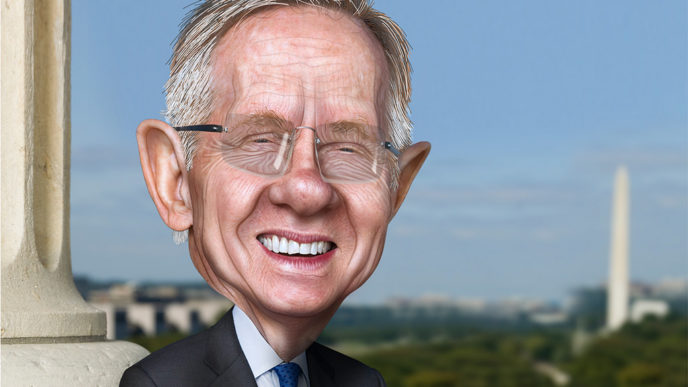
Did Harry Reid Take a $2 Million Bribe? The Feds Won’t Let Investigators Find Out

There are allegations that outgoing U.S. Senator Harry Reid, D-Nev. (F, 2%) may have accepted a massive bribe to push a bill legalizing online poker nationwide in 2010. And the federal government has reportedly “stymied” the investigation into those allegations.

Tom Harvey and Jennifer Dobner report for The Salt Lake Tribune that Davis County Attorney Troy Rawlings is investigating the origins of a $2 million cashier’s check with connections to an online poker company that was laundered through “Mail Media LTD” — an outfit for laundering online-gambling funds — and may have landed in a Marshall Islands bank account in the name of a holding company “to benefit, or even bribe, Harry Reid, the once-powerful majority leader.”

According to their reporting, “state and federal investigations, court filings and public records requests — including audio recordings of interviews and thousands of pages of transcripts, summaries by investigators, emails, requests for evidence and other materials — show that the Department of Justice (DOJ) and the FBI failed to pursue a vigorous investigation of this money and any potential tie to Reid.”

The matter was brought to Rawlings’ attention when “disgraced” businessman Jeremy Johnson confessed that the money came out from a now-defunct business where Johnson and his cohorts illegally processed payments for poker companies. Johnson told FBI agents and Rawlings that Sen. Reid was going to get “a little something extra” in exchange for political help.

Rawlings’ investigation into the route of the $2 million check picked up the trail from two former Utah attorneys general of interest, with the officials’ suspicious actions motivating Rawlings to further pursue the case. Harvey and Dobner of the Tribune report:

The available evidence contains no direct connection between the money and the Nevada Democrat, only that Rawlings wants to dig into that possibility.

Federal authorities have stymied his effort, leaving Rawlings to wonder why. Were agents ordered to steer clear of that money trail? And, if so, by whom? In short, was there a cover-up? […]

Even at the state level, though, Rawlings’ push for funding for a grand jury also has stalled. Attorney General Sean Reyes’ office has not turned over any funds for such an inquiry despite months of negotiations.

Johnson had claimed to authorities at the time of Reid’s contentious 2010 reelection bid against Republican Sharon Angle, his company SunFirst was asked to distribute poker funds to Reid through various donors at a July 6, 2010 fundraiser.

The Salt Lake Tribune documents the following events thereafter:

Reid, according to Johnson, told the crowd — including Bitar, Ifrah and Poker Players Alliance Executive Director John Pappas — that he was switching positions and would now support legislation to ensure that online poker was legal at the federal level. Pappas said in an interview that he didn’t remember what Reid said at the meeting.

In his multiple accounts of the meeting, and specifically in a February 2014 interview with two FBI agents, Johnson has said, “Harry Reid is going around meeting people and saying ‘Hi’ and I was standing next to one of Ray’s entourage and I’m like, ‘How did you guys get Harry Reid to go against his own constituents and do this?’ and he’s like, ‘Well, let’s just say he’s getting a little something extra in his retirement fund.'”

Attorney Troy Rawlings has asked federal agencies for evidence linking Reid to this bank account. But while they have been happy to investigate other figures of interest, they have blocked efforts to gain information about the Democratic Senate minority leader: “Rawlings said he has been told by federal authorities to ‘forget Harry Reid.’”

A month after Sen. Reid’s reelection in 2010, he began campaigning in Congress to legalize online poker.

According to Tom Harvey and Jennifer Dobner, “Reid’s spokeswoman did not return emails and a phone message seeking comment for this story. Previously, his office called any bribery allegations “unsubstantiated” and accused Rawlings of grandstanding to advance his political career.” (For more from the author of “Did Harry Reid Take a $2 Million Bribe? The Feds Won’t Let Investigators Find Out” please click HERE)

Follow Joe Miller on Twitter HERE and Facebook HERE.

Forty Electoral College Members Now Calling for Intelligence Briefing Before They Vote

Thirty additional members of the Electoral College signed their names to a letter Tuesday demanding an intelligence briefing prior to casting their votes for president Dec. 19.

Forty electors have now signed the letter, all of them Democrats with the exception of one Republican, according to The Hill.

As reported by Western Journalism, a group of 10 electors requested more information Monday about the ongoing investigation regarding what influence the Russians may have had in the presidential election.

In an open letter addressed to Director of National Intelligence James Clapper, the electors stated they would need additional details before meeting Dec. 19 to formally vote for the country’s next president.

Christine Pelosi, the daughter of House Minority Leader Nancy Pelosi, is one of the electors leading the effort.

The letter reads, in part: “The Electors require to know from the intelligence community whether there are ongoing investigations into ties between Donald Trump, his campaign or associates, and Russian government interference in the election, the scope of those investigations, how far those investigations may have reached, and who was involved in those investigations.”

“We further require a briefing on all investigative findings, as these matters directly impact the core factors in our deliberations of whether Mr. Trump is fit to serve as President of the United States,” the letter continues.

It concludes, “Additionally, the Electors will separately require from Donald Trump conclusive evidence that he and his staff and advisors did not accept Russian interference, or otherwise collaborate during the campaign, and conclusive disavowal and repudiation of such collaboration and interference going forward.”

The campaign of Democrat Hillary Clinton is backing the effort by the electors.

On Fox News Sunday, President-elect Trump was asked about a Washington Post story Friday headlined, “Secret CIA Assessment Says Russia Was Trying To Help Trump Win White House.”

“I think it’s ridiculous. I think it’s just another excuse. I don’t believe it. I don’t know why, and I think it’s just — you know, they talked about all sorts of things. Every week, it’s another excuse,” he replied.

“So, why would the CIA put out this story that the Russians wanted you to win?” host Chris Wallace followed up.

“I’m not sure they put it out. I think the Democrats are putting it out because they suffered one of the greatest defeats in the history of politics in this country. And, frankly, I think they’re putting it out. It’s ridiculous,” the president-elect responded.

During the race, the Clinton campaign and fellow Democrats blamed the Russians for being behind the hack of the Democratic National Committee that resulted in embarrassing emails being released by WikiLeaks.

Since the election, the Clinton team has supported Green Party Candidate Jill Stein’s recount efforts in Wisconsin, Pennsylvania and Michigan, despite the former secretary of state’s having described any attempts to undermine or not accept the election results as “horrifying” during a presidential debate in October.

“That is not the way our Democracy works,” Clinton said. “We have been around for 240 years. We’ve had free and fair elections. We’ve accepted the outcome when we may not have liked them and that is what must be expected. … [Trump] is talking down our democracy, and I, for one, am appalled that someone who is the nominee of one of our two major parties would take that kind of position.”

Additionally, the Democrat nominee has pointed to “fake news” and FBI Director James Comey as reasons Trump won the election. (For more from the author of “Forty Electoral College Members Now Calling for Intelligence Briefing Before They Vote” please click HERE)

Follow Joe Miller on Twitter HERE and Facebook HERE.