Obama Political Appointees to Continue as Career Employees Under Trump

After President Barack Obama exits office, at least 88 of his political appointees will likely remain working in the federal government under a Donald Trump administration, according to numbers from the Office of Personnel Management.

From Jan. 1, 2010, through Sept. 30, 2016, federal agencies selected 112 political appointees for career civil service jobs. Of those, the Office of Personnel Management approved 88 and rejected 24.

Unlike political appointees, federal workers in the civil service system are hired through a merit system, are difficult to fire, and carry over during administration changes, Republican or Democrat.

Political appointees are allowed to transition to career federal jobs, but under the law, they are supposed to go through the same merit-based selection process as other applicants.

“Selecting civil servants based on ideology instead of qualifications results in a less effective, more politicized bureaucracy,” Henry Kerner, assistant vice president of Cause of Action Institute, said in an email to The Daily Signal Tuesday. “Burrowing also provides the outgoing presidential administration the ability to reward its allies by stacking agencies with politically-aligned people who will be less inclined to help implement the new administration’s priorities.”

After an agency has hired a political appointment to a career position, the conversion has to face final approval by the Office of Personnel Management.

“Federal guidelines require agencies to seek approval from [the Office of Personnel Management] for such moves, but it’s unclear how often these rules are followed,” Kerner added.

Office of Personnel Management spokeswoman Laura Goulding said the number could be higher.

“It’s difficult to provide an accurate number of Obama administration employees who may be in the process of converting, since it changes by the day,” Goulding told The Daily Signal.

She added, “We don’t know how many political appointees apply for permanent federal positions; we just see the number of selectees. [The Office of Personnel Management] has checks and balances in place to ensure cases requiring pre-appointment review are submitted to OPM for approval.”

An Obama administration political employee, who converted earlier this year to a civil service job in the Department of Veterans Affairs, could be playing a role in the presidential transition.

This could at least violate the spirit of the policy on presidential transitions, which is supposed to minimize partisanship, according to the Cause of Action Institute, a conservative government watchdog group.

The organization is more broadly investigating how many political appointees are moving into career civil service positions, a practice known as “burrowing.” The watchdog has made a Freedom of Information Act request to both the Office of Personnel Management and the VA.

Obama appointed Gina Farrisee in September 2013 to serve in the political job of VA assistant human resources secretary. In May, she converted to the career civil service position of deputy chief of staff—a role she will continue in after Trump takes office.

Before serving in the VA, Farrisee was an Army veteran and was awarded several military decorations. She served as the commanding general of the U.S. human resources command at Fort Knox, Kentucky.

“According to information obtained by [Cause of Action] Institute, Gina Farrisee, the deputy chief of staff at VA, is apparently a key member of the VA White House transition team that is preparing the agency for the next administration,” wrote Lamar Echols, counsel for Cause of Action, in a FOIA request to the VA. “If true, this arrangement creates the appearance that the transition process will be managed by Obama administration political appointees because Ms. Farrisee was an Obama administration appointee until May 2016.”

That could be a problem because each federal agency is supposed to have two transition leaders, one from the political level and another from the career level.

“In this case, it appears a former political appointee will be playing the role of a nonpartisan career employee, an apparent conflict of interest,” Echols wrote.

Echols’ letter said this could also go against a May executive order by Obama, which said:

The peaceful transition of power has long been a hallmark of American democracy. It is the policy of the United States to undertake all reasonable efforts to ensure that presidential transitions are well-coordinated and effective, without regard to party affiliation.

The VA did not respond to phone and email inquiries from The Daily Signal as of post time to confirm whether Farrisee is part of the transition team.

Goulding, with the Office of Personnel Management, said, “We can’t confirm any specific members of transition teams; we don’t have that information.”

The Obama administration did not follow the rules to avoid political favoritism in hiring a quarter of all Obama administration political appointees into career civil service jobs, according to a Government Accountability Office report issued in September.

The report covered 30 federal agencies from Jan. 1, 2010, through Oct. 1, 2015. According to the report, agencies failed to get final Office of Personnel Management approval when hiring political appointees to career jobs.

“In those instances where the agency did not submit a request for pre-appointment review, [the Office of Personnel Management] informs the agencies in writing of the requirement to conduct a review of the selection post-appointment,” Goulding said, adding:

OPM also works with agencies to increase awareness and understanding of OPM policy in this area. In addition, we are required by law to report to Congress when those individuals who underwent a pre-appointment review were appointed to the career position.

(For more from the author of “Obama Political Appointees to Continue as Career Employees Under Trump” please click HERE)

Follow Joe Miller on Twitter HERE and Facebook HERE.

In Texas, Republicans Fight New Sanctuary Cities in Wake of Trump Victory

In the border state of Texas, the Republican governor and state Legislature are promising to combat a new trend since the election of Donald Trump, in which cities and localities vow to limit how much they assist federal authorities with removing immigrants living illegally in their communities.

Sally Hernandez, the Democratic sheriff-elect in Travis County, home to the liberal state capital of Austin, ran on a platform opposing cooperation with U.S. Immigration and Customs Enforcement (ICE) when it seeks to deport illegal immigrants held in the county jail.

“The sheriff’s office will not be part of a deportation force that sacrifices hundreds and thousands of people, our neighbors, to a broken federal immigration system,” Hernandez said during a Nov. 17 press conference.

She and other city and county elected officials told reporters they wanted to address residents’ “safety concerns” since Trump’s election.

If Hernandez fulfills her pledge, Austin would become the state’s first official sanctuary city, a move that would put her at odds with Texas Gov. Greg Abbott and the Republican-led Legislature. Both plan to pursue policies punishing localities that won’t help the federal government enforce immigration law.

“Governor Abbott looks forward to signing a bill banning sanctuary cities in the state of Texas,”John Wittman, Abbott’s press secretary, said in an interview with The Daily Signal.

The fight in Texas shows how states and cities are defining their own policies in anticipation of Trump’s fulfilling his aggressive campaign promises to crack down on immigration enforcement—including his vow to block federal funding from sanctuary cities.

Withholding Funds

Local governments of cities such as the District of Columbia, Los Angeles, New York City, Chicago, and Boston have said they will not change policies that limit their cooperation with immigration-related requests from the federal government.

The Daily Signal previously reported that Trump has broad tools to encourage localities to play a more proactive role in immigration enforcement.

Republican governors and legislators, emboldened by Trump’s victory, also have ways to coerce cities and counties into working with ICE.

Last year, Abbott announced a policy of withholding certain criminal justice grants from sheriff’s offices that do not fulfill requests from ICE to help federal authorities deport illegal immigrants in local custody.

Wittman said that since the policy’s implementation in November 2015, the governor has not blocked any funding because all local jurisdictions in Texas complied with his order.

But that hasn’t stopped state Republican lawmakers from trying to pass laws punishing sanctuary cities.

Last month, state Sen. Charles Perry filed legislation that would deny state grants to local jurisdictions that do not help the federal government enforce immigration law.

Previous versions of the bill failed to make it out of the Senate, but Perry’s latest legislation is supported by Abbott and Lt. Gov. Dan Patrick, also a Republican.

“I have no doubt this will be one of the earliest bills passed by the Senate this session [beginning Jan. 10],” Perry told The Daily Signal in an interview. “Federal and state politicians should have a remedy of reducing or removing discretionary funding if local jurisdictions are found to have policies explicitly harboring criminal aliens.”

Local Backlash

Yet Trump’s victory has inspired some local Texas leaders to guard against his potential policies.

In Harris County, where Houston is located, Sheriff-elect Ed Gonzalez, a Democrat, campaigned on ending his county’s participation in an ICE program known as 287(g).

That program permits local law enforcement to alert federal authorities when they have suspected illegal immigrants in the county jail, and ask about the immigration status of those they arrest.

Javier Salazar, the newly elected Democratic sheriff of Bexar County, which includes San Antonio, also hinted during his campaign that he would forbid deputies from inquiring about immigration status.

The 287(g) program is controversial, and there are just 32 jurisdictions across the country currently involved with it, but Trump has expressed support for bolstering these partnerships.

In 2012, the Obama administration scrapped an aspect of the program that essentially deputized state and local law enforcement as immigration agents who are allowed to make arrests related to immigration status.

Trump has called 287(g) a “popular” program that he would like to “expand and revitalize.”

“I expect the Trump administration’s Department of Homeland Security to strengthen and expand the 287(g) program,” said David Inserra, a policy analyst at The Heritage Foundation, who supports the program. “Because that program is a memo of understanding from DHS to state and local governments, there is nothing holding the Trump administration back from expanding 287(g) to as far as the budget will allow, and they could request more funding for it.”

Immigration experts have speculated that Trump could bring back another contentious local enforcement program, called Secure Communities, as a way of expanding deportations.

In Secure Communities, federal immigration agents asked local law enforcement agencies to keep illegal immigrants in custody for 48 hours longer than usual so they could be picked up and deported. These requests were known as detainers.

The Obama administration revamped Secure Communities in 2014, asking that local authorities notify ICE only when they plan to release someone from jail whom the government seeks to deport.

It also limited who ICE targets for deportation to illegal immigrants considered to be threats to national security and public safety, those convicted of a felony or multiple misdemeanors, and recent border crossers.

Split Sanctuary

Adrian Garcia, a Democrat who was Harris County’s sheriff from 2009 to 2015, said local law enforcement is not legally obligated to help ICE enforce immigration law.

Garcia warns that state politicians using the threat of withholding money to encourage local assistance with immigration enforcement are putting communities at risk.

“It makes no damn sense, you would hinder agencies from doing their job and catching the people we’re all worried about,” Garcia told The Daily Signal in an interview, adding:

This is a bogus position by the governor and others. A sanctuary implies if you do something wrong, nothing happens to you. In Harris County, if you hurt somebody or rob somebody, you go to jail and you are held accountable. There is no sanctuary in that. So they ought to let law enforcement do their jobs and decide on policies best for their communities.

But A.J. Louderback, the Republican sheriff of Jackson County and legislative director of the Sheriffs’ Association of Texas, said law enforcement shouldn’t risk releasing people ICE wants to deport.

“Any sheriff who has a jail needs to work with the federal government on deporting criminal foreign-born individuals who are in the country illegally,” Louderback told The Daily Signal in an interview. “I hope sincerely that each of the new sheriffs that come in will do their job and take their constitutional oath seriously. Our responsibility is to protect our public from criminal activity.” (For more from the author of “In Texas, Republicans Fight New Sanctuary Cities in Wake of Trump Victory” please click HERE)

Follow Joe Miller on Twitter HERE and Facebook HERE.

Did Donald Trump Really Agree with Barack Obama That People Shouldn’t Make Too Much Money?

On Tuesday morning, President-elect Donald Trump Tweeted that Boeing’s effort to construct a new Air Force one for future presidents was too expensive:

Later in the day, he added, “we want Boeing to make a lot of money, but not that much money.”

The implications of this Tweet were heavily debated throughout Tuesday. Some, like The Washington Free Beacon — disclosure: this reporter is a contributor to The Free Beacon — suggested that he agreed with the president, who has said, “I do think, at a certain point, you’ve made enough money.”

On the surface, the Beacon is looking at similar comments: two wealthy men who are or will be president of the United States, neither a proponent of the free market, criticizing those who desire to make lots of money.

However, a deeper look indicates that Trump was looking out for the taxpayers, while Obama was expressing a personal opinion about income.

Why Target Boeing?

One of the nation’s largest defense contractors, Boeing receives billions in military contracts. Contrary to Trump’s Tweet, the company says that the Air Force One project is budgeted for $2.1 billion through 2021, though the Secretary of the Air Force said that the Air Force One construction will take about a decade. Reuters reports that the cost of two planes plus related research and development makes an accurate estimate difficult.

Trump might be wrong about the exact dollar amount for the contracts, and whether they are over-budget is something we won’t know for sure until the projects are completed a decade from now. However, Americans should not automatically consider Boeing a victim.

They are a major of a Department of Defense contracting system that is woefully inefficient, and they profit from the taxpayer-backed Export-Import Bank. This allows the company to take risks while putting average Americans at risk if the bank lost money. Additionally, it was heavily criticized for taking advantage of the Obama administration’s Iran deal to sell billions in planes to Iran.

Obama Versus Trump

On the surface, Trump’s comments express a similar opinion about income as Obama. However, as the folks at The Right Scoop pointed out, context creates a lot of space between Obama and Trump. The President-elect appears to be talking about Boeing costing taxpayers too much money. Obama was expressing a personal opinion that income should be halted at a certain point in general.

But even The Right Scoop didn’t entirely get it right. Here is more of what Obama said in the relevant speech, which was made about financial reform in 2010. “I want to be clear, we’re not trying to push financial reform because we begrudge success that’s fairly earned.”

I mean, I do think at a certain point you’ve made enough money. [Laughter.] But part of the American way is you can just keep on making it if you’re providing a good product or you’re providing a good service. We don’t want people to stop fulfilling the core responsibilities of the financial system to help grow the economy.

In other words, the president was expressing a personal desire about income, even as he said he doesn’t “begrudge success that’s fairly earned.” While he clearly does “begrudge success that is fairly earned” — as seen in his efforts to tax those who are honestly wealthy while simultaneously helping cronies become wealthier through the government bureaucracy — the statement he made does not make him “a socialist moron,” to quote The Right Scoop.

Trump’s Tweet a Good Sign of Times to Come?

At the risk of falling into the trap of assuming a Trump policy based upon a single Tweet and a brief statement, both made before he enters office, I hope that the president-elect will do what no president has been able to do: Reform our bloated and inefficient contracting system.

Holding Boeing and other contractors accountable to the taxpayers is very different than the tax bribes Trump negotiated with Carrier to keep some jobs inside the United States. The latter violates basic free market principles, much like Trump’s proposed protectionist policies.

Taking on Boeing is simply good policy and good politics — Trump’s Tweet came less than 12 hours after The Washington Post reported that the Pentagon hid a report whose authors recommended $25 billion in annual administrative savings for the nation’s military. (For more from the author of “Did Donald Trump Really Agree with Barack Obama That People Shouldn’t Make Too Much Money?” please click HERE)

Follow Joe Miller on Twitter HERE and Facebook HERE.
Trump’s Mexico Border ‘Wall’ Vanishing as GOP Lawmakers Bolt

The Mexican border wall that Donald Trump promised in the campaign doesn’t really have to be a wall, says Representative Dennis Ross, a member of the president-elect’s transition team.

“The ‘wall’ is a term to help understand it, to describe it,” says Ross, a Florida Republican, adding that it “really means ‘security.’ It could be a fence. It could be open surveillance to prevent people from crossing. It does not mean an actual wall.”

Even the president-elect’s closest allies in Congress are working to redefine Trump’s top campaign promise, which many view as too costly and impractical for securing the 1,933-mile border with Mexico. Most illegal immigration can be halted with fencing, more Border Patrol agents and drones, they contend. House Speaker Paul Ryan on Sunday suggested using approaches that simply make the most sense . . .

House Homeland Security Chairman Michael McCaul said Wednesday, “We are going to build the wall. Period.” But he also described his plan, which he plans to propose next year, as a “historic, multi-layered defense system so that drug cartels and terrorists don’t skip through the cracks.”

“That means more Border Patrol agents, new authorities, aerial surveillance, sensors and other technology to protect our territory,” said McCaul of Texas at the Heritage Foundation in Washington. (Read more from “Trump’s Mexico Border ‘Wall’ Vanishing as GOP Lawmakers Bolt” HERE)

Follow Joe Miller on Twitter HERE and Facebook HERE.

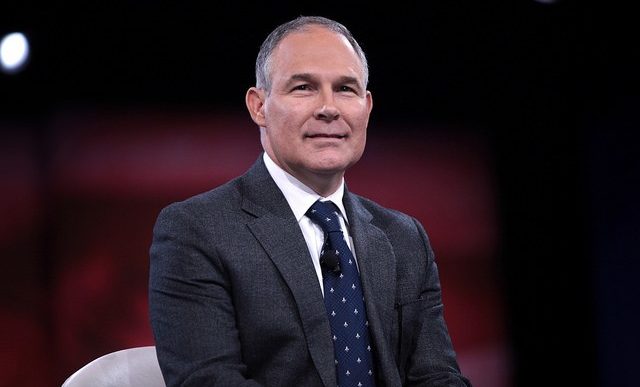
Trump’s Pick for EPA Has a History of Fighting the Agency

President-elect Donald Trump reportedly has nominated Oklahoma Attorney General Scott Pruitt to head the Environmental Protection Agency.

Pruitt is known for waging legal battles against the EPA over its climate change agenda, suggesting that Trump could intend to make good on his promise to “get rid of [the agency] in almost every form.”

Pruitt, a Republican, led the charge in the states’ fight against what he considers an overreach by the EPA on issues including the Clean Power Plan, which aims to combat global warming; the Waters of the United States rule, which aims to protect wetlands and waterways; and the Renewable Fuel Standard, which aims to reduce greenhouse gas emissions.

He has publicly expressed skepticism about climate change science, and supports the notion that the debate is “far from settled.”
The possibility of undoing a series of rules and regulations established under the Obama administration immediately caused alarm among green groups on the left.

“The mission of the EPA and its administrator requires an absolute commitment to safeguard public health and protect our air, land, water, and planet,” said Rhea Suh, president of the Natural Resources Defense Council. “If confirmed, Pruitt seems destined for the environmental hall of shame.”

“Having Scott Pruitt in charge of the U.S. Environmental Protection Agency is like putting an arsonist in charge of fighting fires,” added Michael Brune, executive director of the Sierra Club. “He is a climate science denier who, as attorney general for the state of Oklahoma, regularly conspired with the fossil fuel industry to attack EPA protections.”

Karl Rove, a former senior adviser under the George W. Bush administration, came to Pruitt’s defense, congratulating Trump “on another superb pick.”

“About time for sensible regulator again at such powerful agency,” Rove tweeted.

Pruitt has been criticized for having cozy relationships with energy companies. In 2014, The New York Times reported a letter he sent to the EPA was written “almost entirely” by Devon Energy, a natural gas and petroleum producer.

But in the face of criticism, Pruitt responded: “It should come as no surprise that I am working diligently with Oklahoma energy companies, the people of Oklahoma, and the majority of attorneys general to fight the unlawful overreach of the EPA and other federal agencies.”

Pruitt, who serves in one of the biggest oil and natural gas states in the country, has also been active in defending companies who express skepticism about climate change science.

In March, a group of state attorneys general formed a coalition to “criminally investigate energy companies for disputing the science behind global warming.”

Pruitt, along with Alabama Attorney General Luther Strange, came to the defense of the companies. In a statement, they voiced strong opposition to a coalition they said is an attempt to “use the law to silence voices with which we disagree.”

“Reasonable minds can disagree about the science behind global warming, and disagree they do,” Pruitt and Strange said in a statement. “This scientific and political debate is healthy, and it should be encouraged. It should not be silenced with threats of criminal prosecution by those who believe that their position is the only correct one and that all dissenting voices must therefore be intimidated and coerced into silence.”

Pruitt was elected as attorney general in Oklahoma in 2010, and before that served as a conservative in the Oklahoma state Senate.

In addition to prosecuting the EPA, Pruitt has challenged the Affordable Care Act and the Obama administration’s transgender bathroom guidance. (For more from the author of “Trump’s Pick for EPA Has a History of Fighting the Agency” please click HERE)

Follow Joe Miller on Twitter HERE and Facebook HERE.

Trump Picks Retired Marine General as Homeland Security Secretary

President-elect Donald Trump has chosen retired Marine Gen. John F. Kelly to lead the Department of Homeland Security, news organizations reported Wednesday.

If nominated and confirmed, Kelly would join a Cabinet that already promises to be well represented by military figures.

Trump has announced his selections of retired Marine Gen. James N. Mattis for secretary of defense and retired Army Lt. Gen. Michael T. Flynn for national security adviser.

“That would be the third general in the top echelon of the emerging Trump administration, indicating his preference for military experience, expertise, and accountability,” Major Garrett, chief White House correspondent for CBS News, said in discussing Trump’s choice of Kelly.

Kelly has served for over 40 years in the military and recently retired from his role as commander of U.S. Southern Command, or Southcom.

U.S. Southern Command, according to the Department of Defense, oversees “all Defense Department security cooperation in the 45 nations and territories of Central and South America and the Caribbean Sea, an area of 16 million square miles.”

In this role, Kelly acknowledged the widespread issue of drug trafficking and said he believes in continuing a partnership with Colombia to end drug trafficking, a debate he will likely have to revisit during confirmation hearings for the Department of Homeland Security job.

“Let’s not throw away a success story,” Kelly said during a Pentagon news conference in January, speaking about Colombia’s partnership with the U.S. in fighting drug trafficking, according to an article published by the Defense Department. “We have to stand and continue Plan Colombia, in my opinion, for another 10 years.”

Plan Colombia, established by Congress in 2000, is a cooperative alliance with Colombia that works to combat drugs, guerrilla violence, and social issues.

Kelly also says that he is devoted to fighting terrorism, and that attacks similar to 9/11 are likely to happen again.

“Given the opportunity to do another 9/11, our vicious enemy would do it today, tomorrow, and every day thereafter,” Kelly said in 2013 during a Memorial Day address, according to a tweet by a Washington Post reporter.

“I don’t know why they hate us, and frankly I don’t care, but they do hate us and are driven irrationally to our destruction,” Kelly said.

Kelly’s dedication to the military has not come without sacrifices, however.

Kelly’s son, Marine 1st Lt. Robert Michael Kelly, died after he stepped on a concealed bomb in Afghanistan in 2010, making the senior Kelly “the highest-ranking military officer to lose a son or daughter in Iraq or Afghanistan,” according to The New York Times.

During his son’s funeral, Kelly said that terrorism is “an enemy that is as savage as any that ever walked the earth,” the Los Angeles Times reported.

Kelly reaffirmed his commitment to fighting terrorism during a speech he gave in 2013 at the 5th Marine Regiment Operation Enduring Freedom Memorial dedication ceremony at Camp San Mateo Memorial Garden in Camp Pendleton, California. The memorial honors those who died while serving with 3rd Battalion and 5th Marines in Afghanistan, including Kelly’s son.

“Our nation is still at war, and I think will be for years, if not decades to come,” Kelly said. “It may be inconvenient to some, but I think it is reality. It is not in our power to end it but simply to fight it until our murderous enemy who hates us with visceral disgust for everything we stand for either gives up or we kill them.” (For more from the author of “Trump Picks Retired Marine General as Homeland Security Secretary” please click HERE)

Follow Joe Miller on Twitter HERE and Facebook HERE.

OOPS: Michigan Recount Appears to Expose Industrial-Scale Democrat Vote Fraud

Over half of Detroit’s 662 voting precincts may be ineligible for the ongoing Michigan recount, since the number of ballots in precinct poll books do not match those from voting machine printout reports.

More than a third of precincts in Wayne County, Michigan’s largest county and home to Detroit, could be disqualified from the statewide recount because county officials, “couldn’t reconcile vote totals for 610 of 1,680 precincts during a countywide canvass of vote results late last month,” according to the Detroit News.

Wayne County has over 1.7 million residents and voted overwhelmingly for former Secretary of State Hillary Clinton, at 95 percent. Krista Haroutunian, chair of the Wayne County Board of Canvassers, told the Detroit Free Press that the discrepancies could make 610 precincts across the county (including the 392 in Detroit), ineligible for recount. A final decision has not yet been made.

The Michigan Republican Party, President-elect Donald Trump and the state’s Republican attorney general all filed notice that they plan to appeal a U.S. District Court decision to start the recount Monday, arguing the effort should not be decided by the federal courts system. (RELATED: Michigan GOP Files Appeal To Stop Recount)

“This is a Michigan issue, and should be handled by the Michigan court system,” Michigan Republican Party Chairman Ronna Romney McDaniel said in a press release. (Read more from “OOPS: Michigan Recount Appears to Expose Industrial-Scale Democrat Vote Fraud” HERE)

Follow Joe Miller on Twitter HERE and Facebook HERE.

Obama’s IRS Commissioner Escapes Impeachment Vote in Congress

The GOP-led House voted Tuesday against impeaching IRS Commissioner John Koskinen, delaying indefinitely the conservative effort to hold President Barack Obama’s top taxman accountable for the targeting of tea party groups.

Koskinen “would have been the first appointed executive-branch official to meet that fate in 140 years.,” had the resolution succeeded, according to Politico.

Conservative lawmakers on Capitol Hill, however, had been pushing for Koskinen’s impeachment.

“We think Mr. Koskinen has to go,” Rep. Jim Jordan, R-Ohio, told The Daily Signal.

Jordan, who has repeatedly called for Koskinen’s impeachment, said the targeting of conservative groups by the IRS is unacceptable. He said Koskinen’s role in the scandal warrants impeachment proceedings.

“Koskinen [was] brought in to clean up the mess, and he has done, in my judgement, just the opposite,” said Jordan, who previously led the House Freedom Caucus.

In the interview, Jordan outlined the corruption he said has occurred on Koskinen’s watch, including “allowing backup tapes to be destroyed that were under subpoena to be given to Congress, not telling [Congress] about Lois Lerner’s missing emails, making statements to Congress that turn out later to be not true.”

Jordan also highlighted a story from a tea party organization in Albuquerque, New Mexico, which has been waiting seven years for the IRS to approve its tax-exempt status.

All of this activity, according to Jordan, is sufficient grounds for Congress to impeach Koskinen.

“When all that happens, and you’re the head of this agency, we think you’ve got to go. So we plan to make a motion [Tuesday] afternoon on the House floor that says that we should bring up impeachment proceedings and an impeachment vote against Mr. Koskinen,” Jordan said.

By filing a motion Tuesday, the conservative lawmakers attempted to force the House to vote before Congress adjourns for the year.

Rep. Mark Meadows, R-N.C., agrees, saying that if that resolution passed, the next Congress would “take it up and judge it on the merits of the argument.”

Meadows, who recently became chairman of the conservative House Freedom Caucus, said this call for impeachment is all about holding government officials accountable for their actions.

President Barack Obama has described efforts to impeach Koskinen “crazy” and Koskinen believes that allegations calling for his impeachment “lack merit.” (For more from the author of “Obama’s IRS Commissioner Escapes Impeachment Vote in Congress” please click HERE)

Follow Joe Miller on Twitter HERE and Facebook HERE.

Obama Sent Someone to Castro’s Funeral, but Not Thatcher’s. Why It Sends the Wrong Message.

President Barack Obama sent high-level administration officials to Cuban dictator Fidel Castro’s funeral procession last week, a gesture of respect he did not offer for former British Prime Minister Margaret Thatcher’s funeral.

After Castro’s death, Obama released a statement saying: “History will record and judge the enormous impact of this singular figure on the people and the world around him.”

The carefully guarded words made no reference to the legacy of tyranny and destruction Castro left for the Cuban people, nor did it explain how much Castro’s communist ideology played a role in the half-century of humanitarian catastrophes during his regime.

As reported in Conservative Review, “Ben Rhodes, the White House deputy national security adviser and one of the president’s closest aides,” was sent to attend Castro’s funeral service along with the U.S. ambassador to Cuba, Jeffrey DeLaurentis.

Rhodes became notorious this spring when he boasted of selling a “narrative” about the U.S.-Iran nuclear deal to journalists to push the president’s agenda through Congress.

He was also a key player in opening up relations between the U.S. and Cuba in 2015, ending a long-standing American policy to isolate the communist nation.

The Obama administration failed to send high-level members to Thatcher’s funeral in 2013, which many British saw as a “snub” of their famous leader. Nor was that the first sharp elbow thrown at legendary British leaders by the Obama administration.

The words and actions of an administration, such as who a president chooses to send to a funeral, have a heightened influence on the global stage without the chief executive ever having to act officially.

As historian Richard Neustadt wrote, paraphrasing President Harry Truman, “presidential power is the power to persuade.” And as Neustadt noted, this power to persuade leads to the more tangible power to negotiate—perhaps the most important presidential role in foreign relations.

That the president seems so willing to symbolically and concretely abandon the “special relationship” the U.S. has had with Britain while going out of the way to tiptoe around the sore spots of the Cuban regime is a reversal of priorities for a nation that stood as a beacon for the free world.

Of course, Castro and Thatcher stood at opposite ends of the Cold War in the ultimate test of freedom against authoritarianism—Castro was a revolutionary communist who battled with the United States for decades and Thatcher was a legendary Cold Warrior who stood shoulder to shoulder with President Ronald Reagan against international communism in the 1980s.

When Thatcher was elected prime minister in 1979, she, along with Reagan, pursued a more confrontational approach to the Soviet Union, which she viewed as a primary global threat to human liberty.

She saw the difference between free countries like the United States and Great Britain and authoritarian regimes like under the Soviet Union and Cuba as fundamental.

Like Reagan, who called the Soviet Union an “evil empire” in a famous 1983 speech, Thatcher rhetorically undermined the tyrannical regimes and indicated that a mere détente with them was unacceptable.

When negotiating with the Soviet Union at the end of the Cold War, Reagan and Thatcher came from a position of strength.

In a 1983 television appearance, the Iron Lady, as Thatcher came to be called, explained the radically different outcomes for people living under these nearly opposite systems of government:

[Nations] that have gone for equality, like communism, have neither freedom nor justice nor equality, they’ve the greatest inequalities of all, the privileges of the politicians are far greater compared with the ordinary folk than in any other country. The nations that have gone for freedom, justice, and independence of people have still freedom and justice, and they have far more equality between their people, far more respect for each individual than the other nations.

Castro’s Cuba has been the very picture of this despotism based on a false “equality,” as Thatcher described.

“Castro’s communism has not just left Cubans economically pauperized, but politically bereft, a situation that Obama’s unilateral concessions to Castro’s little brother, the 85-year-old Raul, Cuba’s present leader, has only made worse,” Heritage Foundation senior fellow Mike Gonzalez wrote for The Daily Signal.

Cuba’s pursuit of communism under Castro crippled the island nation and pushed hundreds of thousands to risk their lives to escape. Thatcher and Reagan’s rhetorical stands against autocracy helped break the power of communism as an international threat as they pushed the Soviet Union to collapse.

But the Obama administration now has sent high-ranking officials to the funeral service of the man who pleaded with Soviet leader Nikita Khrushchev to wage nuclear war against the United States during the 1962 Cuban missile crisis. The system the now-deceased Castro created still exists after his death and continues under his brother.

The simple act of administration officials attending or not attending a state leader’s funeral service communicates a great deal to the world about what a president’s intentions are.

Signaling that free countries like the United States will back off in their condemnation of oppressive, communist regimes like the one propped up by the Castro brothers helps breathe new life into their failed ideology. (For more from the author of “Obama Sent Someone to Castro’s Funeral, but Not Thatcher’s. Why It Sends the Wrong Message.” please click HERE)

Follow Joe Miller on Twitter HERE and Facebook HERE.

Trump’s First 100 Days: His Supreme Court Choice Could Have a Lifetime Impact

President Thomas Jefferson long ago offered a salient if sour lament about members of the Supreme Court: “They never retire, and they rarely die.”

So a vacancy in Washington’s most exclusive club is a time for political opportunity and obstacle. It is also something President-elect Donald Trump must confront in his first 100 days in office as he works to replace the late conservative icon Justice Antonin Scalia.

Sources close to the process say the president-elect is getting close to naming a nominee. He said on Fox News’ “Hannity” last week that he was “down to probably three or four” candidates and an announcement would come “pretty soon.”

“They are terrific people,” he added.” “Highly respected, brilliant people.”

A formal nomination would come after the inauguration. But how successfully Trump and his GOP allies can navigate the confirmation process in the first hectic days of his presidency will depend on how much political air it sucks up, amid other pressing personnel and legislative priorities. (Read more from “Trump’s First 100 Days: His Supreme Court Choice Could Have a Lifetime Impact” HERE)

Follow Joe Miller on Twitter HERE and Facebook HERE.