Want to Take Back Our Sovereignty? Start by Breaking up the Ninth Circuit

The spectacle of the U.S. government having to grovel before the Ninth Circuit to determine whether we are a sovereign nation or not should draw attention to another important initiative: the effort to break up the tyrannical Ninth Circus Court of Appeals.

Believe it or not, the courts did not create themselves. Congress has plenary control over lower courts and the appellate jurisdiction of the Supreme Court. Congress can abolish the lower courts altogether and reroute their cases to state courts. Every aspect of the court system’s structure — administrative procedures, rules of adjudication, methods of interpretation, and logistics of proceedings — can be regulated by Congress in any way. As such, it goes without saying that Congress can, as it has done in the past, modify the geographical jurisdiction of an existing circuit.

The Ninth Circuit cesspool

The time has come to strip the Ninth Circuit down to size. This court is by far the most anti-constitutional circuit amidst a federal judiciary where the majority of the circuits don’t respect the Constitution as written. Most of the members of the Ninth have literally supplanted the written Constitution for an ever elastic set of ethos that are anchored to nothing more than the political values of these unelected judges at the time they woke up that day. Most importantly, what they have done to the sovereign state of Arizona is outrageous. Congress owes it to the good citizens of the Grand Canyon State to free them of the clutches of judicial tyranny.

To begin with, putting politics aside, the Ninth Circuit — which includes Alaska, Hawaii, California, Nevada, Arizona, Oregon, Washington, Idaho, and Montana — is too big. As of the end of FY 2016, there were 13,334 pending appeals before the Ninth Circuit, more than twice the amount of the second busiest circuit (the Fifth) and more than ten times as much as the adjacent Tenth Circuit. The idea of breaking up the Ninth goes back respected figures like current Supreme Court Justice Sandra Day O’Connor, a native Arizonan. Not to mention the fact that the Ninth Circuit is, by far, the most reversed appeals court in the country, making Anthony Kennedy look like James Madison in comparison.

To that end, Rep. Andy Biggs, R-Ariz. (A, 0%) has followed in the tradition of many non-California residents of the Ninth Circuit’s tentacles and introduced H.R. 250 — the Judicial Administration and Improvement Act. This bill would limit the jurisdiction of the Ninth Circuit to California, Washington, Oregon, and Hawaii. A new “twelfth circuit” would be created to oversee appeals from district courts in Arizona, Nevada, Idaho, Montana, and Alaska. Personally, I’d limit the Ninth Circuit to California alone, as was suggested in a bill from a previous Congress, (or better yet, a few square acres in Death Valley), but overall this is a great starting point.

Now is the best time to create a new circuit. With GOP control of the Senate and the filibuster having been eliminated for lower court judges, Trump can flood the zone with originalists (to the extent they exist) and establish the first full circuit that actually follows the law and the Constitution as written. These judges can start fresh, unvarnished from lawless “precedent” of the past.

Cry for Arizona

Arizona is one of the most important states for the judiciary because so many immigration cases emanate from the Grand Canyon State. Words cannot describe how the Ninth Circuit has stolen the sovereignty of Arizona to the detriment of the state’s economy, security, and social cohesion. This officious panel has invalidated every single thing the legislature and the people (through ballot referendum) have done to protect their state. In addition, the Ninth Circuit has forced the state to give driver’s licenses to illegals, offer bail to the most violent criminal aliens, and has blocked the state from requiring proof of citizenship in order to register to vote. The Roberts Supreme Court has not lifted a finger to overturn almost any of the dozen or so decisions from the Ninth Circuit [Scalia and Thomas called them out for it]. With at least 630,000 illegals residing in the state, at a cost of $2.4 billion a year, Arizona is left defiled and helpless in protecting its own residents and even their right to vote in untainted elections.

Indeed, the Trump administration and the GOP Congress owe it to the state to provide them with a new federal appeals court. The Constitution [art. IV, § 4.] requires the federal government to “guarantee to every state in this union, a republican form of government, and shall protect each of them against invasion.” Arizona has been invaded in the worst way possible and they have lost all republican representation by having their sovereignty and right to self-determination denuded by the unelected and unaccountable Ninth Circuit.

As I observed in Stolen Sovereignty [page 100]:

One of the indictments against King George listed in the Declaration was: “He has forbidden his Governors to pass Laws of immediate and pressing importance, unless suspended in their operation till his Assent should be obtained; and when so suspended, he has utterly neglected to attend to them.”

Certainly, when the federal government was created to replace King George as the national authority, they never intended to suppress states from passing laws to protect themselves and their taxpayers, not with a standing army, but at least with their legitimate state law enforcement and power over local issues. In fact, they guaranteed the help of the federal government to protect them from invasion.

In his dissent in Arizona v. United States, Justice Scalia concluded with a rhetorical question: “[W]ould the States conceivably have entered into the Union if the Constitution itself contained the Court’s holding? … if securing its territory in this fashion is not within the power of Arizona, we should cease referring to it as a sovereign State.”

Our founders certainly feared that their experiment might result in the collapse into an executive oligarchy, but they certainly never envisioned powers of King George being wielded by a judicial oligarchy, much less a puny lower court existing at the pleasure of Congress. (For more from the author of “Want to Take Back Our Sovereignty? Start by Breaking up the Ninth Circuit” please click HERE)

Follow Joe Miller on Twitter HERE and Facebook HERE.

Shapiro: Is Trumpism the New Reagan Revolution?

Last week, Ethics and Public Policy Center senior fellow Henry Olson released a revisionist look into the legacy of Ronald Reagan. The purpose: to recast Donald Trump in Reagan’s mold. According to Olson, Trump could be the New Reagan Revolution. Why? Because Reagan was not, in fact, “an anti-government ideologue.” Here is Olson’s breakdown of Reaganism:

Reagan’s conservatism was not a more attractive version of Barry Goldwater’s anti-statist ideology. From the moment Reagan started speaking out as a conservative in the late 1950s, he endorsed an active role for government. He believed that government should care for those who could not care for themselves, build public housing for the poor and expand public universities…Reagan’s conservatism even supported the idea of universal health coverage….Reagan did not shrink from endorsing government action when needed as governor or as president. He raised the gas tax in 1983 to fund road construction and repair. He also imposed sanctions on Japanese industries and companies for what he believed were unfair trade practices even as he sought to extend free-trade agreements throughout the world. Even Reagan’s support for immigration was limited by a belief in protecting U.S. workers….That’s not to say Reagan would have agreed with everything Trump says or does. But the overlap in their views on these issues stems from a broader overlap in philosophy.

And just like that – it’s magic! – Trump is the new Reagan.

Unfortunately, this is a dramatic overstatement of Reagan’s position in order to justify Trump’s. It turns Reagan into a big government advocate. He wasn’t. (Read more from “Want to Take Back Our Sovereignty? Start by Breaking up the Ninth Circuit” HERE)

Follow Joe Miller on Twitter HERE and Facebook HERE.

On Immigration, Winning Cheap Grace

The great theologian Dietrich Bonhoeffer wrote scathingly of “cheap grace,” which is the warm fuzzy feeling we give ourselves, and the praise we win from others, by making little virtue-signals that cost us almost nothing — and might well impose suffering on innocent third parties. Jesus Himself denounced it when He saw it among the Pharisees, but Christians are not immune.

In Bonhoeffer’s time, German pastors won cheap grace by safely denouncing Communist atrocities, while pretending that the same crimes weren’t happening just down the train tracks from their churches, at the hands of their own Nazi government. Catholic philosopher Rene Girard spoke of a similar psychological trick, which he called “victimism,” or the cynical use of weaker people’s suffering to aggrandize yourself and win power.

Speak Soothingly to Power

Cheap grace can always be gained by signing on with the sins that are popular with the powerful, and denouncing some evil that is distant or widely despised. Hence pastors in the segregated South could safely denounce the crimes of Josef Stalin, while ignoring the “strange fruit” that hung in their own towns’ trees after brutal lynchings of black men. How many pastors piled up cheap grace aplenty in the 1980s by fighting apartheid in faraway South Africa, and ignoring the abortion clinics that killed black babies by the thousands right down the street?

Now open borders Christians, such as the media-savvy Fr. James Martin, SJ, are gathering cheap grace in bushel baskets on the subject of immigration. In a shrill, moralistic screed that The Stream already analyzed as contrary to Catholic doctrine, Fr. Martin told Americans that it is simply and blankly un-Christian to secure our country’s borders, enforce its labor laws, or carefully vet refugees to keep out those committed to terrorism or sharia.

That is meant to end the argument, to threaten us with eternal damnation if we don’t accept Fr. Martin’s political program — one which no Christian government has enacted anywhere for almost 2,000 years. As a leader in the movement to really implement Christianity for the first time, ever, on immigration issues, Fr. Martin claims his place as one of the best Christians in history. Or so he would like us to see him.

We Learn, 2,000 Years Late, that Borders are Un-Christian

Does Fr. Martin, or any of the bishops who echo him, really believe that no Christian may vote to secure his country’s borders? Is it sinful for Mexico to police its border with Central America? For Latvia to guard its frontier with Putin’s Russia? For Israel to police the crossing into Jordan? I’ve never read any such statements, and I think I know the reason: It’s perfectly obvious that international borders require the rule of law, that sovereign countries deciding who comes and goes is part of what we must “render unto Caesar.”

It doesn’t harm Fr. Martin, in his cozy Manhattan office, that drug cartels and people smugglers control the U.S.-Mexico border, honeycombing it with tunnels and planting it with “rape trees,” with the clothes ripped off young women. Nor does he find himself exploited in an underground economy, where greedy employers turn away poor American workers with enforceable legal rights, then fill their factories or fields with docile, frightened foreign people whom they can threaten with deportation.

Fr. Martin doesn’t have children whose public school is in chaos, overburdened with the hopeless task of trying to assimilate and educate kids in a dozen different languages. Fr. Martin’s health insurance is covered by the wealthy Jesuit order, so he never needs to worry about what it will cost him to use an emergency ward — at a hospital which treats long lines of undocumented and uninsured workers, and so has to soak its few paying customers to avoid going bankrupt. Fr. Martin will never lose his job at America magazine to a lower-paid foreign priest who came in on an H1-B visa, whom he is forced to train.

The Cheapest Grace in the History of the Church
There is a long list of people, both foreign and American, who pay a heavy price for our blithe acceptance of immigration chaos. Few such people have columns in prestigious magazines, or get hired as faith consultants by Martin Scorcese — which Fr. Martin was, for the movie Silence. (As you’ll read here at The Stream, that movie’s ending was an icy apologia for priests who renounce Jesus, betray the Faith, and make a comfortable living helping pagans to persecute the church.)

Those people exist, from the villages emptied of men in rural Mexico, to the ghettos of America where black and Latino teens cannot find entry-level jobs. But it’s easy to ignore them.

Likewise it’s easy for Fr. Martin and others like him to call for utopian policies, wave Jesus around to silence our reality-based objections, and refuse to examine their real-world impact on the poor and the vulnerable. Better still, they can wield their “high-minded” demands to blunt the force of the growing pro-life movement, by insisting that all of us swallow their Seamless Garment poison pill, before we’re allowed to stop killing a million children each year. That wins them points with their powerful friends like Joseph Biden and Tim Kaine, both Jesuit allies and pro-choice Democrats. So men like Fr. Martin coast through life on a cushion of unearned praise and cultural privilege, while sneering at their weaker fellow citizens as “un-Christian,” cruel, and selfish.

I’ll give this to open borders Christians: They have found the source of the cheapest grace in the history of the church. Simon Magus would be proud. (For more from the author of “On Immigration, Winning Cheap Grace” please click HERE)

Follow Joe Miller on Twitter HERE and Facebook HERE.

Obama’s Lasting, Damaging Legacy: Leftist Judges

Barack Obama may lose his Obamacare legacy when Congress repeals and replaces it, but he has left the nation a far bigger and more damaging legacy. Sen. Charles Schumer (D-NY) gloated in 2014, “one of the most profound changes this Congress made was filling the bench” with Obama’s appointments of federal judges. He went on: “This will affect America for a generation, long after the internecine battles on legislative issues are forgotten.”

Obama is proud of his record. “I am — not to brag — but I have transformed the federal courts from a diversity standpoint with a record that’s been unmatched,” he said. That is mostly true. A scholar of judicial appointments, Sheldon Goldman, observed that “The majority of Obama’s appointments are women and nonwhite males.” Though only 43 percent of his appointments were women, the former president appointed 11 openly gay judges, more than 10 times as many than any other president. (President Clinton appointed lesbian Deborah Batts as a judge on the U.S. District Court for the Southern District of New York in 1994.)

Why does this matter? Everyone focuses on the Supreme Court. But the Supreme Court hears fewer than 100 cases a year. The lower federal courts handle about 135,000 per year. The vast majority of cases decided by the lower courts become law in their respective circuits. A liberal bench there means a huge number of liberal decisions affecting almost every aspect of American life.

Obama’s Liberal Legacy

Obama got 329 federal judges appointed to the circuit and district courts, all lifetime appointments. The Daily Signal characterizes the change in composition of the courts as a revolution that has been “comprehensive, dramatic, and under the radar.” Liberal legal analyst Jeffrey Toobin says Obama’s legal legacy is especially strong in the areas of same-sex marriage and blocking voter identification laws.

When Obama entered office in 2008, only one of the 13 United States Courts of Appeals had more Democratic appointed judges than Republican. 99 circuit court judges had been appointed by Republicans, 65 by Democrats. Now, nine of the appeals courts have more Democratic-appointed judges.

One-third of judges currently serving on the federal bench were appointed by Obama. He got two more judges confirmed than George W. Bush did during his two terms as president. Carrie Severino, chief counsel for Judicial Crisis Network, observed that “Obama was just very aggressive in getting those spots filled.”

Obama appointed left-leaning judges. He stealthily appointed judges who appeared to be non-ideological but then ended up “on the same side as outspoken liberals,” according to conservative legal experts quoted by Politico. The Ethics and Public Policy Center‘s Ed Whelan, for example, noted that between one of Obama’s leftist appointments and his “moderate” appointments, “on a broad range of matters there’s not a dime’s worth of difference.”

But did the Republicans object? Over 200 of Obama’s nominees were confirmed unanimously. Ken Cuccinelli, president of the Senate Conservatives Fund, said Senate Republicans “handed over the keys to the judiciary without a fight.” Republicans successfully filibustered just two nominees.

Not all senators completely caved. Sen. Richard Burr (R-NC) has continued to block one of Obama’s nominees for district court, even though the judgeship has been vacant since 2005. Texas senators Ted Cruz and John Cornyn, both Republicans, objected so strongly to many Obama nominations that many of the vacancies are now considered “judicial emergencies” due to large caseloads.

Changes in the Courts of Appeals

The United States Court of Appeals for the D.C. Circuit (informally considered the 13th circuit) is considered the second most powerful court in the country, after the Supreme Court. It hears cases involving the federal government.

When Obama assumed office, the court consisted of six judges appointed by Republican presidents, three named by Democrats, and two vacancies. When Senate Republicans objected to three of Obama’s nominees for that court, Democrats invoked the “nuclear option.”

On November 21, 2013, the Democratic majority shut down the ability of Senate Republicans to filibuster Obama’s judicial nominees. The rule requiring 60 votes to bring up a nominee for a confirmation vote was interpreted to only require 51.

Democrats successfully pushed through the three judges, as well as a fourth later on, changing the composition to a 7-4 split in favor of Democratic appointees. How did this affect the court’s decisions? The new court rejected a challenge to Obamacare in Halbig v. Burwell. In another decision, an Obama appointee cast the deciding vote upholding the Federal Communication Commission’s Net Neutrality censorship regulations.

When Obama took office, the United States Court of Appeals for the Fourth Circuit had more Republican-appointed judges. It was known as one of the most conservative circuit courts in the country, encompassing West Virginia, Virginia, North Carolina, and South Carolina. Obama’s appointees changed the balance.

Two Obama appointees out-voted a Reagan appointee on a three-judge panel to rule against North Carolina’s voter identification law. They also held that a transgender student (a male identifying as female or vice versa) must be allowed to use the opposite sex’s restrooms and showers. One of the two justices was confirmed by the Senate in a 96-0 vote. Severino says the Fourth Circuit “is now on the cutting edge of liberal activism.”

But He Couldn’t Change the Supreme Court

Obama couldn’t change the composition of the Supreme Court, however. It remains divided between conservative and liberal judges, with Anthony Kennedy in the middle. Obama merely replaced two left-leaning judges with Sonia Sotomayor, the first Hispanic justice, and Elena Kagan, his former solicitor general.

Republicans in the Senate prevented Obama from replacing the late Antonin Scalia last year. That would have changed the balance. They refused to bring Obama’s nominee Garland Merrick up for a vote. The senators argued that the decision should be left to the next president.

The left had hoped SCOTUS Justices Ruth Bader Ginsburg and Stephen Breyer would retire during Obama’s terms so he could replace them with liberal justices. Breyer is 78. Ginsberg is 83 and suffers from health issues. They didn’t, but are thought likely to retire during Trump’s first term, and almost certainly during his second if he has one.

The Pendulum Swings Back

When Republicans took over the Senate in 2015, they stopped the easy approval process, leaving 86 district court and 17 circuit court vacancies for Trump to fill. In contrast, Obama only had 59 total vacancies to fill when he became president. Just 22 appointments were confirmed during the Senate’s 2015-16 session. Senate Majority Leader Mitch McConnell let 25 nominations expire instead of scheduling confirmation votes.

With Republicans in control of the Senate and Donald Trump as president, it should be fairly easy to confirm right-leaning judges. Democrats knew when they implemented the nuclear option that it would eventually be used against them. Trump has said he will encourage McConnell to use it if Democrats filibuster Neil Gorsuch, his pick to replace Justice Scalia. (For more from the author of “Obama’s Lasting, Damaging Legacy: Leftist Judges” please click HERE)

Follow Joe Miller on Twitter HERE and Facebook HERE.
It’s Time to Restore Free Speech to American Churches

For more than 60 years, the federal government has been sticking its nose where it doesn’t belong, threatening to punish houses of worship and their leaders for what they say.

The Free Speech Fairness Act was introduced in Congress earlier this week and, if enacted, would go a long way toward ending that.

Ever since 1954, when Congress enacted the Johnson Amendment, the IRS has been telling churches that it has the power to monitor their speech.

Under that law, if pastors or other clergy say anything that (in the government’s opinion) is “on behalf of (or in opposition to) any candidate for public office,” the feds can begin taxing them and potentially bring about their financial ruin.

The history behind that speech-censoring law is not what you might expect.

Most people might assume that it was part of secularists’ relentless efforts to “separate church and state.” But the story that history tells is quite different.

In the 1950s, then-Sen. Lyndon B. Johnson, D-Texas, faced stiff criticism from nonreligious nonprofit organizations. In order to silence their attacks against his future campaigns, he introduced a bill to ban all nonprofit groups from speaking for or against political candidates.

Interestingly enough, churches weren’t even the target of his proposal.

But regardless of Johnson’s intent, houses of worship nevertheless find themselves squarely within that law’s reach. And for well over half a century, they’ve had to continually wonder when their speech on some of the most pressing political issues of the day might trigger IRS scrutiny.

This tramples on the rightful role of churches.

Pastors, priests, and other clergy are called to instruct their congregants in all areas of life. The holy texts of the Abrahamic faiths have implications for everything in life, including politics and how to vote.

As Christian theologian and former Prime Minister of the Netherlands Abraham Kuyper wrote, “There is not a square inch in the whole domain of our human existence over which Christ, who is Sovereign over all, does not cry, ‘Mine!’”

The Johnson Amendment, however, carves out portions of this domain and labels them off-limits for churches unwilling to incur steep financial penalties.

The Johnson Amendment’s scope is sometimes misunderstood. It doesn’t just prohibit clergy from telling congregants who to vote for; it reaches beyond that, threatening to punish all houses of worship for saying anything that the IRS might deem to be in favor of, or in opposition to, a political candidate.

That vague guidance makes it impossible for religious leaders to know what crosses the line and what doesn’t.

Consider these scenarios: What if a pastor states in a sermon that a politician is unfit because his or her personal morality is not in line with the Bible’s teachings? Or what if a rabbi remarks that a politician’s immigration proposals do or do not honor the lessons of his faith’s sacred texts?

It’s not clear whether one, neither, or both of these examples cross the line.

But this we do know—churches and other houses of worship shouldn’t have to worry about this.

They should be free to speak on personal morality, immigration policies, and countless other issues as they relate to anything, including political candidates, and they should be free to do so without fear of government punishment.

The Free Speech Fairness Act would put an end to religious leaders’ playing this guessing game.

It would tell the federal government to stop scrutinizing what churches say about political candidates, and it would lift the muzzles that now cover America’s pulpits on the many issues that often cross into the realm of politics.

The often misunderstood idea of “separation of church and state” is a common objection to bills like the Free Speech Fairness Act. But those sorts of arguments have it exactly backwards: The Free Speech Fairness Act would actually restore (rather than undermine) a proper division between the government and the church.

Currently, bureaucrats are empowered to monitor pastors’ sermons. What could be a greater governmental intrusion into a church’s operations than that?

By removing a primary basis upon which the IRS inspects what clergy say, the Free Speech Fairness Act would put the government back in its proper place.

Over six decades ago, Texas politician Lyndon Johnson set off a chain of events that invited federal officials to meddle where they didn’t belong. The Free Speech Fairness Act says it’s high time we sent them packing. (For more from the author of “It’s Time to Restore Free Speech to American Churches” please click HERE)

Follow Joe Miller on Twitter HERE and Facebook HERE.

The Patriots Didn’t Just Beat the Falcons. They Crushed the Liberal Media

History was made Sunday night when the New England Patriots came back from a 21–3 halftime deficit in Super Bowl 51 to pull an historic and stunning overtime victory, defeating the Atlanta Falcons 34 to 28.

Patriots fans are understandably exuberant. Atlanta fans are beyond dejected. And the liberal media is eating crow.

You see, prior to the game, the liberal media had determined that quarterback Tom Brady’s friendship with Donald Trump made it unacceptable to root for the Patriots, unless of course you are a bigoted, racist, homophobic deplorable.

On Feb. 1, The New York Times ran an expose on “The uncomfortable love affair between Donald Trump and the New England Patriots.” The piece attempted to shame the Patriots by pointing out the team’s ties to the president and noted that “no small number of fans are convinced that the Patriots (like Trump) achieve their victories through dubious means and wish they would just go away and get off their TVs forever.”

The New York Daily News praised Bill Maher for an “epic rant” in which the progressive comedian and host of “Real Time with Bill Maher” went on a profanity-laced tirade declaring his opposition to a Patriots’ victory.

“The Falcons are playing a team where the owner, the coach and the star quarterback all love Donald Trump,” said Maher. “So I’d really like for them to lose by a score of a million f–king thousand to none.”

The Los Angeles Times ran an op-ed by sports documentary producer Kelly Candaele declaring his support for the Falcons on the basis of the “loathsome politics” of Tom Brady, Bill Belichick, and Robert Kraft.

SB Nation brought up the controversy between President Trump and Congressman John Lewis, D-Ga. (F, 22%) — who represents part of Atlanta — declaring the Super Bowl was “Donald Trump vs. the city of Atlanta.”

Slate even ran an explainer titled “How to pull for the Patriots in the Age of Trump.” But look closely at the URL on that piece and you’ll see an alternative headline poses a moral quandary to Slate’s audience: “Is it morally acceptable to root for the New England Patriots in the Super Bowl?”

One of the big moral questions Slate tackles is: “Is it cool to like a football team because its owner and some of its players like a politician I disagree with?” Truly the philosophical question for the times we live in.

A less philosophical individual called for a “boycott” of the Patriots way back in November.

For a while, it looked like the Falcons were indeed going to crush the Patriots. And progressive Twitter couldn’t have been happier.

And then, in an uncanny election night parallel, things began to turn around on the liberals. With a strip-sack, a miracle catch, and a tenacious drive by Tom Brady, the Pats turned the game around for the win in overtime.

Things were looking a lot like Election Night.

The annoying liberals rooting for a Patriots defeat, they were all wrong.

But the best reaction to the Patriots win is captured with one deleted tweet.

Eat crow, lefties.

Eat. Crow. (For more from the author of “The Patriots Didn’t Just Beat the Falcons. They Crushed the Liberal Media” please click HERE)

Follow Joe Miller on Twitter HERE and Facebook HERE.
Ronald Reagan, Donald Trump and Abortion

Wine, as it ages, becomes sweeter and more flavorful, as we all know. In our own memories, the past also has that ability. It appears to be hard-wired into human nature. Think about your own childhood. The events that most of us choose to remember, especially involving other people, are usually good. I see this at reunions. I look at a person that I did not necessarily like, but give them a hug and recall only the good things about them. It’s sincere, a sort of “forgive-and-forget”. If this is part of our human nature, we can thank God.

But “We learn from History that Man does not learn from History.” Maybe that is the bad side to this. So, let us make an honest assessment of that supposedly prolife icon, Ronald Reagan, regarding the abortion issue.

That Reagan’s rhetoric uplifted and gave legitimacy to the prolife movement is perhaps his greatest legacy. He is the only sitting president, to my knowledge, who wrote a book, entitled Abortion and the Conscience of the Nation. He took advice in writing it, but Pat Buchanan says it is entirely Reagan’s work, and came from the heart.

His record as governor of California was not good, signing liberal abortion statutes into law in the 60s. He disowned those actions forthrightly as he campaigned in 1980, and prolifers flocked to him — naively expecting that Roe v. Wade might be overturned under a Reagan presidency.

Then came Reagan’s chance to demonstrate his commitment with a supreme court vacancy. He made history by nominating … Sandra Day O’Connor, whose record on the issue was terrible, a sort of Arizona Goldwater conservative, who detested socialism but thought abortion on demand all nine months of pregnancy was just fine. At the time, there was a breathless shock throughout the prolife movement, and conservative columnists called the O’Connor appointment a betrayal. Why pander to your political enemies, who will not support you, anyway?

O’Connor won the appointment, then shocked everyone in the first abortion-related decision she had the chance to rule upon, by stating “Roe v. Wade is … unworkable…” and “… is on a collision course with itself.” Reagan was suddenly redeemed, and the thought was, at the time, that he had pulled a brilliant fast one on the abortion promotion crowd.

But O’Connor proved to be malleable, and her legacy will live on as a justice who held the line on Roe, especially with the absurd Casey decision of 1992, when the supreme court declared itself to be an interested party in maintaining Roe, so that, basically, it would not lose face as an institution!

It is true, Reagan nominated Scalia and Bork, but also gave us Anthony Kennedy, a swing vote that kept Roe intact. Bork was defeated without a strong Reagan defense and Scalia’s brilliance never changed the balance of the court. While the Roe majority was whittled away, it was never killed. The prolife chant, “7-2, 6-3, 5-4!” has been frozen now for decades.

Donald Trump, whose prolife bona fides are recent and questionable, appears to be a better instrument in this kulturkampf over western civilization’s future. He has come to power by defying and ignoring the zeitgeist of socialism, liberalism and feminism, is far from a perfect role model, yet appears to understand which side his bread is buttered.

But, constitutional ignorance still reigns supreme. The courts are not the only way to intercept Roe. Yet, I recall with searing accuracy Reagan’s press conference reply: “Well, my oath of office requires that I enforce all supreme court decisions. Even those I disagree with.”

It must be proclaimed that this is utter nonsense. A quick reading of the Federalist Papers shows the promise that the courts provided merely opinions, while the executive has the power of enforcement, was lost on the Reagan White House.

Or, maybe they wanted it kept on the QT.

And, then there is Congressional authority over the court, with Article III, Section 2: a prolife Congressional majority could, immediately, remove the courts from abortion and all other troublesome social issues, and return them where they belong: a matter of states’ rights.

Nullification is being used, right now, over federal marijuana laws. Prolifers need to put pressure on not only their local legislators, but also Congressional representatives to remind them of all this.

And it is my guess that Donald Trump, who is obviously no constitutional scholar, would actually do it if it was explained to him. Like St. George, he is not going to tip-toe about in the dark like a frightened child, afraid of the Dragon, but may instead find the courage to slay it.

Let us pray!

Follow Joe Miller on Twitter HERE and Facebook HERE.

Trump’s New National Security Adviser Has a Doctorate in Art History. Here’s Why That’s a Good Thing

Lost in the sound and fury of President Trump’s first days in office was the tapping of Victoria Coates to serve as Trump’s senior director for strategic assessments on the National Security Council.

Coates — who has served as the national security advisor for Sen. Ted Cruz, R-Texas (A, 97%) for nearly four years — before that was an adjunct fellow at the Foundation for Defense of Democracies, a foreign affairs advisor for Governor Rick Perry’s 2012 presidential campaign, and director of research for former Defense Secretary Donald Rumsfeld, where she edited Rumsfeld’s autobiography.

Pretty decent national security bona fides, right? Overall, Coates has been working in a very high level of the foreign affairs field for a decade.

But Coates has attained other impressive achievements in another field: art. Coates has a doctorate in Art History from the UPenn, served as a consulting curator for the Cleveland Museum of Art for three years, and recently published a book titled “David’s Sling: A History of Democracy in Ten Works of Art.”

Victoria Coates’ art-related background has opened her up to questions and criticism about her qualifications to advise anyone on national security. In a salty piece for Esquire, Army veteran Robert Bateman took aim at Coates’ liberal arts background, criticizing the fact that she hasn’t worked in the Pentagon, the State Department, served in the military, or written books or articles on national security. As for her work as Donald Rumsfeld’s research director, Bateman said: “Editing the English Language does not exactly make you a National Security expert, does it?”

What Bateman didn’t know or acknowledge was that Coates had written about national security — but had written under pseudonyms. Further, it was the quality of her thoughtful writing on foreign policy that first drew Rumsfeld’s attention. In a 2016 interview, Coates said that she “always had a double track” when it came to art history and national security as intellectual pursuits.

“It was something I’ve always been involved in. My family was politically active, it’s long been a part of my life,” Coates told Breitbart.

So not only does Coates have 10 years of solid, professional national security experience, but her liberal arts background is a help — not a hindrance. The point of a liberal arts degree is to learn how to think critically, so that a person can discern truth. The intensive reading, writing, and thinking involved translates into lifelong skills.

In fact, the Association of American Colleges and Universities has found that “the skills employers value most in the new graduates they hire are not technical, job-specific skills, but written and oral communication, problem solving, and critical thinking—exactly the sort of ‘soft skills’ humanities majors tend to excel in,” Fortune reported.

In his attack piece on Coates in Esquire, Army veteran Robert Bateman says, “Death is permanent. For those who deal in the reality of combat, this is not an abstract issue open to offhand suggestions … based on the advice of Don Rumsfeld’s art-historian editor.”

While no one denies that combat experience makes the reach of foreign policy decisions viscerally real, to argue that a person who has never seen a death in the field can’t understand foreign policy or national security issues and give good counsel on them is unfair. Jeane Kirkpatrick never served in the military, yet was an excellent foreign policy adviser on Ronald Reagan’s 1980 campaign. Reagan then made her the U.S. ambassador to the United Nations.

Most American presidents haven’t had military experience, and most have had liberal arts degrees. President Obama never served in the military, and also was an academic before he ran for Senate — to then almost immediately start running for the presidency. Did Bateman and other Coates critics have a problem with Obama’s lack of visceral foreign policy experience?

Victoria Coates’s strong speaking, writing, and critical-thinking skills will only serve to benefit her on Trump’s National Security Council. And to be sure, if Coates was incompetent or a political lightweight, Sen. Ted Cruz wouldn’t have kept her around. (For more from the author of “Trump’s New National Security Adviser Has a Doctorate in Art History. Here’s Why That’s a Good Thing” please click HERE)

Follow Joe Miller on Twitter HERE and Facebook HERE.

A New Great Awakening Is Unlikely? More Unlikely Than Donald Trump Being Elected President?

We are often too rational for our own good, not willing to believe in the seemingly impossible because, well, after all, it seems to be impossible. But are some of the things we’re afraid to dream about any more unlikely than the election of Donald Trump to the presidency of the United States?

In the morning prayer service the day of the inauguration, evangelical leader James Robison said after addressing Trump, “We believe, dear God, that the stage is set for the next great spiritual awakening, and I believe with all my heart it is absolutely essential.”

Yes, of course, an awakening “is absolutely essential” to our nation, but are we really supposed to believe that “the stage is set for the next great spiritual awakening”? Are we really supposed to believe that the moral and spiritual climate of our nation can be changed? Absolutely.

The Unlikely Surprise of Donald Trump

History tells us it is possible and the unlikely events we’re witnessing before our eyes remind us that anything is possible.

From the perspective of history, if you’ll study past awakenings, you’ll see that they all came after a season of steep spiritual decline, often leading to hopelessness, with many feeling as if “things will only go downhill from here.”

But if God awakened us before, He can do it again and, from the perspective of current events, is it really any harder to believe that God can send another great awakening than it is to believe that a man like Donald Trump could become our president?

Just think about it.

Let’s say I asked you this two years ago: Which is more likely to occur? There will be a spiritual awakening in America or Donald Trump will win the Republican nomination, defeating senators and governors along the way, and then will defeat Hillary Clinton in the general election, getting 81 percent of the white evangelical vote. What would your answer have been? Which would have seemed more likely?

Let’s take it one step further. What if I asked you two years ago, which is more likely to occur? There will be a spiritual awakening in America or Donald Trump will become the darling of the pro-life movement, nominating a solid pro-life conservative to replace Antonin Scalia within two weeks in office?

Certainly a spiritual awakening would have seemed far more believable than what has happened already with President Trump. What stops us, then, from believing for the former if the latter is happening before our eyes?

In an interview in the Star-Telegram, Robison said, “I do believe if [Trump] remains wise — as preposterous as this might sound to some — … he can prove to be as great a president as this nation has ever had.”

For some, this does sound preposterous, but is it any more preposterous that these words came from the mouth of Robison?

After all, during the primaries, Robison had very strong reservations about Trump, urging Dr. Ben Carson not to endorse him. In fact, Robison shared on my radio show that to the very last moment, even as Carson was on stage, about to endorse Trump, the two were talking by phone, with Robison urging him not to give his endorsement.

Ironically, Carson gave his endorsement on the condition that Trump would meet privately with Robison, which he did, for 90 minutes. Afterwards, Robison joked to Trump that it was “the longest you’ve been quiet in your entire life.”

Who would have thought that this staunch opponent of Trump would have become of one of his most trusted spiritual advisors?

The Lesson of Reagan, Thatcher and Pope John Paul II

John Zmirak, a conservative Catholic columnist who holds a Ph.D. in English from Louisiana State University and is a senior editor of The Stream, told me that when he was a student at Yale, his professors uniformly praised communism, making clear that it was communism, not capitalism, that was the key to the world’s future success. They were quite confident that this socialist system was here to stay, with its sphere of influence growing by the decade.

Who would have imagined how dramatically and quickly it would collapse around the globe? And, Zmirak asked, who would have believed that the principal players who would help topple communism would be a former Hollywood actor (Reagan!), a female Prime Minister in England, the daughter of a lay preacher and grocer (Thatcher!), a shipyard worker who became the head of a Polish trade union (Walesa!) and a Polish pope (John Paul II!).

Today, it is a wealthy, former playboy, real estate tycoon and reality TV star who is shaking up the political scene and exposing the biases of the mainstream media.

If this, then, is actually happening, why is it so hard to imagine that God will send a massive spiritual awakening to our nation?

Why not? (For more from the author of “A New Great Awakening Is Unlikely? More Unlikely Than Donald Trump Being Elected President?” please click HERE)

Follow Joe Miller on Twitter HERE and Facebook HERE.
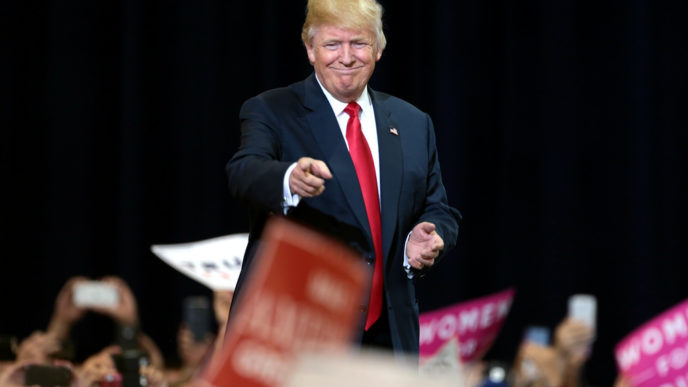
Four Major Takeaways From President Trump’s Nomination of Justice Gorsuch

Now that the dust has settled in the aftermath of the president’s nomination of Justice Neil Gorsuch and the battle lines are being drawn, here are four major takeaways.

1. Trump is Fulfilling Campaign Promises — Fast

First, more than any president in memory, Trump is acting swiftly on his campaign promises, and when he said to the American people the night of the Gorsuch announcement that “I am a man of my word,” you had to say to yourself, “Like him or not, he’s doing exactly what he said he would do.” This is incredibly significant.

In February 2016, in the heat of the Republican primaries, I wrote an article titled “Donald Trump, Vacillator-in-Chief,” starting with this: “If Donald Trump ends up being our next president, I will pray that he will be the greatest president we have ever had and I will fervently hope that I’m absolutely wrong about all of my concerns. Until then (or at least until we decide on the Republican nominee), I will sound the alarm and raise my voice as loudly and clearly as I can.

“Do not be duped by Donald Trump!”

Among other examples in the article, I stated that Trump “vacillated wildly when asked whether his sister (of pro-partial birth abortion fame) should be nominated as a Supreme Court justice including: yes; no; I was joking; I wasn’t joking; I have no idea what she believes. (This is a partial, very rough summary.) Then add to the mix that in 2000 he said there should be no abortion litmus test for federal judges.”

That he did the very thing he promised he would do — and quite swiftly at that, given the turmoil surrounding his first weeks in office — is something to commend.

I also pointed out that “During Thursday night’s debate, Leon Wolf tweeted this quote from Trump: ‘I have great respect for Justice Scalia,’ followed by, ‘Trump Less than 5 months ago … slammed Scalia for not supporting affirmative action.’”

As the campaign wore on, Trump’s positions became more and more consistent, to the point that he convinced me that he was serious about nominating a pro-life justice in the mold of Scalia.

So, let it sink in. Donald Trump is keeping his word. (And, as noted in the quote from my February article, I’m glad I was proven wrong. My hope now is that our president will weigh his words even more carefully so that what he promises to do is what he should do.)

2. The Great Divide Between Right and Left

Second, the ideological divide in our country between left and right has never been more stark. (The horrifically costly divisions during the time of the Civil War were along other lines.)

The conservative praise for Gorsuch is off the charts, and I could fill this entire article with links to quotes from well-placed individuals (like Senator Ted Cruz) to influential organizations (like the Family Research Council) to conservative websites (like the National Review Online) all praising Gorsuch as someone truly in the mold of Scalia, a real Constitutionalist, a worthy pro-life nominee.

The reaction against Gorsuch from the left has been at least as strident — if not far more — than the reaction from the right, and it can truly be called hysterical.

An op-ed headline on USA Today announced, “Time for outrageous obstruction against Gorsuch: Jason Sattler,” while Nancy Pelosi said at a CNN Townhall meeting, “If you breathe air, drink water, eat food, take medicine, or in any other way interact with the courts, this is a very bad decision,” labeling Gorsuch a “very hostile appointment.” Could you make yourself a little clearer, Ms. Minority Leader?

It is true that there is a history of hysterical reactions to Supreme Court picks in the past, but the reactions to Gorsuch are just the very sharp, quite obvious tip of the iceberg of massive social divide. Or did a former aide to President George W. Bush suggest the military overthrow of President Obama, as a former aide to Obama just did to Trump? Or did conservative entertainers call for a violent coup against the newly-installed President Obama, as Sarah Silverman just did to Trump? (And let’s not forget Madonna’s expressed desire to blow up the White House.)

The opposition to Gorsuch simply illustrates the intensity and depth of the chasm between right and left.

3. The Democratic Party Can Not Be Appeased

Third, there will be no appeasing the Democratic Party.

As much as Trump may want to be a team player (I do believe he’d like to be seen as someone who can bridge divides) and as much as he is a master negotiator, there will be no appeasing the current Democrat leadership, which is simply dead-set against him.

Forget about common political courtesies.

Forget about building a consensus.

Right now, there’s as much chance as that happening with the Democrats as there is of Cecile Richards of Planned Parenthood being nominated pro-life champion of the year.

Of course, Trump’s style of campaigning and leadership has certainly contributed to the conflict, but the Democratic response to Trump’s pick so far — namely, oppose him at all costs, and use every tactic in the book to do it — should be a strong reminder to Trump that a friendly, let’s meet in the middle attitude will be totally counterproductive right now.

The simple fact that some of the same Democrats who voted for Gorsuch in 2006 are now firmly pledged to vote against him says it all.

4. Pray for the Supreme Court

Fourth, believers who pray regularly for our president should also pray for the members of the Supreme Court, especially for Gorsuch should he be appointed, as seems highly likely.

I say that because nothing can be taken for granted with our justices, and hardly anyone would have imagined that Justice Kennedy, appointed by Ronald Reagan, would one day be the swing vote in redefining marriage (really now, who would have imagined during Reagan’s presidency that the Supreme Court would one day sanction homosexual “marriage”?), nor would many have guessed that Chief Justice Roberts, appointed by George W. Bush, would have been the swing vote in favor of Obamacare.

It is true that neither Kennedy nor Roberts have the pedigree of Gorsuch, but the significant failings of these two justices should put a cautionary damper on our enthusiasm, at the least, reminding us to pray for Justice Gorsuch to judge righteously if appointed.

The late Justice Scalia famously wrote that “A system of government that makes the People subordinate to a committee of nine unelected lawyers does not deserve to be called a democracy.”

Unfortunately, that is the system of government which we currently have, and with Neil Gorsuch having the real potential to serve our nation well past the year of 2050, an investment of prayer on his behalf makes good sense.

And while we’re at it, we should pray for God’s mercy on our land. If ever we needed it, it is now. (If I sound like a broken record here, it is quite intentional. America needs the mercy of God!) (For more from the author of “Four Major Takeaways From President Trump’s Nomination of Justice Gorsuch” please click HERE)

Follow Joe Miller on Twitter HERE and Facebook HERE.